Category Archives: US Navy
Here’s an Idea…Visit a Memorial or Monument for Memorial Day This Year!
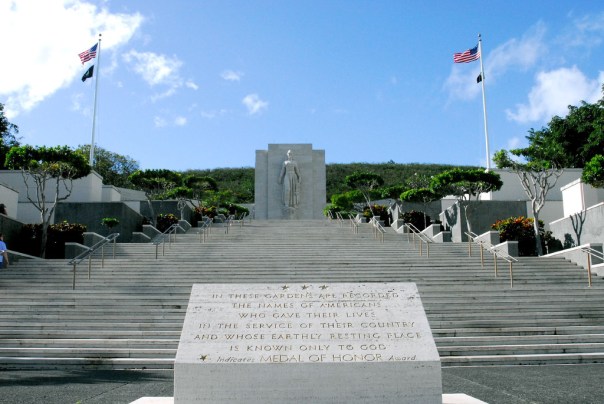
One of the most shocking areas to visit in the National Memorial Cemetery of the Pacific is the memorial to those who were missing in action or were lost in naval battles and were either buried at sea or went down with their ships or aircraft. “In these gardens are recorded the names of Americans who gave their lives in the service of their country and whose earthly resting place is known only to God. | * indicates Medal of Honor award.”
Historically, when I wrote an article regarding Memorial Day, I would publish it during that weekend or as close to the actual day as possible. I chose to take a slightly different approach with today’s post as I am hopeful that I can perhaps influence one or more readers to depart from the weekend getaway plans for camping, fishing, boating, hiking, etc. altering them to include an activity that would cause them to remember and reflect upon their own freedom and that for some American families, this particular holiday is but a painful reminder of the cost of freedom.
- Decorating Sacrifice: Honoring Our Fallen
- History Must be Preserved; Militaria, Monuments and Memorials
- Decoration Day: Survivors Honor Fallen Brothers-in-Arms
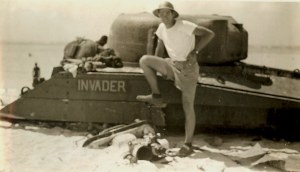
An airman poses next to a wrecked American Sherman tank on the shore of Saipan in 1944. This tank remains in place, nearly 75 years later.
When the guns fall silent and the now grizzled and weary combat veterans return home from war, time begins to erode the harsh realities the combatants lived and breathed on the field of battle. As the memories become distorted and faded, faces of those lost in combat are difficult to recall. Though, for many the scars never heal. The battle remains as vivid and crisp throughout the decades. But for the citizens who remained on the home-front, all is easily forgotten.
On the now-silent battlefields of the world wars, reminders can still be found even as the surrounding environment engulfs and enshrouds them. On land and in the surrounding waters of some South Pacific islands, visitors can still locate relics of war. Artillery shells and plane crash sites dot the landscape in places like Guadalcanal and Peleliu. Carcasses and hulks of tanks and AMTRACs (amphibious armored tracked vehicles or LVTs) remain partially or entirely submerged in the reefs of Saipan and Tarawa. But these are far from permanent or honoring remembrances.
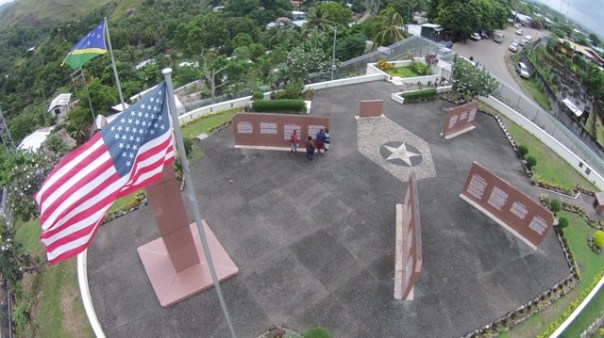
The Guadalcanal American Memorial was dedicated in 1992 as a tribute to American and Allied troops who lost their lives in the Guadalcanal Campaign. (Image courtesy of Solomons Scouts and Coastwatchers Trust)
Throughout the many years and decades following the American Civil War, veterans were drawn, compelled by lingering painful memories, returning to the battlefields to retrace their bloody footprints and to reunite with others from their units who were following their own compulsions. By the early 1900s, full-blown reunions were happening in places like Gettysburg as once youthful, sworn enemies came together as aged friends. These old veterans, motivated by their efforts decades earlier, began raising funds with the idea to erect monuments and memorials to commemorate their units’ deeds and to remember those lost during the conflict. Today, there are countless monuments located at the various battlefield sites as well as spread throughout the nation, particularly within the participating states.
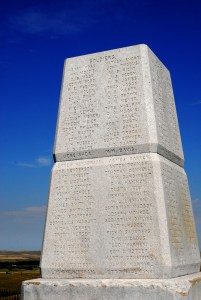
The final resting place for the majority of the men who were killed at the Little Big Horn battlefield site is marked with this granite obelisk which contains the names of the men who are interred beneath it.
As the United States has sent men (and women) off to war throughout the last century, the tradition of erecting memorials and monuments has continued both on foreign soil (with local consent and cooperation) and domestically. With the assistance of the military, the American Battle Monuments Commission, state and local governments, and various veteran service organizations, monuments have been erected in all fifty states as well as within several U.S. territories.
I make a point of locating local monuments to remind myself that the statistics that are easily found on the internet are more than that to the people of their hometowns. Names etched in stone or cast in bronze are reminders of the very personal cost of war. Sons (and now daughters) who will never return home to their families and loved ones – their names are displayed that we will never forget.
Some local monuments have national significance as they are symbols of the rally-cries – “Remember the Alamo!” “Remember the Arizona!” – that took us to war. In San Antonio, the Alamo mission is faithfully preserved. At Pearl Harbor, the Arizona Memorial sits astride the sunken ship, recalling the Day of Infamy. In my hometown, a small, nearly forgotten memorial stands as a reminder of war that most of my generation have no knowledge of.
-
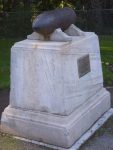
- Placed more than a century ago, this monument is largely ignored by local citizenry though the artifact on display was taken from the wreck of one of the most recognizable ships in US history.
-
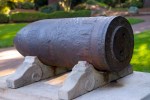
- This 10-inch naval gun projectile was recovered from the wreck of the USS Maine and placed here to serve as a reminder of those who were lost during the Spanish American War.
-
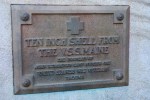
- The plaque attached to the pedestal supporting the round reads, “Ten inch shell from the USS Maine.”
“Remember the Maine!”
In a local park, there stands a small pedestal holding a ten-inch naval gun shell that was removed from the sunken armored cruiser, USS Maine (ACR-1). The sinking of the ship was an impetus that vaulted the United States into a war with Spain, two months later (though the cataclysmic explosion that that destroyed the Maine remains a mystery that some experts believe could have been merely a crew-caused mishap or accident).
-
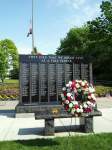
- The list of local service personnel who were lost during WWII. This monument is placed at War Memorial Park.
-
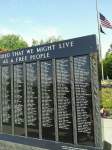
- A close up of the list of local war dead of WWII.
-
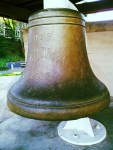
- This bell was recoverd from the wreck of the USS Tacoma CL-20) which was lost on Blanquilla Reef near Vera Cruz in January of 1924, killing her commanding officer and three radiomen.
At my city’s War Memorial Park (interestingly, the Maine monument is not located here), a large bell hangs with the name of a navy ship and the date of which the ship was commissioned, cast into its face. Very few details are known about this ship, only that it was a protected cruiser and that it was lost when it became entrapped on a reef near Vera Cruz, Mexico, breaking apart in a heavy storm. The ship, named for this city, was commissioned in 1903 and served in World War I, ran aground lodging herself on a reef as it approached the port in 1924. Some suspect that the navigation aids marking the channel had been moved by Mexican revolutionaries. The commanding officer of the ship, Captain Herbert G. Sparrow, gave his life, refusing to leave the ship, hopeful that the USS Tacoma could be saved. Along with the captain, four radiomen lost their lives while the rest of the crew had been evacuated under the orders of the captain.
Some collectors I know, spend lifetimes attempting to bring home the uniforms, medals and other militaria items as they assemble displays to honor their hometown heroes, utilizing the names etched on their local monuments.
This memorial Day, along with paying respects to those lives who were lost in service to our nation, I encourage you to locate the monuments and memorials in your local areas and pay a visit to at least one:
- Civil War Monuments
- Spanish American War Memorials
- WWI Monuments in Each State
- World War II memorials in the United States
As you will note, the above list has nothing from the Korean or Vietnam wars as there are only a handful that exist throughout our country. As the planning for the Iraq and Afghanistan War memorial is planning and development (it was approved by Congress a few years ago), it seems that our nation is truly forgetting about those from the most recent conflicts and becoming increasingly indifferent towards service men and women and our veterans. Apathy and complacency becomes animosity and sadly our nation is already in the early stages of that transition.
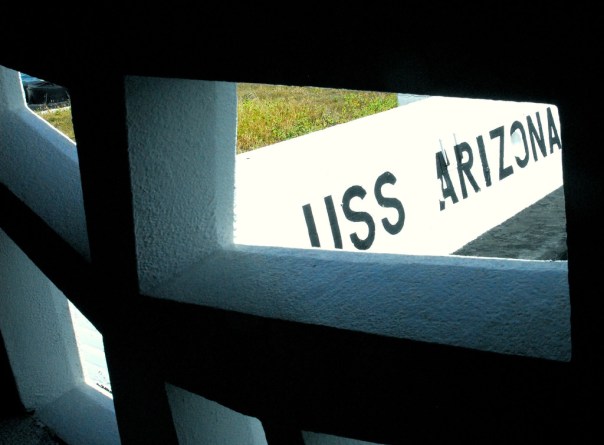
Viewing the original mooring quay that the USS Arizona was tied to (when she was attacked) from within the memorial.
Collecting, preserving, researching and documenting military artifacts is another vehicle by which a small segment of the population honors those who served. This passion can serve to maintain the face of the veteran in conjunction with the sacrifice and service. Monuments and memorials provide communities with a focal point with which to assemble and remember the many generations of our fellow citizens who never returned home to their families. Memorial Day serving as a vehicle with which to re-center our citizens’ understanding of service and self-sacrifice and the very real cost of freedom.
I emphatically encourage Americans (natural born, naturalized and would-be citizens) to embrace this nation’s history. One of the best ways with which to learn about the sacrifices that were made throughout our nation’s founding and preservation is to visit the monuments and memorials dedicated to those who gave their last full measure of devotion that we all would live and cherish our freedom.
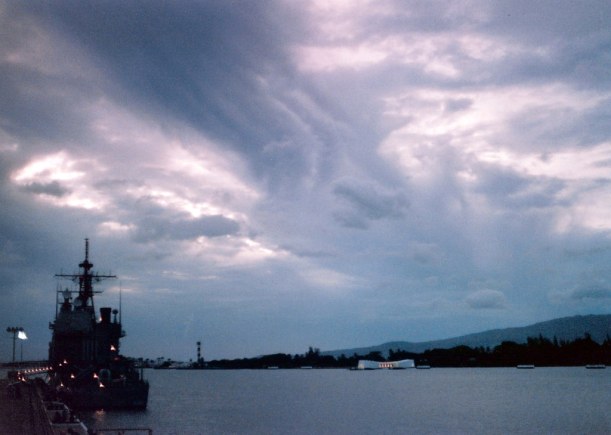
The USS Arizona Memorial is lighted at dusk with the USS Vincennes (CG-49) moored across the South Channel at Hotel Pier.
The original source of the cliche’ that is often repeated on Memorial and Veteran’s Day, “Freedom is not free,” seems to be author-less. However, it is my belief that the origins of that thought stem from yet another oft-recycled excerpt from a letter penned by Thomas Jefferson (on November 13, 1787 to William S. Smith):
“..what country can preserve it’s liberties if their rulers are not warned from time to time that their people preserve the spirit of resistance? Let them take arms. The remedy is to set them right as to facts, pardon & pacify them. What signify a few lives lost in a century or two? The tree of liberty must be refreshed from time to time with the blood of patriots & tyrants. It is it’s natural manure.”
Granted, Jefferson was referring to rebellion and revolution, however the sentiment applies to the restoration of freedom in foreign lands and the preservation of it for our own. The blood of patriots has been spilled since our nation was founded recommencing with the War of 1812 on through to present day. Standing on the hallowed battlefield grounds within our shores, once can gain a sense for the horrors of war an the sacrifices made by our great grandfathers, grandfathers, fathers, mothers, brothers, sisters, sons and daughters. This heritage belongs to all Americans, despite their nation of origin. Along with their freedom, they also inherit the history and legacy that is represented by the memorials and monuments found within our nation’s cemeteries, battlefields and public spaces, located domestically and abroad: American Battlefields and Monuments Commission: Cemeteries and Memorials.
Other related Veteran’s Collection articles:
- Remembering (and Collecting) the USS Maine!
- A Piece of the Day of Infamy or Simply a Connection to an Historic Ship?
- Answering the Call of Remembrance Through Collecting
Memorials and monuments references and resources:
- The Ideals Guide to Places of the American Revolution by Julie Shively
- Civil War Battlefields Then and Now by James Campi Jr.
- Confederate Monuments: Why Every American Should Honor Confederate Soldiers and Their Memorials by Lochlainn Seabrook
- Photographing Custer’s Battlefield: The Images of Kenneth F. Roahen
- Interment of the Custer Dead
- The USS Arizona Men: 75th Anniversary by T J Cooper
- Rust in peace: South Pacific battlegrounds revisited by Bruce Adams
- Monument Wars: Washington, D.C., the National Mall, and the Transformation of the Memorial Landscape by Kirk Savage
- Historic Photos of Washington D.C. Monuments by Tracey Gold Bennett
“We here highly resolve that these dead shall not have died in vain—that this nation, under God, shall have a new birth of freedom, and that government of the people, by the people, for the people, shall not perish from the earth.” Abraham Lincoln, November 19, 1863
Enlisted Aviators: Naval Aviation Pilots and Insignia
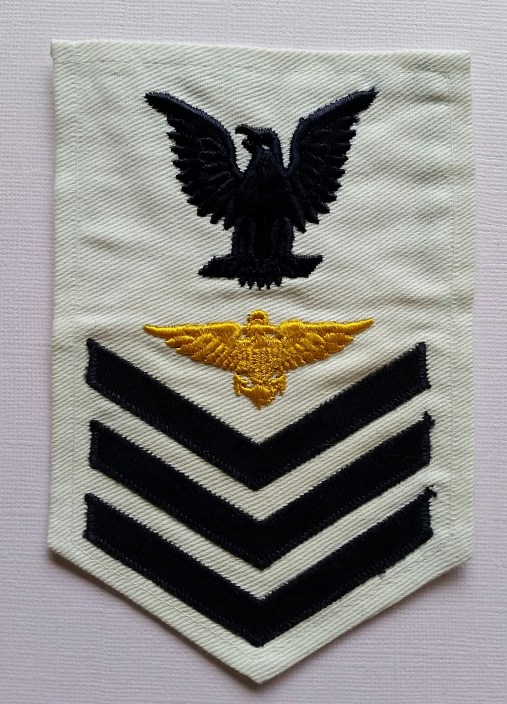
One of collectors’ most sought-after rating badges from the World War II-era (and prior), the Naval Aviation Pilot (NAP).
In the past six months, news stories centered on the increasing pilot-shortage issues faced by the United States Air Force have been frequently published in the media ranging from the Military and Air Force Times to mainstream outlets such as the Washington Post, New York Times and Fox News. With the severe cuts made to the armed forces in the last decade combined with retirements and a vibrant aviation industry, luring aviators from their Air Force careers to more financially lucrative civilian jobs, the stick and rudder vacancies are mounting leaving leadership to think creatively in order to fill the empty seats.
- Air Force May Approve Enlisted Pilots for First Time in 75 Years – By Oriana Pawlyk, Military.com, March 31, 2018
- Air Force program may lead to enlisted combat pilots – By Douglas Ernst – The Washington Times – December 6, 2017
- Enlisted pilots? – Editorial by Dick Trail, McCook Gazette, April 3, 2018
Not since World War II has the Air Force turned to the enlisted ranks to source candidates to pilot aircraft. In 2016, USAF leadership commenced a program to begin training (E-5 and up) enlisted drone pilots in an effort to free up experienced officers for candidacy as manned aircraft aviators. Leadership announced an expansion of the enlisted drone pilot program in January.
Utilizing enlisted personnel is certainly not a new idea for sourcing military aviator candidates. Both the Army and the Navy trained non-commissioned and petty officers as aviators prior to the United States’ entry into World War I. In fact, the Aviation Section, U.S. Signal Corps (the predecessor to the Flying Service which would become the Army Air Corps) was already engaged in training non-officer personnel as early as 1912, graduating the qualified men as Flying Sergeants. Similarly, the Navy graduated seven petty officers and two Marine Corps sergeants in 1916, launching the program that would evolve into the Naval Aviation Pilot rating.
-
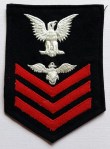
- The curved-wing NAP with a left-facing eagle. One of two such anomalies in my collection.
-
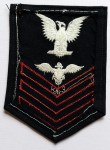
- Showing the reverse of the left-facing rating badge, this one is dated 1943.
-
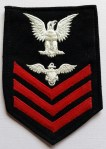
- The second of my two rating badges with a curved-wing NAP and a left-facing eagle.
-
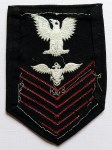
- Showing the reverse of the second (in my collection) left-facing rating badge, dated 1943.
Throughout WWI, enlisted pilot training continued for the Navy with flyers in ratings (Quartermaster and Machinist’s Mate) designated as aviators. A significant number of the enlisted aviators were offered and accepted commissions as naval officers while a few continued serving and flying as petty officers. In the years after the 1918 Armistice, the Bureau of Navigation (the command responsible for managing and training personnel) issued a policy that would incorporate enlisted and warrant officers as a standard practice for flight training. In a March 12, 1924 Bureau of Navigation Circular, the Navy officially established the rating of Naval Aviation Pilot (NAP) for for Chief Petty Officers. As the program continued, the Navy expanded the NAP rating for first class petty officers in September of 1927.
-
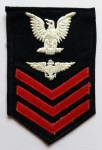
- This straight-wing NAP rating badge features the standard, right-facing eagle and is dated (on the reverse), 1944.
-
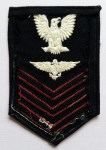
- The left side of the bottom chevron is embroidered with the 1944 date.
-
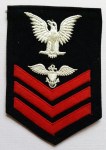
- A standard, right-facing NAP rating badge. This particular rating badge has an anchor embroidered on the reverse side.
-
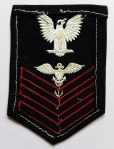
- The anchor-embroidery is not very common on rating badges. The maker that applied this mark is unknown to collectors.
With World War II in full swing and the shift from ship-to-ship fighting became secondary to over-the-horizon, aviation-based offensive tactics expanded the need for pilots exponentially. The Bureau of Navigation further expanded the ratings for NAP to include second and third class petty officers. During World War II, at least 2,200 NAPs earned their wings (according to Bluejackets.com). By 1948 when Congress discontinued the training program for enlisted naval aviation pilots, nearly 3,800 enlisted sailors had completed the training program since it was established. Though there would be no new NAPs following April 2, 1948, those existing in the rating who continued to serve on active duty, also maintained their rating and flight status in dwindling numbers. On January. 31, 1981, the last Navy enlisted pilot, ACCM Robert Jones (who had been designated in 1947) retired, closing the book on the NAP rating and insignia.
-
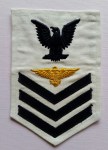
- The gold wings are straight, representing those of the officer’s wing device (worn above the left breast pocket). This 1945 NAP (gold on white) rating badge was made by New York Emblem Company (NYEC).
-
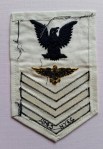
- Showing the revers with the NYEC and 1945 stitching.
-
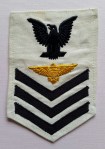
- Another example of the late-WWII straight winged gold NAP distinguishing mark.
-
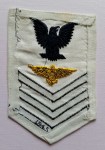
- The reverse of of the 1945-dated dress white NAP rating badge. The manufacturer of these date-only badges are unknown.
One of the most sought-after rating badges from the World War II-era is seemingly the Naval Aviation Pilot due to the decidedly high listing prices (some reaching upwards of $400). Whether people are actually paying these amounts is more difficult to determine.
The NAP rating badge consists of the Naval Aviator wings centered beneath the eagle and above the petty officer chevrons (and beneath the CPO arc). When the mark was established in 1924, the thread-color specification for the winged insignia was gold (or yellow) to match the Naval Aviator gold wing device. In the Bureau of Personnel circular of 12 July 1944, the color of the mark was changed to align it with the all other rating badges (i.e. white thread on dress blues and blue thread on whites).
-
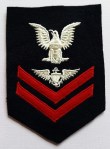
- The pattern of this wing differs from both the straight and the curved wings. This unusual design feature high, rounded shoulders. Also somewhat unusual is that the badge was made as a second class petty officer rather than being a 1/c petty officer to be cut and hemmed by the 2/c petty officer.
-
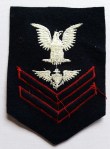
- The reverse of the high, curved-shoulder AP/2c has no maker’s marks or dates.
Aside from the color change of the mark, there are two design differences with the wings. Prior to World War II, the wings had a curved (some collectors call them “drooped”) appearance. Speculation among the collecting community suggest that the straight wing (that matches the appearance of the officer’s metal device) began making its way onto badges after 1942. In John Stacy’s invaluable resource, U.S. Navy Rating Badges, Specialty Marks & Distinguishing Marks 1885 -1982, the author references suggestions that the curved wing rating badge was used by naval personnel and the curved wing was adopted by Coast Guard NAPs, however provides a caveat that no supporting evidence exists.
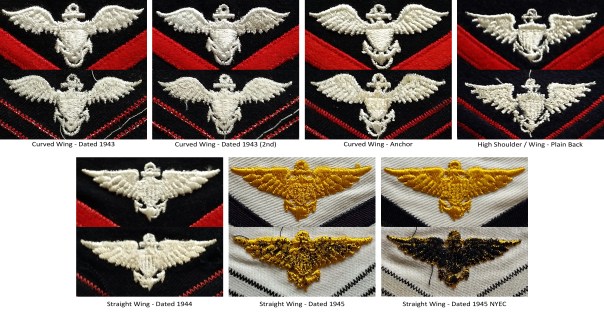
I have seven NAP rating badges and photographed each to show both consistency and variation across the same era. All of these are from the 1940s – perhaps all are from WWII.
John Stacey’s referenced comments made by the last NAP, ACCM Robert Jones regarding the different colored wing marks in the rating badges. The “white ones,” Jones commented, ” were (found in) small stores, gold were PX” referring the sources of the different badges. Further comments made by Jones (in Stacey’s book) state that Jones was authorized to wear either the gold or white (colored) rating badge on his dress (blue) uniform when he attained his designation as an AP1/c.
-
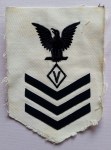
- The 1948-1960 Specialist V rating badge was used for the Aviation Pilots who continued to serve following the disestablishment of the NAP rating. The badge itself is unfinished as the chevrons are only held in place with the manufacturer’s adhesive.
-
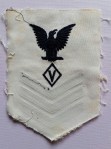
- The unfinished specialist V rating badge shows that the adhered chevrons had yet to be sewn into place.
Besides the winged insignia of the NAP, a specialist rating mark was also used for the Aviation Pilot rating. Originally established in 1942 for the Transport Airman rating, the “V” centered in a diamond insignia was re-purposed for the Aviation Pilot ratings for chief, first and second class petty officers from 1948 until it was disestablished in 1962 (BuPers Notice 1440, dated 29 December 1961; effective 1 March 1962).
Resources:
- Enlisted Naval Aviation Pilots (NAP) USN, USMC & USCG 1916-1981
- Enlisted Pilots Boosted Fledgling Flight Training Program
- The Flying Chiefs
- Navy pilot program opens to enlisted ranks
- U.S. Coast Guard Enlisted Naval Aviation Pilots (NAPs)
- U.S. Navy Rating Badges, Specialty Marks & Distinguishing Marks 1885 -1982
A General’s Naval Beginnings: My Named Seaman 2/c Aviation Radioman Uniform
I often grapple with what to focus a particular article upon as I sit down to write. I like to keep fresh content on this site and part of that process is for me to attempt to strike a balance with topics that might be of interest to readers and collectors while not leaning too heavily in any direction. Regardless of how much I strive to achieve this, I invariably end writing about what I prefer to collect and what interests me the most.
With my recent post regarding the aviation radioman rating and the uniforms that I presently hold within my collection, I am finding that today’s piece is going to be seasoned with some fresh redundancy considering that the most recent uniform item acquisition that I have is one from a sailor who began his career in this rating specialty. This particular uniform was unique in that in both what it lacked and what it possessed; something that I had not seen on a Navy uniform prior to happening upon this auction listing. The two Aviation Radioman uniforms in my collection have “crows” affixed to their sleeves: one, a third class petty officer and the other a chief petty officer. The new acquisition was from a seaman first class (non-petty officer) which is easily determined by the three stripes of piping on the cuff and the distinguishing mark of the ArM on the left shoulder (positioned where the sailors’ future petty officer mark would be).
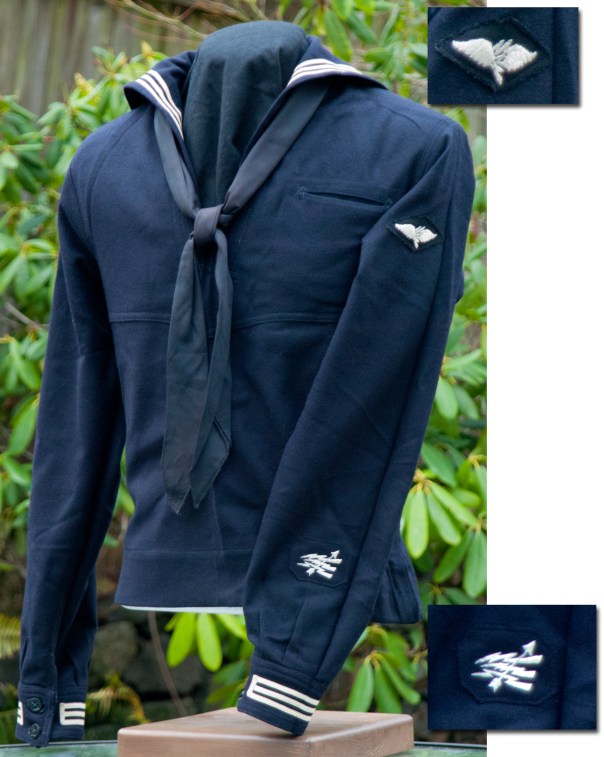
This jumper is the first Aviation Radioman/Technician uniform that I have seen that includes the Radarman distinguishing mark.
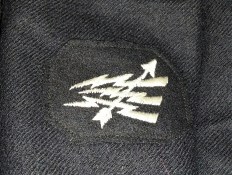
Affixed to the lower left sleeve of this uniform, the distinguishing mark denotes Harpainter’s training and qualifications with radar equipment for naval aircraft.
Aside from the rating mark on the shoulder, this uniform was adorned with an additional mark – that of a radarman distinguishing mark (DM) – located on the lower left sleeve, a few inches above the cuff. Aside from the ArM redundancy, this DM has been the subject of several previous articles on The Veteran’s Collection (see: Rare Bird – Outside of Uniform Regulations, Silver Eagles: Navy Bullion Rates and Tracking U.S. Navy Specialties: The History of Radarmen). perhaps due to my own service as today’s iteration of the rating, Operations Specialist. When I saw the listing with these two elements, and its typical-low price, I was ready to buy it, solely on these factors. The seller also included a photo of the uniform tag and the name of the original owner along with a brief overview of the veteran’s career.
“A very nice jumper with both an aviation radioman rate on the shoulder and radar operator specialty on the cuff. Best part is that it’s named on the Naval Clothing Factory tag and I was able to pull his bio off the internet. His service began in the US Navy during WW2 training as an aircrewman. After WW2 he entered law enforcement and the US Army reserve and had a distinguished career at both. He served as an MP officer during the Korean War and retired as a Reserve Brigadier General. The jumper is in very good condition. Please email if you have any questions.”
I didn’t, for a second, consider buying the uniform based upon the seller’s story as I was ready to take it solely for the marks. Once I performed some searches on the web, Fold3 and Ancestry, seeking out the sailor’s information, I was able to confirm that this uniform did come from the reservist Brigadier General, Robert E. Harpainter.
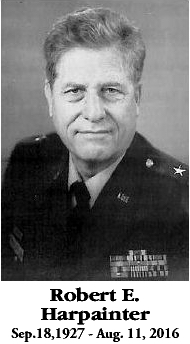
Robert E. Harpainter, Brigadier General, USAR, retired (image source: San Jose Police Benevolent Association, Farsider).
General Harpainter was almost too young for World War II service (he was born in 1927) as he enlisted into the Navy in 1945 following his graduation from Berkeley High School. According to his 2016 obituary, he attended schools for both aviation radioman (rating) and aerial gunner training. I suspect that due to the lengthy of time required for his rating and specialty training, ArM seaman 1/c Harpainter most-likely never made it to the fleet prior to the end of the war. What makes this uniform even more special (for me, at least) is that Robert Harpainter, after graduating from his post-WWII undergraduate studies (at San Jose State University and University of California at Berkeley), he was commissioned as an officer in the U.S. Army, serving with the military police in the Korean War as a military police platoon leader,security officer and assistant camp commander, as well as with the UNC-MAC Advance Camp during the prisoner exchange. His army service included command of the 496th Military Police Battalion; chief of staff and deputy commander of the 221st Military Police Brigade.By the time Mr. Harpainter’s military service was completed, he attained the rank of Brigadier General (in the California State National Guard) completing assignments as the commanding officer of the Northern Area Command from June 1987 through 1988 and finishing as Deputy Commander – Operations, State Military Reserve.
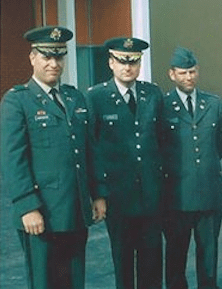
General Harpainter is shown (far left) in this San Jose Police Benevolent Association image.
Though I have assembled a fair summary regarding General Harpainter’s career, more complete research, especially his WWII naval service, would help me to piece-together awards and decorations that he would have received at the time of his discharge. In lieu of a Freedom of Information Act request (submitted to the National Archives), I can safely assume that he received, at the very least, the American Campaign and World War II Victory medals.
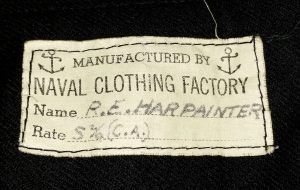
The Naval Clothing Factory tag showes that it is correct for the World War II era, has R. E. Harpainter, Seaman Second Class markings.
There are many folks who enjoy collecting uniform groups of general officers (and admirals) and I can certainly understand how they can be drawn to the uniforms (they are rather ornate and their awards and decorations are unique) and the appeal of being in possession of something tangible and representative of a veteran’s lengthy career having attained a rank towards or at the top of all ranks. This particular uniform is clearly not ornate in the upper echelon of any rank structure but it does help to tell the beginning of the story of such a veteran in that he was compelled to answer his nation’s call as a young high school graduate and never ceased. As a civilian (and active reservist), Mr. Harpainter served as a law enforcement officer for 15 years as he pursued his undergraduate and juris doctor degrees. The remainder of his professional career, General Harpainter served as a senior deputy district attorney with the Santa Clara County District Attorney’s Office for 22 years. As I reviewed the general’s memorial and online tributes, a comment made by Harpainter’s partner (from his time as a police officer), Bob Moir (retired lieutenant, SJPD 1954-1985) wrote, “Always in the Veterans Day parade in Nov (sic) each year with is military uniform and shinning star.”
What’s next for me with this uniform? I enjoy seeing a uniform displayed properly (which for me means that I like to possess the proper decorations) so I will be requesting information pertaining to this veteran’s naval service. I am fairly certain that there will be, at the very least, two ribbons (the American Campaign and World War II Victory) however, there could be other elements (such as a combat air crew wing device) as indicated by details within Harpainter’s obituary and publicly-available biographical information.
It is rewarding to find (what appears to be) an insignificant uniform that was completely overlooked by other collectors and to be able to preserve part of the history of notable veteran.
“Blue Seas, Red Stars” Details How The Soviet Union Honored Heroes of the Battle of the Atlantic
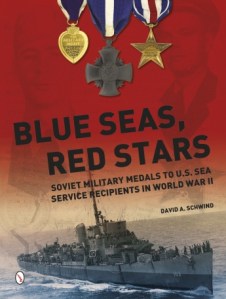
Blue Seas, Red Stars: Soviet Military Medals to U.S. Sea Service Recipients in World War II by David A. Schwind (image source: Schiffer Publishing).
Many of the stories found within the pages of this site, while centered upon artifacts and items that once belonged to veterans – some those pieces possess researchable history that is traceable to the individual. If you’ve read any of these articles, you know that as much as is possible, I try to provide a snapshot of the military careers of the service members, inclusive of their decorations and awards they received. Acknowledging the achievements of the military member or those of the units for which they were assigned, or the campaigns these men and women participated in, while a common practice within this realm of military service, it is somewhat foreign in the civilian sector.
Medals and decorations are a common focus of militaria collectors – especially medals that are engraved (i.e. named) as valor medals typically are at the time of presentation to the service member – due to their unique and very specific historical nature. A group of medals and ribbons that were worn by a veteran provide a visual narrative – a tangible representation of the career of a service member showing, at the very least, when and perhaps where the individual served, if he or she served in combat or was decorated for service above and beyond the norms of duty. There are many areas of focus within the sphere of collecting decorations. Some may zero in on a specific era, military branch, discipline or specialty (aviators, armor, etc.) or specific medal awardees (Navy Cross, Distinguished Service Cross or other valor medals) or those who were killed in action (Purple Heart medals awarded to those who were killed or listed as missing in action). Though I am in possession of several decorations, I am not a collector of medals and ribbons. All that I have were either inherited (I am the steward/archivist for family history) as part of a relative’s group or were acquired as part of my restoration efforts to preserve the full story of a family member’s service.
A veteran myself, I recognize that the preservation of my own decorations is part of my responsibility to maintain the family legacy and history of service. With the exception of the decorations awarded to my father (a Vietnam combat veteran who is very much alive and well), I have been given the task of maintaining these priceless family artifacts which are inclusive of the medals and ribbons that I earned and received during my service. I couldn’t imagine seeing family history such as this falling into the hands of collectors rather than being preserved by our following generations.
It may be just my perception but it seems as though there is a steady stream of military-history books being released throughout each year with increasing frequency. With the passing of the World War II generation and their stories fading away, our nation’s interest in them, fueled by stories and films that dominated the national conscience from the mid 1990s through the middle of this decade, too has waned. The stories of the common soldiers, marines, sailors and airmen have all but been forgotten. The attention in military stories has turned toward the more recent conflicts in the Middle East is more prevalent as the generation who fought and served in these conflicts is reaching (military) retirement age. However, there are still good stories from WWII that remaining to be told and a recent publication, though now a few years old, deserves my readers’ attention.
Prior to the December 7, 1941 attack on Pearl Harbor, the United States’ participation in WWII was in support of our European allies – predominantly Great Britain – by way of supplying materials to sustain their fight against the wave of the Third Reich that was washing over Western Europe. When Americans think about the Battle of the Atlantic, it isn’t uncommon for visions of the Allied convoys and the German U-boats operating in “wolfpacks” hunting the defenseless merchant ships come to mind. However, the overall campaign in the Atlantic Ocean was far more involved and following the United States’ declaration of war on the Axis powers, was truly a multinational alliance effort that led to the defeat of Germany. Many Americans participated in the harrowing and dangerous duties in the Atlantic in striving to support the fight in Europe. Convoy after convoy of materials, food and troops departed ports in the United States heading to destinations in Europe (England, Ireland, Russia) and in the Mediterranean faced the threat of being torpedoed by German U-boats who waited for the vulnerable ships to pass by. Shore-based anti-submarine patrols flew supporting missions from each side of the Atlantic providing air cover as far out to see as could be reached but there were still gaps of open seas that were ideal hunting grounds for the wolfpacks.
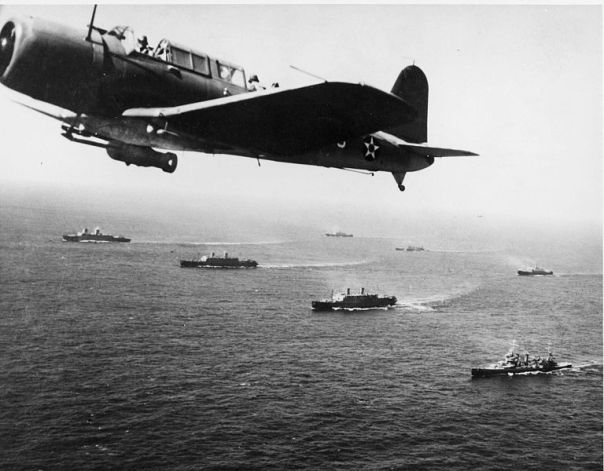
Convoy WS-12: A Vought SB2U Vindicator scout bomber from USS Ranger (CV-4) flies anti-submarine patrol over the convoy, while it was en route to Cape Town, South Africa, 27 November 1941. The convoy appears to be making a formation turn from column to line abreast. Two-stack transports in the first row are USS West Point (AP-23) — left –; USS Mount Vernon (AP-22) and USS Wakefield (AP-21). Heavy cruisers, on the right side of the first row and middle of the second, are USS Vincennes (CA-44) and USS Quincy (CA-39). Single-stack transports in the second row are USS Leonard Wood (AP-25) and USS Joseph T. Dickman (AP-26). US Navy Photo.
Convoys consisted of merchant ships, crewed by a mixture of merchant seaman, active-duty naval personnel and the US Navy Armed Guard (serving primarily as gunners, signal men and radio operators), destroyer-escorts, destroyers and, by 1943, small aircraft carriers that possessed the armament and tactics necessary to conduct anti-submarine offensive measures along with their role in providing protection for the convoys.
While there are many publications, documentaries and books that are fantastic in providing great coverage of the Battle of the Atlantic, not much exists regarding the men who served. Historian and fellow militaria collector, David Schwind spent years researching and traveling the United States in order to capture and retell the stories of American sailors who fought in the Battle of the Atlantic. The one aspect of his effort that is unique (and was a complete surprise to me) is that each man that he spotlights was recognized by the Soviet Union with some of that nation’s highest honors and decorations. In fact, nearly 220 men who served in these convoys (as part of the United States sea services: Navy, Coast Guard, and Merchant Marine) were awarded Soviet decorations of varying degrees, such as:
- Order of the Patriotic War
- First Class
- Second Class
- Order of Kutuzov
- First Class
- Second Class
- Third Class
- Order of Suvorov
- First Class
- Second Class
- Third Class
With the rise of Communism in conjunction with the West’s fight to stem the expansion of the Iron Curtain following WWII, many of these veterans tucked the medals away, opting not to wear them on their uniforms. In his December 2015 work, Blue Seas, Red Stars: Soviet Military Medals to U.S. Sea Service Recipients in World War II, Schwind provides individual narratives of each recipient, inclusive of their military careers and post-service lives. Along with the detailed information, he includes extensive photographs of each recipient’s Soviet medals, their presentation boxes, documentation, vintage photographs and images of the medals themselves. David Schwind’s photographic efforts in capturing the details of these incredible medals is nothing short of fantastic and perfectly compliments his extensive research. This book is not merely a compilation of veterans and their medals but rather a very personal presentation of vignettes, photographs and an extensive amount of supporting references.
The book production (by Schiffer Publishing) is first-rate with pages that are substantial and glossy, and printed in full color. The binding is stable and sturdy. Even the endpapers and are impressive with photographs of the veterans’ award cards. After nearly two years of use, my copy of Blue Seas, Red Stars looks like new though I have been through it, cover to cover multiple times and it shows none of the typical signs of use in many books of this size. Speaking of size, Blue Seas’ dimensions are consistent with those of many coffee-table books (9″ x 12″ x 1″) but is far from just a collection of nice pictures. The men who received these Soviet awards were truly heroes and they were so recognized by our WWII ally for their deeds and service above and beyond the call of duty. Many of the heroes in this book will be recognizable to many contemporary navy veterans and history buffs as their names have been affixed to transoms of a few notable combatant naval vessels.
-
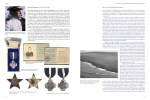
- Blue Seas, Red Stars: Soviet Military Medals to U.S. Sea Service Recipients in World War II (image source: Schiffer Publishing).
-
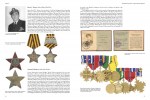
- Blue Seas, Red Stars: Soviet Military Medals to U.S. Sea Service Recipients in World War II (image source: Schiffer Publishing).
-
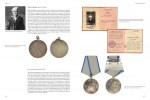
- A sample page from Schwind’s work, Blue Seas, Red Stars: Soviet Military Medals to U.S. Sea Service Recipients in World War II (image source: Schiffer Publishing).
Perhaps the most noteworthy fact of Schwind’s brilliant production is that the of the 217 Soviet medals that were awarded to American sea-service personnel, a significant number of these decorations remain with the veterans’ families and are treasured for their future generations and that more than 100 of the families participated in this project, partnering with the author and granting him access to handle and photo-document these treasures for his book.
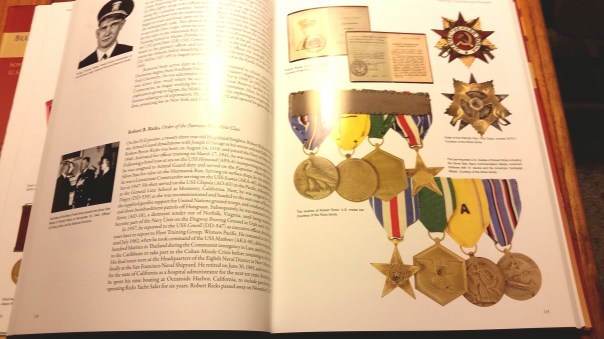
The photography reveals the details of the individuals’ awards and decorations along with other service-related pieces that breathe life into the narratives of each veteran.
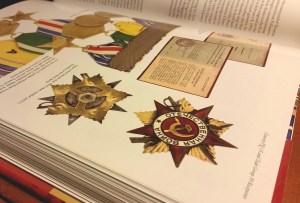
The book is printed on beautiful heavy-stock coated paper which provides a wonderful measure of clarity to the text and helps the colors of the awards to leap from the pages.
It is my hope (especially within the capacity of my responsibility) that other families make the decision to preserve and maintain their family’s legacy and keep these precious awards to be handed down throughout their generations. However, if these pieces are divested, I hope that collectors will make every effort to assume the mantle of historian and continue the legacy where the family left off.
Blue Seas, Red Stars is a great addition to anyone’s library, whether they are a military or naval historian, militaria collector or simply interested in in the little-known relationship between WWII veterans and the Soviet Union’s gratitude bestowed upon them for their service during the war.

Researching to Establish Provenance: A Cigarette Box with Historical Connections
While much of my militaria collection consists of family-connected items (such as uniforms, decorations, documents and photographs) I also have some oddities that serve to add interest and perhaps to make a display more visually aesthetic. In reviewing the (online displays of) collections from other enthusiasts, it is quite easy to see that many of them have focused their attention upon such areas as service branches, theaters of combat, veterans’ groupings, decorations and medals to list the most prevalent.
-
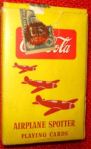
- These Coca-Cola branded “Airplane Spotter” playing cards are a great example of a cross-over collectible. Collectors of Coke memorabilia, militaria and even of playing cards would enjoy these in their collection (source: eBay image).
-
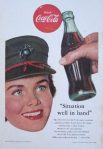
- Military-themed advertising is another example of collectibles that have cross-over appeal (source: eBay image).
-

- Plucked from the pages of magazines such as “Life,” these colorful, patriotic adverts look fantastic dislayed with other Coca-Cola memoriabilia or militaria (source: eBay image).
Crossover collecting can be even more rewarding due to the uniqueness that it offers the enthusiast. For example, an individual may already be a collector of memorabilia from a commercial company such as Coca-Cola (focusing on signage, advertising, drinkware, etc.) who then discovers a militaria sub-set within that area of collecting. Other areas of militaria crossover can include Tobacciana, Zippo lighters and my personal favorite, baseball.
The piece that I am focusing this article on does fit into a crossover the tobacciana category but hardly signifies that my interests are branching into that area of collecting. This artifact fits into another crossover facet of collecting that is more my speed: folk art or, in military terms, Trench Art. As an amateur military historian and someone who enjoys artifacts related to the U.S. Navy, this cigarette box was something of interest to me. I also thought that the piece would look great on my dresser and serve as a storage place for personal items while fitting in alongside of my other antique boxes.
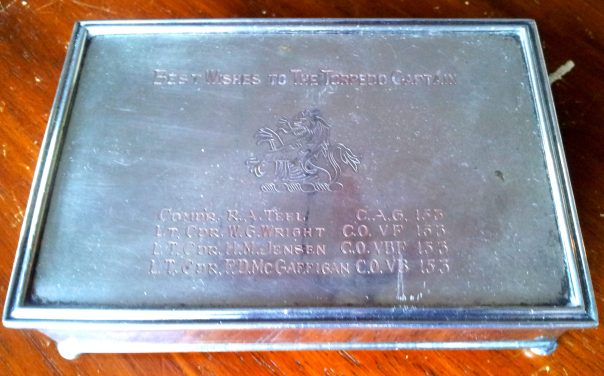
I have owned this silver cigarette box for several years but never spent any significant time researching it.
The cigarette box is engraved with “Best Wishes to the Torpedo Captain” along with a griffin and a list of naval aviators and their commands (part of Air Group 153). When I first acquired this piece, I assumed it was made from scrap metal – possibly obtained from an aircraft part – and crafted by a squadron aviation structural mechanic. As the box has since been displayed for the last few years, the surface has tarnished which leads me to suspect that the metal material is silver. The absence of any hallmarks means that the only way to determine the material composition is to perform one or more tests (hopefully) without damaging the artifact.
-
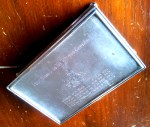
- Though it has no hallmarks, it seems to be a nice piece of craftsmanship.
-

- The cedar lining is removable.
-
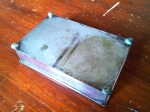
- The feet are brazed onto the bottom which is a mark of good craftsmanship.
As with other militaria artifacts, especially named pieces, researching is part of the enjoyment (and sometimes the pain when research hits a dead-end) and though the collector that I purchased this from included some information, I pursued the information further. Examining the engraving, the names are listed out:
COMD’R. R. A. Teel, CAG 153
L.T. CDR. W.G. Wright, C.O. VF 153
L.T. CDR. H. M. Jensen, C.O. VBF 153
L.T. CDR. F. D. McGaffigan C.O. VB 153
Judging by the present information, one would think that the odds to identify the box’s original owner might be fairly descent, and with good reason considering that there were nine data points (ten, if one includes the griffin and the presentation statement) to base the research upon. Understanding nomenclature, rank abbreviations and the numerics of naval aviation squadrons is a good starting point. Navy rank abbreviations during WWII were a bit more complex than the simplified modern counterparts. Officer rank structure can be defined easily:
| Rank | WWII Abbreviation |
Current Abbreviation |
| Ensign | Ens. | ENS |
| Lieutenant Junior Grade | LT.j.g. | LTJG |
| Lieutenant | LT. | LT |
| Lieutenant Commander | L.T. CDR. | LCDR |
| Commander | COMD’R | CDR |
| Captain | CAPT. | CAPT |
For those who are new to naval aviation squadron designations and their meanings, “V” is the designation for fixed wing aircraft. For the sake of brevity and keeping this post focused on these specific squadrons, I’ll refrain from providing definitions for all WWII naval aviation squadrons.
- CAG – Commander, Air Group
- VF – Fixed Wing Fighting Squadron
- VBF – Fixed Wing Fighting/Bombing Squadron
- VB – Fixed Wing Bombing Squadron
Commander, Air Group 153 (listed above as “CAG”) with Commander R. A. Teel, was the group commander who was responsible for the squadrons within his group (VF-153, VBF-153 and VB-153). Lieutenant Commanders W.G. Wright, H.M. Jensen and F.D. McGaffigan were commanding officers of the subordinate squadrons reporting up to Commander Teel. Successfully researching the information (names, squadrons) will certainly help to provide great information but I have no way of determining the original owner of the box (to whom it was presented). Being geographically located at the farthest reaches from the National Archives or the Naval History and Heritage Command in Washington, DC (while still residing within the contiguous United States) limits the scope of research. I am resigned to scouring the fractional data that is available online.
The ultimate goal of my research was to determine the identity of the original owner of the cigarette box which, when I purchased it, was thought to have been one of the aviators named in the engraving. Judging by the inscription, “Best Wishes to the Torpedo Captain,” that title, in my estimation, refers to the commanding officer of the squadron of torpedo bombers. Being that all of the other listed squadrons were either fighter, fighter-bomber or bomber squadrons, it would seem that the Torpedo Captain would have been the skipper of the Air Group’s VT squadron, which was not engraved onto the box.
Before proceeding further, I sought to confirm that the air group’s assigned VT squadron also shared the same numbering convention. A quick search led me to a very limited listing of Air Group One Fifty Three (ComAirGrp 153). Indeed, the composition of the group consisted of four squadrons:
- VB-153 (composed of 15 VSB aircraft, or fixed wing scouting bombers)
- VF-153 (composed of 36 VF aircraft, or fixed wing fighters)
- VBF-153 (composed of 36 VF aircraft)
- VT-153 (composed of 15 VTB aircraft, or torpedo bombers)
While this information was a solid initial step, the source lacked further confirmation regarding any of the engraved names on my box. As I write this article, I await a response from a fellow collector who has access to naval aviation records. Turning my attention to the names listed on the case, I do have a few avenues in which to proceed in order to get a clearer picture of the careers of these naval aviators. When I received the box, inside was a folded-up printout (of a WWII Memorial entry for Francis D. McGaffigan) that provided me with a head start for one of the box’s engraved names.
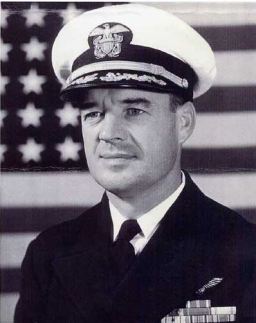
Captain Francis Daniel McGaffigan (source: WWII Memorial).
Lieutenant Commander F. D. McGaffigan, my research revealed, was born January 13, 1910, to Irish immigrants in Boston, Massachusetts. After graduating high school, he enlisted as a Seaman Second Class and was assigned to Naval Aviation Elimination Training in Boston (shown in official records as “Squantum”) in January of 1940. According to his memorial page (submitted by a family member), the naval aviator served with a number of commands during WWII. I’ve spotlighting a few:
- Commanding Officer, Bomber Squadron (VB) 306, flying SBD-5 Dauntless , Solomon Islands
- Commanding Officer, Bombing Squadron 99, Saipan
McGaffigan’s career as listed by his relative is highlighted with the following post-war assignments. Subsequent research could determine what, if any, wartime service the captain might have experienced prior to the conclusion of his career.
- Commanding Officer, Bombing Squadron 150, USS Lake Champlain (CVS-33)
- Commanding Officer, Bomber Squadron 153, USS Kearsarge (CV-33)
- Air Officer, USS Essex (CV-9)
- Commanding Officer, Naval Air Reserve Training Unit, NAS Lakehurst (NJ)
Captain McGaffigan’s awards and decorations which include:
- Distinguished Flying Cross
- Air Medal (3)
- Naval Reserve Medal
- American Defense Service Medal
- Asiatic–Pacific Campaign Medal (with campaign star)
- American Campaign Medal
- World War II Victory
McGaffigan’s post-naval life commenced with retirement in 1960, and he lived out his year, passing in 2001.
After searching through the careers of the naval aviators listed on the box, it is clear that the name that was absent is the one who was presented with the box from the remainder of those listed, starting with the Commander Air Group (CAG), Commander Richard A. Teel.
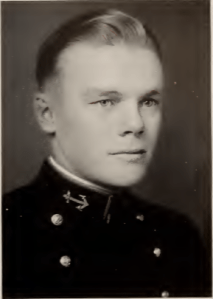
Richard Ashley Teel’s 1936 Naval Academy graduation portrait (source: The Lucky Bag).
Commander Richard Ashley Teel was born on Christmas Day, 1913 in Annapolis, Maryland (his father, Roland M. was a boy’s school principal and his mother, the former Susan B. Ashley, was an English immigrant homemaker), and after completing high school (at Severna Park H.S.), he entered the United States Naval Academy in June of 1932. Upon his graduation and commissioning, Teel was assigned to the battleship, USS New Mexico (BB-40). In 1938, LTJG Teel reported to Naval Air Station Pensacola for aviation training. Teel’s first assignment upon receiving his naval aviator’s wings was with the newly formed Bombing Squadron Seven (VB-7) aboard the USS Wasp (CV-7) in 1939. By 1942, VB-7 was redesignated a fighter squadron (VF-71) and was transferred to shore-based operations on Espirtu Santo following the sinking of the Wasp in September of 1942 (she was torpedoed by a Japanese submarine). After VF-71 was disbanded, LT Teel was flying from the USS Independence (CVL-22). Considering that Commander Teel is not the focus of this research, I ceased pursuing his career further. I was able to find that Captain Richard Teel retired after thirty years of service on July 1, 1966, and enjoyed another 28 years, passing on August 9, 1994. Richard Ashley Teel’s final resting place (the Naval Academy Cemetery) is not far from his birth home in Annapolis.
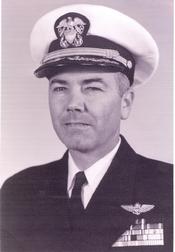
Commander Wilson George Wright III.
Lieutenant Commander Wilson George Wright III was born in Ogden, Utah, on May 15, 1916, to Wilson G. and Lelia D. Wright. He graduated from Ogden High School, and attended Weber College for one year and then entered the U.S. Naval Academy in June of 1935, and was commissioned an ensign on June 1, 1939. Following graduation from the Naval Academy, Wilson served one year on the battleship USS Idaho (BB-42) and one year on the USS Lamson (DD-367). Wright reported to NAS Pensacola for flight training and was designated a Naval Aviator on December 16, 1941. His first aviation duty was in VF-71 aboard USS Wasp (CV-7) and flew combat missions surrounding Guadalcanal in support of the First Marine Division landings during the invasion of Guadalcanal, August 7-8, 1942. LTJG Wright was aboard when the Wasp was torpedoed and sunk by Japanese submarine I-19 near San Cristobal Island in the Solomon Islands.
Wright’s next assignment was as Executive Officer of VF-33 which was land-based in the Solomon Islands, flying many combat missions including fighter sweeps and bomber escort missions over Rabaul.
Following six months as a Fighter Type Instructor at the Naval Air Station Atlantic City, he was ordered to the Naval Air Station Grosse Ile, Michigan, to start and commission Air Group 97, and served in that unit as the Commanding Officer of Fighter Bomber Squadron 97. He was awarded the Navy Commendation Medal for his service in Air Group 97. Upon the decommissioning of Air Group 97, Wright’s next assignment was as the commanding officer of Fighter Squadron 153, followed by a tour as the commanding officer of the Flag Administrative Unit and finally, as the staff personnel officer of Commander Fleet Air Alameda.
Following his retirement, having attained the rank of commander, Wright worked as an engineer and supervisor in the aerospace industry, spending three years with the Lockheed Missile Division on the Polaris Missile project, 17 years with Rockwell Space Division and was involved with the lunar landings and the Space Shuttle programs. He was 95 years old when he passed away on Nov. 2, 2011, and was laid to rest in home state of Utah.
Among Wright’s numerous awards and decorations were:
- Distinguished Flying Cross
- Air Medal (5)
- Navy Commendation Medal
- American Defense Service Medal
- Asiatic–Pacific Campaign Medal
- American Campaign Medal
- World War II Victory
The last of the names listed turned out to not only be notable, but he earned the status of an Ace fighter pilot (meaning that he had five confirmed air-to-air enemy kills) during his service with VF-5.
Lieutenant Commander Hayden Martin Jensen was born on January 30, 1911, in St. Paul, Minnesota where he attended high school and college. Jensen was commissioned an ensign on August 19, 1939. Having completed flight training, Ensign Jensen was assigned to Bombing Squadron Five (VB-5, part of the Yorktown Air Group), flying the Northrop BT-1 aboard the USS Yorktown (CV-5). By 1941, the young ensign had transferred to VF-5 (the “Stafighters”) as his role changed from a bombing to a fighter pilot, flying the F4F-3 Wildcat. Still assigned to VF-5 when it was transferred to the USS Saratoga (CV-3) in June of 1942, Jensen would meet the enemy in the South Pacific – in the Guadalcanal Campaign – in two separate engagements in August of 1942, twice earning the Navy’s second highest valor decoration, the Navy Cross, scoring two enemy kills on August 7, 1942, and three more on August 24. For these engagements, LT Jensen was also awarded the Distinguished Flying Cross. LCDR Jensen assumed command of VBF-153 on March 26, 1945.
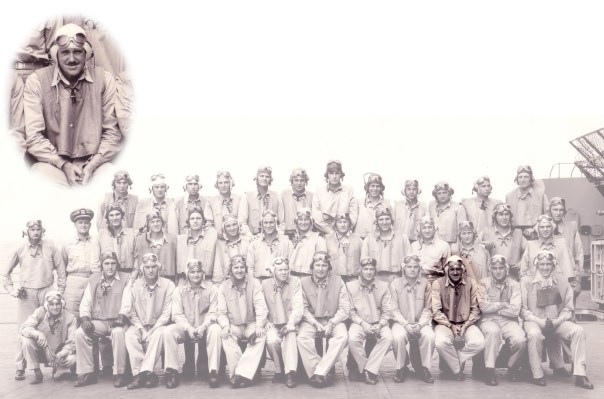
LT Hayden Jensen poses with the men of VF-5 aboard the USS Saratoga, July 15. 1942. In a little more than two weeks, Jensen will have his first two of five enemy air kills.
Jensen married the former Henrietta Mathilda Schirmer (also of St. Paul) on December 27, 1938. Still serving on active duty, 38 year-old LCDR Jensen passed away on June 6, 1949, at Naval Hospital Newport, Rhode Island, with his wife, Henrietta by his side. He was laid to rest at Arlington National Cemetery.
Among Jensen’s numerous awards and decorations were:
- Navy Cross Medal (2): see citations
- Distinguished Flying Cross Medal
- Air Medal (3)
- American Defense Service Medal
- Asiatic–Pacific Campaign Medal
- American Campaign Medal
- World War II Victory Medal
After reviewing the incredible service details for these four naval aviators, I was convinced that the box never belonged to any of the men listed on the box. Based upon their careers, none could be considered as “The Torpedo Captain” leaving me to pursue the next logical step. As with each naval air group, I confirmed that Air Group One Fifty Three did, in fact, have a torpedo squadron (VT). Cursory internet searches were dead-ends as far as attempting to discover possibilities of assigned commanding officers. Fortunately, I am a member of an amazing group of fellow collectors on the U.S. Militaria Forum where there are folks who possess years of experience and knowledge and have access to records and sources. I posted some requests for assistance and like clockwork, two members answered me and began to fill in the blanks. Instantly, I had the names of two naval aviators who commanded VT-153: LCDR H.C. Madden and his successor, LCDR F.G. Lewis.
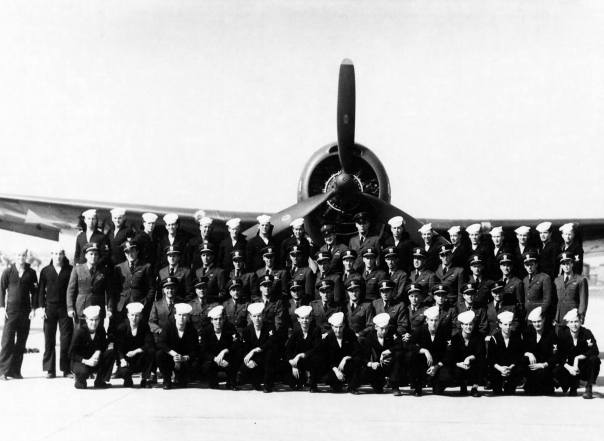
The officers and men of Torpedo Squadron 153 (courtesy of Jack Cook).
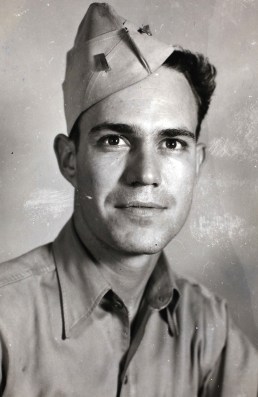
LTJG Harlan C. McFadden Jr.
LCDR Harlan Curtis McFadden Jr. was born June 29, 1918. After completing high school in Clayton, New Mexico, McFadden pursued his degree in English Literature at the University of New Mexico before enlisting as a naval aviation cadet on July 9, 1941. He began six weeks of elimination flight training at Naval Air Station Long Beach, California and, upon completion, McFadden commenced flight training at NAS Corpus Christi for 44 more weeks. Harlan finished his final 12 weeks of operational flight at NAS Ft. Lauderdale.
LT McFadden was assigned to Torpedo Squadron Three Hundred Five (the “Red Asses”) from 1943-44. On August 1, 1944, when VT-305 was ordered decommissioned, McFadden was transferred to VT-99 along with five fellow flyers and additional enlisted support personnel. Much of his early months of service during the war were spent flying missions over various Japanese strongholds in the Solomon Islands, such as Bougainville and Rabaul. On March 26, 1945, LCDR McFadden assumed command of VT-153 at Naval Auxiliary Air Facility (NAAF) Lewiston in Maine. One of McFadden’s assigned aviators was LT George H. W. Bush who served with the squadron from March through September of 1945. Ten days after the squadron was activated, Mcfadden was relieved of command by LCDR Lewis. From April 6 through his discharge on September 5, 1945, I have been unsuccessful in locating McFadden’s naval service or why he was relieved of command. In his four years of service as a naval aviator, McFadden saw a total of 14 (four months in the North Atlantic and 10 in the South Pacific). On his separation documents, McFadden stated that he was pursuing a career in commercial aviation.
LCDR Frederick Gary Lewis was born on March 13, 1916, in Springfield, Massachusetts. Though I have had some success in researching Lewis, I have not been as successful in discovering as much detail regarding his life and the breadth of his time as a naval aviator. He was commissioned an ensign on November 14, 1940, and was assigned to the fleet aboard the battleship USS Pennsylvania (BB-38) as the Communications Officer. Ensign Lewis was present aboard the ship during the Japanese attack on Pearl Harbor, witnessing the carnage and utter destruction on the ships and facilities surrounding the Pennsylvania, including the tremendous damage inflicted upon the destroyers USS Cassin (DD-372) and USS Downes (DD-375) which were sharing the same drydock as the battleship. As the battleship was floated and directed to San Francisco for repairs, LTJG Lewis reported for flight training at Naval Air Station Pensacola. Once Lewis received his wings of gold, he was assigned as a flight instructor at NAS Ft. Lauderdale where he served for the next twelve months. In December 1943, LT Lewis took command of Composite Squadron Seventy-Eight (VC-78) aboard the USS Saginaw Bay (CVE-82). His only combat action that he experienced was in support of the liberation of the Philippines in October of 1944. Receiving a temporary promotion (to LCDR) prior to relieving LCDR McFadden on April 6, 1945, serving as VT-153’s commanding officer until June 1946.
Other than Lewis’s permanent promotion to LCDR in 1950, I was unable to find anything further regarding his naval career. Frederick Lewis passed away on April 7, 1978 at the age of 62 in San Leandro, California.
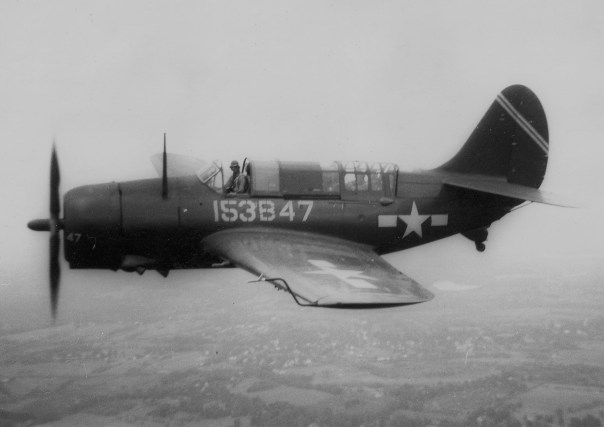
SB2C of VT-153 courtesy of Jack Cook.
After diving deep into each of the men, I had one remaining piece of information left to work through – the insignia of the griffin that was engraved on the top of the cigarette box. I started to seek insignia for all of the listed squadrons. I was able to locate just two insignia and squadron nicknames: VBF-153 was listed as the “Copperheads” though the corresponding insignia that I found didn’t seem to fit the name (more research to follow); VB-153 was known as the “Flying Cannons” and its insignia seemed to fit perfectly.
-
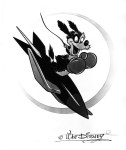
- VBF-153 insignia as drawn by Disney.
-
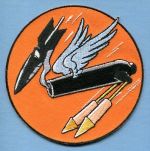
- Bombing Squadron (VB) 153 (“The Flying Cannons”) insignia patch.
-
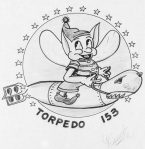
- The “Gremlins” of Torpedo 153 VT-153 (Courtesy of Jack Cook).
My contact at the U.S. Militaria Forum provided me with the insignia for VT-153 which added confusion; the “Gremlins” as they were known, did little to support my thought that the griffin on the box bore some significance, however, that isn’t where my trail ended. Following the lineage of each squadron, I found that VA-153 (“A” for attack squadron, the current designation for a carrier-based fixed wing bombing aircraft), which was disestablished in 1977, employed a very similar-looking griffin in their logo. The two griffin appearances is more than likely coincidental but it certainly leaves me with the idea that there is some connection.
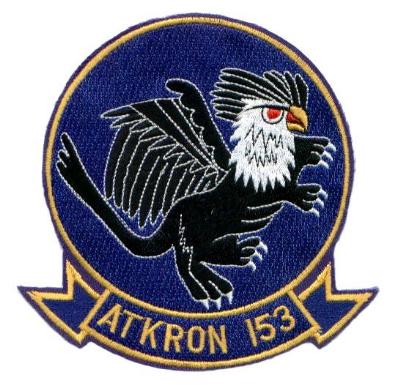
Attack Squadron 153’s insignia – a griffin – (as seen on their unit patch) has to be more than mere coincidence considering the similar image on the cigarette box
Ultimately, my research did not provide me with any sort of definitive evidence that I could use to pinpoint the original owner of my silver cigarette box. I am deducing that it was most likely given to LCDR Frederick G. Lewis from his air group colleagues near or after the end of World War II.
Read more about collecting unusual militaria:
 The Veteran's Collection