Child’s Play: Distinguishing Navy Uniforms from Middies
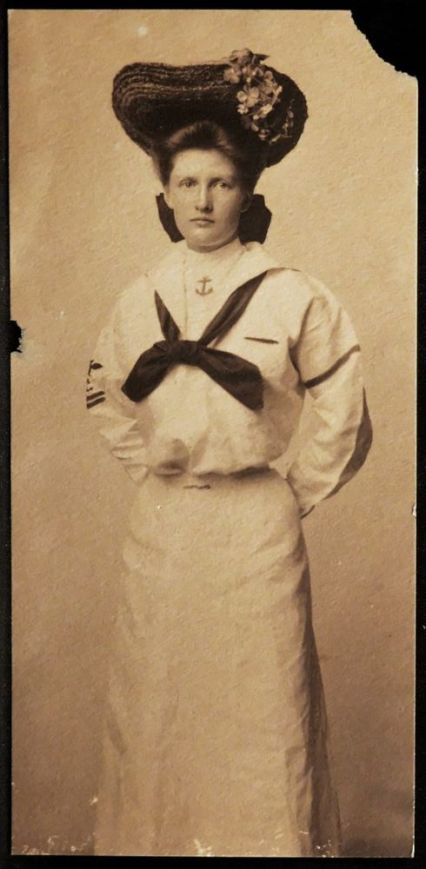
Naval-themed middies were very popular attire for women and children beginning around the turn of the 20th Century. How does one distinguish between a Middie and a Navy dress uniform?

A young woman wearing in the early 20th Century. Note the Ex-Apprentice mark located near the “V” of the neckline, similar to an authentic navy dress blue uniform. This can be very misleading to a novice collector.
I recently noticed an online auction for a naval uniform item that was listed as a World War II U.S. Navy enlisted man’s jumper. For the seller, it appeared to have the same characteristics of other similarly listed uniforms so guiding him (or her) to describe it as being the same as those. This is very common occurrence with online listings. An unsuspecting buyer could easily pull the trigger on this listing, thinking they were purchasing the item as described. Imagine the disappointment when they will most certainly learn that what they brought home wasn’t U.S. Navy uniform, but rather it was a middy.
Middies as a fashion statement
A middy (or middy blouse) was part of a popular fashion trend of the late 19th Century that continued on up through World War I, bringing the styling of the naval uniform to civilian attire to women and children’s apparel. Designs incorporated the “sailor collar and flap” (complete with the piping stripes), neckerchief and in many examples, rating badges. To the untrained eye, the garments look no different from their authentic counterparts.
-
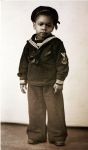
- This young man is sporting a 1930s “chief quartermaster” dress blue middy uniform, complete with a flat hat (with a “US Navy” tally)
-
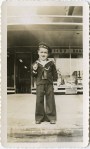
- This child’s middy is complete with a white lanyard (typically for a boatsqwain’s pipe) that is stowed in the left breast pocket.
-
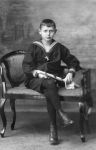
- Complete with knickers, this boy’s middy uniform (from the late 19th or early 20th Century) has white lacing over the neckerchief at the “v” of the neckline.
U.S. Naval enlisted uniforms vary through the ages
While the overall naval enlisted uniforms design (theme) has been relatively unchanged since the mid-1800s, they have in reality, gone through several subtle iterations, easily confusing novice or new collectors. Along with the uniform variations, the insignia have transitioned considerably compelling even experienced naval collectors to seek informative sources to discern one uniform or rate from another.
In addition to the variations between the different eras of naval uniform and rate designs (which includes the various rate insignia heraldry), individual customization can factor into the mix of uniform deviation. Naval personnel even to this day try to find ways to make their uniform uniquely theirs in an effort to define their appearance as an individual. These customizations may fly in the face of uniform regulations or tap dance in the grey area of with individual interpretation. Another contributing factor is the unique nature of ship’s commanding officers possessing the ability to relax or modify the regulations to fit their command style.
Several excellent publications are available that provide collectors with the ability to assess a uniform item and properly identify it…most of the time. Occasionally, uniform anomalies surface that clearly stand out and appear to deviate from the uniform regulations or known practices of the purported time period of the item. Fortunately, there are experts in online forums who are experienced with enough of the variances that can help to decipher the uniform attributes in an effort to guide the collector to the best conclusion as to the authenticity of the piece.Navy enlisted uniform basics – what to look for
I am certainly not an expert when it comes to navy uniforms however, through osmosis and reviewing the various reference materials, I am beginning to recognize the nuances and can provide some beginner-level guidance. If you’re just starting out with naval enlisted uniform collecting, I can provide some basic details on what to look for (I have included a few images from previous articles covering navy enlisted uniforms):
-
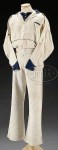
- This Civil War-vintage dress white uniform was recently listed with an estimated sale price of $3,000-$8,000. Note the blue cuffs and the blue flap (white white stars), a design that would persist well into the 20th Century (source: James D. Julia Auctions).
-
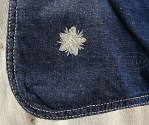
- This close-up view of the Civil War uniform shows the hand-embroidered star on the collar flap’s corner (source: James D. Julia Auctions).
-

- A close-up of a SpanAm jumper shows the wool material and the three-stripe white piping (source: eBay image).
-
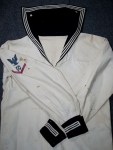
- I have the privilege of owning this 1905-1913 coxswain dress white uniform. Note the blue wool cuffs and collar flap and the three-stripe white piping affixed. The flap also has two white stars directly embroidered to each corner.
-
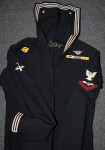
- When the Navy began to specialize the enlisted ranks in the late 1800s, special marks were incorporated to denote the skills of the enlisted sailors. This WWII aviation radioman 3/c uniform has the distinguishing mark of an aerial gunner on the right sleeve.
- Tags or labels
Check the garment for a label or tag as a method to determine when the uniform was constructed. This can also apply for tailor made items, but consultation with experts should be required in order to nail down the tailor and any comparative details that could be used. - Rate insignia
John Stacey’s book, United States Navy Rating Badges, and Marks, 1833-2008: A History of Our Sailors’ Rate and Rating Insignia is an invaluable tool to decipher the lengthy list of variations with insignia. Mr. Stacey possesses many decades of documentation and research that includes having delved deep into the Navy’s archives of uniform regulations, uniform contracts, and design specifications. Collectors are continuously reaching out to him with their discoveries of anomalies, providing feedback to add to his research and to provide material for the many revisions his book has been subjected to. - Distinguishing Marks
Modern enlisted uniforms no longer employ these specialty insignia as the rates and ratings are firmly developed and managed by naval regulations. As the Navy began to mature and place a significant amount of management of the enlisted ranks (contrary to the previous era of conscription), leadership started to institute systems to allow specialization for these men. With that came a need to allow for recognition for these sailors to display their shipboard role on their uniform. To gain a better understanding of why and when these were implemented, again, refer to Stacey’s book. - Construction
There are several types of materials that have been used throughout the years in the construction of enlisted navy uniforms. Keep in mind that there have been times when sailors would have multiple types of uniforms (blues, whites, undress, dress, working, etc.). Textile variants also play into determining the time-frame (heavy melton wool, weave, duck, canvas, etc.). If the collector is confused, consult the experts. - Embroidery and stitching
Some early 20th century naval uniforms can be especially baffling. A few years ago, one in particular drew significant attention among collectors for its distinctive embellishments and custom embroidery. What was confusing (to a novice like me) was that every aspect of the uniform was so ornate and beautifully designed, unlike the conventional uniforms of the same period. Many collectors (including me) debated as to the authenticity and whether it was truly a uniform or perhaps a middy. As it turns out, it was a custom-tailored “liberty” uniform that is unauthorized for official wear, yet proudly worn ashore.
Research – a wise investment
Spending time to get familiar with some of these basics along with investing in reference materials will go a long way to prevent you from making costly mistakes. The flip-side of this situation is that educated buyers might even discover a piece that the seller has grossly undervalued (due to their own ignorance of naval uniform nuances) thereby providing the piece to be acquired at a bargain-basement price.
In the case of the seller with the middy eBay listing (mentioned above), I did make contact regarding the mistaken description for which I was politely thanked; the seller informing me that they would remove the auction and properly identify it when relisted.
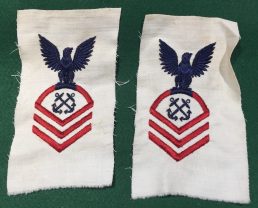
Most middy rating badges are boatswains mates and quartermasters. Notice how disproportionate the crossed anchors are. Also note that the eagle is on odd pattern as compared to the authentic design. As for the red chevrons (on white uniform), they were discontinued after 1913 (source: eBay image)
Middy Rating Badges
In addition to the mis-identification of middy costumes and clothing as Navy uniforms, the rating badges that are stitched to the sleeves of these garments can also be improperly listed for sale online. To the unsuspecting or untrained eye, a middy badge could be seen as authentic. Middy rating insignia are often proportionally distorted from their authentic counterparts. In addition to the size variances (middies were made for children and women so their badges had to be smaller to be aesthetically appealing on smaller sleeves), the distinguishing marks are always sized disproportionately to the eagle and the chevrons. Also, pay attention to the way that the embroidery work was done. Most chevrons were sewn-on pieces of wool flannel (rather than directly embroidered to the base material).
-
- This “chief boatswain’s mate” middy badge has fully-embroidered chevrons, setting it apart from the genuine pre-1914 badges of the U.S. Navy (source: eBay image).
-
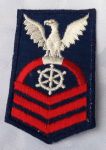
- This tiny middy rating badge (chief quartermaster) is a very late example from a child-sized costume (source: Etsy)
-
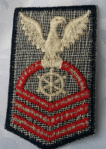
- The distorted eagle and disproportionate distinguishing mark along with the full-embroidered chevrons are classic examples of a middy rating badge (source: Etsy).
Giving sellers the benefit of doubt, they may not be intentionally deceptive with their listings. I suspect that when they come across these badges, they truly believe that they are authentic and are merely adding them to their manifold-listings of online sales, not considering for a moment that the pieces are merely costume elements.
Dream of Me When You Sleep: Homefront Military Pillow Covers
While reading a discussion on a militaria forum regarding a World War I veteran’s medal group (that at that time had recently been listed for sale by Bay State Militaria), I was reminded that so much in military collecting is out of reach for my budget. This particular collection of artifacts contained the Army officer’s decorations and medals which included the Distinguished Service Cross, Belgian Order of the Crown, Knights level, Belgian Croix de Guerre, three awards of the French Croix de Guerre, United States Silver Star Medal, Purple Heart Medal, Legion of Honor, Knights class and many other decorations. Not only was this group considerably out of my reach but I couldn’t even afford to purchase this soldier’s WWI Victory medal (which included ten clasps, documenting the battles he participated in) if it had been parted out. The group was listed for just under $6,800 and based upon the amount of history the buyer acquired (yes, it sold very shortly after it was listed), it was worth every penny.
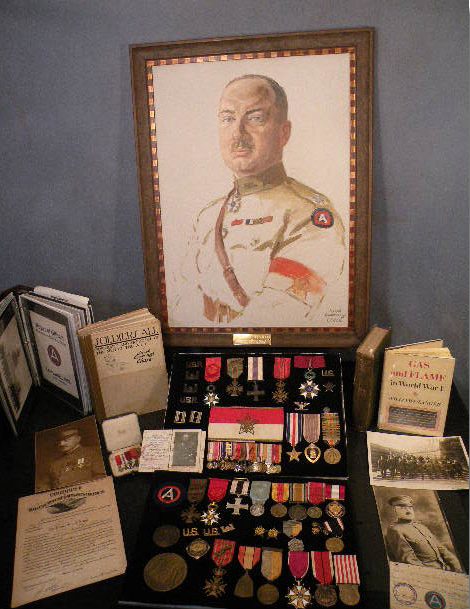
From a painting by noted artist, Arthur Cummings Chase, to the array of medals, decorations and ephemera, this WWI Army officer’s grouping is nothing short of spectacular (image source: Bay State Militaria).
The career of the veteran was not only significant during his time in uniform but in his work after he served. In reading his history-making accomplishments as noted, one could see why this grouping commanded such a high listing price:
- “This Officer was decorated while attached to the British during advanced Chemical Training in 1918. He then personally led the first American Chemical Weapons Attack in History as Company Commander of B Company, 1ST Gas and Flame Regiment.”
- “A very historic grouping with a famous painting of this Officer by Joseph Cummings Chase which is in itself a treasure. This portrait was one of 125 painted in France in 1918-19 by Joseph Cummings Chase. approximately 75 ended up in the National Portrait Gallery in Washington, DC. This is one of just a few known to be in Private Hands.”
This WWI Army officer’s (his name was not disclosed) group is purely museum quality as this officer also played a significant engineering role (during the interwar period) on New York’s George Washington Bridge and Holland Tunnel construction projects.
Meanwhile, back in the realm where I live (known to me simply as reality), my World War I collection consists of a few items that were affordable and have visual appeal. With my family serving in every American conflict dating back to the War for Independence, I try to locate objects that will display well and have some sort of connection to my family’s military heritage.
-
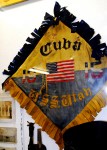
- This pillow cover (on display at the Indiana Military Museum) recognizes the USS Utah’s (BB-31) service in 1915 around Cuba. The Utah would later be sunk at Pearl Harbor on December 7, 1941.
-
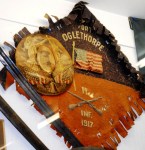
- A rather tattered Fort Oglethorpe (Georgia) pillow cover dating to 1917 shows the crossed rifles of the the 11th Infantry Regiment which participated in the Vosges Mountains, St. Mihiel, and Meuse-Argonne offensive engagements during WWI. This cover is on display at the Indiana Military Museum.
Two pieces that fit my criteria (as stated above) and met my budgetary constraints are these WWI-specific wool flannel pillow covers. As it turns out, their similar designs complement each other quite well and will look fantastic on my office wall.
-
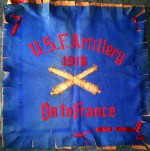
- One of my uncles enlisted into the Army and was assigned to an artillery regiment (under the Coast Artillery Corps) and served in France from 1918 until late 1919. I purchased this well-worn pillow cover as a reminder of his service during the war.
-
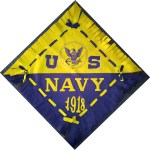
- Homefront pieces such as this 1918-dated U.S. Navy pillow cover helped to remind family of the service of their loved one as they openly displayed their patriotism in their homes. When I acquired this several years ago, there seemed to be several listings over the course that year (2011). I haven’t seen any listed in several years, since then.
-
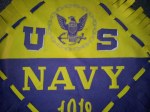
- This close-up reveals the detail of the cover with the hand-cut lettering and insignia and the needlework on the naval crest and chain.
-
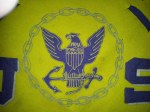
- Since one of my uncles served in the Navy during the Great War, I wanted this pillow cover to compliment the Army Artillery cover that I acquired (in honor of his twin brother). The detail in the embroidery is subtle yet ornately executed.
Pillow covers were quite popular during World War II with most designs being simple silk-screened patterns or pictorials on silk material. Typically, these were gifts purchased by the service members and sent to family and sweethearts as reminders of the loved one away at war. During the war, these were mass-produced and can be acquired without severely crippling your collecting budget.
Commemorating a wide variety of subjects such as military branches of service, forts or military bases, ships or aircraft, pillow covers have been dated to the first few years of the twentieth century. The early examples tend to be constructed from a wool flannel with lettering and designs stitched to the face.
-
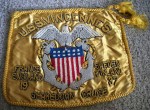
- This ornately appointed pillow cover commemorates shakedown cruise of the (then) newly commissioned New Orleans class heavy cruiser, USS Vincennes (CA-44).
-
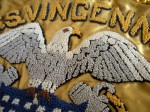
- The eagle of the officer’s crest insignia has the bird’s head facing its left shoulder. From 1860 to 1940 the eagle in the officer’s crest faced this direction. In 1941, Navy uniform regulations changed the eagle’s facing direction to conform with heraldic tradition (facing right indicates honor).
-
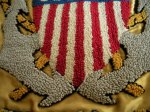
- Close inspection of the Vincennes pillow cover shows the ornate chenille needle work in the colorized naval officer’s crest insignia.
While the common designs of WWII (such as the more generic “Army” and “Navy” versions) will be plentiful and therefore inexpensive, the more ornate or specific they are, the price will be higher. With Navy ships of significance (such as the USS Arizona or Enterprise) expect to pay a premium.
Wahoo! A Bounty of Historical and Antique Books!
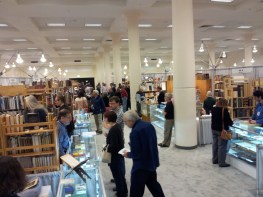
There are abundance of book dealers and vendors to visit at the Seattle Antiquarian Book Fair and attendees should spend time in each booth to find the treasures they seek.
Having attended many types of collectibles (sports memorabilia, coins, comic books, etc.) and antique shows over the course of the past few decades, I can attest that this event (that held my attention for several hours) was probably the most captivating of them all.
Knowing that I had not previously attended a show of this nature, one of my militaria collector colleagues told me about the Seattle Antiquarian Book Fair and that there would be book dealers who specialize in military history and associated rare and hard to find publications. Knowing that I’d have an opportunity to locate an out of print work or simply peruse literal pages of military history made attending this show an absolute must.
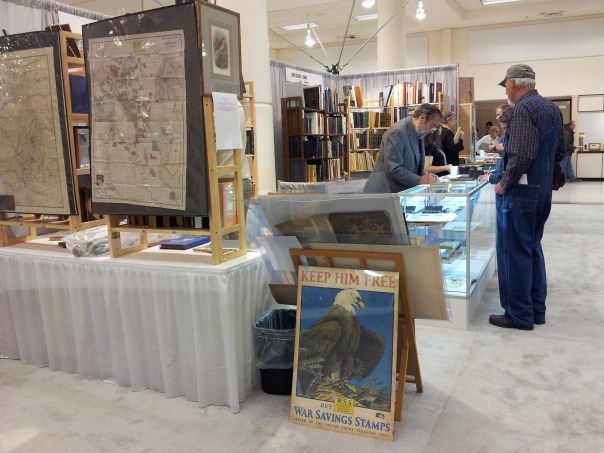
While the Seattle Antiquarian Book Fair is dominated by vintage and collectible books, there is also a considerable amount of ephemera, such as this WWI war savings stamps poster, for sale.
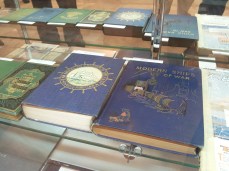
These two late-19th century books are in pristine condition.
Waiting in line to enter the exhibition hall, a staff member briefed the eager crowd about the rules, in order to provide the sellers with a measure of inventory security, to gain admittance: there would be no heavy coats, large bags or loose books allowed in. Once I checked my coat, I walked through the large double doors and my eyes immediately widened. From the highly organized booth spaces, complete with LED-lighted glass display cases and large bookshelves and wall-to-wall carpet, one could tell this wasn’t the typical gathering of vendors.
The very first display that I visited, my eyes were overwhelmed by the pristine, recognizable titles. I began to peer into the gleaming displays featuring books and noted works that were worthy of the bright lights and presentation. Books from the 18th and 19th century in pristine condition were sitting side-by-side with rare, one-of-a-kind manuscripts and documents. Booth after booth, I was continually amazed by each vendor’s wares.
-
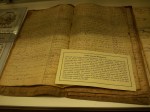
- Although not specifically militaria-related, this late 18th century whaling ship log (from two ships; the Harlequin and Leviathan) was an amazing piece of history to see. At $75,000, it was a few “zeros” out of my financial reach.
-
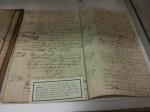
- Yet another whaling ship log. This one for the vessel, William, dates from 1838. Note the whale stamp next to the latitude and longitude entry.
-
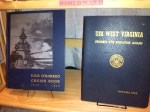
- WWII cruise books of the battleships USS Colorado and USS West Virginia.
-
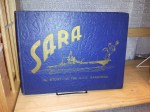
- The aircraft carrier USS Saratoga’s WWII cruise book is in absolute pristine condition and was available for only $200.
Unfortunately for me, most of the pieces that truly held my interest had price tags well into the thousands (such as the Narrative of the Mutiny aboard His Majesty’s Ship Bounty published in 1790 for a mere $12,500, which was exceptional). Had my bank account been more flush, I would have had a much more difficult time trying to make a decision between the various historic items for purchase.
-
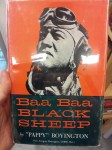
- For a mere $30, this later printing of Medal of Honor recipient Greg Boyington’s autobiographic work was a steal…
-
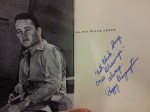
- …That it was autographed was extremely enticing, even though I already had signed copy!
With a few dollars burning a hole in my pocket, I knew I couldn’t leave the show empty-handed. Having walked the entire show over the course of a few hours, I returned to an earlier-visited vendor who specializes in military books and selected the signed first edition of Medal of Honor recipient Rear Admiral Richard O’Kane’s World War II narrative about the legendary submarine, the USS Wahoo and her fearless skipper, Commander Dudley “Mush” Morton.
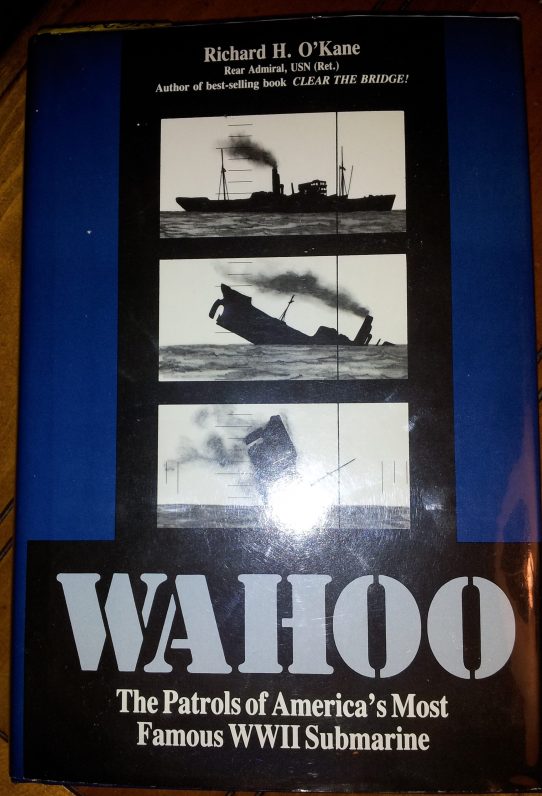
After visiting the military book vendor’s booth several times, I was drawn to add to my collection of Medal of Honor recipients’ autographs; purchasing Rear Admiral O’Kane’s work on the WWII submarine, the USS Wahoo.
With a few dollars burning a hole in my pocket, I knew I couldn’t leave the show empty-handed. Having walked the entire show over the course of a few hours, I returned to an earlier-visited vendor who specializes in military books and selected the signed first edition of Medal of Honor recipient Rear Admiral Richard O’Kane’s World War II narrative about the legendary submarine, the USS Wahoo and her fearless skipper, Commander Dudley “Mush” Morton.
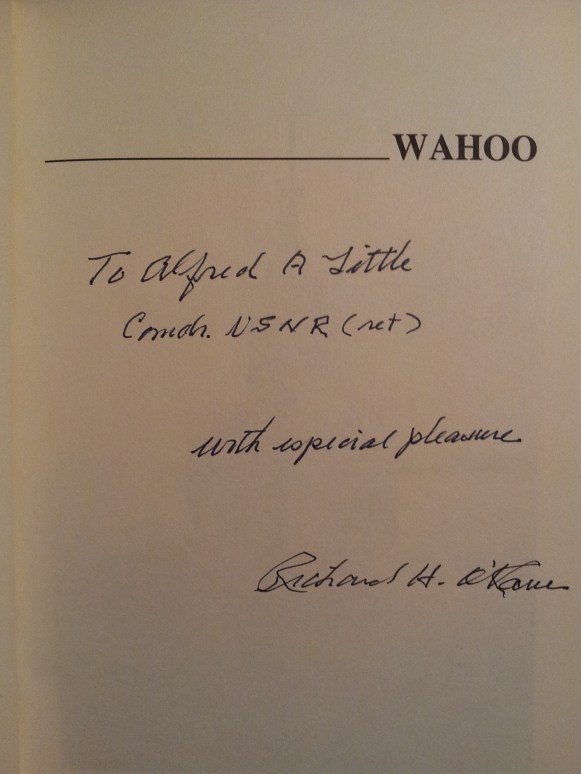
My first edition copy of Wahoo is autographed by Rear Admiral Richard O’Kane.
My feet thoroughly tired and my hunger pangs overwhelming me, my time at the fair drew to a close and I was happy to be leaving with a piece to add to my collection of autographs from notable military veterans.
My Signature Soapbox: Veterans of Valor Autograph Collecting
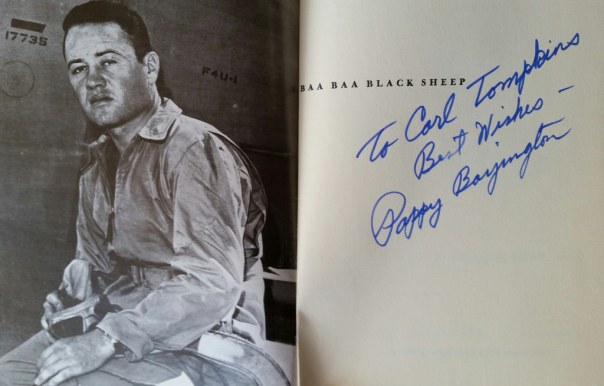
One of my favorite Medal of Honor recipient autographs is this one from Colonel Gregory “Pappy” Boyington.
For the current 2017 Major League Baseball season, twenty four players will earn $21,000,000 or more to play the game. Of those, two pitchers; David Price, Boston Red Sox and Clayton Kershaw, Los Angeles Dodgers will earn $30m and $33m (respectively) to collect “outs” for their teams throughout the season (and post-season).
Being the huge baseball fan that I am, I do understand that the MLB season is gruelingly long at 162 games and half of them are on the road, visiting cities stretching across the United States and into Toronto, Ontario, Canada. Life on the road is difficult and has considerable impact on family life with all the time away. While the season typically starts in late March to early April, for the players, it actually begins in February with spring training. If the team makes it to postseason play, that means they are working from mid-February to late October.
Many athletes’ families do not live in the city in which they are playing, further adding to the separation challenges. Players routinely miss out on birthdays, anniversaries and other family gatherings. For roughly eight months of the year, these athletes are subjected to air travel (some aboard chartered team jets) and the nicest hotel rooms. While on road trips, team equipment managers pack and unpack their gear, ensure that their baggage is in their hotel rooms when they arrive and picked up when they depart the various cities.
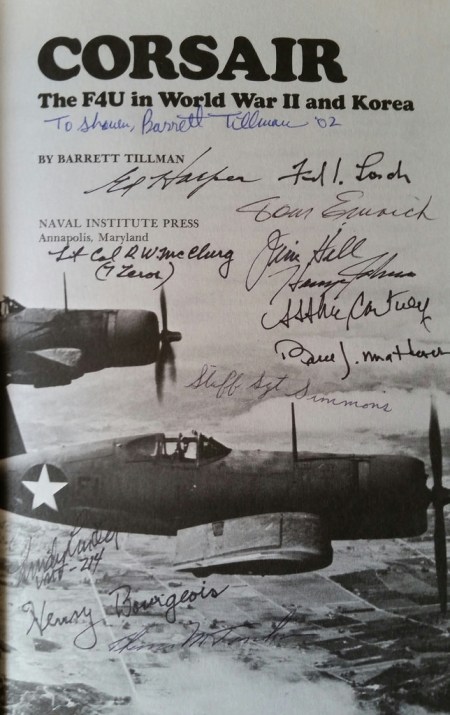
Meeting 12 of the surviving members of the Blacksheep of VMF-214 was a thrill for me. Ace, Lt. Colonel (Pappy Boyington’s wingman) was quite amusing as he and his wife “attempted” to steal my baby daughter, snickering and laughing as he wheeled her stroller away. All that I had to get signed was this book by notable author, Barrett Tillman.
During batting practice and pre-game warm-ups, fans arrive early for the chance at obtaining the autograph of their favorite players on a baseball card, ball or scorecard. Autograph hounds seek out the stars of the game to get as many items signed as possible, even hiring kids to obtain as many signatures of the game’s elite players as possible. Autographs of the stars command premium prices when sold on the market. Many of the stars understand this part of the business (yes, the game of baseball is a business) and choose only to sign at arranged events where they are paid fees, commanding thousands of dollars, further padding their multi-million dollar salaries.
By now, you are asking yourself, “what does this have to do with militaria or military collecting?” I ask that you give me a little latitude as I am getting to the heart of the subject.
As a member of the local aviation museum (which is one of the best in the nation), I occasionally attend functions that typically focus on the stars of military aviation. During these events, one or more figures make appearances where they interact with the audience, detailing or describing their escapades in aerial combat or flight operations in support of significant military historical events. The schedule typically follows the format of a presentation in the auditorium, followed by a question and answer session, then an opportunity for the “fans” to get an autograph.
-
- A few of my crossover autographs are on baseballs. Major League Hall of Fame outfielder for the Brooklyn Dodgers, Edwin “Duke” Snider served in the Pacific Theater as a Navy fireman 1/c aboard a ship. In addition to shipboard service, he played on his ship’s baseball team when they reached friendly ports.
-
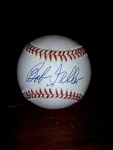
- Navy Gunnersmate Chief, Bob Feller was a star pitcher for the Cleveland Indians for five years before enlisting into the Navy on December 8, 1941. Feller served both at the Naval training station in Great Lakes, IL and saw combat while serving aboard the battleship, USS Alabama. He was elected to baseball’s Hall of Fame in 1962.
-
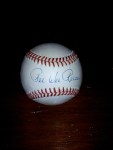
- Harold “Pee Wee” Reese was an All-Star with the Brooklyn Dodgers when he enlisted into the Navy after the 1942 season and spent most of the war serving with Sea Bees in the Pacific, playing for and coaching Navy and USMC ball teams before finishing his Hall of Fame career with the Dodgers, in 1958.
Since I’ve been a member, I have had the opportunity to meet legendary veterans that were significant participants, authors of events that had considerable impact on the outcome of the war. From Marine Corps pilots of the Black Sheep squadron (VMF-214), “sled” (SR-71 Blackbird) drivers, Tuskegee Airmen, and countless Aces from WWII, the Korean and Vietnam wars. The roster of historical figures is nothing short of impressive. While the queue of autograph seekers isn’t small at these events, it pales in comparison to those seeking signatures of the multi-million dollar ballplayers.
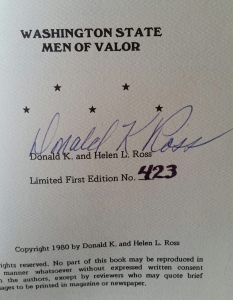
Captain Donald K. Ross, Medal of Honor recipient (for his actions aboard USS Nevada on December 7, 1941) wrote this book about MoH recipients with ties to Ross’ adopted home state.
Is it fair to compare the two? I think it is when we consider the cost of service to our country, especially when one is deployed to a combat zone. The tour of duty isn’t limited to an eight-month season. The training is far more intense and exceedingly more difficult. While batting practice may have its risks (getting hit by a pitch or taking a foul off the foot or leg), ball players aren’t psychologically preparing to protect their own lives or that of their teammates.
Deployments are a far cry from the road trips of their Major League counterparts. Some are cooped up in cramped quarters aboard ship, have to sleep in fox holes, or seek shelter beneath a truck in the desert. Current soldiers, sailors and airmen can spend up to 16 months away from family with occasional access to phones or email for a momentary taste of home. During World War Two, some were in theater for years, on the front lines for months at a time with brief respites mixed in. Mail from home was only an occasional luxury, if at all.
The risks ball players face each time they step out onto the field are real – torn ACL (anterior cruciate ligament ), rotator cuff tears, elbow ligament damage and in some rare cases, the risk of traumatic brain injury (TBI) from a wild pitch to the head. When compared to what our service men and women face – such as being shot; losing limbs, eyesight or hearing; and death – the multi millionaire athletes’ reality takes a significant backseat.
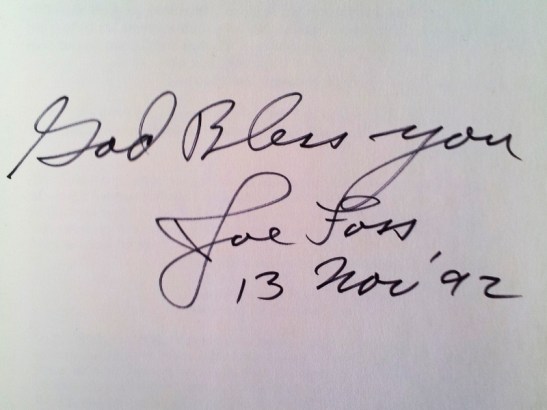
Another Marine Corps ace and Medal of Honor recipient, Major Joe Foss’ signature in his autobiography is a treasured addition to my collection.
Readers might suggest that my comparisons are patently unfair. My response is that the comparison is meant to provide focus on how we the collectors, place value and emphasis on athletes (and actors, musicians, etc.) over those who have sacrificed so much more. While in the area of autograph collecting, signatures from well-known veterans often command high prices on the resale market, lesser known vets or common military personalities get no attention.
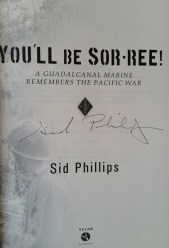
Though he didn’t earn a valor medal for his service in the USMC during WWII, his personal accounts (told in both Ken Burns’ “The War” and Tom Hanks’ “The Pacific” television series) were remarkable. I was happy to receive his signed WWII memoir.
I used to obtain and collect signatures of ball players and amassed quite a collection. Unfortunately, most of the signatures were from prospects who never truly panned out, rendering the collection to more of a humble status in its value. I did manage to obtain some choice stars and hall of fame players. But to me, these pale in comparison to the other more significant inscriptions that I have obtained since I started focusing on veterans.
I doubt that most of the signatures have much in the way of monetary value to autograph collectors, but to me, they are priceless mementos of personal encounters with men who have “been there.” My collection contains autographs from 32 Medal of Honor recipients, two World War II Marine Corps Aces, several WWII, Korean and Vietnam war Navy Cross recipients, several silver star recipients, many prisoners of war and members of the famed “Easy” company (Band of Brothers) veterans and many more.
The personal sacrifices made by these men easily overshadow any significant achievement or career milestone attained by the greatest Hall of Fame baseball player…unless that player also happens to be a combat veteran (my collection contains a few of those signatures as well).
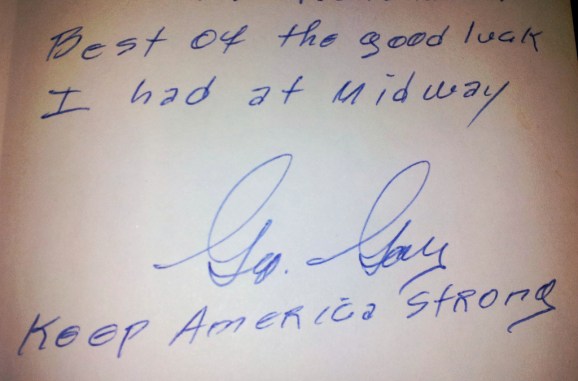
Navy Lieutenant Commander George Gay signed his autobiography in 1982. LCDR Gay was awarded his Navy Cross medal for his squadron’s torpedo dive bomber attack on the Japanese carrier, Kaga. He was the only member of his squadron to survive the attack (all were shot down, including Gay).
I didn’t intend for this posting to be a rant against ballplayers or those who enjoy collecting their autographs. My goal was purely to call attention to the value of those who willingly raise their right hand, swearing to protect this nation from all enemies, foreign and domestic and then proceed to do that very thing. Serving in the military tends to be a very thankless job and when the service member finally hangs up their uniform, there are no invites to attend any All Star weekends for autograph signing sessions.
I surrender my soapbox.
See Also:
Calculated Risks: Bidding on Online Auctions that Contain Errors
Yardlong Photography and the Military: Family Military History Discovery in Less than a Yard
Because I am known within my family and circle of friends as the military-history person, I am on the receiving end of artifacts from those who know about my interests. From the moment that I was gifted with my maternal grandfather’s WWII navy uniforms and decorations (which can be seen in this post) and my grand uncle’s Third Reich war souvenirs, my appreciation for military history was ignited.
Over the years, I have either received or been approached to determine my interest in becoming the steward of historical family military items which have included, uniforms, medals and decorations, weapons (along with artillery rounds and small arms ammunition), flags, documents and other historical pieces. Some of the most special items that I have inherited have been photography (albums and individual photos). With the last box of items that were part of two family estates (my paternal grandparents and a step-relative), I received a nearly two-foot long, vintage panoramic photograph (known as a yardlong photo due to their length: these images can be nearly thee feet in length) of a U.S. Navy crew, professionally positioned and posed pier-side in front of their destroyer.
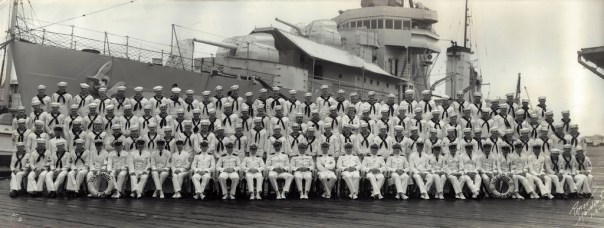
Finding this framed yardlong photo was a pleasant surprise. It took me a second or two to spot the lettering on the life-rings to know that this was my uncles’ ship. Moments later, I found them both, posed with their shipmates.
For the first half of the 20th Century, a common practice within the military was to capture, in photographs, an entire company, regiment, even battalion of soldiers. The same holds true with the compliment of naval vessels with divisions, departments or even the full crew (obviously, size of the ship and on-duty personnel dictate who is present in a photo). The photographs were taken with cameras that allow the lens to be pivoted or panned from side to side in order to span the entire width of the subject, exposing a very large piece of film. As with the negative, the resulting images were elongated and fairly detailed (most often, these were contact prints, the same size as the negative). However the extremities of the photographs were slightly distorted or lacking in crisp lines due to the chromatic aberration that is almost unavoidable. For the most part, the elongated images are quite detailed and almost without exception, faces are recognizable when the military units were captured within these yardlong photographs. There are still photographers creating panoramic images using vintage cameras and film.
-
- While visiting the USAF Airman Heritage Museum at Lackland AFB this past summer, I snapped some photos of this 1947 yardlong of the Air Training Command formation of the USAF insignia.
-
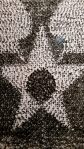
- This image shows the how the command used different uniforms and headgear to form the details of the insignia.
-
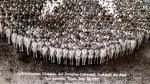
- Moving in closer to the photo, one can see the facial details of the airmen. The caption reads, “Indoctrination Division, Air Training Command, Lackland Air Base, San Antonio, Texas July 19, 1947.
The photograph that I received was in an old frame, backed with corrugated cardboard and pressed against the glass pane. As I inspected the image, I noticed the ship in the background behind the crew that was posed in their dress white uniforms. Noting the blue flaps and cuffs on the enlisted jumpers, I knew that the photo was taken in the 1930s. My eyes were drawn to the two life-rings that were held by sailors on each end of the image, displaying the name of the ship; USS Smith and the hull number, 378. From researching my paternal grandmother’s siblings, I discovered that both of her brothers had served in the U.S. Navy and were both plankowners of the Mahan-class destroyer, USS Smith (DD-378). Dating the image will take a little bit of work (there are no indications of when it was taken – not in the photographer’s marks on either corner nor written on the back). However, I do know when the ship was commissioned, when my uncles reported aboard and departed the ship. Discernible in the image on my uncles’ uniforms are some indications of rank. I can tell that the older brother (who enlisted in 1932) is a petty officer (he reported aboard as a Seaman 1/c) and the younger brother was still a seaman (I can’t see the cuffs of his uniform to determine the number of white piping stripes present) as noted by the blue cord on his right shoulder. I should be able to narrow down the period once I can go through the massive service records to locate dates of rank. However, my initial assessment is that the photo might have been captured near the time of commissioning or, perhaps to commemorate a change of commanding officers.
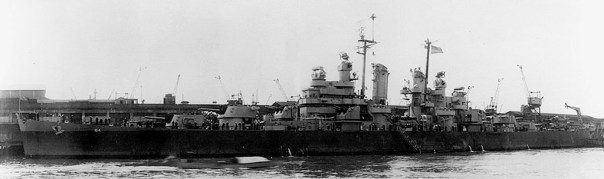
This yardlong image (a scan and a reproduction print) was sent to me by the son a of a veteran who served aboard the USS Vincennes (CL-64) during WWII.
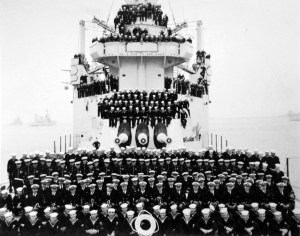
This image was shot using a panoramic camera though it technically isn’t a yardlong photograph. The crew of the USS Vincennes (CA-44) is posed on the ship’s fantail, after 8″ turret and superstructure which is a nod to how many naval crew photos were posed in the late 19th Century.
Being an archivist for my ship and the recipient of some fantastic artifacts, I have been contacted by folks seeking to provide me with images to preserve within my photo archive. A few years ago, a gentleman emailed requesting to send to me a copy of a yardlong photograph that his father, a WWII navy veteran, owned from his time in service. The image was of the second cruiser (USS Vincennes) that was named for the city in Southwestern Indiana. The Cleveland-class light cruiser, hull number 64, had been laid down as the USS Flint but was changed during construction following the loss of the heavy cruiser during the Battle of Savo Island on August 8-9, 1942. The light cruiser was completed and commissioned on January 21, 1944 and served gallantly through WWII and was decommissioned in September of 1946. The man who contacted me had the ship’s photo scanned at a high resolution and sent the image file to me (on a thumb-drive along with a full-size print).

I wish I could have landed this photo of the USS Tacoma (CL-20) crew from 1920, four years before her demise on Blanquilla Reef, Vera Cruz, Mexico.
I am not a collector of yardlong photography but when the images are contextual to the areas that I do collect, I am happy to be able to acquire them. Receiving the image of the Smith and finding my grandmother’s brothers in the photograph motivated me to promptly hang it with my other family military history. In scanning the image for this article, I am reminded that I need to have it properly framed with archival materials to allow it to be preserved for generations to come.
 The Veteran's Collection