Paper and Postcards – Telling a More Complete Military Story
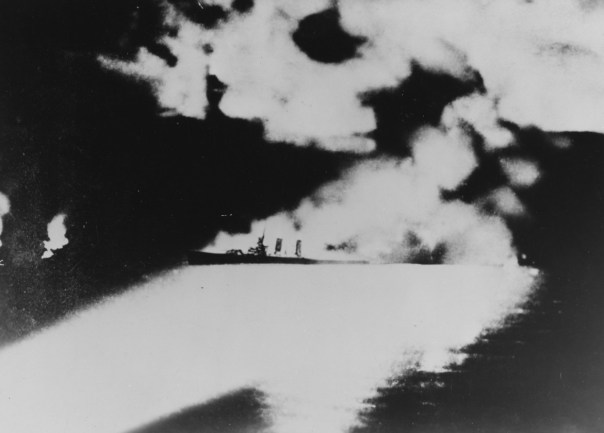
USS Quincy (CA-39) photographed from a Japanese cruiser during the Battle of Savo Island, off Guadalcanal, 9 August 1942. Quincy, seen here burning and illuminated by Japanese searchlights, was sunk in this action. To the left of the image, USS Vincennes (CA-44) can be seen burning in the distance (image source: Naval History and Heritage Command | NH 50346).
Although I am not much of a ephemera collector or fancy myself a philatelist, there are certain aspects of these areas of collecting that interest me. More specifically, if there are ephemera or postal items that connect with or align to my focus areas, I try to grab them in an effort to augment my collection.
People might see the term ephemera and wonder what it means. What sort of item can be characterized or classified as such? In order to answer that question, at least for myself, I proceeded to search the internet. One of the first items within the search results was the organization that is dedicated to these collectors, the Ephemera Society of America, who characterizes it this way:
“Ephemera includes a broad range of minor (and sometimes major) everyday documents intended for one-time or short-term use. The 402-page Encyclopedia of Ephemera lists more than 500 categories from bookmarks to fruit wrappers to posters to theater tickets.”
For this article, the specific categories (presented among the group’s list of 26) that I am touching on are photographs, postcards, and brochures. In some cases, a few of my items (such as real photo postcards) span multiple categories.
In 2009, I published my first book (and hopefully, many more to come though much time has passed since then without a subsequent offering) about the naval warships that bore the name USS Vincennes. In the process of assembling my collection of artifacts that would be used to provide the readers with some visual references, I realized that I had amassed a significant group of items relating to the CG-49. I also realized that though I had a smattering of items, I was really lacking in anything associated with, at the very least, the two WWII cruisers. This realization catapulted me into active militaria collecting that was very focused.
Since I started writing about militaria, I have authored articles (see below) that include a smattering of some of the items from my own USS Vincennes collection.
- Subtle History – Finding a Unique Naval Militaria Piece
- Collecting U.S. Navy Uniform Ship Identifiers
- Remember Me When You Sleep… Sweetheart Pillow Covers
- Spark Your Collection: Military-Themed Zippos
- A Mere Symbolic Plank: A Navy Ship Plankowner’s Perception
The items documented in these posts represent a growing and well-rounded and ever-increasing group of Vincennes-related militaria and would make for a nice arrangement or display. With my ephemera and philatelic additions, this collection (and any subsequent displays I might set up) takes on a more vibrant and colorful appearance.
The philatelic pieces (covers) from the CA-44 cruiser all date from the late 1930s and provide a documented timeline of the ship’s early years of service. The cover from the CL-64 documents the launching of the second Vincennes cruiser in 1943. Combining the ephemera (photographs) and philatelic pieces, my collection has depth and dimension.
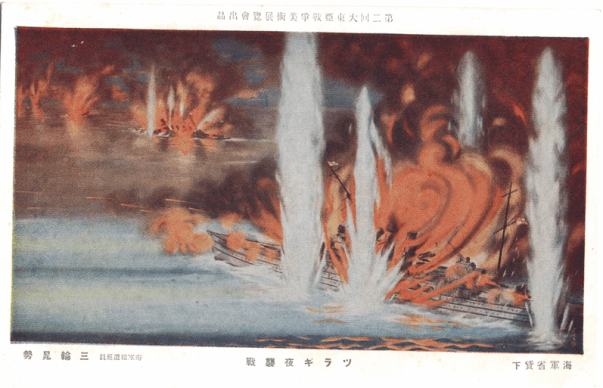
The Japanese produced postcards depiction of the Savo Island battle is not too far from the reality (see the Japanese photo of the Quincy burning and foundering – above) of what took place overnight, August 8-9, 1942.
One of the more interesting artifacts in my collection is a postcard that published during the war. When I saw the postcard listed for sale, I noted that it was being sold by someone located in Japan and the text of the listing was lacking details but the title and the artwork were enough to motivate me to submit a bid. The postcard’s face featured an artistic depiction of three American cruisers, wrecked and burning among shell-geysers (as the Japanese ships pressed their attack upon the wounded American cruisers) that, while meant to serve as propaganda, was actually close to what truly happened. I asked a friend translate the Japanese text which revealed the title of the image as, “Night (Attack) Warfare at Tulagi.” The caption states that the painting was displayed at the second Great East Asia War Art Exhibition, which was held in 1943.
The reverse of the Savo Island battle postcard. I have been meaning to re-send a higher resolution scan my friend so that it too, can be translated.
The ships that are depicted in the image are (unknown to the Imperial Japanese Navy officials at the time) the USS Quincy, USS Astoria (CA-34) and the USS Vincennes. All were left disabled and burning after a night engagement by Admiral Gunichi Mikawa’s task force at Savo Island. This painting was a propaganda piece that was more fact than inflated story-telling as the attack was the largest surface defeat suffered by the U.S. Navy during WWII.
I was quite surprised to find such a piece existed and was elated to obtain it for my collection.
A Mere Symbolic Plank: A Navy Ship Plankowner’s Perception
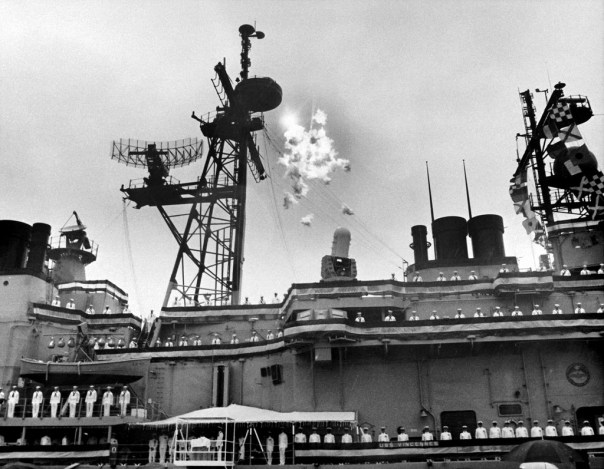
A burst of fireworks above amidships as the radars and equipment spring to life following the Vincennes being placed into commission on July 6, 1985 (image source: US Navy).
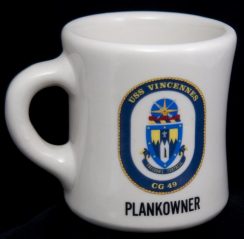
Not too long after the ship commissioned, crew members ordered these personalized mugs with “plankowner” beneath the ship’s crest.
As a navy veteran and a part of a ship’s commissioning crew (termed “plankowner”), by tradition, I am entitled to receive a piece of the deck planking when “my” ship is put out of service and dismantled or broken up. In the days when wood-planking was installed on the external (top-side) decks, sailors were actually eligible to receive a section of the teak wood decking material from the Navy Department when the ship was scrapped. Modern warships however, are devoid of wooden deck coverings having steel or aluminum surfaces covered with non-skid material and paint. In light of this, the Navy no longer provides plankowners with the mementos from their ships.
Since the Navy no longer provides sailors with planks, they are left to settle for the symbolic certificate and various paraphernalia (ship ballcaps, Zippo lighters, shirts, coffee mugs, etc.) that is emblazoned with “Plankowner.” Most sailors are satisfied with these representative pieces as reminders of their service aboard their ships, regardless of their synthetic importance. Some sailors still seek pieces of their ship as actual, tangible reminders of the vessels they spent years of their lives serving aboard. But there are challenges to acquiring actual pieces.
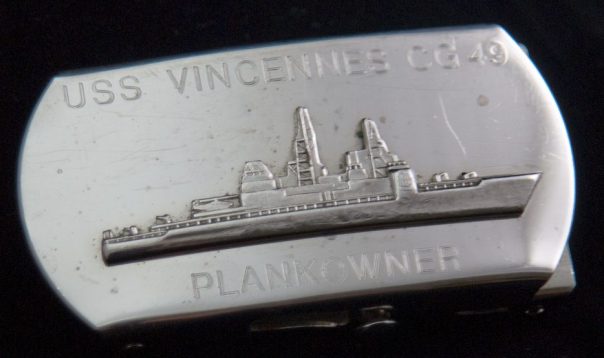
One of the plankowner items – a Zippo-brand belt buckle – is engraved with the ship’s name, hull number and “Plankowner” along with the image of the ship.
Ideally, when ships are stricken from the the Naval Vessel Register, they would be transferred from inactive maintenance storage locations to a ship recycling facility (a private company that is awarded a contract) for dismantling. The persistent plankowner (or collector) would then be able to work with the management at the scrapping facility to acquire a piece. In a perfect world, this scenario works nicely. However, nothing really works perfectly.
-
- Vincennes’ skeleton crew disembarks the ship and brings about her end as an active warship.
-
- A veteran from the CL-64 lowers the CG-49’s ensign as the ship’s crew disembarks the ship.
Not all decommissioned ships head for the scrapper’s cutting torch. Some ships are leased or sold to friendly nations. Some are used as sacrificial training targets, struck by an array of missiles and naval gunfire before finding their way to the ocean floor. Others were set in place (by way of explosive charges) as artificial reefs (a practice that was terminated in 2012 due to environmental concerns) providing habitat for marine life and attractive destinations for SCUBA divers. Obtaining a piece of the ship in any of these instances is next to impossible. Collectors seeking to remove a piece of a reef ship might want to check the local laws to ensure that they won’t be facing legal issues for such an activity.
-

- The foremast of the Vincennes as seen from the O3 level. My mastlight was taken from this mast.
-
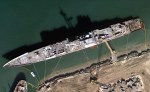
- The partially dismantled CG-49 hull has already had the foremast (where my mast light was mounted) removed as indicated by the absence in the shadow-silhouette seen on the water (source: Google Earth).
-
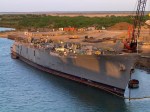
- The Vincennes’ hull has been stripped of the enture superstructure though both of her MK-26 missile launchers remained.
The navy ship on which I served (for the first sea tour of my career) was decommissioned in 2005 after slightly less than 20 years of service. Being present that day to see her crew physically disembark the vessel thereby effectively shutting her down, was a surreal experience for me. In those moments, I recalled two decades earlier when my shipmates and I walked from the pier, up the brow and to our stations and placing her into active service. The ship and I had come full circle. Walking her quiet and empty decks after the ceremony, I began searching for a piece that I could take with me – something significant yet small enough to conceal (sailors have a knack for the art of procurement), but there was virtually nothing to be had, save for a t-wrench for a sealed deck-drain and an monkey-fist from the flag bag in the signal bridge (both pieces found their way into my camera bag).
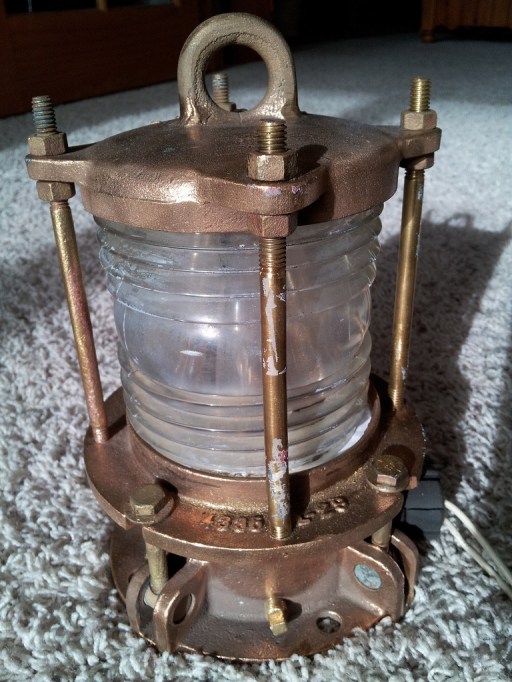
Fresh from the shipping box, the mast light still needed cleaning. The original wiring can be seen protruding from the electrical fitting.
In the seven years since her decommissioning, I was finally able to connect with a person with ties to the ship breaker contracted by the Navy to dispose of the ship (the ship was dismantled from 2010-2011). The person I contacted afforded me the opportunity to acquire a piece with significance – one of the ship’s mast lights. This particular light had been mounted on the ship’s foremast providing a nighttime visual navigation element for other ships’ crews to observe. Having been a lookout watch-stander early in my career, I recall looking up to see the forward light glowing overhead as we steamed through the waters of the Pacific Ocean.
-

- Wired and illuminating, the mast light (from USS Vincennes’ foremast) shines in my office.
-

- The room lights turned off and the mast lights dimmer in the fully-bright position, the light is not only intense but throws off a bit of warmth.
Though my light has no physical markings indicating that it was actually taken from my ship, I do have provenance (from the person who provided me the with the light) to connect the light to the Vincennes. Cast entirely from bronze, the piece is considerably stout, weighing north of 25 pounds. I re-wired the fixture to accommodate a residential 110-volt current (including a dimmer) and hope to have it mounted to a wooden base. The finishing touch will be to affix the light base with a brass plate complete with engraved with details of the ship. In its new life, the mast light will continue to provide light and serve as a reminder of the once proud ship on which it served.
Here’s an Idea…Visit a Memorial or Monument for Memorial Day This Year!
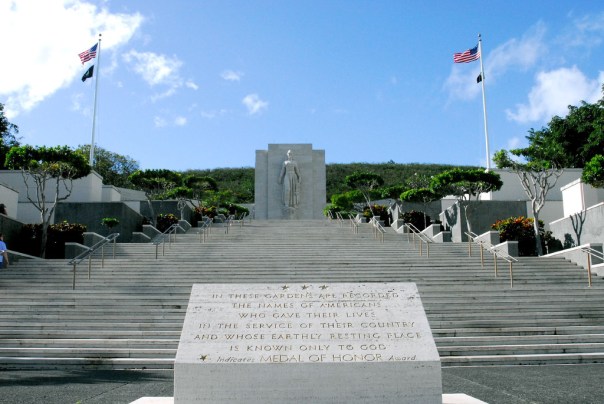
One of the most shocking areas to visit in the National Memorial Cemetery of the Pacific is the memorial to those who were missing in action or were lost in naval battles and were either buried at sea or went down with their ships or aircraft. “In these gardens are recorded the names of Americans who gave their lives in the service of their country and whose earthly resting place is known only to God. | * indicates Medal of Honor award.”
Historically, when I wrote an article regarding Memorial Day, I would publish it during that weekend or as close to the actual day as possible. I chose to take a slightly different approach with today’s post as I am hopeful that I can perhaps influence one or more readers to depart from the weekend getaway plans for camping, fishing, boating, hiking, etc. altering them to include an activity that would cause them to remember and reflect upon their own freedom and that for some American families, this particular holiday is but a painful reminder of the cost of freedom.
- Decorating Sacrifice: Honoring Our Fallen
- History Must be Preserved; Militaria, Monuments and Memorials
- Decoration Day: Survivors Honor Fallen Brothers-in-Arms
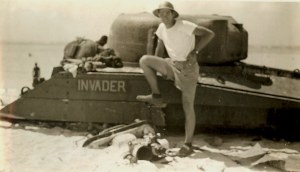
An airman poses next to a wrecked American Sherman tank on the shore of Saipan in 1944. This tank remains in place, nearly 75 years later.
When the guns fall silent and the now grizzled and weary combat veterans return home from war, time begins to erode the harsh realities the combatants lived and breathed on the field of battle. As the memories become distorted and faded, faces of those lost in combat are difficult to recall. Though, for many the scars never heal. The battle remains as vivid and crisp throughout the decades. But for the citizens who remained on the home-front, all is easily forgotten.
On the now-silent battlefields of the world wars, reminders can still be found even as the surrounding environment engulfs and enshrouds them. On land and in the surrounding waters of some South Pacific islands, visitors can still locate relics of war. Artillery shells and plane crash sites dot the landscape in places like Guadalcanal and Peleliu. Carcasses and hulks of tanks and AMTRACs (amphibious armored tracked vehicles or LVTs) remain partially or entirely submerged in the reefs of Saipan and Tarawa. But these are far from permanent or honoring remembrances.
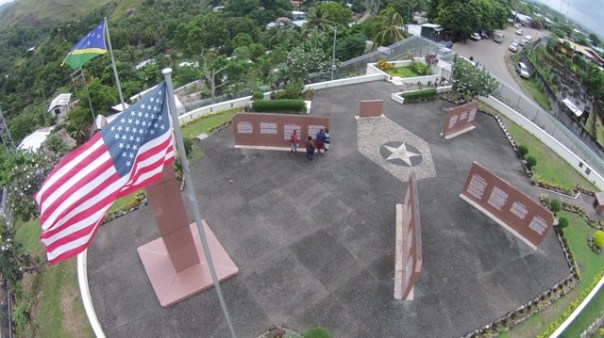
The Guadalcanal American Memorial was dedicated in 1992 as a tribute to American and Allied troops who lost their lives in the Guadalcanal Campaign. (Image courtesy of Solomons Scouts and Coastwatchers Trust)
Throughout the many years and decades following the American Civil War, veterans were drawn, compelled by lingering painful memories, returning to the battlefields to retrace their bloody footprints and to reunite with others from their units who were following their own compulsions. By the early 1900s, full-blown reunions were happening in places like Gettysburg as once youthful, sworn enemies came together as aged friends. These old veterans, motivated by their efforts decades earlier, began raising funds with the idea to erect monuments and memorials to commemorate their units’ deeds and to remember those lost during the conflict. Today, there are countless monuments located at the various battlefield sites as well as spread throughout the nation, particularly within the participating states.
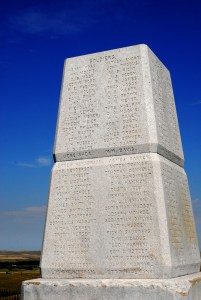
The final resting place for the majority of the men who were killed at the Little Big Horn battlefield site is marked with this granite obelisk which contains the names of the men who are interred beneath it.
As the United States has sent men (and women) off to war throughout the last century, the tradition of erecting memorials and monuments has continued both on foreign soil (with local consent and cooperation) and domestically. With the assistance of the military, the American Battle Monuments Commission, state and local governments, and various veteran service organizations, monuments have been erected in all fifty states as well as within several U.S. territories.
I make a point of locating local monuments to remind myself that the statistics that are easily found on the internet are more than that to the people of their hometowns. Names etched in stone or cast in bronze are reminders of the very personal cost of war. Sons (and now daughters) who will never return home to their families and loved ones – their names are displayed that we will never forget.
Some local monuments have national significance as they are symbols of the rally-cries – “Remember the Alamo!” “Remember the Arizona!” – that took us to war. In San Antonio, the Alamo mission is faithfully preserved. At Pearl Harbor, the Arizona Memorial sits astride the sunken ship, recalling the Day of Infamy. In my hometown, a small, nearly forgotten memorial stands as a reminder of war that most of my generation have no knowledge of.
-

- Placed more than a century ago, this monument is largely ignored by local citizenry though the artifact on display was taken from the wreck of one of the most recognizable ships in US history.
-
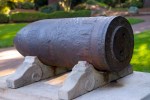
- This 10-inch naval gun projectile was recovered from the wreck of the USS Maine and placed here to serve as a reminder of those who were lost during the Spanish American War.
-
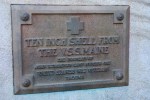
- The plaque attached to the pedestal supporting the round reads, “Ten inch shell from the USS Maine.”
“Remember the Maine!”
In a local park, there stands a small pedestal holding a ten-inch naval gun shell that was removed from the sunken armored cruiser, USS Maine (ACR-1). The sinking of the ship was an impetus that vaulted the United States into a war with Spain, two months later (though the cataclysmic explosion that that destroyed the Maine remains a mystery that some experts believe could have been merely a crew-caused mishap or accident).
-

- The list of local service personnel who were lost during WWII. This monument is placed at War Memorial Park.
-

- A close up of the list of local war dead of WWII.
-
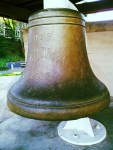
- This bell was recoverd from the wreck of the USS Tacoma CL-20) which was lost on Blanquilla Reef near Vera Cruz in January of 1924, killing her commanding officer and three radiomen.
At my city’s War Memorial Park (interestingly, the Maine monument is not located here), a large bell hangs with the name of a navy ship and the date of which the ship was commissioned, cast into its face. Very few details are known about this ship, only that it was a protected cruiser and that it was lost when it became entrapped on a reef near Vera Cruz, Mexico, breaking apart in a heavy storm. The ship, named for this city, was commissioned in 1903 and served in World War I, ran aground lodging herself on a reef as it approached the port in 1924. Some suspect that the navigation aids marking the channel had been moved by Mexican revolutionaries. The commanding officer of the ship, Captain Herbert G. Sparrow, gave his life, refusing to leave the ship, hopeful that the USS Tacoma could be saved. Along with the captain, four radiomen lost their lives while the rest of the crew had been evacuated under the orders of the captain.
Some collectors I know, spend lifetimes attempting to bring home the uniforms, medals and other militaria items as they assemble displays to honor their hometown heroes, utilizing the names etched on their local monuments.
This memorial Day, along with paying respects to those lives who were lost in service to our nation, I encourage you to locate the monuments and memorials in your local areas and pay a visit to at least one:
- Civil War Monuments
- Spanish American War Memorials
- WWI Monuments in Each State
- World War II memorials in the United States
As you will note, the above list has nothing from the Korean or Vietnam wars as there are only a handful that exist throughout our country. As the planning for the Iraq and Afghanistan War memorial is planning and development (it was approved by Congress a few years ago), it seems that our nation is truly forgetting about those from the most recent conflicts and becoming increasingly indifferent towards service men and women and our veterans. Apathy and complacency becomes animosity and sadly our nation is already in the early stages of that transition.
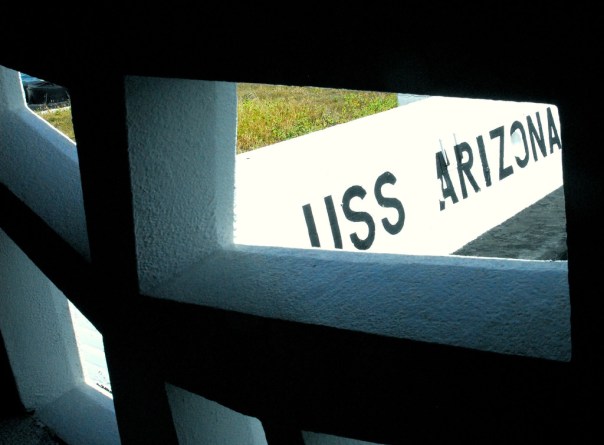
Viewing the original mooring quay that the USS Arizona was tied to (when she was attacked) from within the memorial.
Collecting, preserving, researching and documenting military artifacts is another vehicle by which a small segment of the population honors those who served. This passion can serve to maintain the face of the veteran in conjunction with the sacrifice and service. Monuments and memorials provide communities with a focal point with which to assemble and remember the many generations of our fellow citizens who never returned home to their families. Memorial Day serving as a vehicle with which to re-center our citizens’ understanding of service and self-sacrifice and the very real cost of freedom.
I emphatically encourage Americans (natural born, naturalized and would-be citizens) to embrace this nation’s history. One of the best ways with which to learn about the sacrifices that were made throughout our nation’s founding and preservation is to visit the monuments and memorials dedicated to those who gave their last full measure of devotion that we all would live and cherish our freedom.
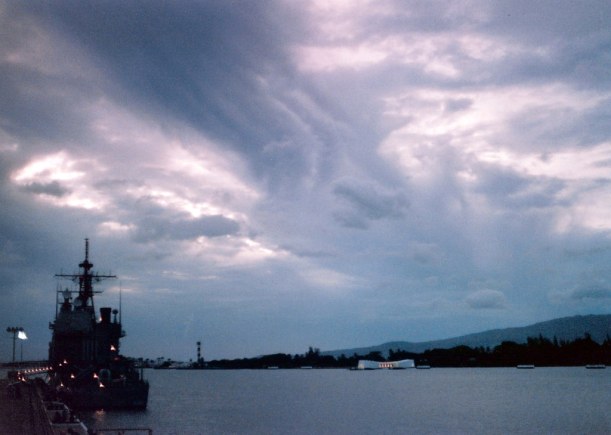
The USS Arizona Memorial is lighted at dusk with the USS Vincennes (CG-49) moored across the South Channel at Hotel Pier.
The original source of the cliche’ that is often repeated on Memorial and Veteran’s Day, “Freedom is not free,” seems to be author-less. However, it is my belief that the origins of that thought stem from yet another oft-recycled excerpt from a letter penned by Thomas Jefferson (on November 13, 1787 to William S. Smith):
“..what country can preserve it’s liberties if their rulers are not warned from time to time that their people preserve the spirit of resistance? Let them take arms. The remedy is to set them right as to facts, pardon & pacify them. What signify a few lives lost in a century or two? The tree of liberty must be refreshed from time to time with the blood of patriots & tyrants. It is it’s natural manure.”
Granted, Jefferson was referring to rebellion and revolution, however the sentiment applies to the restoration of freedom in foreign lands and the preservation of it for our own. The blood of patriots has been spilled since our nation was founded recommencing with the War of 1812 on through to present day. Standing on the hallowed battlefield grounds within our shores, once can gain a sense for the horrors of war an the sacrifices made by our great grandfathers, grandfathers, fathers, mothers, brothers, sisters, sons and daughters. This heritage belongs to all Americans, despite their nation of origin. Along with their freedom, they also inherit the history and legacy that is represented by the memorials and monuments found within our nation’s cemeteries, battlefields and public spaces, located domestically and abroad: American Battlefields and Monuments Commission: Cemeteries and Memorials.
Other related Veteran’s Collection articles:
- Remembering (and Collecting) the USS Maine!
- A Piece of the Day of Infamy or Simply a Connection to an Historic Ship?
- Answering the Call of Remembrance Through Collecting
Memorials and monuments references and resources:
- The Ideals Guide to Places of the American Revolution by Julie Shively
- Civil War Battlefields Then and Now by James Campi Jr.
- Confederate Monuments: Why Every American Should Honor Confederate Soldiers and Their Memorials by Lochlainn Seabrook
- Photographing Custer’s Battlefield: The Images of Kenneth F. Roahen
- Interment of the Custer Dead
- The USS Arizona Men: 75th Anniversary by T J Cooper
- Rust in peace: South Pacific battlegrounds revisited by Bruce Adams
- Monument Wars: Washington, D.C., the National Mall, and the Transformation of the Memorial Landscape by Kirk Savage
- Historic Photos of Washington D.C. Monuments by Tracey Gold Bennett
“We here highly resolve that these dead shall not have died in vain—that this nation, under God, shall have a new birth of freedom, and that government of the people, by the people, for the people, shall not perish from the earth.” Abraham Lincoln, November 19, 1863
Enlisted Aviators: Naval Aviation Pilots and Insignia
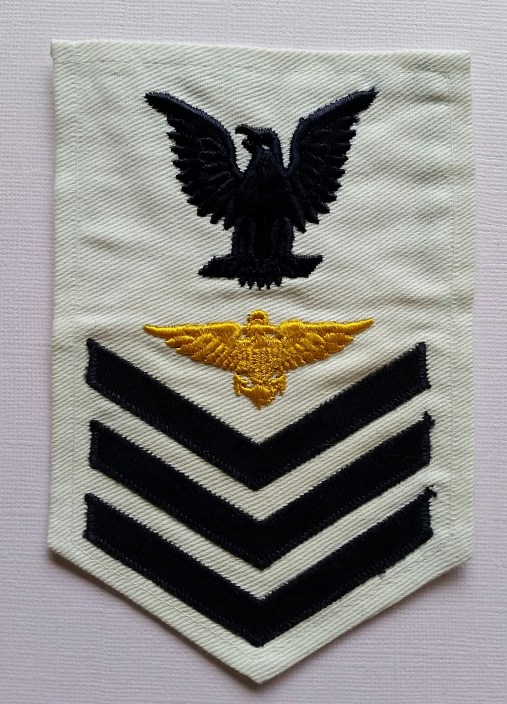
One of collectors’ most sought-after rating badges from the World War II-era (and prior), the Naval Aviation Pilot (NAP).
In the past six months, news stories centered on the increasing pilot-shortage issues faced by the United States Air Force have been frequently published in the media ranging from the Military and Air Force Times to mainstream outlets such as the Washington Post, New York Times and Fox News. With the severe cuts made to the armed forces in the last decade combined with retirements and a vibrant aviation industry, luring aviators from their Air Force careers to more financially lucrative civilian jobs, the stick and rudder vacancies are mounting leaving leadership to think creatively in order to fill the empty seats.
- Air Force May Approve Enlisted Pilots for First Time in 75 Years – By Oriana Pawlyk, Military.com, March 31, 2018
- Air Force program may lead to enlisted combat pilots – By Douglas Ernst – The Washington Times – December 6, 2017
- Enlisted pilots? – Editorial by Dick Trail, McCook Gazette, April 3, 2018
Not since World War II has the Air Force turned to the enlisted ranks to source candidates to pilot aircraft. In 2016, USAF leadership commenced a program to begin training (E-5 and up) enlisted drone pilots in an effort to free up experienced officers for candidacy as manned aircraft aviators. Leadership announced an expansion of the enlisted drone pilot program in January.
Utilizing enlisted personnel is certainly not a new idea for sourcing military aviator candidates. Both the Army and the Navy trained non-commissioned and petty officers as aviators prior to the United States’ entry into World War I. In fact, the Aviation Section, U.S. Signal Corps (the predecessor to the Flying Service which would become the Army Air Corps) was already engaged in training non-officer personnel as early as 1912, graduating the qualified men as Flying Sergeants. Similarly, the Navy graduated seven petty officers and two Marine Corps sergeants in 1916, launching the program that would evolve into the Naval Aviation Pilot rating.
-
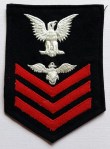
- The curved-wing NAP with a left-facing eagle. One of two such anomalies in my collection.
-
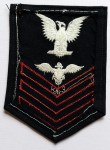
- Showing the reverse of the left-facing rating badge, this one is dated 1943.
-
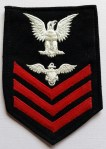
- The second of my two rating badges with a curved-wing NAP and a left-facing eagle.
-
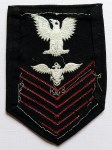
- Showing the reverse of the second (in my collection) left-facing rating badge, dated 1943.
Throughout WWI, enlisted pilot training continued for the Navy with flyers in ratings (Quartermaster and Machinist’s Mate) designated as aviators. A significant number of the enlisted aviators were offered and accepted commissions as naval officers while a few continued serving and flying as petty officers. In the years after the 1918 Armistice, the Bureau of Navigation (the command responsible for managing and training personnel) issued a policy that would incorporate enlisted and warrant officers as a standard practice for flight training. In a March 12, 1924 Bureau of Navigation Circular, the Navy officially established the rating of Naval Aviation Pilot (NAP) for for Chief Petty Officers. As the program continued, the Navy expanded the NAP rating for first class petty officers in September of 1927.
-
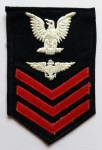
- This straight-wing NAP rating badge features the standard, right-facing eagle and is dated (on the reverse), 1944.
-
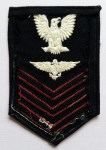
- The left side of the bottom chevron is embroidered with the 1944 date.
-
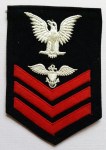
- A standard, right-facing NAP rating badge. This particular rating badge has an anchor embroidered on the reverse side.
-
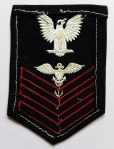
- The anchor-embroidery is not very common on rating badges. The maker that applied this mark is unknown to collectors.
With World War II in full swing and the shift from ship-to-ship fighting became secondary to over-the-horizon, aviation-based offensive tactics expanded the need for pilots exponentially. The Bureau of Navigation further expanded the ratings for NAP to include second and third class petty officers. During World War II, at least 2,200 NAPs earned their wings (according to Bluejackets.com). By 1948 when Congress discontinued the training program for enlisted naval aviation pilots, nearly 3,800 enlisted sailors had completed the training program since it was established. Though there would be no new NAPs following April 2, 1948, those existing in the rating who continued to serve on active duty, also maintained their rating and flight status in dwindling numbers. On January. 31, 1981, the last Navy enlisted pilot, ACCM Robert Jones (who had been designated in 1947) retired, closing the book on the NAP rating and insignia.
-
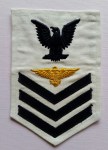
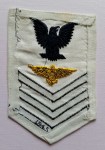
- The gold wings are straight, representing those of the officer’s wing device (worn above the left breast pocket). This 1945 NAP (gold on white) rating badge was made by New York Emblem Company (NYEC).
-
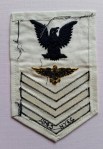
- Showing the revers with the NYEC and 1945 stitching.
-
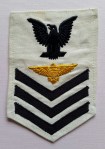
- Another example of the late-WWII straight winged gold NAP distinguishing mark.
-
- The reverse of of the 1945-dated dress white NAP rating badge. The manufacturer of these date-only badges are unknown.
One of the most sought-after rating badges from the World War II-era is seemingly the Naval Aviation Pilot due to the decidedly high listing prices (some reaching upwards of $400). Whether people are actually paying these amounts is more difficult to determine.
The NAP rating badge consists of the Naval Aviator wings centered beneath the eagle and above the petty officer chevrons (and beneath the CPO arc). When the mark was established in 1924, the thread-color specification for the winged insignia was gold (or yellow) to match the Naval Aviator gold wing device. In the Bureau of Personnel circular of 12 July 1944, the color of the mark was changed to align it with the all other rating badges (i.e. white thread on dress blues and blue thread on whites).
-
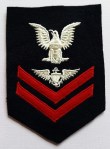
- The pattern of this wing differs from both the straight and the curved wings. This unusual design feature high, rounded shoulders. Also somewhat unusual is that the badge was made as a second class petty officer rather than being a 1/c petty officer to be cut and hemmed by the 2/c petty officer.
-
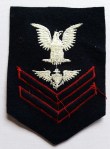
- The reverse of the high, curved-shoulder AP/2c has no maker’s marks or dates.
Aside from the color change of the mark, there are two design differences with the wings. Prior to World War II, the wings had a curved (some collectors call them “drooped”) appearance. Speculation among the collecting community suggest that the straight wing (that matches the appearance of the officer’s metal device) began making its way onto badges after 1942. In John Stacy’s invaluable resource, U.S. Navy Rating Badges, Specialty Marks & Distinguishing Marks 1885 -1982, the author references suggestions that the curved wing rating badge was used by naval personnel and the curved wing was adopted by Coast Guard NAPs, however provides a caveat that no supporting evidence exists.
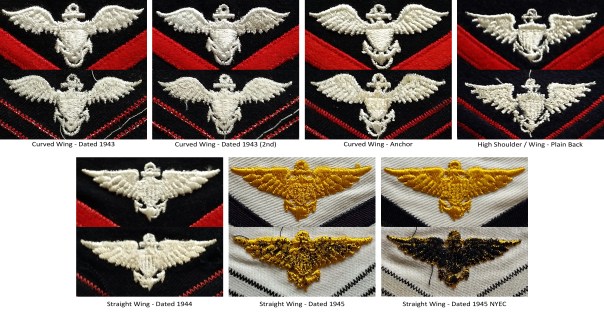
I have seven NAP rating badges and photographed each to show both consistency and variation across the same era. All of these are from the 1940s – perhaps all are from WWII.
John Stacey’s referenced comments made by the last NAP, ACCM Robert Jones regarding the different colored wing marks in the rating badges. The “white ones,” Jones commented, ” were (found in) small stores, gold were PX” referring the sources of the different badges. Further comments made by Jones (in Stacey’s book) state that Jones was authorized to wear either the gold or white (colored) rating badge on his dress (blue) uniform when he attained his designation as an AP1/c.
-
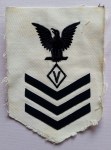
- The 1948-1960 Specialist V rating badge was used for the Aviation Pilots who continued to serve following the disestablishment of the NAP rating. The badge itself is unfinished as the chevrons are only held in place with the manufacturer’s adhesive.
-
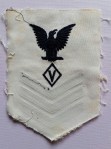
- The unfinished specialist V rating badge shows that the adhered chevrons had yet to be sewn into place.
Besides the winged insignia of the NAP, a specialist rating mark was also used for the Aviation Pilot rating. Originally established in 1942 for the Transport Airman rating, the “V” centered in a diamond insignia was re-purposed for the Aviation Pilot ratings for chief, first and second class petty officers from 1948 until it was disestablished in 1962 (BuPers Notice 1440, dated 29 December 1961; effective 1 March 1962).
Resources:
- Enlisted Naval Aviation Pilots (NAP) USN, USMC & USCG 1916-1981
- Enlisted Pilots Boosted Fledgling Flight Training Program
- The Flying Chiefs
- Navy pilot program opens to enlisted ranks
- U.S. Coast Guard Enlisted Naval Aviation Pilots (NAPs)
- U.S. Navy Rating Badges, Specialty Marks & Distinguishing Marks 1885 -1982
Discovering Rosalie: A French Model 1886 Lebel Bayonet Emerges from the Attic

The cruciform blade of the Lebel. The point on this bayonet is quite sharp and could easily penetrate the heavy wool fabrics of the era.
After a lengthy run of posts covering United States militaria, it seemed appropriate to take a side-jaunt with an attempt to shed a little light upon military artifacts from another nation’s armed forces. Considering my limited experience with foreign military in general and thus even less knowledge in their militaria, I am decidedly headed into uncharted territory with this article.
This site’s three subscribers (ok, there are considerably more, but I seldom field any questions or hear any sort of feedback from them so it can be difficult to discern the actual number) understand that my collection does have a few pieces of foreign militaria and that rather than me seeking and adding them to my archive, they were handed down to me from an uncle who liberated them as war souvenirs during his service in Word War II (he continued on active duty until 1954 having also served in the Korean War. His military career commended when he enlisted to serve during the Great War).
Stowed away inside of trunks since they were sealed in theater and shipped back to the United States following the German surrender, the artifacts hadn’t seen the light of day since May of 1945. In 1994 when the trunks were discovered and opened, I took on the task to identify and obtain valuations for what was inside, once my jaw was able to close after being awestruck by what we found. Following disposition of some of the more rare pieces, I kept what was unsold and remained in my possession. The majority of those artifacts were Third Reich military with a smattering of my uncle’s personal effects and one odd item (that is the focus of this article), a French Model 1886 Lebel Bayonet.
When French chemist Paul Vieille introduced Poudre B, the first smokeless gunpowder in 1884, he propelled (pun very much intended) small arms technology light-years ahead, helping to usher in a new era of rifle and bullet design. While Vielle’s Poudre B produced more explosive force (more than three times that of conventional black powder) at a significantly reduced rate, the Swiss Army’s Eduard Rubin was developing a new jacketed round that would prevent the bullet from melting (as it traversed the rifle barrel) at the higher velocities created by the new gunpowder. The result of these advances prompted French military leadership to fast-track a new infantry rifle that would leverage these advances. The result was the Lebel Model 1886 or Fusil Mle 1886 M93 rifle.
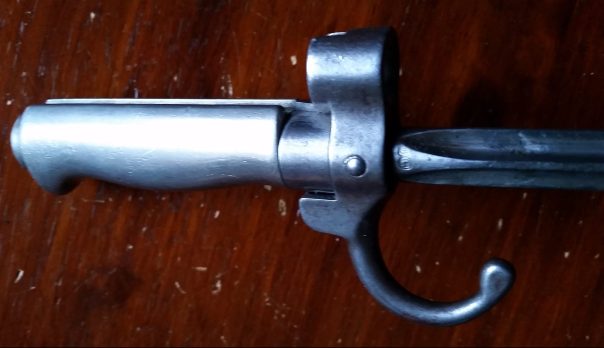
The Lebel bayonet’s handle is in fantastic condition having been stored away for more than 50 years. At the blade’s hilt are the letters “F” and “C” stamped into the metal.
While the Lebel rifle revolutionized infantry weapons, the accompanying bayonet was more inline with earlier , more antiquated designs. The Épée-Baïonnette Modèle 1886 bayonet employed a unique cross-shaped blade (when viewed from the point) which lacked sharpened edges, employing a lengthy point that was designed to penetrate the thick and heavy wool and leather uniforms of the day. The “Rosalie” as it was dubbed by the French, was in use from the 1880s to well into World War I. So popular was the weapon that it became the subject of adoration and lore, that French Poet Théodore Botrel‘s song, Rosalie was dedicated to the glory of “small French bayonets” and came to prominence in 1914 as World War I was ignited.
“Rosalie is elegant
Her sheath-dress tight-fitting,
Pour a drink!
Adorns her up to the neck
Let us drink then”
The Lebel bayonets were made with 20 ½ inch (52.7 cm) long blades, however they can be found in various lengths due to being re-pointed after tip-breakage during battlefield use. During the mid-1930s, many Lebel bayonets were modernized, reducing the length to be more comparable to newer designs and to reduce weight.
-
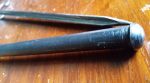
- Showing the ends of the scabbard and the Lebel.
-
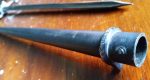
- Even the scabbard is in fantastic condition for this Lebel.
In their original design, the handle of the Lebel bayonets were constructed with a nickel-silver handle and a hooked quillion. However, mid-way through WWI (in 1916), conservation of precious metals for other war-uses led these parts being manufactured from brass. The hooked quillion was subsequently eliminated (during wartime production) as a result of battlefield feedback concerning it being cumbersome and easily ensnared on uniforms and accouterments when used on the enemy.
-
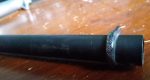
- The serial number of the scabbard is around the frog loop near the opening where the bayonet slides in.
-
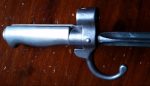
- The Lebel bayonet’s handle is in fantastic condition having been stored away for more than 50 years. At the blade’s hilt are the letters “F” and “C” stamped into the metal.
-

- Showing the handle and the butt-end of the Lebel. Notice the slot in the handle where it slides onto the attach point of the rifle.
The length of the blade was well-suited for use at the end of a rifle, but as ready fighting knife in the trenches of WWI, it was awkwardly lengthy prompting many soldiers to cut down the blade length to a more stiletto-type thrusting knife.
-
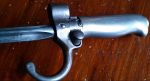
- The Lebels lock-release and the hooked quillion. Barely visible are the letters “T A” stamped into the quillion just below the intersection with the release housing.
-
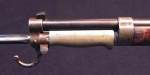
- The Lebel rifle and bayonet mount (image source: Guns Magazine).
As far as the collectibility of this bayonet is concerned, there are several schools of thought ranging from those who avoid the item due to its seemingly abundance and lower values to collectors who see it as a fine representation of weapons-history, worthy of display. A quick glance at online auction listings, prices (at this article’s publishing date), the prices range from $50-300 (with no bids on any of the 20+ items that are available). Obviously, condition, construction and completeness of the bayonet (inclusive of the scabbard and frog) will affect the value.
Collectors could expend a fair amount of their finances seeking out each of the known examples of the Épée-Baïonnette, however I will stand firm with retaining the sole example of Rosalie in my collection. For me, it has more meaning as it was something that my uncle brought back from his service overseas, though I have no insight into whether he acquired it during WWI or WWII.
 The Veteran's Collection