A British Collector of the Alamo – Foreign Collectors of American Militaria
A question was recently posed by militaria collector from the UK asking how Americans feel “about important artifacts which are part of US cultural history being in the private collection of a British musician.” The question was in direct response to a March 2012 publication of a 416 page volume, The Alamo and Beyond: A Collector’s Journey, that details musician Phil Collins’ extensive collection of historic artifacts directly related to the 1836 battle at the Mission San Antonio de Valero in San Antonio, Texas, simply known as the Alamo.
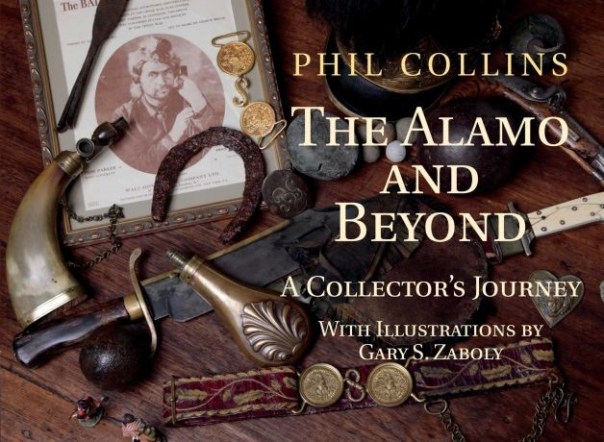
Published in March of 2012, Phil Collins’ book documents his extensive collection of militaria related to the 1836 battle at the Alamo.
Like many American kids of the post-World War II generation, I’ve always related the Alamo to Hollywood-produced entertainment such as Disney’s Davy Crockett (1954-55) and The Alamo(1960), glamorizing the historical characters such as David “Davy” Crockett (played by Fess Parker or John Wayne) and James “Jim” Bowie (Kenneth Tobey or Richard Widmark) and their legendary fight with Antonio López de Santa Anna and the Mexican Army. Glorified in these portrayals are the manner in which each of the two main characters fought and ultimately died alongside their comrades. American youth would be inspired to don faux coonskin caps and buckskin outfits as they act out the scenes.
Singer, songwriter and drummer Phil Collins (of rock band Genesis) was one of those kids growing up watching the onscreen portrayals of Davy Crockett. Fascinated by the Alamo and the siege and battle that took place there in February and March of 1836, Collins was drawn to collecting militaria when he discovered a Crockett autograph for sale while on tour with Genesis, “I didn’t know this stuff was out there, that you could own it,” he noted. Phil had been bitten by the militaria collecting bug and the resulting, spectacular Alamo-specific collection that he spent decades assembling is unequaled.
In March of 2012, Collins diverted from his musical creativity and ventured into writing about his militaria passion. He published his first book, The Alamo and Beyond: A Collector’s Journey which is packed with hundreds of pages of beautiful photography and illustrations documenting the depth and breadth of his collection. Though his book is listed for $120, it can be found for less than $40.
Regarding the question that was posed at the beginning of this post, my response is that there exist monuments, buildings, graves and other large, tangible items and places to view and visit that are related to this historic, tragic event in our history. The individual artifacts such as in the collection of Mr. Collins have been in private collections and out of view of the general public all along. There are probably thousands of individual pieces remaining in private collections that are or can be connected to this event and are still unviewable by the general public.
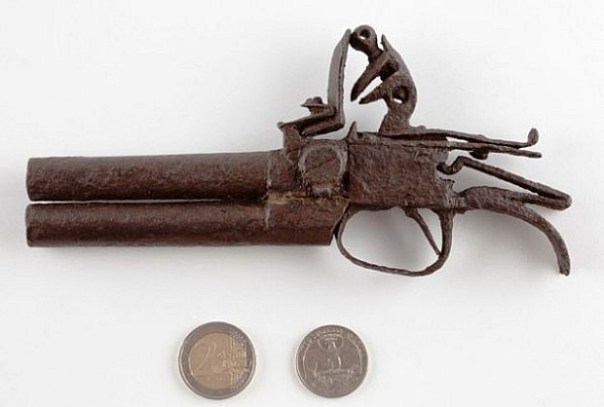
From Collins’ collection, this 1830 over and under flintlock pistol was excavated by at the Alamo site by a construction worker (source: Phil Collins collection).
I see what Phil Collins has done in publishing his book as an act of sharing treasures that have never previously been made available to the public. While the book has (for me, at least) a considerable price tag, I still see this work as a gift to fans of history. Through his efforts, we get to have something tangible that provides us with a look at a slew of items that probably wouldn’t have been assembled together without Phil’s decades of effort.
I applaud his interest in American history, militaria collecting, the Alamo collection and his work on this book.
Introductory Flight – Collecting Aviator Wings
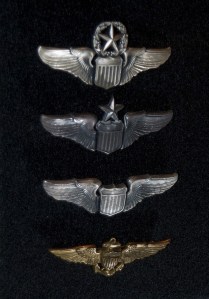
From the top: Command Pilot, Senior Pilot and Pilot of the US Army Air Force. The naval aviator “wings of gold” are really set apart from its USAAF counterparts.
Since the early twentieth century, all of the branches armed forces of the United States have been bolstered by service men and women who are highly skilled, reaching the pinnacle of their specialized area of expertise. From aviators, to paratroopers, to submarine crew members and combat infantrymen, all are easily recognizable by the devices and pins affixed to their uniforms.
Since the advent of military flight and the employment of aviators in war-fighting aircraft, leadership within the ranks realized that there was a need to provide a uniform accouterments to set these special and unique servicemen apart from the rest of those in uniform.
During World War I, the Air Service (U.S. Army) began issuing qualified pilots a winged pin device to attach to the left breast of their uniform blouse. The device was constructed in silver-colored metal (mostly silver or sterling silver or embroidered in silver bullion thread) with two ornately feathered bird wings attached to either side of a shield, which had 13 stars in a field over 13 stripes. Superimposed over the shield were the letters, “U.S.” This wing design would remain in use throughout the Great War.
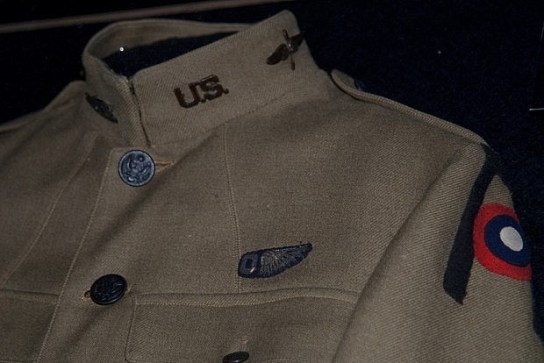
A nice example of a World War i balloon pilot’s single wing of the Army Air Service.
During the interwar period (1919-1941), the U.S. Army Air Corps wings were more standardized, dropping the U.S. lettering and simplifying the design. The shape of the shield became more standardized though it would vary depending upon the manufacturer. The Air Corps also began introducing varying degrees of the pins that signified the experience of the aviator. In addition to the existing pilot badge, the senior pilot (which added a five-point star above the shield) and command pilot (with a five-point star inside a wreath) badges were issued.
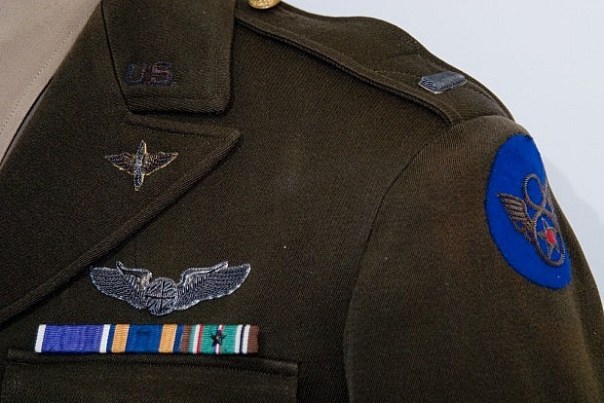
This stunning 8th Air Force 2nd Lieutenant’s uniform has a beautiful example of a silver bullion wing. In fact, all of the (typically metal) devices are made from silver bullion thread.
- World War II Army Pilot Wing Variants
- World War II Army Senior Pilot Wing Variants
- World War II Army Command Pilot Wing Variants
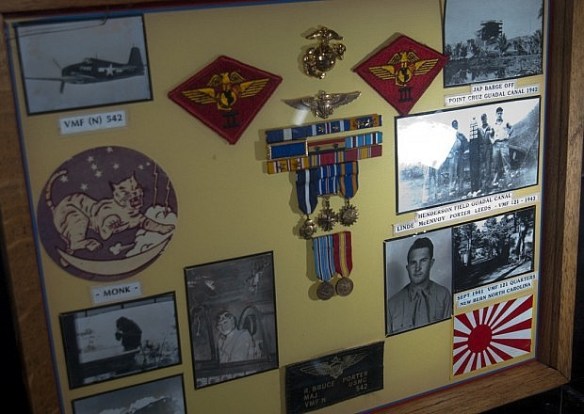
This display features WWII USMC ace, Major Bruce Porter’s decoration and medals with his naval aviator “wings of gold.”
The new naval aviation service also adopted a wing device for their aviators that incorporated a similar design (bird wings attached to a shield with stars and stripes) but with an anchor, arranged vertically, extending from behind the shield with the ring and stock above and the crown and flukes below. Most of these early wings were constructed in a gold metal (sometimes actual gold) or embroidered using gold bullion thread. The navy wings of gold remain virtually unchanged to present day, with variations occurring between various manufacturers.
With a little effort, new collectors can quickly educate themselves as to the nuances of the (World War II to present) coveted, yet relatively affordable, wings. Many of the naval (which include USMC flyers) and air corps/forces wings from WWII can be had for prices ranging from $50-$100 depending on the scarcity or abundance of the variant.
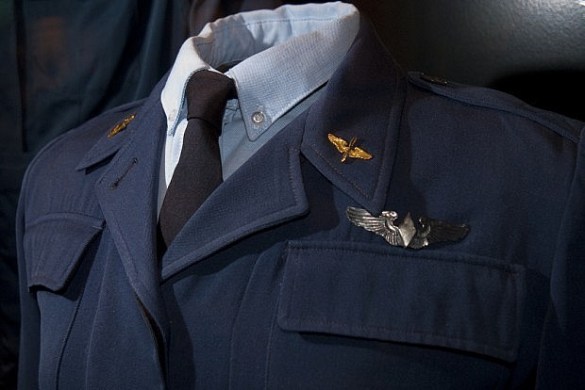
During World War II, women pilots were needed to ferry aircraft from the manufacturers to the troops, saving the experienced aviators for front-line combat. This beautiful WASP uniform features pilot wings.
Due to the incredible desirability and rarity of wings (i.e. extremely high dollar values) from the first World War, these pieces are some of the most copied and faked militaria items. Some of the examples are so well-made (in some cases, by skilled jewelers) that expert collectors have difficulty discerning them from the genuine artifacts. The best advice before acquiring a WWI piece is to consult an expert. Also, be sure that the seller is reputable and will offer a full refund if the item is determined to be a fake.
Provenance and Research Matters: WWII USAAF Aviator’s Cap
I doubt there are many collectors who have NOT experienced the current run that I’ve been on, though I certainly feel alone in this rut.
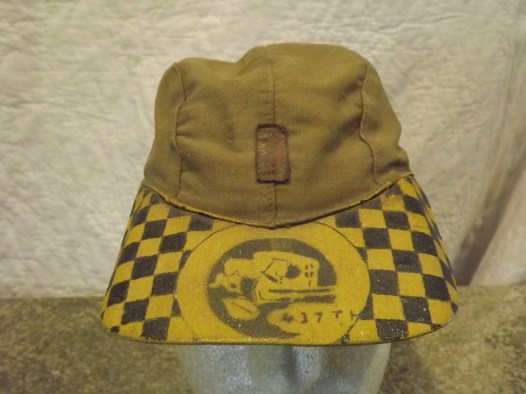
This khaki aviator’s ball cap is an oddity with this artwork on the bill. A sewn-on rank insignia adorns the front panel (source: eBay Image).
Over the past several months, I have been seeing some amazing online auction listings of seldom-seen militaria pieces. It seems that with each week that passes, an item gets listed that falls into one of my many robot-searches, alerting me to investigate and research the piece. After the necessary due diligence, I am reeled-in and decide what I can afford and get set to place my highest bid (yes, I use a sniping program). After a few days of waiting, I receive the dreaded notice that I had been outbid milliseconds after mine was placed.
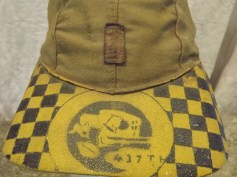
A close-up of the hand-painted bill shows the “437th” in the squadron insignia (source: eBay Image).
Aside from the disappointment of being outbid, the other all-too-familiar letdown that I have been experiencing is the discovery of pieces that would fit perfectly into my collection but the price never seems to align well with my budget. Illustrating this point was when a stunning World War II-vintage aviator’s ball cap, complete with hand-painted squadron artwork was listed at auction.
When I first laid eyes on the khaki ball cap, I was immediately captivated by the hand painted checkerboard pattern surrounding the squadron insignia. Though the design was monochromatic, the design appeared amazingly crisp overlaying the painted-yellow background. My interests lie predominantly with naval history so my expertise is lacking with regards to knowledge of Air Corps squadrons. The “437th inscribed within the insignia was very difficult to research with investigative results being sketchy at that time. Since then, I was able to research further that the hat could most likely have come from an airman who served with the 437th Fighter Squadron (of the 414th Fighter Group) that flew P-47 Thunderbolts in protection of B-29s in the Pacific Theater (in the 20th Air Force).
-
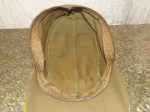
- The cap appears to be a correct-vintage with the leather sweatband (source: eBay Image).
-
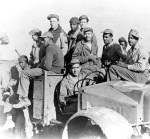
- In this undated WWII photo of the Tuskegee Airmen, notice the aviator ball cap worn by some of the men.
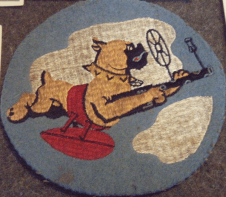
I have only found one single reference to the insignia that is painted onto the ballcap’s bill. It is taken from the unit’s squadron patch. This patch was part of a small group that included a photo and sold at auction for nearly $720.00 in 2014. (source: eBay image).
With no experience in these caps, I had no idea of the range of value for this cap. The one thing that put me off a bit was the initial bid price of $750. On one hand, it seemed to fit my perception of value, but without ironclad provenance (it had none) or any way to confirm the squadron identity, the price started to seem quite high. Too many questions coupled with the lack of sound seller-history, I couldn’t begin to ponder placing a bid even at half the asking price.
Since I first saw the cap, the seller has (unsuccessfully) listed the cap for auction a second time with a lower price. With being listed twice and not a single bid, one could infer that the cap isn’t worth the risk. But something in me keeps me guessing and wondering.
Perhaps I’ll just wait for the next amazing listing to pass on (or be passed on).
WWI Aero Trophies: Aviation Artifacts of Aero-Warriors
Archaeologists could agree that in some form or fashion, militaria collecting has been around seemingly since men have gone to war. Though the concept may not have been seen as collecting, at a base level, man has maintained combat-related artifacts to remind him of battles won or brothers-in-arms that were lost. Not only has man sought to remember his warring past, he has long maintained the spoils of war by removing specific items of his vanquished opponent’s body as it laid on the field of battle.
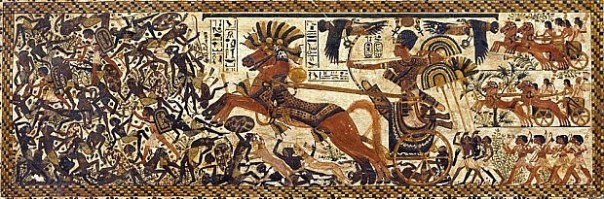
This illustration from Tut’s tomb shows the young pharaoh at war in his chariot (source: Araldo De Luca).
When some of the tombs of the ancient Egyptian pharaohs were opened and the contents were inspected and cataloged, among the gilded, religious and life-story items were weapons of war. Free from the worries and troubles of earth, anthropologists and Egyptologists surmised that the military pieces were objects that heralded the deceased king’s victories. Within the tomb of the most widely known pharaoh, King Tutankhamen (or “Tut”), among several depictions of him in combat, was his beautifully ornate chariot that would, more than likely, have been used in battle as documented throughout his burial treasure.
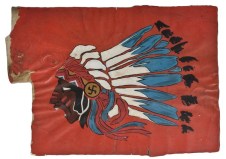
This section of fabric from an aircraft belonging to the famed Lafayette Escadrille (a squadron of American volunteers that flew for France during WWI) recently sold at auction (source: Cowan Auctions).
With the advancement of technology came the modern version of the chariot during World War I, the airplane. The warrior who battled from the seat of these modern machines, though differently equipped, had much in common with the brave Egyptian warriors of ancient times as they bravely piloted their flying machines into the center of the fray. In the quiet of the battle’s aftermath, these warriors would, if possible, descend from their winged chariots to survey their opponent’s wreckage, tearing or cutting strategic pieces of the fabric that contained specific identifying marks that helped to tell their story to both their squadron mates and to their leaders, providing quantifiable evidence of their success.
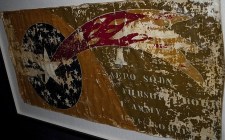
This section of cloth survives from an aircraft of the 1st Army Aero Pursuit Squadron and is preserved at the Museum of Flight in Seattle, Washington.
In many cases, these aerial opponents would extend honors that were reserved for their own fallen heroes, to their vanquished enemies. When Manfred von Richthofen, Rittmeister (Cavalry Captain) of the Luftstreitkräfte (Imperial German Army Air Service) was killed when his Fokker Dr1 was downed, members of the Royal Air Force took custody of his remains. To a casual observer viewing his funeral service, it would have appeared that a renowned British war hero was being laid to rest by the varying honors being rendered to this fallen adversary. However, the preservation of his aircraft was overlooked as souvenir hunters quickly rendered the nearly undamaged plane a shamble as they haphazardly dismantled it.
-
- A section of fabric from a German WWI aircraft with the letters ‘Fok’ could originate from a Fokker war plane. The colorful pattern was typical of the camouflage painting of the war (source: eBay image).
-
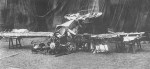
- Showing what was left of Richthofen’s heavily scavenged wrecked Dr 1.
-
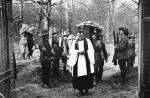
- The elaborate funeral procession for Manfred von Richthofen.
Bestowing honor upon fallen adversaries was practice by the Allies’ opponents, the Germans. Quentin Roosevelt, son of the former president and colonel (from the Spanish-American War’s Rough Riders), was an aviator in the 95th Aero Squadron, flying pursuit aircraft such as the French-made Nieuport 28. After he was shot down during an engagement, his flight of twelve was jumped by seven German fighter planes. Roosevelt received two fatal bullet wounds to his head and his aircraft rolled over and spiraled to the ground. His subsequent funeral service was witnessed by a fellow American soldier, Captain James E. Gee (110th Infantry) who had earlier been taken prisoner:
“In a hollow square about the open grave were assembled approximately one thousand German soldiers, standing stiffly in regular lines. They were dressed in field gray uniforms, wore steel helmets, and carried rifles. Near the grave was a smashed plane, and beside it was a small group of officers, one of whom was speaking to the men. I did not pass close enough to hear what he was saying; we were prisoners and did have the privilege of lingering, even for such an occasion as this. At the time, I did not know who was being buried, but the guards informed me later. The funeral certainly was elaborate. I was told afterward by Germans that they paid Lieutenant Roosevelt such honor not only because he was a gallant aviator, who died fighting bravely against odds, but because he was the son of Colonel Roosevelt whom they esteemed as one of the greatest Americans.”
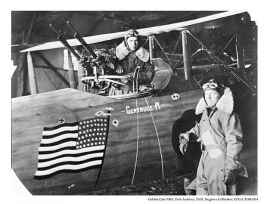
Similar to the flag shown on Pawn Stars, this WWI aircraft has a flag painted on the fuselage side.
Collecting aviation artifacts from WWI is becoming increasingly difficult as nearly a century has elapsed since the armistice was signed. The soft materials that made up the uniforms and accouterments are under continuous attack from the ravages of time and every manner of decay brought on by insects and ultraviolet exposure. Museums in the last few decades have done amazing work at acquiring the best examples of surviving armament and other hardware to provide their audiences with incredible displays and depictions of the Great War. When the rarest pieces arrive in the marketplace, the heavy competition ensues driving the prices skyward.
In an older episode of the History Channel’s Pawn Stars (the “Stick to Your Guns” episode), a woman enters the shop with a rolled-up section of old fabric emblazoned with a hand-painted representation of an American flag. She tells the story of her American serviceman relative darting over to a recently wrecked plane to cut out the flag, saving it from the ensuing fire resulting from the crash.
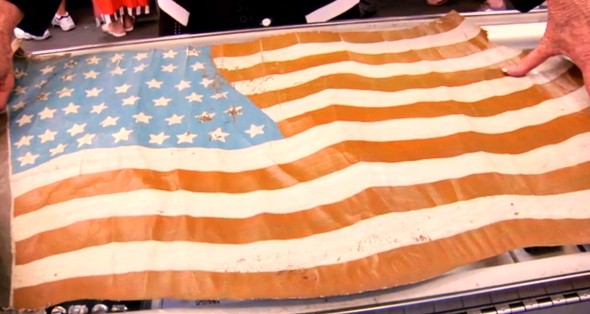
This flag looks to have been cut from a WWI American aircraft. The jury is still out as to whose aircraft it was removed from (source: Pawn Stars screen grab).
In providing the requested provenance, she presents a pair of World War I dog tags. One of the tags shows the information for her ancestor while the other contains the personal identification of Lieutenant Quentin Roosevelt. The Pawn Stars segment could easily lead viewers to draw the conclusion that the flag was removed from Roosevelt’s wreckage but that would be a considerable leap based upon the story of the retrieval and the burning aircraft. It would have been difficult for American to do so, considering that Roosevelt crashed behind enemy lines.
-
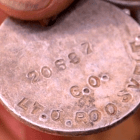
- Could this dogtag have come from Lt. Quentin Roosevelt? It was attached to another WWI tag belonging to the ancestor of the woman who brought in a hand-painted section of WWI airplane fabric to the Pawn Stars’ pawn shop (source: Pawn Stars screen grab).
-
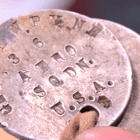
- The reverse side of George Pyne’s dog tag shows that he was a member of the 36th Aero Squadron (source: Pawn Stars screen grab).
-
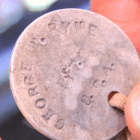
- WWI dog tag belonging to Private George W. Pyne – who is purported to have cut a section of aircraft fabric from a burning wreck – the fabric contains a hand-painted American flag (source: Pawn Stars screen grab).
Ultimately, the Pawn Stars folks purchased the flag (the price was well into four figures) despite the lack of connection to Roosevelt. In my opinion, they probably overpaid for the piece but considering that it was destined for Gold & Silver Pawn Shop owner Rick Harrison’s personal collection, it wasn’t too much of a reach.
Forecasting Patchy Skies: Sew-on Naval Aviation Heraldry
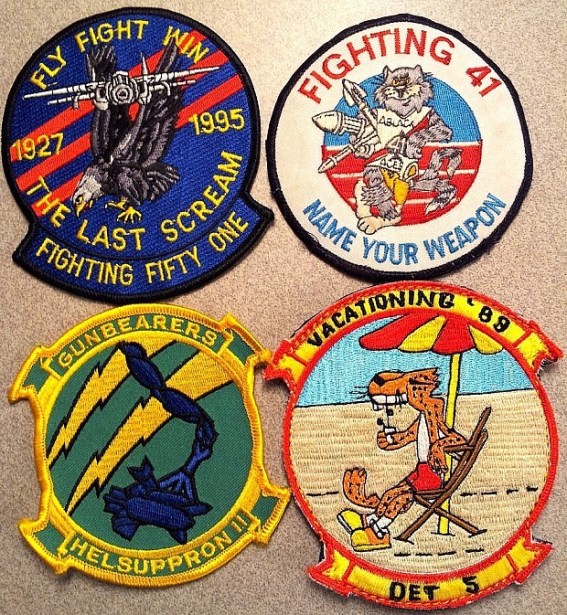
Counterclockwise from top left: VF-51 Screaming Eagles as the unit was being deactivated; VF-41 sporting the Tomcat character (for the F-14 Tomcat aircraft); HC-11, Detachment 5′s WestPac cruise patch; HC-11 squadron patch.
Since I began this blog, I’ve covered various aspects of military-patch collecting. From shoulder sleeve insignia (SSI) to rank and rating badges, this area of collecting has something for every level of collecting, from the beginner with a scant budget to the experienced one who collects each and every obscure variation of his or her favorites.
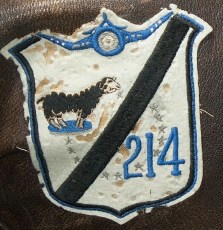
This authentic VMF-214 squadron patch dates from WWII and is most-likely Australian-made. This “Blacksheep” patch is affixed to the G-1 flight jacket that belonged to the Marine pilot, Fred Losch.
One of my personal favorites in collecting patches, even though the size of my collection disagrees, is naval aviation squadrons (including the U.S. Marine Corps) due to the colorful (pun intended) embellishments and symbolism representing each squadron. These patches represent a lengthy history in heraldry and the history of navy flight dating back almost to its very beginning.
The tradition and history of these patches and insignia is acknowledged by U.S. Navy leadership in the Chief of Naval Operations Instructions (OPNAVINST) 5030.4G, as it states:
“The practice fosters a sense of pride, unit cohesion and contributes to high morale, esprit de corps and professionalism within the Naval Aviation community. It also serves as an effective means of preserving a command’s tradition, continuity of purpose and recognition, as traced through its lineage.”
-
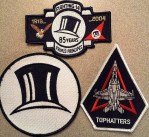
- One of the longest-standing Navy squadrons, the Tophatters of VF-14 is still in operation, but in a fighter/attack capacity with the F/A-18E. The patch on top commemorated the squadron’s 85th anniversary. The single top hat (without any word-marking is the long-running design.
-
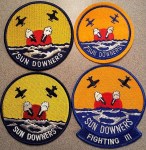
- VF-111 began life in WWII as VF-11. The nickname and design reflect the mission of the squadron during the war – charged with downing the aircraft from the Empire of the Sun (Japan). This design is still in use to this day.
-
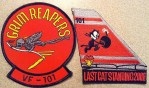
- VF-101 was originally formed in WWII aboard the USS Enterprise. The squadron patch (left) is virtually unchanged from the original with “Moe” in flight beneath the squadron’s nickname. The patch on the right was commemorating the final flight of the F-14 fighter aircraft within the squadron.
-
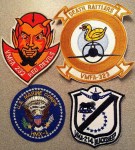
- This diverse collection of USMC aviation patches includes the President’s helicopter squadron (HMX-1) and the current version of the “Blacksheep” patch (VMA-214).
As early as the 1920s, United States naval aviators have employed visual graphics and heraldry complete with symbolism and characterizations of traits, behaviors and/or projections of the personality of their individual squadron commands. Often portraying ferocity or satire, these emblems would be displayed within the confines of the squadron office or the personnel’s common areas to encourage unity within the ranks.
Aviation units are quite diverse across four distinct areas: attack, fighter, patrol and helicopter squadrons. Within these areas are a myriad of functional (active) and decommissioned squadrons with a host of designs. Depending upon the length and breadth of an individual squadron’s service, there could exist dozens of designs and subsequent patch variations. As noted noted within these documents, squadron service history and lineage is incredibly detailed and expansive (histories for fighter and helicopter squadrons are in the works):
As a result of the diversity across the lineages, patch collectors can specialize in very specific areas (such as collecting all Vietnam-era fighter squadrons) or focus on a central design aspect (i.e. any squadron that incorporates an eagle into their design). For me, I look for those squadrons that I had direct contact with during my naval deployments, which include attack, fighter and helicopter squadrons, in the 1980s.
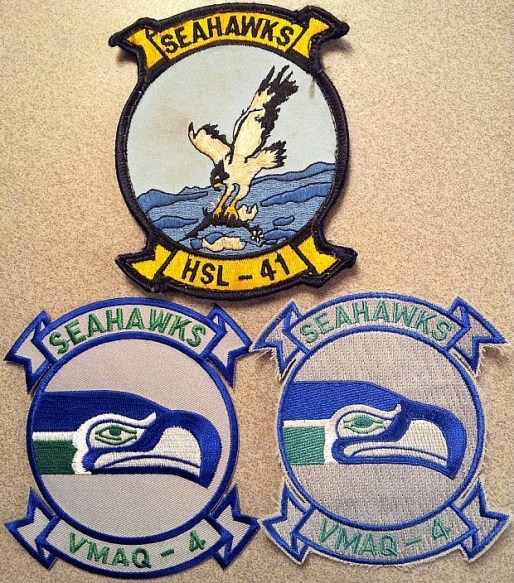
These patches represent two squadrons – one a USMC electronic warfare squadron and the other, an anti-submarine warfare helicopter squadron. Both bear the same nickname of “Seahawks.” The bottom two patches’ design was incorporated into the Marine Tactical Electronic Warfare Squadron (#4) when it was based at NAS Whibey Island in Washington State. The Seahawks (squadron) adopted the imagery from the Seahawks (the local NFL team). Since relocating to Marine Corps Air Station Cherry Point, VMAQ-4 departed from the NFL-based design,
*See related posts:
 The Veteran's Collection