Category Archives: US Navy
You Have the Right to…Collect Armed Forces LEO Militaria
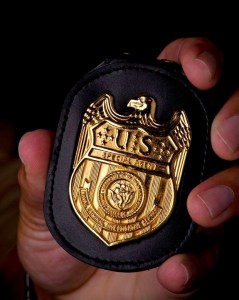
This current-issue NCIS badge is mounted to a leather holder (source: US Navy).
Militaria collecting has a broad spectrum possessing many facets that allow people to specialize or focus their efforts on specific themes or concepts. Aside from settling on a particular branch or time period, collectors might choose to get very narrow with their collections. Some of these focus areas might even cross over into other collecting genres. One category or focus area that has grabbed the attention of collectors beyond the bounds of militaria is law enforcement within the ranks of the armed forces.
When considering military law enforcement, one might immediately begin to think of the Naval Criminal Investigative Service (or NCIS) that has been popularized by the television drama franchise on CBS. The Army has their own similar organization, United States Army Criminal Investigation Command (CID). However, the law enforcement community within the armed forces is significantly more broad, which means that collectors have many options and avenues to pursue.
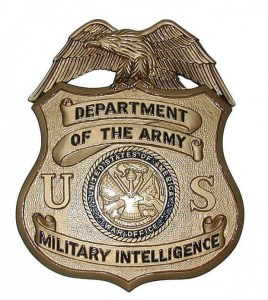
A nice example of a US Army MIS Badge (image source: U.S. Army)
Aside from the civilian-staffed agencies such as the NCIS and CID, there are plenty of uniformed active duty departments and billets that are filled by military personnel. In addition, there are duty-based positions that are performed as an extra responsibility outside the daily duties of the service members’ normal MOS, specialty or job assignment. Regardless of the specific role, there are opportunities for collectors to obtain law enforcement militaria.
In existence since the Revolutionary War, the U.S. Army’s Military Police Corps was not officially organized until September of 1941, when it was formally established. The U.S. Navy’s version of the MP, the Master-at-Arms, has been in place since the nineteenth century, predominantly serving aboard ship in the early days.
One of the more diverse categories of objects available for collectors is in the area of brassards, or arm bands. Within the Air Force Security Police (SP) and Army, this area could present collectors with limitless varieties from countless military police commands. Within the Navy and Marine Corps, there are a fair amount of Shore Patrol (SP) brassard versions—easily confused with the Air Force versions—dating back to well before the second world war.
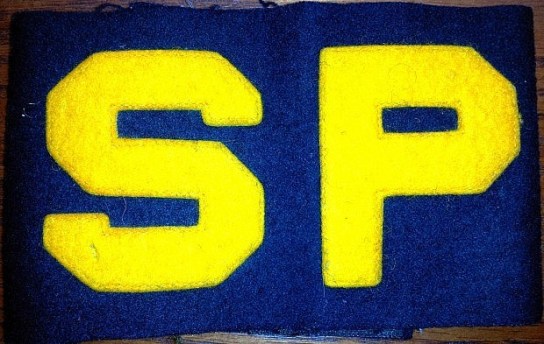
This Shore Patrol brassard is a 1980s vintage. Modern SP arm bands lacking the Velcro attachments can be difficult to discern from examples from the WWII-era.
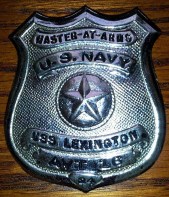
A Master-at-arms badge, dating to the 1970s, was used aboard the aircraft carrier, USS Lexington when she was designated a training carrier.
Along with arm bands, collectors could launch into military law enforcement collecting by pursuing badges. Keep in mind that there could be laws that prohibit owning current versions of these law enforcement badges. Possessing a currently-issued badge could result in considerable legal trouble so be sure to understand what is permissible in your area prior to acquiring the badge. Typically, obsolete badges should be allowable, but I would encourage collectors to remain familiar with their local laws.
Besides brassards and badges, collectors could pursue helmets, uniforms, utility/web belts (and all the attachments) and weapons, such as side arms and batons. The trick is to find your niche and stay within your budget.
Military Police Collecting
Combat Medical Blades – Bolo Knives

Indiana Jones faces off with a sword-wielding opponent on the streets of Cairo in Raiders of the Lost Ark (source: Paramount Home Entertainment (Firm). (2008). Raiders of the lost ark. Hollywood, Calif: Paramount Home Entertainment).
When confronted by a henchman in a scene from the film, Raiders of the Lost Ark, Indiana Jones (played by Harrison Ford) notices the fancy blade-wielding skills of his opponent. Unimpressed by the acrobatics and the fancy blade-twirling bad-guy, Indy retrieves his revolver from his holster firing a single, well-placed shot, dropping the adversary nonchalantly.
I don’t profess to have knowledge of the type of sword wielded by unimportant character in that film nor do I have expert knowledge in the field of military edged weaponry. What I do have in my scabbard is the ability to use the research tools at my disposal – which comes in quite handy when given an arsenal of knives, swords, bayonets and bolo knives.
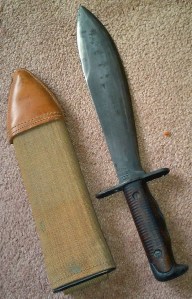
The scabbard and blade of the M1910 bolo.
A few years ago, I was asked to catalog and obtain value estimates of some militaria pieces that were part of a family member’s collection. He had passed away some time before and his executor was carrying out the responsibilities of handling the estate. In the previous years, I had only seen a few items from the collection so I was surprised when I saw what was there for me to review. After completing my work on behalf of the state, I later learned that I was to receive some of the pieces that I had appraised, much to my surprise.
Of the blades I had inherited, three were quite unique, different from the rest of the pieces. Two of the three blades were almost identical in form and the other was a slight departure from the others. What set these blades apart from the rest was machete-like design with more size toward the end of the blade, giving the blade a bit of weight toward the end of the blade rather than at the center or toward the hilt. The design of these blades were fashioned after the weapon of choice of the Filipino resistance fighters from the revolt that started at the end of the Spanish-American war in 1898.
Known simply as bolo knives, the U.S. military-issue blades were less weapon and more utilitarian in function.
-
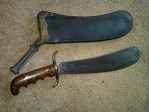
- The unique brass belt hanger of the leather-clad scabbard is much different from most WWI web gear attachments.
-
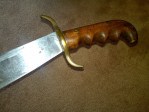
- The M1904 hospital corps bolo with its unique s-shaped brass hilt.
Now in my collection, the oldest of the three knives is the M1904 Hospital Corps Knife. Though many people suspect that the broad and heavy blade was important to facilitate field amputations, this thought is merely lore. Along with the knife is a bulky, leather-clad scabbard with a heavy brass swiveling brass belt hanger. My particular example is stamped with the date, “1914” which is much later in the production run. The M1904 knives were issued to field medical soldiers as the United States entered World War I in 1917.
The second knife is less bolo and more machete in its design. The M1910 bolo was designed and implemented for use as a brush-clearing tool. Some collectors reference the M1910 as a machine-gunner’s bolo as it was employed by the gun crews and used to clear machine gun nests of foliage and underbrush. My M1910 bolo is date-stamped 1917 and includes the correct leather-tipped, canvas-covered wooden scabbard.
-
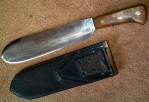
- This 1944-dated USMC bolo and scabbard are a cherished part of my collection.
-
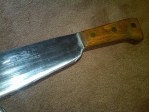
- The blade and hilt of the USMC World War II bolo.
The last bolo in my collection is probably the most sought-after of the three examples. Stamped U.S.M.C. directly on the blade, these knives were issued to U.S. Navy pharmacist’s mates who were attached to U.S. Marine Corps units. This detail leads many collectors to improperly conclude that the markings on the blade clearly indicate that the knives were made for the Marines. While this is indirectly true, the U.S.M.C. markings represent the United States Medical Corps, a branch of the U.S. Navy. On the reverse side, the blade is date-stamped, “1944” making the blade clearly a World War II-issued knife.
Although the blades are relatively inexpensive, they are considerably valuable to me as they come from a family member’s collection and were handed down to me. Though I do not have a desire to delve too far into edged weapons-collecting, I added to my collection by acquiring a pair of US Navy fighting knives to round out my collection. In future posts, I will cover these two types of knives, swords and sabers and even a few bayonets.
Introductory Flight – Collecting Aviator Wings
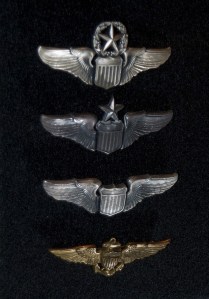
From the top: Command Pilot, Senior Pilot and Pilot of the US Army Air Force. The naval aviator “wings of gold” are really set apart from its USAAF counterparts.
Since the early twentieth century, all of the branches armed forces of the United States have been bolstered by service men and women who are highly skilled, reaching the pinnacle of their specialized area of expertise. From aviators, to paratroopers, to submarine crew members and combat infantrymen, all are easily recognizable by the devices and pins affixed to their uniforms.
Since the advent of military flight and the employment of aviators in war-fighting aircraft, leadership within the ranks realized that there was a need to provide a uniform accouterments to set these special and unique servicemen apart from the rest of those in uniform.
During World War I, the Air Service (U.S. Army) began issuing qualified pilots a winged pin device to attach to the left breast of their uniform blouse. The device was constructed in silver-colored metal (mostly silver or sterling silver or embroidered in silver bullion thread) with two ornately feathered bird wings attached to either side of a shield, which had 13 stars in a field over 13 stripes. Superimposed over the shield were the letters, “U.S.” This wing design would remain in use throughout the Great War.
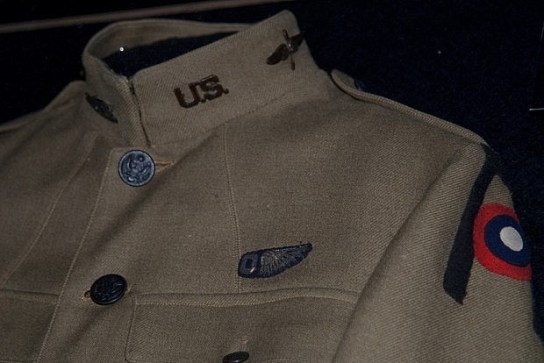
A nice example of a World War i balloon pilot’s single wing of the Army Air Service.
During the interwar period (1919-1941), the U.S. Army Air Corps wings were more standardized, dropping the U.S. lettering and simplifying the design. The shape of the shield became more standardized though it would vary depending upon the manufacturer. The Air Corps also began introducing varying degrees of the pins that signified the experience of the aviator. In addition to the existing pilot badge, the senior pilot (which added a five-point star above the shield) and command pilot (with a five-point star inside a wreath) badges were issued.
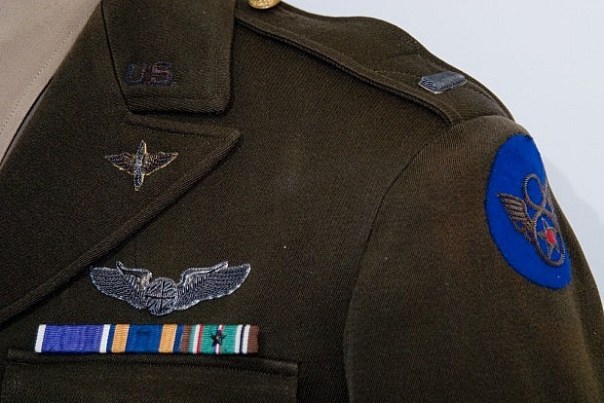
This stunning 8th Air Force 2nd Lieutenant’s uniform has a beautiful example of a silver bullion wing. In fact, all of the (typically metal) devices are made from silver bullion thread.
- World War II Army Pilot Wing Variants
- World War II Army Senior Pilot Wing Variants
- World War II Army Command Pilot Wing Variants
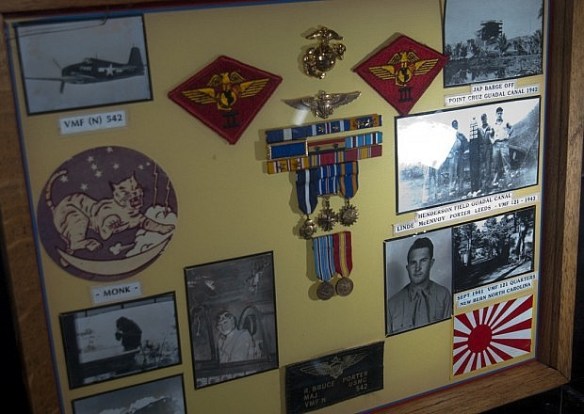
This display features WWII USMC ace, Major Bruce Porter’s decoration and medals with his naval aviator “wings of gold.”
The new naval aviation service also adopted a wing device for their aviators that incorporated a similar design (bird wings attached to a shield with stars and stripes) but with an anchor, arranged vertically, extending from behind the shield with the ring and stock above and the crown and flukes below. Most of these early wings were constructed in a gold metal (sometimes actual gold) or embroidered using gold bullion thread. The navy wings of gold remain virtually unchanged to present day, with variations occurring between various manufacturers.
With a little effort, new collectors can quickly educate themselves as to the nuances of the (World War II to present) coveted, yet relatively affordable, wings. Many of the naval (which include USMC flyers) and air corps/forces wings from WWII can be had for prices ranging from $50-$100 depending on the scarcity or abundance of the variant.
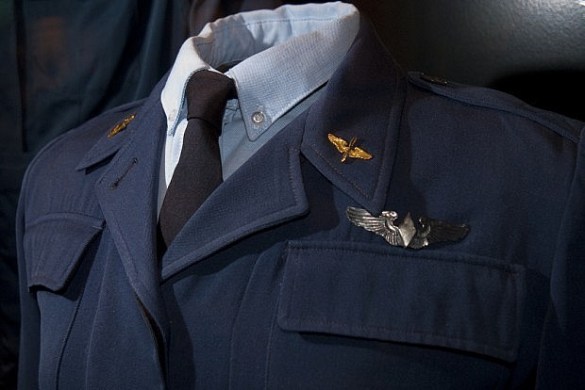
During World War II, women pilots were needed to ferry aircraft from the manufacturers to the troops, saving the experienced aviators for front-line combat. This beautiful WASP uniform features pilot wings.
Due to the incredible desirability and rarity of wings (i.e. extremely high dollar values) from the first World War, these pieces are some of the most copied and faked militaria items. Some of the examples are so well-made (in some cases, by skilled jewelers) that expert collectors have difficulty discerning them from the genuine artifacts. The best advice before acquiring a WWI piece is to consult an expert. Also, be sure that the seller is reputable and will offer a full refund if the item is determined to be a fake.
Finding the “Lady Lex,” One Piece at a Time
A few weeks ago, our nation honored the 75th anniversary of the sneak attack on the Pacific Fleet at Pearl Harbor on December 7th. In the past few years, we have marked significant anniversaries of victories from WWII, the War of 1812 and this year we will begin recognizing the centennial of the U.S.entrance into the Great War. For collectors, these occasions spur us to evaluate our own collections while attempting to be discerning of sellers’ listings who are also trying to capitalize on the sudden interest.
In May of this year, 75 years will have elapsed since the first significant clash between the opposing naval forces of Japan and the United States in the Coral Sea. Leading up to this battle, the Navy had suffered losses in The Philippines, Wake Island and Guam followed by the sinking of the USS Houston (in the battle of Sunda Strait) all of which were leaving the U.S. extremely vulnerable and nearly incapable of mounting a naval offensive.
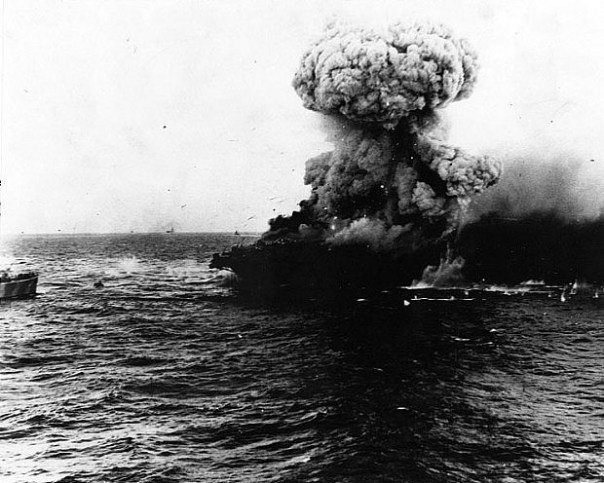
The Lady Lex is rocked by an enormous explosion during the Coral Sea battle, May 8, 1942 (Photo: Naval Historical Center).
USS Lexington (CV-2) provides electrical power to the City of Tacoma (WA) during a severe drought and subsequent electricity shortage – December 1929 – January 1930 (Photo: Tacoma Public Library).
Beginning with a joint effort between the US Army Air Force and the US Navy, the fight was taken to the Japanese home front with an B-25 air strike launched from the USS Hornet. But the direction of the war was seriously in doubt and Navy brass knew that inevitably, a direct naval engagement with the Japanese fleet were very near on the horizon.
Navy code-breakers had discovered the Imperial Japanese forces intended on taking Port Moresby in New Guinea and quickly dispatched Task Forces (TF) 11 and 17 to join up with TF 44 near the Solomon Islands and proceed West toward the Coral Sea. Over the course of May 3rd through 8th, the ensuing engagements between US and IJN forces resulted in substantial losses for both sides, including a carrier from each navy.
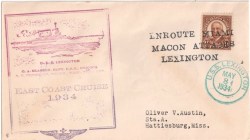
This 1934 postal cover commemorates the Lexington’s East Coast cruise of 1934 (photo: eBay).
For the U.S. Navy, that carrier was the USS Lexington, CV-2. Though not the first purpose-built aircraft carrier (that distinction goes to the USS Ranger CV-4), Lexington was the first to be originally commissioned as a flat top. The Langley (CV-1) had a previous life as a collier, the USS Jupiter, for seven years from 1913 to 1920. The “Lady Lex”, as she would come to be known, laid down as a battle cruiser but was reconfigured during construction and was commissioned in 1927 as the US Navy’s second carrier, CV-2.
The result of the Coral Sea Battle was that the Navy was left with just two operational carrier: Hornet and Enterprise, as the Yorktown also suffered substantial damage in the battle requiring repairs. Less than a month later, the tables would be turned on Japan with the major American victory at Midway.
-
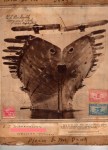
- A postal cover of the USS Lexington (Photo: Navsource.org).
-
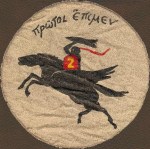
- A leather squadron patch from the Early Knights of Bombing Two (VB-2) from the Lexington (photo: Brian’s WWII Surplus& Antiques Store)
-

- This SBD-2 Dauntless aircraft was recovered from a lake where it sat since 1945. While it was not a veteran of the Coral Sea battle, it did fly from the decks of the Lexington during the early months of 1942 (photo: National Naval Aviation Museum)
-
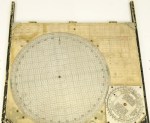
- This plotting board was used by Lieutenant (junior grade) Joseph Smith during the Battle of the Coral Sea when, while on a scouting mission from the carrier Lexington (CV 2), he spotted Japanese aircraft carriers and their escorts (photo: Naval Aviation Museum).
-
- A sailor’s leather-bound USS Lexington CV-2 Photo album (photo: eBay).
The loss was not only felt by her crew and navy strategists, but also by communities, such as Tacoma, Washington. For 31 days during winter drought conditions, the Lexington was sent to aid the city’s citizens by generating power ’round the clock, helping to keep their homes lit and warm. Many of those beneficiaries of the electrical power assistance were devastated by the news of her loss.
Today, few artifacts remain from the Lady Lex. Militaria collectors would be hard-pressed to obtain anything specific to the ship, instead having to settle for obtaining USS Lexington veterans’ personal effects or uniform items, surviving ephemera, philatelics, or vintage photographs. For many naval collectors, the hunt for anything from this historic ship can very rewarding. Some artifacts can be found by happenstance as was the case with this Curtiss SB2C Hell Diver, recently pulled from the Lower Otay Reservoir near San Diego, discovered by a fisherman who observed the plane’s outline on his fish-finder.
Armed with patience and time, collectors could assemble a nice group of artifacts to pay proper respect to the Lady Lex and the men who served aboard this historic ship.
UPDATE March 5, 2018: Paul Allen’s Undersea Exploration team that has been searching and discovering the wrecks of the Pacific War, finding such infamous sunken vessels as the USS Indianapolis and the lost ships from the Battle of Savo Island (USS Vincennes, Astoria and HMAS Canberra), announced today that they have located and filmed the wreck of the USS Lexington (CV-2) at the bottom of the Coral Sea in nearly two-miles of depth.
A Piece of the Day of Infamy or Simply a Connection to an Historic Ship?
For most Americans, this time of year spurs thoughts of lighted trees, large and rotund red-suited elves, massive crowds at local shops and mega malls, anxiety, and ever-increasing credit card debt in the rush to obtain the perfect gift for loved ones and friends. All of this translates into the hopes that the recipients of said gifts illuminate with unbridled joy and gratitude. Meanwhile, a continuously diminishing segment of the population, in addition to the aforementioned seasonal activities and concerns, recall a monumentally tragic and infuriating event, now 75 years hence.
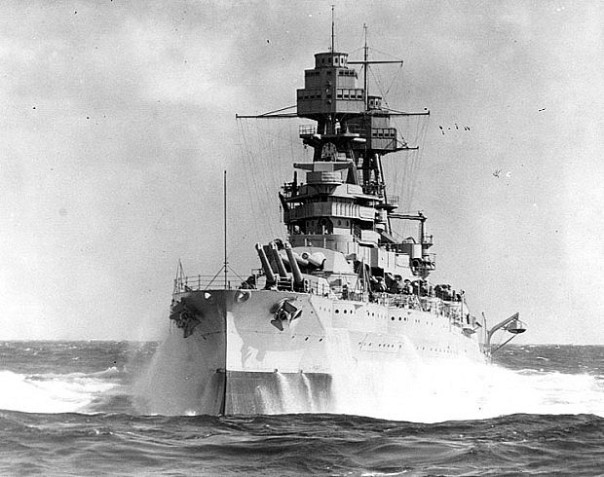
The USS Arizona’s bow pitches upward on the high seas sometime in the late 1930s (source: U.S. Navy Naval History and Heritage Command).
At that time (three quarters of a century ago), Americans, like today, were in the throes of an economic depression while war and conflict littered regions around the globe. Many Americans had been without work for months, while others had been unemployed for years. The holiday season was in full swing but on an infinitely smaller scale. All of this about to change, catapulting the nation into chaos and doubt while transforming the nation’s doubt into a singular mindset, while rising from the literal ashes and wreckage to defeat fascism.
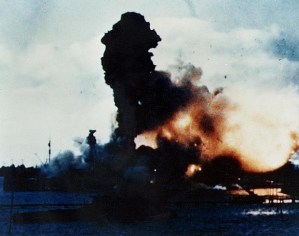
A rare color image showing the USS Arizona’s forward magazine detonating after it was struck by a high altitude aerial bomb (Source: U.S. Navy Naval History and Heritage Command).
The World War II generation is departing our society at an increasingly accelerated pace. The men and women who banded together on the war front and home front still recall the Day of Infamy, remembering those who fell prey to unpreparedness and bumbling governmental bureaucracy and a dastardly attack. When the final tally was counted in the weeks and months following December 7, 1941, more than 2,400 Americans were dead at the hands of the Empire of Japan. Three battleships of the U.S. Navy were complete losses. One of those ships, the USS Arizona (BB-39), was obliterated by an aerial bomb that penetrated into the forward magazines (for the 14” guns), igniting a cataclysmic explosion, killing 1,117 sailors, accounting for more than half of the Pearl Harbor attack death toll.
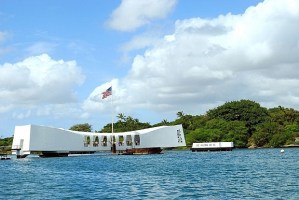
The memorial structure straddles the stricken ship’s hull as she rests in the mud and silt of Pearl Harbor.
In the 75 years since that fateful day, much has transpired to cause the slow evaporation of Pearl Harbor memories of from the American conscience. The current younger generation experienced their own day of infamy 11 years ago with the 9/11 attacks, fueling the 12/7/41 forgetfulness with redirected angst.
Conversely for militaria collectors, the events of Pearl Harbor are held close to the vest and worn on their sleeves. The pursuit to hold a piece connected to that tragic day isn’t taken lightly. More often than not, collectors pay an extremely high premium for the honor of preserving and displaying items that tell the individual stories of the struggle to survive and the will to fight the attackers. Collectors treasure anything directly related to a veteran, aircraft or ship that participated in warding off the Japanese onslaught.
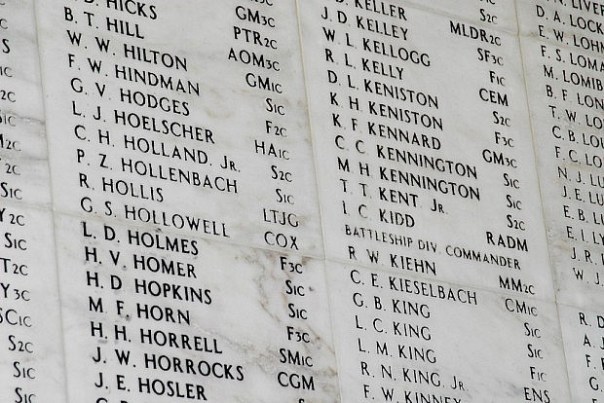
Inside the Arizona Memorial, this wall bears the names of the 1,177 victims who were killed on that tragic day.
For me, the realization of the Pearl Harbor collector mindset truly occurred for me awhile ago when I spotted an auction listing for a flat hat from a navy veteran that served aboard the most notable ship casualty of the attack, the Arizona. I scanned through the associated photographs, noting the condition while attempting to approximate the age of the item.
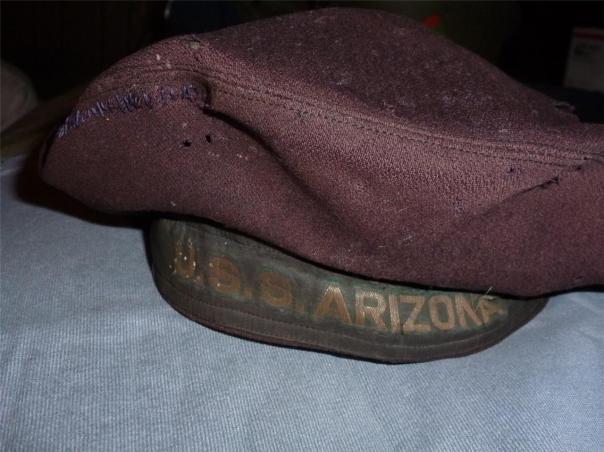
Worth its weight in gold, this flat hat recently sold for nearly $900 at auction (source: eBay image).
By 1941, operation security had been steadily increasing due to the waging war, both in Europe and the Western Pacific. The Navy, seeking to reduce the visible indications of ship movements, stipulated in uniform regulations that all ship identifiers, such as ship-name tallies on enlisted blue flat hats, be omitted from uniforms. Generic “U.S. Navy” lettered tallies replaced the those bearing the names of ships which meant that the one in the auction listing predated WWII by at least a year. However, this particular cap is a pre-1933 design that has had the stiffener removed leaving a more “slouched” appearance that became standard with the 1940s caps.
-
- Though the lettering is faded and shows some signs of the bullion thread corroding, this USS Arizona enlisted sailor’s flat hat is a rarity and is well worth the investment (source: eBay image).
-
- The real value of the USS Arizona flat hat is in the tally. Due to the historic-nature of the famous ship and the scarcity of tallies bearing ship names, the damage seen here had little impact on the final selling price of the hat (source: eBay image).
-
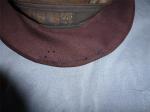
- Condition is everything. This hat has some serious issues from moth damage and was repaired at some point (source: eBay image).
-
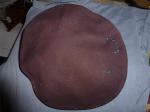
- Top of the USS Arizona flat hat – showing the moth holes (source: eBay image).
-
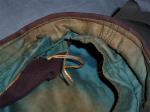
- This view shows the inside of the Arizona hat and gives some indication to the age – the liner does appear to be post World War I (source: eBay image).
-
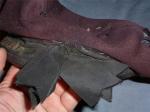
- Details of the flat hat – showing how the tally is tied into the traditional bow at the side of the hat (source: eBay image).
The condition of the hat left lots to be desired. From dozens of small holes scattered across all of the woolen surfaces, it was readily apparent that moths had a field day as they enjoyed their “hat salad.” The only components on this cap untouched by the Lepidoptera larvae were the tally and the liner.
What would be a significant value-increasing factor is if the hat bore the name of its owner. I was unable to discern from the provided photos any hint of a stenciled or inscribed name. If I had been able to see the original owner’s name, I might have been able to locate related details concerning his naval service, and quite possibly, the dates he served aboard the Arizona. It might be safe to assume that the value of the hat increases if the veteran did survive the ship’s sinking. However, based upon the features of the hat (the overall design, the liner and the tally), I would surmise that the hat is closer to the World War I-era.
Regardless of when the hat was used or if it belonged to a survivor of the Pearl Harbor attack, the auction’s final, closing bid of $848.00 was astonishing. Without a doubt, the winning bidder took a chance on acquiring an extremely rare piece with direct ties to a historic ship. In doing so, this collector now possesses a tangible connection to that fateful day.
See also:
 The Veteran's Collection