Category Archives: World War II
Theater-Made Militaria: Shoulder Sleeve Insignia…are they Real?
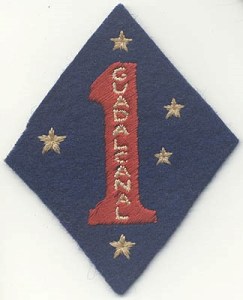
This Australian-made First Marine Division patch was created for the battle-hardened veterans of Guadalcanal while on R&R in Melbourne Australia (source: Flying Tiger Antiques).
Within the realm of just about every collecting pastime exists undocumented glossaries packed with terms and phrases used to describe certain aspects of that particular genre. For those of us new to collecting, these terms can be some of the biggest obstacles to understanding the ins and outs of collecting, especially as we are trying to navigate our way to better understand specifics and details.
In some instances, terms can be rather self-explanatory (at least for people like me), but still may not make a whole lot of sense. Such is the case with “theater-made.” which seems to be bandied about rather freely.
As I launched into militaria collecting, I saw the term applied to a broad swath of army items, predominantly shoulder sleeve insignia (or patches) dating from World War I to present day. What astounded me was that these experts could spot not only that a particular piece was theater-made, but could tell you where in the world it was made. With certain pieces, a theater-made example could sell for considerably more than an American-made patch. The Australian-made 1st Marine Division patch comes to mind.
-
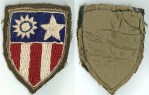
- This China Burma India (CBI) patch is one of my theater made SSIs.
-
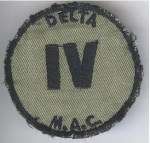
- My father, a Viet Nam combat veteran, wore a patch like this on his OD fatigues in country. I have my doubts as to the authenticity of it as a vintage patch, instead it could be one of the thousands currently reproduced in Viet Nam to capitalize on the growing collector market
As a veteran of the U.S. Navy, theater-made items seem commonplace. During our six month-long deployments to the Western Pacific, our ships would visit ports in countries such as the Philippines and Hong Kong. During our three- and four-day stays, many of us would take what little money we saved and head out to the tailor and embroidery shops to order custom uniforms or uniform items from the local craftsmen. These special-order pieces add a unique and personal touch for uniforms worn out on liberty or to make us stand out in a positive manner during inspection. However, we never thought of these components as theater-made.
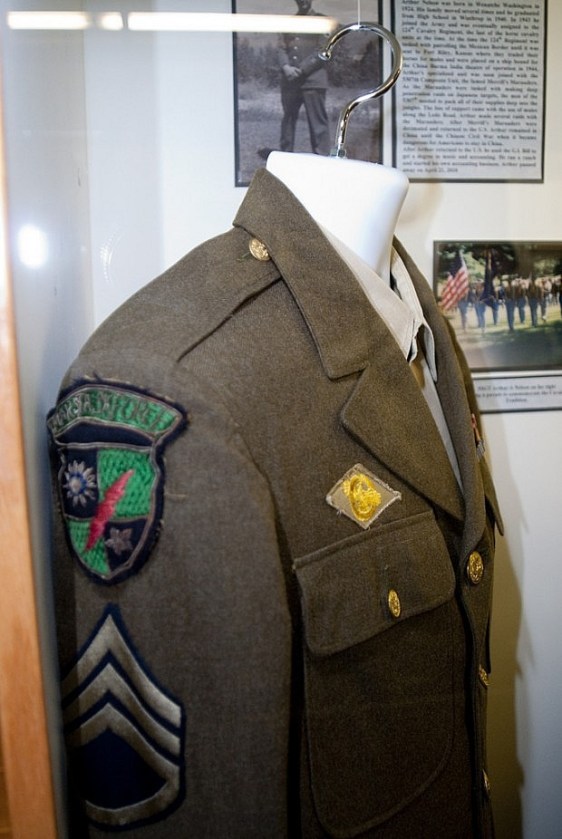
This WWII army veteran’s uniform sports a right-shoulder SSI of the 5307th Composite Unit (also known as Merrill’s Marauders).
As some of the custom pieces are slightly more rudimentary in construction, forgers tend to leverage that to their advantage. When collectors begin to pursue what are being passed off as theater-made items, they must have some sort of education before pulling the trigger to protect themselves from being deceived.

Researching to Establish Provenance: A Cigarette Box with Historical Connections
While much of my militaria collection consists of family-connected items (such as uniforms, decorations, documents and photographs) I also have some oddities that serve to add interest and perhaps to make a display more visually aesthetic. In reviewing the (online displays of) collections from other enthusiasts, it is quite easy to see that many of them have focused their attention upon such areas as service branches, theaters of combat, veterans’ groupings, decorations and medals to list the most prevalent.
-
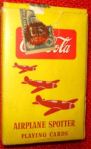
- These Coca-Cola branded “Airplane Spotter” playing cards are a great example of a cross-over collectible. Collectors of Coke memorabilia, militaria and even of playing cards would enjoy these in their collection (source: eBay image).
-
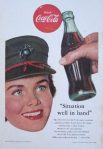
- Military-themed advertising is another example of collectibles that have cross-over appeal (source: eBay image).
-

- Plucked from the pages of magazines such as “Life,” these colorful, patriotic adverts look fantastic dislayed with other Coca-Cola memoriabilia or militaria (source: eBay image).
Crossover collecting can be even more rewarding due to the uniqueness that it offers the enthusiast. For example, an individual may already be a collector of memorabilia from a commercial company such as Coca-Cola (focusing on signage, advertising, drinkware, etc.) who then discovers a militaria sub-set within that area of collecting. Other areas of militaria crossover can include Tobacciana, Zippo lighters and my personal favorite, baseball.
The piece that I am focusing this article on does fit into a crossover the tobacciana category but hardly signifies that my interests are branching into that area of collecting. This artifact fits into another crossover facet of collecting that is more my speed: folk art or, in military terms, Trench Art. As an amateur military historian and someone who enjoys artifacts related to the U.S. Navy, this cigarette box was something of interest to me. I also thought that the piece would look great on my dresser and serve as a storage place for personal items while fitting in alongside of my other antique boxes.
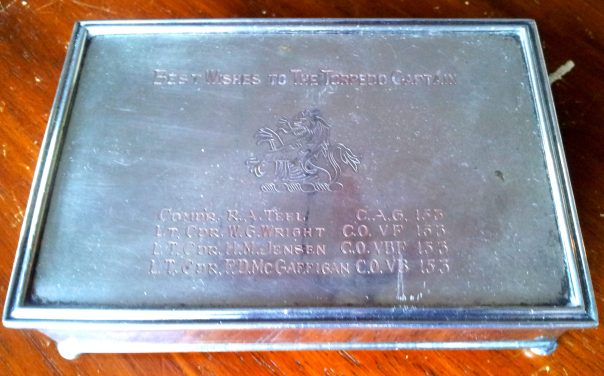
I have owned this silver cigarette box for several years but never spent any significant time researching it.
The cigarette box is engraved with “Best Wishes to the Torpedo Captain” along with a griffin and a list of naval aviators and their commands (part of Air Group 153). When I first acquired this piece, I assumed it was made from scrap metal – possibly obtained from an aircraft part – and crafted by a squadron aviation structural mechanic. As the box has since been displayed for the last few years, the surface has tarnished which leads me to suspect that the metal material is silver. The absence of any hallmarks means that the only way to determine the material composition is to perform one or more tests (hopefully) without damaging the artifact.
-
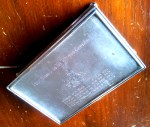
- Though it has no hallmarks, it seems to be a nice piece of craftsmanship.
-
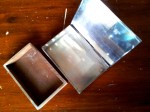
- The cedar lining is removable.
-
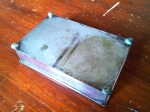
- The feet are brazed onto the bottom which is a mark of good craftsmanship.
As with other militaria artifacts, especially named pieces, researching is part of the enjoyment (and sometimes the pain when research hits a dead-end) and though the collector that I purchased this from included some information, I pursued the information further. Examining the engraving, the names are listed out:
COMD’R. R. A. Teel, CAG 153
L.T. CDR. W.G. Wright, C.O. VF 153
L.T. CDR. H. M. Jensen, C.O. VBF 153
L.T. CDR. F. D. McGaffigan C.O. VB 153
Judging by the present information, one would think that the odds to identify the box’s original owner might be fairly descent, and with good reason considering that there were nine data points (ten, if one includes the griffin and the presentation statement) to base the research upon. Understanding nomenclature, rank abbreviations and the numerics of naval aviation squadrons is a good starting point. Navy rank abbreviations during WWII were a bit more complex than the simplified modern counterparts. Officer rank structure can be defined easily:
| Rank | WWII Abbreviation |
Current Abbreviation |
| Ensign | Ens. | ENS |
| Lieutenant Junior Grade | LT.j.g. | LTJG |
| Lieutenant | LT. | LT |
| Lieutenant Commander | L.T. CDR. | LCDR |
| Commander | COMD’R | CDR |
| Captain | CAPT. | CAPT |
For those who are new to naval aviation squadron designations and their meanings, “V” is the designation for fixed wing aircraft. For the sake of brevity and keeping this post focused on these specific squadrons, I’ll refrain from providing definitions for all WWII naval aviation squadrons.
- CAG – Commander, Air Group
- VF – Fixed Wing Fighting Squadron
- VBF – Fixed Wing Fighting/Bombing Squadron
- VB – Fixed Wing Bombing Squadron
Commander, Air Group 153 (listed above as “CAG”) with Commander R. A. Teel, was the group commander who was responsible for the squadrons within his group (VF-153, VBF-153 and VB-153). Lieutenant Commanders W.G. Wright, H.M. Jensen and F.D. McGaffigan were commanding officers of the subordinate squadrons reporting up to Commander Teel. Successfully researching the information (names, squadrons) will certainly help to provide great information but I have no way of determining the original owner of the box (to whom it was presented). Being geographically located at the farthest reaches from the National Archives or the Naval History and Heritage Command in Washington, DC (while still residing within the contiguous United States) limits the scope of research. I am resigned to scouring the fractional data that is available online.
The ultimate goal of my research was to determine the identity of the original owner of the cigarette box which, when I purchased it, was thought to have been one of the aviators named in the engraving. Judging by the inscription, “Best Wishes to the Torpedo Captain,” that title, in my estimation, refers to the commanding officer of the squadron of torpedo bombers. Being that all of the other listed squadrons were either fighter, fighter-bomber or bomber squadrons, it would seem that the Torpedo Captain would have been the skipper of the Air Group’s VT squadron, which was not engraved onto the box.
Before proceeding further, I sought to confirm that the air group’s assigned VT squadron also shared the same numbering convention. A quick search led me to a very limited listing of Air Group One Fifty Three (ComAirGrp 153). Indeed, the composition of the group consisted of four squadrons:
- VB-153 (composed of 15 VSB aircraft, or fixed wing scouting bombers)
- VF-153 (composed of 36 VF aircraft, or fixed wing fighters)
- VBF-153 (composed of 36 VF aircraft)
- VT-153 (composed of 15 VTB aircraft, or torpedo bombers)
While this information was a solid initial step, the source lacked further confirmation regarding any of the engraved names on my box. As I write this article, I await a response from a fellow collector who has access to naval aviation records. Turning my attention to the names listed on the case, I do have a few avenues in which to proceed in order to get a clearer picture of the careers of these naval aviators. When I received the box, inside was a folded-up printout (of a WWII Memorial entry for Francis D. McGaffigan) that provided me with a head start for one of the box’s engraved names.
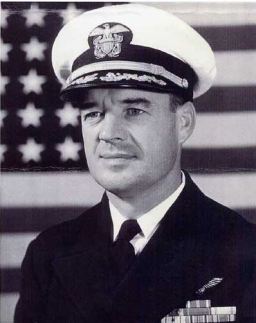
Captain Francis Daniel McGaffigan (source: WWII Memorial).
Lieutenant Commander F. D. McGaffigan, my research revealed, was born January 13, 1910, to Irish immigrants in Boston, Massachusetts. After graduating high school, he enlisted as a Seaman Second Class and was assigned to Naval Aviation Elimination Training in Boston (shown in official records as “Squantum”) in January of 1940. According to his memorial page (submitted by a family member), the naval aviator served with a number of commands during WWII. I’ve spotlighting a few:
- Commanding Officer, Bomber Squadron (VB) 306, flying SBD-5 Dauntless , Solomon Islands
- Commanding Officer, Bombing Squadron 99, Saipan
McGaffigan’s career as listed by his relative is highlighted with the following post-war assignments. Subsequent research could determine what, if any, wartime service the captain might have experienced prior to the conclusion of his career.
- Commanding Officer, Bombing Squadron 150, USS Lake Champlain (CVS-33)
- Commanding Officer, Bomber Squadron 153, USS Kearsarge (CV-33)
- Air Officer, USS Essex (CV-9)
- Commanding Officer, Naval Air Reserve Training Unit, NAS Lakehurst (NJ)
Captain McGaffigan’s awards and decorations which include:
- Distinguished Flying Cross
- Air Medal (3)
- Naval Reserve Medal
- American Defense Service Medal
- Asiatic–Pacific Campaign Medal (with campaign star)
- American Campaign Medal
- World War II Victory
McGaffigan’s post-naval life commenced with retirement in 1960, and he lived out his year, passing in 2001.
After searching through the careers of the naval aviators listed on the box, it is clear that the name that was absent is the one who was presented with the box from the remainder of those listed, starting with the Commander Air Group (CAG), Commander Richard A. Teel.
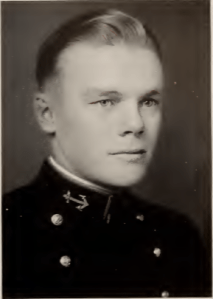
Richard Ashley Teel’s 1936 Naval Academy graduation portrait (source: The Lucky Bag).
Commander Richard Ashley Teel was born on Christmas Day, 1913 in Annapolis, Maryland (his father, Roland M. was a boy’s school principal and his mother, the former Susan B. Ashley, was an English immigrant homemaker), and after completing high school (at Severna Park H.S.), he entered the United States Naval Academy in June of 1932. Upon his graduation and commissioning, Teel was assigned to the battleship, USS New Mexico (BB-40). In 1938, LTJG Teel reported to Naval Air Station Pensacola for aviation training. Teel’s first assignment upon receiving his naval aviator’s wings was with the newly formed Bombing Squadron Seven (VB-7) aboard the USS Wasp (CV-7) in 1939. By 1942, VB-7 was redesignated a fighter squadron (VF-71) and was transferred to shore-based operations on Espirtu Santo following the sinking of the Wasp in September of 1942 (she was torpedoed by a Japanese submarine). After VF-71 was disbanded, LT Teel was flying from the USS Independence (CVL-22). Considering that Commander Teel is not the focus of this research, I ceased pursuing his career further. I was able to find that Captain Richard Teel retired after thirty years of service on July 1, 1966, and enjoyed another 28 years, passing on August 9, 1994. Richard Ashley Teel’s final resting place (the Naval Academy Cemetery) is not far from his birth home in Annapolis.
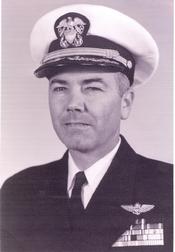
Commander Wilson George Wright III.
Lieutenant Commander Wilson George Wright III was born in Ogden, Utah, on May 15, 1916, to Wilson G. and Lelia D. Wright. He graduated from Ogden High School, and attended Weber College for one year and then entered the U.S. Naval Academy in June of 1935, and was commissioned an ensign on June 1, 1939. Following graduation from the Naval Academy, Wilson served one year on the battleship USS Idaho (BB-42) and one year on the USS Lamson (DD-367). Wright reported to NAS Pensacola for flight training and was designated a Naval Aviator on December 16, 1941. His first aviation duty was in VF-71 aboard USS Wasp (CV-7) and flew combat missions surrounding Guadalcanal in support of the First Marine Division landings during the invasion of Guadalcanal, August 7-8, 1942. LTJG Wright was aboard when the Wasp was torpedoed and sunk by Japanese submarine I-19 near San Cristobal Island in the Solomon Islands.
Wright’s next assignment was as Executive Officer of VF-33 which was land-based in the Solomon Islands, flying many combat missions including fighter sweeps and bomber escort missions over Rabaul.
Following six months as a Fighter Type Instructor at the Naval Air Station Atlantic City, he was ordered to the Naval Air Station Grosse Ile, Michigan, to start and commission Air Group 97, and served in that unit as the Commanding Officer of Fighter Bomber Squadron 97. He was awarded the Navy Commendation Medal for his service in Air Group 97. Upon the decommissioning of Air Group 97, Wright’s next assignment was as the commanding officer of Fighter Squadron 153, followed by a tour as the commanding officer of the Flag Administrative Unit and finally, as the staff personnel officer of Commander Fleet Air Alameda.
Following his retirement, having attained the rank of commander, Wright worked as an engineer and supervisor in the aerospace industry, spending three years with the Lockheed Missile Division on the Polaris Missile project, 17 years with Rockwell Space Division and was involved with the lunar landings and the Space Shuttle programs. He was 95 years old when he passed away on Nov. 2, 2011, and was laid to rest in home state of Utah.
Among Wright’s numerous awards and decorations were:
- Distinguished Flying Cross
- Air Medal (5)
- Navy Commendation Medal
- American Defense Service Medal
- Asiatic–Pacific Campaign Medal
- American Campaign Medal
- World War II Victory
The last of the names listed turned out to not only be notable, but he earned the status of an Ace fighter pilot (meaning that he had five confirmed air-to-air enemy kills) during his service with VF-5.
Lieutenant Commander Hayden Martin Jensen was born on January 30, 1911, in St. Paul, Minnesota where he attended high school and college. Jensen was commissioned an ensign on August 19, 1939. Having completed flight training, Ensign Jensen was assigned to Bombing Squadron Five (VB-5, part of the Yorktown Air Group), flying the Northrop BT-1 aboard the USS Yorktown (CV-5). By 1941, the young ensign had transferred to VF-5 (the “Stafighters”) as his role changed from a bombing to a fighter pilot, flying the F4F-3 Wildcat. Still assigned to VF-5 when it was transferred to the USS Saratoga (CV-3) in June of 1942, Jensen would meet the enemy in the South Pacific – in the Guadalcanal Campaign – in two separate engagements in August of 1942, twice earning the Navy’s second highest valor decoration, the Navy Cross, scoring two enemy kills on August 7, 1942, and three more on August 24. For these engagements, LT Jensen was also awarded the Distinguished Flying Cross. LCDR Jensen assumed command of VBF-153 on March 26, 1945.
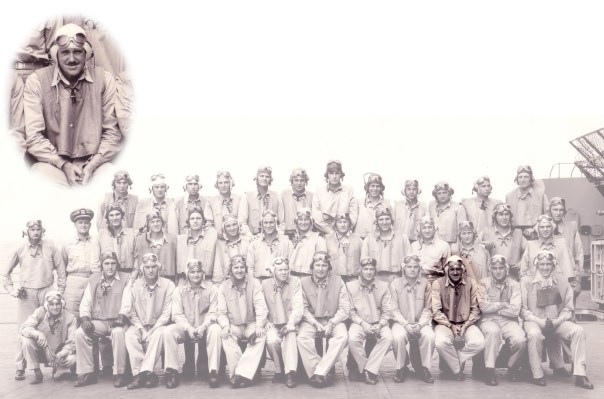
LT Hayden Jensen poses with the men of VF-5 aboard the USS Saratoga, July 15. 1942. In a little more than two weeks, Jensen will have his first two of five enemy air kills.
Jensen married the former Henrietta Mathilda Schirmer (also of St. Paul) on December 27, 1938. Still serving on active duty, 38 year-old LCDR Jensen passed away on June 6, 1949, at Naval Hospital Newport, Rhode Island, with his wife, Henrietta by his side. He was laid to rest at Arlington National Cemetery.
Among Jensen’s numerous awards and decorations were:
- Navy Cross Medal (2): see citations
- Distinguished Flying Cross Medal
- Air Medal (3)
- American Defense Service Medal
- Asiatic–Pacific Campaign Medal
- American Campaign Medal
- World War II Victory Medal
After reviewing the incredible service details for these four naval aviators, I was convinced that the box never belonged to any of the men listed on the box. Based upon their careers, none could be considered as “The Torpedo Captain” leaving me to pursue the next logical step. As with each naval air group, I confirmed that Air Group One Fifty Three did, in fact, have a torpedo squadron (VT). Cursory internet searches were dead-ends as far as attempting to discover possibilities of assigned commanding officers. Fortunately, I am a member of an amazing group of fellow collectors on the U.S. Militaria Forum where there are folks who possess years of experience and knowledge and have access to records and sources. I posted some requests for assistance and like clockwork, two members answered me and began to fill in the blanks. Instantly, I had the names of two naval aviators who commanded VT-153: LCDR H.C. Madden and his successor, LCDR F.G. Lewis.
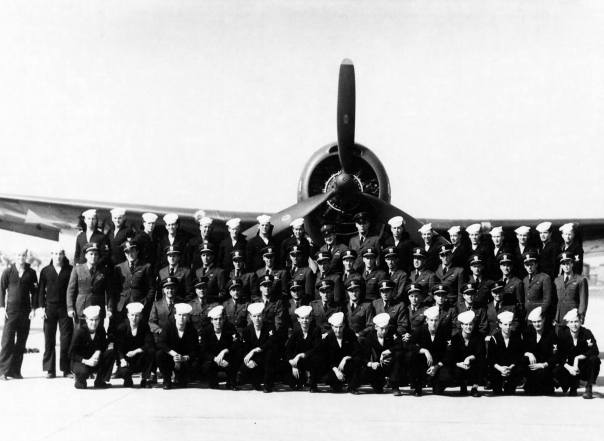
The officers and men of Torpedo Squadron 153 (courtesy of Jack Cook).
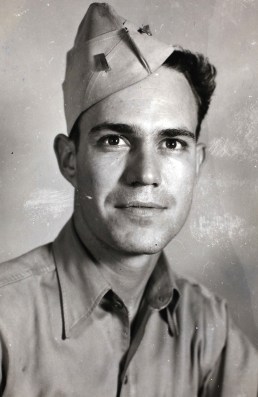
LTJG Harlan C. McFadden Jr.
LCDR Harlan Curtis McFadden Jr. was born June 29, 1918. After completing high school in Clayton, New Mexico, McFadden pursued his degree in English Literature at the University of New Mexico before enlisting as a naval aviation cadet on July 9, 1941. He began six weeks of elimination flight training at Naval Air Station Long Beach, California and, upon completion, McFadden commenced flight training at NAS Corpus Christi for 44 more weeks. Harlan finished his final 12 weeks of operational flight at NAS Ft. Lauderdale.
LT McFadden was assigned to Torpedo Squadron Three Hundred Five (the “Red Asses”) from 1943-44. On August 1, 1944, when VT-305 was ordered decommissioned, McFadden was transferred to VT-99 along with five fellow flyers and additional enlisted support personnel. Much of his early months of service during the war were spent flying missions over various Japanese strongholds in the Solomon Islands, such as Bougainville and Rabaul. On March 26, 1945, LCDR McFadden assumed command of VT-153 at Naval Auxiliary Air Facility (NAAF) Lewiston in Maine. One of McFadden’s assigned aviators was LT George H. W. Bush who served with the squadron from March through September of 1945. Ten days after the squadron was activated, Mcfadden was relieved of command by LCDR Lewis. From April 6 through his discharge on September 5, 1945, I have been unsuccessful in locating McFadden’s naval service or why he was relieved of command. In his four years of service as a naval aviator, McFadden saw a total of 14 (four months in the North Atlantic and 10 in the South Pacific). On his separation documents, McFadden stated that he was pursuing a career in commercial aviation.
LCDR Frederick Gary Lewis was born on March 13, 1916, in Springfield, Massachusetts. Though I have had some success in researching Lewis, I have not been as successful in discovering as much detail regarding his life and the breadth of his time as a naval aviator. He was commissioned an ensign on November 14, 1940, and was assigned to the fleet aboard the battleship USS Pennsylvania (BB-38) as the Communications Officer. Ensign Lewis was present aboard the ship during the Japanese attack on Pearl Harbor, witnessing the carnage and utter destruction on the ships and facilities surrounding the Pennsylvania, including the tremendous damage inflicted upon the destroyers USS Cassin (DD-372) and USS Downes (DD-375) which were sharing the same drydock as the battleship. As the battleship was floated and directed to San Francisco for repairs, LTJG Lewis reported for flight training at Naval Air Station Pensacola. Once Lewis received his wings of gold, he was assigned as a flight instructor at NAS Ft. Lauderdale where he served for the next twelve months. In December 1943, LT Lewis took command of Composite Squadron Seventy-Eight (VC-78) aboard the USS Saginaw Bay (CVE-82). His only combat action that he experienced was in support of the liberation of the Philippines in October of 1944. Receiving a temporary promotion (to LCDR) prior to relieving LCDR McFadden on April 6, 1945, serving as VT-153’s commanding officer until June 1946.
Other than Lewis’s permanent promotion to LCDR in 1950, I was unable to find anything further regarding his naval career. Frederick Lewis passed away on April 7, 1978 at the age of 62 in San Leandro, California.
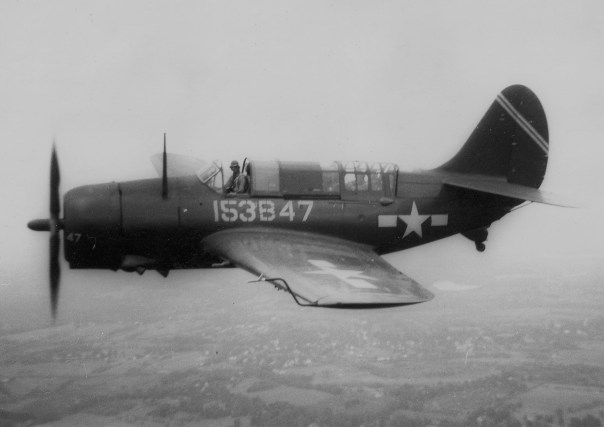
SB2C of VT-153 courtesy of Jack Cook.
After diving deep into each of the men, I had one remaining piece of information left to work through – the insignia of the griffin that was engraved on the top of the cigarette box. I started to seek insignia for all of the listed squadrons. I was able to locate just two insignia and squadron nicknames: VBF-153 was listed as the “Copperheads” though the corresponding insignia that I found didn’t seem to fit the name (more research to follow); VB-153 was known as the “Flying Cannons” and its insignia seemed to fit perfectly.
-
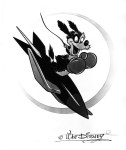
- VBF-153 insignia as drawn by Disney.
-
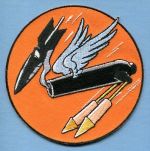
- Bombing Squadron (VB) 153 (“The Flying Cannons”) insignia patch.
-
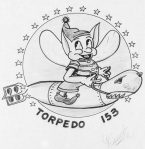
- The “Gremlins” of Torpedo 153 VT-153 (Courtesy of Jack Cook).
My contact at the U.S. Militaria Forum provided me with the insignia for VT-153 which added confusion; the “Gremlins” as they were known, did little to support my thought that the griffin on the box bore some significance, however, that isn’t where my trail ended. Following the lineage of each squadron, I found that VA-153 (“A” for attack squadron, the current designation for a carrier-based fixed wing bombing aircraft), which was disestablished in 1977, employed a very similar-looking griffin in their logo. The two griffin appearances is more than likely coincidental but it certainly leaves me with the idea that there is some connection.
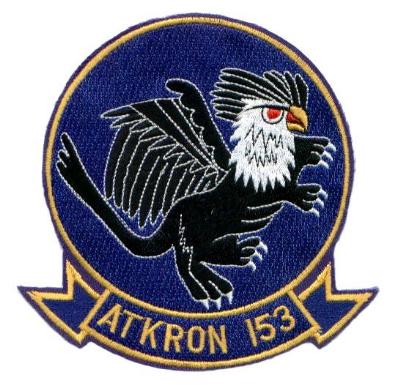
Attack Squadron 153’s insignia – a griffin – (as seen on their unit patch) has to be more than mere coincidence considering the similar image on the cigarette box
Ultimately, my research did not provide me with any sort of definitive evidence that I could use to pinpoint the original owner of my silver cigarette box. I am deducing that it was most likely given to LCDR Frederick G. Lewis from his air group colleagues near or after the end of World War II.
Read more about collecting unusual militaria:
Airborne Radiomen
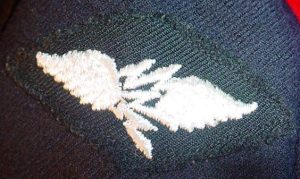
This Aviation Radioman distinguishing mark adorns the sleeve of a seaman 1/c jumper from WWII. Men and women trained to service and operate specific radio equipment for naval air forces during WWII (source: eBay image).
A simple scan of the topics of the articles that I have written over the last (nearly) six years of this site reveals that I am heavily biased towards militaria artifacts from naval service. In reviewing the books that are in my personal library, the overwhelming subjects are naval history (the runner-up topic being baseball). Within the sphere of naval militaria collecting, enlisted uniform-items dominate what I possess – rating badges, patches, hats, caps and covers and of course, the uniforms themselves.
I have a personal connection that fuels my interest in a specific area of Navy ratings – including the development of the technology that surrounds that area: radio and RADAR – and my collection is dominated by the associated job specialties. I have written about the development of radar and the radarman rating and radiomen due to the several uniforms that I have within my collection, my family history and my own interest in the application of the technology for combat advantage.
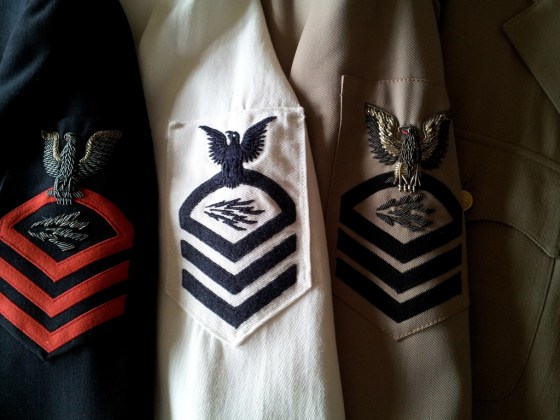
Three of my WWII chief petty officer uniform jackets are part of my predominant radioman and radarman militaria collecting focus.
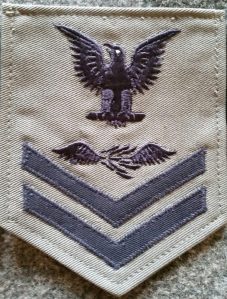
Established in 1942 and enduring throughout WWII, the Aviation Radioman rating is an example of the Navys rapid technological advancement and the need to train and man the ranks accordingly.
Within the radio and RADAR arena of my collecting, I have barely touched upon these jobs as they apply to naval aviation. In terms of airborne technology, World War II saw rapid advancement in the equipment and adoption and usage to gain an edge against enemy forces. One of the ratings that played a significant role in this arena was the Aviation Radioman which was established in all grades (third, second, first class and chief petty officers) in January 1942 after recognizing the need to differentiate these radiomen from their shipboard counterparts. As with the sea-going radiomen, the field of ArMs were split between those who operated the equipment (Aviation Radiomen) and those who were skilled technicians (Aviation Radio Technician) and yet they wore the same rating insignia. In some instances, the sailors had perform in both capacities. As with the shipboard and submariners, certain aviation radiomen were aircrewmen – part of the crew that served on missions within the aircraft.
Stephen R. Walley, Aviation Radioman 2nd Class (of Albany, NY) spoke about his naval career during a May 20, 2006 interview with the New York State Military Museum. Walley’s pathway to becoming and ArM was fairly typical, stating that when he enlisted (in September, 1942) to serve, he opted to train as a Radioman in the Navy. After completing his basic training in Newport, RI, Mr. Walley was sent to four months of schooling for shipboard radio training. ”Upon completion of that course, I came out as a Radioman third petty officer.” Walley said of his early career. “At the last week of the course,” Stephen continued, “we had people come in from naval school in Memphis, Tennessee asking for volunteers to become Aviation Radiomen.” Six to eight of Walley’s graduating class from radioman school reported to Memphis for ten weeks of aviation training, learning additional skills for communication and operating aircraft radio and comms equipment. Because airborne RADAR technology was in its infancy at the time of Walley’s career, he had two additional weeks of education in operating and maintaining equipment to be prepared when the fleet aircraft would be outfitted with the highly secret gear.
-
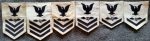
- The aviation radioman rating symbol can vary dependent upon the manufacturer of the rating badge.
-
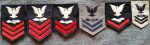
- Purely a WWII rating, these aviation radioman badges range from first to third class petty officer. Note the rating badge for the short-lived service dress gray uniform. At the far right is the female seersucker rating badge.
-
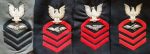
- Chief petty officer aviation radioman rating badges. These bullion beauties are all unused. Note the service dress gray version at the left and the very odd arrangement of the radioman “sparks” on the far right example.
Airborne radiomen required additional training in aerial gunnery school in order to be proficient in providing protection from enemy fighter aircraft. Dive (Douglas SBD Dauntless and Curtiss SB2C Helldiver) and torpedo bomber (Grumman TBF Avenger and Douglas TBD Devastator) aircraft were equipped with .30 caliber machine guns (the Avenger two gunners – the ArM would typically man the ventral-mounted .30 cal versus the dorsal .50 caliber gun) which would be the primary responsibility of these radiomen when enemy aircraft were present. Aerial gunnery school was an additional ten weeks where upon completion, these men would either choose or be selected (based upon the candidates’ height) for their aircraft assignments. The shorter men, up to 5’-9” were better suited for the cramped cockpits of the carrier-based aircraft and the taller men were assigned to train for the large, land and sea-based planes (such as the Consolidated Catalina PBY and the PB4Y-2 Privateer).
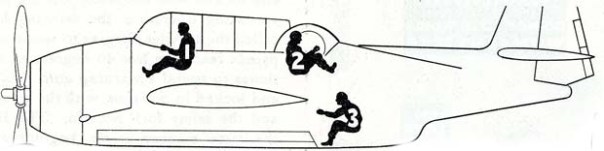
There were three crew members: (1) pilot, (2) turret gunner and (3) radioman/bombardier/ventral gunner – an aviation radioman.
With nearly 21,000 carrier-based aircraft (out of more than 56,000 naval combat aircraft), the need for ArMs was substantial. Not only was the demand for manning aircrews but also for the maintenance staff within the squadrons. In addition, aviation radiomen would fill positions in support of the airwing communications within the radio spaces of the embarked aircraft carriers. Add to this demand, manning requirements for the dozens of naval air stations and facilities in the continental United States and in the Pacific theater meant that there were countless thousands of men and women who served as aviation radiomen during the war.
In some instances, aviation radiomen served as pilots of aircraft (primarily filled by naval aviators and enlisted naval aviation pilots), such was the case for CArM Johnnie E. Mattis during the battle of the Coral Sea in 1942 when he was piloting his torpedo bomber in a harrowing attack on a Japanese carrier, scoring a hit against tremendous odds. In all, more than 650 medals of valor (for the Navy, these include the Bronze and Silver Star medals, Navy and Marine Corps medal, Distinguished Flying Cross, Air Medal, and the Medal of Honor) were conferred upon aviation radiomen for their service above and beyond the call of duty during WWII.
Navy Cross Recipients:
- Bradley, Russell J., Aviation Radioman Third Class
- Karrol, Joseph J., Aviation Radioman First Class
- Mattis, Johnnie E., Aviation Chief Radioman
- Stokely, George D., Aviation Radioman First Class
With the rapid advancement in technology in the Navy and the massive expansion of ratings leading up to and during World War II, changes were afoot for Aviation Radiomen in the years immediately following the War. The peacetime navy ranks experienced considerable contraction as more than 70% (2.3 million) of those serving at the War’s end were discharged back into civilian life. In 1945, the Aviation Radioman rating was renamed to Aviation Electronics Technician’s Mate while still wearing the same mark.
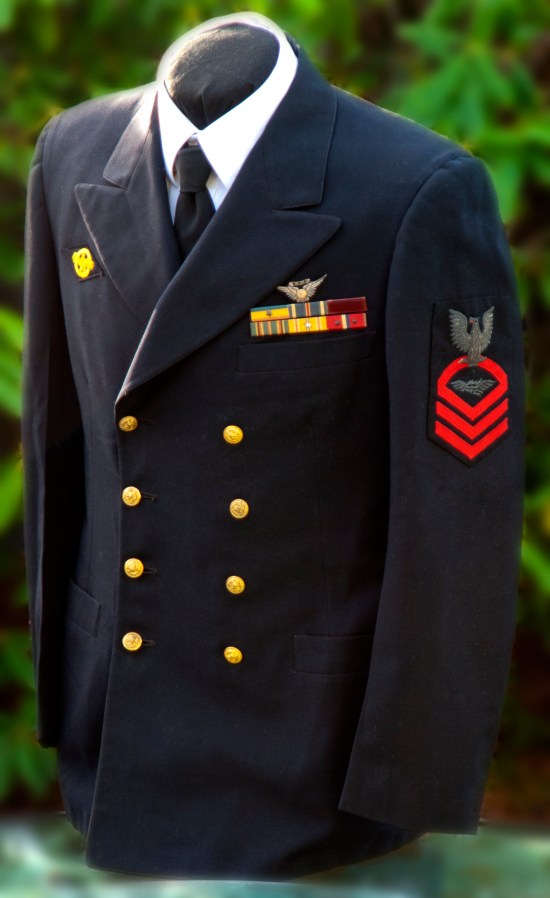
This early WWII eight-button chief aviation radioman jacket has a beautiful bullion rating badge. The chief is seemingly missing a hashmark but he only served during World War II . Also featured on this jacket are the combat aircrew pin and the chief’s ruptured duck discharge patch (note that the combat aircrew wing and ribbons were added solely for the purposes of display. The sailor named in the jacket spent the duration of the war at Naval Air Station San Juan, PR).
As with the changes in Radioman rating (Electronics Technician’s Mate which was the technician side of the RM rating from 1942-1945 – was split out in 1948, creating the new ET or Electronics Technician), a new rating was established from the Aviation Radioman rating in 1948; Aviation Electronics Technician (AT).
| DATE | 8/14/45* | 6/30/46 | 6/30/47 | 6/30/48 | 6/30/49 | 6/30/50 |
| BATTLESHIPS | 23 | 10 | 4 | 2 | 1 | 1 |
| CARRIERS, FLEET | 28 | 15 | 14 | 13 | 11 | 11 |
| CARRIERS, ESCORT | 71 | 10 | 8 | 7 | 7 | 4 |
| CRUISERS | 72 | 36 | 32 | 32 | 18 | 13 |
| DESTROYERS | 377 | 145 | 138 | 134 | 143 | 137 |
| FRIGATES | 361 | 35 | 24 | 12 | 12 | 10 |
| SUBMARINES | 232 | 85 | 80 | 74 | 79 | 72 |
| MINE WARFARE | 586 | 112 | 55 | 54 | 52 | 56 |
| PATROL | 1204 | 119 | 74 | 50 | 50 | 33 |
| AMPHIBIOUS | 2547 | 275 | 107 | 86 | 60 | 79 |
| AUXILIARY | 1267 | 406 | 306 | 273 | 257 | 218 |
| SURFACE WARSHIPS | 833 | 226 | 198 | 180 | 174 | 161 |
| TOTAL ACTIVE | 6768 | 1248 | 842 | 737 | 690 | 634 |
* V-J Day (source: Naval History and Heritage Command)
| Year | Active Naval Personnel |
| 1940 | 160,997 |
| 1941 | 284,427 |
| 1942 | 640,570 |
| 1943 | 1,741,750 |
| 1944 | 2,981,365 |
| 1945 | 3,319,586 |
| 1946 | 978,203 |
| 1947 | 497,773 |
| 1948 | 417,535 |
| 1949 | 447,901 |
| 1950 | 380,739 |
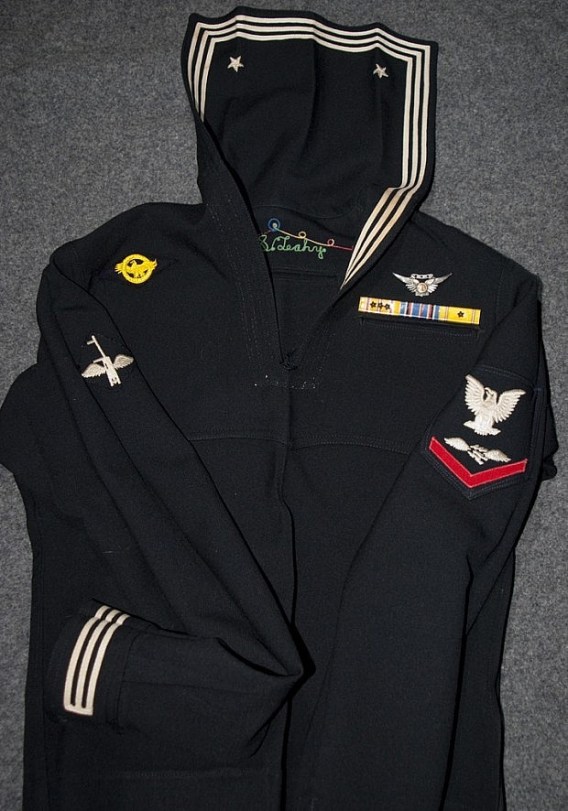
When the Navy began to specialize the enlisted ranks in the late 1800s, special marks were incorporated to denote the skills of the enlisted sailors. This WWII aviation radioman 3/c uniform has the distinguishing mark of an aerial gunner on the right sleeve.
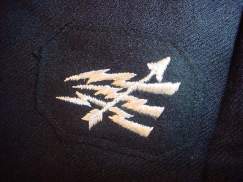
This aviation radioman seaman 1/c wore a Radarman distinguishing mark on the lower right sleeve of his uniform.
Collecting ArM rating badges, distinguishing marks, devices and uniforms along with other, more significant items such as named/engraved decorations (Distinguished Flying Cross, Air Medal, Silver and Bronze Stars and Purple Heart medals) is rather rewarding, considering that the rating essentially existed for the duration of WWII. For my collection, I have acquired a selection of various rating badges and two named uniform items. While I have a sparse collection of navy decorations, both of the two uniform tops; one, a chief aviation radioman technician (CArT) and the other, a ArM3/c (with an aerial gunner distinguishing mark) were great additions even though they were stripped of decorations.
-
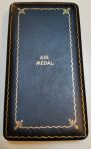
- This WWII-era “coffin” style medal case holds the most common medal for U.S. armed forces aviators and air crewmen.
-
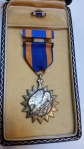
- This WWII Air Medal set includes the standard wide ribbon and lapel pin.
-
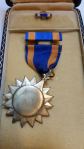
- Engraved medals showing the awardees name, rank and sometimes a date make these medals far more desirable by collectors.
There are militaria collectors who focus on very specific artifact types such as wing devices. Still, some may hone in more tightly, choosing to keep their collecting on naval wings (of which, there are countless variations throughout the 100+ years of existence). Within my “museum,” I have a few navy wings and among them is one WWII-era combat aircrew wing device.
-
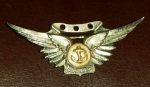
- This WWII combat air crew wing has three places for gold stars to denote the wearer’s individual combat awards.
-
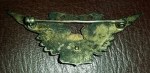
- The back of the Combat Aircrew wing is marked “sterling” and has the maker’s mark just below and to the right of the fastener.
“The insignia featured a banner across the top on which eligible sailors could affix up to three stars signifying individual combat awards. Aircrews engaging enemy aircraft, singly or in formation; engaging armed enemy combatant vessels with bombs, torpedoes or machine guns; and engaging in bombing or offensive operations against fortified enemy positions were qualified to wear a combat star, with unit commander approval, on their aircrew breast insignia.”
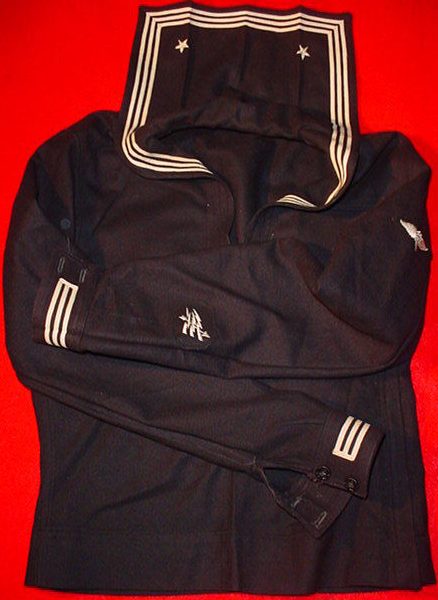
This seaman first class aviation radioman jumper shows that he was a radar technician for airborne radar equipment. This is the first example of an ArM that I have seen with the radarman distinguishing mark.
In performing the research or this article, I made several discoveries and learned how overlooked by collectors and historians alike, these men are. The distinguished actions and sacrifices made by the naval aviators (piloting the aircraft) seem to have overshadowed the duties performed by the flying radiomen of the United States Navy during the second world war.
Related Articles
- Tracking U.S. Navy Specialties: The History of Radarmen
- Rare Bird – Outside of Uniform Regulations
- Silver Eagles: Navy Bullion Rates
- Cryptology and the Battle of Midway – Emergence of a New Weapon of Warfare
- The Militaria Collector’s Search for the White Whale
- Militaria Rewards – Researching the Veteran

Learning to Listen to that Quiet Voice of Reason: A Medal That Wasn’t Quite Right
You see the militaria item and at first glance, it looks great. Your heart starts racing as you begin to realize that you’re finally getting your hands one a highly sought-after piece of history. Understanding the story behind the piece, the sweat begins to bead on your forehead. “Could this be one of those?” you question yourself. The convincing thoughts race through your mind as you begin to dig through your wallet for the credit card thinking,“I am sure of it!”
Fighting back any thoughts of doubt, you hurriedly pay for the treasure. Once in your hands, you begin to begin to examine the details. The doubts come rushing back along with the possibility that regret will soon follow. This scenario is bound to happen, even to the most seasoned experts. Eventually, every collector will experience the letdown upon the discovery that they rushed into a purchase ignoring all the education and experience that would have protected them from buying a fake.
My experience came last year when I spotted a much coveted Navy Expeditionary Medal with the rare Wake Island clasp affixed to the ribbon. The medal (with the clasp) was awarded only to those sailors and marines who served in defense of Wake Island in December, 1941 from the 7th to the 22nd.
More than 450 Marines and nearly 70 naval personnel bravely repelled multiple Japanese aerial and naval bombardments and landing assaults as the Japanese attempted to wrest the island away from the U.S. forces. Severely outnumbered more than five to one, the Americans finally surrendered Wake to the enemy. Suffering 120 killed in action and 50 wounded, the Americans inflicted heavy losses on the Japanese forces sinking two destroyers and two patrol boats as well as heavily damaging a light cruiser. Japanese landing forces suffered 820 killed and more than 330 wounded in action.
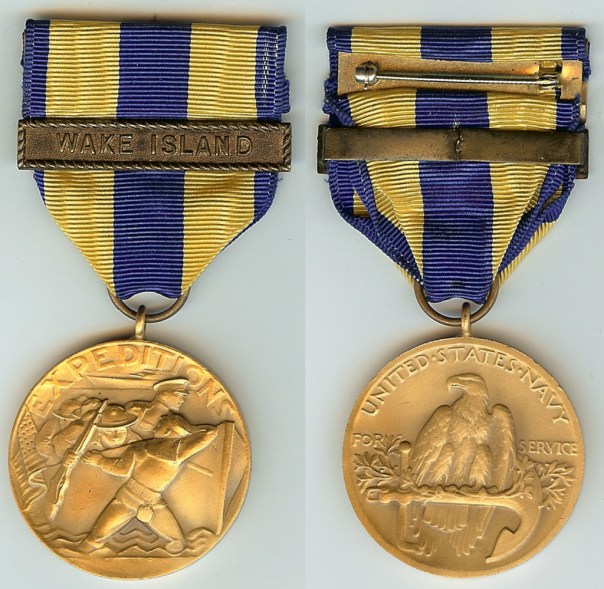
My 1950s HLP-made Navy Expeditionary Medal with the fake Wake Island clasp.
My “fake” medal consists of a late 1950s authentic Navy Expeditionary medal with HLP (for the maker, His Lordship Products, Inc.) stamped into the rim of the planchet. The details of the strike are quite fine and even the most subtle areas of the design are quite crisp. The planchet is significantly thicker than a modern strike and is devoid of the modern synthetic antiquing. The brooch indicates that it is from the late ‘50s to early ‘60s.
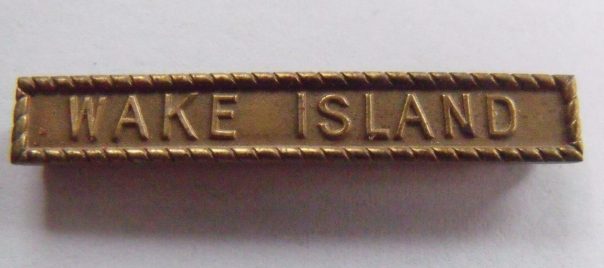
To compare, this Wake Island clasp for the Navy Expeditionary Medal appears to be authentic. Note the crisp lettering and sharpness to the detail of the rope-border (source: eBay image).
Where the trouble with this medal starts to surface is with close examination of the Wake Island clasp. Ignoring the Rube Goldberg hack-job on the reverse (which can be overlooked…I have seen other claps butchered, although not quite as bad as this), the face is where I should have focused my initial attention.
-
- Showing the detail of the “WAKE” lettering and border (source: eBay image).
-
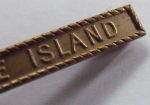
- Note the crisp lettering and the rope border (source: eBay image).
-
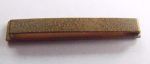
- The back side of the Wake Clasp (source: eBay image).
Upon a close examination of the field (of the clasp), I noticed the bumpy surface between the lettering and the edge where it should have been smooth. I also noticed that the lettering and the rope-design that surrounded the face all looked blurry or soft (as opposed to being crisp and sharp). All of these issues should have set off alarm bells in my head. All of these discernible issues indicate that the clasp was a forgery – a product of sand mold-casting, which is a cheap reproduction method that is routinely employed in these forgeries.
I will chalk this episode up as a lesson learned. I am keeping this medal in my collection as both a reminder and a nice “filler” as I will probably never be able to afford an authentic example. Everything else about the medal, suspension and clasp is makes this an otherwise very nice example of an early Navy Expeditionary Medal.
Historic Group Spotlight: Naval Aviator who Spotted and Maintained Visual Contact of the Bismarck
Most of the militaria and artifacts that I write about are pieces that are in my collection or are historical events that have some sort of personal context or connection. There are times, however that I find myself absolutely fascinated with artifacts in others’ collections that have me absolutely captivated. The subject of my efforts in this piece has me captivated both by the items and their original owner’s participation in history.
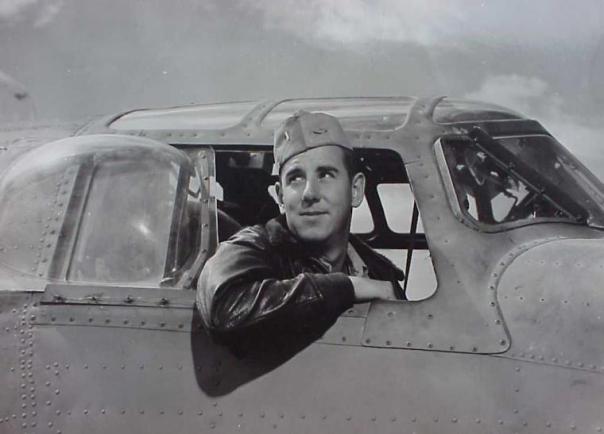
U.S. naval aviator, Carl Rinehart in the co-pilot seat during World War II (image source: Kurt Stauffer).
Militaria collecting, for me and many other collectors, is about the history. More specifically, it is about the individual and personal connections to historical events. For collectors, seeking out and acquiring artifacts from veterans who participated in pivotal or notable events helps to breathe life into what can otherwise be, for much of the population, a mundane event from the past.
The average American fan of World War II history is familiar with events tied to the more obvious specific dates: December 7, 1941, June 6, 1944 or perhaps even, August 6, 1945. For those of you who might need some hints as your morning coffee or tea has yet to take effect: Pearl Harbor, D-Day and Hiroshima. Most people know about specific campaigns and battles such as Iwo Jima, Midway, Operation Overlord and the Battle of the Bulge.
Considering those details, how many Americans are familiar enough with history to understand that World War II was being fought in Europe for nearly two years prior to the United States Congress’ war declaration on December 8th? For that matter, war was in full swing in Asia for almost five years by December of 1941. With this in mind, how many of the American public understand that though the U.S. was abstaining from the war and clinging to the isolationist stance, U.S. servicemen were, in fact, active and serving in both the Pacific and European theaters?
Perhaps one of the most significant naval pursuits (culminating in two significant battles) during those early years of WWII surrounds the engagement between the navy of Great Britain and the German Kriegsmarine that spanned six days in May of 1941. A prevalent and familiar battle cry that still resonates from that time was the call to “Sink the Bismarck” as the British sought to both avenge the loss of the HMS Hood (at the Battle of the Denmark Strait on May 24, 1941) and prevent the German ship from succeeding in her mission to disrupt the transatlantic shipping lifeline from North America (Operation Rheinübung). The Royal Navy ultimately prevailed in her mission, ending the German battleship’s short-lived career with the effective employment of carrier-based aircraft to disable the ship followed by naval gunfire to send her to the bottom on May 27.
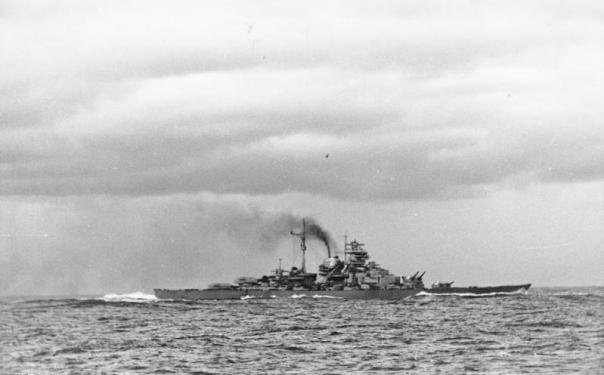
Bismarck after her breakout steams near Iceland prior to the Battle of Denmark Strait, 1941.
These naval battles between our ally and the Germans are the subject study by historians and military strategists alike and are frequently popularized with articles, books and television programs, keeping the history on the forefront of cultural heritage on both sides of the Atlantic. But one fact that is seldom discussed is that American naval aviators played a small role in the Royal Navy’s open-ocean victory.
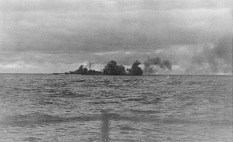
Bismarck fires her main battery.
In the early years of Britain’s war with Germany, the U.S. was providing assistance in their fight by sending supplies (food, fuel and military equipment) across the ocean in large convoys. Recognizing the significance of that vital lifeline, the Germans re-employed and improved upon a WWI tactic of utilizing submarines (U-boats) in “wolf-packs” to destroy, or at least, disrupt the movement of the convoys, sending thousands of tons of merchant ships to the ocean bottom. In response, the U.S. began supplying Britain with long-range patrol and bomber aircraft providing an effective counter-tactic, protecting the convoys from the subsurface threats.
Just weeks prior to the Bismarck engagements, the Royal Air Force began taking delivery of American-supplied PBY Catalina flying boats. To expedite training of the RAF flight crews on their new aircraft, the U.S. Navy also sent their own support crews and aviators. Despite the U.S. neutrality at this point in the war, some U.S. Navy aircrews would support the RAF by flying patrol missions in the PBYs.
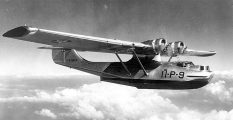
The PBY “Catalina” made by Consolidated was one of the most unsung yet invaluable aircraft of WWII.
Days following the Denmark Strait engagement (and the loss of the battlecruiser Hood), a Consolidated-built PBY-5 Catalina departed Oban, Scotland on a patrol mission in search of the Bismarck. PBY “O” with Carl W. Rinehart in command, launched May 26 at 12:15pm on what would become a record-setting (for airborne length of time) and historic flight. Twelve hours later, Rinehart’s crew spotted the Bismarck steaming in the direction of occupied France (the ship had been spotted and position reported hours earlier by another U.S. Navy Catalina pilot, Ensign Leonard B. Smith). Dropping down for a closer look, the Catalina descended from the clouds into a firestorm of anti-aircraft gunnery from the enemy ship, and Rinehart and his co-pilot struggled to maneuver the flying boat to safety.
-
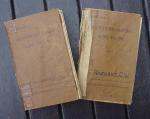
- The pinnacle of the Rinehart group – his naval aviator flight log books. It is fascinating to see such monumental historic moments on the pages of these logs (image source: Kurt Stauffer).
-
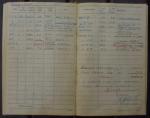
- Rinehart’s Flight Log – Entries for May, 1941. Note the entry with the red pencil encircling of two specific entries – the 26.2 hours of flight and the search for the Bismarck (image source: Kurt Stauffer).
-
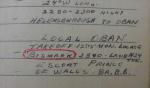
- The entry for the May 26-27, 1941 Bismarck search mission that resulted in a record-setting flight for time in the air. It also resulted in locating the enemy ship and maintaining contact until she was sunk (image source: Kurt Stauffer).
Remaining in the vicinity of the Bismarck, Rinehart and his crew maintained visual contact with the ship observing the ensuing aerial torpedo assault by the Swordfish aircraft from the HMS Ark Royal on the evening of the 26th. Now with her rudders jammed, Bismarck was unable to continue her course to the safety of German air cover. Over the course of the night, the Royal Navy was able to draw in the attacking surface force and bring about the end of the Kriegsmarine’s pride. Catalina “O” and her crew were present, witnessing the entire last battle of the Bismarck. Low on fuel, Rinehart turned his plane on a heading to return to base. Touching down at 13:40 on May 27, his Catalina had been airborne for more than 26 hours of continual flight.
Rinehart would continue to serve throughout WWII and through the Korean War. He retired from the navy with the rank of captain having earned the Distinguished Flying Cross (not for the Bismarck patrol). Captain Rinehart passed away in 1996 at the age of 83 in Pensacola, Florida.
-
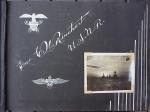
- Rinehart’s Photo Album Cover (image source: Kurt Stauffer).
-
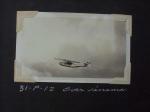
- One of the images in Rinehart’s photo album showing a PBY Catalina, 31-P-21, in flight over Panama (image source: Kurt Stauffer).
-
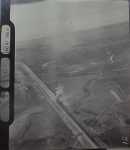
- Rinehart Image – Lining up for a bombing run on an enemy train (image source: Kurt Stauffer).
-
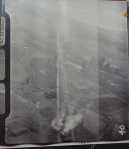
- Another scan of a Rinehart Image of what appears to be an attack on a train(image source: Kurt Stauffer).
-
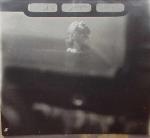
- One of Carl Rinehart’s photos of an aerial bomb exploding over a target. This image was probably taken, most likely, from Rinehart’s PBY (image source: Kurt Stauffer).
Years later, artifacts from his lengthy naval career surfaced at auction and one collector was fortunate to acquire several items, piecing together this well-rounded group that documents Captain Rinehart’s tenure. Among his decorations and ribbons are Rinehart’s service and campaign medals along with his DFC medal. There are also the usual rank devices and a nice set of gold naval aviator’s wings and other insignia devices all belonging to Rinehart.
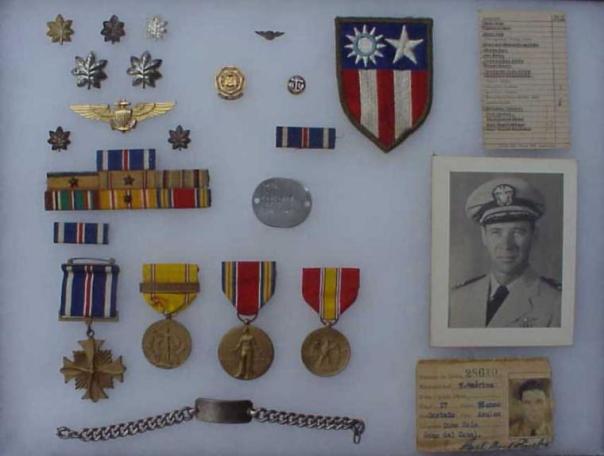
This excellent collection of medals, devices and other personal pieces from Captain Rinehart’s naval service are a nice example of a WWII naval aviator’s service. As Rinehart served through the Korean War, he most certainly would have had additional medals and ribbons along with devices for his final rank. These pieces must exist in another collector’s possession (image source: Kurt Stauffer).
For me, the items that truly makes this group stand out are ephemera. This collector was able to obtain Rinehart’s spectacular photo album containing snapshots from his wartime service. While each of these images are one-of-a-kind and represent a seldom seen vantage point into the life of WWII decorated flying boat aviator, they still pale in comparison to the central, most historically significant aspect of Rinehart group, his flight log books.
-
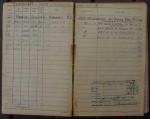
- The first entry on this page sums up the historic day, the capitulation aboard the USS Missouri by the Japanese (image source: Kurt Stauffer).
-
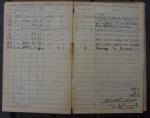
- Rinehart noted that the Japanese had agreed to the unconditional surrender terms of the Allied forces (image source: Kurt Stauffer).
-
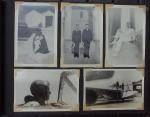
- A page from Rinehart’s Photo Album (image source: Kurt Stauffer).
-
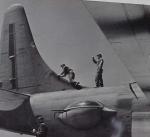
- Rinehart Image – Performing Maintenance on the PBY’s vertical stabilizer (image source: Kurt Stauffer).
Thumbing through the pages, there are significant events noted by Rinehart among his various flights and missions including, “Peace Signed Aboard BB USS Missouri in Tokyo Bay V-J Day.” Capping off the log entries is one particular flight with mention of the Bismarck search circled in red colored pencil and the take-off/landing times.
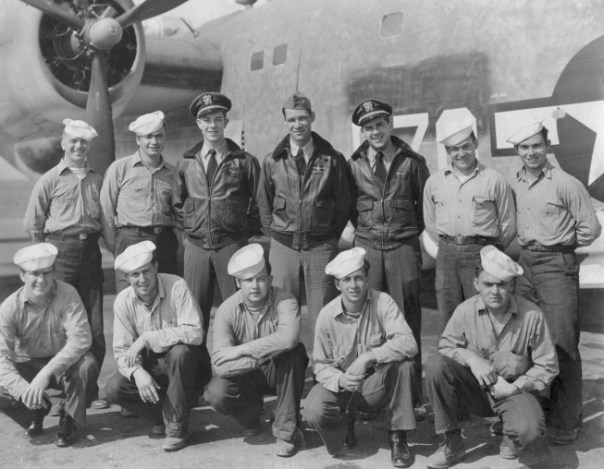
Rinehart’s PBY Crew somewhere in the South Pacific during World War II (image source: Kurt Stauffer).
While a grouping from Rinehart’s more notable colleague, Leonard Smith, might bring more attention and monetary value, this group is no less historically significant.
(All photos depicting the Carl Rinehart collection are courtesy of Kurt Stauffer unless otherwise noted)
 The Veteran's Collection