Category Archives: Ephemera and Photographs
Historic Group Spotlight: Naval Aviator who Spotted and Maintained Visual Contact of the Bismarck
Most of the militaria and artifacts that I write about are pieces that are in my collection or are historical events that have some sort of personal context or connection. There are times, however that I find myself absolutely fascinated with artifacts in others’ collections that have me absolutely captivated. The subject of my efforts in this piece has me captivated both by the items and their original owner’s participation in history.
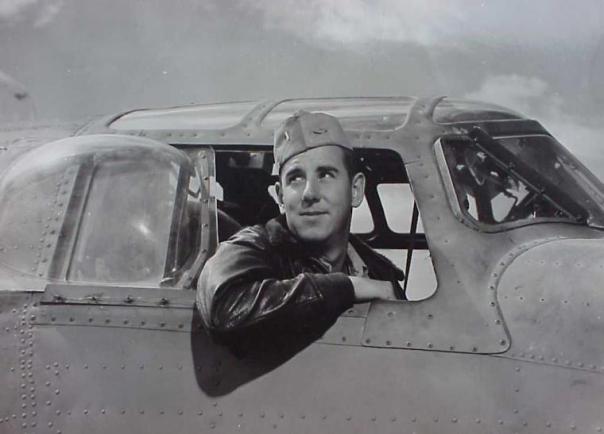
U.S. naval aviator, Carl Rinehart in the co-pilot seat during World War II (image source: Kurt Stauffer).
Militaria collecting, for me and many other collectors, is about the history. More specifically, it is about the individual and personal connections to historical events. For collectors, seeking out and acquiring artifacts from veterans who participated in pivotal or notable events helps to breathe life into what can otherwise be, for much of the population, a mundane event from the past.
The average American fan of World War II history is familiar with events tied to the more obvious specific dates: December 7, 1941, June 6, 1944 or perhaps even, August 6, 1945. For those of you who might need some hints as your morning coffee or tea has yet to take effect: Pearl Harbor, D-Day and Hiroshima. Most people know about specific campaigns and battles such as Iwo Jima, Midway, Operation Overlord and the Battle of the Bulge.
Considering those details, how many Americans are familiar enough with history to understand that World War II was being fought in Europe for nearly two years prior to the United States Congress’ war declaration on December 8th? For that matter, war was in full swing in Asia for almost five years by December of 1941. With this in mind, how many of the American public understand that though the U.S. was abstaining from the war and clinging to the isolationist stance, U.S. servicemen were, in fact, active and serving in both the Pacific and European theaters?
Perhaps one of the most significant naval pursuits (culminating in two significant battles) during those early years of WWII surrounds the engagement between the navy of Great Britain and the German Kriegsmarine that spanned six days in May of 1941. A prevalent and familiar battle cry that still resonates from that time was the call to “Sink the Bismarck” as the British sought to both avenge the loss of the HMS Hood (at the Battle of the Denmark Strait on May 24, 1941) and prevent the German ship from succeeding in her mission to disrupt the transatlantic shipping lifeline from North America (Operation Rheinübung). The Royal Navy ultimately prevailed in her mission, ending the German battleship’s short-lived career with the effective employment of carrier-based aircraft to disable the ship followed by naval gunfire to send her to the bottom on May 27.
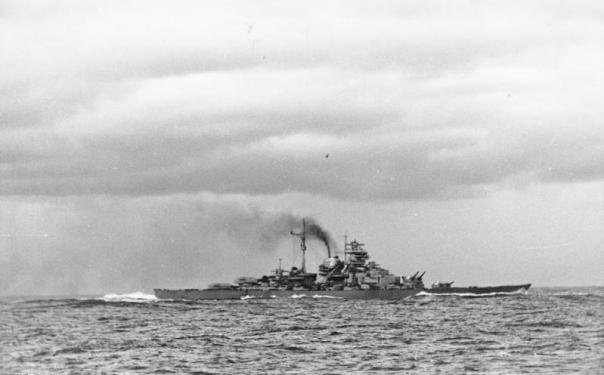
Bismarck after her breakout steams near Iceland prior to the Battle of Denmark Strait, 1941.
These naval battles between our ally and the Germans are the subject study by historians and military strategists alike and are frequently popularized with articles, books and television programs, keeping the history on the forefront of cultural heritage on both sides of the Atlantic. But one fact that is seldom discussed is that American naval aviators played a small role in the Royal Navy’s open-ocean victory.
Bismarck fires her main battery.
In the early years of Britain’s war with Germany, the U.S. was providing assistance in their fight by sending supplies (food, fuel and military equipment) across the ocean in large convoys. Recognizing the significance of that vital lifeline, the Germans re-employed and improved upon a WWI tactic of utilizing submarines (U-boats) in “wolf-packs” to destroy, or at least, disrupt the movement of the convoys, sending thousands of tons of merchant ships to the ocean bottom. In response, the U.S. began supplying Britain with long-range patrol and bomber aircraft providing an effective counter-tactic, protecting the convoys from the subsurface threats.
Just weeks prior to the Bismarck engagements, the Royal Air Force began taking delivery of American-supplied PBY Catalina flying boats. To expedite training of the RAF flight crews on their new aircraft, the U.S. Navy also sent their own support crews and aviators. Despite the U.S. neutrality at this point in the war, some U.S. Navy aircrews would support the RAF by flying patrol missions in the PBYs.
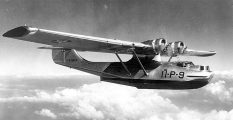
The PBY “Catalina” made by Consolidated was one of the most unsung yet invaluable aircraft of WWII.
Days following the Denmark Strait engagement (and the loss of the battlecruiser Hood), a Consolidated-built PBY-5 Catalina departed Oban, Scotland on a patrol mission in search of the Bismarck. PBY “O” with Carl W. Rinehart in command, launched May 26 at 12:15pm on what would become a record-setting (for airborne length of time) and historic flight. Twelve hours later, Rinehart’s crew spotted the Bismarck steaming in the direction of occupied France (the ship had been spotted and position reported hours earlier by another U.S. Navy Catalina pilot, Ensign Leonard B. Smith). Dropping down for a closer look, the Catalina descended from the clouds into a firestorm of anti-aircraft gunnery from the enemy ship, and Rinehart and his co-pilot struggled to maneuver the flying boat to safety.
-
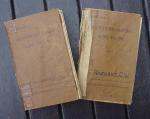
- The pinnacle of the Rinehart group – his naval aviator flight log books. It is fascinating to see such monumental historic moments on the pages of these logs (image source: Kurt Stauffer).
-
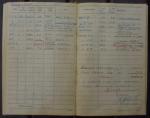
- Rinehart’s Flight Log – Entries for May, 1941. Note the entry with the red pencil encircling of two specific entries – the 26.2 hours of flight and the search for the Bismarck (image source: Kurt Stauffer).
-
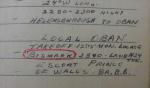
- The entry for the May 26-27, 1941 Bismarck search mission that resulted in a record-setting flight for time in the air. It also resulted in locating the enemy ship and maintaining contact until she was sunk (image source: Kurt Stauffer).
Remaining in the vicinity of the Bismarck, Rinehart and his crew maintained visual contact with the ship observing the ensuing aerial torpedo assault by the Swordfish aircraft from the HMS Ark Royal on the evening of the 26th. Now with her rudders jammed, Bismarck was unable to continue her course to the safety of German air cover. Over the course of the night, the Royal Navy was able to draw in the attacking surface force and bring about the end of the Kriegsmarine’s pride. Catalina “O” and her crew were present, witnessing the entire last battle of the Bismarck. Low on fuel, Rinehart turned his plane on a heading to return to base. Touching down at 13:40 on May 27, his Catalina had been airborne for more than 26 hours of continual flight.
Rinehart would continue to serve throughout WWII and through the Korean War. He retired from the navy with the rank of captain having earned the Distinguished Flying Cross (not for the Bismarck patrol). Captain Rinehart passed away in 1996 at the age of 83 in Pensacola, Florida.
-
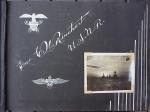
- Rinehart’s Photo Album Cover (image source: Kurt Stauffer).
-
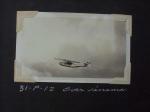
- One of the images in Rinehart’s photo album showing a PBY Catalina, 31-P-21, in flight over Panama (image source: Kurt Stauffer).
-
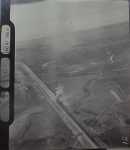
- Rinehart Image – Lining up for a bombing run on an enemy train (image source: Kurt Stauffer).
-
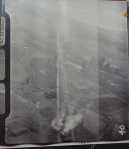
- Another scan of a Rinehart Image of what appears to be an attack on a train(image source: Kurt Stauffer).
-
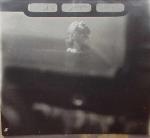
- One of Carl Rinehart’s photos of an aerial bomb exploding over a target. This image was probably taken, most likely, from Rinehart’s PBY (image source: Kurt Stauffer).
Years later, artifacts from his lengthy naval career surfaced at auction and one collector was fortunate to acquire several items, piecing together this well-rounded group that documents Captain Rinehart’s tenure. Among his decorations and ribbons are Rinehart’s service and campaign medals along with his DFC medal. There are also the usual rank devices and a nice set of gold naval aviator’s wings and other insignia devices all belonging to Rinehart.
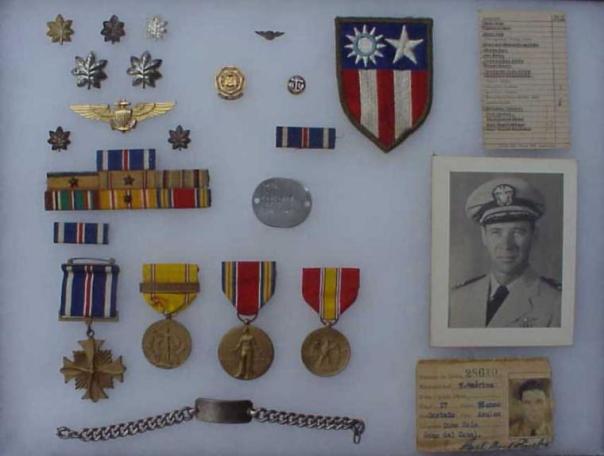
This excellent collection of medals, devices and other personal pieces from Captain Rinehart’s naval service are a nice example of a WWII naval aviator’s service. As Rinehart served through the Korean War, he most certainly would have had additional medals and ribbons along with devices for his final rank. These pieces must exist in another collector’s possession (image source: Kurt Stauffer).
For me, the items that truly makes this group stand out are ephemera. This collector was able to obtain Rinehart’s spectacular photo album containing snapshots from his wartime service. While each of these images are one-of-a-kind and represent a seldom seen vantage point into the life of WWII decorated flying boat aviator, they still pale in comparison to the central, most historically significant aspect of Rinehart group, his flight log books.
-
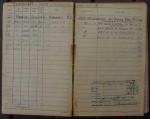
- The first entry on this page sums up the historic day, the capitulation aboard the USS Missouri by the Japanese (image source: Kurt Stauffer).
-
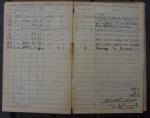
- Rinehart noted that the Japanese had agreed to the unconditional surrender terms of the Allied forces (image source: Kurt Stauffer).
-
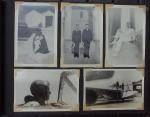
- A page from Rinehart’s Photo Album (image source: Kurt Stauffer).
-
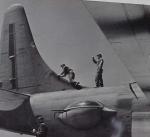
- Rinehart Image – Performing Maintenance on the PBY’s vertical stabilizer (image source: Kurt Stauffer).
Thumbing through the pages, there are significant events noted by Rinehart among his various flights and missions including, “Peace Signed Aboard BB USS Missouri in Tokyo Bay V-J Day.” Capping off the log entries is one particular flight with mention of the Bismarck search circled in red colored pencil and the take-off/landing times.
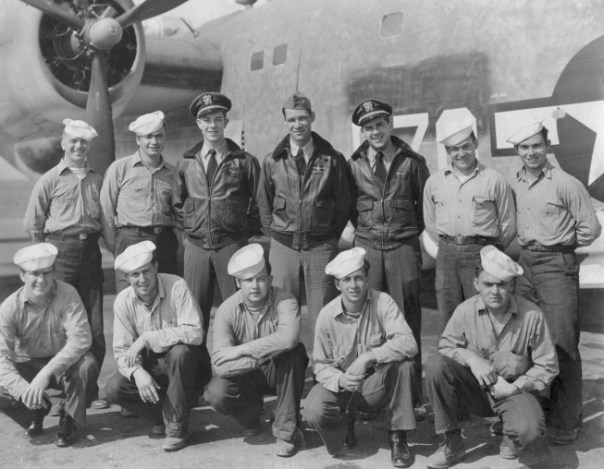
Rinehart’s PBY Crew somewhere in the South Pacific during World War II (image source: Kurt Stauffer).
While a grouping from Rinehart’s more notable colleague, Leonard Smith, might bring more attention and monetary value, this group is no less historically significant.
(All photos depicting the Carl Rinehart collection are courtesy of Kurt Stauffer unless otherwise noted)
Wahoo! A Bounty of Historical and Antique Books!
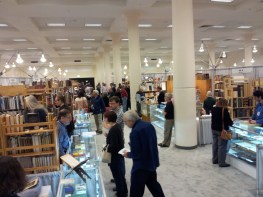
There are abundance of book dealers and vendors to visit at the Seattle Antiquarian Book Fair and attendees should spend time in each booth to find the treasures they seek.
Having attended many types of collectibles (sports memorabilia, coins, comic books, etc.) and antique shows over the course of the past few decades, I can attest that this event (that held my attention for several hours) was probably the most captivating of them all.
Knowing that I had not previously attended a show of this nature, one of my militaria collector colleagues told me about the Seattle Antiquarian Book Fair and that there would be book dealers who specialize in military history and associated rare and hard to find publications. Knowing that I’d have an opportunity to locate an out of print work or simply peruse literal pages of military history made attending this show an absolute must.
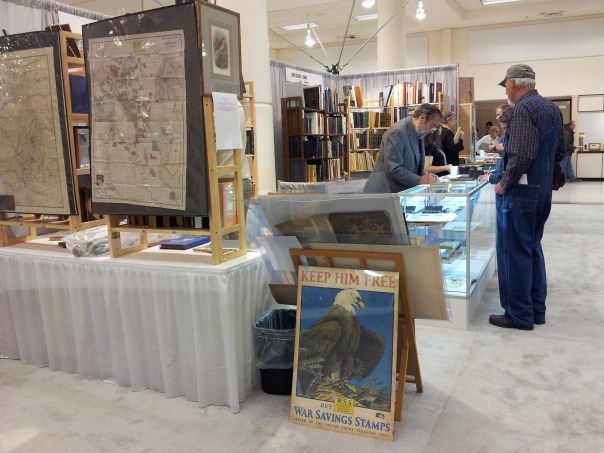
While the Seattle Antiquarian Book Fair is dominated by vintage and collectible books, there is also a considerable amount of ephemera, such as this WWI war savings stamps poster, for sale.
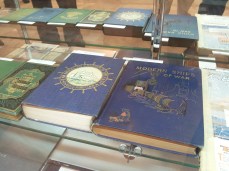
These two late-19th century books are in pristine condition.
Waiting in line to enter the exhibition hall, a staff member briefed the eager crowd about the rules, in order to provide the sellers with a measure of inventory security, to gain admittance: there would be no heavy coats, large bags or loose books allowed in. Once I checked my coat, I walked through the large double doors and my eyes immediately widened. From the highly organized booth spaces, complete with LED-lighted glass display cases and large bookshelves and wall-to-wall carpet, one could tell this wasn’t the typical gathering of vendors.
The very first display that I visited, my eyes were overwhelmed by the pristine, recognizable titles. I began to peer into the gleaming displays featuring books and noted works that were worthy of the bright lights and presentation. Books from the 18th and 19th century in pristine condition were sitting side-by-side with rare, one-of-a-kind manuscripts and documents. Booth after booth, I was continually amazed by each vendor’s wares.
-
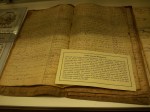
- Although not specifically militaria-related, this late 18th century whaling ship log (from two ships; the Harlequin and Leviathan) was an amazing piece of history to see. At $75,000, it was a few “zeros” out of my financial reach.
-
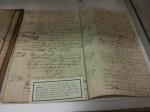
- Yet another whaling ship log. This one for the vessel, William, dates from 1838. Note the whale stamp next to the latitude and longitude entry.
-
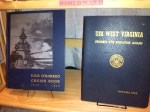
- WWII cruise books of the battleships USS Colorado and USS West Virginia.
-
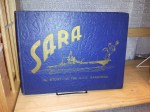
- The aircraft carrier USS Saratoga’s WWII cruise book is in absolute pristine condition and was available for only $200.
Unfortunately for me, most of the pieces that truly held my interest had price tags well into the thousands (such as the Narrative of the Mutiny aboard His Majesty’s Ship Bounty published in 1790 for a mere $12,500, which was exceptional). Had my bank account been more flush, I would have had a much more difficult time trying to make a decision between the various historic items for purchase.
-
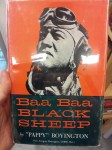
- For a mere $30, this later printing of Medal of Honor recipient Greg Boyington’s autobiographic work was a steal…
-
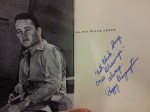
- …That it was autographed was extremely enticing, even though I already had signed copy!
With a few dollars burning a hole in my pocket, I knew I couldn’t leave the show empty-handed. Having walked the entire show over the course of a few hours, I returned to an earlier-visited vendor who specializes in military books and selected the signed first edition of Medal of Honor recipient Rear Admiral Richard O’Kane’s World War II narrative about the legendary submarine, the USS Wahoo and her fearless skipper, Commander Dudley “Mush” Morton.
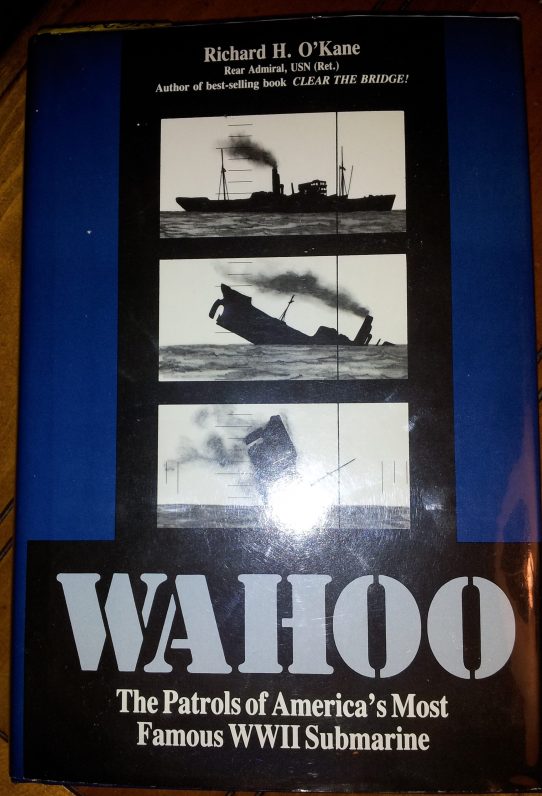
After visiting the military book vendor’s booth several times, I was drawn to add to my collection of Medal of Honor recipients’ autographs; purchasing Rear Admiral O’Kane’s work on the WWII submarine, the USS Wahoo.
With a few dollars burning a hole in my pocket, I knew I couldn’t leave the show empty-handed. Having walked the entire show over the course of a few hours, I returned to an earlier-visited vendor who specializes in military books and selected the signed first edition of Medal of Honor recipient Rear Admiral Richard O’Kane’s World War II narrative about the legendary submarine, the USS Wahoo and her fearless skipper, Commander Dudley “Mush” Morton.
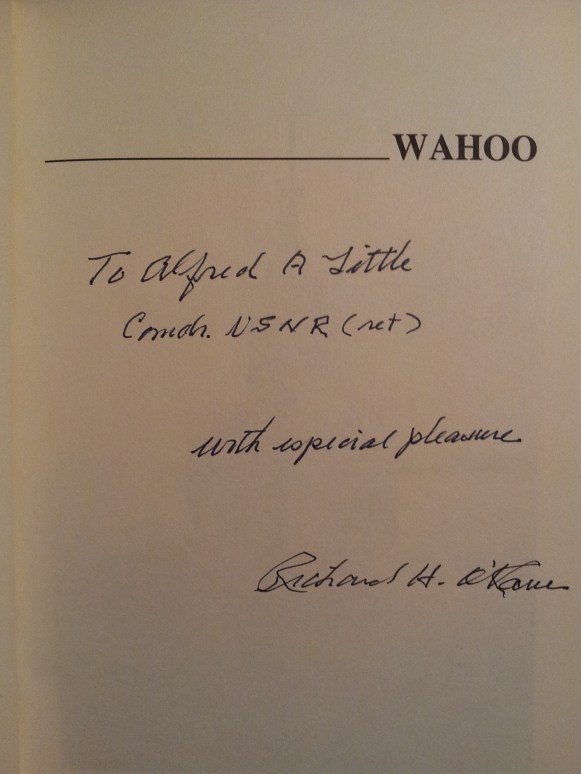
My first edition copy of Wahoo is autographed by Rear Admiral Richard O’Kane.
My feet thoroughly tired and my hunger pangs overwhelming me, my time at the fair drew to a close and I was happy to be leaving with a piece to add to my collection of autographs from notable military veterans.
My Signature Soapbox: Veterans of Valor Autograph Collecting
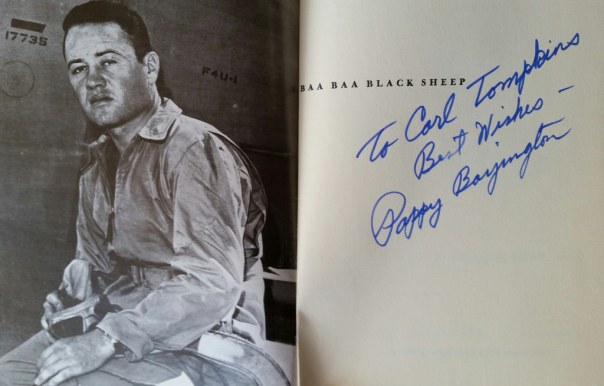
One of my favorite Medal of Honor recipient autographs is this one from Colonel Gregory “Pappy” Boyington.
For the current 2017 Major League Baseball season, twenty four players will earn $21,000,000 or more to play the game. Of those, two pitchers; David Price, Boston Red Sox and Clayton Kershaw, Los Angeles Dodgers will earn $30m and $33m (respectively) to collect “outs” for their teams throughout the season (and post-season).
Being the huge baseball fan that I am, I do understand that the MLB season is gruelingly long at 162 games and half of them are on the road, visiting cities stretching across the United States and into Toronto, Ontario, Canada. Life on the road is difficult and has considerable impact on family life with all the time away. While the season typically starts in late March to early April, for the players, it actually begins in February with spring training. If the team makes it to postseason play, that means they are working from mid-February to late October.
Many athletes’ families do not live in the city in which they are playing, further adding to the separation challenges. Players routinely miss out on birthdays, anniversaries and other family gatherings. For roughly eight months of the year, these athletes are subjected to air travel (some aboard chartered team jets) and the nicest hotel rooms. While on road trips, team equipment managers pack and unpack their gear, ensure that their baggage is in their hotel rooms when they arrive and picked up when they depart the various cities.
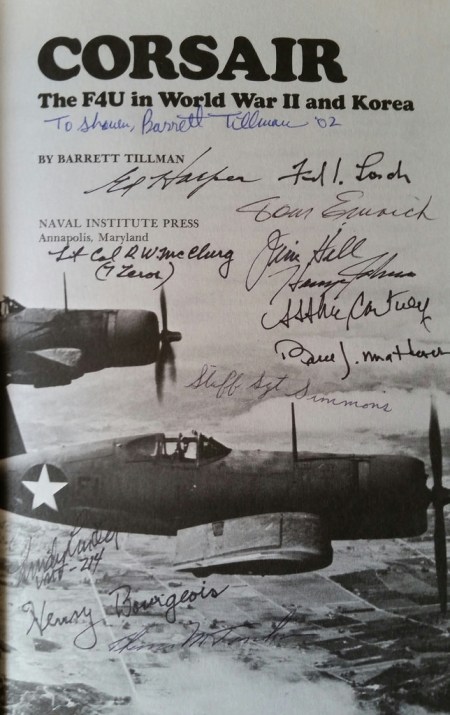
Meeting 12 of the surviving members of the Blacksheep of VMF-214 was a thrill for me. Ace, Lt. Colonel (Pappy Boyington’s wingman) was quite amusing as he and his wife “attempted” to steal my baby daughter, snickering and laughing as he wheeled her stroller away. All that I had to get signed was this book by notable author, Barrett Tillman.
During batting practice and pre-game warm-ups, fans arrive early for the chance at obtaining the autograph of their favorite players on a baseball card, ball or scorecard. Autograph hounds seek out the stars of the game to get as many items signed as possible, even hiring kids to obtain as many signatures of the game’s elite players as possible. Autographs of the stars command premium prices when sold on the market. Many of the stars understand this part of the business (yes, the game of baseball is a business) and choose only to sign at arranged events where they are paid fees, commanding thousands of dollars, further padding their multi-million dollar salaries.
By now, you are asking yourself, “what does this have to do with militaria or military collecting?” I ask that you give me a little latitude as I am getting to the heart of the subject.
As a member of the local aviation museum (which is one of the best in the nation), I occasionally attend functions that typically focus on the stars of military aviation. During these events, one or more figures make appearances where they interact with the audience, detailing or describing their escapades in aerial combat or flight operations in support of significant military historical events. The schedule typically follows the format of a presentation in the auditorium, followed by a question and answer session, then an opportunity for the “fans” to get an autograph.
-
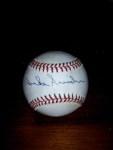
- A few of my crossover autographs are on baseballs. Major League Hall of Fame outfielder for the Brooklyn Dodgers, Edwin “Duke” Snider served in the Pacific Theater as a Navy fireman 1/c aboard a ship. In addition to shipboard service, he played on his ship’s baseball team when they reached friendly ports.
-
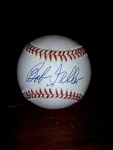
- Navy Gunnersmate Chief, Bob Feller was a star pitcher for the Cleveland Indians for five years before enlisting into the Navy on December 8, 1941. Feller served both at the Naval training station in Great Lakes, IL and saw combat while serving aboard the battleship, USS Alabama. He was elected to baseball’s Hall of Fame in 1962.
-
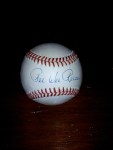
- Harold “Pee Wee” Reese was an All-Star with the Brooklyn Dodgers when he enlisted into the Navy after the 1942 season and spent most of the war serving with Sea Bees in the Pacific, playing for and coaching Navy and USMC ball teams before finishing his Hall of Fame career with the Dodgers, in 1958.
Since I’ve been a member, I have had the opportunity to meet legendary veterans that were significant participants, authors of events that had considerable impact on the outcome of the war. From Marine Corps pilots of the Black Sheep squadron (VMF-214), “sled” (SR-71 Blackbird) drivers, Tuskegee Airmen, and countless Aces from WWII, the Korean and Vietnam wars. The roster of historical figures is nothing short of impressive. While the queue of autograph seekers isn’t small at these events, it pales in comparison to those seeking signatures of the multi-million dollar ballplayers.
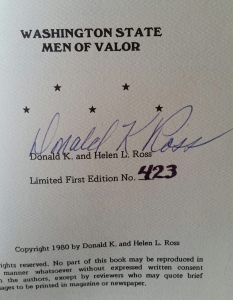
Captain Donald K. Ross, Medal of Honor recipient (for his actions aboard USS Nevada on December 7, 1941) wrote this book about MoH recipients with ties to Ross’ adopted home state.
Is it fair to compare the two? I think it is when we consider the cost of service to our country, especially when one is deployed to a combat zone. The tour of duty isn’t limited to an eight-month season. The training is far more intense and exceedingly more difficult. While batting practice may have its risks (getting hit by a pitch or taking a foul off the foot or leg), ball players aren’t psychologically preparing to protect their own lives or that of their teammates.
Deployments are a far cry from the road trips of their Major League counterparts. Some are cooped up in cramped quarters aboard ship, have to sleep in fox holes, or seek shelter beneath a truck in the desert. Current soldiers, sailors and airmen can spend up to 16 months away from family with occasional access to phones or email for a momentary taste of home. During World War Two, some were in theater for years, on the front lines for months at a time with brief respites mixed in. Mail from home was only an occasional luxury, if at all.
The risks ball players face each time they step out onto the field are real – torn ACL (anterior cruciate ligament ), rotator cuff tears, elbow ligament damage and in some rare cases, the risk of traumatic brain injury (TBI) from a wild pitch to the head. When compared to what our service men and women face – such as being shot; losing limbs, eyesight or hearing; and death – the multi millionaire athletes’ reality takes a significant backseat.
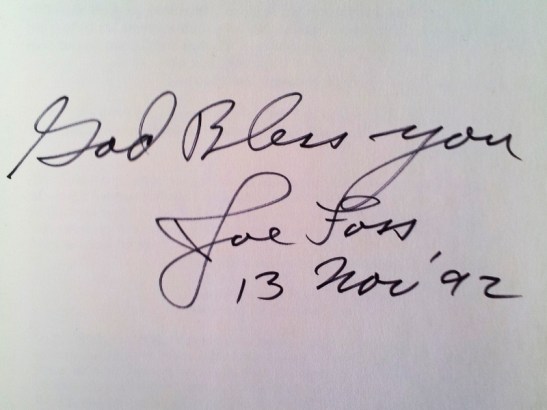
Another Marine Corps ace and Medal of Honor recipient, Major Joe Foss’ signature in his autobiography is a treasured addition to my collection.
Readers might suggest that my comparisons are patently unfair. My response is that the comparison is meant to provide focus on how we the collectors, place value and emphasis on athletes (and actors, musicians, etc.) over those who have sacrificed so much more. While in the area of autograph collecting, signatures from well-known veterans often command high prices on the resale market, lesser known vets or common military personalities get no attention.
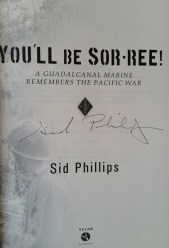
Though he didn’t earn a valor medal for his service in the USMC during WWII, his personal accounts (told in both Ken Burns’ “The War” and Tom Hanks’ “The Pacific” television series) were remarkable. I was happy to receive his signed WWII memoir.
I used to obtain and collect signatures of ball players and amassed quite a collection. Unfortunately, most of the signatures were from prospects who never truly panned out, rendering the collection to more of a humble status in its value. I did manage to obtain some choice stars and hall of fame players. But to me, these pale in comparison to the other more significant inscriptions that I have obtained since I started focusing on veterans.
I doubt that most of the signatures have much in the way of monetary value to autograph collectors, but to me, they are priceless mementos of personal encounters with men who have “been there.” My collection contains autographs from 32 Medal of Honor recipients, two World War II Marine Corps Aces, several WWII, Korean and Vietnam war Navy Cross recipients, several silver star recipients, many prisoners of war and members of the famed “Easy” company (Band of Brothers) veterans and many more.
The personal sacrifices made by these men easily overshadow any significant achievement or career milestone attained by the greatest Hall of Fame baseball player…unless that player also happens to be a combat veteran (my collection contains a few of those signatures as well).
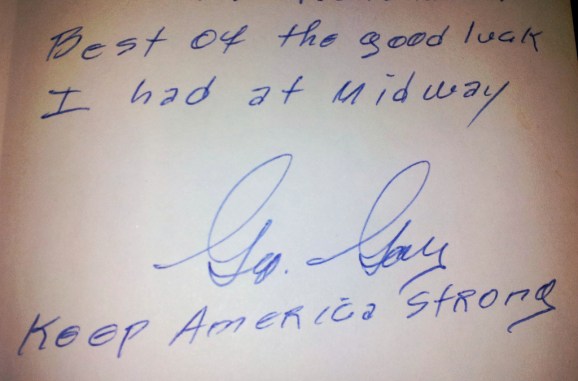
Navy Lieutenant Commander George Gay signed his autobiography in 1982. LCDR Gay was awarded his Navy Cross medal for his squadron’s torpedo dive bomber attack on the Japanese carrier, Kaga. He was the only member of his squadron to survive the attack (all were shot down, including Gay).
I didn’t intend for this posting to be a rant against ballplayers or those who enjoy collecting their autographs. My goal was purely to call attention to the value of those who willingly raise their right hand, swearing to protect this nation from all enemies, foreign and domestic and then proceed to do that very thing. Serving in the military tends to be a very thankless job and when the service member finally hangs up their uniform, there are no invites to attend any All Star weekends for autograph signing sessions.
I surrender my soapbox.
See Also:
Calculated Risks: Bidding on Online Auctions that Contain Errors
Yardlong Photography and the Military: Family Military History Discovery in Less than a Yard
Because I am known within my family and circle of friends as the military-history person, I am on the receiving end of artifacts from those who know about my interests. From the moment that I was gifted with my maternal grandfather’s WWII navy uniforms and decorations (which can be seen in this post) and my grand uncle’s Third Reich war souvenirs, my appreciation for military history was ignited.
Over the years, I have either received or been approached to determine my interest in becoming the steward of historical family military items which have included, uniforms, medals and decorations, weapons (along with artillery rounds and small arms ammunition), flags, documents and other historical pieces. Some of the most special items that I have inherited have been photography (albums and individual photos). With the last box of items that were part of two family estates (my paternal grandparents and a step-relative), I received a nearly two-foot long, vintage panoramic photograph (known as a yardlong photo due to their length: these images can be nearly thee feet in length) of a U.S. Navy crew, professionally positioned and posed pier-side in front of their destroyer.
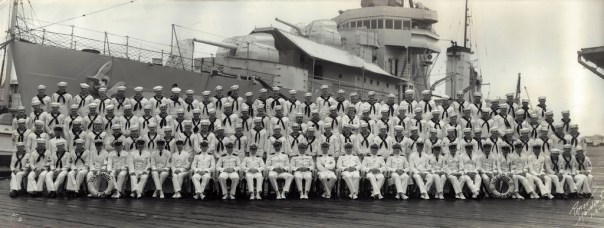
Finding this framed yardlong photo was a pleasant surprise. It took me a second or two to spot the lettering on the life-rings to know that this was my uncles’ ship. Moments later, I found them both, posed with their shipmates.
For the first half of the 20th Century, a common practice within the military was to capture, in photographs, an entire company, regiment, even battalion of soldiers. The same holds true with the compliment of naval vessels with divisions, departments or even the full crew (obviously, size of the ship and on-duty personnel dictate who is present in a photo). The photographs were taken with cameras that allow the lens to be pivoted or panned from side to side in order to span the entire width of the subject, exposing a very large piece of film. As with the negative, the resulting images were elongated and fairly detailed (most often, these were contact prints, the same size as the negative). However the extremities of the photographs were slightly distorted or lacking in crisp lines due to the chromatic aberration that is almost unavoidable. For the most part, the elongated images are quite detailed and almost without exception, faces are recognizable when the military units were captured within these yardlong photographs. There are still photographers creating panoramic images using vintage cameras and film.
-
- While visiting the USAF Airman Heritage Museum at Lackland AFB this past summer, I snapped some photos of this 1947 yardlong of the Air Training Command formation of the USAF insignia.
-
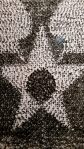
- This image shows the how the command used different uniforms and headgear to form the details of the insignia.
-
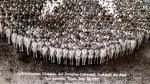
- Moving in closer to the photo, one can see the facial details of the airmen. The caption reads, “Indoctrination Division, Air Training Command, Lackland Air Base, San Antonio, Texas July 19, 1947.
The photograph that I received was in an old frame, backed with corrugated cardboard and pressed against the glass pane. As I inspected the image, I noticed the ship in the background behind the crew that was posed in their dress white uniforms. Noting the blue flaps and cuffs on the enlisted jumpers, I knew that the photo was taken in the 1930s. My eyes were drawn to the two life-rings that were held by sailors on each end of the image, displaying the name of the ship; USS Smith and the hull number, 378. From researching my paternal grandmother’s siblings, I discovered that both of her brothers had served in the U.S. Navy and were both plankowners of the Mahan-class destroyer, USS Smith (DD-378). Dating the image will take a little bit of work (there are no indications of when it was taken – not in the photographer’s marks on either corner nor written on the back). However, I do know when the ship was commissioned, when my uncles reported aboard and departed the ship. Discernible in the image on my uncles’ uniforms are some indications of rank. I can tell that the older brother (who enlisted in 1932) is a petty officer (he reported aboard as a Seaman 1/c) and the younger brother was still a seaman (I can’t see the cuffs of his uniform to determine the number of white piping stripes present) as noted by the blue cord on his right shoulder. I should be able to narrow down the period once I can go through the massive service records to locate dates of rank. However, my initial assessment is that the photo might have been captured near the time of commissioning or, perhaps to commemorate a change of commanding officers.
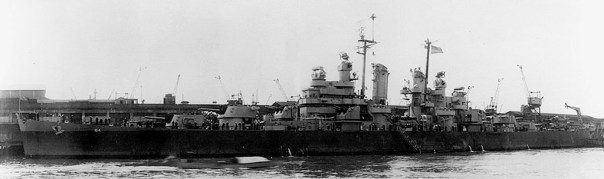
This yardlong image (a scan and a reproduction print) was sent to me by the son a of a veteran who served aboard the USS Vincennes (CL-64) during WWII.
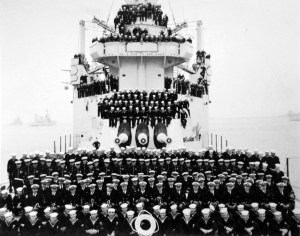
This image was shot using a panoramic camera though it technically isn’t a yardlong photograph. The crew of the USS Vincennes (CA-44) is posed on the ship’s fantail, after 8″ turret and superstructure which is a nod to how many naval crew photos were posed in the late 19th Century.
Being an archivist for my ship and the recipient of some fantastic artifacts, I have been contacted by folks seeking to provide me with images to preserve within my photo archive. A few years ago, a gentleman emailed requesting to send to me a copy of a yardlong photograph that his father, a WWII navy veteran, owned from his time in service. The image was of the second cruiser (USS Vincennes) that was named for the city in Southwestern Indiana. The Cleveland-class light cruiser, hull number 64, had been laid down as the USS Flint but was changed during construction following the loss of the heavy cruiser during the Battle of Savo Island on August 8-9, 1942. The light cruiser was completed and commissioned on January 21, 1944 and served gallantly through WWII and was decommissioned in September of 1946. The man who contacted me had the ship’s photo scanned at a high resolution and sent the image file to me (on a thumb-drive along with a full-size print).

I wish I could have landed this photo of the USS Tacoma (CL-20) crew from 1920, four years before her demise on Blanquilla Reef, Vera Cruz, Mexico.
I am not a collector of yardlong photography but when the images are contextual to the areas that I do collect, I am happy to be able to acquire them. Receiving the image of the Smith and finding my grandmother’s brothers in the photograph motivated me to promptly hang it with my other family military history. In scanning the image for this article, I am reminded that I need to have it properly framed with archival materials to allow it to be preserved for generations to come.
Subtle History – Finding a Unique Naval Militaria Piece
Remaining focused with collecting can be a challenge, especially when it comes to militaria. If you are a die-hard fan of military history, it becomes quite difficult to keep composed when unique pieces of history become available. However, when one of those unique items surface that actually does directly tie-in to one’s principal areas of collecting, it cannot be passed up.
During the first four of my ten years of naval service, I was blessed to be assigned to the pre-commissioning crew of the U.S. Navy’s newest (at that time) cruiser – the first to be assigned to the Pacific Fleet – the USS Vincennes. My assignment was handed to me as I was graduating from my naval training school and, at that time, I had no idea of the history of the name of that ship. It was a name that I struggled to pronounce correctly.
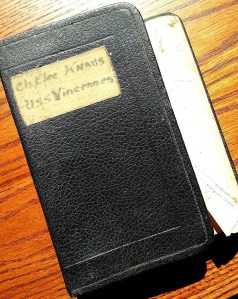
This binder is labeled with the name of the owner (Chief Electrician Knaus) for the USS Vincennes. It was used during the ship’s overhaul in 1939. I still need to research Chief Knaus to see if I can locate any details of his service.
Upon reporting in to the command located in San Diego, where the ship was to be homeported upon completion, I was quickly immersed into the history of the ship’s name and bowled over by the sheer excitement and passion for the legacy of the citizens of the Indiana city from where the ship drew her name. I was also immediately connected to a 500-member-strong group of World War II veterans (who had served aboard either of the two WWI cruisers that also bore the name), all of which had incredible pride for this ship. These men and their wives had played a significant role in convincing the navy leadership to name the third ship of the Ticonderoga class cruisers to honor three previous front-line navy warships that had also carried the name Vincennes.
Since the mid-1980s, I’ve been immensely interested in anything pertaining to the three previous USS Vincennes warships. I’ve collected press photos, news articles, first day postal covers and other ephemera that are somehow connected to the ships. Seldom have I seen items with more direct significance than something that actually came from the ships as preserving the history during their service was neither a thought, or in the case of the CA-44 – which was sunk by the Japanese at Savo Island on August 9, 1942— possible. A few months ago, an interesting piece surfaced that had historical significance and direct ties to the CA-44. More than likely, it was aboard the ship as part of a daily routine. While it isn’t anything that is correlated to a battle or naval engagement, the importance of this piece did provide some ancillary historical details regarding the configuration changes made to the weapons and other shipboard systems.
-
- This work order specifies changes made to the 5″ – 25 caliber anti-aircraft guns’ electrical system.
-
- The Vincennes’ main battery was comprised of three triple turrets, each with 8″ – 55 caliber guns. This work order details changes to the emergency hatches.
-
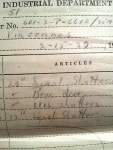
- This slip documents changes to the ship’s signal lights – the tools of the trade for the signalmen.
Listed on an online auction site was, at least for me, was the holy grail. It is a binder containing work orders for electrical jobs during an overhaul period in 1939. Contained within are forms and handwritten work orders specifying upgrades and configuration changes made to the ships electrical systems. Some work orders detail modernization of weapons systems that would meet the changes to the geopolitical landscape and the escalation of war in Europe and Asia.
I was fortunate that my bid was high enough to beat out others but was still in line with my budgetary limitations.
The binder provides me with a fantastic vantage point as I continue to document the history of these great warships and is a great addition to my tiny Vincennes collection.
 The Veteran's Collection