A Piece of Naval History or Just Macabre?
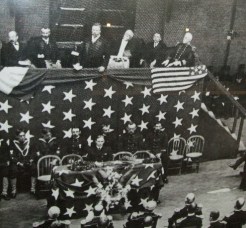
President Theodore Roosevelt speaks at the 1906 re-interment service for John Paul Jones.
“The future naval officers, who live within these walls, will find in the career of the man whose life we this day celebrate, not merely a subject for admiration and respect, but an object lesson to be taken into their innermost hearts. . . . Every officer . . . should feel in each fiber of his being an eager desire to emulate the energy, the professional capacity, the indomitable determination and dauntless scorn of death which marked John Paul Jones above all his fellows.” President Roosevelt uttered these words (on April 24, 1906) within the confines of the United States Naval Academy at the re-interment of the of remains of the man who is known today as the father of the US Navy, Captain John Paul Jones.
Framing an artifact with historical context helps me (and hopefully readers of The Veteran’s Collection) to better understand the importance of an object or artifact. Rather than dive straight into an item, I find that setting the stage helps to provide perspective, so please bear with me.
As a militaria collector whose primary interest lies in US Navy artifacts, the idea of possessing anything from the Continental Navy is an aspiration that is almost too lofty to consider. The sheer scarcity of objects precludes ordinary collectors like me from pretense of forays into the Revolutionary-era collecting. Seeking out musket balls and powder horns from the Continental Army is one thing, but the minuscule number of patriot participants in the naval service (in comparison to that of the ground soldiers) equates to an incredibly limited volume of available artifacts for collectors.
Considering my financial position and the reality that just about any piece (that I would contemplate as being worthy of my interest) from the Revolutionary War is well out of my reach helps to keep me focused on artifacts that are both within my area of focus and budget constraints. However, on occasion, I do find myself wandering about through dealers’ internet sites and online auction listings from the 1775-1783 time-frame. Very seldom do I find anything that captures my attention which is something that happened not too long ago.
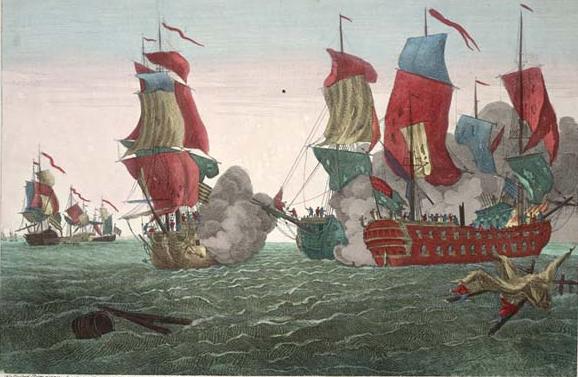
Engraving of the famous sea-battle involving John Paul Jones based on the painting “Action Between the Serapis and Bonhomme Richard” by Richard Paton (published 1780).
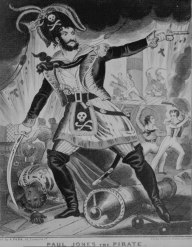
“Paul Jones the pirate”, British caricature (engraving) of American naval commander John Paul Jones
In school, we learned about the famous exploits of Captain Jones (born John Paul in Scotland in 1747, he added the surname Jones after emigrating to the Virginia Colony in the 1770s) with the notable sea battles between his ships and those of the Royal Navy. His legendary response to the surrender inquiry (“Has your ship struck?”) by the enemy commander of the HMS Serapis (Captain Richard Pearson), “I have not yet begun to fight!” will forever be cited in U.S. Naval lore. But most American school children are not educated on what became of Jones following his war service and his ultimate untimely demise.
Following the 1783 signing of the Treaty of Paris that brought about peace between Great Britain and the newly established United States, the need for maintaining a navy was lost on (most) congressional members. By 1785, the Continental Navy was disbanded and the last ship (Alliance) was sold off. Jones found himself in Europe (assigned to collect prize money on behalf of Continental Navy privateer sailors) without a command. After a short stint serving Empress Catherine II of Russia as an admiral in the Russian navy (along with some controversial legal troubles), John Paul Jones retired to Paris at the ripe old age of 45 in 1790. Two years later, the great Revolutionary War captain was found dead in his Paris apartment having succumbed to interstitial nephritis.
Jones was buried in the French royal family’s cemetery (Saint Louis Cemetery) with considerable expense to M. Pierre François Simonneau, who was incensed that the American government wouldn’t render the honors due such a national hero at his passing. Simonneau said that if America “would not pay the expense of a public burial for a man who had rendered such signal services to France and America” he would pay (the large sum of 462 Francs) himself.
With the collapse of the Louis XVI’s monarchy soon after Jones’ death and burial, the cemetery was sold and after a few years was largely forgotten. Decades passed and John Paul Jones’ grave was lost to decay and years of neglect.
In 1897, General Horace Porter was appointed as U.S. Ambassador to France by President McKinley. Soon after his arrival in Paris, Porter took personal interest in the pursuit of Jones grave while gathering official and private documents (much of it was conflicting) pertaining to his death and burial.
“After having studied the manner and place of his burial and contemplated the circumstances connected with the strange neglect of his grave, one could not help feeling pained beyond expression and overcome by a sense of profound mortification. Here was presented the spectacle of a hero whose fame once covered two continents and whose name is still an inspiration to a world-famed navy, lying for more than a century in a forgotten grave like an obscure outcast, relegated to oblivion in a squalid corner of a distant foreign city, buried in ground once consecrated, but since desecrated by having been used at times as a garden, with the moldering bodies of the dead fertilizing its market vegetables, by having been covered later by a common dump pile, where dogs and horses had been buried, and the soil was still soaked with polluted waters from undrained laundries; and as a culmination of degradation, by having been occupied by a contractor for removing night-soil.”
After years of research, Porter was confident that he had narrowed down the approximate grave site location. In 1905, excavation work commenced as archaeologists began digging beneath a building that had been constructed over the cemetery. Upon unearthing a third coffin (they knew that Jones had been buried in a costly lead casket), the men opened it and found a well-preserved body that matched all the details of the man they sought. Porter wrote, “For the purpose of submitting the body to a thorough scientific examination by competent experts for the purpose of complete identification, it was taken quietly at night, on April 8, to the Paris School of Medicine (École de Médecine) and placed in the hands of the well-known professors of anthropology, Doctor Capitan and Doctor G. Papillault and their associates, who had been highly recommended as the most accomplished scientists and most experienced experts that could be selected for a service of this kind. I of course knew these eminent professors by reputation, but I had never met them.”
-

- Still inside the dig site, workers pose with lead casket of what was believed to be the body of John Paul Jones.
-

- John Paul Jones in 1905. This is an official autopsy photograph taken of John Paul Jones’ corpse. Photo courtesy of the U.S. Naval Academy
-

- The 1780 bust of John Paul Jones by Jean-Antoine Houdon that was used in 1905 to positively identify the remains of John Paul Jones.
After careful examination, the physicians confirmed the identity (of the remains) as being that of the late Captain Jones. By August of 1905, the lead casket (which was placed inside a wooden casket) had arrived in the U.S. and was temporarily laid to rest at the US Naval Academy’s (USNA) Bancroft Hall during an April 24, 1906 ceremony. Jones’ body remained in this location while his final resting place was constructed beneath the USNA chapel. Upon completion of the elaborate and ornate crypt in 1913, the naval hero of the American Revolution was laid to rest at his final location.
-
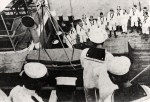
- Casket of John Paul Jones is lowered to the deck of the USS Standish (U.S. Naval Historical Center Photograph.).
-
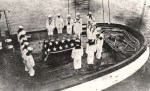
- Casket containing the body of John Paul Jones on the after deck of the Tug Standish, after its transfer from USS Brooklyn (Armored Cruiser # 3) in Annapolis Roads, off the U.S. Naval Academy, 23 July 1905. An honor guard stands around the flag-draped casket (U.S. Naval Historical Center Photograph.).
-
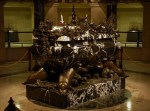
- John Paul Jones’ final resting place as it appears today (US Navy photo).
By now you might be wondering why I am going to such great length in describing what happened with the naval hero of the American Revolution and what the possible context is regarding militaria. While perusing an online auction site, I stumbled upon a listing pertaining to Captain Jones.
“RARE FATHER OF US NAVY JOHN PAUL JONES LOCK OF HAIR DOCUMENTED BY AUTOPSY DR” – Auction listing title
As I scanned through the various images detailing the different facets included with the piece it began to sink in that the auction lot was highly bizarre and extremely unique (if not macabre). Though seller made a minute attempt to fully describe what the item within the listing, he (or she) opted instead to let the incredibly small images (low resolution, no less) makeup for the lack of details within the text.
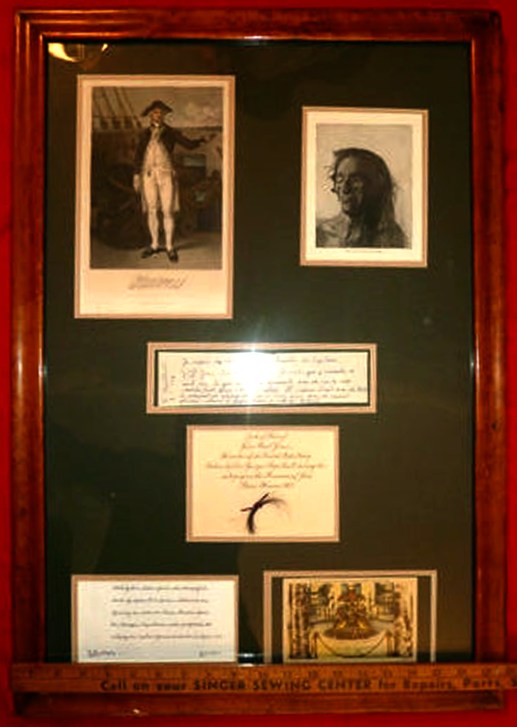
The rather large framed John Paul Jones group has the lock of his hair prominently displayed among the provenance and images (source: eBay image).
From appearances, the lot contained a lock of the Captain’s hair that had supposedly been removed by one of the physicians who performed the 1905 post-exhumation autopsy. Accompanying the lock (which was bound with a ribbon) was the doctor’s hand-written note regarding how he obtained the piece. Along with these two pieces is another handwritten note inscribed by the man who purchased the hair (“H. H. Strigley”) from the physician in January, 1926.
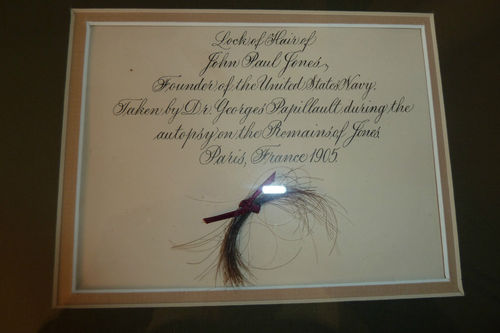
“Lock of hair of John Paul Jones, founder of the United States Navy. Taken by Dr. Georges Papillault during the autopsy on the remains of Jones. Paris, France 1905” (source: eBay image).
While this listing certainly piqued my interest, I’d shudder at the idea of forking over $3,500 (which I don’t happen to have available) without performing the necessary due diligence in verifying the documentation trail (or maybe a DNA test of the hair would be in order?). Taken at face value, the item would be a fantastic acquisition and quite the conversation piece for naval collectors.
-
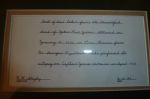
- Preserved within the frame is the note from the original purchaser with his signature and the date (source: eBay image).
-

- Showing the orientation of the lock of hair, the original purchaser’s provenance note and the vintage postcard of Jones’ Naval Academy crypt (source: eBay image).
-

- The handwritten note from Dr. Georges Papillault, Assistant Director of the Laboratory of the Ecole des Hautes Etudes, professor in the school of anthropology (source: eBay image).
-

- Contextualizing the group are two images of John Paul Jones. One, an illustration of him during his naval service and the other, a photograph taken after exhumation, during his examination (source: eBay image).
-
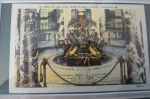
- Also framed with the group is a vintage postcard of Jones’ crypt at the Naval Academy (source: eBay image).
-

- On the back of the John Paul Jones framed group is an attached envelope of supporting documents (source: eBay image).
While there is reason to question the validity of such an item, to the right collector, this John Paul Jones group would make a great investment. Perhaps the provenance documents are traceable and can establish enough proof (a hand-writing analysis of the note purportedly drafted by Dr. Papillault)?
Are the Best Sources of Militaria Online?
Almost to a fault, I am an online shopper, especially when I shop for birthday and Christmas gifts. I compare prices and seek out the best deals (inclusive of shipping costs) and try to find the best blend of economy, availability and convenience before I commit to a purchase. If I can avoid visiting a store in person and still find a bargain, I am satisfied. However, there are still merchants that I do enjoy patronizing (my local bike shop, for one) in person.
An overwhelmingly large percentage of my articles here and on my baseball militaria site cover my acquired artifacts that were predominantly sourced via online auctions. Seeking the militaria pieces that I am interested in outside of auctions can be a fruitless task for a person who doesn’t have the patience for garage, yard and estate sales. There are a few military surplus stores in my region as well as a local militaria business (that is seemingly never open) but they typically sell and buy modern items. What other sources are there?
Several years ago when I was becoming active in militaria collecting, I was invited to tag along with some veteran-friends (they are all Vietnam vets) to drive a few hours to a military antiques show held at the Jackson Armory in Portland, Oregon. I was overwhelmed by the number of tables that were filled with artifacts from present-day and back to the Civil War. Not only were there American items but also pieces from other nations’ armed forces, captivating my attention for hours as I walked (and re-walked) each row. I arrived at the show without a single objective – I had nothing targeted as I didn’t know what to expect and as a result, left empty-handed. However, I did leave the show with a new understanding of the possibilities for locating pieces if other sources are do not yield results.

At this year’s show, there were considerably fewer tables of militaria for sale which coincided with the show’s small attendance.
As with other collectible shows (antiques, sports memorabilia, vintage toys, etc.), these gatherings are dominated by collectors and experts who are seeking to buy, sell and trade their pieces and since they are (mostly) private sellers, they don’t have the operating costs that brick-and-mortar business have to cover with their transactions. Items sold by individuals are generally less-expensive as they lack mark-up pricing.
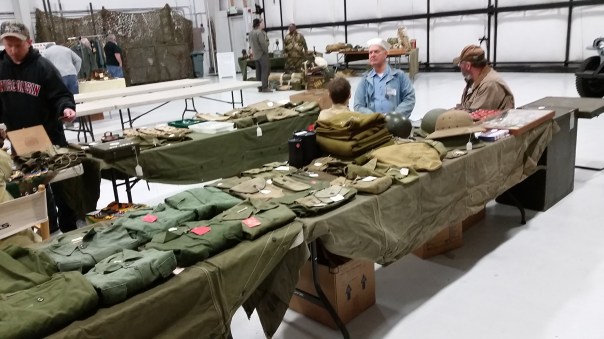
With so few customers to engage with, vendors socialized among themselves. Though the show was smaller than previous years, there was plenty for me see.
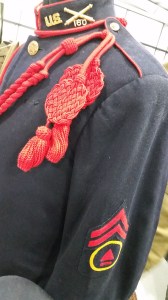
This beautiful CAC uniform (along with the cap from the same period) immediately caught my attention.
Aside from seeking specific items for my collection, I have since discovered that I enjoy attending militaria collectors shows just to be able to converse in person with other collectors and people who are passionate about preserving history. This was the case last month when I made plans to attend a local, semi-annual show, hosted at the Olympic Flight Museum in Olympia, WA. Considering that most of what I am presently seeking (military baseball artifacts) is seldom seen within militaria collections, I had no expectations heading into this show. The last time I attended, my son (a budding military history buff and part-time collector) accompanied me but he has since left the nest and embarked upon his own military career. Desiring to spend more time with my best-friend and wife, I asked her if she would join me. I should mention that I am blessed to be married to someone who shares my passion for history and encourages me with my interests (and sometimes assists with the editing of my writing when she is available).
-
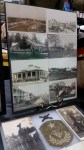
- This display of vintage photographs of local CAC forts was fantastic.
-

- Each one of these Riker cases displayed vintage artifacts from specific local CAC forts.
-

- Though this cap was not worn by the original owner of the displayed jacket, it is the correct head covering for this type of CAC uniform.
-
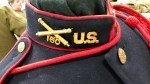
- The large brass crossed cannons devices are spectacular against the blue wool and artilleryman red trim.
It has been nearly four years since my last visit and upon entering (this year), my initial observation, compared to what I saw in 2014, I noticed that there were about half the number of tables. After a few hours of carefully viewing what was for sale along with a fantastic display of a Coast Artillery Corps (CAC) collection (artifacts from now-defunct local coastal forts), I purchased a few small pieces to add to my collection of WWII naval officers metal collar and cap insignia and headed out to take my wife to my favorite local Mexican restaurant for lunch.
-

- I noticed that there was greater volume of foreign militaria at this year’s show. A large portion of it consisted of early 20th Century German and Third Reich items.
-
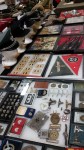
- Unless one is experienced and highly knowledgeable on Third Reich militaria, my advice is to stay away from these pieces as they are highly reproduced and expertly-faked pieces. That is not to suggest that anything at this dealer’s table was less than authentic.
-

- Though I have Third Reich pieces in my collection (my uncle sent them home as war souvenirs), I do not collect this sort of militaria.
-

- It seems that with the current political climate, people react negatively at the sight of anything from the Third Reich. Recoiling in fear of artifacts (from our vanquished enemy) is an unreasonable reaction. The preservation of artifacts, even something that came from an evil power such as Nazi Germany, serves to remind us of the the evils of socialism and fascism.
-
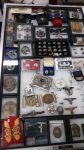
- Yet another case dominated by Third Reich militaria.
-
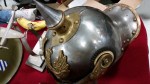
- These Imperial German spike helmets are impressive to see in person.
-

- For a mere $2,500, one could take this beautifully dressed Imperial German spike helmet home.
-
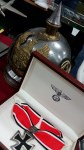
- A boxed Knight’s Cross of the Iron Cross was displayed (and for sale) next to the Imperial German spiked helmet.
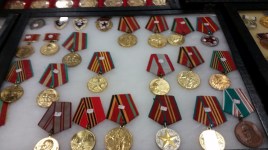
I am a veteran of the Cold War and seeing these Soviet medals being sold made me smile a little as I recalled the images of Russian officers with (seemingly) 60 pounds of medals pinned to their uniforms (see: https://bit.ly/2J0La8g).
With the Olympic show happening twice each year, the local opportunities are rather limited. I might consider driving to the Portland show in the future but that is about the farthest distance that I would consider traveling for militaria. If you reside on left side of the continent, The West Coast Historical Militaria Collectors Show (billed as the largest gathering of military collectibles west of the Mississippi) might be a worthwhile place to seek the obscure or rare pieces that have eluded you.
If you have been a collector of militaria for more than a few years, chances are you have heard about The Show of Shows (SOS). The SOS is the largest gathering of militaria collectors and dealers and is hosted annually by the Ohio Valley Military Society. Imagine, countless rows of tables filled with all manners of militaria being offered for sale. If one cannot find pieces to complete a collection at such a show, then it is either extremely rare or non-existent.
For my humble searches, I will continue with my online pursuits of military artifacts (along with future birthday and holiday gifts)
125 years of Deckplate Leadership: Chief Petty Officers of the U.S. Navy
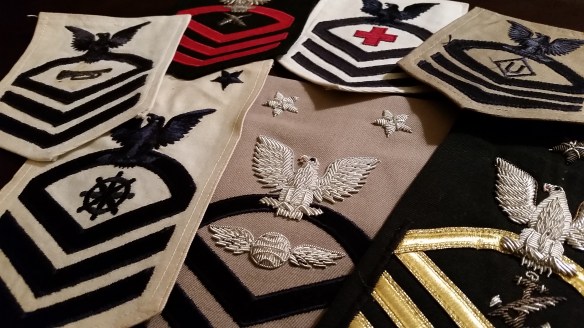
This is just a random selection of my CPO rating badges. A few of these date from WWII and still others are more contemporary, dating from the 1960s and 70s.
As I set out to write this article (I began writing the draft more than two weeks ago), I wasn’t consciously considering the timing of its publishing. Once I began to lay out the pertinent facts, it occurred to me that I needed to push the publishing date ahead by a few days (the originally scheduled date was the 5th). Hopefully my readers will follow this story through to the end to fully understand the historical significance of (what is known to most Americans as April Fools Day) April 1st.
In the decade that I served as a bluejacket; an enlisted sailor, I spent nearly seven of those years aboard ships (where else does real a sailor serve?). Regardless of where I served, my life was positively impacted by men who had the experience, knowledge and zeal for shaping the lives of young sailors in an effort to build cohesive and efficient teams that breathed life into the ships of our nation’s fleets. Like no other branch in the armed forces, the Navy’s senior enlisted leadership is set apart from seamen and petty officers which is visibly apparent, especially when the dress uniforms are worn.

CPO rating badges 1893-94 (image source: US Militaria Forum).
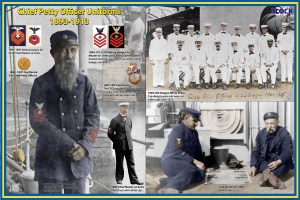
From the establishment of the CPO rating, their dress uniforms were very similar to those of naval officers (source: Naval History and Heritage Command).
Though there are earlier references to Chief Boatswain’s Mate, Chief Gunner’s Mate, and Chief Quartermaster or Signal Quartermaster (as described in General Order 36 of May 16, 1864 – effective July 1, 1864), the rating of Chief Petty Officer would not be truly established until April 1, 1893 when all petty officer ratings (and their pay) were officially set apart. One could argue that chiefs were effectively established on January 8, 1885, when the Navy classed all enlisted personnel as first, second, or third class for petty officers, and as Seaman first, second, or third class for non-petty officers, however at that time chiefs were positions rather than rated personnel.
With the official establishment of CPOs, these senior petty officers were effectively set apart from the lower ratings of petty officers. These sailors were the experts in their fields and it was expected of them to both train and lead their assigned subordinate and junior personnel. Officers also had expectations of the CPOs in their assigned divisions; as experts in these specialty fields, they would also be responsible for providing advice as well as being the conduit between the wardroom and the bluejackets.
For an officer to look back on their career and not see the importance of the role their first chief petty officer played when they were learning the ropes as a young division officer would be a gross oversight. The division CPO advises and guides and a bond of trust is created between the two that lasts a lifetime. At the end of the war (and close to the end of his career) Admiral Halsey participated in a ceremony to honor those who served. The following story was relayed by an author and WWII war correspondent in a subsequent book which illustrates the relationship between the CPO and the junior officer:
“At the end of World War II, all the towns and cities across the country were looking for a Home town boy makes good person to celebrate the victory with. Los Angeles chose Admiral Halsey, whom it was rumored had done quite well. The ceremony was held on the steps of the LA county courthouse, and at the end of it when Halsey was leaving, they had a line of sideboys. They were active duty and retired Chief Petty Officers that had been brought in from all over the country. As he walked through the ranks, my uncle walked apace on the outside. As Halsey approached one old CPO that my uncle described as being older than God, my uncle saw them wink at each other.
Later, at a cocktail party, my uncle had the opportunity to have a chat with the great Admiral. He commented on the wink between Halsey and this old Chief, and asked Halsey if he would mind explaining it. Halsey looked at me uncle very seriously, and said this: ‘That man was my Chief when I was an Ensign, and no one before or after taught me as much about ships or men as he did. You civilians don’t understand. You go down to Long Beach, and you see those battleships sitting there, and you think that they float on the water, don’t you?’ My uncle replied, ‘Yes sir, I guess they do.’ ‘ You are wrong,’ replied Halsey, ‘they are carried to sea on the backs of those Chief Petty Officers!'” – John Reese as told to his nephew, ATCS(AC) Jack Reese, USN (Ret.)
While other U.S. Armed Forces branches’ senior enlisted members possess similar leadership and authority, the role of the CPO is different. Unlike the other branches, the CPO is not a non-commissioned officer – the Navy does not have non-coms (as the Army, Marines and Air Force have with their enlisted leaders), though to some, the differences may be merely a technicality (consider that the two are separately called out in the NCO/PO handbook). Within the Army and Marines, the NCO (albeit, “junior”) status is attained at the paygrade of E-4 (corporal) and within the Air Force, an NCO begins with E-5 (Staff Sergeant). In the Navy, petty officer third class (E-4) commences the junior enlisted leadership status.
To the Navy novice, the uniform of the CPO is scarcely different from that of the naval officer though the subtleties are readily distinguishable. Prior to April 1, 1893, the uniform of a “chief” was essentially the same as that of a first class petty officer; sack coat style uniform. After the CPO rating was established, along with structural changes to all enlisted ratings (pay, rates), all petty officers and enlisted (non-chiefs) wore the same uniform. A new CPO rating badge was created that included three arcs over three chevrons with the distinguishing mark positioned inside. This design was similar to the rating badges that were worn by pre-1893 master-at-arms (MAA) first class petty officers. In the following year, the Navy adopted new designs for badges for all ratings that are still in use (albeit with some gradual design tweaks and the addition of two ratings above CPO: Senior Chief and Master Chief petty officers).
-
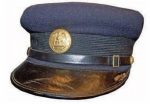
- Chief petty officer blue cape (1893-1897). The CPO cap device adopted in 1893 was the same device previously worn by first class petty officers from 1885-1893 (image source: US Militaria Forum).
-
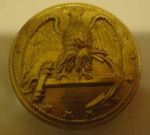
- Close-up of the 1893-97 CPO Cap Device (image source: US Militaria Forum).
Mass Communications Specialist, SN Dakota Rayburn of the USS John C. Stennis wrote in his article, A look back at the history of naval uniforms (published June 20, 2016, Kitsap Sun)”On April 1, 1893, the Navy had grown large and complex enough to necessitate the creation of the chief petty officer to help manage increasingly specialized rates. A chief still worked closely with enlisted personnel but also held managerial roles. That combination (eventually) required them to replace their white Dixie cup covers with the hard-billed combination covers and have durable working uniforms and service and dress uniforms similar to the commissioned officers’ to reflect their status.”
Until the establishment of the CPO rating, first class petty officer MAAs, in addition to the sack coat uniform were already wearing a blue cap that incorporated a rigid visor (or “bill” as noted by MCSN Rayburn). Affixed to the front of this cap was a unique device (resembling a large version of a gold uniform button) that bore the image of an eagle perched upon the shank of a horizontal anchor. Surrounding this design are thirteen stars, located just inside the circumference’s edge. This device and cap combination continued in use for CPOs after the ratings was officially established. Meanwhile, first class petty officers adopted the uniform that was consistent with junior enlisted personnel.
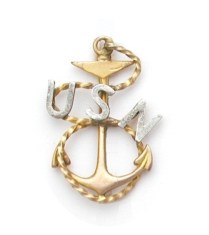
The 1897 CPO cap device was the first official metal insignia designed for chief petty officers. This device was worn at the front of the combination cover and rotated slightly counter-clockwise so that the U.S.N. appeared to be level (image source: Quarterdeck.corg).
By 1897, a new design for chief petty officer caps was approved, “CPO hat devices were first mentioned in the 1897 Navy Uniform Regulations and described the device as ‘The device shall be the letters U. S. N. in silver upon a gilt foul anchor,’ according to quarterdeck.org. The orientation of the silver letters was affixed rotated slightly so that when properly attached to the cap (positioned with the top of the anchor pointed towards 10-o’clock), the letters appear to be horizontal. In the years and decades to follow, the device would see changes ranging from the design of the anchor chain, how the chain was fouled around the anchor, the orientation of the U. S. N., the attachment devices, and finally with the addition of stars for the senior and then master chief petty officer ratings.
Besides the design variations that were the product of uniform regulation changes, the devices were also impacted by the individual manufacturers and suppliers of the devices. Some pieces were constructed from precious metals (such as sterling silver and gold) in different combinations. Many of these deviations are very minute and therefore create scarcities and thus influence values among collectors of CPO devices.
-
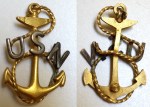
- Though this CPO device is very early (second pattern dating to 1910), had the pillow been associated to this period, the CPO device would be more aligned with this style.
-
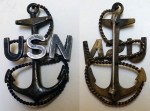
- Though I have been unable to nail down a specific match to this one that can give me a more precise date, I suspect that it was made and used during the 1920s (based upon the clasp, the style of the fouling, lettering, and the design of the anchor).
-
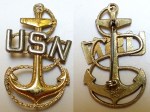
- This CPO device was made and used during the early years of WWII. By the war’s end, the “N” was no longer slanted as seen here.
-
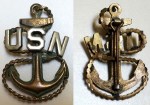
- A rather rare CPO cap device is the Australian-made edition that dates from WWII. It is hallmarked, K.G. Luke, Melbourne (the “K” is very faintly stamped).
Until a few months ago, my collection of CPO items consisted of a handful of rating badges, a half-dozen World War II-era uniform jackets (dress blues, whites and khaki) and a few combination caps with devices. I recently acquired four CPO cap devices that date from the first half of the 20th Century, the earliest piece originating from the first decade. Although I do collect Navy items, these haven’t been on my list of active pursuit.
-

- Several years ago, I acquired this WWII-vintage dress blue CPO combination cover with the unmarked cap device.
-
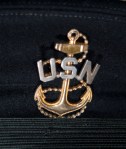
- A close-up of the CPO device on the WWII-era dress blue cap.
-
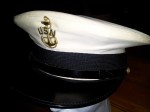
- Like the dress blue cap and device, this WWII-era dress white CPO combination cover also has an unmarked CPO cap device.
The number of CPO rating badges in my collection expanded a bit a few months ago and I am still getting my arms around what came into my collection (along with hundreds rating badges ranging in eras from WWII to the mid-1970s) that include ratings that existed for brief periods, mirroring the rapid development of naval technology and the specialists that would support or operate the associated equipment. Most of the badges are third, second and first class petty officers but there are a few CPO badges that I was quite happy to add into the fold.
Happy 125th to my CPO brethren on this significant milestone in the history of the United States Navy that you have all played such a significant role.
See also:
An Open Invitation for Trouble: Risks of Sharing Militaria Collections Online
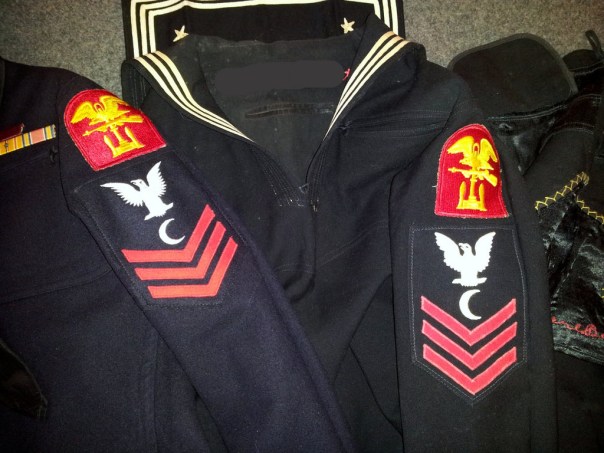
These named WWII Navy uniforms were passed down to me from my grandfather who served in the South Pacific.
Today’s post is a bit of a departure from my typical collecting discussion and is something that collectors should consider in term the various risks that exist as they share photos of their collections online. Some of those risks include:
- The family comes calling.
- Thieves trace their way to your collection in order to steal from you.
- Claims (false or otherwise) are made that your item does not belong to you.
- Image theft:
- Used for fraudulent militaria sales.
- Used without photo attribution.
Without belaboring every possible scenario, this post will focus on the four most common potentially negative outcomes.
The Family Comes Calling
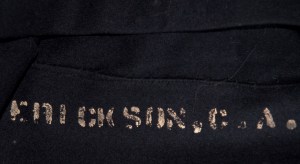
Ship’s Cook/Baker, C. A. Erickson is clearly stenciled inside this WWI dress blue uniform jumper.
My collection is predominantly made up of uniforms that belonged to one of my relatives and the items were passed down to me due to my obvious interest in preserving family history. However, I have made some purchases of uniforms and other personal (named) items that belonged to veterans with no connection to me or my family. Uniforms are normally named (the service member placed identifying marks on the piece – normally on the manufacturer’s label or stenciled in a prominent location on the inside of the garment) with the troop’s last name, first and an initial and possibly their service number (there are variations and exceptions). When one goes as far as to share the identification details of a specific item online (as I did for articles such as, Militaria Rewards – Researching the Veteran and Academic Baseball Award: Rear Admiral Frank W. Fenno’s Baseball Career), I am risking someone reaching out to me to make a claim that the piece belongs in their family’s possession.
Virtually anyone can make a claim to the veteran’s items and state that they are the rightful heir of something that I purchased from a dealer, antiques store or private collector. Within our community there has been lengthy discussion surrounding what one should do if this situation is presented to them by a supposed family member. The stories (of the militaria leaving the family) are varied, ranging from theft to an heir not possessing interest in the military history (who sells the items rather than to pass them to another family member) to an unintended sale. It is easy to be sympathetic but that can be problematic for the collector as it is difficult to determine if the alleged family member is who they say they are (rather than another collector applying guilt and sympathy to get their hands on a desired piece). Here is a fantastic piece that was written regarding what family members should consider prior to contacting a collector in seeking the “return” of a family item.
With regards to the Admiral Fenno medal in the article listed above, I was contacted by a family member that was surprised to find that this medal was not in the family’s hands, let alone that it even existed. I was asked how it came to be in my hands (purchased from a picker who bought it at an estate sale) and speculated that the medal was sold along with other household belongings without any family members realizing what it was. The conversation was friendly between us as we exchanged a few emails. However, the person that I was communicating with wanted me to call them to chat about it further (which left me sensing that there was a request forthcoming). What I was thankful for was that the family member did convey additional history associated with the admiral that wasn’t available through research means. As of now, I am still hesitant to make the call as I don’t want to be asked to give it up. I suspect that the conversation could have been far more direct and uncomfortable between us so I am thankful with what I experienced.
Thieves Target Your Collection
I don’t actively worry about this possibility but I know that it happens. The general public may not realize the monetary value that many militaria pieces possess but people who lack moral compasses understand fully, what collectors are willing to pay for certain pieces. With WWII helmets that are attributable to veterans from well-known battles or engagements bringing sale prices in excess of $5-6,000, or a purple heart medal to a USS Arizona sailor who was KIA during the 7 December attack fetching double that amount, theft is a definite risk. I have read numerous news stories about break-ins and burglaries that involve the theft of militaria from homes. Not only are collectors at risk but veterans themselves are often subjected to these horrible actions:
- Local Marine’s military uniform and medals stolen Independence Day morning
- Former U.S. Marine says con man stole his military medals and uniforms
On occasion, there are successful recoveries:
- 24 military medals returned after being stolen during California dam evacuation
- Veteran’s Stolen Service Medals Returned
We have to be careful of who we invited into our homes being careful to limit visual access to these treasures when we answer the door to the furnace repairman, the plumber or the appliance technician. While they may be fantastic at their jobs, they might also be unwitting participants in tipping off burglars to the militaria inside your home. In addition, collectors need to consider how they share their pieces on social media. If they provide their real names and hometown locations in their public profiles, they could be providing a picking list and a treasure map to these seekers. If one shares their collection online, they should lock down their profiles and limit who can see personal details. Also, be cognizant of what is visible in the photos themselves for easily recognizable landmarks that can be used for locating.
Claims (false or otherwise) Attempting to Invalidate Collectors’ Ownership
In light of the previously listed risk, legally purchasing militaria can very well end up being an illegal transaction. In other words, you could be the recipient of stolen property. There are occasions that arise that upon sharing your collection item online, you face a challenge from someone claiming to be the legal and rightful owner. When one recognizes the flow of militaria from seller to buyer and that by the time it ends up in your own collection, it could have changed hands a few times. The piece could very well have been stolen from the veteran or a subsequent collector before the present owner received it. Imagine the thief selling the item to a picker who, in turn sells the piece at a flea market. That buyer then lists the piece on eBay where you, the collector purchases the piece in good faith. You proudly share your “score” with other collectors when you are contacted by the theft victim. What then?
As with essentially all collecting, the above scenarios are very real. What do you, the collector do? Imagine you paid thousands of dollars for the item? Do you simply surrender it to the victim? How do you know that this person is being honest? How can the claims being made be verified?
When a claim is made against your collection (be it the family, the veteran, a collector, etc.), the best action you can take is to be patient and consider the facts. Does the claimant possess photos of the item? Has a police report been filed (with a genuine case number) that matches the story? Did you record the details (dates, seller, price paid, etc.) of your transactions when you purchased the item? False claims are a part of this hobby and the unscrupulous folks thrive by preying upon good-natured, honest people (consider what happened to Phil Collins, the musician from the rock band, Genesis: Showing Off Your Collection is Not Without Risk). Collectors need to employ the same due diligence used to make sound purchases when these situations arise. I don’t profess to have the answers for every possible scenario but I am prepared as much as I can be to protect my investments.
Image theft
One of the risks that I want to focus my attention on surrounds the photography that we share of the items in our collections. I imagine that most people don’t consider the copyright protection that exist upon the creation of a photograph. Your photographs that you compose and capture belong to you whether you share them online or publish them in print. No one can reproduce (copy with their camera, grab a screenshot, etc.) without your permission (there are caveats to this and it can be a rather lengthy exploration of the laws and case law). One of the common actions that take place online, on eBay in particular, are the unscrupulous sellers who use other people’s photographs to defraud potential buyers by misrepresenting a similar item or selling taking money for an item that they do not possess and have no intention of delivering.
Another aspect of photo theft is that other collectors or hobbyists take your photos without asking or providing attribution. I have discovered use of my images in a few different manners ranging from a news outlet to sports bloggers (a few of my on-field sports photos were used for both without permission nor attribution). Fellow enthusiasts can also engage in these practices. In the recent months, I have discovered that one of my images of a Third Reich piece in my collection (I inherited it from a family member who served in the European Theater during WWII) has been used throughout the internet without my consent. The image was lifted from one of my Veterans’ Collection posts and has been used to illustrate this particular piece as it pertains to WWII German militaria. Understanding that it is quite a rare item, it doesn’t bother me (as much) when used in this capacity. When I found it being shared on an image-sharing site and being passed off as that person’s own work, it ruffled my feathers a bit.
The photo in question is of a Nazi Socialists Party Security armband that I also have hosted within my Flickr site:

National Socialist Party Security Personnel armband.
One of the sites where my image has been altered (they removed it from the background) has a massive online reference library of Third Reich armbands:

My armband photo has been altered and is listed as “NSDAP Ordnungsdienst Security” on the reference page without my permission.
There are several locations where I have found my photo being used sans permission. Seeing it displayed as another person’s property (they have it listed with “Some rights reserved”) is very infuriating:
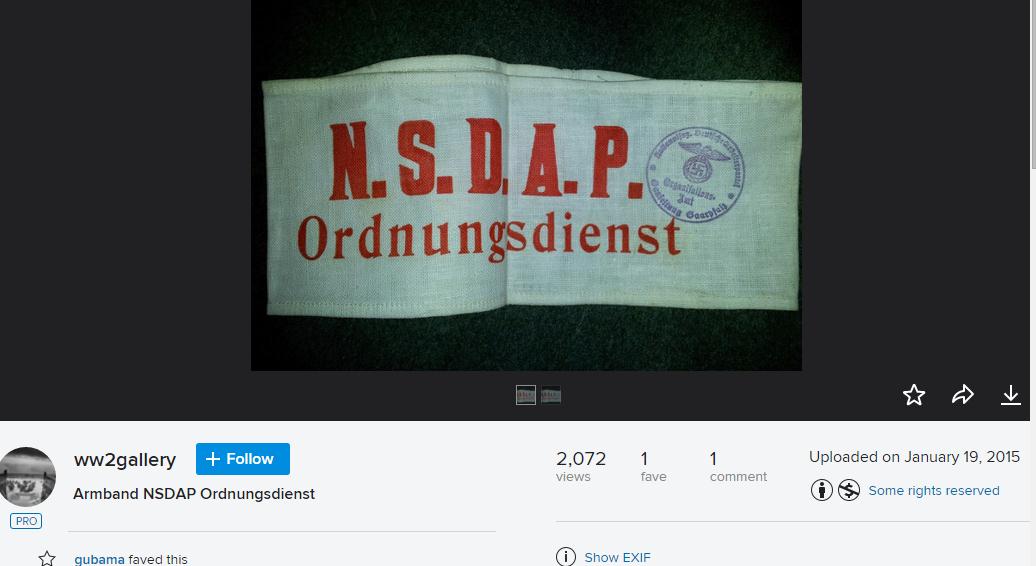
My stolen image of my armband as it sits on someone else’s Flickr account.
Collectors must always be vigilant and cautious about how they share their passion with others. Using the internet as the vehicle for exposing your pieces and discoveries is very easy and may seem to be the safe pursuit, but there is no real insulation from those who would seek to do you or your collection harm.
A General’s Naval Beginnings: My Named Seaman 2/c Aviation Radioman Uniform
I often grapple with what to focus a particular article upon as I sit down to write. I like to keep fresh content on this site and part of that process is for me to attempt to strike a balance with topics that might be of interest to readers and collectors while not leaning too heavily in any direction. Regardless of how much I strive to achieve this, I invariably end writing about what I prefer to collect and what interests me the most.
With my recent post regarding the aviation radioman rating and the uniforms that I presently hold within my collection, I am finding that today’s piece is going to be seasoned with some fresh redundancy considering that the most recent uniform item acquisition that I have is one from a sailor who began his career in this rating specialty. This particular uniform was unique in that in both what it lacked and what it possessed; something that I had not seen on a Navy uniform prior to happening upon this auction listing. The two Aviation Radioman uniforms in my collection have “crows” affixed to their sleeves: one, a third class petty officer and the other a chief petty officer. The new acquisition was from a seaman first class (non-petty officer) which is easily determined by the three stripes of piping on the cuff and the distinguishing mark of the ArM on the left shoulder (positioned where the sailors’ future petty officer mark would be).
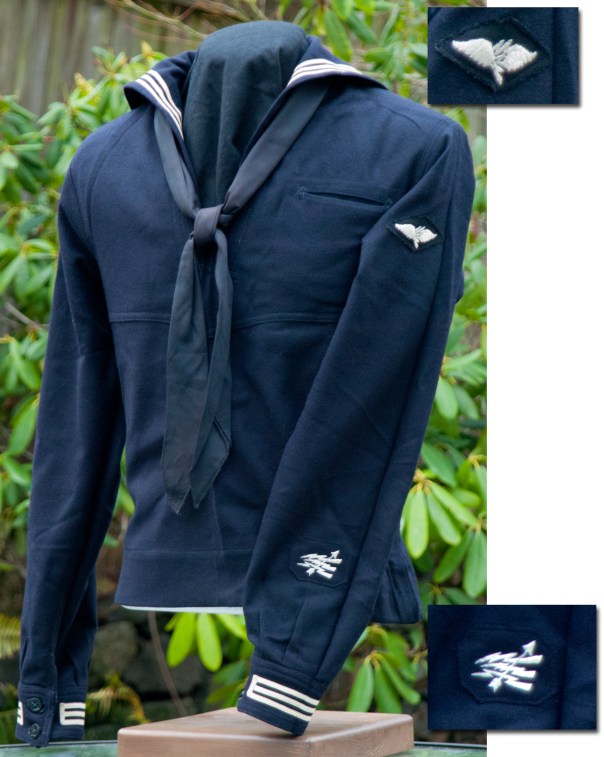
This jumper is the first Aviation Radioman/Technician uniform that I have seen that includes the Radarman distinguishing mark.
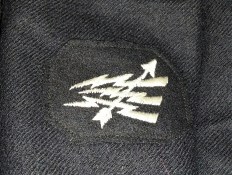
Affixed to the lower left sleeve of this uniform, the distinguishing mark denotes Harpainter’s training and qualifications with radar equipment for naval aircraft.
Aside from the rating mark on the shoulder, this uniform was adorned with an additional mark – that of a radarman distinguishing mark (DM) – located on the lower left sleeve, a few inches above the cuff. Aside from the ArM redundancy, this DM has been the subject of several previous articles on The Veteran’s Collection (see: Rare Bird – Outside of Uniform Regulations, Silver Eagles: Navy Bullion Rates and Tracking U.S. Navy Specialties: The History of Radarmen). perhaps due to my own service as today’s iteration of the rating, Operations Specialist. When I saw the listing with these two elements, and its typical-low price, I was ready to buy it, solely on these factors. The seller also included a photo of the uniform tag and the name of the original owner along with a brief overview of the veteran’s career.
“A very nice jumper with both an aviation radioman rate on the shoulder and radar operator specialty on the cuff. Best part is that it’s named on the Naval Clothing Factory tag and I was able to pull his bio off the internet. His service began in the US Navy during WW2 training as an aircrewman. After WW2 he entered law enforcement and the US Army reserve and had a distinguished career at both. He served as an MP officer during the Korean War and retired as a Reserve Brigadier General. The jumper is in very good condition. Please email if you have any questions.”
I didn’t, for a second, consider buying the uniform based upon the seller’s story as I was ready to take it solely for the marks. Once I performed some searches on the web, Fold3 and Ancestry, seeking out the sailor’s information, I was able to confirm that this uniform did come from the reservist Brigadier General, Robert E. Harpainter.
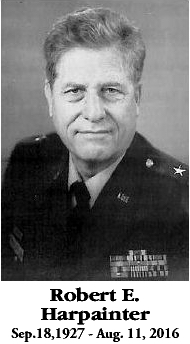
Robert E. Harpainter, Brigadier General, USAR, retired (image source: San Jose Police Benevolent Association, Farsider).
General Harpainter was almost too young for World War II service (he was born in 1927) as he enlisted into the Navy in 1945 following his graduation from Berkeley High School. According to his 2016 obituary, he attended schools for both aviation radioman (rating) and aerial gunner training. I suspect that due to the lengthy of time required for his rating and specialty training, ArM seaman 1/c Harpainter most-likely never made it to the fleet prior to the end of the war. What makes this uniform even more special (for me, at least) is that Robert Harpainter, after graduating from his post-WWII undergraduate studies (at San Jose State University and University of California at Berkeley), he was commissioned as an officer in the U.S. Army, serving with the military police in the Korean War as a military police platoon leader,security officer and assistant camp commander, as well as with the UNC-MAC Advance Camp during the prisoner exchange. His army service included command of the 496th Military Police Battalion; chief of staff and deputy commander of the 221st Military Police Brigade.By the time Mr. Harpainter’s military service was completed, he attained the rank of Brigadier General (in the California State National Guard) completing assignments as the commanding officer of the Northern Area Command from June 1987 through 1988 and finishing as Deputy Commander – Operations, State Military Reserve.
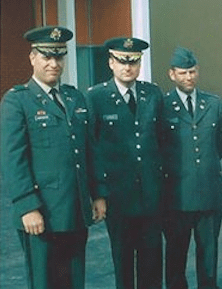
General Harpainter is shown (far left) in this San Jose Police Benevolent Association image.
Though I have assembled a fair summary regarding General Harpainter’s career, more complete research, especially his WWII naval service, would help me to piece-together awards and decorations that he would have received at the time of his discharge. In lieu of a Freedom of Information Act request (submitted to the National Archives), I can safely assume that he received, at the very least, the American Campaign and World War II Victory medals.
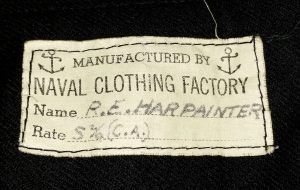
The Naval Clothing Factory tag showes that it is correct for the World War II era, has R. E. Harpainter, Seaman Second Class markings.
There are many folks who enjoy collecting uniform groups of general officers (and admirals) and I can certainly understand how they can be drawn to the uniforms (they are rather ornate and their awards and decorations are unique) and the appeal of being in possession of something tangible and representative of a veteran’s lengthy career having attained a rank towards or at the top of all ranks. This particular uniform is clearly not ornate in the upper echelon of any rank structure but it does help to tell the beginning of the story of such a veteran in that he was compelled to answer his nation’s call as a young high school graduate and never ceased. As a civilian (and active reservist), Mr. Harpainter served as a law enforcement officer for 15 years as he pursued his undergraduate and juris doctor degrees. The remainder of his professional career, General Harpainter served as a senior deputy district attorney with the Santa Clara County District Attorney’s Office for 22 years. As I reviewed the general’s memorial and online tributes, a comment made by Harpainter’s partner (from his time as a police officer), Bob Moir (retired lieutenant, SJPD 1954-1985) wrote, “Always in the Veterans Day parade in Nov (sic) each year with is military uniform and shinning star.”
What’s next for me with this uniform? I enjoy seeing a uniform displayed properly (which for me means that I like to possess the proper decorations) so I will be requesting information pertaining to this veteran’s naval service. I am fairly certain that there will be, at the very least, two ribbons (the American Campaign and World War II Victory) however, there could be other elements (such as a combat air crew wing device) as indicated by details within Harpainter’s obituary and publicly-available biographical information.
It is rewarding to find (what appears to be) an insignificant uniform that was completely overlooked by other collectors and to be able to preserve part of the history of notable veteran.
 The Veteran's Collection