Category Archives: US Navy
Unlocking the Secrets of Your Collection: Research is the Key
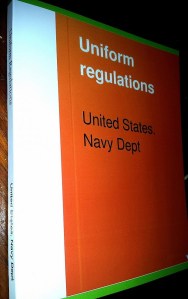
The cover of the 1913 U.S. Navy Uniform Regulations is very high quality in its construction.
Researching early military uniforms to ascertain a date or time period when they were issued or used can pose a challenge for collectors. Navy uniforms can be exceedingly difficult to pinpoint when it comes to dating them for a number of reasons.
Over the last few years, I have stressed that education and research materials only serve to enable collectors to make sound purchasing decisions. Knowing where to turn for information can be a daunting task for someone making their initial foray into this hobby. Simply knowing what research material might exist isn’t in the mindset of those seeking details about a uniform or uniform item.
This copy is complete with all of the details including tables and pertinent data.
When I started a serious approach to research (in this case, verifying a jumper as pre-World War I), I was in the dark as to where to look so I turned to Google to begin my investigation. With the understanding that information on the web is seldom complete or authoritative, the search results seemed to be ambiguous and quite vague, so I narrowed my focus to locating people I could glean information from. As with any relationship, time is necessary to determine whether an “expert” is truly knowledgeable in their professed field of experience, so there was a risk that I might have received some inaccurate data.
Wanting to have go-to resources at my disposal, I began to gather reference material that suited my needs. My collection being predominantly focused on the service of my relatives and ancestors, I knew that I had to get the details (i.e. enlistment dates, commands assigned to, campaigns they participated in, etc.) of their individual service records. Armed with hard facts, I could then pursue the pertinent reference materials such as individual unit histories, training manuals, and uniform regulations.
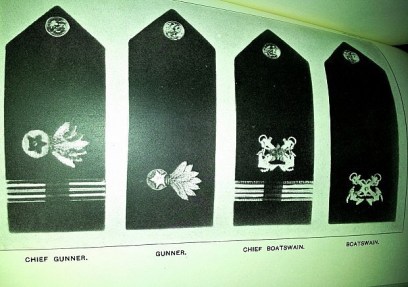
The plates are spectacular! This one shows the warrant officer shoulder boards and insignia.
Some of these materials are plentiful and relatively inexpensive, such as the Navy’s Blue Jackets Manual (issued to new recruits). Others are somewhat rare, making them difficult to find or posing negative impacts onto collecting budgets. One reference book I had been seeking was the 1913 United States Navy Uniform Regulations. I couldn’t locate one through various book stores or eBay. Fortunately for me, Google Books digitized a copy and had the majority of the book’s content available for online use. Unfortunately, the missing portions were the ones I needed for my research. I was amazed to see that I could purchase a hard copy, printed and bound complete book for less than $10.00, shipped to my door! Naturally, I pulled the trigger and less than five days later, I had the needed reference book in my hands.
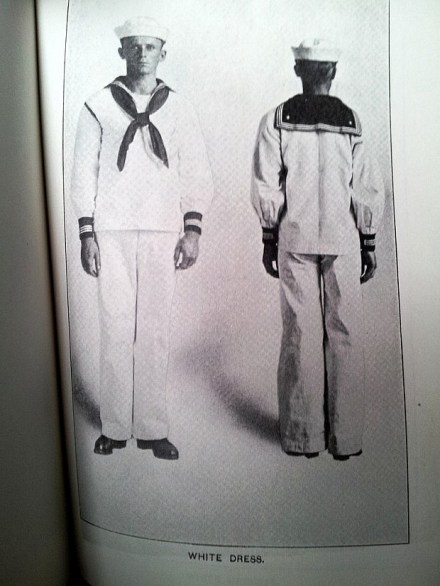
This plate shows the construction of the dress whites – bleached white duck and blue flannel cuffs and collar.
What arrived was a paperback book with a high quality glued-in binding that will withstand repeated viewings or being transported to collector shows much better than an original 100-year-old hardbound book with a weakened spine.
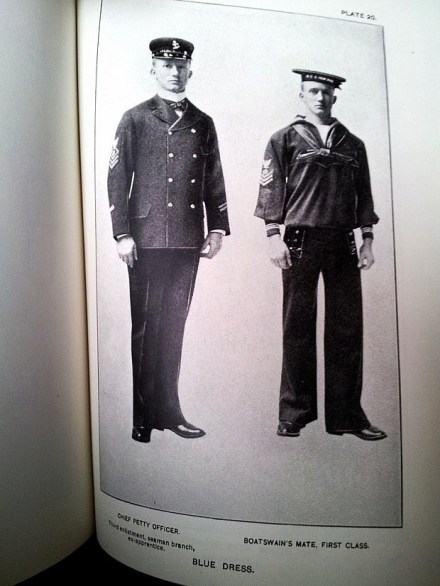
The chief and enlisted dress blues plate shows the proper wear and insignia placement.
Acquiring the 1913 regulations may not appeal to others, but for me this was like locating a missing piece that completes a collection. I’ve confirmed a piece as authentic and I can correctly pursue the remaining outstanding parts to properly complete my uniform display!
Reaching the Pinnacle of Militaria Collecting
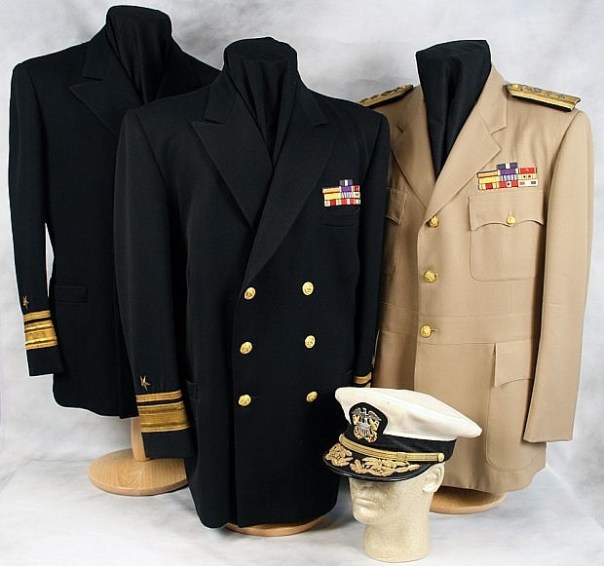
This uniform group belonged to Rear Admiral Robert Copeland who received the Navy Cross for his heroic attack (while in command of the USS Samuel B. Roberts and the destroyers of “Taffy 3″) against a Japanese battleship force in the Battle off Samar (source: D. Schwind).
I’ve been collecting militaria for about three years and nothing that I’ve purchased for my collection is worthy of comparison to some of the impressive acquisitions that I’ve seen other, more seasoned collectors acquire. Some of these people have reached what I would characterize as the pinnacle of militaria groupings that could put most museums’ collections to shame.
Flight suit belonging to Distinguished Service Cross recipient, Colonel Francis Gabby Gabreski.
I spend a great deal of time touring history- and military-themed museums in my local area. On occasion, a museum might have an item or group related to a recognizable name from our nation’s military history. For me, there is a sense of being close to a significant contributor or a pivotal moment that made a difference in the outcome of the battle or even the war at the sight of a famous veteran’s personal effects. One would expect to see these sorts of artifacts in a museum… but what about a private collection?
In the world of militaria collecting, obtaining a named uniform of a veteran who participated in a significant battle and, perhaps receiving a valor medal for his (or her) service while under fire adds a massive layer of icing for that piece of cake. What if that item was from a well-known historical figure? Audie Murphy? General MacArthur? The chances are extremely remote that a collector would be able to locate a genuine item belonging to one of these people, let alone being able to afford to acquire it.
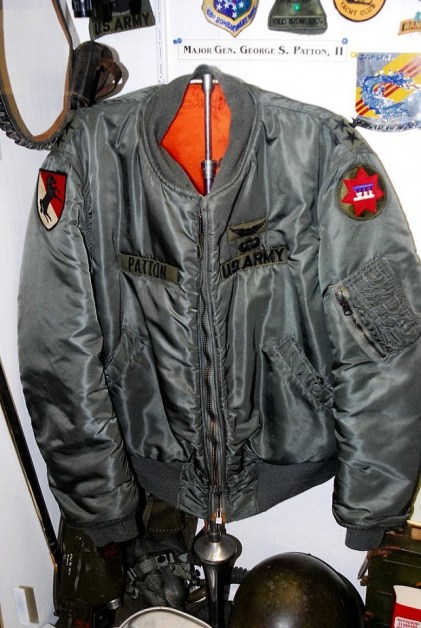
This jacket belonged to Major General George S. Patton Jr.
In the community of United States Militaria collectors (to which I belong), there are several folks who have worked diligently to acquire uniforms and decoration sets that belonged to notable military figures from American history. From general or flag officers to member of the Joint Chiefs of Staff (some holding the position of Chairman, JCS) to Medal of Honor and Navy Cross recipients, these collectors have reached a level that regardless of the time, effort or finances, I could never achieve.
Extreme Collections
For now, I will simply settle on admiring these collections from afar.
Spark Your Collection: Military-Themed Zippos
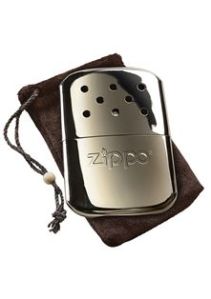
My memory with this Zippo hand warmer is vivid: I remember the smell of the fluid burning and how it warmed my hands on a cold winter morning.
When I was invited to write for A&E’s Collectors Quest collector’s forum as their resident militaria blogger, I knew that I had my work cut out for me. Besides possessing some basic skills with my native tongue (or at least the written word), I knew that I would have a very diverse field from which to extract topics for my columns. With nearly two years researching and writing on an aggressive deadline schedule coupled with my passion for militaria collecting, I developed a fair amount of expertise that I brought to bear when I moved on to my own blog.
From my initial post on this blog (Militaria Collecting: It Isn’t Just Fatigues and Helmets), I mentioned the diversity of the “genre” and how far reaching – extending beyond the bounds of military-specific items – the various categories would be. It is very easy to be myopic as we focus on what we enjoy, forgetting that a specific area of collecting militaria could be part of a larger field of collecting that has very little to do with the military. One of those heavily-collected areas is in the field of cigarette/cigar lighters…more specifically, Zippo lighters.
My introduction to Zippo products came when I was a pre-teen as my uncle, a World War II army combat veteran of the Pacific theater, offered to warm my hands up with a unique device…a hand warmer. Fueled by lighter fluid, the warmer took the bite out of the cold that was causing my hands to stiffen and ache. I marveled at the its soft metal-feel and the warmth it provided. I remember seeing the name emblazoned across the device’s bottom, “Zippo.” My uncle was also a pipe smoker and when he went to light up the fragrant tobacco in his pipe, I again saw the name and it stuck with me for years. My uncle told me of the reliability of the Zippo; that it could still light up in a strong wind. He mentioned that all of his buddies sought them out, often trading battlefield souvenirs for them.
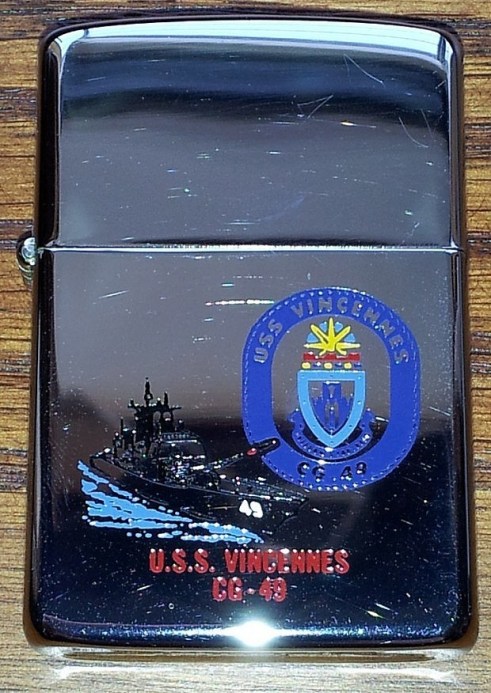
This Zippo dates from the 1980s and is the more typical chrome design with USS Vincennes CG-49 engraving.
Though I do not smoke (I never have), I own a handful of the iconic, treasured pocket flame-producing implements. All of my specific pieces are lie firmly in the military category of Zippo collecting – specifically U.S. Navy (for those of you who’ve been following my posts, this would be obvious). The depth and breadth of my collection covers all of two ships, only one of which I served aboard, and numbers somewhere in the neighborhood of five pieces, all of which are in new condition (remember, I don’t smoke). I’ve even managed to acquire, though I don’t remember how, a navy-themed Zippo pocket knife.
-
- This is another USS Vincennes Zippo from the 1980s clad in ivory plastic and engraved with the ship’s crest.
-

- The opposite side of the ivory plastic cladding with the ship engraving.
-
- This is a second variety of the USS Vincennes Zippo from the 1980s clad in black plastic and engraved with the ship’s crest.
-
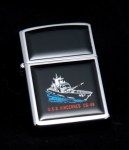
- The opposite side of the black plastic cladding with the ship engraving.
Plainly and painfully obvious, I don’t possess much knowledge beyond being able to identify a lighter as being a Zippo versus a knock-off. Beyond that, I have to resort to my basic abilities of research to determine the sort of information collectors need: the age of the lighter, scarcity, desirability, condition, etcetera. One of the nice things about a company like Zippo is that they consider both their customers those who use the products and the collectors, producing quality products, standing behind them, and providing collectors with authoritative production data and information, dating back to their infancy in the 1930s.
Interested in collecting Zippo? Try some of these resources to spark your interest::
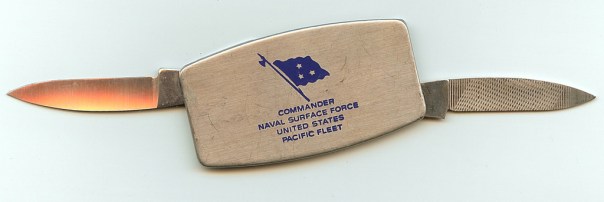
This flat Zippo pocket knife was left behind aboard my ship following one of the many parades of high-ranking naval officers who wanted to see what the (then) newest naval technological marvel could do.
For me, I will continue on in my collecting pursuits, leaving my lighter collection to remain as is – though I might have to locate a hand warmer to warm my hands and nostalgically reminisce about those days with my uncle, now long gone.
Rare Bird – Outside of Uniform Regulations
In an article that I wrote last year, I touched on an aspect of rating badge collecting that focuses on those constructed with bullion-metallic thread. The post was primarily covering the design and aesthetic aspects rather than regulatory or uniform issue standards. However, in order for collectors to make sound purchases or additions for their collections, they need to be well informed.
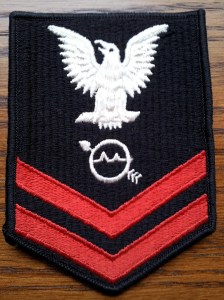
This crow dates from the 1970s and is entirely embroidered. This was a short-lived experimental rating badge.
Let me be very up front by stating that I am, by no means, an expert in rating badge collecting. As I am acquiring pieces for my collection, I am researching and back-filling the details. In some cases, I have the order reversed – researching a piece after acquiring it – hoping that I didn’t make a bad purchase. While reviewing some online auction listings of rating badges (for my former rating), something that I have never seen before caught my attention and without hesitation, I pulled the trigger on the “buy it now” button. Rather than spend time ahead of purchasing the crow, I decided that the best course of action would be to research it after I had it securely in my hands. I had no idea of it’s date of manufacture, whether it was genuine, experimental/prototype or a fantasy piece.
My rating badge collection consists primarily of variations of the rate that I wore when I served. Four years ago, I set out to purchase a new, unused rating badge to mount in my shadow box display. All of the examples I had in my collection were affixed to my old uniforms so they weren’t’ quite up to par with what I’d want to be shown beside my medals and decorations. I ended up with a variety we (in the fleet) referred to as a “peacoat” crow. As it turns out, the fully embroidered rating badge (with merrowed edging) was a test crow that never really caught on. While they are somewhat uncommon, they aren’t necessarily rare or highly desired among collectors.
-
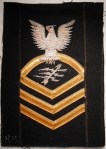
- This pre-1947 Radarman CPO bullion rating badge (with gold good conduct chevrons) is prototypical of what would be seen with a bullion crow.
-
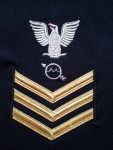
- This current-issue OS1 rating badge is what one would expect to see – a first class petty officer with gold chevrons (indicating at least 12 years of good conduct service) – rather than a second class with bullion and red chevrons.
-

- This is an example of an authorized bullion crow (current-issue) for an Operations Specialist chief petty officer.
The latest addition to my collection is a silver bird – a bullion eagle and specialty mark hovering over red, embroidered chevrons. The reason this is an odd combination is that (according to Navy Uniform Regulations) the silver/red configuration is only available for E-7 through E-9. Ratings fo E-4 through E-6 may use the silver (bullion) eagle and specialty mark in conjunction with gold chevrons (indicating 12 consecutive years of good conduct service). One could deduce that perhaps this predates the current uniform regulations, however, this would be an incorrect assumption.

A rare bird – an Operations Specialist/Radarman badge with a bullion eagle with red chevron stripes.
1913 Uniform Regulations
-
“For petty officers holding three consecutive good-conduct badges, the chevrons for blue clothing (dress/undress blues) shall be made of gold lace instead of scarlet cloth, and the eagle and specialty mark shall be embroidered in silver.”

The reverse of the OS2 bullion rating badge showing the construction and the Gemsco label.
Why then does this E-5, Operations Specialist/Radarman 2nd class crow exist? More than likely, the manufacturer (Gemsco) made this variation either errantly or in anticipation of a uniform regulation change that ultimately never occurred. Not to be stuck with inventory, manufacturers most likely divested these crows and shipped them to uniform shops or uniform tailors to be disseminated to sailors. Seeking to have a measure of individuality with their uniforms, sailors who might be able to “pass,” in wearing the unauthorized embroidery at a command that might not have strict adherence to regulations, would stitch on these subtle “custom” enhancements.
Now that I have this rare bird, I decided that it would display nicely and swapped it into my shadow box (supplanting the standard OS rating badge) as these bullion crows are just too beautiful to sit in a storage box.
Subtle History – Finding a Unique Naval Militaria Piece
Remaining focused with collecting can be a challenge, especially when it comes to militaria. If you are a die-hard fan of military history, it becomes quite difficult to keep composed when unique pieces of history become available. However, when one of those unique items surface that actually does directly tie-in to one’s principal areas of collecting, it cannot be passed up.
During the first four of my ten years of naval service, I was blessed to be assigned to the pre-commissioning crew of the U.S. Navy’s newest (at that time) cruiser – the first to be assigned to the Pacific Fleet – the USS Vincennes. My assignment was handed to me as I was graduating from my naval training school and, at that time, I had no idea of the history of the name of that ship. It was a name that I struggled to pronounce correctly.
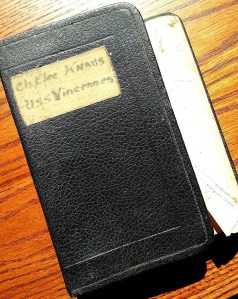
This binder is labeled with the name of the owner (Chief Electrician Knaus) for the USS Vincennes. It was used during the ship’s overhaul in 1939. I still need to research Chief Knaus to see if I can locate any details of his service.
Upon reporting in to the command located in San Diego, where the ship was to be homeported upon completion, I was quickly immersed into the history of the ship’s name and bowled over by the sheer excitement and passion for the legacy of the citizens of the Indiana city from where the ship drew her name. I was also immediately connected to a 500-member-strong group of World War II veterans (who had served aboard either of the two WWI cruisers that also bore the name), all of which had incredible pride for this ship. These men and their wives had played a significant role in convincing the navy leadership to name the third ship of the Ticonderoga class cruisers to honor three previous front-line navy warships that had also carried the name Vincennes.
Since the mid-1980s, I’ve been immensely interested in anything pertaining to the three previous USS Vincennes warships. I’ve collected press photos, news articles, first day postal covers and other ephemera that are somehow connected to the ships. Seldom have I seen items with more direct significance than something that actually came from the ships as preserving the history during their service was neither a thought, or in the case of the CA-44 – which was sunk by the Japanese at Savo Island on August 9, 1942— possible. A few months ago, an interesting piece surfaced that had historical significance and direct ties to the CA-44. More than likely, it was aboard the ship as part of a daily routine. While it isn’t anything that is correlated to a battle or naval engagement, the importance of this piece did provide some ancillary historical details regarding the configuration changes made to the weapons and other shipboard systems.
-

- This work order specifies changes made to the 5″ – 25 caliber anti-aircraft guns’ electrical system.
-

- The Vincennes’ main battery was comprised of three triple turrets, each with 8″ – 55 caliber guns. This work order details changes to the emergency hatches.
-
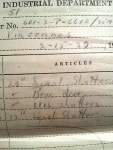
- This slip documents changes to the ship’s signal lights – the tools of the trade for the signalmen.
Listed on an online auction site was, at least for me, was the holy grail. It is a binder containing work orders for electrical jobs during an overhaul period in 1939. Contained within are forms and handwritten work orders specifying upgrades and configuration changes made to the ships electrical systems. Some work orders detail modernization of weapons systems that would meet the changes to the geopolitical landscape and the escalation of war in Europe and Asia.
I was fortunate that my bid was high enough to beat out others but was still in line with my budgetary limitations.
The binder provides me with a fantastic vantage point as I continue to document the history of these great warships and is a great addition to my tiny Vincennes collection.
 The Veteran's Collection