Category Archives: Civil War
To Whom do Artifacts Truly Belong?

This cigarette box is engraved with the names of four WWII naval aviators (engraved” Best Wishes to The Torpedo Captain”). Though this piece is in my collection, as a collector, I am merely a steward of the history associated with it.
Historians, museum curators, historians and collectors all have differing, yet valid answers to the question of historical artifact ownership. Aside from the debate as to where an artifact belongs, there can be difficulties for collectors surrounding rightful ownership that can have more nefarious roots and beginnings.
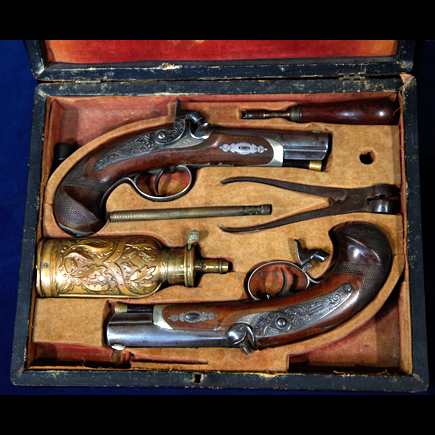
Confederate Major John P. Thompson’s Derringer Pistol Set (image source: PBS/Antiques Road Show).
While watching an episode of the popular PBS television program History Detectives, a woman desired to learn more about a boxed set of named (inscribed) mid-19th century Derringer pistols (season 10, “Civil War Derringers, KKK Records & Motown’s Bottom Line”) that her father purchased in the 1970s. The woman had previously had the Derringer set appraised on another PBS show, Antiques Roadshow (Pittsburgh #1607) for $30,000 but she had no idea who the original owner was or any details surrounding the history of the pistols. Included with the pistol was a document detailing the post Civil War pardon of a Confederate soldier – the name matched the one inscribed on the pistols.
The “detective,” Wes Cowan embarked on a quest to learn about the original owner (John P. Thompson) and if he was, in fact, a Civil War veteran and to learn his history if at all possible. The trail that Cowan followed ultimately led to the great, great-granddaughter of John C. Thompson who told the story of her ancestor and how the pistols were stolen from the ancestral home in the 1970s. To whom do these pistols belong?
My entrance into militaria collecting began more as a matter of happenstance rather than an active pursuit. Having a passion for local area history and genealogy began for me at an early age. As a child, I would often imagine myself digging up arrowheads or other historical artifacts while digging in the backyard or the adjacent vacant lot. Sparked by my grandfather’s stories of the “Indian Uprising” in present-day Pierce County (the father of his childhood friend told him stories of their family evacuating to the safety of Fort Steilacoom), I would picture myself finding my own piece of history.
I never pursued any real archaeological adventures as my focus shifted toward sports and other adolescent activities. After completing my schooling, I was thrust back into history but this time with a military focus when I was assigned to my first ship (following boot camp and my specialty school). I was immersed into the legacy that led to the naming of my (then) soon-to-be commissioned U.S. Navy cruiser. I began to dialog with the veterans of my ship’s namesake predecessors from WWII. From that point on, my interest in military history was truly piqued.

This sampling of Third Reich militaria items were passed down to me from my uncle (who served in the U.S. Army MIS/CIC). He sent these peices home from Germany in 1945 having liberated them following the collapse of the Wehrmacht.
Collecting, for me, began when I was asked to bring my interests and research skills to bear on some artifacts belonging to my uncle that had been stored for 50 years in my grandparents’ attic. The items were in a few trunks that were unopened since they were packed by my uncle and shipped from Germany in May of 1945. I knew very little about Nazi militaria but was up to the challenge to ascertain value and locate a buyer (my grandparents needed money to help cover their costs of care) for the artifacts. I spent a few months learning about the various uniforms, flags, headgear and badges. Little did I know that I was being immersed into the world of the high-dollar Third Reich collecting (yes, I sold most of the pieces).

My uncle served in three wars (WWI, WWII and the Korean War) rising from private to captain. This uniform and bag are from his service with Battery F the 63rd of 36th Coast Artillery Corps.
A few years later when I received my maternal grandfather’s uniforms, records, medals, ribbons, etc., I began to understand that while these items are in my possession, they really do not belong to me. I am merely safeguarding and preserving them for posterity. This has become more evident during my search for anything relating to my ancestors who served in previous centuries. I often wonder what became of their militaria. In watching the History detectives episode, my concern for lost family history is decidedly more acute as I have yet to locate a single photo (of my lengthiest pursuit – my 3x great-grandfather who served in the Civil War).
Recreating History: Researching and Assembling an Ancestor’s Civil War Artifacts:
In actively pursuing items now in my collection, I have acquired a handful of pieces that have names inscribed or engraved of their original owners. The thought has occurred to me that the potential exists for a descendant to claim rights to anything that bears a name.
People fall on hard times or may not possess interest in the military history of their ancestry. A financial need or the desire to free up storage space can drive people to divest themselves of military “junk” without pausing to realize their own connection to that history. In some cases, the heir of militaria may pass away severing ties to the historical narrative thereby devaluing it entirely.
While one person (family member “A”) could have inherited an ancestor’s militaria and subsequently opted to sell, another relative (family member “B”) might have not have been provided the opportunity to retain the history within the family. I have seen stories of this scenario playing out where family member “B” notices a post by a collector (in an online militaria forum) about something recently acquired. “B” feels the need to reach out to the collector to restore the item back to the family, often times to the point of accusing the collector of being a party to theft.
I can identify with the plight of family member “B” in the desire to regain the lost family artifacts. However, I do respect that militaria collectors are some of the most generous and considerate people. I’ve seen them go out of their way to restore artifacts to the family – sometimes at their own expense. However, I advise that family members should exercise decorum and restraint while not expecting a collector to side with them and relinquish their treasured artifacts.
In early 2012, musician Phil Collins published a book detailing his passion for militaria connected to the Alamo and the people who fought and died there. Beginning early in his career, his passion for this infamous siege and battle between the Santa Ana-led Mexican army and a small, armed Republic of Texas unit (led by Lt. Col. William Travis). Collins beautifully displayed his collection across the many pages of his coffee table book, The Alamo and Beyond: A Collector’s Journey. Though his publication was well-received among collectors, it did open the door for a legal challenge to the ownership of several artifacts in his possession.
Last week, I posted an article detailing one person’s pursuit of a historic handmade U.S. flag on behalf of her former-POW father. The bedsheet-turned-national-ensign had been gifted to the U.S. Navy by the owner’s family to ensure its preservation and safekeeping to share for future generations. The veteran’s family felt strongly that the flag, while steeped with familial history and significance, the flag belonged to the citizens of the United States rather than it being relegated to “molding away in someone’s attic” or seeing it “thrown away by someone who did not know the story behind it.”
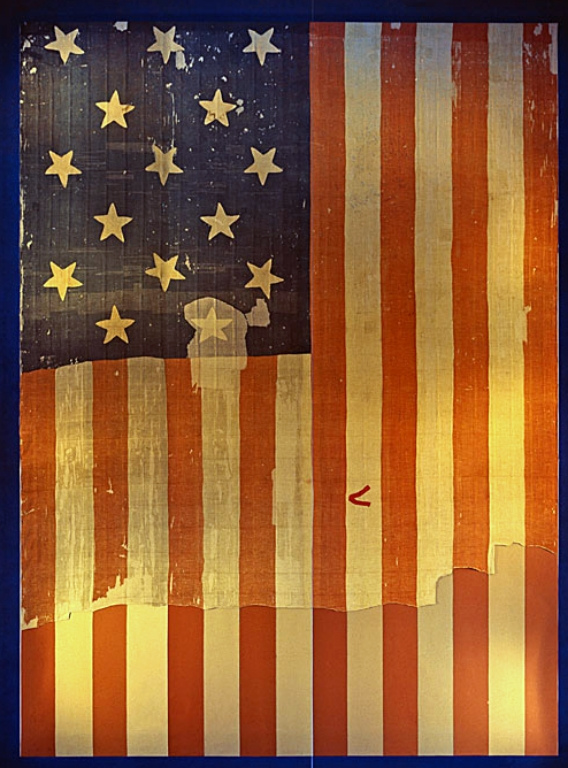
Shown as it was displayed in 1964 at the Smithsonian Institute, the Star Spangled Banner suffered deterioration and damage while in the possession of Major Armistead’s family for over 100 years (image source: Smithsonian Institution Archives).
One of the most significant military artifacts now in the possession of the People of the United States is the subject of our National Anthem. The Star Spangled Banner (the flag flown over Fort McHenry during the September 5-7, 1814 British bombardment) sat in the hands of the Major George Armistead’s (the fort’s commander) family for more than 110 years (with one public display in 1880) before it was donated by his grandson to the Smithsonian Institute.
Militaria collectors are merely caretakers and stewards of history. Though we possess these artifacts, ownership is truly not our principal focus. We expend countless resources (time and finances) preserving each piece and researching the associated veteran or historical events in order to preserve the swiftly eroding and priceless history.
Additional Related Articles:
Following the Flag

Depicting the Massachusetts 54th Infantry Regiment at Fort Wagner, SC, this (2004) painting, “The Old Flag Never Touched the Ground” by Rick Reeves prominently displays the flag leading the troops in battle.
Today is Flag Day. On June 14, 1777, Congress passed a resolution to adopt the stars and stripes design for our national flag. In honor of that, I felt compelled to shed some light on how the impact of the flag holds for men and women who serve this country in uniform.
Throughout the history of our nation, the Stars and Stripes have had immeasurable meaning to to those serving in uniform. On the field of battle, the Flag has been a rallying point for units as they follow it toward the enemy. From their vantage points, commanding generals are able to observe their troop movements and progress throughout battles by following the flag.
Troop reverence for the national ensign was no more apparent during the battle during the early American conflicts (Revolutionary War through the Civil War). Carrying the flag in battle was a considerable honor and the bearer was especially vulnerable to enemy fire. If the color bearer was wounded or killed, the colors would be dropped increasing the potential to demoralize the troops. If the bearer was incapacitated, another soldier would drop his weapon and pick up the flag, continuing to lead the unit toward the enemy.
In the 1989 TriStar film Glory (starring Matthew Broderick and Denzel Washington), Private Trip (Washington’s character) prevented the colors from hitting the ground when the flag bearer was shot during the assault on Fort Wagner. At that moment, the troops were mired in the hail of Confederate gun and cannon fire and the Massachusetts 54th Infantry Regiment casualties were piling up. The troops, seeing the flag raised even higher, rose to the occasion and broke through walls of the fort.
Though Glory was a fictitious portrayal of actual events, a similar factual event took place in the November 25, 1863 Battle of Missionary Ridge in Tennessee. A young Union officer, 1st Lt. Arthur MacArthur (father of future General Douglas MacArthur) took up the regimental colors, taking it to the crest of Missionary Ridge and planting it for his regiment to see, shouting, “On Wisconsin” rallying the (24th Wisconsin Infantry) regiment. MacArthur, the last in a succession of color bearers (each falling during the assault on the ridge), was awarded the Medal of Honor for this action.
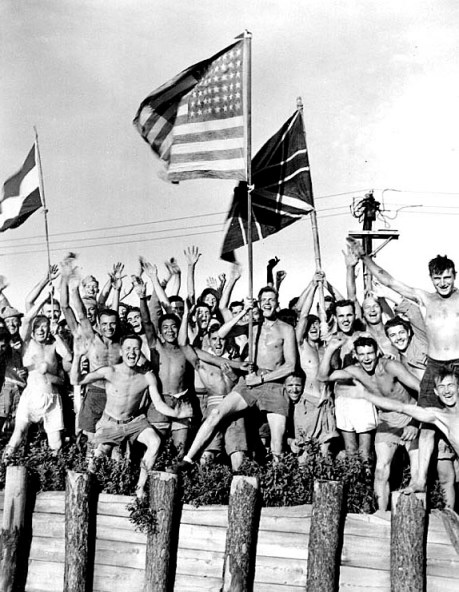
USS Grenadier crew member Engineman 1/c James Landrum holds the handmade American flag above a crowd of jubilant Omori Camp prisoners who were being liberated. August, 1945 (source: U.S. Navy photo).
Aside from their use on the battlefield, the Stars and Stripes has been known to rally servicemen and women to survive horrific and trying situations and conditions. In the numerous prisoner of war (POW) camps in Japanese-occupied territories and home-islands, American POWs were not permitted to possess a flag. When the Japanese military was on the verge of capitulation, the Americans gathered what materials they could to construct a flag which was captured in a famous image (snapped by an unknown photographer on August 29, 1945) of jubilant POWs celebrating their impending liberation.
Though I have seen the image countless times in my life, I never stopped to consider who the men were or what became of the flag. In my own collection, I have managed to maintain a few flag items of significant meaning (at least to me and my shipmates) from the first ship that I served aboard and until recently, I didn’t give them or any other flags a lot of thought. Instead my flags sat in boxes, tucked away for safekeeping. For the Omori POWs, the flag has a meaning that is tenfold more significant than the manufactured, government-issue items I possess.
My interest in this Omori POW flag was ignited when the daughter of WWI veteran Electrician’s Mate 3/c Charles Johnson, initiated a thread (on a militaria discussion board) in 2012 with a post detailing her pursuit of a hand-made flag that was made famous in a photograph of the liberation of an Allied POW camp in Japan. Her father was a survivor of the U.S. submarine, USS Grenadier (SS-210) and a POW at the Omori prison camp near Yokohama.
The daughter continued her post, “My father wondered what happened to the flag and was afraid it was molding away in someone’s attic (or) gotten thrown away by someone who did not know the story behind it.” She continued, “I promised him before he passed that I would continue to look for it.”
Over the course of the ensuing weeks, many helpful replies were submitted by forum members yet no certain leads on the flag were submitted. At the end of September a break in the daughter’s pursuit came when a gentleman submitted a post stating that he was the son of the man holding the flag (Engineman 1/c James D. “Slim” Landrum – USS Grenadier) when the photo of the POWs was taken.
The son of Landrum recalled his father’s story of how he attached the handmade flag to a fireman’s pike pole because he wanted the American flag to extend up higher above the others (displayed by the British and Dutch POWs). Afterward, the senior Landrum returned the flag to the fellow POW who supplied the bed sheet.
Armed with this information, the daughter of Petty Officer Johnson was able to locate a 1973 news article that told of the flag’s history and disposition. The Aomori camp flag was made by (then) Boatswain’s Mate 1/c Raymond Jakubielski (survivor of the USS Tanager – AM-5) and a handful of fellow POWs. In 1971, Jakubielski told the story, “In August when we heard from the camp grapevine that the Japs were about to surrender, I figured we ought to have a flag to welcome our boys in. Being the camp tailor, it was easy to get hold of an extra bed sheet and steal a couple colored pencils. Four of the mates helped color the flag and we had it up on the roof August 15, the day the Japs (sic) offered to surrender. Later, when the boats came to rescue us, our boys ran the flag up on a pole.” Having attained the rank of lieutenant prior to retiring from the navy, Raymond Jakubielski further remarked, “It was a welcome sight after seeing that rising sun thing around all the time.”
The Jakubielski family presented the flag to the U.S. Navy at Submarine Base in Norwich, Connecticut (Sunday, July 8, 1973) to Admiral Paul J. Early (a noteworthy veteran of the USS Nautilus’ submerged polar ice explorations known as Operation Sunshine) to be preserved for posterity. Subsequent to the gifting of the flag to the U.S. Navy, then-Connecticut senator Abraham A. Ribicoff arranged to have the flag flown over the U.S. Capital in tribute.
Though the information helped to close the loop for Charles Johnson’s daughter, the current disposition of the flag remained unknown. My curiosity had been piqued and I was subsequently prompted to reach out to the folks at the Naval Historical and Heritage Command. I requested information regarding the current location of the flag and, if it was in their possession, I asked if it would be photographed and shared within their Flickr photography collection. Several months after contacting them, I received the greatly anticipated affirmative response from the NHHC staff. They did, indeed have the flag within their collection and they had photographed and posted the flag at my request.

Purported to be the first American flag to fly over Tokyo, this 48-star flag was made from a white bed sheet and colored with colored pencils by prisoners at Sendai Camp No 11 in Omori Japan. It was flown in August, 1945 (source: collection of Curator Branch: Naval History and Heritage Command).
The conclusion to this story (locating the Omori flag), as happy as it may be for some readers, is not always a good one for a handful of collectors. The value in having an artifact of such incredible historical significance in the hands of archivists who will strive to preserve it and share it with the nation is immeasurable. Had the flag landed into a private collection or, worse yet, befallen the fate described by Charles Johnson, the history could have been lost.
Learn more about the American POWs in Japan:
- Submariner Prisoners of World War II
- Flags of Our POW Fathers
- Omori Tokyo Base Camp #1 Roster (Raymond Jakubielski, James Landrum)
- Fukuoka POW Camp, #3-B Roster (Charles Johnson)
Related Flag-Collecting Articles:
Decoration Day: Survivors Honor Fallen Brothers-in-Arms
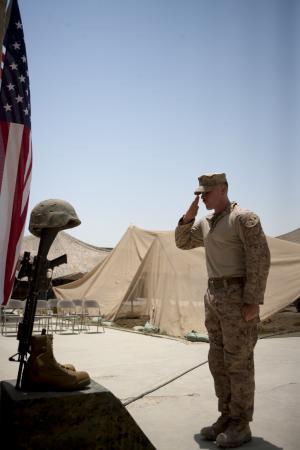
A U.S. Marine with 2nd Battalion, 8th Marines, Regimental Combat Team 8, pays his final respects to U.S. Marine Corps Cpl. Kyle R. Schneider during a memorial ceremony held at Patrol Base Hanjar, Sangin, Afghanistan July 7. Schneider was killed in action while conducting combat operations in the district on June 30, 2011(U.S. Marine Corps photo by Corporal Logan W. Pierce).
Over the past few weeks, I have taken a little time to focus on other priorities such as my primary job (I don’t write on a full-time basis), my family and my fitness (not necessarily in that order). In response to that focus, my attention had shifted away from militaria and the various aspects of collecting during that period of time. Now that we are in the latter half of May, I need to bring my thoughts back to my passion for military history as one of the most important holidays (in my opinion) draws near.
Turning on the news this morning, my interest in the weekend forecast is piqued as the meteorologist begins to discuss the cooler than normal temperatures, the risk of rainfall and how these conditions will impact camping, boating and backyard barbecue plans. The statement really struck me as my only considerations for this weekend surrounded spending time at the various cemeteries and placing flags on fallen veterans’ graves and those of my veteran ancestors and relatives. This activity is something my wife and I have been doing dating back to my time in uniform. Making alternative plans is never a consideration and now my children are so accustomed to this practice, they look forward to Memorial Day.
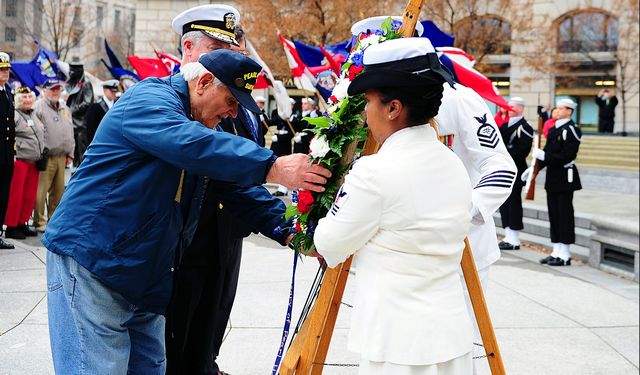
WWII Navy Veteran Frank Yanick honors fallen comrades by placing a wreath at a WWII memorial in 2012 (source: U.S. Navy photo )
As our culture continues to morph and shift with each passing year, the gap of time expands and the meaning and origins of Memorial Day fade from the American population’s conscience. In a time where less than half of one percent of Americans are serving in uniform, there is virtually no understanding of the personal sacrifices (that are routinely paid by those on active duty). When someone falls on the battlefield, that societal understanding of the price paid just isn’t there. I increasingly wonder how it is that we arrived at this point.
Americans’ Participation in War
- 1860 US Population (North + South): 29 million | 3.2 million served (10.35% of population)
-
WWII era (avg. 1941-45): 136.7 million | 16.1 million served (11.8 %)
- Vietnam era (avg. 1964-74) 203 million | 9 million served (4.5%)
-
Current population: 314 million | 1.4 million serving (0.46%)
With fewer Americans serving in uniform, particularly during the current wars in Iraq and Afghanistan, general population is disconnected from the costly nature of service. It is no wonder that our culture tends to be more self-focused as they spend Memorial Day without considering the sacrifices that afforded them the freedom to enjoy a three-day weekend.
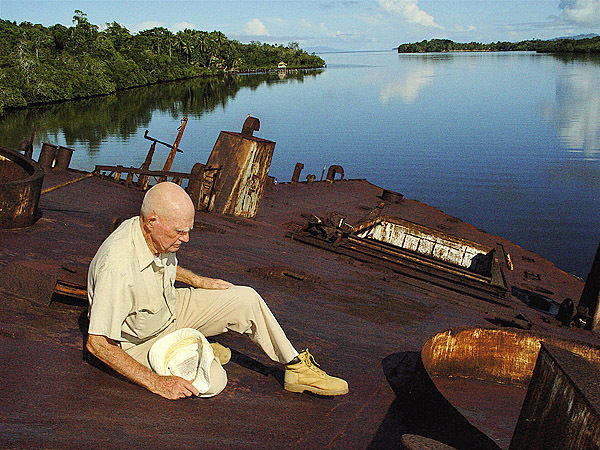
World War II Veteran Mac MacKay pauses for reflection after placing a wreath aboard his former ship, the LST 342, during a trip that several veterans made to Guadalcanal and Tulagi in 2009 (Photo courtesy of Anderson Giles).
Through my quest to understand the origins of this particular holiday, I have been led to be more forgiving of people who choose outdoor activities over trips to cemeteries. Considering that the present-day Memorial Day federal recognition was born from Decoration Day – a tradition started following the end of the American Civil War as surviving veterans began to deal with the battlefield losses of their comrades. Over the passing years, these veterans formed various veterans organizations (ranging from unit-specific to the enormous such as the GAR and UCV) and took the lead on preserving the legacy of those who made the ultimate sacrifice. Because of the efforts of these groups, battlefield and cemetery preservation and monument construction efforts were undertaken along with ceremonial gatherings for commemorative dedications.
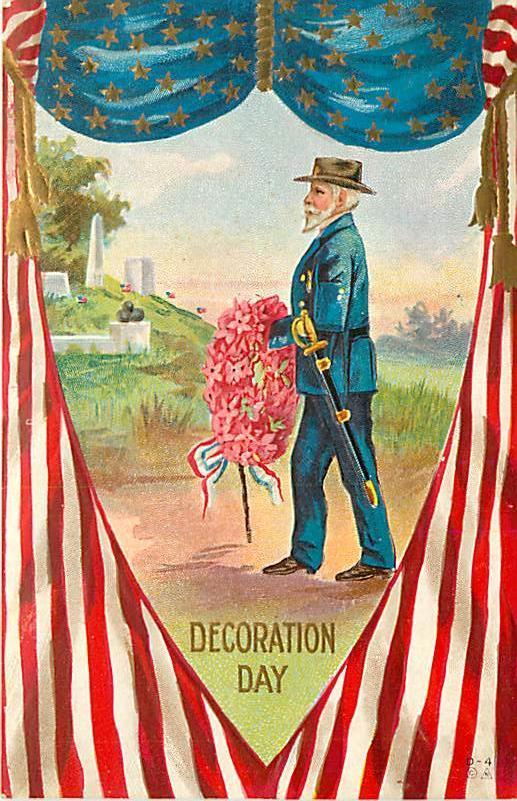
Decked in his cavalry uniform, this old veteran places a wreath among the graves of veterans on Decoration Day.
Throughout our nation’s history, it has been the veterans who have taken the lead on honoring the war dead. Mourning the loss of a brother (or sister) who fell on the field of battle is something a surviving veteran never forgets. That moment isn’t simply a memory etched into their minds but rather akin to a remaining scar in place of a missing limb. It cannot be forgotten or, as some civilians would suggest, something to “get over.”
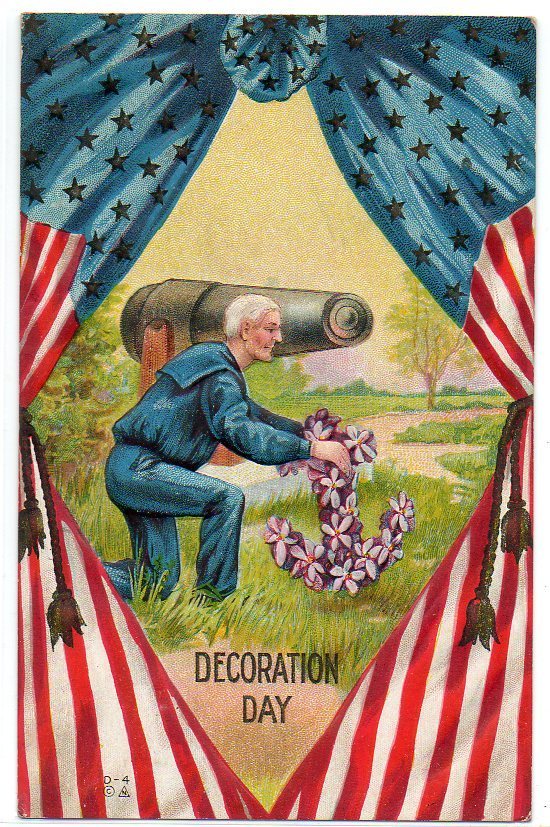
In this postcard, an old Navy veteran donned his uniform before carrying his anchor-shaped flower arrangement to the monument to render honors to the dead of the Civil War.
A few years ago, I started taking notice of various references to Decoration Day and antique items that make mention of it. One of those items that caught my attention was a postcard (from the early 20th Century) depicting an elderly Civil War veteran placing a wreath of flowers at a grave. The image, an illustration, was so moving that I was overwhelmed with emotions. The postcard evoked more recent memories of World War II veterans (at D-Day celebrations) paying respects to their fallen comrades some 70 years hence and the fresh, vivid memories painted across their faces.
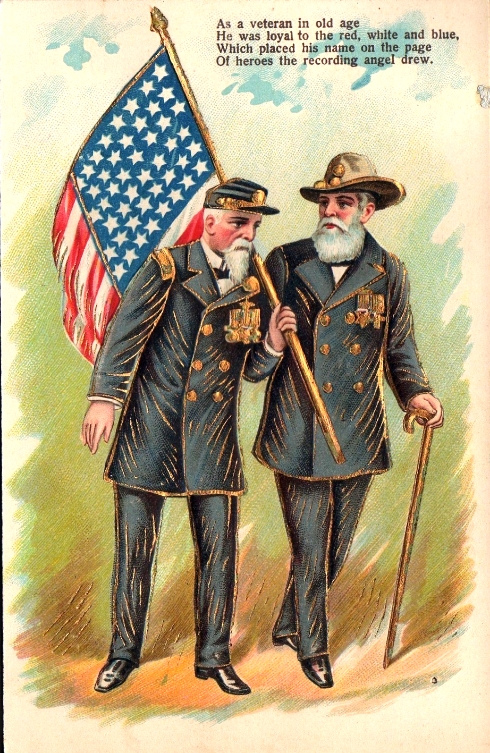
This Decoration Day postcard depicts two elderly veterans of the Civil War assisting each other as they honor their comrades who fell in battle.
Over the course of the past century, it seems that nothing has changed. Veterans still ache for their lost buddies and they are compelled to continue to honor them as long as they are physically able to do so. As a veteran, I am committed to continuing the tradition of honoring and remembering those who gave their last full measure protecting and ensuring freedom for future generations.
USS Vincennes Under the Microscope
Those who know me on a personal basis understand my affinity for a specific U.S. naval warship. Technically speaking, that interest lies with four combatant vessels, all of which were named to honor the site of a Revolutionary War battle (more accurately, a campaign) that ended the British assaults on the remote Western colonial front. That location in present-day Southwestern Indiana would later become the seat of the Northwest Territorial government in the town of Vincennes.
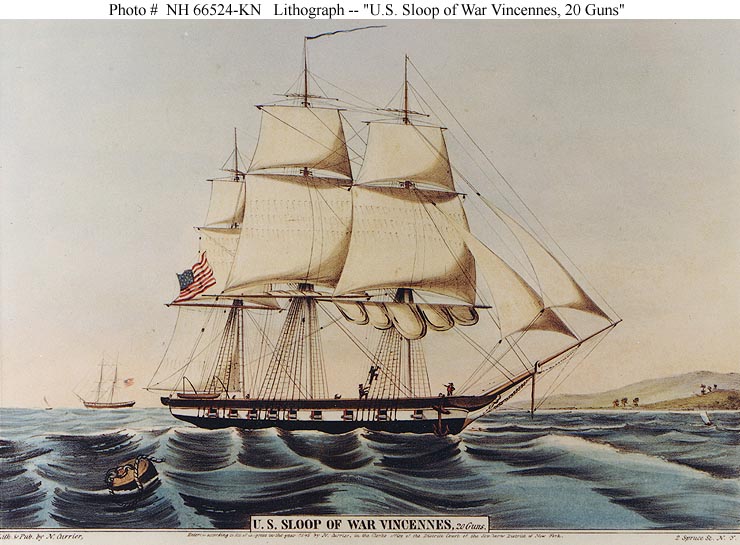
Colored lithograph published by N. Currier, 2 Spruce Street, New York City, 1845 (source: Naval Historical Center).
My connection to this ship’s name extends all the way back to the place of my birth which was also the location of the commencement of an extensive 1840 charting survey of Puget Sound (in Washington State). Locations and geographical features surrounding my home were named by Lieutenant Charles Wilkes (commander of the United States Exploring Expedition of 1838-1842) and members of his team when the sloop of war, USS Vincennes (along with other ships of the expedition) was in the Sound. I can even cite some Baconesque connections with great, great, great-grandfather who served in the Ringgold Light Infantry (after he was discharged from his cavalry regiment following a disabling injury). The Ringgold name was inherited from Samuel Ringgold, Expedition-member Cadwalader’s older brother (yes, I realize that this is very convoluted).
My personal connection (to the ships named Vincennes) was solidly established when I was assigned to the pre-commissioning crew of the CG-49. During the first several months (leading toward the 1985 commissioning date), like many of my shipmates, I was exposed to the history of the ship’s namesake and established personal relationships with veterans of the WWII cruisers of the same name. Collecting items from “my” ship was purely functional in that I was proud to purchase t-shirts, lighters, ball caps and other items (from the ship’s store) that bore the name or the image of the ship’s crest. Many of the items I purchased in those days proudly remain in my collection while a few did manage to fade away.
I am constantly on the lookout for artifacts that are connected to these ships (the heavy cruiser: CA-44, the light cruiser: CL-64) and occasionally, some quality pieces (beyond the plethora of typical postal covers) surface on the market. Fortunately, I have been successful in obtaining a few of these items, though the competition has been fierce. The ones that got away were quite stunning.
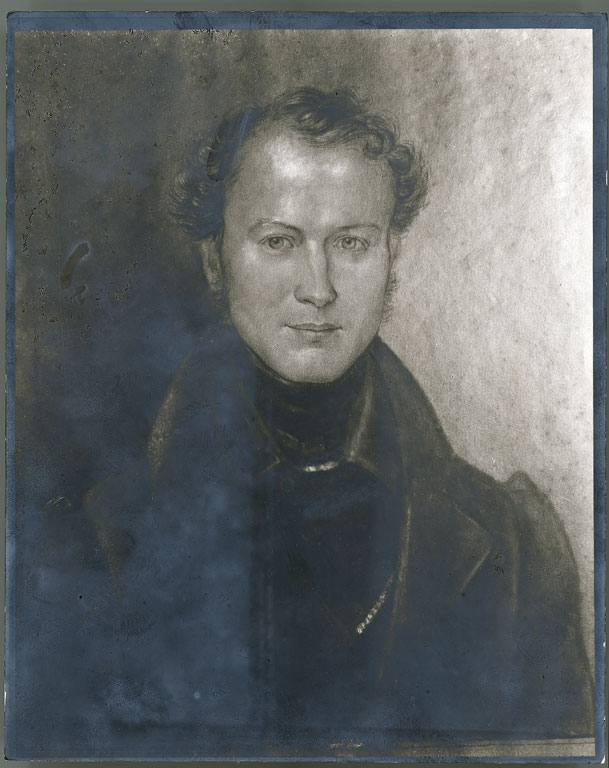
William D. Brackenridge was the assistant botanist for the U.S. Exploring Expedition serving aboard the USS Vincennes from 1838-1842.
The infrequency of appearances of pieces from the two WWII cruisers pales in comparison to anything related to the 19th Century sloop-of-war. During the past decade of searching for anything related to the USS Vincennes, I have only seen one item connected to the three-masted warship. While searching a popular online auction site, a rather ordinary, non-military item showed up in the search results of one of my automated inquiries. The piece, a wood-cased field microscope from 1830-1840, bore an inscription that connected it to the assistant botanist of the United States Exploring Expedition, William Dunlop Brackenridge.
Admittedly, I am not in the least bit interested in a field microscope as militaria collector, but the prospect of owning such a magnificent piece that would have been a fundamentally important tool used during the United States first foray into exploration was an exhilarating thought. At its core, the goal of the (1838-1842) U.S. Ex. Ex. was to chart unknown waters, seek the existence of an Antarctic continent and discover and document unknown species of flora and fauna. Brackenridge’s field microscope would have been a heavily used item as he and his assistants would most-certainly examine the various characteristics of plant species at a microscopic level.
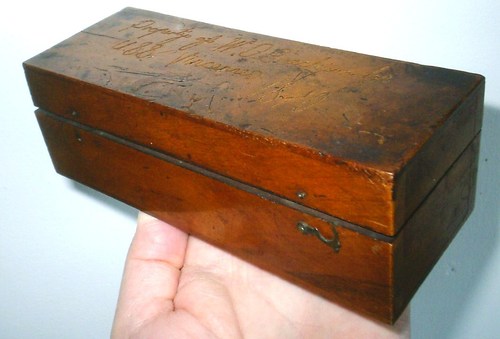
The box appears to be missing some of the securing hardware which would help to hold the lid closed (source: eBay image).
Authenticity and provenance is certainly a major concern when purchasing a piece like this and the listing made no mention of any materials or means to verify the claim. However, in searching for similar microscopes, there was sufficient comparative evidence to support the time-frame in which the Brackenridge instrument was made. The box and the engraving seems to be genuinely aged and appears to resemble what one would find from a 170 year old example.
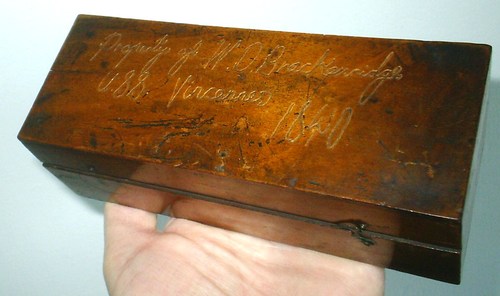
The box for the field microscope is inscribed with “Property of W. D. Brackenridge U.S.S Vincennes 1840″(source: eBay image).
In my opinion, the investment was well-worth the risk and I was poised to make my maximum bid (invariably draining my discretionary savings) knowing that the closing price would exceed what I could ultimately afford. The auction closed with the winning bid ($810.58) exceeding my funds by a few hundred dollars, though I suspect that the winner had a far higher bid in place to guarantee victory.
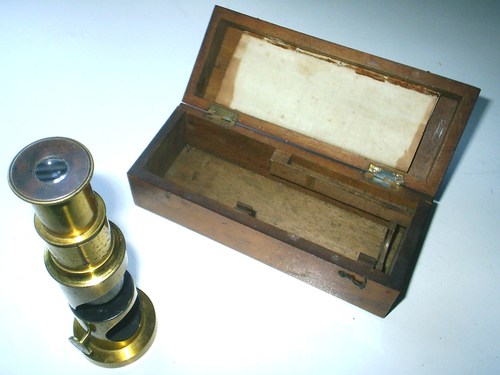
Showing the eye-piece perspective of the microscope and the wooden box (source: eBay image).
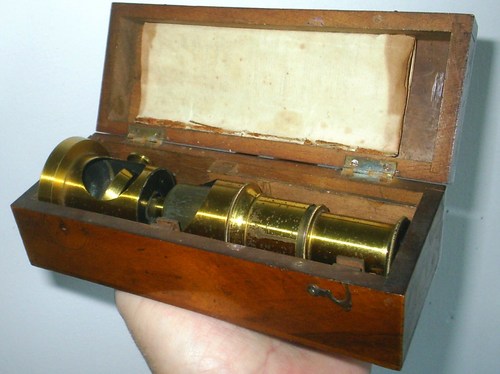
The microscope sets securely into the accompanying wooden box (source: eBay image).
I am a realist yet remain hopeful that I won’t have to wait another decade before another sloop-of-war piece comes to market.
Ancestral Flag: A “Guidon” my Family History
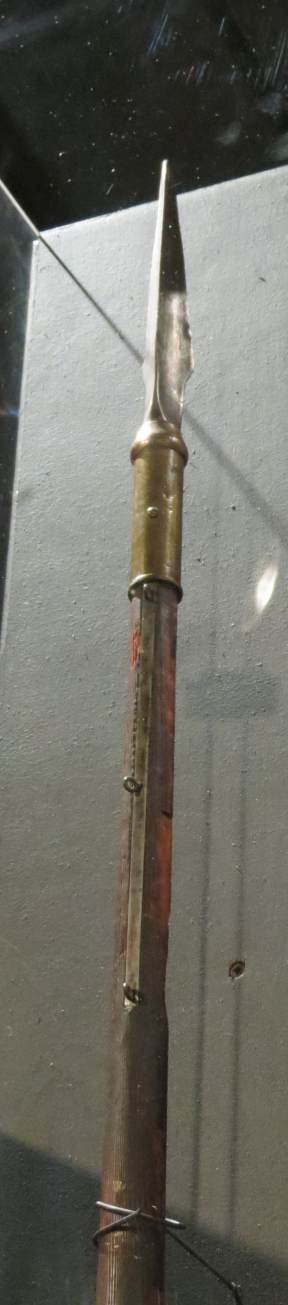
Housed at the US Army Heritage Education Center (located in Carlisle, PA), this image shows one of the actual lances carried by 6th Pennsylvania Cavalry troops.
Years ago, I embarked on a project to document most (if not all) the members of my family’s ancestry who served in the United States armed forces. Researching genealogy can be quite a daunting task when pursuing such a specific theme within confines of a family history. The difficulty in that task is compounded when the there is little or no documentation available to begin with.
I began my research with the names that I knew on my list – my father, grandfather (only one served), uncles, grand uncles and so on. Merely working backwards two generations, I accounted for six veterans (five with combat experience). The third generation up is where I began to experience challenges (some parts of the family emigrated from Canada or the United Kingdom which adds another complexity layer to the research effort), but was able to persevere, discovering several more U.S. service members.
It was at the fourth generation (removed from me) that I discovered one veteran in particular that had really captured my attention. My 3-times great-grandfather was a veteran of the American Civil War (ACW). I took several notes of his vital information and continued searching. I found that two of his grandfathers and at least one great-grandfather were veterans of the Revolutionary War. With this information, I established a stopping point and began to focus on ferreting out as much data as I could find. I decided to hone in on the Civil War veteran and began exhausting all of the online resources.
After receiving two packets of information following a National Archives request (and several weeks of waiting) I began to piece together what my ancestor did during his time in service. Like thousands of young men across the Union, my great, great, great-grandfather, Jarius Heilig, volunteered (September, 1861) to serve alongside his (Reading, PA) neighbors and relatives, enlisting into the 6th Pennsylvania Cavalry (70th Pennsylvania Volunteers) – a unit formed by Colonel Richard Henry Rush (son of Richard Rush who was President Madison’s Attorney General and grandson of Dr. Benjamin Rush, a signer of the Declaration of Independence), classmate and friend of General George McClellan.
One interesting fact about the 6th Penna is that their primary weapon. the lance (rather than the standard U.S. cavalry-issued carbine rifle), was suggested by McClellan, harkening to the once-feared European dragoons and cavalry units. The weapon is described as:
“The Austrian pattern was adopted. It was nine feet long, with an eleven inch, three edged blade; the staff was Norway fir, about one and a quarter inches in diameter, with ferrule and counterpoise at the heel, and a scarlet swallow-tailed pennon, the whole weighing nearly five pounds.”
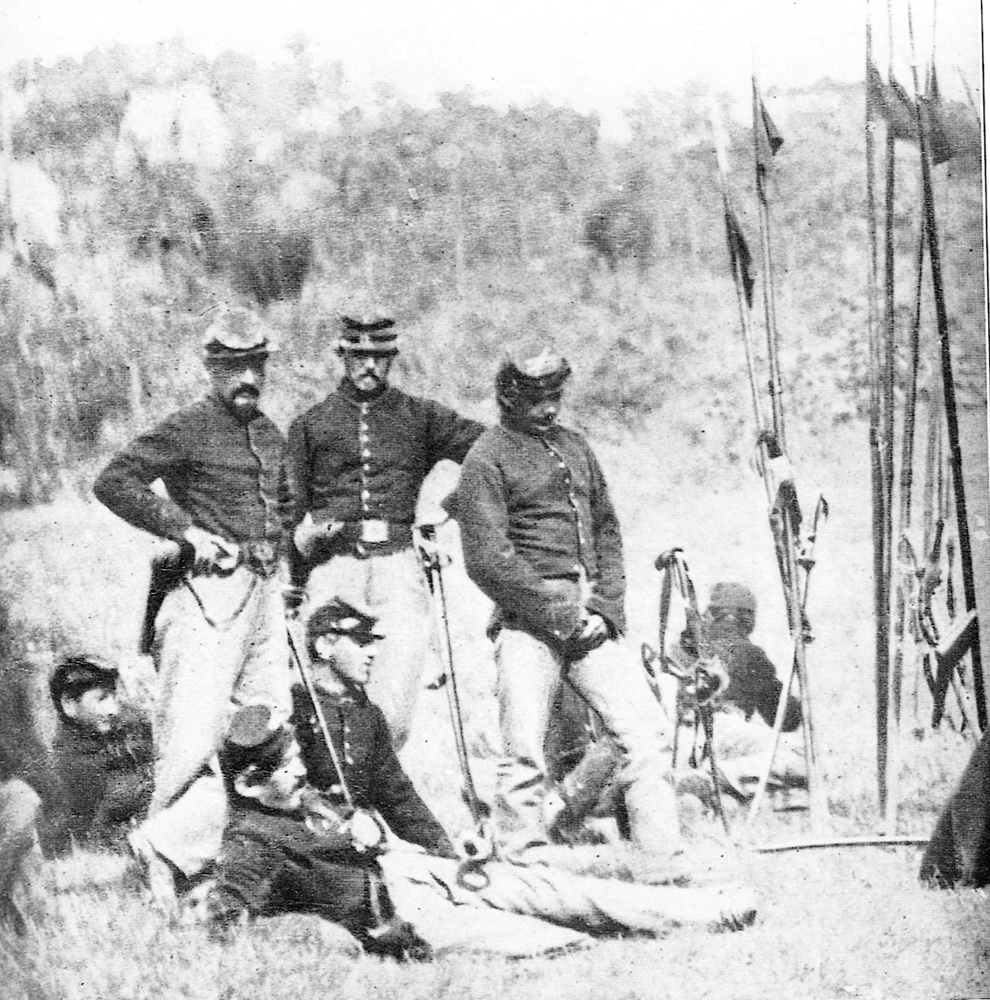
“I” Company of the famed Rush’s Lancers as captured by Matthew Brady.
Though injured (by a horse-kick, of all things) at the end of 1862, Heilig had seen his share of combat serving entirely with “F” company until his February 1863 discharge (due to disability), with action in the following battles and skirmishes:
-
Skirmish, Garlick’s Landing, Pamunkey River, VA (June 13, 1862)
-
Seven Days Battles, VA (June 25-July 1, 1862)
-
Battles, Gaines Mill, Cold Harbor, Chickahominy, VA (June 27, 1862)
-
Battle, Glendale, Frazier’s Farm, Charles City Crossroads, New Market Crossroads, Willis Church, VA (June 30, 1862)
-
Battle, Malvern Hill, Crew’s Farm, VA (July 1, 1862)
-
Skirmishes, Falls Church, VA (Sept. 2-4, 1862)
-
Skirmish, South Mountain, MD (Sept. 13, 1862)
-
Skirmish, Jefferson, MD (Sept. 13, 1862)
-
Action, Sharpsburg, Shepherdstown, and Blackford’s Ford (Boteler’s Ford) and Williamsport, MD (Sept. 19, 1862)
-
Actions, Bloomfield and Upperville, VA (Nov. 2-3, 1862)
Research resources are quite abundant for this unit (which I am still pouring through) and it has been the subject of a handful of books that were the product of painstakingly thorough historical investigation.
What does this have to do with militaria collecting, you might be asking? Part of my quest in producing a historical narrative of my familial military service is to provide visual and tangible references. To illustrate history, words are only part of the equation in connecting the audience to the story. To see, smell and touch a piece of history provides an invaluable accompaniment to the narrative.
I have given considerable thought to my approach in gathering items to assemble a group of artifacts as a “re-creation” of things my great-grandfather might have kept over the years. Visual appeal, authenticity, believability and cost were all factors guiding me as I purchase various pieces for the collection. My goal with the group is to arrange it into an aesthetically pleasing display that I can then hang on my home office wall (along with the displays I have already created).
Collecting artifacts from the American Civil War is not a task that can easily be easily accomplished on a shoestring budget (such as my own). Seemingly everything is expensive from weapons (rifles, pistols and edged weapons) down to ordinary uniform buttons seen on literally millions of soldiers’ uniforms. The high prices and the popularity of the Civil War’s historical popularity (which is maintained by pop-culture with films like Steven Spielberg’s Lincoln) can have detrimental effects on the market as unscrupulous counterfeiters work tirelessly to cash in.
Adding to my challenge is the fact that there were far fewer cavalry soldiers who served during the war. Even more challenging is that my ancestor served with a state volunteer cavalry regiment, many of which had extremely unusual uniform appointments and accouterments requiring even more research and discernment as to what my 3x-great grandfather would have been outfitted with.
These factors (combined with my own lack of experience) limited my focus to keep the pursuit as simplistic and affordable as possible while focusing on the more common ACW pieces for the display.
Since I embarked on this mission, I have acquired several pieces – a mixture of genuine and reproduction (recommended by a collector colleague) – that will display nicely together. From hat devices to corporal’s stripes (repro) to veteran’s group medals (GAR – Grand Army of the Republic – an ACW vets’ organization my ancestor was a lifelong member of). In addition, I’ve collected some small arms projectiles (from weapons Heilig would have carried) excavated from battlefields where my great-grandfather fought.
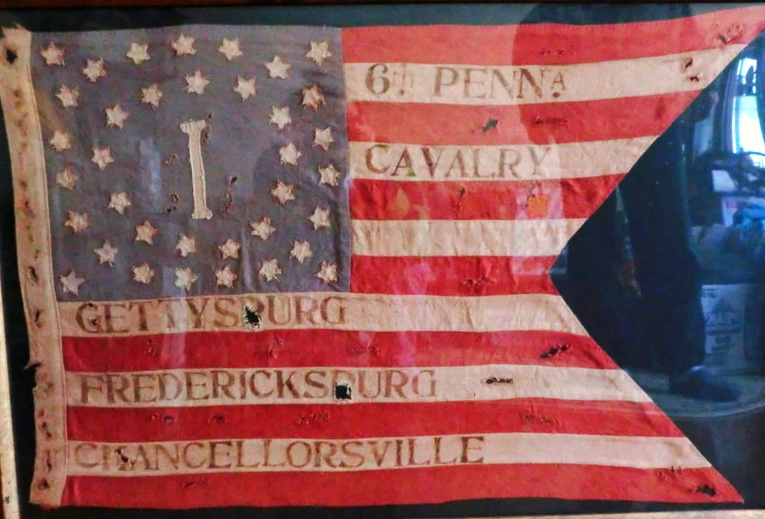
Nicely framed vintage American Civil War guidon of the 6th Penna Calvary (source: eBay image).
I am constantly on the lookout for pieces that would display well or that might be interesting additions to my militaria collection that could be directly tied to my ancestor’s unit. When a cavalry guidon flag (directly connected to the 6th Pennsylvania Cavalry) was listed at online auction, my heart raced as I eagerly poured over the photos of the tattered and worn swallow-tailed cloth.
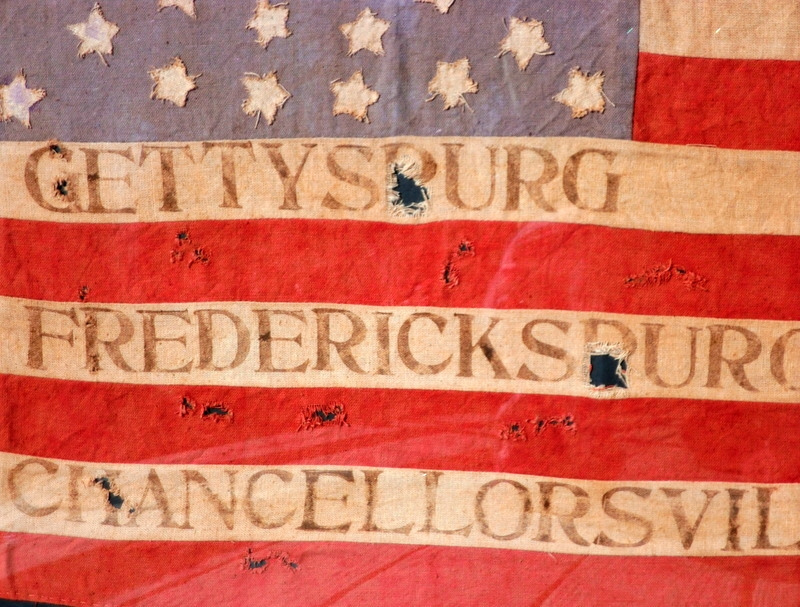
As was the custom of the Civil War, the major battles and engagements in which the unit participated were printed directly onto the stripes on the fly of the flag (source: eBay image).
Lost in the detailed images of the flag, I was amazed to see the faded relic nicely preserved in a frame behind glass. Bearing marks of the unit and the major battles printed directly on the red and white stripes, this flag appeared to be a true relic of the past. The the “I” designator in the blue canton (encircled by the white stars of the states) indicated that this was the guidon from I company (my great-grandfather served in company “F”). Everything about this flag excited me…until I read the description. The flag was a recreation of the original (which is permanently preserved and displayed at the Pennsylvania state house), right down to the synthesized aging (at least the seller was being honest about the piece).
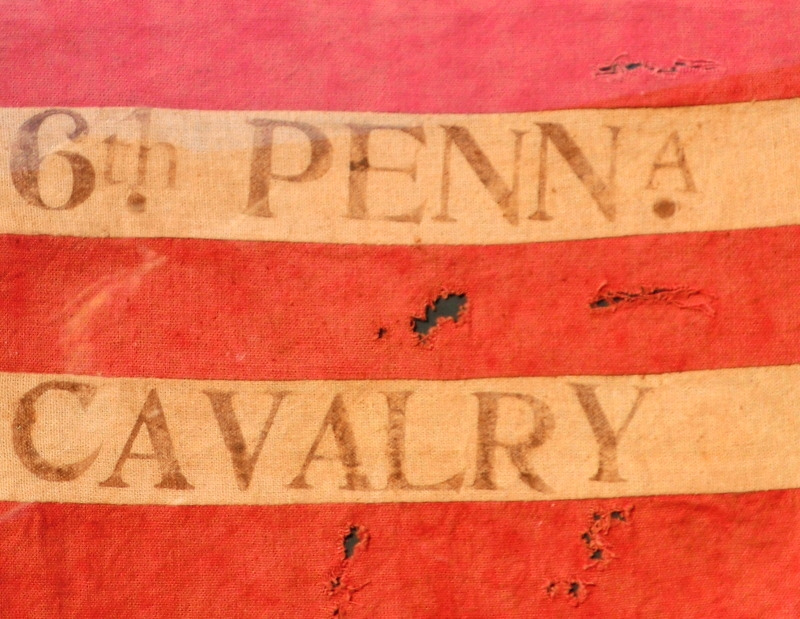
Aside from the tell-tale swallow-tail design of the flag, the printed unit name indicates that this flag was from a cavalry regiment – specifically, the 6th Pennsylvania (source: eBay image).
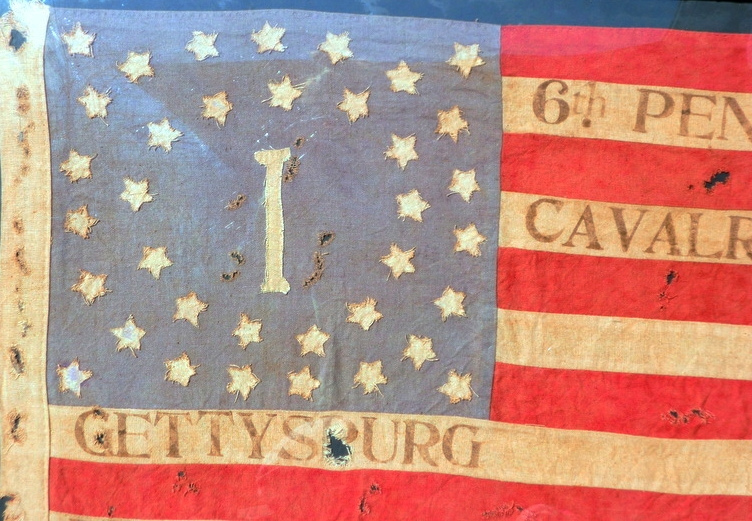
The letter “I” in the center of the blue canton represents the associated company within the 6th Pennsylvania that used this guidon (source: eBay image).
Had the price of the auction been realistic, (the starting bid was $1,000), I would have been interested in pursuing it as a realistic accompaniment to the display I am assembling.
 The Veteran's Collection