Category Archives: Rates and Ranks
Airborne Radiomen
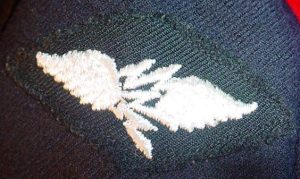
This Aviation Radioman distinguishing mark adorns the sleeve of a seaman 1/c jumper from WWII. Men and women trained to service and operate specific radio equipment for naval air forces during WWII (source: eBay image).
A simple scan of the topics of the articles that I have written over the last (nearly) six years of this site reveals that I am heavily biased towards militaria artifacts from naval service. In reviewing the books that are in my personal library, the overwhelming subjects are naval history (the runner-up topic being baseball). Within the sphere of naval militaria collecting, enlisted uniform-items dominate what I possess – rating badges, patches, hats, caps and covers and of course, the uniforms themselves.
I have a personal connection that fuels my interest in a specific area of Navy ratings – including the development of the technology that surrounds that area: radio and RADAR – and my collection is dominated by the associated job specialties. I have written about the development of radar and the radarman rating and radiomen due to the several uniforms that I have within my collection, my family history and my own interest in the application of the technology for combat advantage.
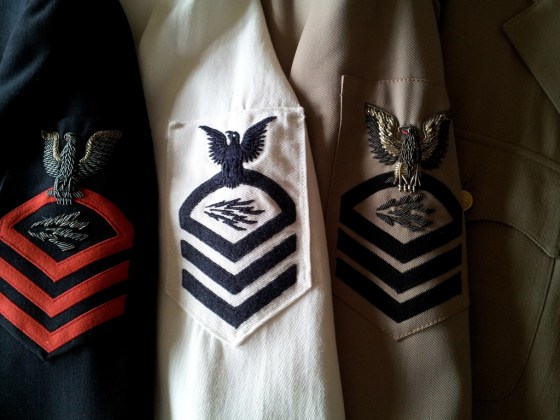
Three of my WWII chief petty officer uniform jackets are part of my predominant radioman and radarman militaria collecting focus.
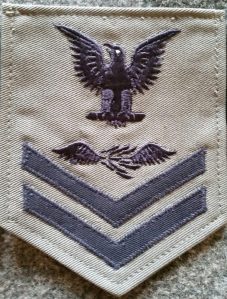
Established in 1942 and enduring throughout WWII, the Aviation Radioman rating is an example of the Navys rapid technological advancement and the need to train and man the ranks accordingly.
Within the radio and RADAR arena of my collecting, I have barely touched upon these jobs as they apply to naval aviation. In terms of airborne technology, World War II saw rapid advancement in the equipment and adoption and usage to gain an edge against enemy forces. One of the ratings that played a significant role in this arena was the Aviation Radioman which was established in all grades (third, second, first class and chief petty officers) in January 1942 after recognizing the need to differentiate these radiomen from their shipboard counterparts. As with the sea-going radiomen, the field of ArMs were split between those who operated the equipment (Aviation Radiomen) and those who were skilled technicians (Aviation Radio Technician) and yet they wore the same rating insignia. In some instances, the sailors had perform in both capacities. As with the shipboard and submariners, certain aviation radiomen were aircrewmen – part of the crew that served on missions within the aircraft.
Stephen R. Walley, Aviation Radioman 2nd Class (of Albany, NY) spoke about his naval career during a May 20, 2006 interview with the New York State Military Museum. Walley’s pathway to becoming and ArM was fairly typical, stating that when he enlisted (in September, 1942) to serve, he opted to train as a Radioman in the Navy. After completing his basic training in Newport, RI, Mr. Walley was sent to four months of schooling for shipboard radio training. ”Upon completion of that course, I came out as a Radioman third petty officer.” Walley said of his early career. “At the last week of the course,” Stephen continued, “we had people come in from naval school in Memphis, Tennessee asking for volunteers to become Aviation Radiomen.” Six to eight of Walley’s graduating class from radioman school reported to Memphis for ten weeks of aviation training, learning additional skills for communication and operating aircraft radio and comms equipment. Because airborne RADAR technology was in its infancy at the time of Walley’s career, he had two additional weeks of education in operating and maintaining equipment to be prepared when the fleet aircraft would be outfitted with the highly secret gear.
-
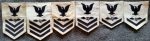
- The aviation radioman rating symbol can vary dependent upon the manufacturer of the rating badge.
-
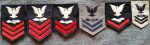
- Purely a WWII rating, these aviation radioman badges range from first to third class petty officer. Note the rating badge for the short-lived service dress gray uniform. At the far right is the female seersucker rating badge.
-
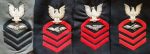
- Chief petty officer aviation radioman rating badges. These bullion beauties are all unused. Note the service dress gray version at the left and the very odd arrangement of the radioman “sparks” on the far right example.
Airborne radiomen required additional training in aerial gunnery school in order to be proficient in providing protection from enemy fighter aircraft. Dive (Douglas SBD Dauntless and Curtiss SB2C Helldiver) and torpedo bomber (Grumman TBF Avenger and Douglas TBD Devastator) aircraft were equipped with .30 caliber machine guns (the Avenger two gunners – the ArM would typically man the ventral-mounted .30 cal versus the dorsal .50 caliber gun) which would be the primary responsibility of these radiomen when enemy aircraft were present. Aerial gunnery school was an additional ten weeks where upon completion, these men would either choose or be selected (based upon the candidates’ height) for their aircraft assignments. The shorter men, up to 5’-9” were better suited for the cramped cockpits of the carrier-based aircraft and the taller men were assigned to train for the large, land and sea-based planes (such as the Consolidated Catalina PBY and the PB4Y-2 Privateer).
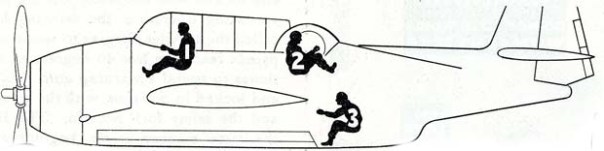
There were three crew members: (1) pilot, (2) turret gunner and (3) radioman/bombardier/ventral gunner – an aviation radioman.
With nearly 21,000 carrier-based aircraft (out of more than 56,000 naval combat aircraft), the need for ArMs was substantial. Not only was the demand for manning aircrews but also for the maintenance staff within the squadrons. In addition, aviation radiomen would fill positions in support of the airwing communications within the radio spaces of the embarked aircraft carriers. Add to this demand, manning requirements for the dozens of naval air stations and facilities in the continental United States and in the Pacific theater meant that there were countless thousands of men and women who served as aviation radiomen during the war.
In some instances, aviation radiomen served as pilots of aircraft (primarily filled by naval aviators and enlisted naval aviation pilots), such was the case for CArM Johnnie E. Mattis during the battle of the Coral Sea in 1942 when he was piloting his torpedo bomber in a harrowing attack on a Japanese carrier, scoring a hit against tremendous odds. In all, more than 650 medals of valor (for the Navy, these include the Bronze and Silver Star medals, Navy and Marine Corps medal, Distinguished Flying Cross, Air Medal, and the Medal of Honor) were conferred upon aviation radiomen for their service above and beyond the call of duty during WWII.
Navy Cross Recipients:
- Bradley, Russell J., Aviation Radioman Third Class
- Karrol, Joseph J., Aviation Radioman First Class
- Mattis, Johnnie E., Aviation Chief Radioman
- Stokely, George D., Aviation Radioman First Class
With the rapid advancement in technology in the Navy and the massive expansion of ratings leading up to and during World War II, changes were afoot for Aviation Radiomen in the years immediately following the War. The peacetime navy ranks experienced considerable contraction as more than 70% (2.3 million) of those serving at the War’s end were discharged back into civilian life. In 1945, the Aviation Radioman rating was renamed to Aviation Electronics Technician’s Mate while still wearing the same mark.
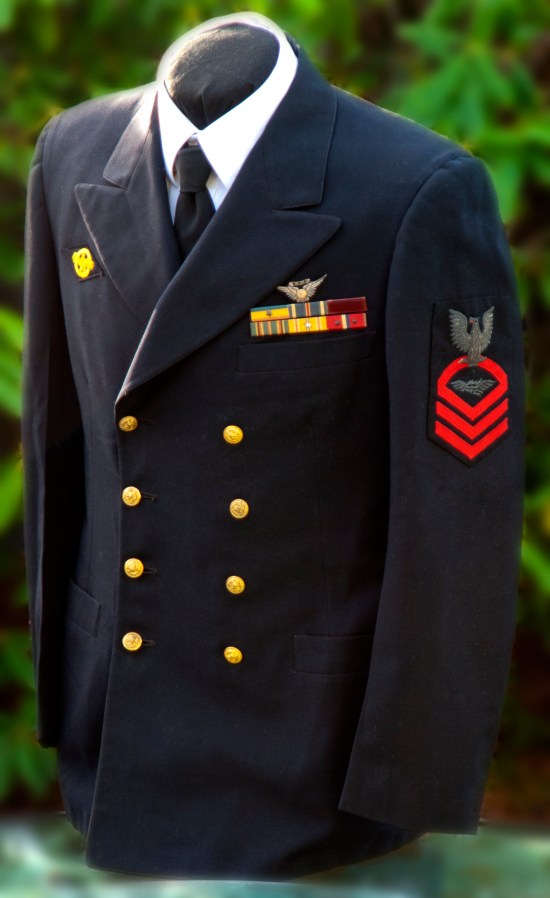
This early WWII eight-button chief aviation radioman jacket has a beautiful bullion rating badge. The chief is seemingly missing a hashmark but he only served during World War II . Also featured on this jacket are the combat aircrew pin and the chief’s ruptured duck discharge patch (note that the combat aircrew wing and ribbons were added solely for the purposes of display. The sailor named in the jacket spent the duration of the war at Naval Air Station San Juan, PR).
As with the changes in Radioman rating (Electronics Technician’s Mate which was the technician side of the RM rating from 1942-1945 – was split out in 1948, creating the new ET or Electronics Technician), a new rating was established from the Aviation Radioman rating in 1948; Aviation Electronics Technician (AT).
| DATE | 8/14/45* | 6/30/46 | 6/30/47 | 6/30/48 | 6/30/49 | 6/30/50 |
| BATTLESHIPS | 23 | 10 | 4 | 2 | 1 | 1 |
| CARRIERS, FLEET | 28 | 15 | 14 | 13 | 11 | 11 |
| CARRIERS, ESCORT | 71 | 10 | 8 | 7 | 7 | 4 |
| CRUISERS | 72 | 36 | 32 | 32 | 18 | 13 |
| DESTROYERS | 377 | 145 | 138 | 134 | 143 | 137 |
| FRIGATES | 361 | 35 | 24 | 12 | 12 | 10 |
| SUBMARINES | 232 | 85 | 80 | 74 | 79 | 72 |
| MINE WARFARE | 586 | 112 | 55 | 54 | 52 | 56 |
| PATROL | 1204 | 119 | 74 | 50 | 50 | 33 |
| AMPHIBIOUS | 2547 | 275 | 107 | 86 | 60 | 79 |
| AUXILIARY | 1267 | 406 | 306 | 273 | 257 | 218 |
| SURFACE WARSHIPS | 833 | 226 | 198 | 180 | 174 | 161 |
| TOTAL ACTIVE | 6768 | 1248 | 842 | 737 | 690 | 634 |
* V-J Day (source: Naval History and Heritage Command)
| Year | Active Naval Personnel |
| 1940 | 160,997 |
| 1941 | 284,427 |
| 1942 | 640,570 |
| 1943 | 1,741,750 |
| 1944 | 2,981,365 |
| 1945 | 3,319,586 |
| 1946 | 978,203 |
| 1947 | 497,773 |
| 1948 | 417,535 |
| 1949 | 447,901 |
| 1950 | 380,739 |
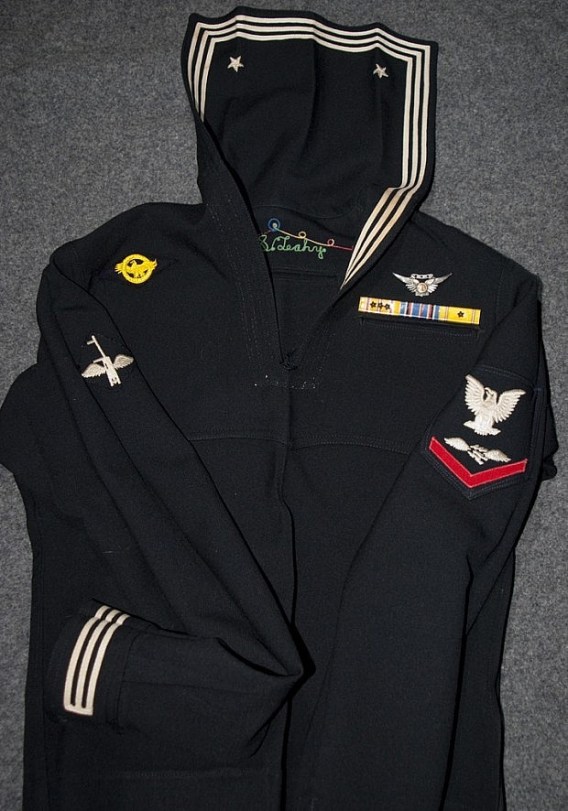
When the Navy began to specialize the enlisted ranks in the late 1800s, special marks were incorporated to denote the skills of the enlisted sailors. This WWII aviation radioman 3/c uniform has the distinguishing mark of an aerial gunner on the right sleeve.
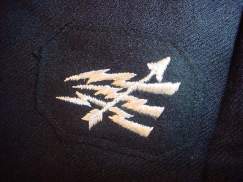
This aviation radioman seaman 1/c wore a Radarman distinguishing mark on the lower right sleeve of his uniform.
Collecting ArM rating badges, distinguishing marks, devices and uniforms along with other, more significant items such as named/engraved decorations (Distinguished Flying Cross, Air Medal, Silver and Bronze Stars and Purple Heart medals) is rather rewarding, considering that the rating essentially existed for the duration of WWII. For my collection, I have acquired a selection of various rating badges and two named uniform items. While I have a sparse collection of navy decorations, both of the two uniform tops; one, a chief aviation radioman technician (CArT) and the other, a ArM3/c (with an aerial gunner distinguishing mark) were great additions even though they were stripped of decorations.
-
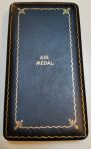
- This WWII-era “coffin” style medal case holds the most common medal for U.S. armed forces aviators and air crewmen.
-
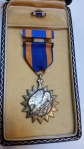
- This WWII Air Medal set includes the standard wide ribbon and lapel pin.
-
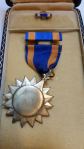
- Engraved medals showing the awardees name, rank and sometimes a date make these medals far more desirable by collectors.
There are militaria collectors who focus on very specific artifact types such as wing devices. Still, some may hone in more tightly, choosing to keep their collecting on naval wings (of which, there are countless variations throughout the 100+ years of existence). Within my “museum,” I have a few navy wings and among them is one WWII-era combat aircrew wing device.
-
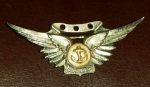
- This WWII combat air crew wing has three places for gold stars to denote the wearer’s individual combat awards.
-
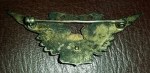
- The back of the Combat Aircrew wing is marked “sterling” and has the maker’s mark just below and to the right of the fastener.
“The insignia featured a banner across the top on which eligible sailors could affix up to three stars signifying individual combat awards. Aircrews engaging enemy aircraft, singly or in formation; engaging armed enemy combatant vessels with bombs, torpedoes or machine guns; and engaging in bombing or offensive operations against fortified enemy positions were qualified to wear a combat star, with unit commander approval, on their aircrew breast insignia.”
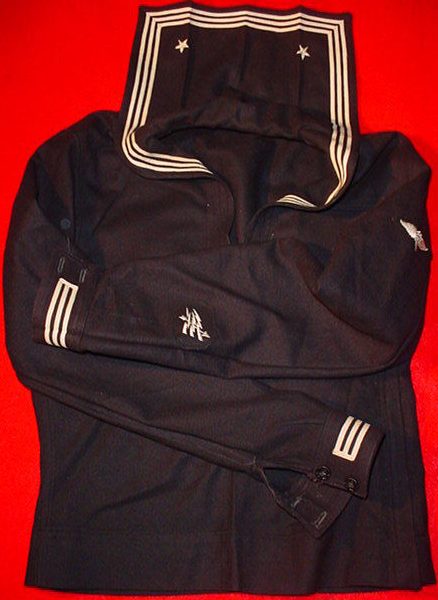
This seaman first class aviation radioman jumper shows that he was a radar technician for airborne radar equipment. This is the first example of an ArM that I have seen with the radarman distinguishing mark.
In performing the research or this article, I made several discoveries and learned how overlooked by collectors and historians alike, these men are. The distinguished actions and sacrifices made by the naval aviators (piloting the aircraft) seem to have overshadowed the duties performed by the flying radiomen of the United States Navy during the second world war.
Related Articles
- Tracking U.S. Navy Specialties: The History of Radarmen
- Rare Bird – Outside of Uniform Regulations
- Silver Eagles: Navy Bullion Rates
- Cryptology and the Battle of Midway – Emergence of a New Weapon of Warfare
- The Militaria Collector’s Search for the White Whale
- Militaria Rewards – Researching the Veteran
Showcasing Your Militaria Investment
What good is a collection if it is maintained behind a closet door (where mine tends to be), stored in the basement or locked in a trunk? We spend years gathering items and filling in gaps in our collections as we reach goals that, in some cases, could take a lifetime to achieve. Despite those successes, we fail when we choose to keep them under wraps, hidden from the eyes of our house guests.
Most collectors’ spouses raise objections to the idea of them bringing old, musty-smelling objects into the spaces that we regularly inhabit. Olive drab hardly matches any home decor and the idea of weapons, armament and mannequins occupying limited floor or wall space tends to create friction with our spouses or significant others.
When I can, I like to visit museums that choose to commit their valuable floor real estate to displaying military history. I enjoy seeing the care that was taken by the staff to draw from the collection a tasteful blend of artifacts to present specific themes or create visual representations of specific historic events. Knowing that too much can cause viewers to gloss over the display, missing the all of the details. Too few artifacts or vague information cards in a display can have a similar effect. In both cases, the efforts of the curator are laid to waste as the museum visitor ambles past the display.
Through my membership in the U.S. Militaria Forum, I have seen some very impressive personal collections with well thought out displays that rival any of the best museums in the United States. From the hand-crafted cases and cabinets to the tastefully selected art hung on the walls, these collectors demonstrate that their investment is something to share with others.
-
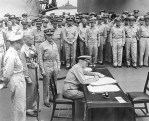
- Fleet Admiral Nimitz signs the documents, accepting the surrender of the Empire of Japan (source: U.S. Navy).
-
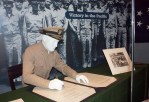
- Note the collar device insignia of Nimitz’ uniform and the tastefully simple display (source: Naval Academy Museum).
-
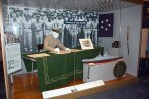
- Tastefully simplistic, the large display has a few items in order to emphasize the monumental significance of the event (source: Naval Academy Museum).
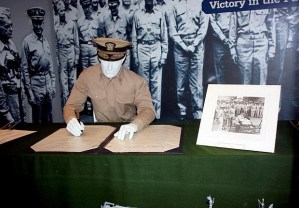
Take note of the mannequin’s altered ring finger on the left hand that matches Nimitz’ partial amputation from 1916 (source: Naval Academy Museum).
Not too long ago, the Naval Academy Museum shared some photos on their Facebook page of one of their latest displays that showcases one of the most historic events of the last century, the signing of the Instrument of Surrender aboard the USS Missouri. Presented is the uniform worn by Fleet Admiral Chester Nimitz on that September 1945 day in Tokyo Bay. The display clearly shows his khaki uniform with the rare 5-star insignia affixed to each collar. The museum staff went as far to alter the mannequin’s left ring finger to match Nimitz’s left hand: a portion of his finger was severed in 1916 by a diesel engine that he was demonstrating.
The key, limiting factor in my home is that I have a considerable lack of space. It is challenging enough to store my collection so the thought of propping up torsos to show my uniforms is nullified. Besides, it can be a little disturbing to walk into a room and see a still and quiet human-form at 4:00 AM as I prepare to head off to work.
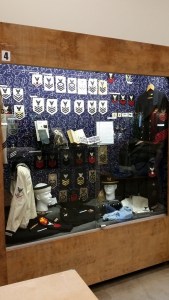 A few years ago, I was invited to participate in a public showing of my military baseball collection at our state fair in their hobby hall. My artifacts where showcased in and among adult and youth collections that were varied, ranging from pig-themed collectibles to artifacts from our nation’s bicentennial celebration. This year, I have yet another part of my militaria collection on display at the state fair. Being that the overwhelming military population (veterans, retirees, reservists and active duty personnel) is army and air force, I wanted to educate the citizenry on enlisted uniforms of the United States Navy. I gathered a few selections of my enlisted rating badges and uniforms to spotlight the history, designs and the ratings themselves. My wife and I visited the fair and stood in the distance to observe visitors to see how they respond to what I had on display. People-watching is fun but seeing people enjoying these artifacts is pleasing and provides some satisfaction to collecting, even if I can only experience it on rare occasions.
-
- Showing the 8-button Machinist’s Mate Chief (bullion) and Electrician (radio) 2/c from WWI uniforms backed by ratings, distinguishing marks and shoulder insignia patches and WWII warrant officer shoulder boards and devices.
-
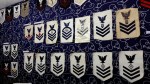
- A selection of rating badges showing eras, specialties, date and manufacturer’s marks.
-
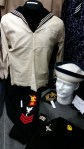
- A few other uniforms: 1905-1913 Coxswain, 1944 Ship’s Cook 1/c and a 1944 Aviation Radioman 3/c (with aerial gun pointer mark) next to a vintage naval academy midshipman rating badge and plebe cover.
Spotlight on private collector militaria displays
- “Belleau Wood Museum” – fabulous World War I Marine Corps displays.
- Chaplain Collection– focused on chaplains of all branches and all conflicts.
- General Officer Collection – one of the most impressive collections – this one focuses solely on officers who attained the rank of general or admiral
Militaria Collecting Made Complicated – No Checklists

One of several checklists within the 1956 baseball card set by Topps.
Prior to delving into militaria and historical research, I collected sports cards for years. My principal interest in this arena was with baseball which is also my favorite sport to watch. Back then, my interest in the game centered on the history – the “golden era” – and the legends of the game. However, with baseball card collecting, I chose to focus on the 1950s and 1960s.
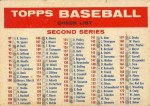
This 1957 Topps baseball card checklists shows the marks the collector made as they worked to complete the set.
With so many players in the game (not all of them represented on a card) in the early 1950s, card companies recognized that they could create more interest by letting their target audience know how many different cards were produced. This information, in the form of checklist cards, contained all the information that informed collectors what cards were produced. This information would keep collectors buying the wax packs (of course, getting the wonderfully powdered sugar covered, hard sticks of bubblegum) and trading their extras with their friends. As they filled out their sets, collectors would check their checklists.
Militaria couldn’t be a more polar opposite from sports card collecting. There are no checklists and finite production runs, no hardened rules about variations, no price guides that afford collectors with knowledge of sales trends….none of that. Militaria collecting requires the collector to acquire knowledge about the artifact – where it was used, who used it, when it was produced and available, when it was issued, how it was modified (in the field), etcetera – before they commit significant finances to collecting.
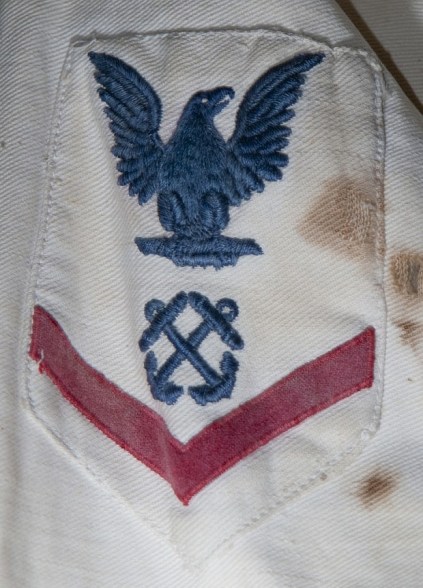
The right-sleeve rate of the 1905-1913 coxswain (with an additional chevron, this would be a boatswain’s mate 2nd class petty officer).
Navy rate collectors can tell stories about variations and just how frustrating it can be to acquire all of the renditions of a specific rate. When considering a long-standing rate, such as a boatswain’s mate (pronounced “bosun’s mate”, BM for short) that has been in existence since the founding of the U.S. Navy, its rate badges have gone through considerable transition. One could assemble an amazing volume of examples of each badge iteration as BM (and Coxswain) insignia have been around since the 1880s.
With each change to uniform regulations (1886, 1905, 1913, 1941, 1946, and so on) rate badges were impacted. Some changes were simply moving from one sleeve to the other (1946) while still others changed the design of the crow (the design of the eagle, color of the chevrons). Additional variations stem from the uniform that the crow is applied to (khaki, blues, whites, greens, grays) as well as the material variations of the base fabric (multiple iterations of blue and white cloth) or the color of the chevrons and eagle (such as bullion).
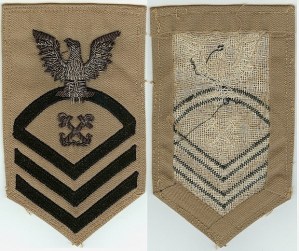
One of countless boatswain’s mate rate badge variations, this post-WWII crow is a bullion on khaki.
If a collector focused solely on the boatswain’s mate rate spanning its entire existence, the collection could potentially be quite large and very costly to build. Unfortunately, there are no checklists to guide collectors. What can confound collectors is the discovery of a rate variant that has never been seen before by seasoned, knowledgeable experts.
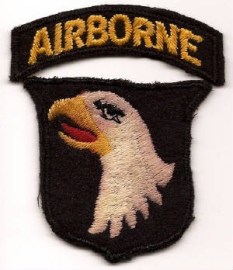
This Screaming Eagles patch is one of countless variants for collectors to pursue (source: Topkick Militaria).
Similar to rate collecting, U.S. Army patches are very diverse and have experienced many iterations over the course of their employment on uniforms. Variations exist within the same era on the same patch design which give collectors reason for pause as they try to collect every option available. Since I don’t really dabble in army patches, my eyes tend to glaze over when other collectors begin to espouse the many facets of the World War II-era Screaming Eagles shoulder insignia. From the different “airborne” tabs to the design of the eagle’s eye and tongue, the 101st Airborne patch could occupy collectors for years as they seek to assemble a complete collection. Cut-edge, marrowed-edge, fully embroidered, felt, greenbacks, white backs, the possibilities are seemingly endless making the concept of having a checklist ideal.
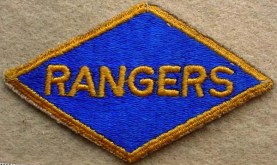
While I can’t vouch as to the authenticity of this being the real thing, it is the design of a World War II Rangers patch (source: SA Militaria).
One aspect I’ve not mentioned and won’t really delve into is the issue of fakes. When a television show or film achieves the level of popularity that Saving Private Ryan (SPR) and Band of Brothers (BoB) have, shady characters create opportunities to separate novices from their hard-earned cash. The Ranger (SPR) and Screaming Eagles patches (BoB) are some of the most heavily-faked embroidery in the militaria market.
In all fairness to those who invest heavily into these areas (with both time and finances), the main reason I shy away from army patches (specifically Rangers and 101st) is that I have no idea how to tell a fake from the real McCoy. I suppose that the pricing of some of the more rare variants (sometimes in excess of $1,000) keep me steering well-clear of collecting army patches all together.
Militaria Issued: Giving and Receiving
Over the span of the last seven years, I’ve worked diligently in learning the ins and outs of collecting militaria and yet have only begun to scratch the surface. Delving into the details, for me, has produced an incredible wealth of knowledge surrounding many aspects of military pieces, such as when or where an item was worn or used. But that hasn’t been the most substantial reward in my passion for military collecting.
Being a student (not to be glib, as I am always learning) of American history has occupied my attention for decades. My wife and children could tell you stories about my side excursions to see some obscure item or location of historic note during our family vacations, in my passion to align book knowledge with the visual reality. Experiencing history helps to bring the stories to life and while facts are solidified in this process, actually seeing an item or location opens my mind to new questions with this acquired perspective. This process of learning is fun for me, but in regards to militaria, it still isn’t the pinnacle of satisfaction in collecting.
My military artifact collecting was sparked when a few boxes of Third Reich items were dropped into my lap nearly twenty years ago as my family dealt with our aging grandparents and the need to relocate them from their home of fifty years to an assisted living care facility. Having moved only once over the course of eighty-five years, my grandfather had accumulated quite a “treasure-trove” of artifacts including his older brother’s World War II trunks that were untouched from the time they arrived from Germany in 1945. I was suddenly thrust into the task of researching the pieces that my uncle had “acquired” during his participation in the elimination of the Nazi menace.
Though I didn’t get into collecting German militaria, my interest was piqued with the idea of owning pieces of history. The thought of possessing a tangible artifact that was connected to history as well as the connection to my family member’s participation in those events, was compelling and dovetailed nicely into the incessant genealogy project I was, and still am, working on.
-
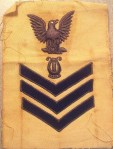
- I was gifted this 1920s navy musician 1/c rating badge – like one my uncle would have worn – from fellow collector when I first began collecting U.S. militaria. This act demonstrated to me that the militaria community was much different from the others I’d participated in.
-
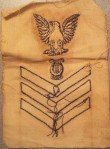
- Showing the reverse side of the rating badge – much can be revealed about these patches by looking at the back.
I have dabbled in collecting in several areas in my lifetime and I have met a lot of nice and passionate people who shared similar interests as me. Those relationships always tended to be more proprietor-patron rather than collaborative and sharing. However, from the moment I started to seek answers to questions regarding personal military artifacts that I had inherited from a few relatives, I began recognizing different traits in the people who collect militaria. Aside from a passion for the objects and the rich history, these collectors were quick with thoughtful responses to my inquiries as they provided detailed descriptions and guided me to research resources in an effort to enable me to be self-reliant. Among all the quirks and odd interests, I noticed an authentic sense of community with militaria collectors.
One trait that really blindsided me as I was increasingly immersed into militaria collecting was the trusting and giving nature of these people. As I participated in the discourse and discussion surrounding these wonderful objects, I began to build relationships with other collectors. Out of the blue, one collector asked me for my address as he had “something” for me. This fellow collector observed and gleaned, from my posts on a militaria forum, what my interests were and subsequently sent me a vintage 1920s rating badge – something that one of my uncles would have worn on his navy uniform. I was humbled by the gesture and that this collector would accept no offer of payment for his trouble. This example was merely a foretaste of what I would experience on a somewhat regular basis and my collection has grown because of the kind hearts of others. The charitable nature of others is infectious which prompted me to do the same with other collectors.
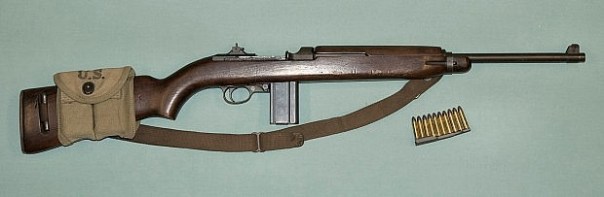
This fine example of the M1 carbine shows a magazine pouch attached to the rifle’s stock.
Awhile ago, I was invited to tag along with two other guys that are as passionate about military history and collecting as me to visit a local dealer of antique books and manuscripts. This dealer, a highly regarded authority in many circles, showed several fantastic pieces from his personal collection that prompted three jaws to repeatedly drop. Toward the end of our visit, the gentleman retrieved a WWII-vintage M1 carbine rifle in immaculate condition that was a distinct departure from the paper artifacts and, knowing that we were all interested in militaria, offered it for sale with a low-ball price tag. Unfortunately for me, financial constraints precluded me from purchasing the vintage weapon. However, one of my companions did “pull the trigger” and came away with the rifle.
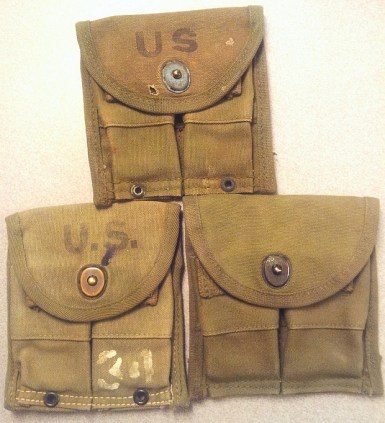
I recently acquired these M1 carbine pouches to give to a friend and fellow collector who recently purchased a late-WWI M1 carbine rifle. The nice, used condition will be great accompanying his rifle.
Not long after the M1 offering, I stumbled across a set of three WWII-vintage M1 carbine magazine pouches that were in good condition and were listed at a very affordable price. Thinking about my friend’s recent purchase, I snagged the pouches to give to the new carbine owner.
-
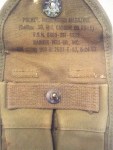
- This mag pouch shows a much later set of markings that appear to have a date stamp of 1957.
-
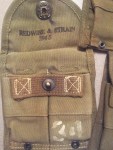
- Looking inside one of the pouch’s magazine flaps reveals a 1945 date stamp.
Over the last few years, I have gifted several pieces from my collection in the hope that it helps a fellow collector fill in the gaps or simply provides enjoyment in receiving a new piece they had not seen before or never knew existed.
Unlocking the Secrets of Your Collection: Research is the Key
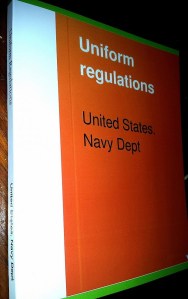
The cover of the 1913 U.S. Navy Uniform Regulations is very high quality in its construction.
Researching early military uniforms to ascertain a date or time period when they were issued or used can pose a challenge for collectors. Navy uniforms can be exceedingly difficult to pinpoint when it comes to dating them for a number of reasons.
Over the last few years, I have stressed that education and research materials only serve to enable collectors to make sound purchasing decisions. Knowing where to turn for information can be a daunting task for someone making their initial foray into this hobby. Simply knowing what research material might exist isn’t in the mindset of those seeking details about a uniform or uniform item.
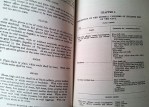
This copy is complete with all of the details including tables and pertinent data.
When I started a serious approach to research (in this case, verifying a jumper as pre-World War I), I was in the dark as to where to look so I turned to Google to begin my investigation. With the understanding that information on the web is seldom complete or authoritative, the search results seemed to be ambiguous and quite vague, so I narrowed my focus to locating people I could glean information from. As with any relationship, time is necessary to determine whether an “expert” is truly knowledgeable in their professed field of experience, so there was a risk that I might have received some inaccurate data.
Wanting to have go-to resources at my disposal, I began to gather reference material that suited my needs. My collection being predominantly focused on the service of my relatives and ancestors, I knew that I had to get the details (i.e. enlistment dates, commands assigned to, campaigns they participated in, etc.) of their individual service records. Armed with hard facts, I could then pursue the pertinent reference materials such as individual unit histories, training manuals, and uniform regulations.
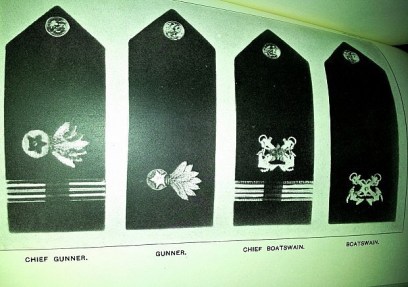
The plates are spectacular! This one shows the warrant officer shoulder boards and insignia.
Some of these materials are plentiful and relatively inexpensive, such as the Navy’s Blue Jackets Manual (issued to new recruits). Others are somewhat rare, making them difficult to find or posing negative impacts onto collecting budgets. One reference book I had been seeking was the 1913 United States Navy Uniform Regulations. I couldn’t locate one through various book stores or eBay. Fortunately for me, Google Books digitized a copy and had the majority of the book’s content available for online use. Unfortunately, the missing portions were the ones I needed for my research. I was amazed to see that I could purchase a hard copy, printed and bound complete book for less than $10.00, shipped to my door! Naturally, I pulled the trigger and less than five days later, I had the needed reference book in my hands.
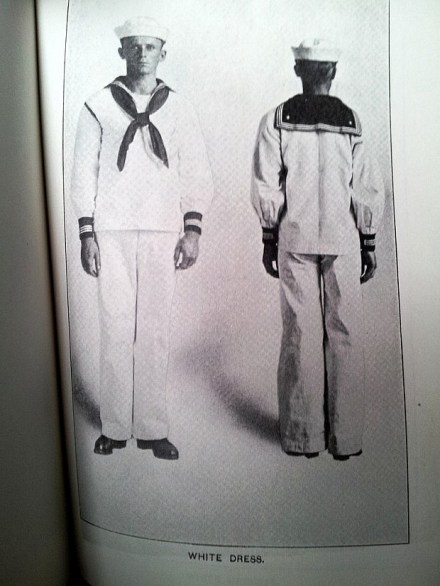
This plate shows the construction of the dress whites – bleached white duck and blue flannel cuffs and collar.
What arrived was a paperback book with a high quality glued-in binding that will withstand repeated viewings or being transported to collector shows much better than an original 100-year-old hardbound book with a weakened spine.
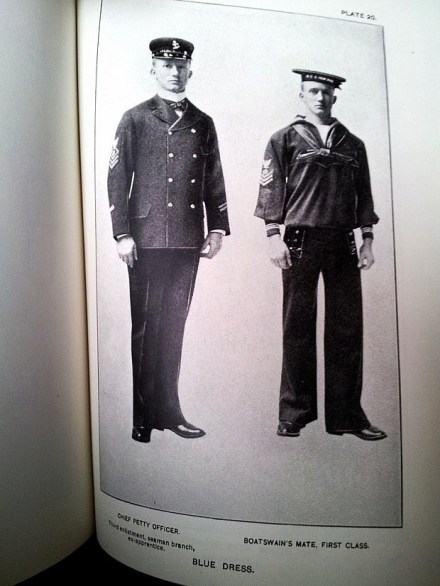
The chief and enlisted dress blues plate shows the proper wear and insignia placement.
Acquiring the 1913 regulations may not appeal to others, but for me this was like locating a missing piece that completes a collection. I’ve confirmed a piece as authentic and I can correctly pursue the remaining outstanding parts to properly complete my uniform display!
 The Veteran's Collection