Blog Archives
Finding the “Lady Lex,” One Piece at a Time
A few weeks ago, our nation honored the 75th anniversary of the sneak attack on the Pacific Fleet at Pearl Harbor on December 7th. In the past few years, we have marked significant anniversaries of victories from WWII, the War of 1812 and this year we will begin recognizing the centennial of the U.S.entrance into the Great War. For collectors, these occasions spur us to evaluate our own collections while attempting to be discerning of sellers’ listings who are also trying to capitalize on the sudden interest.
In May of this year, 75 years will have elapsed since the first significant clash between the opposing naval forces of Japan and the United States in the Coral Sea. Leading up to this battle, the Navy had suffered losses in The Philippines, Wake Island and Guam followed by the sinking of the USS Houston (in the battle of Sunda Strait) all of which were leaving the U.S. extremely vulnerable and nearly incapable of mounting a naval offensive.
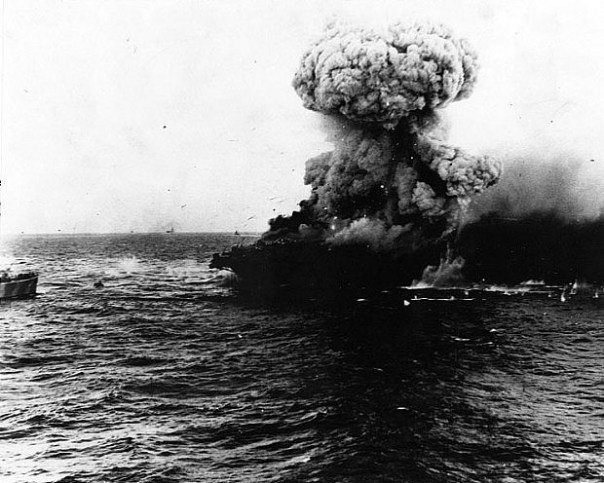
The Lady Lex is rocked by an enormous explosion during the Coral Sea battle, May 8, 1942 (Photo: Naval Historical Center).
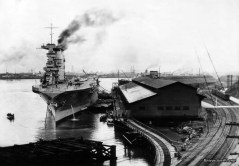
USS Lexington (CV-2) provides electrical power to the City of Tacoma (WA) during a severe drought and subsequent electricity shortage – December 1929 – January 1930 (Photo: Tacoma Public Library).
Beginning with a joint effort between the US Army Air Force and the US Navy, the fight was taken to the Japanese home front with an B-25 air strike launched from the USS Hornet. But the direction of the war was seriously in doubt and Navy brass knew that inevitably, a direct naval engagement with the Japanese fleet were very near on the horizon.
Navy code-breakers had discovered the Imperial Japanese forces intended on taking Port Moresby in New Guinea and quickly dispatched Task Forces (TF) 11 and 17 to join up with TF 44 near the Solomon Islands and proceed West toward the Coral Sea. Over the course of May 3rd through 8th, the ensuing engagements between US and IJN forces resulted in substantial losses for both sides, including a carrier from each navy.
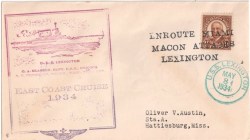
This 1934 postal cover commemorates the Lexington’s East Coast cruise of 1934 (photo: eBay).
For the U.S. Navy, that carrier was the USS Lexington, CV-2. Though not the first purpose-built aircraft carrier (that distinction goes to the USS Ranger CV-4), Lexington was the first to be originally commissioned as a flat top. The Langley (CV-1) had a previous life as a collier, the USS Jupiter, for seven years from 1913 to 1920. The “Lady Lex”, as she would come to be known, laid down as a battle cruiser but was reconfigured during construction and was commissioned in 1927 as the US Navy’s second carrier, CV-2.
The result of the Coral Sea Battle was that the Navy was left with just two operational carrier: Hornet and Enterprise, as the Yorktown also suffered substantial damage in the battle requiring repairs. Less than a month later, the tables would be turned on Japan with the major American victory at Midway.
-
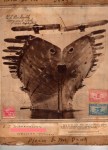
- A postal cover of the USS Lexington (Photo: Navsource.org).
-
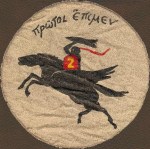
- A leather squadron patch from the Early Knights of Bombing Two (VB-2) from the Lexington (photo: Brian’s WWII Surplus& Antiques Store)
-
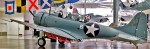
- This SBD-2 Dauntless aircraft was recovered from a lake where it sat since 1945. While it was not a veteran of the Coral Sea battle, it did fly from the decks of the Lexington during the early months of 1942 (photo: National Naval Aviation Museum)
-
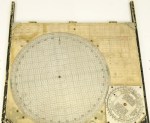
- This plotting board was used by Lieutenant (junior grade) Joseph Smith during the Battle of the Coral Sea when, while on a scouting mission from the carrier Lexington (CV 2), he spotted Japanese aircraft carriers and their escorts (photo: Naval Aviation Museum).
-
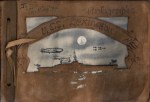
- A sailor’s leather-bound USS Lexington CV-2 Photo album (photo: eBay).
The loss was not only felt by her crew and navy strategists, but also by communities, such as Tacoma, Washington. For 31 days during winter drought conditions, the Lexington was sent to aid the city’s citizens by generating power ’round the clock, helping to keep their homes lit and warm. Many of those beneficiaries of the electrical power assistance were devastated by the news of her loss.
Today, few artifacts remain from the Lady Lex. Militaria collectors would be hard-pressed to obtain anything specific to the ship, instead having to settle for obtaining USS Lexington veterans’ personal effects or uniform items, surviving ephemera, philatelics, or vintage photographs. For many naval collectors, the hunt for anything from this historic ship can very rewarding. Some artifacts can be found by happenstance as was the case with this Curtiss SB2C Hell Diver, recently pulled from the Lower Otay Reservoir near San Diego, discovered by a fisherman who observed the plane’s outline on his fish-finder.
Armed with patience and time, collectors could assemble a nice group of artifacts to pay proper respect to the Lady Lex and the men who served aboard this historic ship.
UPDATE March 5, 2018: Paul Allen’s Undersea Exploration team that has been searching and discovering the wrecks of the Pacific War, finding such infamous sunken vessels as the USS Indianapolis and the lost ships from the Battle of Savo Island (USS Vincennes, Astoria and HMAS Canberra), announced today that they have located and filmed the wreck of the USS Lexington (CV-2) at the bottom of the Coral Sea in nearly two-miles of depth.
USS Vincennes Under the Microscope
Those who know me on a personal basis understand my affinity for a specific U.S. naval warship. Technically speaking, that interest lies with four combatant vessels, all of which were named to honor the site of a Revolutionary War battle (more accurately, a campaign) that ended the British assaults on the remote Western colonial front. That location in present-day Southwestern Indiana would later become the seat of the Northwest Territorial government in the town of Vincennes.
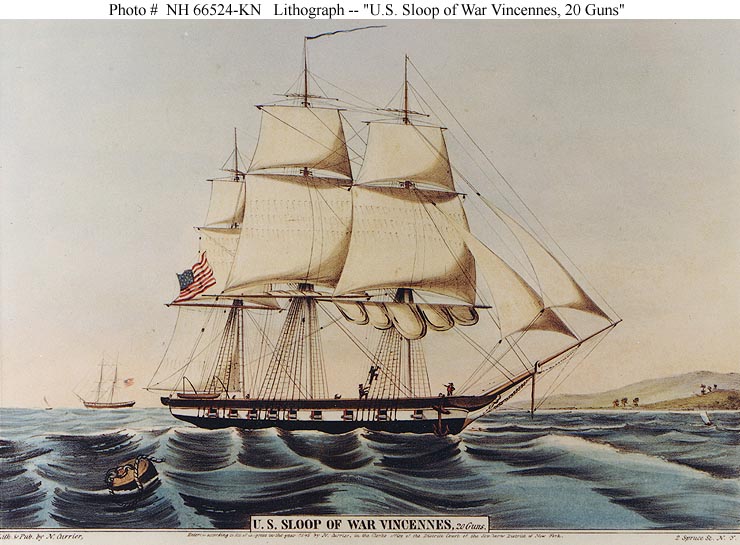
Colored lithograph published by N. Currier, 2 Spruce Street, New York City, 1845 (source: Naval Historical Center).
My connection to this ship’s name extends all the way back to the place of my birth which was also the location of the commencement of an extensive 1840 charting survey of Puget Sound (in Washington State). Locations and geographical features surrounding my home were named by Lieutenant Charles Wilkes (commander of the United States Exploring Expedition of 1838-1842) and members of his team when the sloop of war, USS Vincennes (along with other ships of the expedition) was in the Sound. I can even cite some Baconesque connections with great, great, great-grandfather who served in the Ringgold Light Infantry (after he was discharged from his cavalry regiment following a disabling injury). The Ringgold name was inherited from Samuel Ringgold, Expedition-member Cadwalader’s older brother (yes, I realize that this is very convoluted).
My personal connection (to the ships named Vincennes) was solidly established when I was assigned to the pre-commissioning crew of the CG-49. During the first several months (leading toward the 1985 commissioning date), like many of my shipmates, I was exposed to the history of the ship’s namesake and established personal relationships with veterans of the WWII cruisers of the same name. Collecting items from “my” ship was purely functional in that I was proud to purchase t-shirts, lighters, ball caps and other items (from the ship’s store) that bore the name or the image of the ship’s crest. Many of the items I purchased in those days proudly remain in my collection while a few did manage to fade away.
I am constantly on the lookout for artifacts that are connected to these ships (the heavy cruiser: CA-44, the light cruiser: CL-64) and occasionally, some quality pieces (beyond the plethora of typical postal covers) surface on the market. Fortunately, I have been successful in obtaining a few of these items, though the competition has been fierce. The ones that got away were quite stunning.
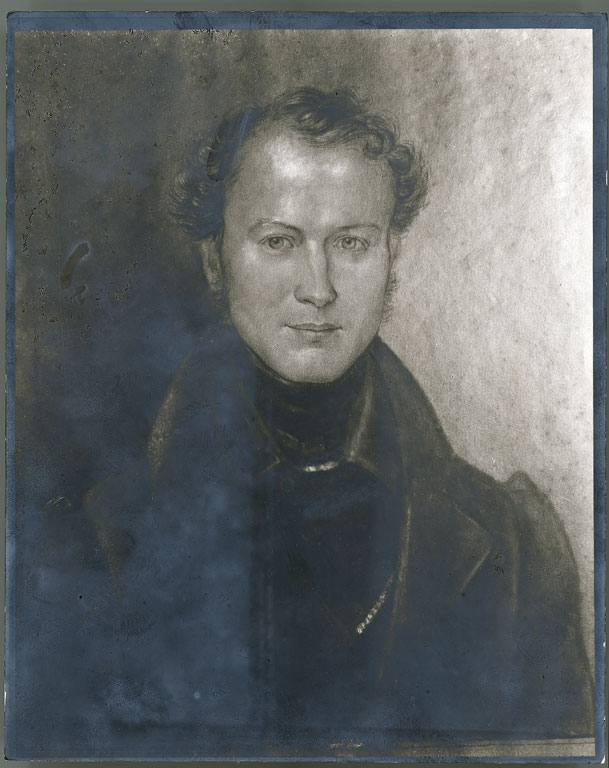
William D. Brackenridge was the assistant botanist for the U.S. Exploring Expedition serving aboard the USS Vincennes from 1838-1842.
The infrequency of appearances of pieces from the two WWII cruisers pales in comparison to anything related to the 19th Century sloop-of-war. During the past decade of searching for anything related to the USS Vincennes, I have only seen one item connected to the three-masted warship. While searching a popular online auction site, a rather ordinary, non-military item showed up in the search results of one of my automated inquiries. The piece, a wood-cased field microscope from 1830-1840, bore an inscription that connected it to the assistant botanist of the United States Exploring Expedition, William Dunlop Brackenridge.
Admittedly, I am not in the least bit interested in a field microscope as militaria collector, but the prospect of owning such a magnificent piece that would have been a fundamentally important tool used during the United States first foray into exploration was an exhilarating thought. At its core, the goal of the (1838-1842) U.S. Ex. Ex. was to chart unknown waters, seek the existence of an Antarctic continent and discover and document unknown species of flora and fauna. Brackenridge’s field microscope would have been a heavily used item as he and his assistants would most-certainly examine the various characteristics of plant species at a microscopic level.
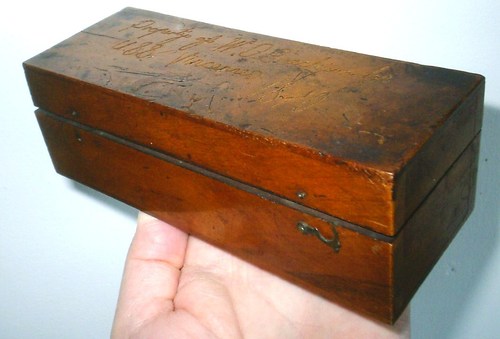
The box appears to be missing some of the securing hardware which would help to hold the lid closed (source: eBay image).
Authenticity and provenance is certainly a major concern when purchasing a piece like this and the listing made no mention of any materials or means to verify the claim. However, in searching for similar microscopes, there was sufficient comparative evidence to support the time-frame in which the Brackenridge instrument was made. The box and the engraving seems to be genuinely aged and appears to resemble what one would find from a 170 year old example.
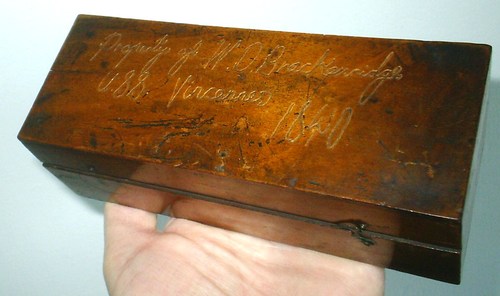
The box for the field microscope is inscribed with “Property of W. D. Brackenridge U.S.S Vincennes 1840″(source: eBay image).
In my opinion, the investment was well-worth the risk and I was poised to make my maximum bid (invariably draining my discretionary savings) knowing that the closing price would exceed what I could ultimately afford. The auction closed with the winning bid ($810.58) exceeding my funds by a few hundred dollars, though I suspect that the winner had a far higher bid in place to guarantee victory.
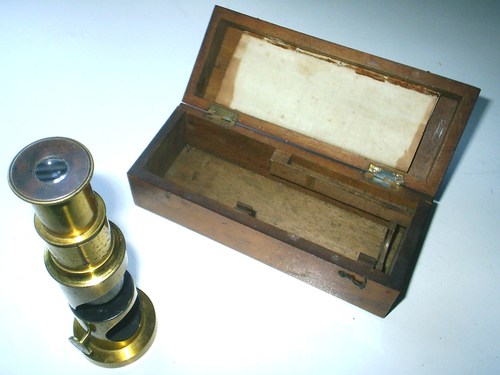
Showing the eye-piece perspective of the microscope and the wooden box (source: eBay image).
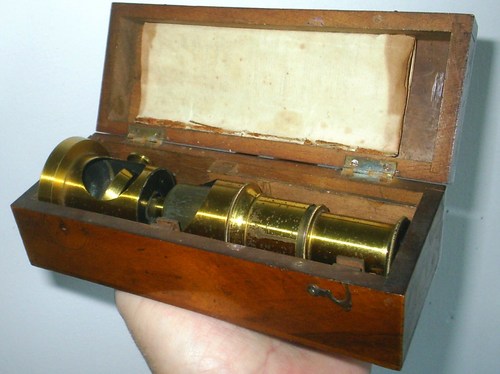
The microscope sets securely into the accompanying wooden box (source: eBay image).
I am a realist yet remain hopeful that I won’t have to wait another decade before another sloop-of-war piece comes to market.
 The Veteran's Collection