Blog Archives
Showcasing Your Militaria Investment
What good is a collection if it is maintained behind a closet door (where mine tends to be), stored in the basement or locked in a trunk? We spend years gathering items and filling in gaps in our collections as we reach goals that, in some cases, could take a lifetime to achieve. Despite those successes, we fail when we choose to keep them under wraps, hidden from the eyes of our house guests.
Most collectors’ spouses raise objections to the idea of them bringing old, musty-smelling objects into the spaces that we regularly inhabit. Olive drab hardly matches any home decor and the idea of weapons, armament and mannequins occupying limited floor or wall space tends to create friction with our spouses or significant others.
When I can, I like to visit museums that choose to commit their valuable floor real estate to displaying military history. I enjoy seeing the care that was taken by the staff to draw from the collection a tasteful blend of artifacts to present specific themes or create visual representations of specific historic events. Knowing that too much can cause viewers to gloss over the display, missing the all of the details. Too few artifacts or vague information cards in a display can have a similar effect. In both cases, the efforts of the curator are laid to waste as the museum visitor ambles past the display.
Through my membership in the U.S. Militaria Forum, I have seen some very impressive personal collections with well thought out displays that rival any of the best museums in the United States. From the hand-crafted cases and cabinets to the tastefully selected art hung on the walls, these collectors demonstrate that their investment is something to share with others.
-
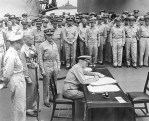
- Fleet Admiral Nimitz signs the documents, accepting the surrender of the Empire of Japan (source: U.S. Navy).
-
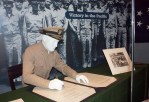
- Note the collar device insignia of Nimitz’ uniform and the tastefully simple display (source: Naval Academy Museum).
-
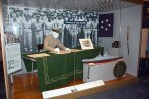
- Tastefully simplistic, the large display has a few items in order to emphasize the monumental significance of the event (source: Naval Academy Museum).
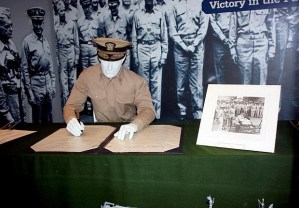
Take note of the mannequin’s altered ring finger on the left hand that matches Nimitz’ partial amputation from 1916 (source: Naval Academy Museum).
Not too long ago, the Naval Academy Museum shared some photos on their Facebook page of one of their latest displays that showcases one of the most historic events of the last century, the signing of the Instrument of Surrender aboard the USS Missouri. Presented is the uniform worn by Fleet Admiral Chester Nimitz on that September 1945 day in Tokyo Bay. The display clearly shows his khaki uniform with the rare 5-star insignia affixed to each collar. The museum staff went as far to alter the mannequin’s left ring finger to match Nimitz’s left hand: a portion of his finger was severed in 1916 by a diesel engine that he was demonstrating.
The key, limiting factor in my home is that I have a considerable lack of space. It is challenging enough to store my collection so the thought of propping up torsos to show my uniforms is nullified. Besides, it can be a little disturbing to walk into a room and see a still and quiet human-form at 4:00 AM as I prepare to head off to work.
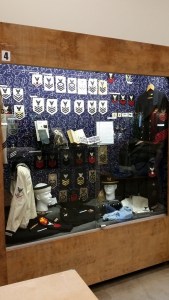 A few years ago, I was invited to participate in a public showing of my military baseball collection at our state fair in their hobby hall. My artifacts where showcased in and among adult and youth collections that were varied, ranging from pig-themed collectibles to artifacts from our nation’s bicentennial celebration. This year, I have yet another part of my militaria collection on display at the state fair. Being that the overwhelming military population (veterans, retirees, reservists and active duty personnel) is army and air force, I wanted to educate the citizenry on enlisted uniforms of the United States Navy. I gathered a few selections of my enlisted rating badges and uniforms to spotlight the history, designs and the ratings themselves. My wife and I visited the fair and stood in the distance to observe visitors to see how they respond to what I had on display. People-watching is fun but seeing people enjoying these artifacts is pleasing and provides some satisfaction to collecting, even if I can only experience it on rare occasions.
-
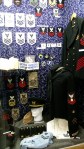
- Showing the 8-button Machinist’s Mate Chief (bullion) and Electrician (radio) 2/c from WWI uniforms backed by ratings, distinguishing marks and shoulder insignia patches and WWII warrant officer shoulder boards and devices.
-
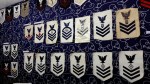
- A selection of rating badges showing eras, specialties, date and manufacturer’s marks.
-
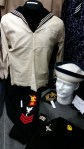
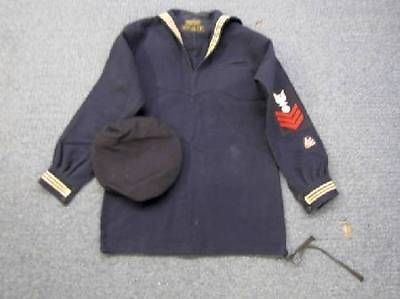
- A few other uniforms: 1905-1913 Coxswain, 1944 Ship’s Cook 1/c and a 1944 Aviation Radioman 3/c (with aerial gun pointer mark) next to a vintage naval academy midshipman rating badge and plebe cover.
Spotlight on private collector militaria displays
- “Belleau Wood Museum” – fabulous World War I Marine Corps displays.
- Chaplain Collection– focused on chaplains of all branches and all conflicts.
- General Officer Collection – one of the most impressive collections – this one focuses solely on officers who attained the rank of general or admiral
Silver Eagles: Navy Bullion Rates
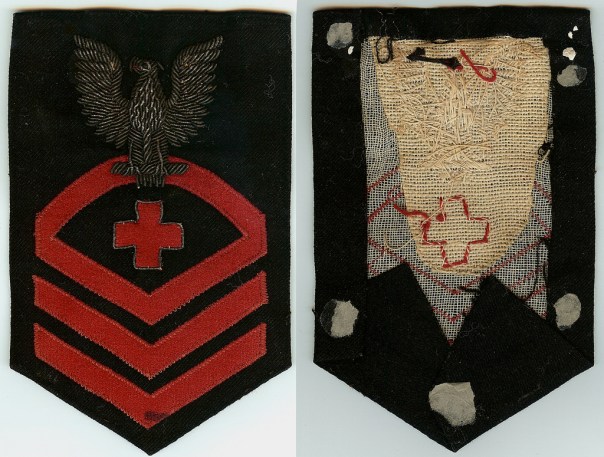
This chief Pharmacist’s Mate’s Geneva Cross is accented with a bullion thread outline.
Beautifully stitched with metallic thread or wound-metal elements overlaid onto crows, bullion navy rates have been in existence for more than a century. By 1913, the U.S. Navy’s uniform regulations established that rate badges with gold stripes (for dress blues) be accompanied with the eagle and specialty mark to be made of silver bullion. Uniform regulations regarding bullion were further expanded providing that all dress blue chief petty officer rates (regardless of the chevron color) would be constructed with silver bullion. These regulations, in my opinion, facilitated the establishment of one of the best aspects of enlisted uniform adornments.
These fantastically embellished crows historically incorporate multiple shades or tones of silver, and at times, gold bullion threads in their designs making for highly detailed and textured rate badges. Along with aesthetics, the bullion crow designs take on a three-dimensional feel and are really quite stunning.
Crow designs are substantially varied in their appearance based upon the time period in which they were made and the manufacturers’ interpretation of the design specification. One can examine two bullion rates from the same period and note that they will have different embroidery patterns. Thread direction will differ as well as the pattern used for the specific elements.
-
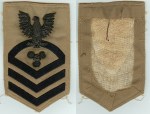
- A nice example of a humble Machinist’s Mate bullion design.
-
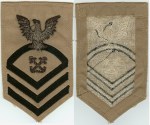
- This post-war Chief Boatswain’s Mate crow-design is subtle and showing some signs of wear.
-
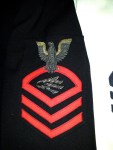
- This Radioman Chief’s eagle is accented with gold thread on the leading edges of the wings.
-
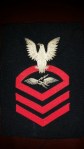
- This red-on-blue chief aviation radioman is a recent acquisition. It appears to be a mid-1940s-era badge.
-
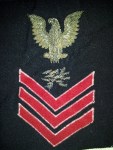
- This rather sloppy Radarman badge has a nice eagle design, however the specialty mark is less than desirable.
Because they were traditionally hand-embroidered, two crows from the same supplier can differ. You might see various embellishments to the bird’s feathers or the beak. Some will have different colored bullion that can really make the bird stand out from the rest of the rate badge.
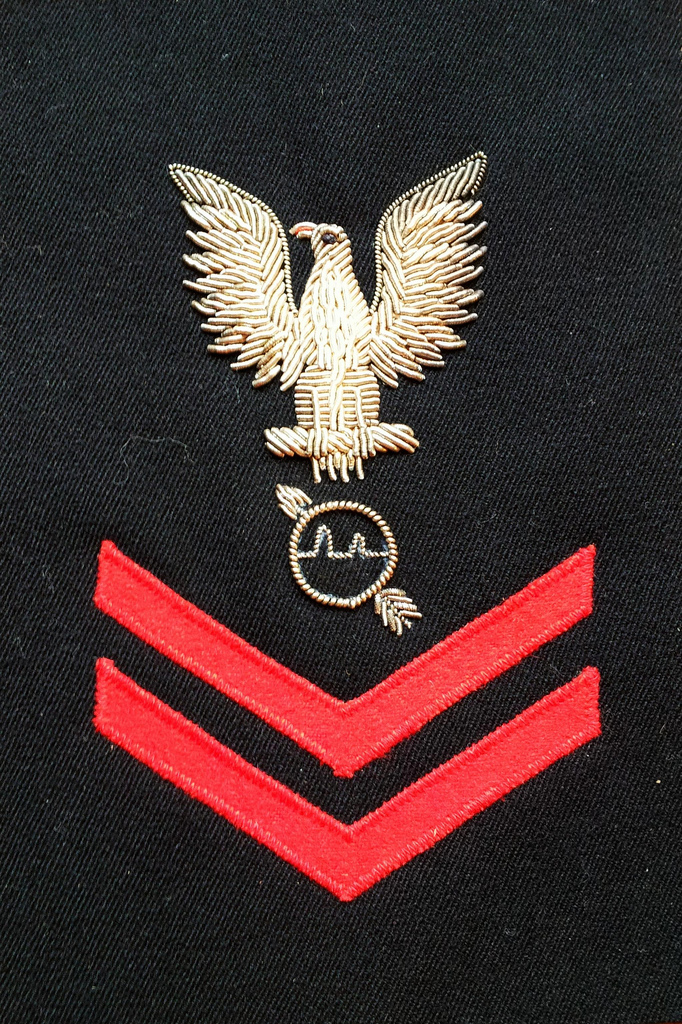
A rare bird. This Radarman/Operations Specialist 2/c badge is not collectors can easily find. Bullion rates were for E-6 and above and this one is clearly not a cut-down E-6 rating badge.
Other embellishments may include custom applications to the specialty mark. Variations to these embellishments pose challenges to collectors. Considering the Pharmacist’s Mate chevron (as seen at the top of this article), for example, one pattern could simply surround the red Geneva Cross with a single outline of thread while another could apply a crisscrossing pattern in addition to the outline. One example of a unique enhancement that I have seen was to a Machinist’s Mate crow that had a precious stone sewn to the center of the propeller insignia. The aquamarine tone of the stone really stood out against the silvery-blue bullion.
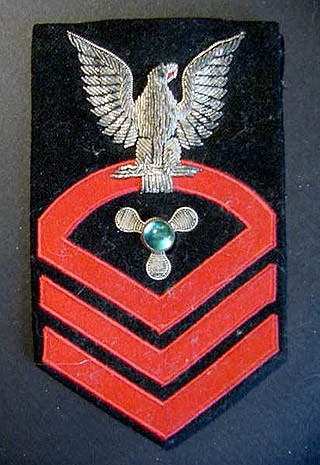
This early Machinist’s Mate crow (right-arm rate) is embellished with a stone in the center of the propeller specialty mark (eBay photo).
With the modern standardization of uniforms and insignia, the highly detailed and character-filled bullion crows are relegated to history (and to collectors). The current designs are sanitized, sterile and merely one-dimensional caricatures of the old patterns causing many navy rate collectors to shy away from them.
Selected References:
Commemorating and Collecting Midway
Approaching June 4, many Americans will be reminded of a pivotal event that took place on this very day during World War II, when a massive armada of ships carrying troops that were preparing for an invasion (that would commence on the morning of June 6th, 1944). The plan was to establish a foothold in enemy-held territory, extending their reach with a new base of operations. Thinking of this date in particular, Americans will conjure thoughts of paratroopers flying over a stretch of water as they begin to traverse flak bursts en route to their targets.
For the past several years, veterans and their families have made their way to the hallowed ground on the beaches and drop zones in and around Normandy, France, seeking to re-trace their steps on the ground where the D-Day Invasion commenced. Though few of those brave men remain this eve of the 72nd anniversary, the children of those veterans will be joined by grateful citizens as they remember the sacrifices made by so many men on that day in 1944. With so much attention given to Normandy (especially by Hollywood in recent years with Saving Private Ryan and the Band of Brothers series), typically overlooked (when thinking about this date) is a battle that arguably had the same or even greater impact on the War’s outcome.
The Battle of Midway took place at a time when the U.S. was still ramping up to fight, having been caught unprepared for war. American Army ground troops wouldn’t be committed for a full-scale assault until November of 1942 with Operation Torch in North Africa. The Marines wouldn’t begin any offensive campaigns until landing craft bow ramps were dropped onto the shores of Guadalcanal. This meant that the majority of the fighting that was taking place since December 7, 1941 was being carried out by U.S. naval forces.
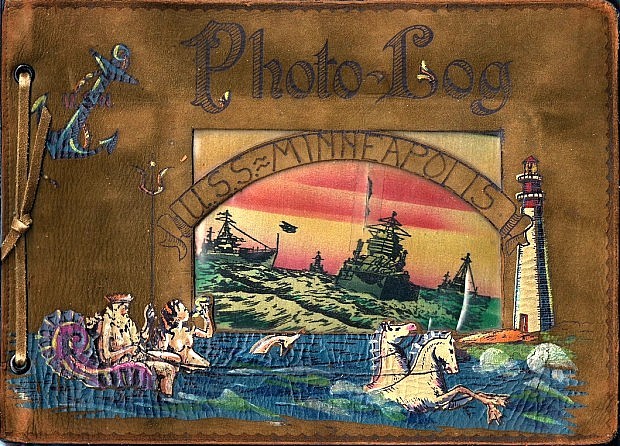
Owning a sailor’s photos may seem odd to some, but they could be one-of-a-kind images that you otherwise might not see. This hand-painted USS Minneapolis photo album is a fine example (source: eBay image).
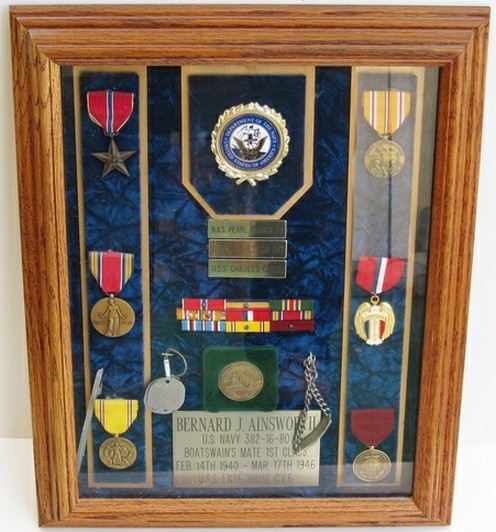
This group of medals from a USS Enterprise veteran largely contains modern hardware. The dog tags appear to be original to the veteran (source: eBay image).
In commemorating the 70th anniversary of the battle, regrettably little ceremonial attention will be paid to the few surviving veterans who are, at the very least, in their late 80s. Yet, we need to remind ourselves of the significance of this battle and remember those who risked it all and sent the Japanese forces into a three-year retreat.
Being a collector (primarily interested in Navy militaria), it takes a fair amount of legwork and an awful lot of providence to acquire authentic pieces that may have been used during this battle. We have to ask ourselves, “what would be the most target-rich focus area that we can pursue for treasure?” Clearly, the answer to that question would be veterans’ uniforms. Considering that there were two task forces containing 28 vessels (and 260 aircraft), there would be literally thousands of veterans each with multiple uniforms to choose from–if you can determine that they actually participated, attached to one of these units.
Those interested in obtaining pieces of ships or aircraft will have an infinitesimal chance to locate authentic items for their collection… but that means there is still a chance. Below is a list of every U.S. Navy ship that participated in the battle (I’ll leave it up to you to research the participating aviation squadrons from the carriers and Midway Island):
- Carriers
USS Enterprise, USS Hornet, USS Yorktown - Cruisers
USS Astoria, USS Minneapolis, USS New Orleans, USS Northampton, USS Pensacola, USS Portland, USS Vincennes, USS Atlanta - Destroyers
USS Aylwin, USS Anderson, USS Balch, USS Benham, USS Blue, USS Clark, USS Conyngham, USS Dewey, USS Ellet, USS Gwin| Hammann, USS Hughes, USS Maury, USS Monaghan, USS Monssen, USS Morris, USS Phelps, USS Russell, USS Ralph Talbot, USS Worden - Submarines
USS Cachalot, USS Cuttlefish, USS Dolphin, USS Finback, USS Flying Fish, USS Gato, USS Grayling, USS Grenadier, USS Grouper, USS Growler, USS Gudgeon, USS Narwhal, USS Nautilus, USS Pike, USS Plunger, USS Tambor, USS Tarpon, USS Trigger, USS Trout - Oilers
USS Cimarron, USS Guadalupe, USS Platte
-
- This Battle of Midway Commemorative Pillow appears to have been produced during WWII (source: eBay image).
-
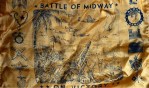
- Showing the nice silkscreen details of the Midway Commemorative pillow (source: eBay image).
Remember, you can also seek commemorative items, vintage newspapers or original photographs, or named (engraved) medal groups from veterans who fought in the battle – creativity and a lot of research will help you reap great reward!
Tracking U.S. Navy Specialties: The History of Radarmen
Many people collect U.S.Navy rating badges and many other folks collect ephemera. Still other collectors pursue metal insignia and uniform devices. But the question I have is, how many of them combine all three “genres” of militaria collecting into one, singular focus?
As a ten-year veteran of the U.S. Navy and an amateur military historian, I’ve researched a vast number of subjects ranging from basic minutia to emotionally gut-wrenching and personally significant stories with historical context that I find utterly fascinating. During my naval career, I performed my job without so much as a fleeting thought regarding the historical aspects of my chosen specialty. Navy enlisted men and women receive schooling and training to perform specific job functions to meet the needs of each unit or command. These ratings (similar to the Army’s Military Occupational Specialty or MOS) are denoted on each sailor’s sleeve insignia with a unique emblem symbolizing certain characteristics of that specialty.
My own rating, Operations Specialist, seemed to be (to me) quite ordinary and less historic as compared to traditional ratings such as boatswain’s mates, gunners mates and machinist mates. I was none too interested in discovering any of the historical aspects or the development of my rating beyond what was presented in my training manuals. Other than the basic historical narratives (also presented in the training manual) regarding the history of naval radar, I didn’t give it much thought. Despite this lack, I did manage to excel at my job and advance in a timely manner.

The foremast of the USS Washington (BB-56) showing the SG radar antennae on the foreward face of the tower. As documented in Muscant’s book, the placement of this unit was cause for a significant sector blindspot, leaving the ship vulnerable during the first Naval Battle of Guadalcanal in November of 1942 (U.S. Navy image).
What turned me onto the historical backstory of my rating was an insignificant story that I read about the installation of radar onto the USS Washington (BB-56) as told in the pages of Ivan Musicant’s 1986 book, Battleship at War: The Epic Story of the USS Washington. What was revealing to me was how radar was installed onto the ship and essentially turned over to untrained operators and technicians. In his book, Wahoo: The Patrols of America’s Most Famous World War II Submarine, Medal of Honor recipient Admiral Richard O’Kane made considerable mention of the submarine’s unreliable radar and the continuous need for the boat’s radiomen (the technicians and operators) to service the wonder-device. Both of these books planted a seed that my navy job had an important history that was berthed during World War II and developed into a key job function in today’s radar-reliant naval service.
Radarmen can trace their beginnings to the Electrician’s Mate (EM) rating. This World War I era EM first class bears the distinguishing mark indicating that the sailor was a radio operator and technician. Shipboard radio technology was in its infancy at this time and in the ensuing decades, a specific rating would be created.
When I added the activity of collecting to my interests, I cultivated a new desire that prompted me into new research directions. One could say that when I was bitten by the rating badge-collecting bug, my interest was tempered by context. I focused on ratings that had connection to me such as my grand-uncle (post-WWI musician), grandfather (ship’s cook), brother-in-law (machinist’s mate), two uncles (radioman) and my own. Along with those rating badge pursuits, I picked up some of the more highly sought-after rates whose ranks were filled by more than their share of heroic blue jackets, such as hospitalmen, aviation radiomen. However, I found myself drawn to the historical aspects of my own rating, originally known as ‘Radarman’.
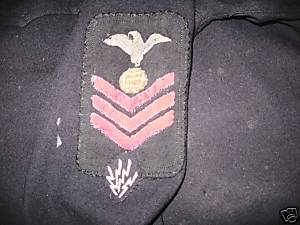
This EM/1c rating badge dating from the WWI time-frame shows the four electrical sparks of the radio operator/technician distinguishing mark affixed directly below the bottom chevron.
The Radarman rating (abbreviated as RdM) was officially established in 1943 after radar became more widely adopted aboard ships and submarines, and was at that time finding its way onto naval aircraft. The demand for highly skilled and trained operators and technicians prompted the Navy’s Bureau of Personnel to create a program to send qualified personnel to the fleet to better utilize the secret weapon. The rating badge that was subsequently created employed a borrowed feature from the radioman rating as it referenced the close connections to the communications technology. Also, many of the early Radarmen had previously served as Radiomen. The badge symbol used the electrical spark bolts (three rather than the four seen on the Radioman’s insignia) with an overlaid arrow indicating the directional detection aspects of the job, indicating the rating’s origins and the technology from radio.
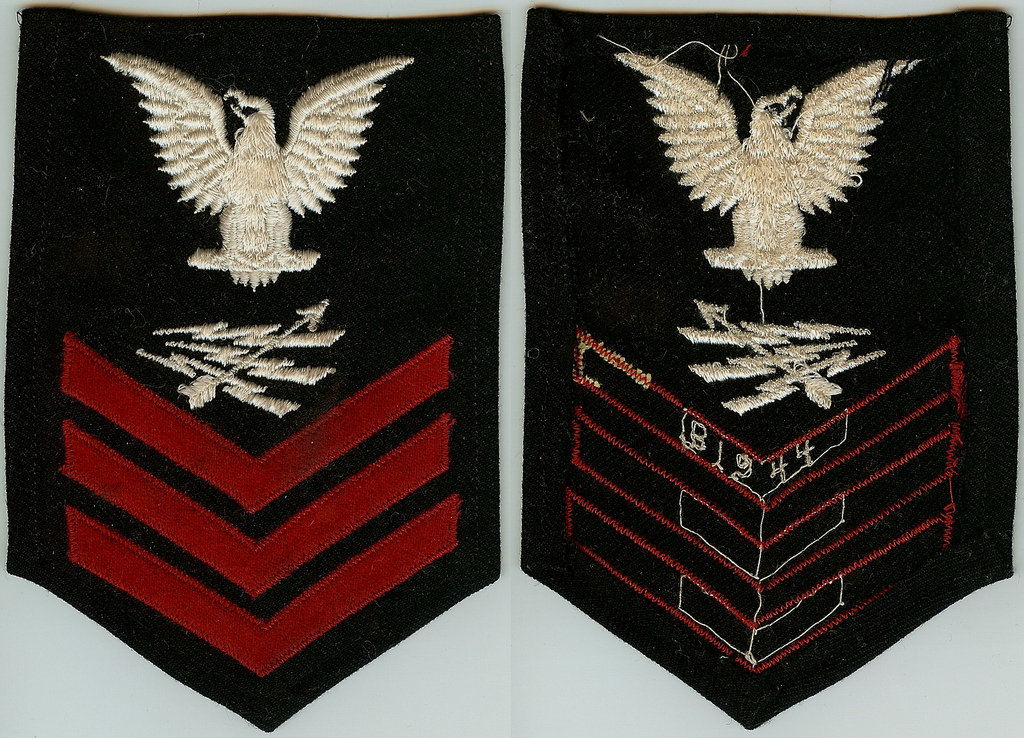
This Radarman first class rating badge is date-marked with “1944” embroidered on the reverse of the first chevron.
In 1946, the Navy updated the insignia, incorporating the oscillator symbol while carrying over the arrow insignia. In 1973, change impacted this rate once again as BUPERS split the rate, removing the technicians (rolling them into the electronics technician rate) and those who were skilled as Electronic Warfare (ESM, ECM and ECCM) specialists as EWs. Those who remained were re-designated as Operations Specialists (OS) yet the rating badge remained and continues at present.
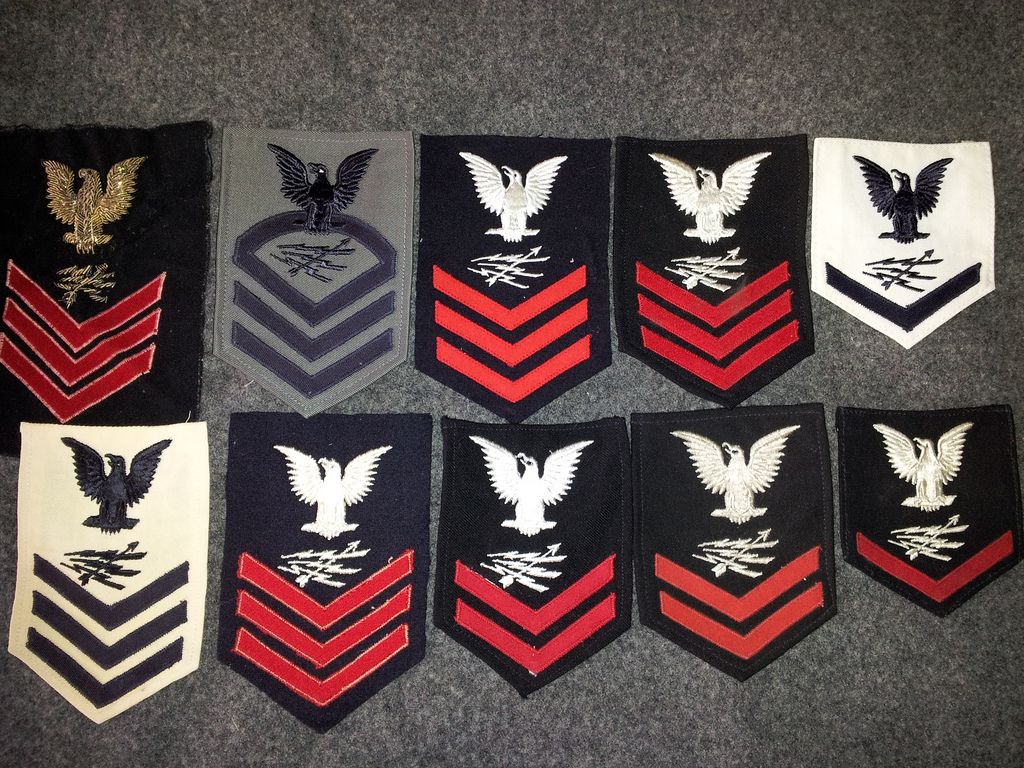
A selection of my Radarman rating badges. All are from during and immediately following the end of WWII.
My collection of OS militaria began with what remained from my time in the service: insignia that was never applied to my uniforms. I began to pursue badges from WWII and worked my way forward to the 1960s and 70s as I picked up some special bullion versions. I searched for insignia from the rating’s roots and then onto ephemera, such as rate training manuals from several eras. I have managed to save some of the tools of the trade in the area of navigation, such as compass and dividers, parallel rulers, and nautical charts. I am still seeking an OJ-194 NTDS (Naval Tactical Data System) console for my office (OK, perhaps this would be overkill).
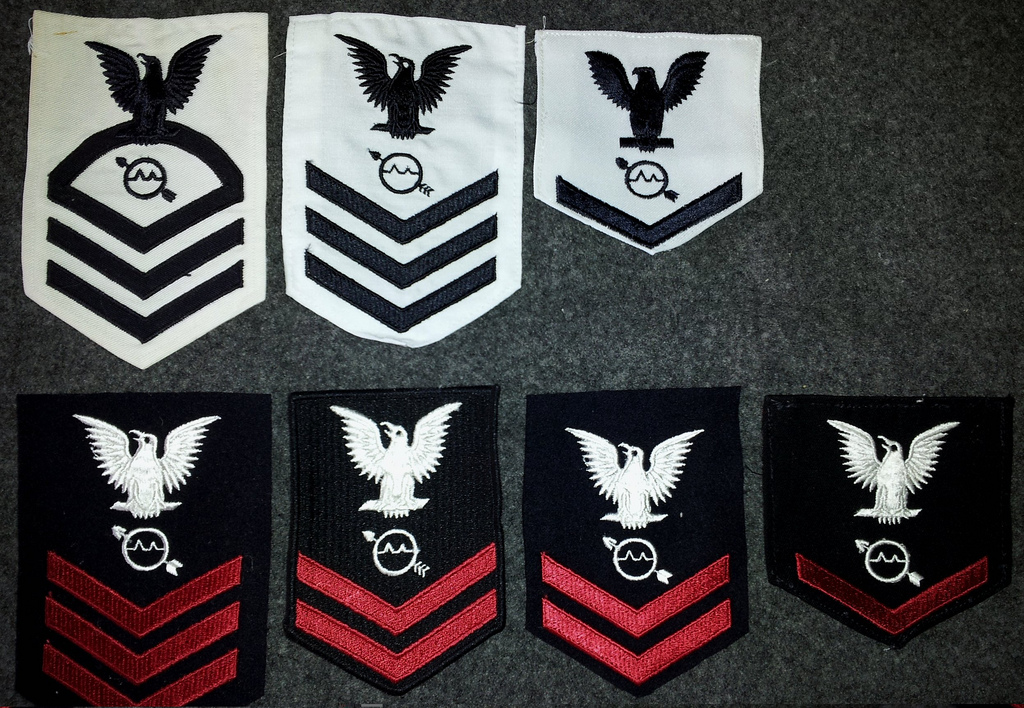
Following the war, the Navy broke away from the lightning bolts of the radioman rating and embraced the oscilloscope and maintained the arrow of the original badge, By the early 1970s, the rating was split out – segmenting the technicians into their own rating (Electronic Technicians or “ET”) and the electronic warfare operators (EW) into their own. Radarman was disbanded in favor of Operations Specialist.
I always keep my eyes open for anything that might augment this collection without breaking my budget or fill the floorspace in my home. At some point, I would like to assemble this collection in order to create a well-rounded display that is representative of this rating.
References:
 The Veteran's Collection