California Congressman Demonizes Collectors with Introduction of a Bill
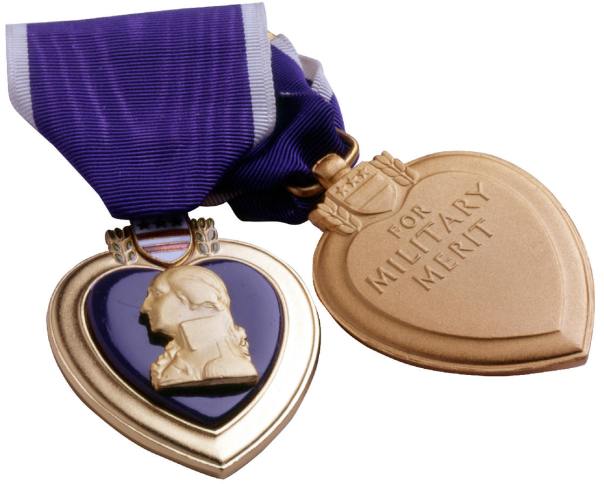
The Purple Heart Medal has been awarded since 1932 to veterans who were wounded or killed in action in WWI through the current conflicts. Showing the reverse of the PHM with the words, “For Military Merit” and the space beneath where it is traditionally engraved with the recipient’s name and rank.
When citizens perceive what they think to be a travesty or tragedy, they scream to their lawmaking-representatives to create laws in order to make changes that will help them to feel good that they did something positive. It is a common action among Americans to want to bring about changes, to right wrongs and to make society more safe. We feel better about ourselves when we stood up and participated in the process. Sadly, the only thing positive with many of these actions are that those scant few people can feel good while the rest of society has to deal with the negative ramifications and unintended consequences brought about by these actions.
-
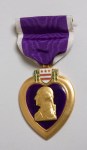
- The Purple Heart Medal (photo source: PurpleHearts.net)
-
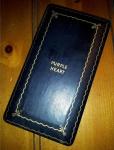
- Affectionately known as a “coffin case,” this presentation box is inscribed with the name of the medal in gold leaf.
-
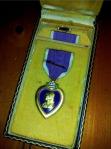
- This is a World War II Purple Heart Medal set complete with the ribbon and lapel device in the correct presentation case.
This week new federal legislation was proposed by U.S. Representative Paul Cook (R-CA-8) to address what he and a select few Americans feel is a troubling trend – the sale of Purple Heart Medals (PHM) among collectors. HR 6234 (known as the “Private Corrado Piccoli Purple Heart Preservation Act”) if passed would “prevent merchants from profiteering from the sale of military-issued Purple Hearts, eliminating the market and making it easier to return them to their rightful owners.” Taken at face-value, this seems to be a very noble goal. Who wouldn’t want Purple Heart Medals returned to their rightful owners?
“These military collectors cheapen the Purple Heart by buying and selling this symbol of sacrifice like a pack of baseball cards,” said Cook, who served 26 years in the Marine Corps before joining Congress, rising to the rank of colonel and receiving two Purple Hearts for injuries sustained during the Vietnam War. – See: Selling Purple Hearts would be illegal if this bill becomes law
One of the underlying beliefs of the bill’s sponsor and his supporters is that militaria collectors are profit-seeking undesirables who buy and sell these vaunted medals, capitalizing on the specific aspects surrounding the awardees’ circumstances (for which the medal was given) such as:
- If the veteran was killed in action (KIA)
- If the battle in which the veteran was wounded (mortally or otherwise) was notable or pivotal
- If the veteran was note-worthy:
- a famous or semi-famous service member
- a member of a notable military unit or vessel
In viewing advertisements of PHMs for sale, these facts are often presented in the medals’ descriptions not too dissimilar to features of a used automobile, rendering them seemingly insensitive and cold. I admit that even I am put-off when I see how they are exhibited as available for purchase.

This Purple Heart Medal collector goes to great lengths in order to demonstrate to the public the terrible costs of war and the personal sacrifices made by Americans. By providing viewers with the ability to see the medals, view the veterans’ photos and read their story, this collector, like countless others, ensures that the individual American history is not lost to time. (Source: ToHonorOurFallen.com/Edward L. Maier III)
Regardless of the manner in which the medals are listed, most of the collectors that I have encountered are not only sensitive regarding the nature of these medals and the reason that they exist and are awarded, they go to great lengths to gather the facts surrounding the medals in order to emphasize the veterans’ service and the gravity of the price that is repeatedly paid by them for our nation. The steps that are taken by these collectors in order to preserve the history is extremely honoring and very sensitive towards the veteran and the surviving family members (in the case of KIAs-awarded medals).
There are many militaria collectors who also wore the uniform of this country. Many of them, like me, take pride in our service and that of others and we strive to preserve the history that is being discarded by families of veterans (and even the veterans themselves). One of my colleagues, a fellow Navy veteran, is pursuing his next book project (his most recent work, Blue Seas, Red Stars: Soviet Military Medals to U.S. Sea Service Recipients in World War II, is a similar, monumental undertaking that recognizes those American servicemen who were decorated by the Soviet Union for heroic acts in convoy and anti-submarine duty in the North Atlantic during WWII) that focuses entirely on the Purple Heart Medals that have been awarded to service men and women who were killed in combat. Many of the hundreds of medals that he has personally photographed for this book are in the hands of collectors who want to see the stories of the awardee preserved and shared in perpetuity.
Bear in mind that I make that statement as both a collector and as someone who is very sensitive about the issue of PHMs being bought and sold (due to the somber nature of why these medals are awarded, owning a medal that is connected to such significant personal loss is too painful for me to see past). Aside from the “For Sale” listings where the current owner painstakingly describes as much detail surrounding the veterans’ service and how they fell in combat, I also have difficulty when I read about an excited collector’s “find.” There is a fair amount of gray area between celebration of landing a medal that helps the collector tell a particular story (in their collection’s area of interest) and one that a collector picked for a very insignificant amount but will garner significant profit when it sells. I know that I am not the only collector who struggles when we see this on display. I also don’t mean to disparage any fellow collector for what brings them excitement and joy with their collection.
One person in particular who is celebrating the introduction of this bill and is hopeful to see it passed is Zachariah Fike (Captain, Vermont National Guard) who is the founder and CEO of Purple Hearts Reunited, a non-profit organization whose mission is to return Purple Heart Medals to the awardees or their families. “We are absolutely humbled to see Private Corrado Piccoli being honored through this bill by Congressman Cook,” reads a Facebook post (dated October 3, 2016) by Fike’s organization. Fike has historically been in opposition of collectors, stated to NBC News in 2012, “’It wouldn’t be fair for me to say they’re all bad. But the ones I have encountered, I would consider myself their No. 1 enemy,” Fike said. “They’re making hundreds or thousands of dollars on (each one) these medals. They think it’s cool. It’s a symbol of death. Because of that, it has a lot of market interest and it has a lot of value.”’ In my near-decade of collecting, I have learned that Fike’s assessment (of medal collectors) is the rare exception rather than the norm.
There is little doubt that Congressman Cook is responding in lockstep with Fikes (who has been vocal in his frustration with collectors’ who did not surrender their medal collection to him) and believe that in banning the sale of these medals will compel collectors to hand them over to organizations and people who are bent on returning them to families. What these well-intentioned people have overlooked is that so many families are the ones who have divested the heirlooms to begin with. For many reasons such as:
- No connection to the distant, deceased relative
- The family suffered a falling out with the veteran (broken marriage, the veteran abandoned his family, etc.) and the medal is a painful reminder
- The survivors are opposed to war, the military and anything that is connected to or associated with it
- Would rather see the medal and history preserved by a collector who has demonstrated this capability
There are many stories of medals being discovered in the most deplorable situations; some of the worst being discovered in dumpsters and curbside garbage cans. As the only one who had an interest in the military history of my family, I was bequeathed militaria from my relatives that included Purple Heart Medals (one of my uncles was wounded in action during both WWI and II). No one else cared. Now I am responsible to ensure that these items are cared for at the end of my life. If this bill passes and no one wants to inherit these items (and with the glut of nearly two million medals being in the same situation as mine), where will they end up?
What happens when Fike comes calling on the family having “recovered” a PHM from a collector only to find that doing so, causes grief with the people who wanted to rid themselves of the item(s) to begin with. What becomes of the medals then? How does this proposed law deal with the collections of PHMs when the collectors pass away and have no future collectors to transfer the medals to? According to the National Purple Heart Hall of Honor, the current estimation is that there have been more than 1,800,000 Purple Heart Medals awarded since 1932. Of those, how many thousands reside within individual militaria collections and what is to become of them? What percentage of those are unwanted by the families?
One of the unintended consequences of the previously established laws (banning the sale of the Congressional Medal of Honor [CMOH]), countless American artifacts have left our shores and landed in the hands of foreign collectors undoubtedly to ever return to our shores. The law that prevents the sale (similar to the one proposed by Congressman Cook will force collectors (who are seeking to recoup all or part of their investment) to locate buyers outside of the United States. Worse yet, some domestic CMOH collectors who have been in the possession of their medals predating the law (that prohibits the sale) have since been discovered by the federal authorities; their medals confiscated and subsequently destroyed by the FBI.
Banning the sale does very little in reaching the stated goal – to facilitate the return of the Purple Heart Medals to veterans and families. It also creates a problem for law enforcement. With 1.8 million medals in existence, how do they discover transactions, track ownership of medals and what becomes of those recovered who have no surviving family with which to receive said “missing” medal?
Despite what Captain Fike stated about collectors, his actions contradict him in regards to how he truly considers militaria and medal collectors. His push to locate a legislator to take such short-sighted and drastic steps to ban the sale of these artifacts are a direct assault of collectors that will have long-term negative impact on his non-profit organization’s noble efforts. The bill will also include penalties for veterans and families who attempt to sell these medals; there are no exclusionary provisions nor exceptions. Congressman Cook and Captain Fike appear to be targeting (whom they deem to be) the victims in the Purple Heart trade along with the collectors.
My voice hardly matters and no one would bother to take note of what I have to say in regards to this issue. Nevertheless, I believe that this good-intentioned law is ill conceived and will ultimately make it more difficult to restore the medals to the families and veterans who want to see them returned.
Related Articles:
Collecting Militaria: Historical Preservation or War Glorification?
“It is well that war is so terrible, or we would grow too fond of it.”*
I started this blog as a continuation of a similar effort that I undertook (as a paid gig) for a large cable television network. I spent some time contemplating a suitable name for this undertaking, settling on The Veteran’s Collection for a number or reasons. The simplest of those reasons was to express my interest in militaria and how my status as a veteran guide both my interests and desire to preserve history.
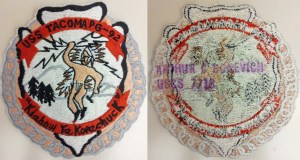
Though my wife might argue, my collection of patches is rather small as compared to those of true military patch collectors. I tend to be more specific about the patches I seek (such as this USS Tacoma crest edition).
Often, I equate my collecting of military items in the vein of being a curator of military history and the role that the military has played in the securing and preserving of basic freedom for our nation (and for the people of other nations who have been trying to survive under repressive regimes). In gathering and collecting these items, it may appear to some that I am glorifying war. Having in my possession weapons (firearms, edged weapons, munitions, etc.) might signify glorification to the untrained eye however these items are part of the overall story being conveyed by collection.
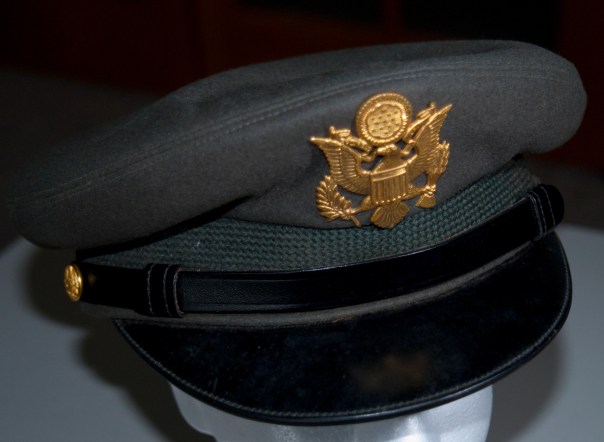
As I scour my collection, I begin to realize that the overwhelming majority of items are Navy-centric. This 1950s U.S, Army cap is part of the display that I am assembling of my paternal grandfather’s older brother’s service.
I am a fairly soft-spoken person when I am out in public (though people who truly know me would have a difficult time believing this). When political conversations emerge near me (when waiting in line or casually walking past strangers in public settings) I have heard, on many occasions, discussions focus on perceptions of men and women who serve ( low-key or have served) in the armed forces. Often times, gross mis-characterizations regarding people in uniform begin to emerge as the dialog devolves into denigration of active duty and veterans as being war-hungry criminals, bent on killing innocents (women and children). I can’t count how many times I have stood in line, listening to people in front of me expressing how frustrated they are when they see a soldier in uniform ahead of them receiving a discount for a food item or service equating their time in service as legalized murder.
I served ten years on active duty and had two deployments into a combat theater, one of which I and my comrades were engaged by the enemy. In all of those ten years, I cannot recall a single person whom I served with who desired or wished to see combat. We prepared and trained for it hoping to never see it. I don’t think that I have ever met a combat veteran who wanted to talk openly about their time under fire. To have the uneducated civilian boil down our willingness to don the uniform, train for years while understanding fully that at some point during our service, we could see the horrors of combat as being blood-thirsty war-mongers only serves to show the extent of their ignorance.
I recently read two articles today concerning veterans of World War II who have (or had) committed their remaining years educating people about the horrors of war that each of them faced.
The first article was about one man, an IJN fighter ace Kaname Harada, who took every moment that he had left in order to do what the Japanese government is failing to do; educating younger generations to warn them about being drawn into future wars. “Nothing is as terrifying as war,” he would state to an audience as he spoke about his air battles from Pearl Harbor to Midway and Guadalcanal. As I read the article, I zeroed in on a chilling quote by one of Harada’s pupils, Takashi Katsuyama, “I am 54, and I have never heard what happened in the war.” He cited not being taught about WWII in school, continuing, “Japan needs to hear these real-life experiences now more than ever.” I am baffled that a man who is a few years older than me was not taught about The War in school.
This WWII Army garrison cap features the orange-and-ultramarine colors of the Air Corps.
In the second article, Army Air force fighter pilot, Captain Jerry Yellin, who like Harada, is educating young people about what he sees as futility of war. He is concerned that young Americans do not have an understanding of the realities of war nor what it is like to fight. “We’re an angry nation,” said Yellin. “We’re a divided nation: Culturally, monetarily, racially and religious-wise we’re divided.” What the veteran of 19 P-51 missions over Japan said (in another article) regarding war is often lost on those who are pacifists (at any and all costs) and lack understanding, “War is an atrocity. Evil has to be wiped out.” He continued, “There was a purity of purpose, which was to eliminate evil. We did that. All of us. So, the highlight of my life was serving my country, in time of war.”
“Those who cannot remember the past are condemned to repeat it.”
– George Santayana
Both of these men clearly understand the cost of war and the hell that they faced when they took up arms and yet neither of them could be characterized with the ridiculous “war mongers” moniker often applied to warriors.
The reasons that people collect militaria are as diverse as each of the hobbyists’ backgrounds. The community of collectors can be completely aligned and in lock-step with each other on some militaria discussion topics and in near animus opposition on others. I tend to stay away from collecting medals and decorations; specifically, anything awarded to a veteran (or, posthumously to his family) due to how a great number of collectors commoditize certain medals (Purple Heart Medals, specifically). I withhold judgment as I abstain from even discussing the medals in question. For the laymen, a Purple Heart is awarded to service members wounded or killed in action. Collectors attach increased value for medals awarded (engraved with the recipient’s name) for posthumous medals; if the person is notable or was killed in a famous or infamous engagement, the value compounds (there are several other contributing factors that influence perceived monetary value).
-
- This is the Western Union telegram that was delivered to PFC Skavinsky’s wife, notifying her of his death. It took 10 days to get word to her. (Source: PurpleHearts.net)
-
- The Purple Heart Medal (photo source: PurpleHearts.net)
-
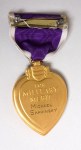
- The back of Skavinsky’s Purple Heart shows the official engraving of his name (Source: PurpleHearts.net)
-
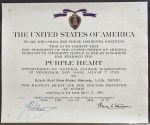
- PFC Skavinsky’s accompanying certificate documenting the awarding of the medal and the date in which he was wounded. (Source: PurpleHearts.net
Purple Heart Medals are a very sensitive area of military collecting and nearly every medal was awarded to combat veterans – soldiers, marines, sailors and airmen who were serving in a war or wartime capacity. There are several collectors who use their Purple Heart collections to demonstrate the realities of the personal cost of war. These caretakers of individual history, such as this collector, painstakingly preserve as much of the information surrounding the WIA and KIA veterans, often maintaining award certificates and even the Western Union telegrams that were presented to the recipients’ parents or widows. Seeing a group with the documentation together is heart-wrenching.

A few of the selected items that my uncle brought back at the end of the war in Europe.
Militaria collecting can be very personal as many of the items, like medals (such as the Purple Heart) actually belonged to a person who served. In my collection, I have uniforms from men who served from as far back as the early 1900s up to and including the Vietnam War (not including my own as seen in this previous post) with the majority centered on World War II. Nothing could be more personal than the uniform worn by the veteran. Having personal items, in my opinion, enhances the collecting experience because of the desire to research what that service member did when they served. Uncovering a person’s story is to understand the sacrifice and cost of leaving family behind to serve rather than glorifying war itself.
Also in my collection are artifacts that were brought back by the veterans from the theater in which they served. While to some people, viewing these items may conjure negative and visceral responses, they still serve to tell a story that shouldn’t be forgotten. One of my relatives returned from German having recovered a great many pieces from the Third Reich machine after it was defeated by May of 1945. Still, this is not celebrating war nor the defeat of a (now former) foe.
There are other facets of my collection that are touch on the functions of engagement and combat; specifically armament and weapons. I have a few pieces that I inherited that, at some point, I will be delving deeper (on this blog) as they do fascinate me. I need to spend some time expanding my knowledge a bit more in order to present these pieces with a modicum of understanding (alright, I’ll admit that I don’t’ want to sound uneducated on my blog). Frankly, weapons are not my forte’ but what I own (a small gathering of edged weapons and ordinance), I have spent some time learning about them.
-
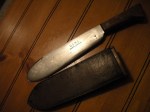
- I have a smattering of edged weapons (or, in this case, an edged tool) that I mostly inherited. This bolo knife was carried by Navy Pharmacists Mates (a.k.a “corpsmen”) who were attached to USMC units. The “U.S.M.C” embossed on the blade represents the United States Medical Corps.
-
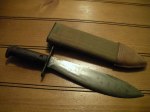
- M1917 U.S. Military bolo knife and scabbard.
-
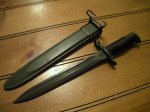
- 1942 M1 Garand Bayonet
Preserving history is paramount to helping following generations to both understand the cost of war and that, while doing what is necessary to avoid future wars, serves to illustrate that nations not only should but must take a stand against tyranny and evil.
See also:
* Military Memoirs of a Confederate, 1907, Edward Porter Alexander
Waving the Vexillologists’ Banner
The first step on the path to recovery is admitting that you suffer from vexillology. Let’s say it together, “I am a vexillogist.” Great. Now that we have that out of the way, we can begin to examine this illness along with the diagnosis – treatment relationship.
By now, I am sure that you’ve already sought the definition of the term and know that vexillology is neither a medical or psychological condition requiring any sort of treatment. Many of you would hardly fancy yourselves as vexillologists, yet you do have interest in the subject matter. For me, I only dabble and have a specific, myopic interest as it pertains to my own militaria focus. For those of you who decided to forgo your own online search (knowing that I would eventually get to it), Merriam-Webster defines vexillology very simply as, “the study of flags.” I’ll leave the etymology of the (relatively new) term for you hardcore folks.
-
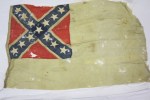
- This tattered example is the second Confederate flag (source: Naval Historical & Heritage Command).
-
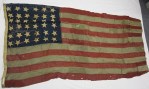
- From the Battle of Manila Bay, this flag flew over the USS Olympia (Source: Naval Historical & Heritage Command).
-
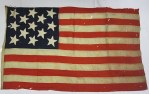
- This small flag was used on one of the small boats from Dewey’s flagship, the USS Olympia (Source: Naval Historical & Heritage Command).
My post today really isn’t about the study of flags per se, but it does play into what I want to share with you. Learning where to turn for sound research and trusted sources is highly important to verifying details as to the authenticity of a flag: the maker, when it was made, who it was made for, et cetera.
Flags play a significant role in militaria collecting. While creating a display with period-correct items, collectors may seek a flag that would provide an appropriate accent or aesthetic value. For a World War II display, the requisite 48-star flag would be fairly easy to source. Or, perhaps a captured German or Japanese flag would be fitting? Acquiring flags that look correct is one thing but buying the real thing requires due diligence and still might not guarantee an authentic flag purchase.
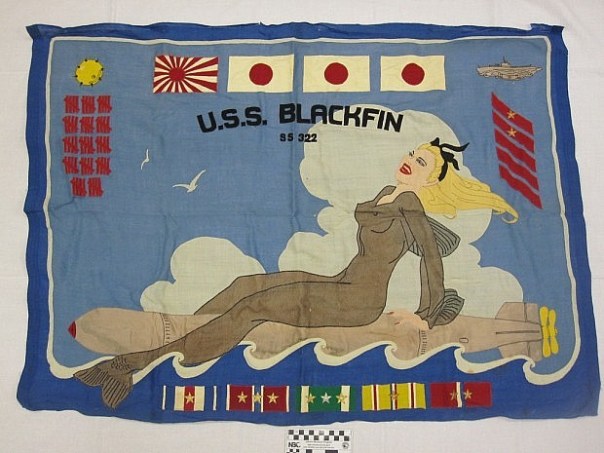
A beautiful example of a WWII Pacific Theater submarine battle flag from the USS Blackfin (SS-322) (source: Naval Historic & Heritage Command).
Perhaps the ultimate American vexillological artifact is the subject of a bicentennial celebration that took place just a few years ago. More than two hundred years have passed since the last national conflict with Great Britain concluded– which is also the last time a foreign enemy invaded the home front (not counting the Confederate northward invasion of 1863) – and there are celebrations and recognition events that took place throughout the United States. The most significant flag of the United States, The Star Spangled Banner, whose popularity stems from the Francis Scott Key poem of the same name, was also recognized during these bicentennial celebrations (the Battle of Baltimore and the shelling of Fort McHenry occurred September 5-7, 1814).
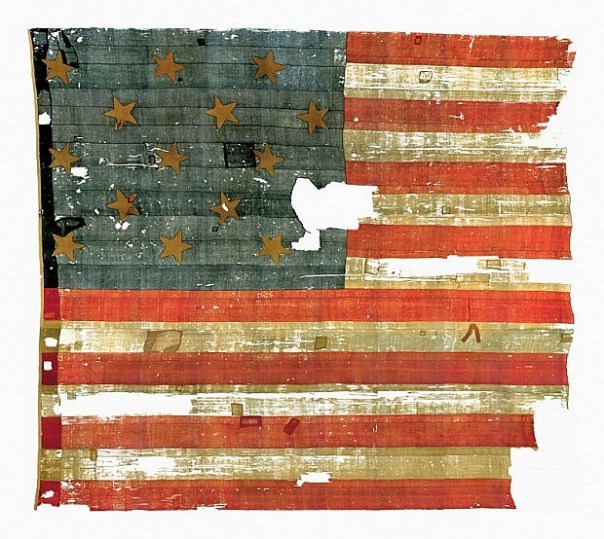
Documenting the Star Spangled Banner: Because of its size and the confined space of the lab, the flag could not be photographed as a whole. This is a composite of seventy-three separate images (source: Smithsonian Institute).
Canvas Bag – the Armistead family kept the Star-Spangled Banner in this large canvas bag (source: Smithsonian institute).
The commander of Fort McHenry, Major George Armistead anticipated a British attack and desired to have an enormous American flag flown over the fort. The renowned flag maker, Mary Pickersgill, was contracted to construct the garrison flag that measured 30 by 42 feet. Pickersgill and her assistants spent seven weeks constructing the flag (along with a smaller, inclement weather or storm flag that measured 17’ x 25’). In the years following the battle, Armistead’s family kept the flag, passing it down two generations. 90 years after the Ft. McHenry bombardment, Key’s poem had gained incredible popularity and the legend of the flag blossomed. Armistead’s grandson, Eben Appleton, released the flag for public display during Baltimore’s sesquicentennial celebration in 1880. The flag then remained in locked storage (in a New York safe deposit box) as deterioration had become an issue. By 1912, the flag was permanently donated to the Smithsonian Institution by Appleton with the directive that it be forever viewable by the American public. The provenance for this flag is traceable and verifiable over the course of the last 198 years, making it truly priceless.
In my collection, I have some significant flags that have more personal historical importance. I served aboard the Navy’s newest (at the time) cruiser, the first of its kind to serve in the Pacific Fleet. I was assigned to the ship 10 months prior to her commissioning. Because of the significant period of time spent with the ship as she was being completed, I developed quite a fondness for her and her legacy (three previous naval warships proudly carried the name). I suppose that my desire for the preservation of history was nurtured in these early years, prompting me to save a number of disposable artifacts.
I have yet to actively pursue any flag purchases, however during that time aboard my ship, five vexillological artifacts found their way into my collection. The most significant (to me, at least) was my ship’s very first commissioning pennant and the acquisition was a matter of happenstance.
During our transit to our home port from Mississippi (where the ship was built and commissioned) a few weeks after the ship was placed into service, I found myself coming off a 4-8am watch, making my way back to the signal bridge to catch up with one of my friends who was a signalman. He was in the process of swapping out the grungy, grimy commissioning pennant with a brand new one, prompting me to ask if I could have it. My shipmate confirmed that the grayed and soiled pennant had flown since the commissioning ceremony and that it was destined for the shredder before I rescued it.
-
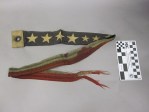
- This commissioning pennant is from the heavy cruiser, USS San Francisco CA-38 (source: Naval Historical & Heritage Command).
-
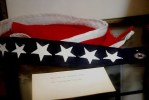
- Commissioning pennant from the WWII light cruiser, USS Vincennes CL-64.
-
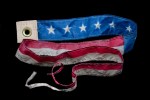
- This is the first commissioning pennant raised aboard the CG-49 on her commissioning day in 1985.
In addition to the pennant, I also have a standard (daily) ensign and union jack set that flew on the ship while in port in 1987. The other two flags were from the captain’s gig (ensign and jack), obtained when I was part of the boat crew serving as the rescue swimmer.
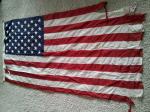
This standard navy ensign’s fly is tattered from the winds and there is some soiling from the stack gasses (exhaust) from the ship’s gas turbine propulsion.
A few years ago, an auction listing for a standard naval ensign that was described as having flown over the USS Vincennes (CG-49) during her 1988 deployment to the Persian Gulf. My interest piqued (mostly fueled by skepticism as to the authenticity of the flag and the credibility of the seller) I placed a watch on the auction. Since I served aboard the ship during that time, I contacted the seller to ascertain details that would prove (or disprove) the veracity of the seller’s description. The seller responded that he was a commissioned officer who had served as the ship’s navigator. This officer departed the ship just prior to the conclusion to our time in the region and was presented the flag by the chief signalman as a memento of the trying deployment and his time serving aboard the ship. A few days later, the auction closed and my bid was one of only three. I was very proud to have the flag along the accompanying provenance from the officer (in a printed email) to add to my collection.
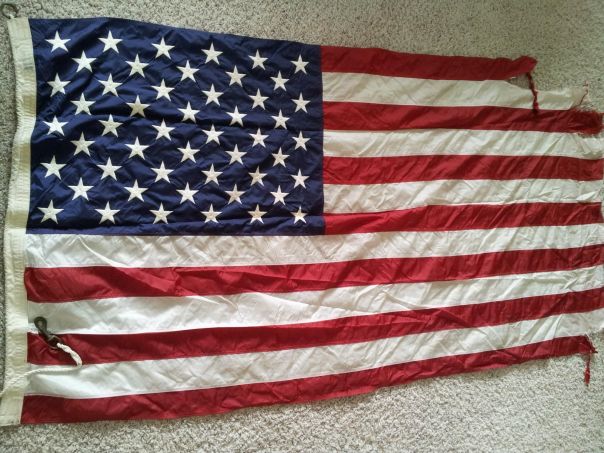
I obtained this flag from the CG-49’s former navigator a few years ago. The flag was presented to him by the chief signalman upon detaching from the ship, bound for a new command.
The ship was decommissioned a few years ago and subsequently scrapped, making these flags even more significant in my collection. As of yet, I have not affixed any documentation or description to provide provenance to the flags and pennants. If something should happen to me, these flags become nothing more than nice examples of naval flags. With the Star Spangled Banner, the flag was kept in a bag that possessed the documented provenance along with the narrative that was passed down from one generation to the next.
Flag Collecting Resources/References
Militaria Bargains to be Had
Taking inventory of my previous blog postings, I find an overwhelming majority of the topics I’ve covered were focused primarily on militaria that is not in the reachable price range for most collectors. These posts have been in stark contrast to my most recent acquisitions, most of which are well below $50 (including shipping costs).
In reality, most of the collectors I know are adept at rooting out the bargains at yard sales, surplus and antique stores, and various other sources. Rather than shelling out loads of cash to online sellers and taking on shipping costs, these collectors locate some very hard-to-find, and in some cases, high dollar items and groups for a pittance.
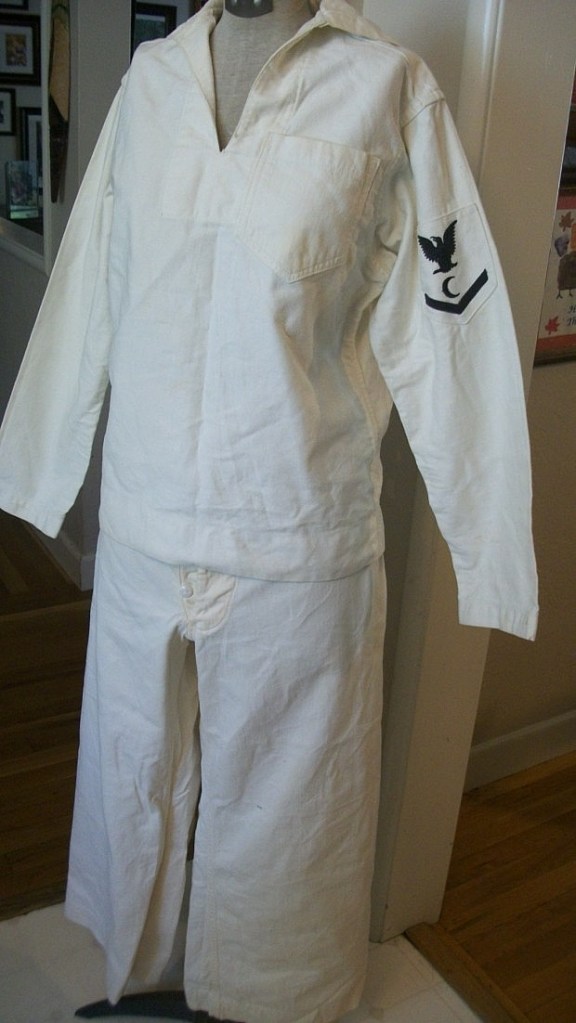
For the bargain-basement price of less than $11.00, I was able to acquire this fantastic tailor-made set of WWII-era dress whites with the precise rating badge I had been seeking (source: eBay image).
One of my collector colleagues spends time sniffing around in bargain bins in a surplus store near one of the local military installations, and once managed to locate a few sets of experimental U.S. Army combat uniform sets for less than $10.00. Subsequently, he discovered that the uniforms were rare and highly sought-after by collectors of current and modern uniforms, and could easily yield several hundred dollars per shirt and trouser set. His find was merely a matter of timing and experience as he recognized that these uniforms had subtle differences from their standard-issue counterparts.
This jumper has a nice, crisp appearance for being 70+ years old. The crow of a Ship’s Cook 3/c is exactly what I was looking for (source: eBay image).
For some collectors (like me), possessing and budgeting for the time to spend scouring these locations for the bargains is difficult. We compensate by letting our browsers and searches do the legwork in discovering the low-priced pieces. Knowledge and experience also comes into play for us as we are able to discover items in listings that are incorrectly identified or tagged by the sellers helping to keep the buyer competition to a minimum.
Still, timing and patience are ultimately the key in finding low-priced pieces. I have been in search of a set of World War II vintage U.S. Navy enlisted dress whites with a ship’s cook third class (SC 3/c) rate and rating badge in good condition for a few years. Such a set would be a great augmentation for the uniform display I am assembling to honor my grandfather. While I already have two sets of his actual dress blues (one is standard Navy-issue and the other is his tailor-made, custom set), his whites were lost to time. When an online auction for a set of whites meeting my criteria was listed for less than $10.00, I began watching, hoping that the competition would be low and I set my snipe bid.
Just a few days ago, I received notice that the auction closed and my bid had been accepted as the winner. I acquired the uniform for less than $11.00 (plus a few bucks more for shipping costs) and I was amazed that this set would sell for such a low price when so many had sold for well over $50.00 during my previous years of searching.
The bargains are still out there for those who arm themselves with knowledge and patience and have a little bit of luck.
Collecting U.S. Navy Uniform Ship Identifiers
To suggest that veterans and sailors of the U.S. Navy have an affinity for their ships would be a gross understatement. It would be difficult to stroll through any public area without seeing a former navy man sporting a ball cap with a USS ___ (fill in the blank). I have seen men well into their late 80s proudly carrying the name of the ship they served aboard, emblazoned across their foreheads, and as I write this, I am proudly wearing one of my own ship’s ball caps.
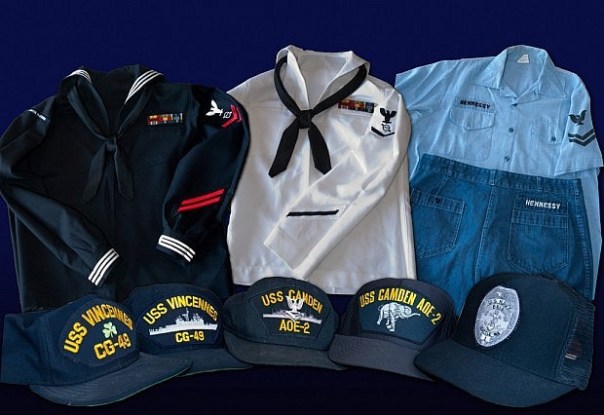
This collection of uniforms shows four official shipboard navy ball caps, authorized for wear with utility uniforms (such as the now-defunct dungaree set on the right). Note the UIM patch on the right sleeve of the dress blue uniform jumper.
Navy ship ball caps are quite commonplace. Many of them have icons or symbols between the name and the hull number designator that make them unique to each specific ship. Some of the symbology might have nothing to do with the ship, instead being representative of the commanding officer or the crew. As far as I’ve determined, ships’ crews have been wearing the named caps aboard ship with utility (dungarees) since the 1960s.
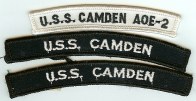
The two blue UIM patches shown are authorized by Navy uniform regulations. The white patch on top is a manufacturing mistake and unauthorized for wear on a Navy uniform. The USS Camden was decommissioned in 2005.
When sailors are required to be in their dress uniforms, identifying them with their associated commands is a requirement… especially when sailors behave like, well… sailors in foreign ports. Present-day enlisted dress uniforms must be adorned with a unit identification mark (UIM) patch on the top of the shoulder of the right sleeve. This regulation has been in place since the late 1950s to early 1960s.
Prior to World War II, the navy employed a much more stylish format of placing the command names on their enlisted sailors. From the 1830s to 1960, sailors wore with their dress blue uniforms a flat hat, affectionately known as the “Donald Duck” hat. Though it wasn’t authorized, in the latter half of the nineteenth century, sailors began to adorn their flat hats with a ribbon (known as a tally) that displayed the name of the ship and was worn only when on liberty (“shore leave” to you landlubbers). Eventually, the tallies were acknowledged within the naval uniform regulations, standardizing their appearance and wear.
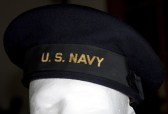
This post-1941 Navy flat hat shows the generic “U.S. Navy” tally. By 1960, these hats were retired from use.
By 1941 and the outbreak of World War II, the rapid expansion of the fleets with many new ships under construction and being delivered to the fleet, the Navy did away with the ship names on the tallies, standardizing all with “U.S. Navy” (there is some speculation that secrecy of ship movement drove the Navy to implement this change).
Ship-named tallies are highly sought after by collectors, pushing prices on some of the more famous (or infamous) vessels well into the ranges of multiple-hundreds of dollars, regardless of condition. Due to the delicate nature of the tallies’ materials and the exposure to the harsh marine environment, the gold threads of the lettering tend to darken and tarnish. The ribbon construction was typically made with silk, so they don’t stand up well to the ravages of several decades of time and storage.
In the last few years, a tally showed up in an online auction for the first time in more than a decade of staking out anything related to USS Vincennes. Until then, I had my doubts as to whether the Navy had allowed the pre-war crew to have the tallies for their ship, even though it was in service since February of 1937, four years before they were abolished. Sadly, the selling price surpassed my maximum bid by nearly triple the amount.
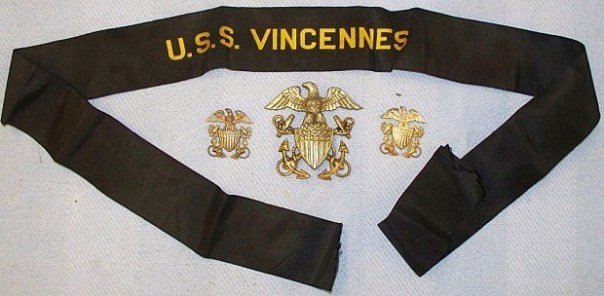
This image shows the rare USS Vincennes tally (along with some officer cap devices), which was sold this week at auction for more than $150 (source: eBay image).
Hopefully, I don’t have to wait as long until I see another USS Vincennes tally!
 The Veteran's Collection