Spark Your Collection: Military-Themed Zippos
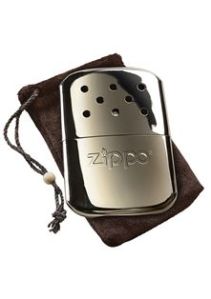
My memory with this Zippo hand warmer is vivid: I remember the smell of the fluid burning and how it warmed my hands on a cold winter morning.
When I was invited to write for A&E’s Collectors Quest collector’s forum as their resident militaria blogger, I knew that I had my work cut out for me. Besides possessing some basic skills with my native tongue (or at least the written word), I knew that I would have a very diverse field from which to extract topics for my columns. With nearly two years researching and writing on an aggressive deadline schedule coupled with my passion for militaria collecting, I developed a fair amount of expertise that I brought to bear when I moved on to my own blog.
From my initial post on this blog (Militaria Collecting: It Isn’t Just Fatigues and Helmets), I mentioned the diversity of the “genre” and how far reaching – extending beyond the bounds of military-specific items – the various categories would be. It is very easy to be myopic as we focus on what we enjoy, forgetting that a specific area of collecting militaria could be part of a larger field of collecting that has very little to do with the military. One of those heavily-collected areas is in the field of cigarette/cigar lighters…more specifically, Zippo lighters.
My introduction to Zippo products came when I was a pre-teen as my uncle, a World War II army combat veteran of the Pacific theater, offered to warm my hands up with a unique device…a hand warmer. Fueled by lighter fluid, the warmer took the bite out of the cold that was causing my hands to stiffen and ache. I marveled at the its soft metal-feel and the warmth it provided. I remember seeing the name emblazoned across the device’s bottom, “Zippo.” My uncle was also a pipe smoker and when he went to light up the fragrant tobacco in his pipe, I again saw the name and it stuck with me for years. My uncle told me of the reliability of the Zippo; that it could still light up in a strong wind. He mentioned that all of his buddies sought them out, often trading battlefield souvenirs for them.
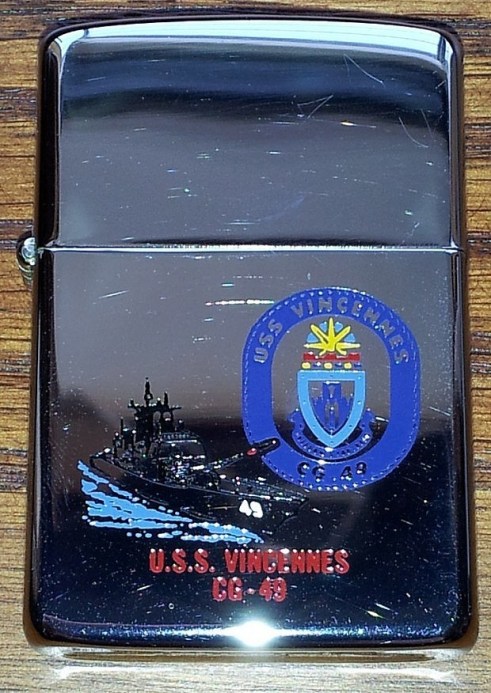
This Zippo dates from the 1980s and is the more typical chrome design with USS Vincennes CG-49 engraving.
Though I do not smoke (I never have), I own a handful of the iconic, treasured pocket flame-producing implements. All of my specific pieces are lie firmly in the military category of Zippo collecting – specifically U.S. Navy (for those of you who’ve been following my posts, this would be obvious). The depth and breadth of my collection covers all of two ships, only one of which I served aboard, and numbers somewhere in the neighborhood of five pieces, all of which are in new condition (remember, I don’t smoke). I’ve even managed to acquire, though I don’t remember how, a navy-themed Zippo pocket knife.
-
- This is another USS Vincennes Zippo from the 1980s clad in ivory plastic and engraved with the ship’s crest.
-

- The opposite side of the ivory plastic cladding with the ship engraving.
-
- This is a second variety of the USS Vincennes Zippo from the 1980s clad in black plastic and engraved with the ship’s crest.
-
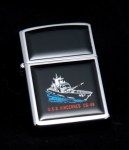
- The opposite side of the black plastic cladding with the ship engraving.
Plainly and painfully obvious, I don’t possess much knowledge beyond being able to identify a lighter as being a Zippo versus a knock-off. Beyond that, I have to resort to my basic abilities of research to determine the sort of information collectors need: the age of the lighter, scarcity, desirability, condition, etcetera. One of the nice things about a company like Zippo is that they consider both their customers those who use the products and the collectors, producing quality products, standing behind them, and providing collectors with authoritative production data and information, dating back to their infancy in the 1930s.
Interested in collecting Zippo? Try some of these resources to spark your interest::
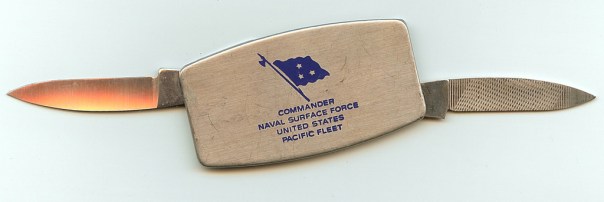
This flat Zippo pocket knife was left behind aboard my ship following one of the many parades of high-ranking naval officers who wanted to see what the (then) newest naval technological marvel could do.
For me, I will continue on in my collecting pursuits, leaving my lighter collection to remain as is – though I might have to locate a hand warmer to warm my hands and nostalgically reminisce about those days with my uncle, now long gone.
Rare Bird – Outside of Uniform Regulations
In an article that I wrote last year, I touched on an aspect of rating badge collecting that focuses on those constructed with bullion-metallic thread. The post was primarily covering the design and aesthetic aspects rather than regulatory or uniform issue standards. However, in order for collectors to make sound purchases or additions for their collections, they need to be well informed.
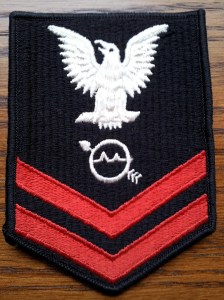
This crow dates from the 1970s and is entirely embroidered. This was a short-lived experimental rating badge.
Let me be very up front by stating that I am, by no means, an expert in rating badge collecting. As I am acquiring pieces for my collection, I am researching and back-filling the details. In some cases, I have the order reversed – researching a piece after acquiring it – hoping that I didn’t make a bad purchase. While reviewing some online auction listings of rating badges (for my former rating), something that I have never seen before caught my attention and without hesitation, I pulled the trigger on the “buy it now” button. Rather than spend time ahead of purchasing the crow, I decided that the best course of action would be to research it after I had it securely in my hands. I had no idea of it’s date of manufacture, whether it was genuine, experimental/prototype or a fantasy piece.
My rating badge collection consists primarily of variations of the rate that I wore when I served. Four years ago, I set out to purchase a new, unused rating badge to mount in my shadow box display. All of the examples I had in my collection were affixed to my old uniforms so they weren’t’ quite up to par with what I’d want to be shown beside my medals and decorations. I ended up with a variety we (in the fleet) referred to as a “peacoat” crow. As it turns out, the fully embroidered rating badge (with merrowed edging) was a test crow that never really caught on. While they are somewhat uncommon, they aren’t necessarily rare or highly desired among collectors.
-
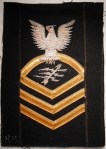
- This pre-1947 Radarman CPO bullion rating badge (with gold good conduct chevrons) is prototypical of what would be seen with a bullion crow.
-
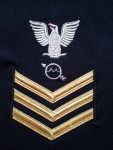
- This current-issue OS1 rating badge is what one would expect to see – a first class petty officer with gold chevrons (indicating at least 12 years of good conduct service) – rather than a second class with bullion and red chevrons.
-

- This is an example of an authorized bullion crow (current-issue) for an Operations Specialist chief petty officer.
The latest addition to my collection is a silver bird – a bullion eagle and specialty mark hovering over red, embroidered chevrons. The reason this is an odd combination is that (according to Navy Uniform Regulations) the silver/red configuration is only available for E-7 through E-9. Ratings fo E-4 through E-6 may use the silver (bullion) eagle and specialty mark in conjunction with gold chevrons (indicating 12 consecutive years of good conduct service). One could deduce that perhaps this predates the current uniform regulations, however, this would be an incorrect assumption.

A rare bird – an Operations Specialist/Radarman badge with a bullion eagle with red chevron stripes.
1913 Uniform Regulations
-
“For petty officers holding three consecutive good-conduct badges, the chevrons for blue clothing (dress/undress blues) shall be made of gold lace instead of scarlet cloth, and the eagle and specialty mark shall be embroidered in silver.”

The reverse of the OS2 bullion rating badge showing the construction and the Gemsco label.
Why then does this E-5, Operations Specialist/Radarman 2nd class crow exist? More than likely, the manufacturer (Gemsco) made this variation either errantly or in anticipation of a uniform regulation change that ultimately never occurred. Not to be stuck with inventory, manufacturers most likely divested these crows and shipped them to uniform shops or uniform tailors to be disseminated to sailors. Seeking to have a measure of individuality with their uniforms, sailors who might be able to “pass,” in wearing the unauthorized embroidery at a command that might not have strict adherence to regulations, would stitch on these subtle “custom” enhancements.
Now that I have this rare bird, I decided that it would display nicely and swapped it into my shadow box (supplanting the standard OS rating badge) as these bullion crows are just too beautiful to sit in a storage box.
Subtle History – Finding a Unique Naval Militaria Piece
Remaining focused with collecting can be a challenge, especially when it comes to militaria. If you are a die-hard fan of military history, it becomes quite difficult to keep composed when unique pieces of history become available. However, when one of those unique items surface that actually does directly tie-in to one’s principal areas of collecting, it cannot be passed up.
During the first four of my ten years of naval service, I was blessed to be assigned to the pre-commissioning crew of the U.S. Navy’s newest (at that time) cruiser – the first to be assigned to the Pacific Fleet – the USS Vincennes. My assignment was handed to me as I was graduating from my naval training school and, at that time, I had no idea of the history of the name of that ship. It was a name that I struggled to pronounce correctly.
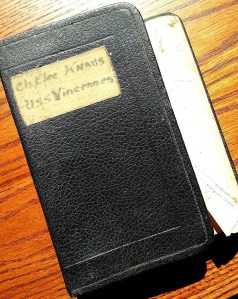
This binder is labeled with the name of the owner (Chief Electrician Knaus) for the USS Vincennes. It was used during the ship’s overhaul in 1939. I still need to research Chief Knaus to see if I can locate any details of his service.
Upon reporting in to the command located in San Diego, where the ship was to be homeported upon completion, I was quickly immersed into the history of the ship’s name and bowled over by the sheer excitement and passion for the legacy of the citizens of the Indiana city from where the ship drew her name. I was also immediately connected to a 500-member-strong group of World War II veterans (who had served aboard either of the two WWI cruisers that also bore the name), all of which had incredible pride for this ship. These men and their wives had played a significant role in convincing the navy leadership to name the third ship of the Ticonderoga class cruisers to honor three previous front-line navy warships that had also carried the name Vincennes.
Since the mid-1980s, I’ve been immensely interested in anything pertaining to the three previous USS Vincennes warships. I’ve collected press photos, news articles, first day postal covers and other ephemera that are somehow connected to the ships. Seldom have I seen items with more direct significance than something that actually came from the ships as preserving the history during their service was neither a thought, or in the case of the CA-44 – which was sunk by the Japanese at Savo Island on August 9, 1942— possible. A few months ago, an interesting piece surfaced that had historical significance and direct ties to the CA-44. More than likely, it was aboard the ship as part of a daily routine. While it isn’t anything that is correlated to a battle or naval engagement, the importance of this piece did provide some ancillary historical details regarding the configuration changes made to the weapons and other shipboard systems.
-

- This work order specifies changes made to the 5″ – 25 caliber anti-aircraft guns’ electrical system.
-
- The Vincennes’ main battery was comprised of three triple turrets, each with 8″ – 55 caliber guns. This work order details changes to the emergency hatches.
-
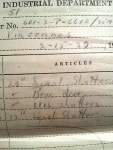
- This slip documents changes to the ship’s signal lights – the tools of the trade for the signalmen.
Listed on an online auction site was, at least for me, was the holy grail. It is a binder containing work orders for electrical jobs during an overhaul period in 1939. Contained within are forms and handwritten work orders specifying upgrades and configuration changes made to the ships electrical systems. Some work orders detail modernization of weapons systems that would meet the changes to the geopolitical landscape and the escalation of war in Europe and Asia.
I was fortunate that my bid was high enough to beat out others but was still in line with my budgetary limitations.
The binder provides me with a fantastic vantage point as I continue to document the history of these great warships and is a great addition to my tiny Vincennes collection.
Bataan/Corregidor POWs – Looking Back 75 Years
Five months. Depending upon your perspective, this span of time may seem to be a brief moment or a lifetime. If you are anticipating a well-planned vacation, you count the days down with excitement. If you are completing a career and your retirement date is approaching, you might have some anxiety about the significant change in life that you are facing. For the men on Corregidor in May of 1942, it was the culmination of a long-fought battle that was about to come to an end.
The Japanese had planned simultaneous, coordinated attacks on United States military bases in an effort to subjugate American resistance to their dominance in the Western Pacific. Seeking to seize control of natural resources throughout Asia and the South Pacific, the Empire of Japan had already been marching through China, and having invaded Manchuria in 1931, they continued with full-scale war in 1937 as they took Shanghai and Nanking, killing countless thousands during the initial days of hostilities. American sanctions and military forces, although not actively engaged, stood firmly in the Japanese path of dominance.
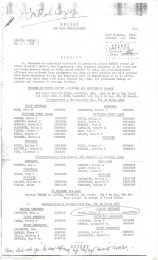
A copy of the transfer orders for the 5th Air Base Group, October 1941. My uncle’s father is listed here along with one other veteran who was with him throughout his entire stay as a guest of the Empire of Japan.
The father of my uncle (by marriage), enlisted in the U.S. Army Air Corps in 1941 and was assigned to the Decontamination Unit of the 4th Chemical Company, one of 204 members of the 5th Air Base Group that had been transferred to the in Far East Air Force in the Philippines in late October. Like many other new privates, this man had enlisted to escape the tight grip of the Great Depression and massive unemployment, seeking steady pay while embracing a new life of service to his country. The Philippine Islands, though remote and thousands of miles away from the comforts of home, represented a certain measure of adventure. He was unaware what the next four years would bring.
On December 8, 1942, Japanese forces landed on Luzon in the Philippines as they kicked off what would become a lengthy campaign in an effort to gain control of the strategic location and to remove the threat of any resistance of their ever-expanding empire by the forces of the United States. Grossly under-prepared for war, the 150,000 troops (a combination of American and Philippine forces) were plunged into battle, defending against the onslaught of the 130,000 well-seasoned, battle-hardened enemy forces.
The American forces were almost immediately cut off from the promised supplies and reinforcements that would never be sent.
-

- 20th Air Force B-29s lined up (on Saipan) for post-surrender POW supply drop.
-

- An aerial photo (taken by 20th Air Force personnel) of one of the POW camps at Fukuoka.
-
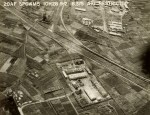
- As they prepared to resupply them after the surrender of Japan, the 20th Air Force photographed and documented the locations of POW camps throughout Japan.
Over the course of the next five months, U.S. and Philippine forces fought a losing battle in an almost constant state of retreat as supplies wore thin and troops wore out. Exhausted, beat-up and starving, the defenders (of the Bataan Peninsula and Corregidor) were done. Having suffered considerable losses (25,000 killed and 21,000 wounded), General Jonathan Mayhew Wainwright indicated surrender by lowering the Stars and Stripes and raising the white flag of surrender. More than 100,000 troops were now prisoners of war in the custody of the Imperial Japanese forces and would endure some of the most inhumane and brutal treatment every foisted upon POWs. My uncle’s father, a young private was now among the captured, on the march to an uncertain future.

An engraved mess kit from a Bataan veteran (photo source: Corregidor – Then and Now).
The five months of uncertainty and hopelessness that my uncle’s father experienced as a Bataan Defender since hostilities began would become years of daily struggles to survive in prison camps where beatings, starvation and executions were the new normal.

A POW letter to loved ones providing basic information of internment (photo source: Corregidor – Then and Now).
To say that Prisoner of War artifacts are a rarity is a gross understatement. POWs (captives of the Japanese) had to scrounge, steal and beg for basic necessities. Any personal possessions they might have had during the 80-mile forced march were taken once they arrived at makeshift camps. Those few captives who were crafty would manage to conceal small mementos, avoiding detection by the prison guards.
Aside from personal accounts of the atrocities that were told by liberated prisoners after the war, documentation proved helpful in war crime trials of the Japanese camp administrators. Prisoners ferreted away scarce paper and documented brutal acts and names of POWs who were killed or died of disease and starvation. Any of the items that were brought home by these men have tremendous significance as historical records and possess value well beyond a price tag.
May 6, 2017 marks the 75th anniversary of the surrender that launched a painful chapter in my uncle’s father’s life that remained with him for the rest of his years. Through my research, I have been able to determine that he was a POW at the Davao Penal Colony until it was closed in August of 1944. By the war’s end, he had been moved to Nagoya #5-B having made the trip to Japan aboard one of the infamous Hell Ships.
He never really talked about his experiences (at least with me). This man chose instead to let the past remain in its proper place. Unfortunately, I don’t know what might have become of any items he may have returned home with. My hope is that if they do exist, his POW artifacts are with his children or grandchildren, preserved in hopes that his experiences are not forgotten.
Bataan Prisoners of War References:
You Have the Right to…Collect Armed Forces LEO Militaria
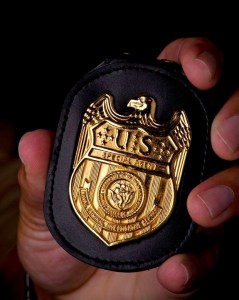
This current-issue NCIS badge is mounted to a leather holder (source: US Navy).
Militaria collecting has a broad spectrum possessing many facets that allow people to specialize or focus their efforts on specific themes or concepts. Aside from settling on a particular branch or time period, collectors might choose to get very narrow with their collections. Some of these focus areas might even cross over into other collecting genres. One category or focus area that has grabbed the attention of collectors beyond the bounds of militaria is law enforcement within the ranks of the armed forces.
When considering military law enforcement, one might immediately begin to think of the Naval Criminal Investigative Service (or NCIS) that has been popularized by the television drama franchise on CBS. The Army has their own similar organization, United States Army Criminal Investigation Command (CID). However, the law enforcement community within the armed forces is significantly more broad, which means that collectors have many options and avenues to pursue.
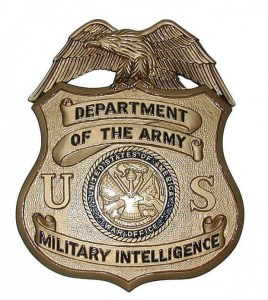
A nice example of a US Army MIS Badge (image source: U.S. Army)
Aside from the civilian-staffed agencies such as the NCIS and CID, there are plenty of uniformed active duty departments and billets that are filled by military personnel. In addition, there are duty-based positions that are performed as an extra responsibility outside the daily duties of the service members’ normal MOS, specialty or job assignment. Regardless of the specific role, there are opportunities for collectors to obtain law enforcement militaria.
In existence since the Revolutionary War, the U.S. Army’s Military Police Corps was not officially organized until September of 1941, when it was formally established. The U.S. Navy’s version of the MP, the Master-at-Arms, has been in place since the nineteenth century, predominantly serving aboard ship in the early days.
One of the more diverse categories of objects available for collectors is in the area of brassards, or arm bands. Within the Air Force Security Police (SP) and Army, this area could present collectors with limitless varieties from countless military police commands. Within the Navy and Marine Corps, there are a fair amount of Shore Patrol (SP) brassard versions—easily confused with the Air Force versions—dating back to well before the second world war.
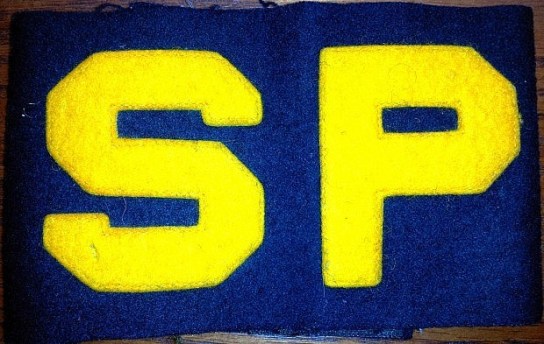
This Shore Patrol brassard is a 1980s vintage. Modern SP arm bands lacking the Velcro attachments can be difficult to discern from examples from the WWII-era.
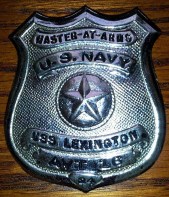
A Master-at-arms badge, dating to the 1970s, was used aboard the aircraft carrier, USS Lexington when she was designated a training carrier.
Along with arm bands, collectors could launch into military law enforcement collecting by pursuing badges. Keep in mind that there could be laws that prohibit owning current versions of these law enforcement badges. Possessing a currently-issued badge could result in considerable legal trouble so be sure to understand what is permissible in your area prior to acquiring the badge. Typically, obsolete badges should be allowable, but I would encourage collectors to remain familiar with their local laws.
Besides brassards and badges, collectors could pursue helmets, uniforms, utility/web belts (and all the attachments) and weapons, such as side arms and batons. The trick is to find your niche and stay within your budget.
Military Police Collecting
 The Veteran's Collection