Category Archives: Uniforms
Shredding History or Genuine Fundraising? Part I
I am kicking off a three-part series this week to focus on a hot-button militaria collector topic : re-purposing militaria artifacts for monetary gain. While the discussion can be category agnostic (meaning that it can be applied to virtually all areas of collecting rather than just militaria), I am focusing on this from the area of military memorabilia.
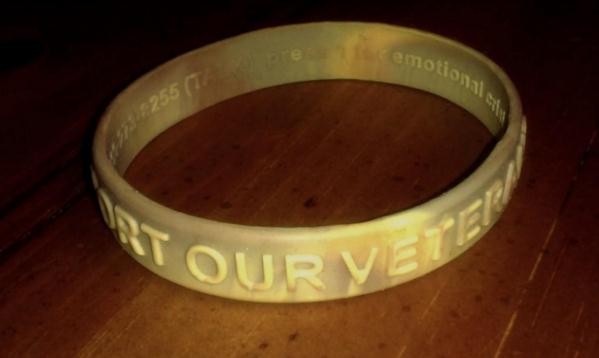
A desert camouflage bracelet for veterans from the VA with crisis support information imprinted on the inside surface.
Wrist bands. They are typically made from a rubbery, silicone-like substance and come in a range of colors from bright and flashy to muted and subdued with some even in camouflage patterns. They have messages embossed (actually molded into the material) that are intended to call attention to various causes and are used to market a company’s brand.
A trendy fashion statement made popular by Lance Armstrong’s LiveStrong charity, you have seen these wrist bands worn by everyone from celebrities, to colleagues, neighbors and even family members over the past half decade. You have probably worn or are wearing one at this very moment. I am sure that there are collectors who focus their attention on them.
In the true spirit of capitalism (which I enthusiastically subscribe to), a Navy veteran found a niche market and created a business called Bands for Arms (B4A) that manufactured and sold their own version – an evolutionary step, if you will – of the message-laden wrist band. Their company website described their products as a way to honor veterans and to help families (and supporters of the U.S. military) feel connected to service members and veterans.
Bands for Arms’ operating model was essentially taking donated U.S. military uniforms (mostly from veterans or their families), dismantling them and constructing wrist bands from the materials that in some way represent the intended message or sentiments of the wearer. I am not disparaging this company or the products they sell as I do find the bands rather intriguing – some are very tastefully designed. And who could find fault with their support (50% of all proceeds) of organizations such as USO Japan, Project Lifting Spirits and the Marine Toys for Tots Foundation?
So what does this have to do with militaria collecting you ask?
Recently, a thread on a popular militaria discussion board alerted collectors to an activity where historic uniforms, worn by veterans who served this nation for the cause of freedom, were donated to B4A as part of a special project, resulting is a special product line. Detailed on the B4A site was how the uniforms had been donated to them by the National WWII Museum (in New Orleans, LA) to create the new line of bracelets known as The Historic Bracelet Collection and 50% of the sales proceeds from this product line would subsequently be donated back to the museum. While the finished product is very well-made, the end result is that the historic uniforms are gone, along with the connection to history associated with the veteran who wore it.
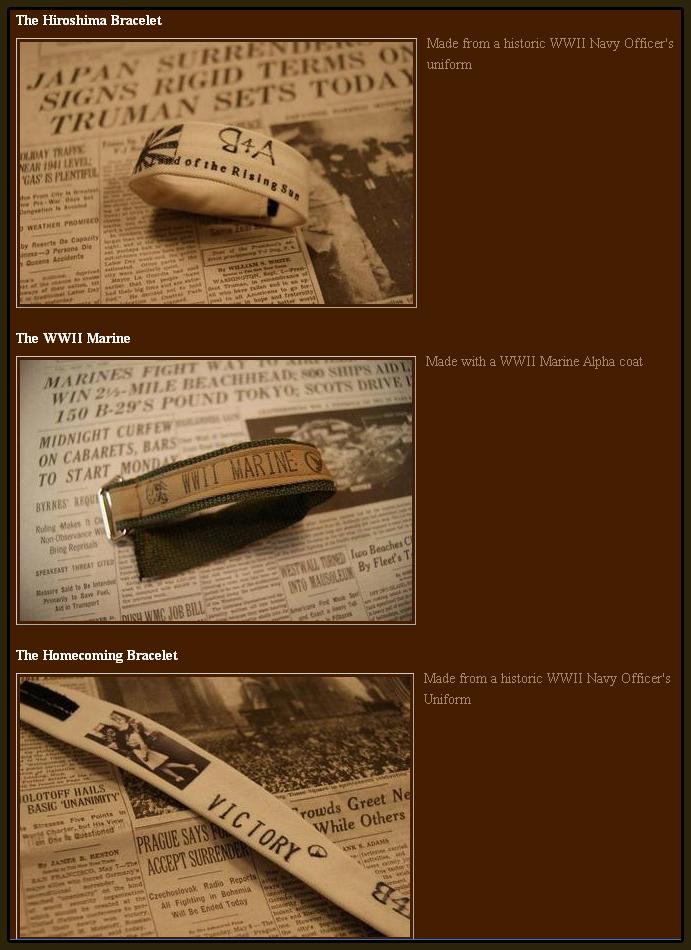
This screen capture shows bracelets were made from uniforms donated by the National World War II Museum. (Source: BandsforArms.com)
For the non-collector, this action may not be an issue. However, it is gut-wrenching for militaria collectors and historians, and has caused them to question the ethical practices of the museum and how they manage their artifacts. The unrest centers around the idea of a museum having donated uniforms for this purpose : intentionally destroying historic artifacts that had been entrusted to them with the promise that they would be preserved and displayed in that museum.
The militaria collectors I’ve associated with take the trust between donors and museums very seriously. If prospective donors no longer have the expectation of proper handling and care of their artifacts, why would they entrust them to any museum? Considering this trust, militaria collectors reacted to the idea that an entity as highly regarded as the National World War II Museum would remove these uniforms from their collection and send them out to be dismembered (and I use this term to emphasize the emotion surrounding this concept) to generate revenue in support of operational cost.
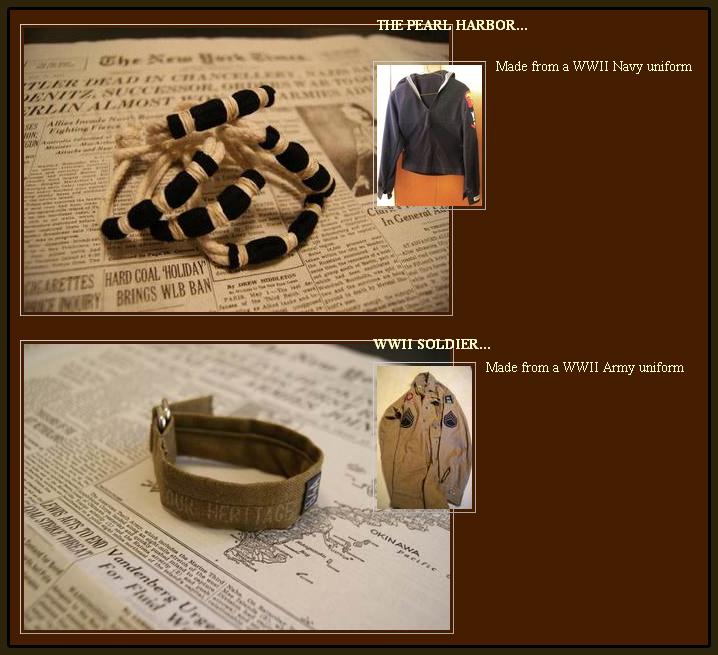
Displayed in this screen capture are two bracelets and the uniforms that were destroyed to make them. (Source: BandsforArms.com)
The militaria discussion board posts raised questions surrounding the proper handling of donated artifacts and the apparent disregard for the widely accepted, industry standard, museum deaccessioning processes. What opened the floodgates of animosity toward both entities were statements posted on the B4A sites (which includes their Facebook page) acknowledging the museum for the donated uniforms, which was the catalyst to the creation of the History Collection.
Frustrated collectors began posting their sentiments directly on the Facebook pages of both the National WWII museum and Bands for Arms, challenging the practice of dismantling historic artifacts (specifically, the WWII uniforms). B4A personnel responded by deleting any posts that called the B4A and National WWII Museum partnership into question.
Bands for Arms personnel added comments to their Facebook page that appeared to mock the collectors with statements such as:
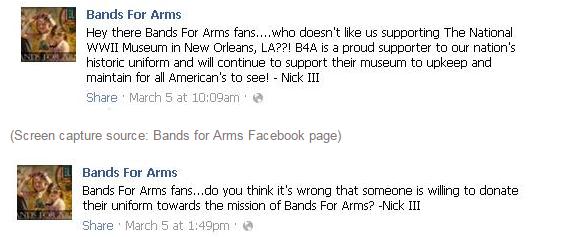
(Screen capture source: Bands for Arms Facebook page)
Over the span of a few days, B4A purged all evidence that referenced the uniform donation from the museum. The messaging on the (now defunct) B4A Historic Collection page had been carefully re-worded to describe the transaction more vaguely, between the ambiguously identified source of the uniform donations.
In stark contrast, the folks managing the Museum’s Facebook page began to directly address the collectors’ challenges openly while also requesting offline dialogue in order to fully explain the details of the transaction. A few of the responses demonstrate their positive actions:
- “We have been working to make sure all parties have the correct information and we are always available to respond to questions or concerns about the Museum.”
- “I would be happy to put you in touch with our registrar who can answer any questions you may have and share the details of our collections policy.”
Several collectors (at least one of which is a museum curator himself) did contact the museum directly and I know that a few had phone conversations with the staffer at the museum who was at the center of the transaction with Bands for Arms. The museum staffer also provided an e-mail response to inquiries regarding the issue:
“Thank you for your recent online inquiry regarding how the Museum cares for artifacts. I’d like to address your concern about a small number of items given to the Bands for Arms organization, but first want to explain our collections process. As you will see, we take very seriously our responsibility for handling artifacts in a professional and proper way.
Items donated to the Museum are considered for two major collections. The first is our Permanent Collection, which contains items that are rare and have a strong historical connection. The Museum always tries to link a military service member’s personal war experience to items donated by the individual or by family members.
The second major collection of the Museum is our Education Collection, which is used by several departments at the Museum for teaching activities. These activities include Living History Corps presentations, where presenters wear genuine World War II uniforms and gear for Museum visitors and students. Other selected items travel off-site under staff supervision for use with students and other interested groups. Educational uses do not preserve the life of the item long-term, but are instrumental in teaching World War II history.
Items that are dropped off at the Museum that do not meet the criteria for either the Permanent or Education Collection are typically returned to the donor. However, some donors do not wish to have items returned to them and the Museum makes these items available to other museums that may be able to use them. These items typically do not relate to the WWII period and have not been accepted into the Museum’s Permanent or Education collection.
When it has not been possible to return items to their original owner and no other institution is found to care for the items, we have utilized various methods to find another place for these pieces, including donation to local charities or other organizations. In 2010, after we were unable to return them to their owner and could not find another museum home for them, five uniform pieces—none from the WWII era—were given to Bands for Arms. These items did not qualify for inclusion in our collection. They are also the only items the Museum has provided to this organization. My personal connection is that I assist Bands for Arms in determining historical dates of uniforms they receive, a role that we play with many inquiring parties.
We currently house more than 140,000 items in our collection. While many items in the collection — including but not limited to Allied and Axis uniforms, weaponry, vehicles, medals, diaries, letters, artwork, photographs and other mementos — are on exhibit, the majority are kept safely in the Museum’s professional storage vault to be used for research and future exhibitions, or are being restored to their original condition.
The artifacts, documents, and personal accounts in the Museum’s Permanent and Education Collections are extremely important to the Museum’s mission of interpreting the American experience in WWII for current and future generations. In addition to carefully preserving these items, the Museum is embarking on a project to provide greater public access by improving our cataloguing and broadening our digitization of these items.”
Clearly, the museum is being responsive and professionally addressing the concerns head on, and I applaud them for these actions. As a novice historian, I still struggle with the destruction of the artifact, but I do understand the position the museum was in with regards to unwanted (at least by other museums or the donors) uniforms.
I know that the community of collectors are also satisfied with the museum’s responsiveness and willingness to be open about how they manage their collection. We are all hopeful that in the future, they will seek other avenues of artifact deaccession, avoiding destruction or disposal in order to continue to preserve our nation’s military history.
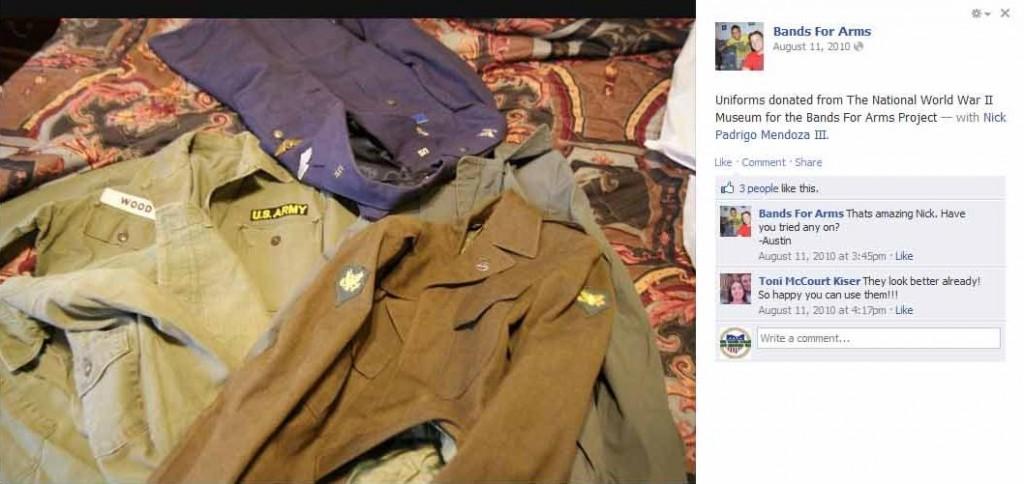
Shown here on an older Facebook post on the Bands for Arms page, references to the uniform donation by the National World War II Museum. These posts were subsequently removed.
What was difficult about the event was that Bands for Arms began a denial and suppression campaign when confronted by collectors who took issue with the uniform destruction. Instead of taking an above-board position by addressing the collectors’ concerns head on, they demonstrated a lack of maturity (and do not perceive this as an attack on B4A as I am not saying they behaved like children) that comes from having seasoned professionals managing external communications and messaging. I am betting that the leadership at B4A will use this event as a learning opportunity and will take note of the mistakes and missteps striving to not repeat them.
I’d also like to note that collectors do not take issue with B4A’s business model as they agree that veterans and family members may certainly do whatever they desire with their personal property. The folks at Bands for Arms do manufacture tasteful products and paying tribute to veterans while funding noteworthy veteran charities is quite admirable.
With the dust settling and the discussion posts winding down, is this the end of the debate? Do bracelets made from veterans’ uniforms truly honor them? As a collector, I have my own thoughts on this topic which will be the subject of the following segments in this series of posts.
Where to Look – Seeking Militaria in all the Right Places

Looking for a metal insignia device to fill a missing gap in your shadow box or a hole in your collection? This table had a decent array of insignia to choose from.
Military Records Research: Pay Attention to the Details
Genealogical research is funny. Overlooking the smallest, insignificant details can insert unintended road blocks into continuing down a valid pathway. With my family (which, I suppose isn’t too different from most families), there are so many branches of the tree to pursue which demands a lot of time spent down in the details. One little detail that I overlooked, kept me guessing on and off for over a year.
In July of 2012, I requested and obtained the WWI Canadian Expeditionary Forces (CEF) service records for my maternal grandmother’s father after making an Ancestry.com discovery of his military attestation record (his service was unknown to my family). Having served in the U.S. military, I am rather familiar with acronyms and terminology that is prevalent across multiple branches of the armed forces. In reviewing my great-grandfather’s CEF records, I began to realize that a fair amount of the documentation was difficult to discern, so much so that I found myself focusing more on the terms I did know and overlooking those that I was unfamiliar with.

Unfamiliar with the any of the Canadian military information, “Special Case” was very nebulous. Without an understanding of the references listed here, I was left guessing as to what this meant.
In examining the rather thin record, I found that my great-grandfather had been called up and was inducted on April 22, 1918 and was discharged on May 6, 1918 after just 15 days of service in the Canadian Army. The discharge certificate reads: “Discharge from the service by reason of ‘Special Case’ Authority Routine Order No. 180 dated 3-2-13. D.C.C. 11 M.D. 99-4-113-13.” This reason was found on several of the pages of his out-processing so from there, I made assumptions and ignored some of the other, more detailed data. I figured that he might have had a medical condition (note the “M.D.” in the above typed reason) or, perhaps there was a family hardship. Either way, he served slightly more than two weeks prior to being discharged.

The question: If he was drafted into the Army (CEF), then why is he wearing a maritime uniform?
A few years ago, my mother presented me with a box full of snapshots and photographs to scan (which I am slowly working on…when I have the time) in an effort to make them available to whoever in the family desires. One of the pictures caught my attention about the time I received my grandfather’s CEF records. The photo was a framed enlargement (from a snapshot) that showed my great-grandfather in a maritime uniform that was clearly Canadian (or British, even). My exposure to anything Canadian maritime was limited to lifting a few cans of Molson aboard a Canadian Destroyer in Pearl Harbor and riding the British Columbia Ferries to Vancouver Island. Translation: I know next-to-nil about Canadian uniforms (military or civil). Looking at my great-grandfather, I was left guessing.
The perplexing part of this story was that the uniform was maritime rather than Army (the CEF Army uniforms were very similar to the American Expeditionary Forces Army uniforms). Needless to say, I was entirely in the dark. Why was a two-week army veteran wearing a clearly non-army uniform? Since last year, the photo has been displayed on a table in our living room inspiring questions from family and guests as to the subject and the uniform in question.
In researching another relative who served in the CEF, I finally decided to reach out to experts to see if someone could enlighten me as my uninformed searches over the last year yielded zero positive results. On Tuesday of this week, I posted the images to a Canadian militaria collector’s forum and sent them to the Canadian Navy League. Today, I received word that the uniform is that of a Canadian naval petty officer first or second class. Thankful for the confirmation, I was still left guessing as to why my ancestor was wearing a navy uniform when he served in the army.

The cause of discharge as listed on this page that was deeper into the records documents was entirely overlooked. “To join R.N.C.V.R. was left hidden until today.
I scanned the Canadian Archives site to determine the next approach to see if I would be able to request records of my great-grandfather’s naval service (if they actually exist). None of the information stood out to me so I decided to take another peek at the CEF records that I already had. As I skimmed through each page, I kept seeing the same reference to the reason for discharge. A few pages deeper, something leapt off the page: “Cause of Discharge – to join R.N.C.V.R.” One simple Google search and I had it nailed. My great grandfather left the Army to join the Royal Naval Canadian Volunteer Reserve.
Armed with this information, I can now pursue (and hopefully be successful) my great grandfather’s naval reserve service records. Clearly he served long enough to advance to petty officer 2nd or 1st class in a short period of time. By October of 1922, my great grandfather and his bride emigrated to the United States and settled in what would become, my hometown. Less than ten years later, he would pass away leaving behind two young daughters and his widow. Any inkling of his wartime service was lost to the ages, leaving me to discover it more than 90 years later.
Chiefly Limited: Space for Uniforms is at a Premium

Always an attention-grabber, vintage silver-bullion chief petty officer rating badges are highly collectible due to their intricate designs and usage of silver thread.
There are many challenges and hurdles for collectors of militaria. Not unlike the difficulties other collectors face, militaria requires research, authentication and a healthy bank account in order to enable the afflicted with the tools to be successful in such endeavors. One of the most significant universal hurdles collectors face is the ever-increasing deficit of square footage needed for storing and displaying collections.
I am no different from any other collector in that space is at a premium when it comes to safely storing my militaria. Without the proper controls being set in place, I could easily displace my closet space needed for hanging my wardrobe in favor of a growing assortment of vintage military uniforms. What sort of proper control could bring to bear the appropriate amount of pause before pulling the trigger on a deal to acquire the next amazing uniform?
My collection, almost from my entry into militaria, has grown slowly due to my tempered approach, focusing on specific areas of interest. Within those areas, I incorporate a finer set of specificity that helps me to keep things under control. Like many U.S. naval collectors, I enjoy uniforms, rates, shoulder insignia, collar and cap devices and other assorted pieces. However, I tend to direct my attention to specific rates when it comes to uniforms and badges. Mostly, my naval uniform collecting focuses on rates that were held by members of my family.
Only one member of member of my family ever advanced through the enlisted ranks to don the rocker-topped chevron of a chief petty officer, so my collection of CPO uniforms is very limited.
On occasion, I might be tempted to acquire an item that falls outside of my parameters if it possesses other aspects that make it too good to pass up as was the case of my most recent acquisition.

This CPO jacket has it all…well almost. It is an 8-button, tailor-made dress blue, World War II-era jacket complete with a silver bullion chief machinist’s mate rating badge and custom sewn-on ribbons.
A few weeks ago, a chief’s uniform jacket and cap became available that was just too good to pass up. The dress blue coat was an older, tailored eight-button version indicating that it was made during (or prior to) World War II. Affixed above the left breast pocket were 2-⅓ rows of custom (sewn-on) ribbons which clearly showed the chief as having served during and after World War I up to (and probably through) World War II. On the left sleeve were six hash marks showing that the chief served for at least 24 years. I have an affinity for bullion rates or insignia and the chief machinist’s mate insignia on this coat was the icing on the cake that put me over the top to make the decision to pick it up.

Included with the CPO jacket was this WWII-era (wicker-framed) combination cap. The condition of the frame, visor and white cover are outstanding.
For many of us, researching veterans is a challenge and when we learn about the original owners (of military uniforms) were, there is a compulsion that pushes us to discover where the served and what they did during their time in uniform. When a uniform (that we acquire) is inscribed with a name, we are invariably driven to pursue the history in order to retain it with the item. Sadly, this jacket was unmarked which only meant that I wouldn’t have any further work once I had my hands on it.

The custom ribbon rack, though a little deformed from years of use and storage is complete with a Navy Good Conduct, WWI Victory, China Service, American Defense, American Campaign, Asiatic Pacific Campaign (with three campaign stars) and WWII Victory.
After it arrived, I was even more impressed by the condition of the jacket and the silver bullion of the rate badge. One glance at the Good Conduct ribbon (sans devices) and the six red hash marks, it is very apparent that the chief had some challenges with Navy regulations, staying out of trouble (when on liberty) or simply clashed with his superiors. I am sure his disciplinary record would make for an entertaining read. It is unfortunate that the jacket is forever decoupled from the sailor’s service. Regardless, the uniform is a great addition to my collection.
Now…where to put it?
A Uniform for an Ordinary Joe
There are times when I find myself with so many topics to write about that my mind wanders so rampantly that I am left with seemingly nothing to cover. It is akin to my wife walking into our closet (that is filled with clothes) and finding nothing to wear.
I look back on all that I have covered during the past 15 months (including my year of writing for CollectorsQuest) in an attempt to avoid repeating myself. I check my collection for items that I haven’t covered yet (there is an abundance at the moment) while looking ahead at some event/calendar-based ideas that I am working on and I realize that I can begin to narrow the field a little. I can focus in on a subject knowing that as this article begins to develop, it may very well transform into something vastly different when I am ready to publish it.
Speaking of closets filled with nothing to wear, there among the garments that I rotate through each week are several garment bags packed full of military uniforms. While some of the uniforms were worn during my naval career and a few others belonged to my grandfather, the lion-share are truly pieces in my modest collection (dominated with U.S. Navy uniforms). Looking at the last few articles that I’ve written for this blog are Navy-focused, I am pushed toward covering one of the two non-Navy uniforms in my possession.
Why collect uniforms someone (new to militaria collecting) might ask? For me at least, the idea of possessing a tangible object that was worn by a service member (especially during a significant period of our nation’s history) provides a sensory connection (sight, scent, touch) that is unattainable with written words or images. In addition, the uniforms themselves possess some elements and characteristics that make them, on their own, aesthetically pleasing.
My uniform collection, when compared with that of other (long-term) collectors, is quite humble and ordinary when it comes to the identities of the veterans who previously owned and wore the items. This is not to suggest that anyone’s service to this country is ordinary, but in comparison to veterans whose careers shaped and impacted history (so much so that their names are legendary because of their battlefield deeds), my uniforms are quite modest.
One colleague owns (or owned) uniforms that would make almost any collector salivate at the mere thought of touching, let alone owning. Imagine having the uniform from the man who, while in command of a diminutive destroyer escort, bore down on Japanese task force that consisted of four battleships (including the Yamato), eight cruisers and several destroyers in order to protect the carriers in his own task force? That commanding officer, Robert Copeland risked himself, his ship and his crew in order to successfully protect the American carriers from certain destruction near Samar in the Battle of Leyte Gulf. Copeland received the Navy Cross for his actions that day in October of 1944.
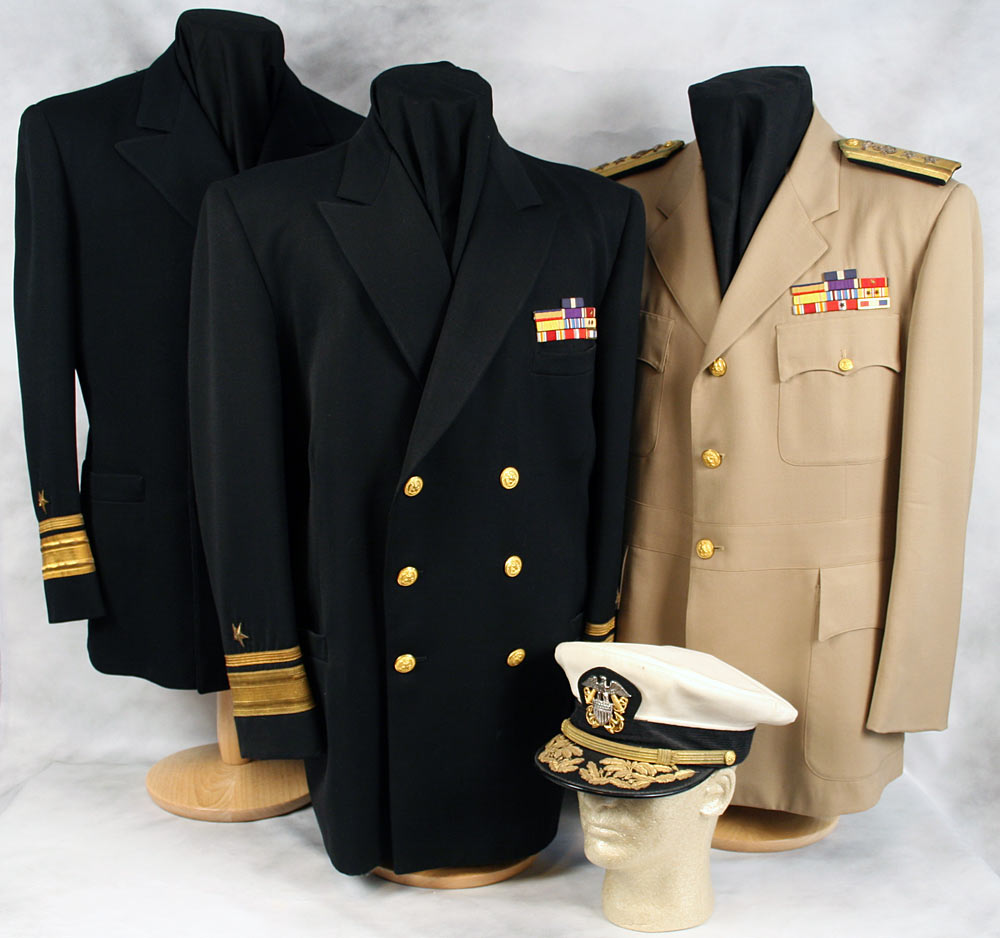
Post-World War II Khaki uniform jacketm dress blues and combination cover, worn by Navy Cross recipient, Admiral Robert Copeland (image source: ForValor.com/Dave Schwind)

This World War I – era U.S. Navy frock coat belonged to (then) Captain Frank Schoflield. Note the ornate bullion collar devices and the pre-WWI sewn-on ribbons (image source: USMilitariaForum.com/Dave Schwind).

The shoulder sleeve insignia (SSI) for the 1st Marine Division. This patch is affixed to the left shoulder of a 1943-dated USMC uniform jacket.
Not everyone has the finances or the perfect timing to locate items from such legendary people. Some collectors seek uniforms that serve to illustrate a story or, perhaps to demonstrate the progression of uniform changes throughout history. In either case, high-dollar uniforms from well-known figures (of American history) would serve to highlight such a story line but are not necessarily needed pieces. For those who (with limited budgets) want to pursue something from a specific (i.e. monumental) period of military history, “settling” for uniforms from the common soldier, airman, sailor or Marine.
I am particularly interested in the history surrounding the Pacific Theater of Operations (PTO) when discussing or researching World War II. Being a Navy veteran and the grandson of a WWII PTO Navy veteran, my collection tends to be focused in this area. I’ve taken considerable interest specifically in the southern Solomon Islands and the battles (both on land and sea) that took place in the surrounding area. When many people think of this region, immediate thoughts of Guadalcanal and the saga of the First Marine Division’s legendary fight (and “abandonment” by the U.S. Navy following substantial vessel losses on August 8-9, 1942 near Savo Island). When a WWII USMC uniform from a 1st MarDiv veteran became available (at an affordable price), I didn’t hesitate to pull the trigger on a purchase.

In stark contrast to the two Navy legends’ uniforms above, this nameless jacket was from a humble PFC of the 1st MarDiv.

Everything about this jacket is superb. Not a single moth hole and all of the buttons are present.
As a research project – trying to determine the service and experiences of the original owner – it possesses next-to-nothing that would afford me a path to pursue. The only identifying marks in the uniform jacket were three initials, “G. E. M.” The odds that I could pinpoint a veteran in the 1st Marine Division with those three letters makes the challenge daunting, to say the least. At this point, I haven’t had the time or desire to begin such an endeavor leaving the uniform to simply fill a space within my collection. I am happy just to own this uniform with the idea that this private first class Marine possibly served in one or more of the notable battles alongside the his brothers in The Old Breed.

To locate the uniform label (which contains the contract and date data) as well as identification marks left by the original wearer, check the inside of the left sleeve.

Immediately beneath the uniform label, the initials “G. E. M.” could correspond with the original owner’s name. Locating this marine would be next to impossible.
Related Uniform Topics:
All images are the property of their respective owners or M. S. Hennessy unless otherwise noted. Photo source may or may not indicate the original owner / copyright holder of the image.
 The Veteran's Collection