Category Archives: Other Militaria
A Collection of Buildings with a Nice Lawn: A Large Piece of British Military History
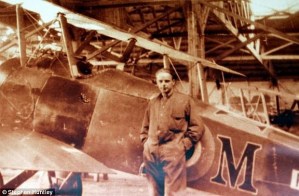
Established in 1914, the construction of the airfield was in response to Britain’s rapid advancement in combat aviation (source: Stow-Maries Aerodrome.com).
I continuously ask myself, “what constitutes militaria?” When I face a writer’s block moment while searching for a topic to present to you all, I find myself chasing my tail as I try to connect the subject to the military. This exercise and subsequent dance can be very revealing for me but it always brings me back to what energizes me about what I enjoy. Plainly speaking, this has always been about history for me.
Since I started writing about militaria for Collectors Quest in 2010 and carried on to my own blog, The Veteran’s Collection, I have tried to keep an open mind with regards to collecting items related to the military. Though I have spent a significant amount of time with naval-themed memorabilia, there have been several posts that delve into other service branches as well as pieces that are related to specific historic events. All of it has merely been a surface-scratching exercise.
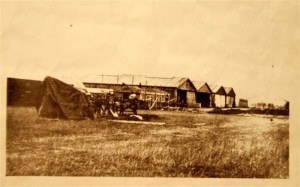
This vintage photo shows the original hangars at the Stow Maries Aerodrome in use during the war (source: StowMaries Aerodrome.com).
Several of my topics come out of left field (I would imagine that most of my regular readers know by now that I love baseball with posts like this and this, so sorry for the pun if you are new here) like today’s subject – which is uncharted territory for this blog and definitely a new area for me.
For most Americans, World War I is merely an event that happened a long time ago. Very few of my generation have a personal connection to anyone who served in this war. If one would take a drive through my local military installation (which was rapidly constructed to facilitate troop training for WWI), it would be difficult to find any reminders, such as buildings or other structures, that date back to the 1917-1918 time period. The needs of the ever-changing U.S. Army have kept the base in a constant state of adapting to the mission. What would it have been like to stroll the parade and drill grounds of a WWI military camp? Sadly, it is only imaginable by viewing vintage photos. Archaeologists are now involved in uncovering history as long-lost battlefields are discovered and unearthed.

Set in 79 acres with 22 buildings, the airfield site near Chelmsford, Essex, was used as a base for the 37th Squadron, Royal Flying Corps (source: Stow Maries Aerodrome.com).
What if you wanted to walk the grounds? What if you wanted to see the structures the way they were when they were in use during the war? For a (then, in 2012) cool $3.14M, one could have purchased a piece of historic real estate in Chelmsford, Essex (in the United Kingdom), complete with 22 buildings, a museum and a functional grass airfield. The Stow Maries Aerodrome, home of the 37th Squadron, Royal Flying Corps was constructed in 1914 to train and equip British aviators in the defense of London during the Great War.
-
- WWI reenactors exchange war stories at the Stow Maries Aerodrome (source: Daily Mail).
-
- Reenactors in full, period uniform, walk the grounds of the Stow Maries Aerodrome (source: Daily Mail).
Granted, it would be an amazing experience to own such a piece of history, but the maintenance of century-old, hastily built facilities would require considerable financial resources. Regardless of the cost to own and operate the facility, it would be amazing to host reenactments and vintage aircraft fly-ins. Imagine hearing the sound of 2 Rolls Royce Eagle II, inline V-12s of a Handley Page heavy bomber firing up for a flight.
If this property were to return to the market, to whom would I make the check to?
WWI Aero Trophies: Aviation Artifacts of Aero-Warriors
Archaeologists could agree that in some form or fashion, militaria collecting has been around seemingly since men have gone to war. Though the concept may not have been seen as collecting, at a base level, man has maintained combat-related artifacts to remind him of battles won or brothers-in-arms that were lost. Not only has man sought to remember his warring past, he has long maintained the spoils of war by removing specific items of his vanquished opponent’s body as it laid on the field of battle.
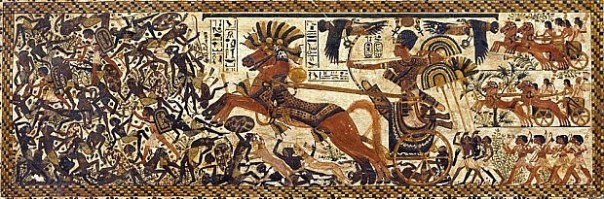
This illustration from Tut’s tomb shows the young pharaoh at war in his chariot (source: Araldo De Luca).
When some of the tombs of the ancient Egyptian pharaohs were opened and the contents were inspected and cataloged, among the gilded, religious and life-story items were weapons of war. Free from the worries and troubles of earth, anthropologists and Egyptologists surmised that the military pieces were objects that heralded the deceased king’s victories. Within the tomb of the most widely known pharaoh, King Tutankhamen (or “Tut”), among several depictions of him in combat, was his beautifully ornate chariot that would, more than likely, have been used in battle as documented throughout his burial treasure.
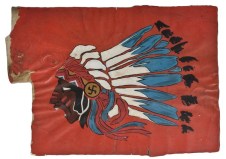
This section of fabric from an aircraft belonging to the famed Lafayette Escadrille (a squadron of American volunteers that flew for France during WWI) recently sold at auction (source: Cowan Auctions).
With the advancement of technology came the modern version of the chariot during World War I, the airplane. The warrior who battled from the seat of these modern machines, though differently equipped, had much in common with the brave Egyptian warriors of ancient times as they bravely piloted their flying machines into the center of the fray. In the quiet of the battle’s aftermath, these warriors would, if possible, descend from their winged chariots to survey their opponent’s wreckage, tearing or cutting strategic pieces of the fabric that contained specific identifying marks that helped to tell their story to both their squadron mates and to their leaders, providing quantifiable evidence of their success.
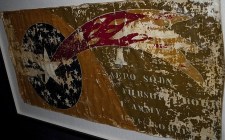
This section of cloth survives from an aircraft of the 1st Army Aero Pursuit Squadron and is preserved at the Museum of Flight in Seattle, Washington.
In many cases, these aerial opponents would extend honors that were reserved for their own fallen heroes, to their vanquished enemies. When Manfred von Richthofen, Rittmeister (Cavalry Captain) of the Luftstreitkräfte (Imperial German Army Air Service) was killed when his Fokker Dr1 was downed, members of the Royal Air Force took custody of his remains. To a casual observer viewing his funeral service, it would have appeared that a renowned British war hero was being laid to rest by the varying honors being rendered to this fallen adversary. However, the preservation of his aircraft was overlooked as souvenir hunters quickly rendered the nearly undamaged plane a shamble as they haphazardly dismantled it.
-

- A section of fabric from a German WWI aircraft with the letters ‘Fok’ could originate from a Fokker war plane. The colorful pattern was typical of the camouflage painting of the war (source: eBay image).
-
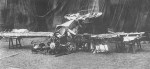
- Showing what was left of Richthofen’s heavily scavenged wrecked Dr 1.
-
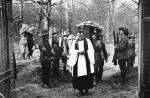
- The elaborate funeral procession for Manfred von Richthofen.
Bestowing honor upon fallen adversaries was practice by the Allies’ opponents, the Germans. Quentin Roosevelt, son of the former president and colonel (from the Spanish-American War’s Rough Riders), was an aviator in the 95th Aero Squadron, flying pursuit aircraft such as the French-made Nieuport 28. After he was shot down during an engagement, his flight of twelve was jumped by seven German fighter planes. Roosevelt received two fatal bullet wounds to his head and his aircraft rolled over and spiraled to the ground. His subsequent funeral service was witnessed by a fellow American soldier, Captain James E. Gee (110th Infantry) who had earlier been taken prisoner:
“In a hollow square about the open grave were assembled approximately one thousand German soldiers, standing stiffly in regular lines. They were dressed in field gray uniforms, wore steel helmets, and carried rifles. Near the grave was a smashed plane, and beside it was a small group of officers, one of whom was speaking to the men. I did not pass close enough to hear what he was saying; we were prisoners and did have the privilege of lingering, even for such an occasion as this. At the time, I did not know who was being buried, but the guards informed me later. The funeral certainly was elaborate. I was told afterward by Germans that they paid Lieutenant Roosevelt such honor not only because he was a gallant aviator, who died fighting bravely against odds, but because he was the son of Colonel Roosevelt whom they esteemed as one of the greatest Americans.”
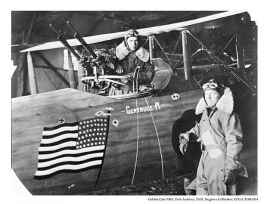
Similar to the flag shown on Pawn Stars, this WWI aircraft has a flag painted on the fuselage side.
Collecting aviation artifacts from WWI is becoming increasingly difficult as nearly a century has elapsed since the armistice was signed. The soft materials that made up the uniforms and accouterments are under continuous attack from the ravages of time and every manner of decay brought on by insects and ultraviolet exposure. Museums in the last few decades have done amazing work at acquiring the best examples of surviving armament and other hardware to provide their audiences with incredible displays and depictions of the Great War. When the rarest pieces arrive in the marketplace, the heavy competition ensues driving the prices skyward.
In an older episode of the History Channel’s Pawn Stars (the “Stick to Your Guns” episode), a woman enters the shop with a rolled-up section of old fabric emblazoned with a hand-painted representation of an American flag. She tells the story of her American serviceman relative darting over to a recently wrecked plane to cut out the flag, saving it from the ensuing fire resulting from the crash.
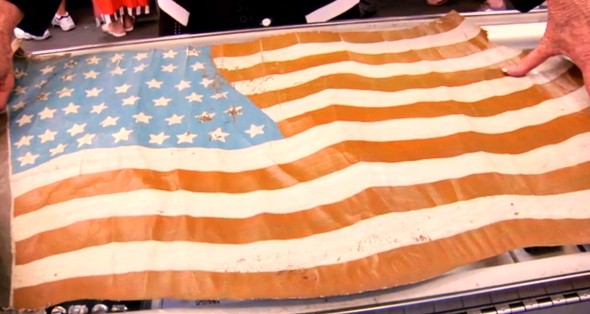
This flag looks to have been cut from a WWI American aircraft. The jury is still out as to whose aircraft it was removed from (source: Pawn Stars screen grab).
In providing the requested provenance, she presents a pair of World War I dog tags. One of the tags shows the information for her ancestor while the other contains the personal identification of Lieutenant Quentin Roosevelt. The Pawn Stars segment could easily lead viewers to draw the conclusion that the flag was removed from Roosevelt’s wreckage but that would be a considerable leap based upon the story of the retrieval and the burning aircraft. It would have been difficult for American to do so, considering that Roosevelt crashed behind enemy lines.
-
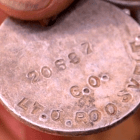
- Could this dogtag have come from Lt. Quentin Roosevelt? It was attached to another WWI tag belonging to the ancestor of the woman who brought in a hand-painted section of WWI airplane fabric to the Pawn Stars’ pawn shop (source: Pawn Stars screen grab).
-
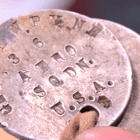
- The reverse side of George Pyne’s dog tag shows that he was a member of the 36th Aero Squadron (source: Pawn Stars screen grab).
-
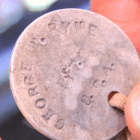
- WWI dog tag belonging to Private George W. Pyne – who is purported to have cut a section of aircraft fabric from a burning wreck – the fabric contains a hand-painted American flag (source: Pawn Stars screen grab).
Ultimately, the Pawn Stars folks purchased the flag (the price was well into four figures) despite the lack of connection to Roosevelt. In my opinion, they probably overpaid for the piece but considering that it was destined for Gold & Silver Pawn Shop owner Rick Harrison’s personal collection, it wasn’t too much of a reach.
Strange Gold: A Tooth with a Story
Merriam Webster defines History as:
1: tale, story
2a: a chronological record of significant events (as affecting a nation or institution) often including an explanation of their causes
b: a treatise presenting systematically related natural phenomena
c: an account of a patient’s medical background
d: an established record <a prisoner with a history of violence>3: a branch of knowledge that records and explains past events <medieval history>
4a: events that form the subject matter of a history
b: events of the past
c: one that is finished or done for <the winning streak was history> <you’re history>
d: previous treatment, handling, or experience (as of a metal)
The very first definition; the first word used to define history is quite interesting.
Tale:
1 obsolete : discourse, talk
2a : a series of events or facts told or presented : account
b (1) : a report of a private or confidential matter <dead men tell no tales> (2) : a libelous report or piece of gossip3a : a usually imaginative narrative of an event : story
b : an intentionally untrue report : falsehood <always preferred the tale to the truth — Sir Winston Churchill>
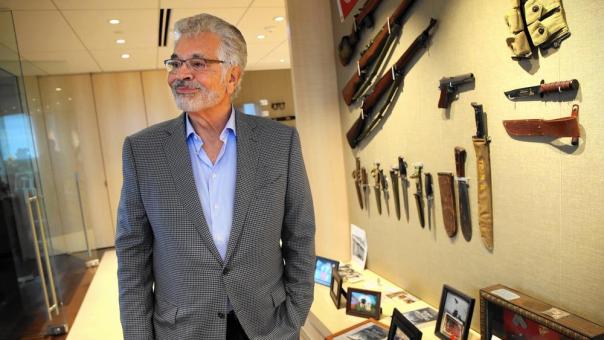
Dick Portillo, shown with military memorabilia in his Oak Brook office Sept, 8, 2016, is on a quest to determine whether a gold tooth discovered on a Pacific island is that of Japanese Cmdr. Isoroku Yamamoto, who planned the Pearl Harbor attack and who was shot down in 1943. (Terrence Antonio James / Chicago Tribune)
Collectors of militaria are always fascinated by the pieces within their collection. (They) we are constantly seeking the history of each object to:
- Connect collection items to historical persons
- Understand how the object is contextually associated to an event or events
- Increase intrinsic value in order to resale an item for profit and financial gain
The idea of being in possession of an item that was carried, worn or used during a significant historical event – a pivotal battle or a crippling defeat – helps to connect the person holding, touching or viewing the object to history in a very tactile manner. Many of my collector colleagues possess pieces in their collections that would be centerpieces of museums due to their historical significance. In my own collection, I have a few pieces that are connected to notable events but not on the order magnitude (of the subject) of this article.
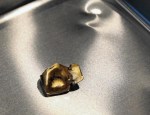
A gold tooth discovered on a Pacific island could be that of Japanese Cmdr. Isoroku Yamamoto. (Terrence Antonio James / Chicago Tribune)
I wrote an article where I focused on the odd and strange militaria items that would otherwise seem bizarre (for anyone to collect) to laymen and casual observers. Yesterday, I read a Chicago Tribune article (Does Chicago hot dog king have WWII Japanese admiral’s gold tooth? – by Ted Gregory, September 18, 2016) that captured my immediate attention. The compelling tale about a team of eight history enthusiasts that made their way to Papua New Guinea, trekked through the dense jungle to Admiral Yamamoto’s plane crash site and by chance, located a gold-encased tooth in the well-picked-over Mitsubishi G4M “Betty” attack bomber. This story seemed to dovetail quite nicely into what I discussed in my previous article – that a tooth from a deceased “enemy” hero certainly fits my idea of a militaria collection oddity.
-
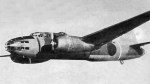
- The Mitsubishi G4M “Betty” bomber.
-

- The fuselage of the Imperial Japanese Navy bomber aircraft that was carrying Admiral Yamamoto.
-

- Part of the wreckage of Yamamoto’s IJN “Betty” aircraft.
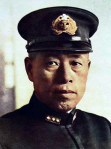
Admiral Isoroku Yamamoto (
To be in the possession of the tooth of a long-dead Japanese “god-like” hero from World War II would be exciting yet somewhat morbid. However, I am rather skeptical as to the potential of the item that was recovered at the crash would be Yamamoto’s (there were eleven men aboard this aircraft) yet I agree that the possibility does exist. There are conflicting reports as to the status of the Admiral’s body when discovered: Early documents (from the IJN doctor who examined the deceased Admiral) mention only a chest-area gunshot wound and that his body was otherwise intact. It was mentioned that other than the obvious mortal wound, Yamamoto appeared to be sleeping, still buckled into his seat, clutching his katana. Subsequent reports mention a substantial gunshot wound to his jaw (which could have dislodged the tooth in question).
The man who is in possession of the tooth, Dick Portillo (if you have never eaten at the restaurants that he founded and recently sold, you are missing out), who purchased the tooth from the owners if the crash site, is hopeful to be able to successfully extract and match the DNA of the tooth to the Admiral in order to authenticate his claim. I question the willingness of the Japanese government and Yamamoto’s decedents to participate in Portillo’s efforts, and if they do, what their motivation would be.
Until any authentication of the tooth is completed, the tooth resides in the collection of Dick Portillo along with what appears to be a wonderful selection of arms (as is visibly displayed on his office wall). If validated, Portillo said that he will give the tooth to the Japanese government, most likely to be repatriated (perhaps to be part of the Isoroku Yamamto Memorial Museum collection). I wonder what will become of the tooth if there is no cooperation or if it proves to be from another passenger of the Betty? Will it remain a part of his collection – a piece of history with two stories (Portillo’s and the Japanese passenger)?
References:
- Pacific Wrecks: G4M Model 11, Betty (manufacture #2656, Tail # T1-323)
- Operation Vengeance
- Video: Yamamoto’s Wreck Site
- Aces Against Japan: The American Aces Speak
- Lightning Strike: The Secret Mission to Kill Admiral Yamamoto and Avenge Pearl Harbor
- The Fleet at Flood Tide: America at Total War in the Pacific, 1944-1945
Naval Heritage Commemorated in Silver
When you have a specific area of collecting interest; a focus that keeps your eyes peeled for items that are beyond the realm of the obvious, you will eventually discover the oddities or atypical pieces that you wouldn’t have intentionally sought out. Collecting can be fun when these discoveries surface, prompting you to act quickly in order to secure the piece for your collection.
Since I started collecting militaria, I have progress from a somewhat broad stance; being very unfocused and undiscriminating about what I would acquire. Lacking in direction can be problematic in that your collection grows in such a manner that you have glaring vacancies that would have otherwise helped to convey the story that you want to tell with your collection. For example, one area (of militaria collecting) that has piqued my interest baseball within the armed forces (uniforms, equipment, photographs, ephemera). Because I remain diligent in keeping my attention on this particular sport, I have abstained from allowing myself to be distracted by other sports-related areas. I have passed on several very impressive pieces that are football-oriented and would be great for a military-sports themed collection. However, these items would have detracted from focus while diverting funds away from another piece that would have been a perfect fit.
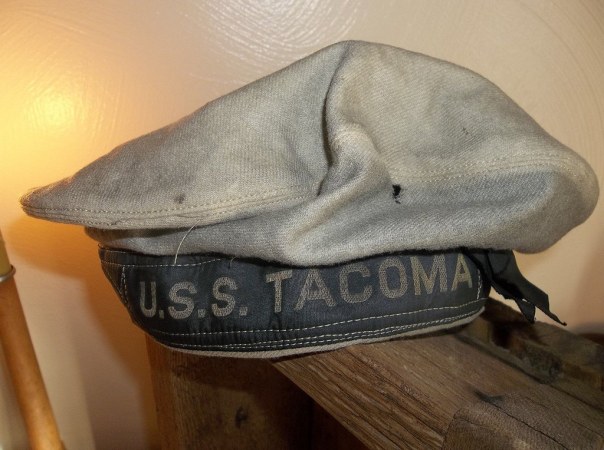
While this pre-WWI flat hat is in rough condition (very faded, misshaped, mothed and shoddy stitching over the ship tally), it is still highly sought after due to the scarcity of the tally. The Tacoma was lost on Blanquilla Reef near Vera Cruz, Mexico following an accidental grounding in 1924. Four of her crew were killed, including her commanding officer, Captain Herbert Sparrow. (Image source: eBay)
Being geographically-centered on my home region, I have been seeking out naval militaria that relates to my home state. Again, what I have been interested in are pieces that have ties to any installation, operation, event, person and, in particular, naval vessels named for cities and geographic features located within my home state. This mini quest has yielded some interesting artifacts that are predominately of the ephemera and antique photographic variety. Two of the most recent pieces (that are not paper or pictures) are not artifacts derived from the ships or the men who served aboard (having a flat hat with a ship’s tally are like gold) but are, instead, commemorative items that may have been presented to crew members.
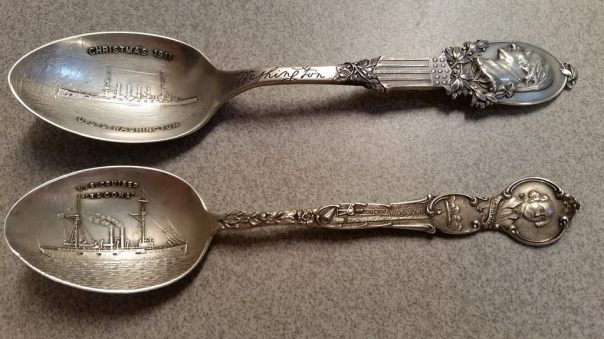
Two sterling silver commemorative spoons (top: USS Washington ACR-11. Bottom: USS Tacoma Cruiser No. 18)
I am not at all interested in collecting souvenir spoons but I made an exception for these two examples from historic ships.
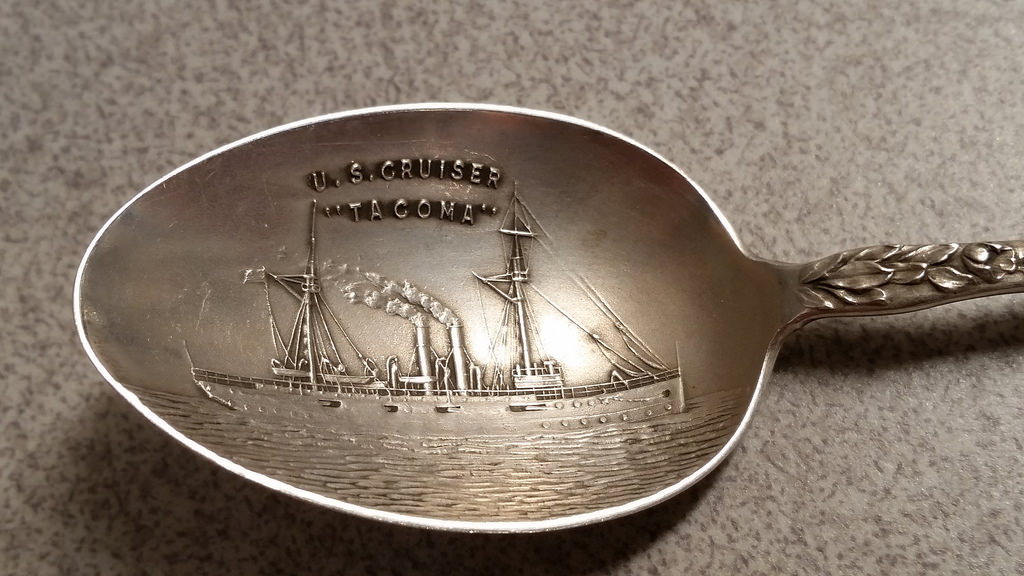
The inside of the bowl has a very detailed depiction of the cruiser. The reverse of the spoon is engraved with “1907, Helen.”
The first spoon that I found a few years ago was in an online auction. The ornate design combined with the silver content made it easier to pull the trigger on purchasing. That it was from a ship with a great history and was named form my hometown made the purchase a no-brainer. The USS Tacoma (Cruiser No. 18) is not only a veteran of five World War One convoys, she also escorted the (then) recently discovered remains of Revolutionary War naval hero, John Paul Jones to the United States from France.
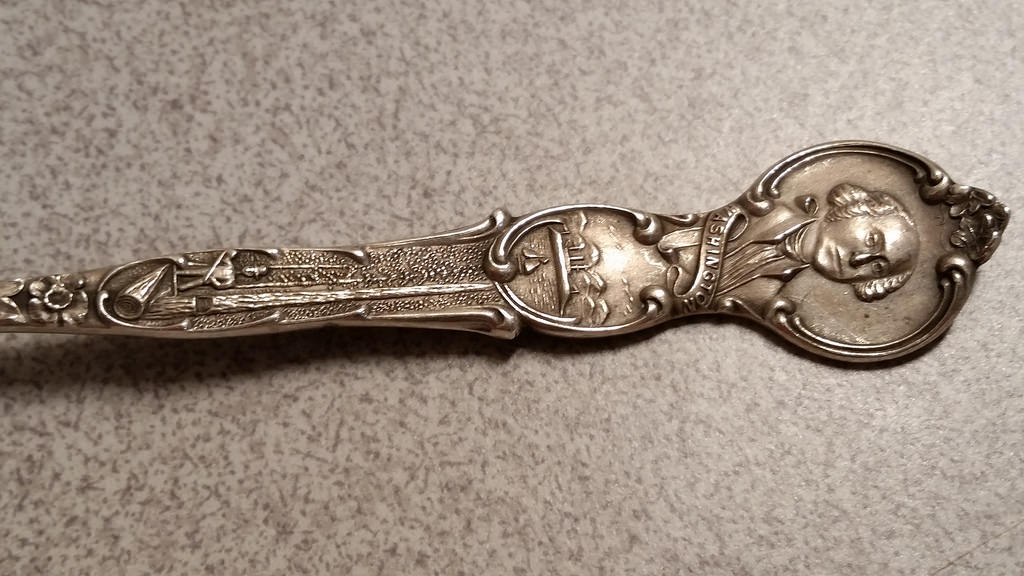
The USS Tacoma spoon is far more ornately decorated with fine details – embellishments of various aspects of Washington State and the city of Tacoma.
The second spoon in my collection arrived just a few days ago – again, purchased from a seller in an online auction. This spoon, slightly longer and more broad than the USS Tacoma example, commemorates the Armored Cruiser, USS Washington (ACR-11). This spoon, along with the relief of the ship (in the spoon’s bowl) has “Christmas 1911” imprinted, indicating that the spoon may have been given to crew members for that year’s holiday. By 1916, the USS Washington was reclassified and renamed USS Seattle. She went on to serve as a flagship during Atlantic convoy operations during WWI. After the war, the Seattle would be relegated to training duties and then as a receiving ship before being scrapped during WWII.
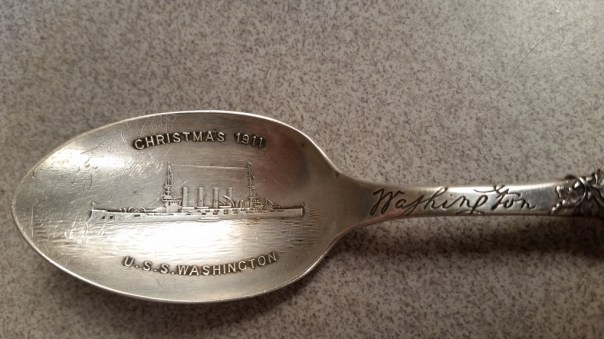
The armored cruiser, USS Washington is beautifully captured in relief in the spoon’s bowl along with the details commemorating Christmas of 1911.
I have had no success in my research attempts regarding either of these pieces beyond what is imprinted on either one. For now, I am content with having them as artistic enhancements to my collection.
Due Diligence – Researching My Ancestor’s Civil War Service
- (Note: This is third installment of a multi-part series covering my research and collecting project for one of my ancestors who was a veteran of the American Civil War)
- Part 1 – Shadow Boxing – Determining What to Source
- Part 2 – Civil War Shadow Box Acquisition: “Round” One is a Win
- Part 3 – Due Diligence – Researching My Ancestor’s Civil War Service
- Part 4 – Boxing My Ancestor’s Civil War Service
Like investing in the stock market, collecting is a long-term venture in which only those with considerable patience and persistence combined with a sense of timing in concert with knowledge, will succeed. Before one commits financial resources to a particular stock, the investor will have performed some manner of due diligence, researching the aspects of the company’s business plan, leadership, as well as short and long-term projections.
When attempting to assemble a display, group or particular theme of militaria, a collector must research the era, unit and veteran(s) before initiating research of the proper item(s) that would be suitable for the collection. One must also be familiar with what to avoid. In the area of Civil War militaria where “insignificant” pieces such as authentic uniform buttons can reach prices near (and sometimes in excess of) $100, collectors need to be aware of the fakes and reproductions.
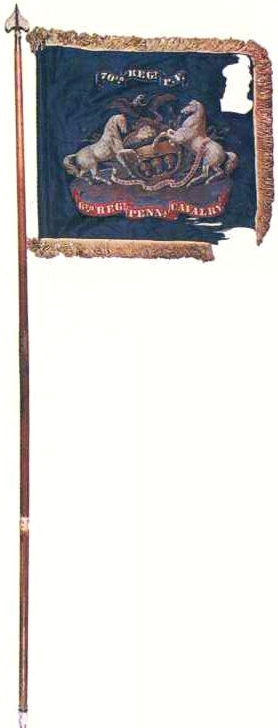
The second Regimental flag of the 6th Pennsylvania Cavalry – the unit in which my 3x great grandfather served (source: Pennsylvania capital Preservation Committee).
Recently, I posted about a commemorative display (to honor an ancestor) that I had begun to assemble. I was kicking off that project with the acquisition of a .52 caliber Sharps Carbine bullet that was discovered at the battlefield of Malvern Hill in Henrico County, Virginia. During my (previous) genealogical research, I discovered that my great, great, great grandfather had served in the 6th Pennsylvania Cavalry during the Civil War. Seeking to honor one of my direct ancestors, I decided to create a shadow box to perpetuate the memory his sacrifice and service during one of the most terrible wars in our nation’s history.
Early on in my research, I discovered that my ancestor, Corporal Jarius Heilig, had been discharged prior to the end of what should have been a three-year enlistment – the same as the balance of the 6th Pennsylvania Cavalry. In addition, I located pension documents (from the late 19th century) that showed my 3x great grandfather had been disabled due to something that had happened to him during the war. Armed with this information, I began to question how he had been disabled. Had he been wounded by an enemy round? Did he sustain shrapnel wounds from an exploding artillery shell? Eager to clearly document his military service as well as fuel my shadow box collecting efforts, I submitted a request to the National Archives to obtain Heilig’s Civil War service records.
Three weeks after submitting my request, a package was delivered to my mailbox and my excitement began to escalate. I ran into the house while tearing into the padded envelope. I rushed to my computer to insert the CD (I had the choice or paper copies or the disc) into my computer. Hoping that the documents (contained on the disc) would solve the mystery and provide me with specific details, I began to read through the scanned documents, most of which were muster sheets showing locations and dates.
Thirteen pages in all, the single, most important document was the discharge certificate which described the reason for his early release from duty (February, 1863). There it was, written in beautiful penmanship, the reality of war for my ancestor, a cavalry soldier. It seems that he sustained a disabling knee injury as the result of being kicked by a horse. Unable to perform his duties, he was released to return to his family. Unfortunately for Heilig, it seems that he suffered from the injury for the rest of his life.
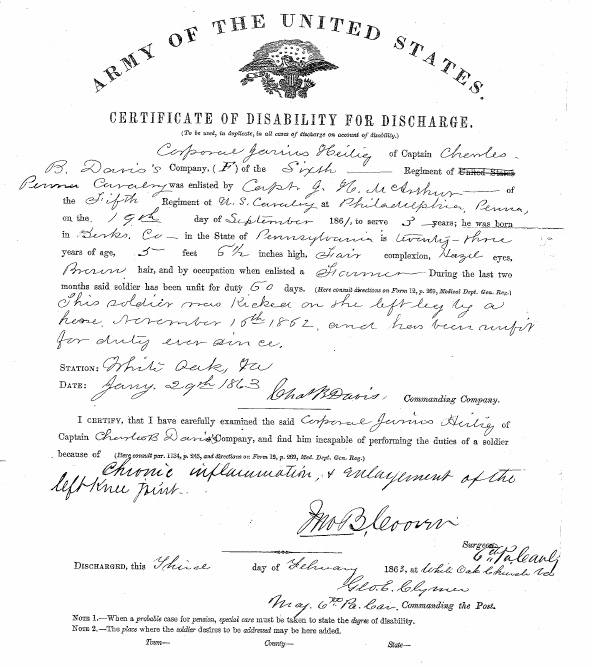
The scan of my 3x great grandfather’s Civil War discharge document showing his service and his wound.
Needless to say the discovery had been a letdown of sorts. I called my mother to relay my discovery and my disappointment to her. Surprisingly, my mother noted that there was also an absence of detail – information about the circumstances of the horse-kick incident. Had he fallen from his horse (on a cavalry charge in battle) and sustained the wound as a result of being dismounted in the fray?
Unfortunately, we will never know.
Continued:
- Part 4: – Boxing My Ancestor’s Civil War Service
 The Veteran's Collection