Category Archives: Shoulder Sleeve Insignia and Patches
Patrolling for Patches: Seeking the Hard-to-Find Embroidery
People start collecting military patches for a number of reasons. Considering that all branches of the United States armed forces use embroidered emblems for a multitude of purposes ranging from markings of rank and rating to unit and squadron insignia, invariably, there is something worthwhile to catapult even the non-militaria collector into pursuing the colorful cacophony of patch collecting.
My own participation in collecting patches originates with my own service in the navy. What began back in those days as an effort to adorn my utility and leather flight jackets with colorful representations of my ship and significant milestones (such as deployments) morphed into a quest to complete a shadow box that would properly represent my career in the service. Many of the patches I acquired while on active duty never found their way into use and were subsequently stashed away. It was not until I began to piece together items from my career that my patch collecting interest was ignited.
Like many other military patch collectors, I expanded my hunt from a narrow focus to a much more broad approach. As I pursued patches for another shadow box project (for a relative’s service) I started to see “deals” on random insignia that I just couldn’t live without. It wasn’t before long that I had a burgeoning gathering of embroidered goodies from World War II ranging from those from the US Marine Corps, US Army Air Corps/Forces and other ancillary US Army corps, division and regimental unit insignia*. For the sake of preserving what little storage space I had available, I throttled down and began to narrow my approach once again.
In keeping with my interest in naval history in concert with my passion for local history (where I was born and raised), my military patch collecting went in a new direction. In the past several years, I have slowly acquiring items associated with several of the ships with Pacific Northwest connections. Aside from readily available militaria associated with the USS Washington, USS Idaho and USS Oregon (all of which have stellar legacies of service). items from the ships named for the various cities (in those states) pose much more of a challenge to locate. When it comes to collecting patches, that difficulty is exponentially increased.

USS Tacoma (PG-92). (Source: U.S. Navy)
Of the many ships named for locations or features within Washington State, the four ships named for the City of Tacoma leave very little for a military patch collector to find, considering that only one of the four served in the era when navy ship patches came into use. The USS Tacoma (PG-92), a patrol gunboat of the Asheville class was actually built and commissioned in her namesake city, served for 12 years in the U.S. Navy from 1969 to 1981. Though her career was relatively brief, she spent her early years operating in the Pacific and in the waters surrounding Vietnam conducting patrol and surveillance operations, earning her two battle stars for her combat service.

This USS Tacoma (PG-92) ship’s crest shows an American Indian and “Tahoma” (Mt. Rainier) in the background. The motto, “Klahow Ya Kopachuck” translates from the Chinook language to “greetings for travelers upon the water.”
While searching for anything related to the USS Tacoma (all ships) last year, a patch from the PG-92 showed up in an online auction that really spoke to me. It was rather expensive and there were many bidders competing for the patch, so I let it go without participating. A few months later, another copy of the patch was listed prompting me to watch for bids. With no bids after a few days, I set my snipe with the understanding that someone is going to exceed my price. One bid came in seconds before the auction closed but my snipe hit at the very last second which resulted in successful outcome for me (winning the auction). It wasn’t until it arrived that I saw the ink-stamp mark on the back. It might be a bit of a detractor, but it certainly isn’t a deal breaker for this vintage 1970s-era patch. However, the patch I received most recently gives me pause.
The second USS Tacoma patch looked fantastic when viewed online even with the staining. The flag-theme evokes memories of 1975-76 and the celebration of the bicentennial of the signing of the Declaration of Independence. On the blue canton, the “PG” encircled by the stars (there are only 10 rather than 13) refers to the hull classification of the ship. Besides the incorrect count of stars, the backing material and the construction of the embroidered edge lead me to believe that this patch was made in Asia. The staining seems as though it was added to the patch to give it some aging.

This USS Tacoma patch seems to be a recently manufactured item. I have my doubts as to it being an original mid-1970s era creation.
Another indication of (what I believe to be) the Spirit of 92 patch’s recent manufacture is that it smelled new. I opened the mailing pouch and the scent of new fabric (rather than a musty odor) wafted out which seems quite strange for an old patch.
Regardless of the veracity of the age, both patches are excellent additions to my meager collection.
*Related patch-collecting articles by this author:
- Collecting U.S. Navy Uniform Ship Identifiers
- Collecting Olympics, Militaria-Style!
- Forecasting Patchy Skies: Sew-on Naval Aviation Heraldry
- US Marine Corps Uniform: Shoulder Sleeve Insignia Introduction
- USMC Patch Rarities and Scarcities – What to Look For
- Theater-Made Militaria
Discerning Birds: U.S. Navy Rating Badges from WWI to WWII
Patch collecting is one of the most affordable aspects of militaria collecting and can be a highly rewarding venture to delve into the history and variations that are available. I am, by no means a serious collector of patches opting instead to be selective about the embroidered and colorful pieces of uniform history.
While the overwhelming majority of militaria collectors who have interests in patch collecting are primarily focused on United States Army unit and rank insignia, a smaller portion of us enjoy the eclectic realm of U.S. Navy enlisted rank insignia and the very colorful and meaningful progression of their designs through the ages. That historical progression along with all of its nuances is enough to fill a book (see U.S. Navy Rating Badges, Specialty Marks & Distinguishing Marks 1885-1982
, by John A. Stacey) so with today’s article, I am instead zeroing in on a specific design from a seemingly specific era.

In the modern US Navy, rating badges are consistent in appearance and wear. From the design elements (eagle, specialty mark and chevrons) to the materials they are constructed from, they are all consistent. While this concept places emphasis on the uniformity of appearance and the unit-mindset (that all crew members work together as a single entity), it does restrict the ability for sailors to express and exhibit a measure of individuality and personal pride in their uniform appearance. The current rating insignia (in my opinion) have a rather sterile and sanitized appearance as they are all manufactured by a single source using one design pattern for each and every piece that is made. However, in previous years, sailors had much more freedom to instill their own spices into their uniforms.
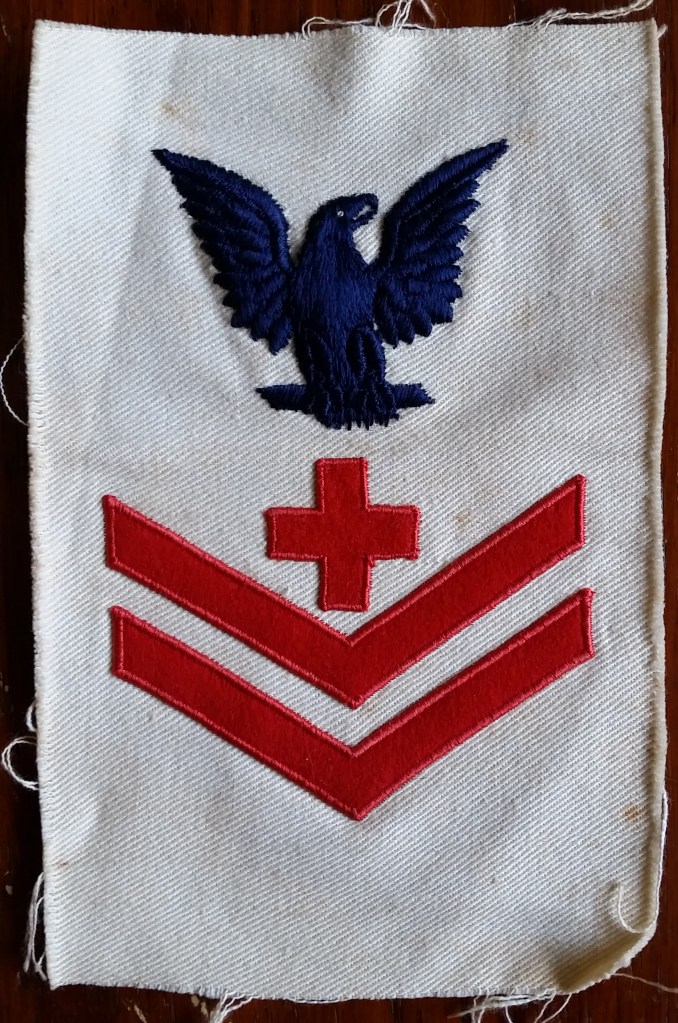
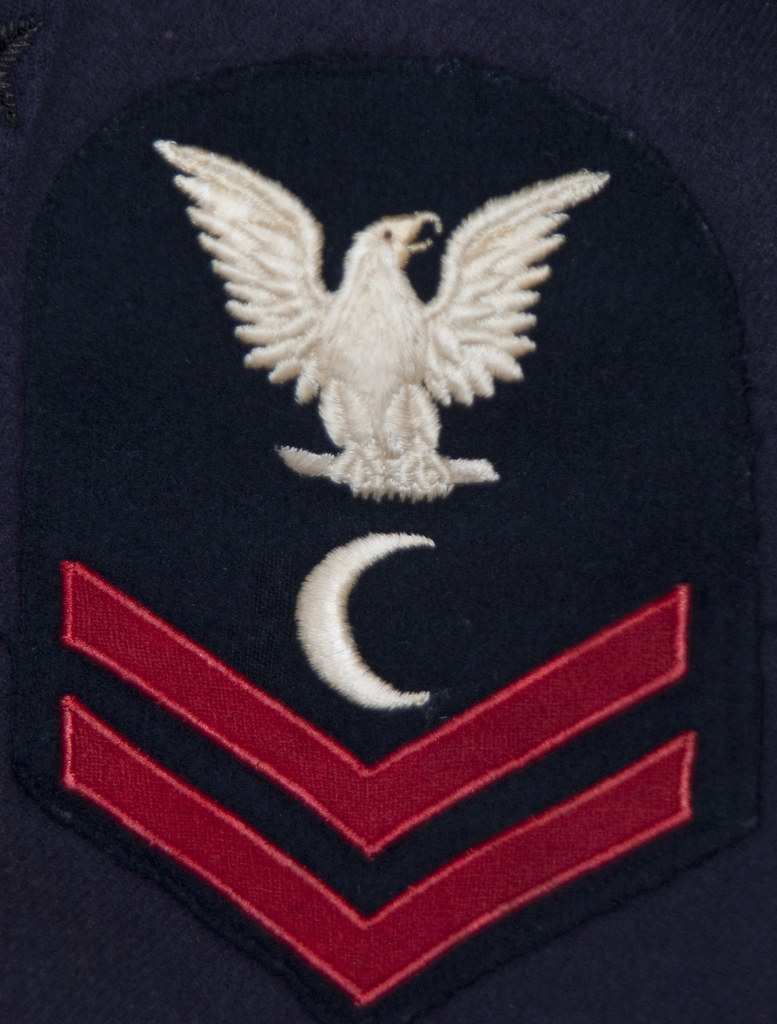
Rating badge collectors might focus their approach from casting a wide net (collecting everything that comes their way) to obtaining every single variety of a specific rating over the course of its existence. I find my collecting efforts to be even more specific as I seek only a handful of specialties (Radarman, Radioman, Ship’s Cook and Pharmacist’s Mate along with a few others) from varied eras (WWI-WWII) on select uniform choices (such as dress blues, whites or khakis). Though my choice of eras might seem rather specific, a closer look at the uniform regulations and the changes imposed during that time-frame reveals that the design of the ratings experienced several iterations.
“All petty officers shall wear on the outer garment a rating-badge, consisting of a spread eagle placed above a class chevron. In the interior angle of the chevron, under the eagle, the specialty mark of the wearer shall be placed. The badge shall be worn on the outer side of the right or left sleeve, half way between the shoulder and elbow. Petty officers of the starboard watch will wear the badge on the right arm; those of the port watch on the left arm.” – Regulations Governing the Uniform of Commissioned Officers, Warrant Officers, and Enlisted Men of the United States 1886
Dating back to 1886, the design (as cited in the uniform regulations) of the eagle called for its wings to be spread. The eagle’s head also now faced toward its left shoulder (having previously faced to the right) and would do so until 1941 when regulations then called for the head to point to the wearer’s front (regardless of the sleeve it was to be worn…more on that later).
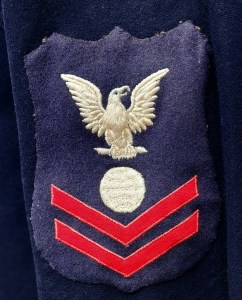
Prior to 1913, ships’ crews were divided into two watchstanding sections and were designated with terms that corresponded with the left (port) and right (starboard) sides of the ship which dictated which sleeve the sections’ petty officers would wear their rating badges. From 1913 onward, all petty officers whose specialties were in the Seaman Branch (such as Boatswain’s Mate, Coxswain, Gunner’s Mate, Turret Captain and Quartermaster) were right-arm ratings while all others in the Artificer Branch and Engine Room Force wore theirs on the left sleeve. What can make this confusing for new collectors is finding a rating badge (such as an electrician’s mate) with the eagle pointing toward the left shoulder. Finding this rating badge affixed to a dress blue jumper with it worn on the left sleeve would narrow the time-period down (given the embroidered pattern of the eagle had the eagle sitting completely vertical on the perch) to the inter-war era.
Though the practice started years before, during World War I, rating badges were customized by petty officers by trimming them from the traditional 5-sided shape (rectangle with the bottom corners cut away to form a point) to a contoured pattern. Fancy hand-stitching was then applied to follow the new shape (many times in the shape of a shield) providing a highly stylized appearance on the jumper shirt. As with many fads, this adornment fell out of practice as the Navy specified the pentagon shape and dimensions in a specific change (dated 16 February 1933) to the Navy Uniform Regulations.
In 1941, the Navy changed the eagle to point to the wearer’s front specifying that all non-Seaman Branch petty officers’ ratings have the eagle look to its right shoulder (rather than to the left). The Seaman Branch (which had grown to include Fire Controlman, Mineman, Signalman, Torpedoman’s Mate). In addition to the eagle’s direction, the eagle no longer included the slouched (or leaning) posture that had existed for decades.Though there is no provenance to support this, the idea for these changes was to have the eagle positioned for fighting (facing the enemy and standing tall).


During WWII, a handful of manufacturers provided dates embroidered directly onto the back of rating badges which nullifies the need for researching.


I have merely scratched the surface with these details. There are pages-worth of content that I could provide that provides additional points and factors to pay attention to in order to discern the date of manufacture (and use) of the rating badge, such as:
- Cloth material (enlisted dress blue material changed between WWI and WWII, additional materials were introduced for WWII, etc.)
- Rating Specialties (ratings were added/retired throughout this period)
In 1947, the most significant change that indicated a desire for uniform appearance across enlisted ranks was moving all ratings to the left arm with the eagle facing forward. The distinction between the Seaman Branch and all other petty officers was removed.
In the months to come, I will be providing additional articles in order to provide you with more insight into collecting rating badges and how to discern them without having to rely on others.
—-
All images are the property of their respective owners or The Veteran’s Collection unless otherwise noted. Photo source may or may not indicate the original owner / copyright holder of the image.
Recreation or Reorder: Are These Patches Reproductions?
Collecting patches is a significant and one of the oldest segments of the militaria hobby. So much so that they established an organization (in the late 1930s), the American Society of Military Insignia Collectors (ASMIC), to better facilitate the exchange of the patches and metal insignia from American military uniforms.
Prior to World War I, U.S. armed forces were only adorned with rank insignia (chevron patches on sleeves for enlisted, collar devices and epaulettes for officers). During the Great War, units began affixing cloth insignia to their shoulders to provide visual indication of the unit to which they were assigned. This practice quickly spread as the war began winding down late in 1918 and became widely adopted, not only in the U.S. Army, but also the Marine Corps and some Naval personnel.
See:
In World War II, the expansion of incorporating insignia to identify aircraft squadrons and other smaller units (versus Army regiments or divisions). These “logos” were caricatures that embodied general traits of the unit, their mission or even their founding leadership. Aircraft squadron insignia from WWII, naval squadrons in particular, are some of the rarest and most sought-after patches by collectors.
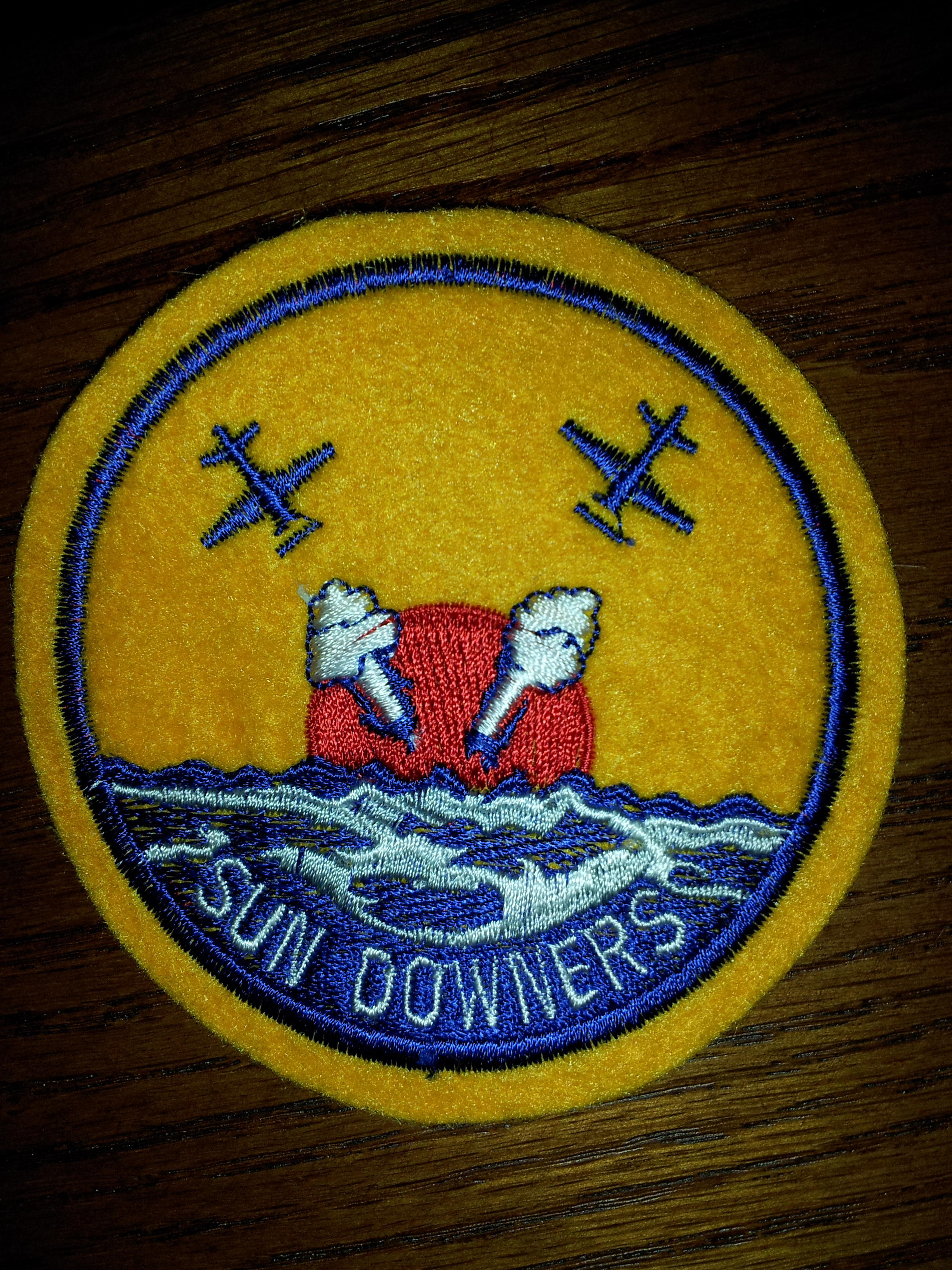
This flannel VF-111 Sundowners patch resembles that of an original WWII version (of VF-11), though it seems to be a modern representation.
See:
By the 1980s, unit insignia had become quite commonplace across all units within the US armed forces branches. In the Navy, as each new ship was placed into service, accompanying them was an officially designed and approved unit crest that bore visual representations of the ship’s name. Subsequently, the ships’ stores (where the crew members buy personal supplies, snacks and ship-branded merchandise) would offer, for sale, fully-embroidered patches of the crest.
When a ship is decommissioned (put out of service), the logos and subsequent merchandise cease to be available (other than in secondary markets). Nostalgic veterans and collectors not wanting to wait for one or two of the ship’s patches to become available in online auctions are left with scant few options. This was a situation that I recently had the joy of resolving for my former shipmates who were more than two decades removed from serving aboard our ship, the cruiser USS Vincennes.
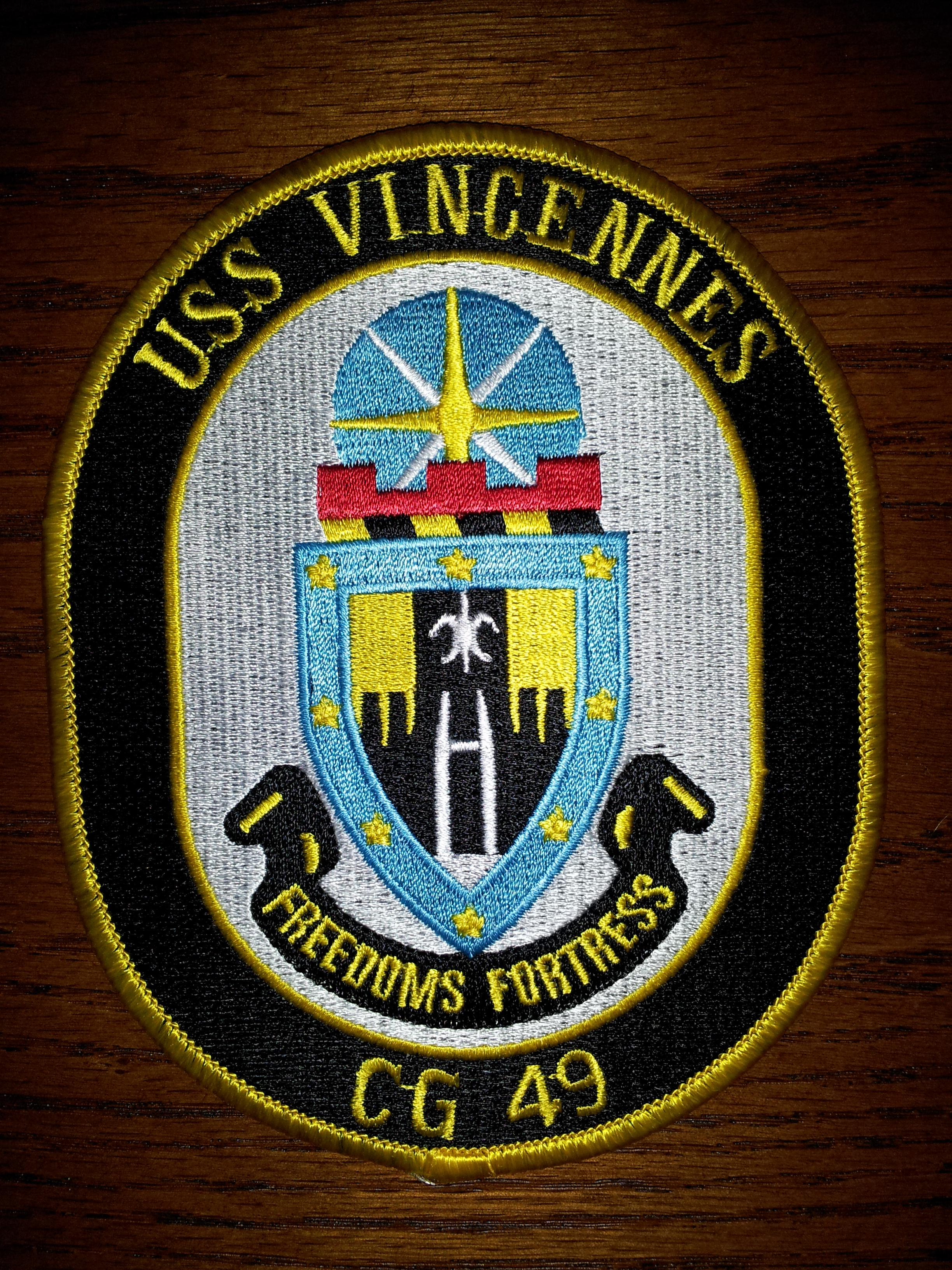
This terrible patch lacks the detail of the crest. Everything is wrong with this example from the coloring to the design elements and lettering. It is just awful.
In the past few years, an Asian-made (poor) representation of the patch was being sold infrequently in online auctions. This patch a terrible facsimile of the original as it lacked all the detail of the ship’s crest. The seller had that audacity to charge more than $10 (plus shipping) for this poor quality example. A few of my shipmates, desperate to fill a void in their ship memorabilia collection, ponied up the funds and buying the pathetic patches.
Recognizing an opportunity to remedy this issue, I went through a lengthy process of locating the original manufacturer and soliciting bids based upon the original patch design. Today, I was happy to report to my shipmates that the patches would be in their hands within a few days. The shipment of authentic ship crest insignia had arrived.
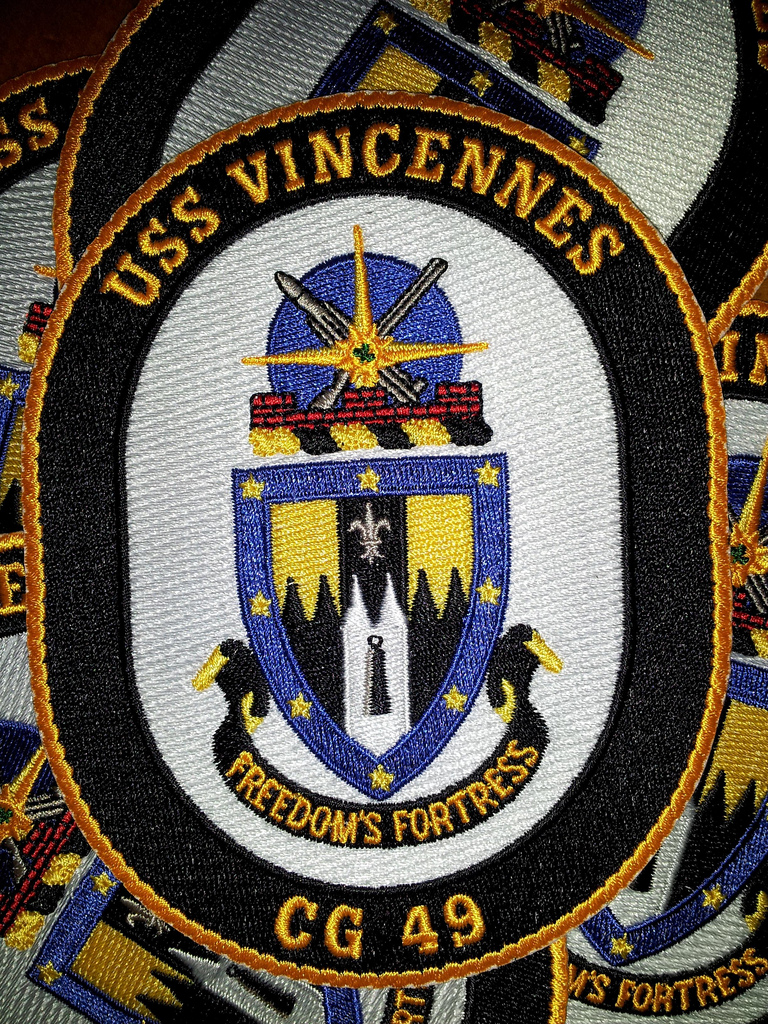
The new patch seems to be at least the same as the original, if not an improvement.
Some of you might be asking, “Is this really militaria if you’re just having it made?” I can attest that though these are newly manufactured, the patches are no different from those made (by the same manufacturer, by the way) two and a half decades ago.
 The Veteran's Collection