Category Archives: Rates and Ranks
Cryptology and the Battle of Midway – Emergence of a New Weapon of Warfare

Here the Japanese carrier Hiryu dodges bombs dropped from Midway-based B-17 bombers (source: U.S. Navy).
The outcome of the war hung in the balance. Until now, the United States Navy’s operational effectiveness and readiness was in peril as they had suffered significant losses of the scant few carriers they had in the Pacific Fleet prior to December 7, 1941. The Imperial Japanese naval forces had extended their effective reach to include most of the Western and Southern Pacific and were seeking overall dominance of the ocean. The only opponent standing in their way was the severely weakened U.S. Navy.
In the previous six months, the American Navy had sustained strategic losses near Java with the sinking of the USS Houston (CA-30) in the Sunda Strait and the USS Edsall (DD-219) in the Java Sea, both on March 1.
Looking to put the Japanese on the defensive, American forces struck the Japanese homeland launching a (psychologically) successful air strike from the deck of the USS Hornet, causing Japanese military leadership to start holding back naval and aviation resources as a home guard, reducing the offensive capabilities. Japan had to consider herself vulnerable for the first time in the war while trying to convince citizens otherwise.
Continuing to press their imperial expansion Southward (Australia’s natural resources the ultimate goal), the Japanese, preparing for an offensive to take Port Moresby, New Guinea, began mobilizing the Combined Fleet in the South Pacific. American Forces countered and pressed for an attack which resulted in what came to be known as the Battle of the Coral Sea. While this battle was a strategic win for the United States, it was substantially painful losing the carrier Lexington and sustaining substantial damage to the Yorktown, leaving the Navy with just two serviceable flat tops, Enterprise and Hornet.
The Coral Sea battle demonstrated that over-the-horizon naval warfare had emerged as the new tactic of fighting on the high seas, as the carrier and carrier-based aircraft surpassed the battleship as the premier naval weapon.
While the Navy was very public in developing aviation during the 1920s, behind the scenes, a new, invisible weapon was being explored. Radio communication was in its infancy following World War I and adversarial forces were just beginning to understand the capabilities of sending instantaneous messages over long distances. Simultaneously, opponents were learning how to intercept, decipher and counter these messages giving rise to encryption and cryptology.
Officially launched in July of 1922, Office of Chief Of Naval Operations, 20th Division of the Office of Naval Communications, G Section, Communications Security (or simply, OP-20-G) was formed for the mission of intercepting, decrypting and analyzing naval communications from the navies of (what would become) the Axis powers: Japan, Germany and Italy. By 1928, the Navy had formalized a training program that would provide instruction in reading Japanese Morse code communications transmitted in Kana (Japanese script) at the Navy Department building in Washington D.C. in Room 2646, located on the top floor. The nearly 150 officers and enlisted men who completed the program would come to be known as the “On The Roof Gang” (OTRG).
By 1942, Naval Cryptology was beginning to emerge as a viable tool in discerning the Japanese intentions. The Navy was beginning to leverage the intelligence gathered by the now seasoned cryptanalysts which ultimately was used to halt the Japanese Port Moresby offensive and the ensuing Coral Sea battle. However, the Japanese changed their JN-25 codes leaving the naval intelligence staff at Fleet Radio Unit Pacific (known as Station HYPO), headed by LCDR Joe Rochefort, scrambling to analyze the continuously increasing Japanese radio traffic.
A breakthrough in deciphering the communication came after analysts, having seen considerable traffic regarding objective “AF,” suggested that the Japanese were targeting the navy base at the Midway Atoll, 1,300 miles Northwest of Hawaii. While this information would eventually prove to be
invaluable and was ultimately responsible for placing Pacific Fleet assets in position to deal a crushing blow to the Japanese Navy, it was anything but an absolute, hardened fact. Fleet Admiral Chester Nimitz risked the balance of his carriers (Hornet, Enterprise and Yorktown) sending them to lie in wait of the assumed impending attack.
The attack came and the prepared American forces struck back, inflicting heavy damage to IJN forces, sinking four carriers, one cruiser and eliminating 250 aircraft along with experienced aviators. Though the war would be waged for another three years, the Japanese were never again on the offensive and would be continuously retracting forces toward their homeland. The tide had been turned.
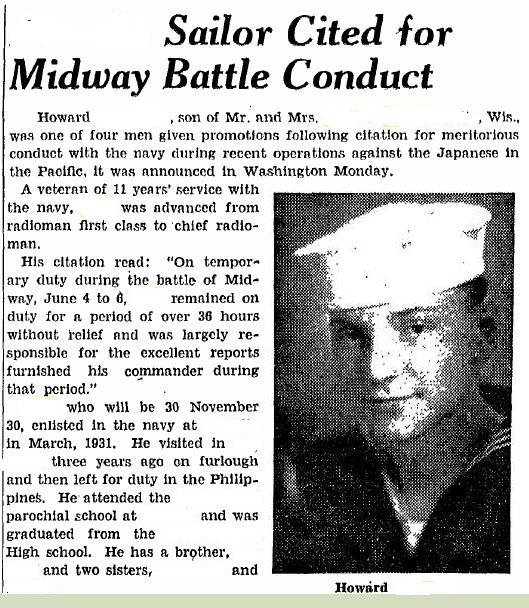
News clipping citing my uncle’s meritorious promotion (one of four sailors advanced for actions during the Midway battle) by Admiral Spruance .
On this 74th anniversary of the Battle of Midway, I wanted to spotlight a different aspect of the history of the battle, the emergence of cryptology as a strategic weapon, and share some of my own collection of that focuses on one of the original OTRG alumni, my uncle Howard.
Howard enlisted as an Apprentice Seaman in the Navy in 1932 (despite what the news clipping states) and proceed to serve in the fleet while working toward a radioman rating. He would be rated as a radioman 3/c in 1934 and accept an assignment to cryptological training at OP-20-G. In the years leading up to the war, he was assigned to Station HYPO and Station CAST (at the Cavite Navy Yard, Philippine Islands) transferring days before the Japanese raid.
-
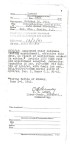
- This service record entry shows that my uncle was meritoriously promoted for his actions during the Midway battle.
-
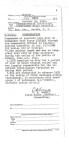
- This service record entry was also the text of my uncle’s commendation from Admiral Fletcher (acting CTF-16) for providing continuous intel.
Assigned to Station HYPO in early 1942, he would work closely with Commander Rochefort in code-breaking efforts and is purported (in my family circle) to have sent the transmission to Midway personnel to send un-coded messages about their inoperable evaporators, which ultimately led to the confirmation of Midway as Objective “AF.” He would be assigned to the Admiral’s staff (Admiral Raymond Spruance, who was substituting for Halsey at the time) aboard the Enterprise and would receive a meritorious promotion from the admiral as the result of his round-the-clock duties for the duration of the 4-day battle.
-
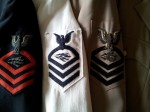
- Though these jackets never belonged to my uncle, they represent his achievement – reward for his dedication to duty during the most pivotal naval battle of WWII.
-
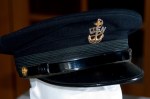
- Assembled from serviceable components from a few WWII navy hats, my dress blue chief radioman display is closer to being complete with this cover.
By 1944, my uncle had been promoted to the officer ranks, making Chief Radio Electrician, warrant officer-1. A career spent in naval cryptology, my uncle retired after 30 years of service.
Regretfully, none of my uncle’s uniforms, decorations or medals survives to this day. Neither of his sons inherited anything from their father’s more than 30 years of naval service. In my decision to honor him, I requested a copy of Uncle Howard’s service record (as thick as an encyclopedia) and began to piece his military tenure together by gathering uniforms and other associated elements. My collection of assembled uniform items representing his career, while not yet complete, has been a long endeavor – dare I say, a labor of love?
Tracking U.S. Navy Specialties: The History of Radarmen
Many people collect U.S.Navy rating badges and many other folks collect ephemera. Still other collectors pursue metal insignia and uniform devices. But the question I have is, how many of them combine all three “genres” of militaria collecting into one, singular focus?
As a ten-year veteran of the U.S. Navy and an amateur military historian, I’ve researched a vast number of subjects ranging from basic minutia to emotionally gut-wrenching and personally significant stories with historical context that I find utterly fascinating. During my naval career, I performed my job without so much as a fleeting thought regarding the historical aspects of my chosen specialty. Navy enlisted men and women receive schooling and training to perform specific job functions to meet the needs of each unit or command. These ratings (similar to the Army’s Military Occupational Specialty or MOS) are denoted on each sailor’s sleeve insignia with a unique emblem symbolizing certain characteristics of that specialty.
My own rating, Operations Specialist, seemed to be (to me) quite ordinary and less historic as compared to traditional ratings such as boatswain’s mates, gunners mates and machinist mates. I was none too interested in discovering any of the historical aspects or the development of my rating beyond what was presented in my training manuals. Other than the basic historical narratives (also presented in the training manual) regarding the history of naval radar, I didn’t give it much thought. Despite this lack, I did manage to excel at my job and advance in a timely manner.

The foremast of the USS Washington (BB-56) showing the SG radar antennae on the foreward face of the tower. As documented in Muscant’s book, the placement of this unit was cause for a significant sector blindspot, leaving the ship vulnerable during the first Naval Battle of Guadalcanal in November of 1942 (U.S. Navy image).
What turned me onto the historical backstory of my rating was an insignificant story that I read about the installation of radar onto the USS Washington (BB-56) as told in the pages of Ivan Musicant’s 1986 book, Battleship at War: The Epic Story of the USS Washington. What was revealing to me was how radar was installed onto the ship and essentially turned over to untrained operators and technicians. In his book, Wahoo: The Patrols of America’s Most Famous World War II Submarine, Medal of Honor recipient Admiral Richard O’Kane made considerable mention of the submarine’s unreliable radar and the continuous need for the boat’s radiomen (the technicians and operators) to service the wonder-device. Both of these books planted a seed that my navy job had an important history that was berthed during World War II and developed into a key job function in today’s radar-reliant naval service.
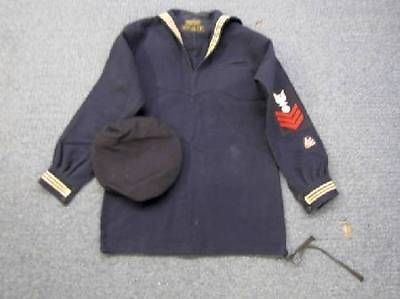
Radarmen can trace their beginnings to the Electrician’s Mate (EM) rating. This World War I era EM first class bears the distinguishing mark indicating that the sailor was a radio operator and technician. Shipboard radio technology was in its infancy at this time and in the ensuing decades, a specific rating would be created.
When I added the activity of collecting to my interests, I cultivated a new desire that prompted me into new research directions. One could say that when I was bitten by the rating badge-collecting bug, my interest was tempered by context. I focused on ratings that had connection to me such as my grand-uncle (post-WWI musician), grandfather (ship’s cook), brother-in-law (machinist’s mate), two uncles (radioman) and my own. Along with those rating badge pursuits, I picked up some of the more highly sought-after rates whose ranks were filled by more than their share of heroic blue jackets, such as hospitalmen, aviation radiomen. However, I found myself drawn to the historical aspects of my own rating, originally known as ‘Radarman’.
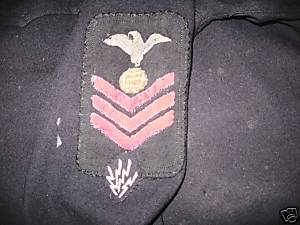
This EM/1c rating badge dating from the WWI time-frame shows the four electrical sparks of the radio operator/technician distinguishing mark affixed directly below the bottom chevron.
The Radarman rating (abbreviated as RdM) was officially established in 1943 after radar became more widely adopted aboard ships and submarines, and was at that time finding its way onto naval aircraft. The demand for highly skilled and trained operators and technicians prompted the Navy’s Bureau of Personnel to create a program to send qualified personnel to the fleet to better utilize the secret weapon. The rating badge that was subsequently created employed a borrowed feature from the radioman rating as it referenced the close connections to the communications technology. Also, many of the early Radarmen had previously served as Radiomen. The badge symbol used the electrical spark bolts (three rather than the four seen on the Radioman’s insignia) with an overlaid arrow indicating the directional detection aspects of the job, indicating the rating’s origins and the technology from radio.
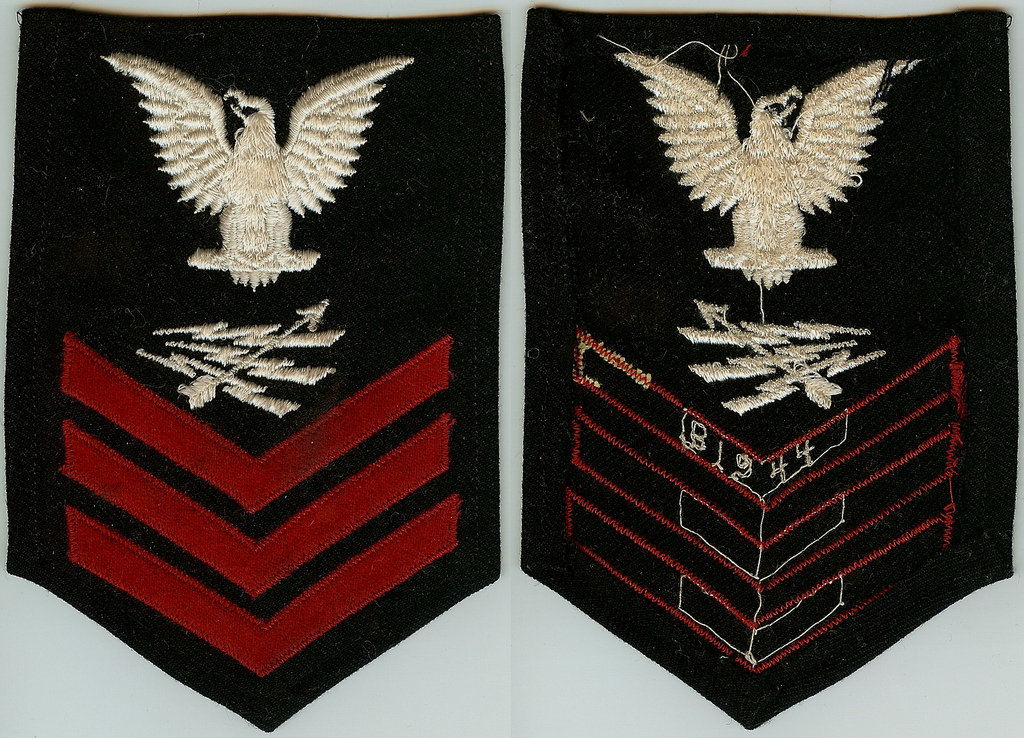
This Radarman first class rating badge is date-marked with “1944” embroidered on the reverse of the first chevron.
In 1946, the Navy updated the insignia, incorporating the oscillator symbol while carrying over the arrow insignia. In 1973, change impacted this rate once again as BUPERS split the rate, removing the technicians (rolling them into the electronics technician rate) and those who were skilled as Electronic Warfare (ESM, ECM and ECCM) specialists as EWs. Those who remained were re-designated as Operations Specialists (OS) yet the rating badge remained and continues at present.
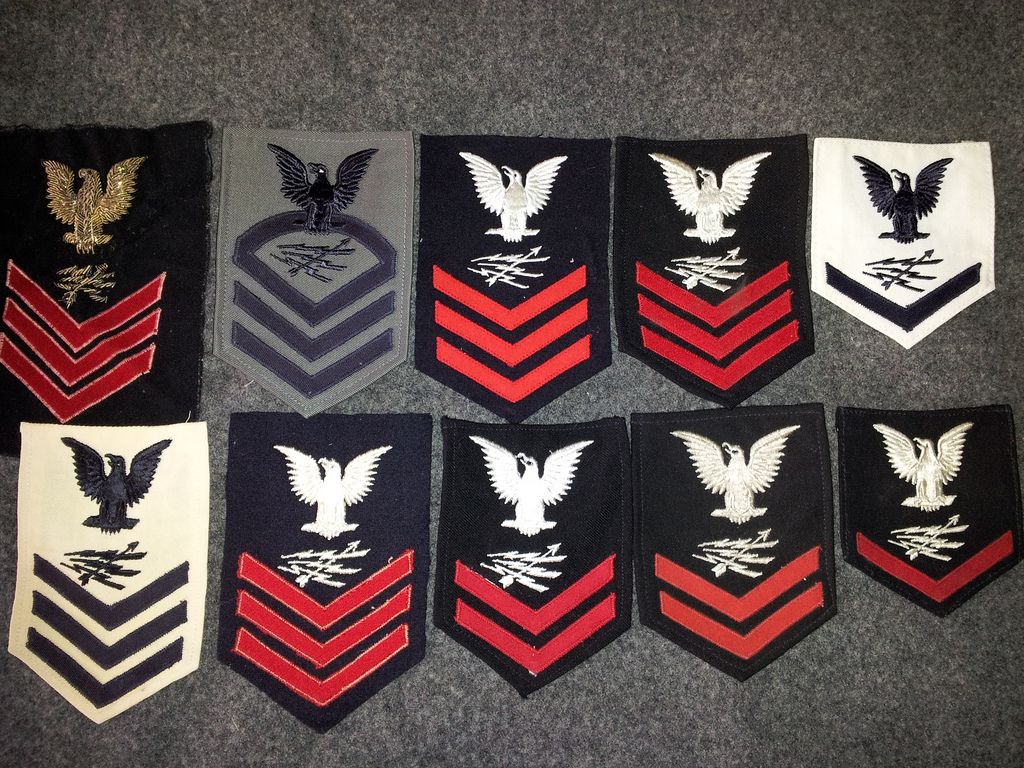
A selection of my Radarman rating badges. All are from during and immediately following the end of WWII.
My collection of OS militaria began with what remained from my time in the service: insignia that was never applied to my uniforms. I began to pursue badges from WWII and worked my way forward to the 1960s and 70s as I picked up some special bullion versions. I searched for insignia from the rating’s roots and then onto ephemera, such as rate training manuals from several eras. I have managed to save some of the tools of the trade in the area of navigation, such as compass and dividers, parallel rulers, and nautical charts. I am still seeking an OJ-194 NTDS (Naval Tactical Data System) console for my office (OK, perhaps this would be overkill).
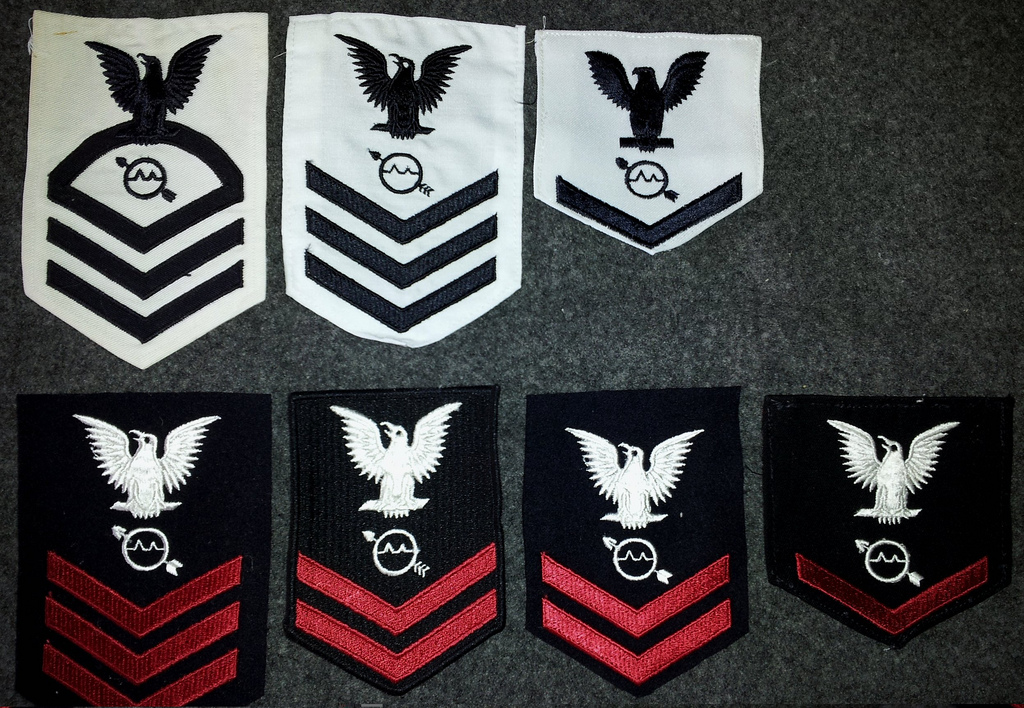
Following the war, the Navy broke away from the lightning bolts of the radioman rating and embraced the oscilloscope and maintained the arrow of the original badge, By the early 1970s, the rating was split out – segmenting the technicians into their own rating (Electronic Technicians or “ET”) and the electronic warfare operators (EW) into their own. Radarman was disbanded in favor of Operations Specialist.
I always keep my eyes open for anything that might augment this collection without breaking my budget or fill the floorspace in my home. At some point, I would like to assemble this collection in order to create a well-rounded display that is representative of this rating.
References:
Where to Look – Seeking Militaria in all the Right Places

Looking for a metal insignia device to fill a missing gap in your shadow box or a hole in your collection? This table had a decent array of insignia to choose from.
Military Records Research: Pay Attention to the Details
Genealogical research is funny. Overlooking the smallest, insignificant details can insert unintended road blocks into continuing down a valid pathway. With my family (which, I suppose isn’t too different from most families), there are so many branches of the tree to pursue which demands a lot of time spent down in the details. One little detail that I overlooked, kept me guessing on and off for over a year.
In July of 2012, I requested and obtained the WWI Canadian Expeditionary Forces (CEF) service records for my maternal grandmother’s father after making an Ancestry.com discovery of his military attestation record (his service was unknown to my family). Having served in the U.S. military, I am rather familiar with acronyms and terminology that is prevalent across multiple branches of the armed forces. In reviewing my great-grandfather’s CEF records, I began to realize that a fair amount of the documentation was difficult to discern, so much so that I found myself focusing more on the terms I did know and overlooking those that I was unfamiliar with.

Unfamiliar with the any of the Canadian military information, “Special Case” was very nebulous. Without an understanding of the references listed here, I was left guessing as to what this meant.
In examining the rather thin record, I found that my great-grandfather had been called up and was inducted on April 22, 1918 and was discharged on May 6, 1918 after just 15 days of service in the Canadian Army. The discharge certificate reads: “Discharge from the service by reason of ‘Special Case’ Authority Routine Order No. 180 dated 3-2-13. D.C.C. 11 M.D. 99-4-113-13.” This reason was found on several of the pages of his out-processing so from there, I made assumptions and ignored some of the other, more detailed data. I figured that he might have had a medical condition (note the “M.D.” in the above typed reason) or, perhaps there was a family hardship. Either way, he served slightly more than two weeks prior to being discharged.

The question: If he was drafted into the Army (CEF), then why is he wearing a maritime uniform?
A few years ago, my mother presented me with a box full of snapshots and photographs to scan (which I am slowly working on…when I have the time) in an effort to make them available to whoever in the family desires. One of the pictures caught my attention about the time I received my grandfather’s CEF records. The photo was a framed enlargement (from a snapshot) that showed my great-grandfather in a maritime uniform that was clearly Canadian (or British, even). My exposure to anything Canadian maritime was limited to lifting a few cans of Molson aboard a Canadian Destroyer in Pearl Harbor and riding the British Columbia Ferries to Vancouver Island. Translation: I know next-to-nil about Canadian uniforms (military or civil). Looking at my great-grandfather, I was left guessing.
The perplexing part of this story was that the uniform was maritime rather than Army (the CEF Army uniforms were very similar to the American Expeditionary Forces Army uniforms). Needless to say, I was entirely in the dark. Why was a two-week army veteran wearing a clearly non-army uniform? Since last year, the photo has been displayed on a table in our living room inspiring questions from family and guests as to the subject and the uniform in question.
In researching another relative who served in the CEF, I finally decided to reach out to experts to see if someone could enlighten me as my uninformed searches over the last year yielded zero positive results. On Tuesday of this week, I posted the images to a Canadian militaria collector’s forum and sent them to the Canadian Navy League. Today, I received word that the uniform is that of a Canadian naval petty officer first or second class. Thankful for the confirmation, I was still left guessing as to why my ancestor was wearing a navy uniform when he served in the army.

The cause of discharge as listed on this page that was deeper into the records documents was entirely overlooked. “To join R.N.C.V.R. was left hidden until today.
I scanned the Canadian Archives site to determine the next approach to see if I would be able to request records of my great-grandfather’s naval service (if they actually exist). None of the information stood out to me so I decided to take another peek at the CEF records that I already had. As I skimmed through each page, I kept seeing the same reference to the reason for discharge. A few pages deeper, something leapt off the page: “Cause of Discharge – to join R.N.C.V.R.” One simple Google search and I had it nailed. My great grandfather left the Army to join the Royal Naval Canadian Volunteer Reserve.
Armed with this information, I can now pursue (and hopefully be successful) my great grandfather’s naval reserve service records. Clearly he served long enough to advance to petty officer 2nd or 1st class in a short period of time. By October of 1922, my great grandfather and his bride emigrated to the United States and settled in what would become, my hometown. Less than ten years later, he would pass away leaving behind two young daughters and his widow. Any inkling of his wartime service was lost to the ages, leaving me to discover it more than 90 years later.
Chiefly Limited: Space for Uniforms is at a Premium

Always an attention-grabber, vintage silver-bullion chief petty officer rating badges are highly collectible due to their intricate designs and usage of silver thread.
There are many challenges and hurdles for collectors of militaria. Not unlike the difficulties other collectors face, militaria requires research, authentication and a healthy bank account in order to enable the afflicted with the tools to be successful in such endeavors. One of the most significant universal hurdles collectors face is the ever-increasing deficit of square footage needed for storing and displaying collections.
I am no different from any other collector in that space is at a premium when it comes to safely storing my militaria. Without the proper controls being set in place, I could easily displace my closet space needed for hanging my wardrobe in favor of a growing assortment of vintage military uniforms. What sort of proper control could bring to bear the appropriate amount of pause before pulling the trigger on a deal to acquire the next amazing uniform?
My collection, almost from my entry into militaria, has grown slowly due to my tempered approach, focusing on specific areas of interest. Within those areas, I incorporate a finer set of specificity that helps me to keep things under control. Like many U.S. naval collectors, I enjoy uniforms, rates, shoulder insignia, collar and cap devices and other assorted pieces. However, I tend to direct my attention to specific rates when it comes to uniforms and badges. Mostly, my naval uniform collecting focuses on rates that were held by members of my family.
Only one member of member of my family ever advanced through the enlisted ranks to don the rocker-topped chevron of a chief petty officer, so my collection of CPO uniforms is very limited.
On occasion, I might be tempted to acquire an item that falls outside of my parameters if it possesses other aspects that make it too good to pass up as was the case of my most recent acquisition.

This CPO jacket has it all…well almost. It is an 8-button, tailor-made dress blue, World War II-era jacket complete with a silver bullion chief machinist’s mate rating badge and custom sewn-on ribbons.
A few weeks ago, a chief’s uniform jacket and cap became available that was just too good to pass up. The dress blue coat was an older, tailored eight-button version indicating that it was made during (or prior to) World War II. Affixed above the left breast pocket were 2-⅓ rows of custom (sewn-on) ribbons which clearly showed the chief as having served during and after World War I up to (and probably through) World War II. On the left sleeve were six hash marks showing that the chief served for at least 24 years. I have an affinity for bullion rates or insignia and the chief machinist’s mate insignia on this coat was the icing on the cake that put me over the top to make the decision to pick it up.

Included with the CPO jacket was this WWII-era (wicker-framed) combination cap. The condition of the frame, visor and white cover are outstanding.
For many of us, researching veterans is a challenge and when we learn about the original owners (of military uniforms) were, there is a compulsion that pushes us to discover where the served and what they did during their time in uniform. When a uniform (that we acquire) is inscribed with a name, we are invariably driven to pursue the history in order to retain it with the item. Sadly, this jacket was unmarked which only meant that I wouldn’t have any further work once I had my hands on it.

The custom ribbon rack, though a little deformed from years of use and storage is complete with a Navy Good Conduct, WWI Victory, China Service, American Defense, American Campaign, Asiatic Pacific Campaign (with three campaign stars) and WWII Victory.
After it arrived, I was even more impressed by the condition of the jacket and the silver bullion of the rate badge. One glance at the Good Conduct ribbon (sans devices) and the six red hash marks, it is very apparent that the chief had some challenges with Navy regulations, staying out of trouble (when on liberty) or simply clashed with his superiors. I am sure his disciplinary record would make for an entertaining read. It is unfortunate that the jacket is forever decoupled from the sailor’s service. Regardless, the uniform is a great addition to my collection.
Now…where to put it?
 The Veteran's Collection