Category Archives: Insignia and Devices
Militaria Bargains to be Had
Taking inventory of my previous blog postings, I find an overwhelming majority of the topics I’ve covered were focused primarily on militaria that is not in the reachable price range for most collectors. These posts have been in stark contrast to my most recent acquisitions, most of which are well below $50 (including shipping costs).
In reality, most of the collectors I know are adept at rooting out the bargains at yard sales, surplus and antique stores, and various other sources. Rather than shelling out loads of cash to online sellers and taking on shipping costs, these collectors locate some very hard-to-find, and in some cases, high dollar items and groups for a pittance.
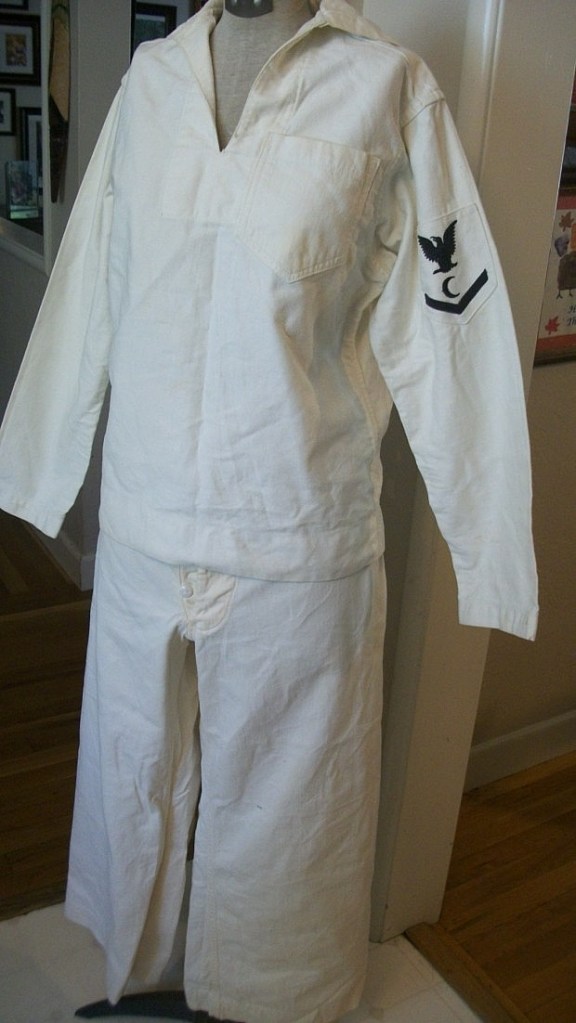
For the bargain-basement price of less than $11.00, I was able to acquire this fantastic tailor-made set of WWII-era dress whites with the precise rating badge I had been seeking (source: eBay image).
One of my collector colleagues spends time sniffing around in bargain bins in a surplus store near one of the local military installations, and once managed to locate a few sets of experimental U.S. Army combat uniform sets for less than $10.00. Subsequently, he discovered that the uniforms were rare and highly sought-after by collectors of current and modern uniforms, and could easily yield several hundred dollars per shirt and trouser set. His find was merely a matter of timing and experience as he recognized that these uniforms had subtle differences from their standard-issue counterparts.
This jumper has a nice, crisp appearance for being 70+ years old. The crow of a Ship’s Cook 3/c is exactly what I was looking for (source: eBay image).
For some collectors (like me), possessing and budgeting for the time to spend scouring these locations for the bargains is difficult. We compensate by letting our browsers and searches do the legwork in discovering the low-priced pieces. Knowledge and experience also comes into play for us as we are able to discover items in listings that are incorrectly identified or tagged by the sellers helping to keep the buyer competition to a minimum.
Still, timing and patience are ultimately the key in finding low-priced pieces. I have been in search of a set of World War II vintage U.S. Navy enlisted dress whites with a ship’s cook third class (SC 3/c) rate and rating badge in good condition for a few years. Such a set would be a great augmentation for the uniform display I am assembling to honor my grandfather. While I already have two sets of his actual dress blues (one is standard Navy-issue and the other is his tailor-made, custom set), his whites were lost to time. When an online auction for a set of whites meeting my criteria was listed for less than $10.00, I began watching, hoping that the competition would be low and I set my snipe bid.
Just a few days ago, I received notice that the auction closed and my bid had been accepted as the winner. I acquired the uniform for less than $11.00 (plus a few bucks more for shipping costs) and I was amazed that this set would sell for such a low price when so many had sold for well over $50.00 during my previous years of searching.
The bargains are still out there for those who arm themselves with knowledge and patience and have a little bit of luck.
Collecting U.S. Navy Uniform Ship Identifiers
To suggest that veterans and sailors of the U.S. Navy have an affinity for their ships would be a gross understatement. It would be difficult to stroll through any public area without seeing a former navy man sporting a ball cap with a USS ___ (fill in the blank). I have seen men well into their late 80s proudly carrying the name of the ship they served aboard, emblazoned across their foreheads, and as I write this, I am proudly wearing one of my own ship’s ball caps.
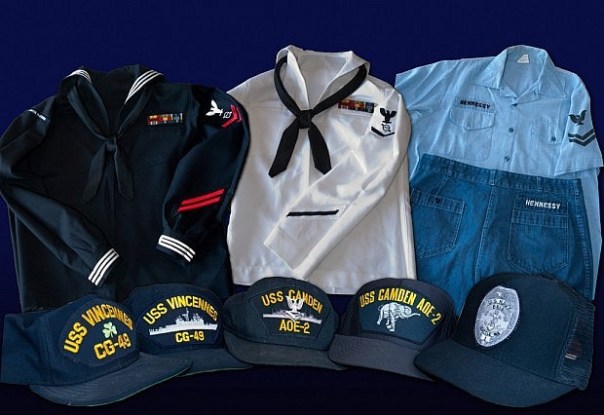
This collection of uniforms shows four official shipboard navy ball caps, authorized for wear with utility uniforms (such as the now-defunct dungaree set on the right). Note the UIM patch on the right sleeve of the dress blue uniform jumper.
Navy ship ball caps are quite commonplace. Many of them have icons or symbols between the name and the hull number designator that make them unique to each specific ship. Some of the symbology might have nothing to do with the ship, instead being representative of the commanding officer or the crew. As far as I’ve determined, ships’ crews have been wearing the named caps aboard ship with utility (dungarees) since the 1960s.
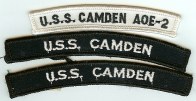
The two blue UIM patches shown are authorized by Navy uniform regulations. The white patch on top is a manufacturing mistake and unauthorized for wear on a Navy uniform. The USS Camden was decommissioned in 2005.
When sailors are required to be in their dress uniforms, identifying them with their associated commands is a requirement… especially when sailors behave like, well… sailors in foreign ports. Present-day enlisted dress uniforms must be adorned with a unit identification mark (UIM) patch on the top of the shoulder of the right sleeve. This regulation has been in place since the late 1950s to early 1960s.
Prior to World War II, the navy employed a much more stylish format of placing the command names on their enlisted sailors. From the 1830s to 1960, sailors wore with their dress blue uniforms a flat hat, affectionately known as the “Donald Duck” hat. Though it wasn’t authorized, in the latter half of the nineteenth century, sailors began to adorn their flat hats with a ribbon (known as a tally) that displayed the name of the ship and was worn only when on liberty (“shore leave” to you landlubbers). Eventually, the tallies were acknowledged within the naval uniform regulations, standardizing their appearance and wear.
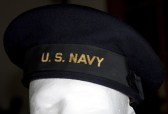
This post-1941 Navy flat hat shows the generic “U.S. Navy” tally. By 1960, these hats were retired from use.
By 1941 and the outbreak of World War II, the rapid expansion of the fleets with many new ships under construction and being delivered to the fleet, the Navy did away with the ship names on the tallies, standardizing all with “U.S. Navy” (there is some speculation that secrecy of ship movement drove the Navy to implement this change).
Ship-named tallies are highly sought after by collectors, pushing prices on some of the more famous (or infamous) vessels well into the ranges of multiple-hundreds of dollars, regardless of condition. Due to the delicate nature of the tallies’ materials and the exposure to the harsh marine environment, the gold threads of the lettering tend to darken and tarnish. The ribbon construction was typically made with silk, so they don’t stand up well to the ravages of several decades of time and storage.
In the last few years, a tally showed up in an online auction for the first time in more than a decade of staking out anything related to USS Vincennes. Until then, I had my doubts as to whether the Navy had allowed the pre-war crew to have the tallies for their ship, even though it was in service since February of 1937, four years before they were abolished. Sadly, the selling price surpassed my maximum bid by nearly triple the amount.
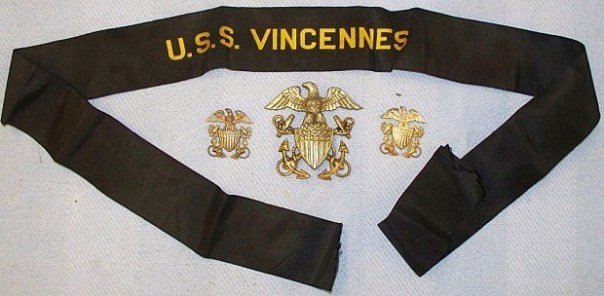
This image shows the rare USS Vincennes tally (along with some officer cap devices), which was sold this week at auction for more than $150 (source: eBay image).
Hopefully, I don’t have to wait as long until I see another USS Vincennes tally!
Shadow Boxing – Determining What to Source
(Note: This is first installment of a multi-part series covering my research and collecting project for one of my ancestors who was a veteran of the American Civil War)
- Part 1 – Shadow Boxing – Determining What to Source
- Part 2 – Civil War Shadow Box Acquisition: “Round” One is a Win
- Part 3 – Due Diligence – Researching My Ancestor’s Civil War Service
- Part 4 – Boxing My Ancestor’s Civil War Service
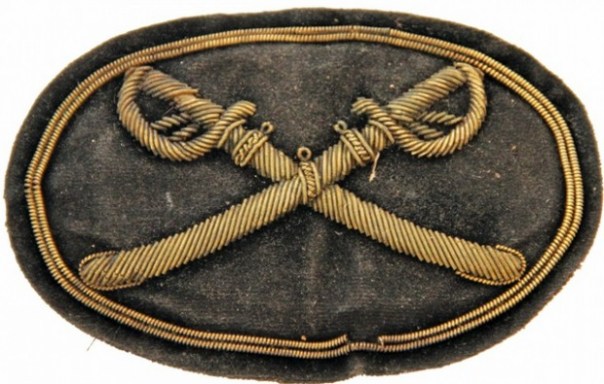
This bullion cavalry hat device could be a centerpiece and would look fantastic in a display (source: Mosby & Co Auctions).
For me, collecting militaria has been an adventure of discovery as I learn about who my ancestors were and what they did to contribute to the freedoms we enjoy in the United States today. As I’ve stated in earlier posts, my research began with the receipt of a handful of militaria pieces and documents for two of my relatives who served in the armed forces.
Rather than simply store the items in a drawer or closet, I wanted to assemble and display them in such a manner as to succinctly describe their service. Seeking to be as complete as possible, I sent for the service records for both relatives so that I could fill in the gaps if there were any missing decorations from what I already possessed. Upon receipt of the records from the National Archives, I noted that there were, in fact, several awards that had never been issued to either veteran (many service members were discharged at the war’s end war, prior to the decorations being created and subsequently awarded) and promptly obtained the missing pieces.
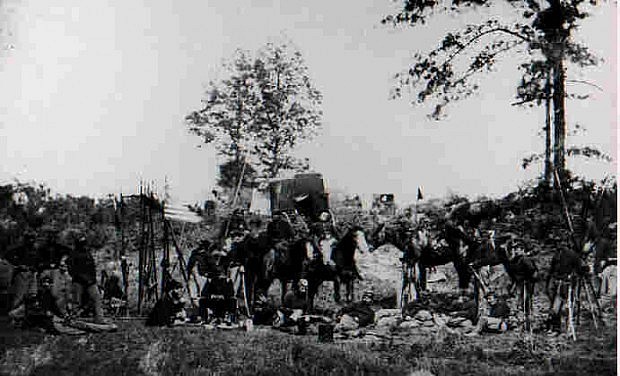
“I” Company of the famed Rush’s Lancers. Photos like these go a long way to help collectors seek the correct items for accurate displays. This photo was taken by Matthew Brady.
In preparation for assembling the displays, I was motivated to learn all that I could about others in my family who served. As I worked on my family tree, I began to discover that there were veterans at each successive prior generation who served. From Vietnam to the Korean War, World War II to the Great War, from the Civil War, the war of 1812 and finally, the American Revolution, I had ancestors who were participants. At the prompting of my kids’ inquiries as to who these people were and what they did, I embarked on a mission to assemble tangible representations of some of the notable veterans in the family lineage – including uniform items, awards and decorations.
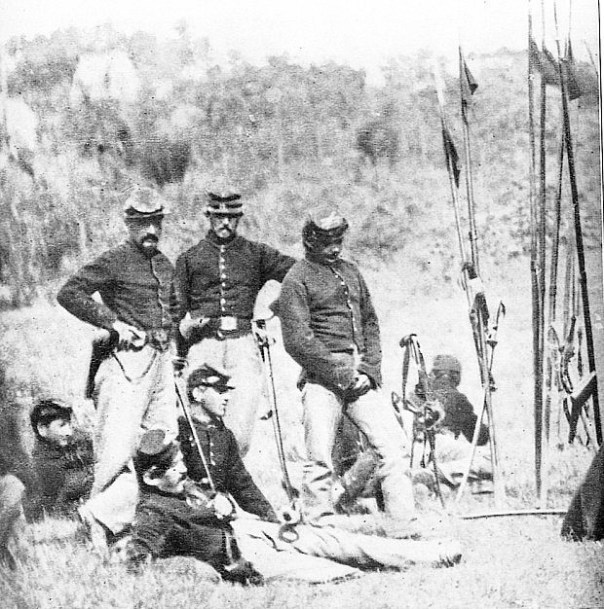
This is a close-up of the soldiers of “I” Company, 6th Pennsylvania Cavalry. This photo was taken by Matthew Brady and clearly shows the weapon that gave the regiment its name.
Limited by financial resources and storage space, I needed to choose the people from our past that would garner my collecting attention. This decision has caused me to abstain from purchasing some of the items that I found very interesting but couldn’t justify acquiring (after all, I am not creating a museum in my home).
One of my recent discoveries is that veteran in my lineage served in a storied regiment during the American Civil War. This unit, the 6th Pennsylvania Cavalry, was the only mounted regiment to be equipped with the lance as their primary weapon, prompting the nickname of Rush’s Lancers (Lt. Colonel Richard Rush was the unit’s first commanding officer). While my ancestor wasn’t a distinguished veteran or officer (he was a corporal), he did serve throughout most of the war, participating in many of the bloodiest battles.
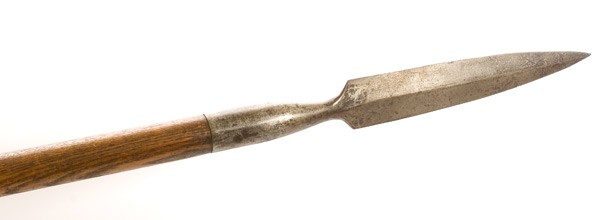
Well out of my budget, this Lance (that was carried by a member of Rankin’s Michigan Lancers) during the Civil War, sold at auction for $1,440.00 a few years ago (Source: Cowan’s Auctions).
I have been pondering how I could create a tasteful, yet small assembly of items that would provide an authentic and visually appealing display. What sort of items are available (and that I could afford) that would fit into a smaller shadow box and tell a story of my great, great, great grandfather’s service?
-
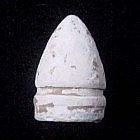
- This .44-caliber slug could provide a measure of authenticity in my display as the revolver was carried by the troops or the 6th Penna. Cav. If this were dug from one of the Lancer’s battlefield sites, it would only make the display that much more personal (Source: Civil War Outpost).
-
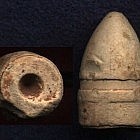
- After shedding the lances, the 6th Penna Cavalry switched to the more traditional weapons. This .52 caliber Sharps carbine round would be appropriate for my display (source: Greg’s Relics).
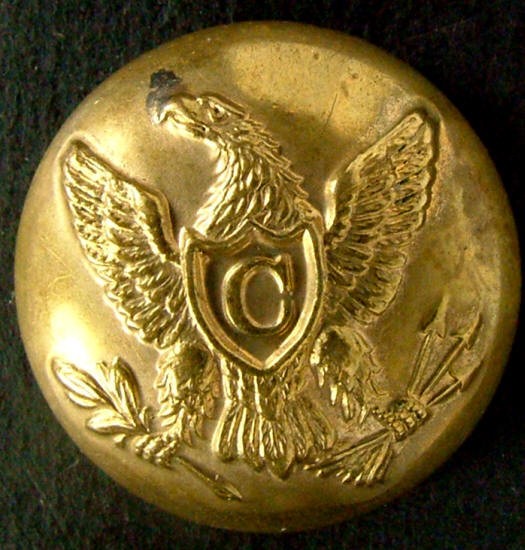
While this cavalry button (as distinguished by the “C” on the eagle’s shield) may be accurate for a cavalryman, it isn’t appropriate for my ancestor’s display as he was a corporal. I am still researching the proper buttons for display to confirm my suspicions, but I may be faced with purchasing the extremely rare Pennsylvania-specific buttons – as Rush’s Lancers were not a mainline Union Army regiment.
Taking into account that my relative was a member of the Union Army, I could pursue pieces of the Union uniform such as buttons or other devices. I would need to focus on cavalry as their buttons are different from those of the infantry. If I was fortunate enough to locate one at a reasonable price, I could obtain the kepi hat device. Including excavated items such as ammunition rounds for weapons carried by cavalry (such as .52- or .56-caliber carbine or .36- or .44-caliber revolver rounds) that were found on one of the unit’s battlefields would be a terrific accent to the display. Ideally, I’d like to get my hands on the blade from a lance, but with the lofty price (one was sold at auction in 2005 for $1,440.00) they command, I will have to abstain. If I can locate a period-correct Civil War medal, it would be icing on the cake.
No matter the direction that I ultimately decide to take, I know that I will be spending the next several months scouring the online dealers and auction sites to acquire the pieces. In the meantime, I await my great, great great grandfather’s service records so that I can (hopefully) nail down his service and create an accurate display.
Continued:
Silver Eagles: Navy Bullion Rates
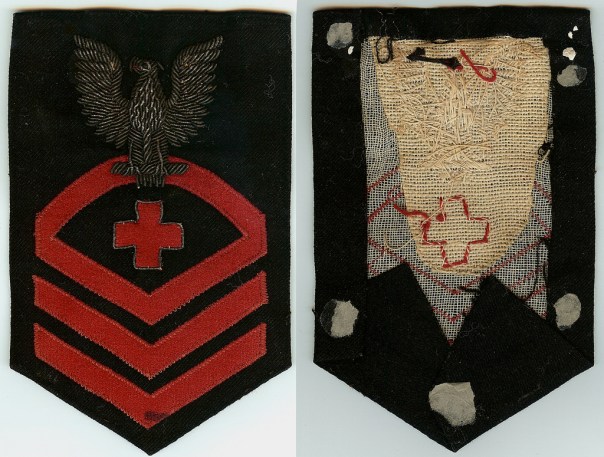
This chief Pharmacist’s Mate’s Geneva Cross is accented with a bullion thread outline.
Beautifully stitched with metallic thread or wound-metal elements overlaid onto crows, bullion navy rates have been in existence for more than a century. By 1913, the U.S. Navy’s uniform regulations established that rate badges with gold stripes (for dress blues) be accompanied with the eagle and specialty mark to be made of silver bullion. Uniform regulations regarding bullion were further expanded providing that all dress blue chief petty officer rates (regardless of the chevron color) would be constructed with silver bullion. These regulations, in my opinion, facilitated the establishment of one of the best aspects of enlisted uniform adornments.
These fantastically embellished crows historically incorporate multiple shades or tones of silver, and at times, gold bullion threads in their designs making for highly detailed and textured rate badges. Along with aesthetics, the bullion crow designs take on a three-dimensional feel and are really quite stunning.
Crow designs are substantially varied in their appearance based upon the time period in which they were made and the manufacturers’ interpretation of the design specification. One can examine two bullion rates from the same period and note that they will have different embroidery patterns. Thread direction will differ as well as the pattern used for the specific elements.
-
- A nice example of a humble Machinist’s Mate bullion design.
-
- This post-war Chief Boatswain’s Mate crow-design is subtle and showing some signs of wear.
-
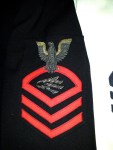
- This Radioman Chief’s eagle is accented with gold thread on the leading edges of the wings.
-
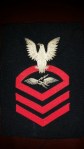
- This red-on-blue chief aviation radioman is a recent acquisition. It appears to be a mid-1940s-era badge.
-
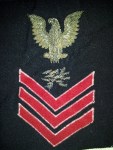
- This rather sloppy Radarman badge has a nice eagle design, however the specialty mark is less than desirable.
Because they were traditionally hand-embroidered, two crows from the same supplier can differ. You might see various embellishments to the bird’s feathers or the beak. Some will have different colored bullion that can really make the bird stand out from the rest of the rate badge.
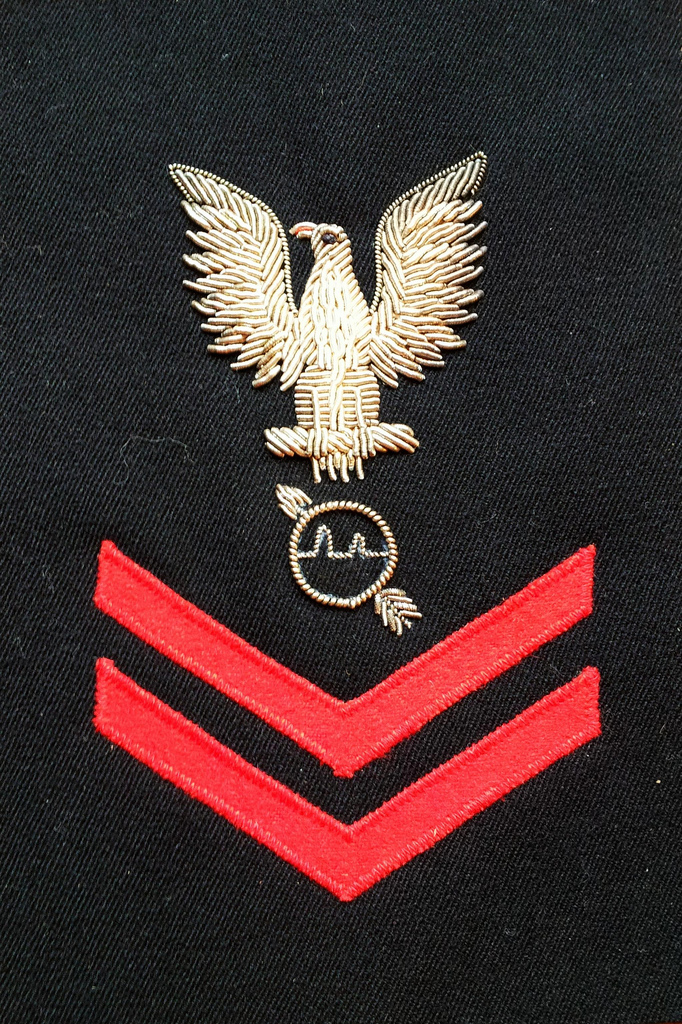
A rare bird. This Radarman/Operations Specialist 2/c badge is not collectors can easily find. Bullion rates were for E-6 and above and this one is clearly not a cut-down E-6 rating badge.
Other embellishments may include custom applications to the specialty mark. Variations to these embellishments pose challenges to collectors. Considering the Pharmacist’s Mate chevron (as seen at the top of this article), for example, one pattern could simply surround the red Geneva Cross with a single outline of thread while another could apply a crisscrossing pattern in addition to the outline. One example of a unique enhancement that I have seen was to a Machinist’s Mate crow that had a precious stone sewn to the center of the propeller insignia. The aquamarine tone of the stone really stood out against the silvery-blue bullion.
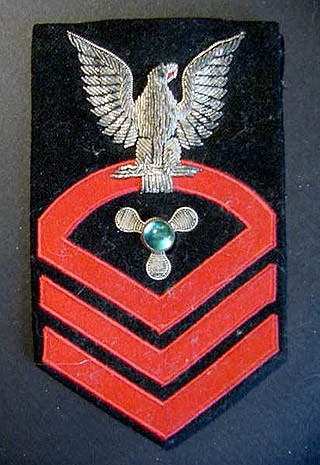
This early Machinist’s Mate crow (right-arm rate) is embellished with a stone in the center of the propeller specialty mark (eBay photo).
With the modern standardization of uniforms and insignia, the highly detailed and character-filled bullion crows are relegated to history (and to collectors). The current designs are sanitized, sterile and merely one-dimensional caricatures of the old patterns causing many navy rate collectors to shy away from them.
Selected References:
Cryptology and the Battle of Midway – Emergence of a New Weapon of Warfare

Here the Japanese carrier Hiryu dodges bombs dropped from Midway-based B-17 bombers (source: U.S. Navy).
The outcome of the war hung in the balance. Until now, the United States Navy’s operational effectiveness and readiness was in peril as they had suffered significant losses of the scant few carriers they had in the Pacific Fleet prior to December 7, 1941. The Imperial Japanese naval forces had extended their effective reach to include most of the Western and Southern Pacific and were seeking overall dominance of the ocean. The only opponent standing in their way was the severely weakened U.S. Navy.
In the previous six months, the American Navy had sustained strategic losses near Java with the sinking of the USS Houston (CA-30) in the Sunda Strait and the USS Edsall (DD-219) in the Java Sea, both on March 1.
Looking to put the Japanese on the defensive, American forces struck the Japanese homeland launching a (psychologically) successful air strike from the deck of the USS Hornet, causing Japanese military leadership to start holding back naval and aviation resources as a home guard, reducing the offensive capabilities. Japan had to consider herself vulnerable for the first time in the war while trying to convince citizens otherwise.
Continuing to press their imperial expansion Southward (Australia’s natural resources the ultimate goal), the Japanese, preparing for an offensive to take Port Moresby, New Guinea, began mobilizing the Combined Fleet in the South Pacific. American Forces countered and pressed for an attack which resulted in what came to be known as the Battle of the Coral Sea. While this battle was a strategic win for the United States, it was substantially painful losing the carrier Lexington and sustaining substantial damage to the Yorktown, leaving the Navy with just two serviceable flat tops, Enterprise and Hornet.
The Coral Sea battle demonstrated that over-the-horizon naval warfare had emerged as the new tactic of fighting on the high seas, as the carrier and carrier-based aircraft surpassed the battleship as the premier naval weapon.
While the Navy was very public in developing aviation during the 1920s, behind the scenes, a new, invisible weapon was being explored. Radio communication was in its infancy following World War I and adversarial forces were just beginning to understand the capabilities of sending instantaneous messages over long distances. Simultaneously, opponents were learning how to intercept, decipher and counter these messages giving rise to encryption and cryptology.
Officially launched in July of 1922, Office of Chief Of Naval Operations, 20th Division of the Office of Naval Communications, G Section, Communications Security (or simply, OP-20-G) was formed for the mission of intercepting, decrypting and analyzing naval communications from the navies of (what would become) the Axis powers: Japan, Germany and Italy. By 1928, the Navy had formalized a training program that would provide instruction in reading Japanese Morse code communications transmitted in Kana (Japanese script) at the Navy Department building in Washington D.C. in Room 2646, located on the top floor. The nearly 150 officers and enlisted men who completed the program would come to be known as the “On The Roof Gang” (OTRG).
By 1942, Naval Cryptology was beginning to emerge as a viable tool in discerning the Japanese intentions. The Navy was beginning to leverage the intelligence gathered by the now seasoned cryptanalysts which ultimately was used to halt the Japanese Port Moresby offensive and the ensuing Coral Sea battle. However, the Japanese changed their JN-25 codes leaving the naval intelligence staff at Fleet Radio Unit Pacific (known as Station HYPO), headed by LCDR Joe Rochefort, scrambling to analyze the continuously increasing Japanese radio traffic.
A breakthrough in deciphering the communication came after analysts, having seen considerable traffic regarding objective “AF,” suggested that the Japanese were targeting the navy base at the Midway Atoll, 1,300 miles Northwest of Hawaii. While this information would eventually prove to be
invaluable and was ultimately responsible for placing Pacific Fleet assets in position to deal a crushing blow to the Japanese Navy, it was anything but an absolute, hardened fact. Fleet Admiral Chester Nimitz risked the balance of his carriers (Hornet, Enterprise and Yorktown) sending them to lie in wait of the assumed impending attack.
The attack came and the prepared American forces struck back, inflicting heavy damage to IJN forces, sinking four carriers, one cruiser and eliminating 250 aircraft along with experienced aviators. Though the war would be waged for another three years, the Japanese were never again on the offensive and would be continuously retracting forces toward their homeland. The tide had been turned.
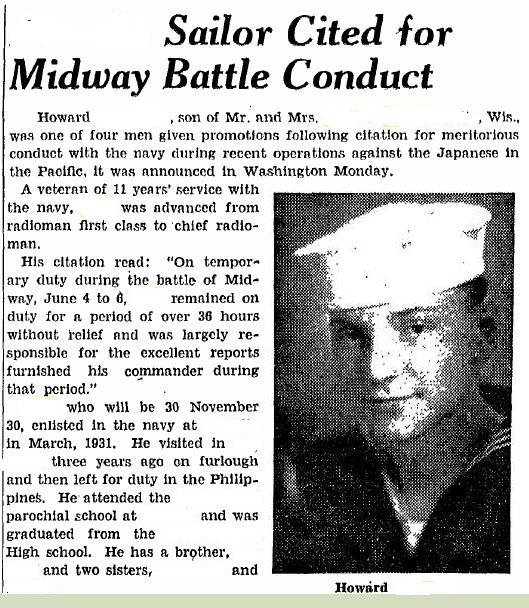
News clipping citing my uncle’s meritorious promotion (one of four sailors advanced for actions during the Midway battle) by Admiral Spruance .
On this 74th anniversary of the Battle of Midway, I wanted to spotlight a different aspect of the history of the battle, the emergence of cryptology as a strategic weapon, and share some of my own collection of that focuses on one of the original OTRG alumni, my uncle Howard.
Howard enlisted as an Apprentice Seaman in the Navy in 1932 (despite what the news clipping states) and proceed to serve in the fleet while working toward a radioman rating. He would be rated as a radioman 3/c in 1934 and accept an assignment to cryptological training at OP-20-G. In the years leading up to the war, he was assigned to Station HYPO and Station CAST (at the Cavite Navy Yard, Philippine Islands) transferring days before the Japanese raid.
-
- This service record entry shows that my uncle was meritoriously promoted for his actions during the Midway battle.
-
- This service record entry was also the text of my uncle’s commendation from Admiral Fletcher (acting CTF-16) for providing continuous intel.
Assigned to Station HYPO in early 1942, he would work closely with Commander Rochefort in code-breaking efforts and is purported (in my family circle) to have sent the transmission to Midway personnel to send un-coded messages about their inoperable evaporators, which ultimately led to the confirmation of Midway as Objective “AF.” He would be assigned to the Admiral’s staff (Admiral Raymond Spruance, who was substituting for Halsey at the time) aboard the Enterprise and would receive a meritorious promotion from the admiral as the result of his round-the-clock duties for the duration of the 4-day battle.
-
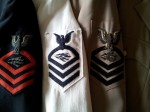
- Though these jackets never belonged to my uncle, they represent his achievement – reward for his dedication to duty during the most pivotal naval battle of WWII.
-
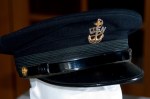
- Assembled from serviceable components from a few WWII navy hats, my dress blue chief radioman display is closer to being complete with this cover.
By 1944, my uncle had been promoted to the officer ranks, making Chief Radio Electrician, warrant officer-1. A career spent in naval cryptology, my uncle retired after 30 years of service.
Regretfully, none of my uncle’s uniforms, decorations or medals survives to this day. Neither of his sons inherited anything from their father’s more than 30 years of naval service. In my decision to honor him, I requested a copy of Uncle Howard’s service record (as thick as an encyclopedia) and began to piece his military tenure together by gathering uniforms and other associated elements. My collection of assembled uniform items representing his career, while not yet complete, has been a long endeavor – dare I say, a labor of love?
 The Veteran's Collection