Category Archives: General Militaria Collecting
Showcasing Your Militaria Investment
What good is a collection if it is maintained behind a closet door (where mine tends to be), stored in the basement or locked in a trunk? We spend years gathering items and filling in gaps in our collections as we reach goals that, in some cases, could take a lifetime to achieve. Despite those successes, we fail when we choose to keep them under wraps, hidden from the eyes of our house guests.
Most collectors’ spouses raise objections to the idea of them bringing old, musty-smelling objects into the spaces that we regularly inhabit. Olive drab hardly matches any home decor and the idea of weapons, armament and mannequins occupying limited floor or wall space tends to create friction with our spouses or significant others.
When I can, I like to visit museums that choose to commit their valuable floor real estate to displaying military history. I enjoy seeing the care that was taken by the staff to draw from the collection a tasteful blend of artifacts to present specific themes or create visual representations of specific historic events. Knowing that too much can cause viewers to gloss over the display, missing the all of the details. Too few artifacts or vague information cards in a display can have a similar effect. In both cases, the efforts of the curator are laid to waste as the museum visitor ambles past the display.
Through my membership in the U.S. Militaria Forum, I have seen some very impressive personal collections with well thought out displays that rival any of the best museums in the United States. From the hand-crafted cases and cabinets to the tastefully selected art hung on the walls, these collectors demonstrate that their investment is something to share with others.
-
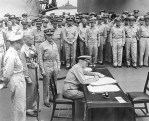
- Fleet Admiral Nimitz signs the documents, accepting the surrender of the Empire of Japan (source: U.S. Navy).
-
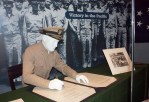
- Note the collar device insignia of Nimitz’ uniform and the tastefully simple display (source: Naval Academy Museum).
-
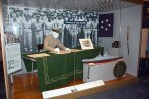
- Tastefully simplistic, the large display has a few items in order to emphasize the monumental significance of the event (source: Naval Academy Museum).
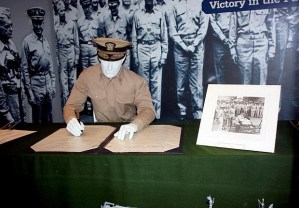
Take note of the mannequin’s altered ring finger on the left hand that matches Nimitz’ partial amputation from 1916 (source: Naval Academy Museum).
Not too long ago, the Naval Academy Museum shared some photos on their Facebook page of one of their latest displays that showcases one of the most historic events of the last century, the signing of the Instrument of Surrender aboard the USS Missouri. Presented is the uniform worn by Fleet Admiral Chester Nimitz on that September 1945 day in Tokyo Bay. The display clearly shows his khaki uniform with the rare 5-star insignia affixed to each collar. The museum staff went as far to alter the mannequin’s left ring finger to match Nimitz’s left hand: a portion of his finger was severed in 1916 by a diesel engine that he was demonstrating.
The key, limiting factor in my home is that I have a considerable lack of space. It is challenging enough to store my collection so the thought of propping up torsos to show my uniforms is nullified. Besides, it can be a little disturbing to walk into a room and see a still and quiet human-form at 4:00 AM as I prepare to head off to work.
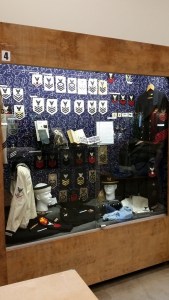 A few years ago, I was invited to participate in a public showing of my military baseball collection at our state fair in their hobby hall. My artifacts where showcased in and among adult and youth collections that were varied, ranging from pig-themed collectibles to artifacts from our nation’s bicentennial celebration. This year, I have yet another part of my militaria collection on display at the state fair. Being that the overwhelming military population (veterans, retirees, reservists and active duty personnel) is army and air force, I wanted to educate the citizenry on enlisted uniforms of the United States Navy. I gathered a few selections of my enlisted rating badges and uniforms to spotlight the history, designs and the ratings themselves. My wife and I visited the fair and stood in the distance to observe visitors to see how they respond to what I had on display. People-watching is fun but seeing people enjoying these artifacts is pleasing and provides some satisfaction to collecting, even if I can only experience it on rare occasions.
-
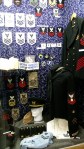
- Showing the 8-button Machinist’s Mate Chief (bullion) and Electrician (radio) 2/c from WWI uniforms backed by ratings, distinguishing marks and shoulder insignia patches and WWII warrant officer shoulder boards and devices.
-
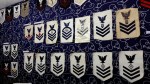
- A selection of rating badges showing eras, specialties, date and manufacturer’s marks.
-
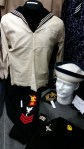
- A few other uniforms: 1905-1913 Coxswain, 1944 Ship’s Cook 1/c and a 1944 Aviation Radioman 3/c (with aerial gun pointer mark) next to a vintage naval academy midshipman rating badge and plebe cover.
Spotlight on private collector militaria displays
- “Belleau Wood Museum” – fabulous World War I Marine Corps displays.
- Chaplain Collection– focused on chaplains of all branches and all conflicts.
- General Officer Collection – one of the most impressive collections – this one focuses solely on officers who attained the rank of general or admiral
Sound Timing and Patience Pays Off
I am a sucker for U.S. naval history. There, I said it. I love it all from John Paul Jones and the USS Ranger to the USS Gerald R. Ford (CVN-78), the lead ship in the newest class of aircraft carriers, I can’t get enough. My tendencies and preferences seem to take me to more contextual aspects of naval history – anything to do with the geographical region of my birth holds my interests (unless, of course it is connected to the ships or commands where I served).
I seek out items that can be associated with ships named for geographic locations (city names, place names, etcetera), pieces that can be connected to the local naval installations or anything that originates with local naval figures, such as the Rear Admiral Robert Copeland group in this earlier post. To date, the majority of these items have been vintage photographs…until yesterday.
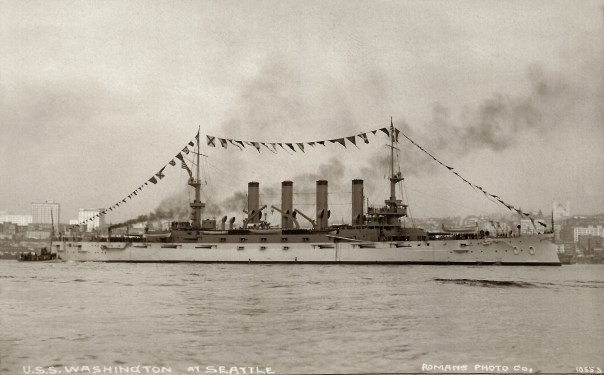
Prior to her reclassification, the (then) USS Washington (ACR-11) rests at anchor near her future namesake, Seattle, WA (author’s collections).
While searching online, I stumbled across a listing that contained a piece of history that made my jaw drop. To see the price was so much lower than it should have been made me giddier than a kid on Christmas morning. I placed my watch on the item and planned observe it for a few days to see if any bids were placed. A few days later, with no one bidding (that I knew of) I configured my bid snipe and hoped that all would work out.
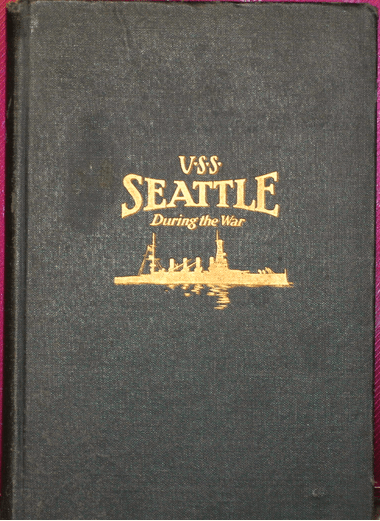
Judging from the auction listing photo, the cover of my new vintage cruise book is in nearly pristine condition (source: eBay image).
Around the time of the auction close, I was out and about when I received an email that my sniped bid was the winner and that no other parties had bid against me, leaving the closing price the minimum amount. The item, a World War I cruise book from the USS Seattle (an armored cruiser of the Tennessee class) that was placed into commission in 1906, documents the ship’s WWI service during the war, serving as a convoy escort as she provided merchant vessels protection from German U-boats during trans-Atlantic crossings to the United Kingdom.
-
- The inside end papers is inscribed with what appears to be the previous owner’s name – who was a coxswain aboard the ship. I will be researching the sailor’s name to see what I can learn about him (source: eBay image).
-
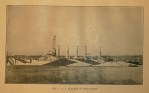
- Inside the pages of the book, this photo shows the USS Seattle in her “dazzle” camouflage paint scheme (source: eBay image).
As cruise books were produced in small numbers (for the crew), they are quite rare typically driving the prices close to, and sometimes surpassing, $500. Like most vintage books, condition is a contributing factor in the value. My USS Seattle book was available at a fraction of these prices making it affordable when it would normally have been well out of my budget.
Good things come to those who wait…and who check at the right time. For me, the waiting continued right up until the time that I tore into the package moments after it was delivered by the letter carrier (yes, I can behave as a child, still).
Reaching the Pinnacle of Militaria Collecting
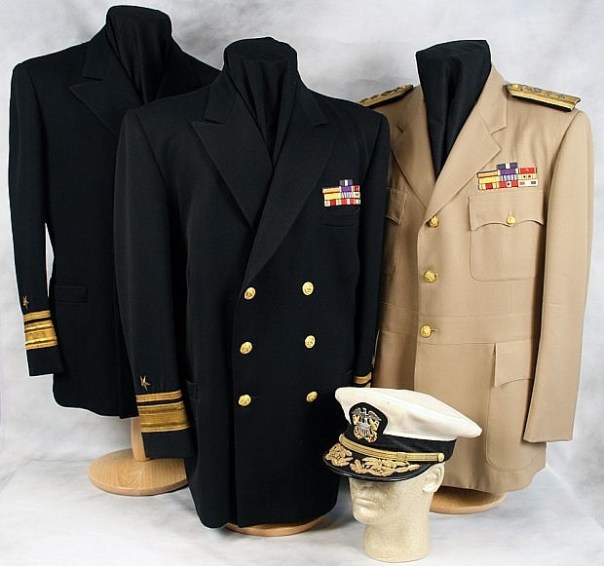
This uniform group belonged to Rear Admiral Robert Copeland who received the Navy Cross for his heroic attack (while in command of the USS Samuel B. Roberts and the destroyers of “Taffy 3″) against a Japanese battleship force in the Battle off Samar (source: D. Schwind).
I’ve been collecting militaria for about three years and nothing that I’ve purchased for my collection is worthy of comparison to some of the impressive acquisitions that I’ve seen other, more seasoned collectors acquire. Some of these people have reached what I would characterize as the pinnacle of militaria groupings that could put most museums’ collections to shame.
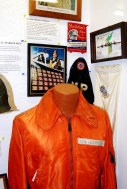
Flight suit belonging to Distinguished Service Cross recipient, Colonel Francis Gabby Gabreski.
I spend a great deal of time touring history- and military-themed museums in my local area. On occasion, a museum might have an item or group related to a recognizable name from our nation’s military history. For me, there is a sense of being close to a significant contributor or a pivotal moment that made a difference in the outcome of the battle or even the war at the sight of a famous veteran’s personal effects. One would expect to see these sorts of artifacts in a museum… but what about a private collection?
In the world of militaria collecting, obtaining a named uniform of a veteran who participated in a significant battle and, perhaps receiving a valor medal for his (or her) service while under fire adds a massive layer of icing for that piece of cake. What if that item was from a well-known historical figure? Audie Murphy? General MacArthur? The chances are extremely remote that a collector would be able to locate a genuine item belonging to one of these people, let alone being able to afford to acquire it.
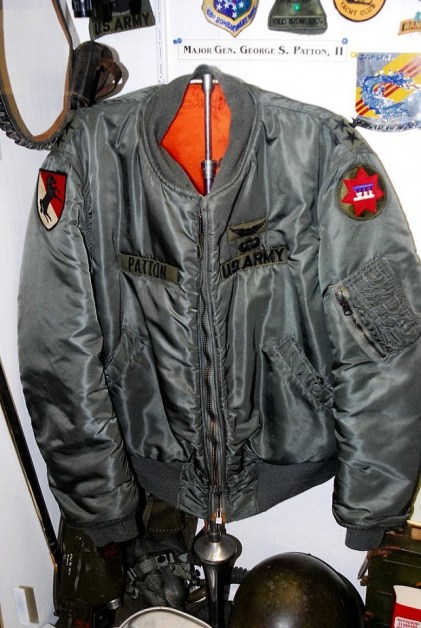
This jacket belonged to Major General George S. Patton Jr.
In the community of United States Militaria collectors (to which I belong), there are several folks who have worked diligently to acquire uniforms and decoration sets that belonged to notable military figures from American history. From general or flag officers to member of the Joint Chiefs of Staff (some holding the position of Chairman, JCS) to Medal of Honor and Navy Cross recipients, these collectors have reached a level that regardless of the time, effort or finances, I could never achieve.
Extreme Collections
For now, I will simply settle on admiring these collections from afar.
Spark Your Collection: Military-Themed Zippos
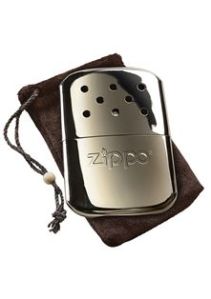
My memory with this Zippo hand warmer is vivid: I remember the smell of the fluid burning and how it warmed my hands on a cold winter morning.
When I was invited to write for A&E’s Collectors Quest collector’s forum as their resident militaria blogger, I knew that I had my work cut out for me. Besides possessing some basic skills with my native tongue (or at least the written word), I knew that I would have a very diverse field from which to extract topics for my columns. With nearly two years researching and writing on an aggressive deadline schedule coupled with my passion for militaria collecting, I developed a fair amount of expertise that I brought to bear when I moved on to my own blog.
From my initial post on this blog (Militaria Collecting: It Isn’t Just Fatigues and Helmets), I mentioned the diversity of the “genre” and how far reaching – extending beyond the bounds of military-specific items – the various categories would be. It is very easy to be myopic as we focus on what we enjoy, forgetting that a specific area of collecting militaria could be part of a larger field of collecting that has very little to do with the military. One of those heavily-collected areas is in the field of cigarette/cigar lighters…more specifically, Zippo lighters.
My introduction to Zippo products came when I was a pre-teen as my uncle, a World War II army combat veteran of the Pacific theater, offered to warm my hands up with a unique device…a hand warmer. Fueled by lighter fluid, the warmer took the bite out of the cold that was causing my hands to stiffen and ache. I marveled at the its soft metal-feel and the warmth it provided. I remember seeing the name emblazoned across the device’s bottom, “Zippo.” My uncle was also a pipe smoker and when he went to light up the fragrant tobacco in his pipe, I again saw the name and it stuck with me for years. My uncle told me of the reliability of the Zippo; that it could still light up in a strong wind. He mentioned that all of his buddies sought them out, often trading battlefield souvenirs for them.
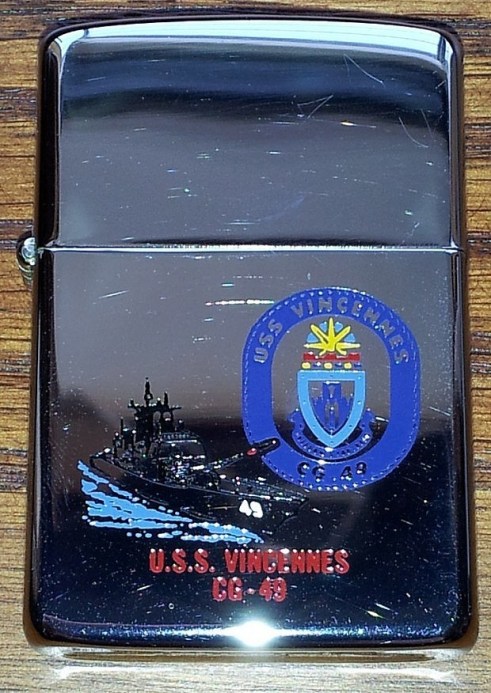
This Zippo dates from the 1980s and is the more typical chrome design with USS Vincennes CG-49 engraving.
Though I do not smoke (I never have), I own a handful of the iconic, treasured pocket flame-producing implements. All of my specific pieces are lie firmly in the military category of Zippo collecting – specifically U.S. Navy (for those of you who’ve been following my posts, this would be obvious). The depth and breadth of my collection covers all of two ships, only one of which I served aboard, and numbers somewhere in the neighborhood of five pieces, all of which are in new condition (remember, I don’t smoke). I’ve even managed to acquire, though I don’t remember how, a navy-themed Zippo pocket knife.
-
- This is another USS Vincennes Zippo from the 1980s clad in ivory plastic and engraved with the ship’s crest.
-

- The opposite side of the ivory plastic cladding with the ship engraving.
-
- This is a second variety of the USS Vincennes Zippo from the 1980s clad in black plastic and engraved with the ship’s crest.
-
- The opposite side of the black plastic cladding with the ship engraving.
Plainly and painfully obvious, I don’t possess much knowledge beyond being able to identify a lighter as being a Zippo versus a knock-off. Beyond that, I have to resort to my basic abilities of research to determine the sort of information collectors need: the age of the lighter, scarcity, desirability, condition, etcetera. One of the nice things about a company like Zippo is that they consider both their customers those who use the products and the collectors, producing quality products, standing behind them, and providing collectors with authoritative production data and information, dating back to their infancy in the 1930s.
Interested in collecting Zippo? Try some of these resources to spark your interest::
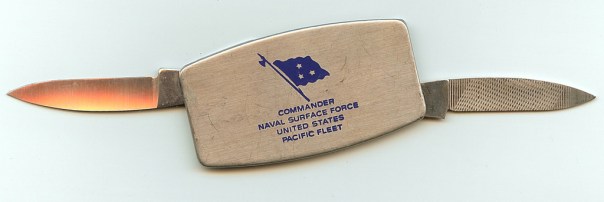
This flat Zippo pocket knife was left behind aboard my ship following one of the many parades of high-ranking naval officers who wanted to see what the (then) newest naval technological marvel could do.
For me, I will continue on in my collecting pursuits, leaving my lighter collection to remain as is – though I might have to locate a hand warmer to warm my hands and nostalgically reminisce about those days with my uncle, now long gone.
A British Collector of the Alamo – Foreign Collectors of American Militaria
A question was recently posed by militaria collector from the UK asking how Americans feel “about important artifacts which are part of US cultural history being in the private collection of a British musician.” The question was in direct response to a March 2012 publication of a 416 page volume, The Alamo and Beyond: A Collector’s Journey, that details musician Phil Collins’ extensive collection of historic artifacts directly related to the 1836 battle at the Mission San Antonio de Valero in San Antonio, Texas, simply known as the Alamo.
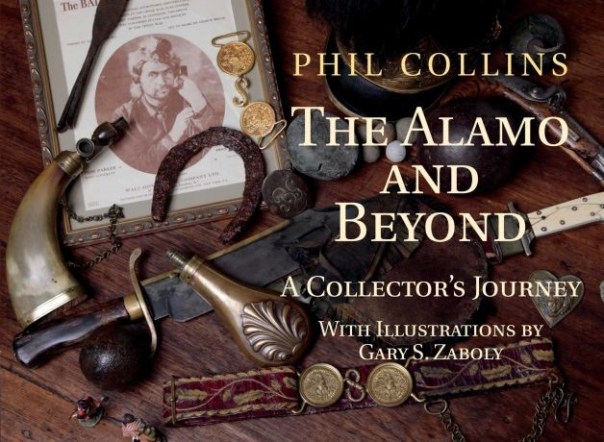
Published in March of 2012, Phil Collins’ book documents his extensive collection of militaria related to the 1836 battle at the Alamo.
Like many American kids of the post-World War II generation, I’ve always related the Alamo to Hollywood-produced entertainment such as Disney’s Davy Crockett (1954-55) and The Alamo(1960), glamorizing the historical characters such as David “Davy” Crockett (played by Fess Parker or John Wayne) and James “Jim” Bowie (Kenneth Tobey or Richard Widmark) and their legendary fight with Antonio López de Santa Anna and the Mexican Army. Glorified in these portrayals are the manner in which each of the two main characters fought and ultimately died alongside their comrades. American youth would be inspired to don faux coonskin caps and buckskin outfits as they act out the scenes.
Singer, songwriter and drummer Phil Collins (of rock band Genesis) was one of those kids growing up watching the onscreen portrayals of Davy Crockett. Fascinated by the Alamo and the siege and battle that took place there in February and March of 1836, Collins was drawn to collecting militaria when he discovered a Crockett autograph for sale while on tour with Genesis, “I didn’t know this stuff was out there, that you could own it,” he noted. Phil had been bitten by the militaria collecting bug and the resulting, spectacular Alamo-specific collection that he spent decades assembling is unequaled.
In March of 2012, Collins diverted from his musical creativity and ventured into writing about his militaria passion. He published his first book, The Alamo and Beyond: A Collector’s Journey which is packed with hundreds of pages of beautiful photography and illustrations documenting the depth and breadth of his collection. Though his book is listed for $120, it can be found for less than $40.
Regarding the question that was posed at the beginning of this post, my response is that there exist monuments, buildings, graves and other large, tangible items and places to view and visit that are related to this historic, tragic event in our history. The individual artifacts such as in the collection of Mr. Collins have been in private collections and out of view of the general public all along. There are probably thousands of individual pieces remaining in private collections that are or can be connected to this event and are still unviewable by the general public.
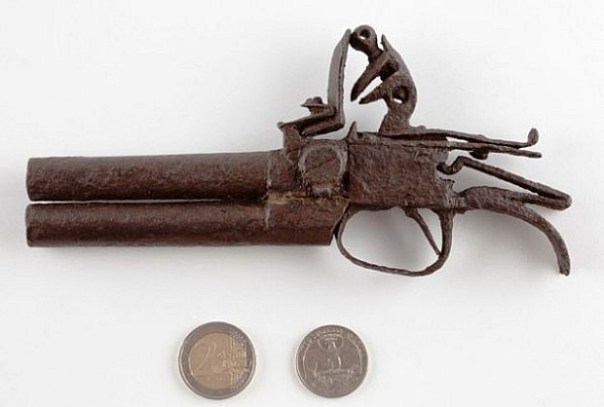
From Collins’ collection, this 1830 over and under flintlock pistol was excavated by at the Alamo site by a construction worker (source: Phil Collins collection).
I see what Phil Collins has done in publishing his book as an act of sharing treasures that have never previously been made available to the public. While the book has (for me, at least) a considerable price tag, I still see this work as a gift to fans of history. Through his efforts, we get to have something tangible that provides us with a look at a slew of items that probably wouldn’t have been assembled together without Phil’s decades of effort.
I applaud his interest in American history, militaria collecting, the Alamo collection and his work on this book.
 The Veteran's Collection