Category Archives: Warships or Vessels

Collecting U.S. Navy Uniform Ship Identifiers


To suggest that veterans and sailors of the U.S. Navy have an affinity for their ships would be a gross understatement. It would be difficult to stroll through any public area without seeing a former navy man sporting a ball cap with a USS ___ (fill in the blank). I have seen men well into their late 80s proudly carrying the name of the ship they served aboard, emblazoned across their foreheads, and as I write this, I am proudly wearing one of my own ship’s ball caps.

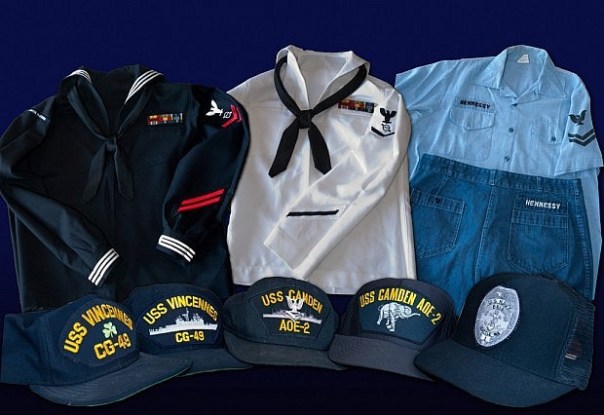
This collection of uniforms shows four official shipboard navy ball caps, authorized for wear with utility uniforms (such as the now-defunct dungaree set on the right). Note the UIM patch on the right sleeve of the dress blue uniform jumper.

This collection of uniforms shows four official shipboard navy ball caps, authorized for wear with utility uniforms (such as the now-defunct dungaree set on the right). Note the UIM patch on the right sleeve of the dress blue uniform jumper.

Navy ship ball caps are quite commonplace. Many of them have icons or symbols between the name and the hull number designator that make them unique to each specific ship. Some of the symbology might have nothing to do with the ship, instead being representative of the commanding officer or the crew. As far as I’ve determined, ships’ crews have been wearing the named caps aboard ship with utility (dungarees) since the 1960s.

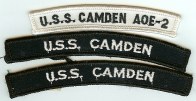
The two blue UIM patches shown are authorized by Navy uniform regulations. The white patch on top is a manufacturing mistake and unauthorized for wear on a Navy uniform. The USS Camden was decommissioned in 2005.

The two blue UIM patches shown are authorized by Navy uniform regulations. The white patch on top is a manufacturing mistake and unauthorized for wear on a Navy uniform. The USS Camden was decommissioned in 2005.

When sailors are required to be in their dress uniforms, identifying them with their associated commands is a requirement… especially when sailors behave like, well… sailors in foreign ports. Present-day enlisted dress uniforms must be adorned with a unit identification mark (UIM) patch on the top of the shoulder of the right sleeve. This regulation has been in place since the late 1950s to early 1960s.

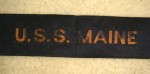
Prior to World War II, the navy employed a much more stylish format of placing the command names on their enlisted sailors. From the 1830s to 1960, sailors wore with their dress blue uniforms a flat hat, affectionately known as the “Donald Duck” hat. Though it wasn’t authorized, in the latter half of the nineteenth century, sailors began to adorn their flat hats with a ribbon (known as a tally) that displayed the name of the ship and was worn only when on liberty (“shore leave” to you landlubbers). Eventually, the tallies were acknowledged within the naval uniform regulations, standardizing their appearance and wear.

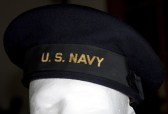
This post-1941 Navy flat hat shows the generic “U.S. Navy” tally. By 1960, these hats were retired from use.

This post-1941 Navy flat hat shows the generic “U.S. Navy” tally. By 1960, these hats were retired from use.

By 1941 and the outbreak of World War II, the rapid expansion of the fleets with many new ships under construction and being delivered to the fleet, the Navy did away with the ship names on the tallies, standardizing all with “U.S. Navy” (there is some speculation that secrecy of ship movement drove the Navy to implement this change).

Ship-named tallies are highly sought after by collectors, pushing prices on some of the more famous (or infamous) vessels well into the ranges of multiple-hundreds of dollars, regardless of condition. Due to the delicate nature of the tallies’ materials and the exposure to the harsh marine environment, the gold threads of the lettering tend to darken and tarnish. The ribbon construction was typically made with silk, so they don’t stand up well to the ravages of several decades of time and storage.

In the last few years, a tally showed up in an online auction for the first time in more than a decade of staking out anything related to USS Vincennes. Until then, I had my doubts as to whether the Navy had allowed the pre-war crew to have the tallies for their ship, even though it was in service since February of 1937, four years before they were abolished. Sadly, the selling price surpassed my maximum bid by nearly triple the amount.

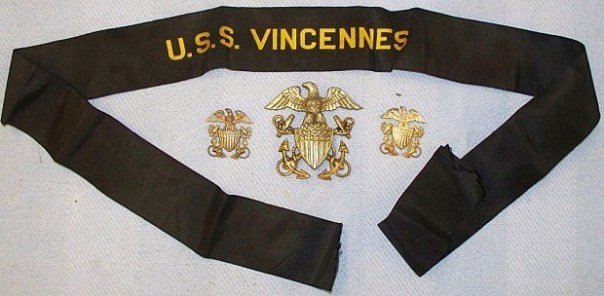
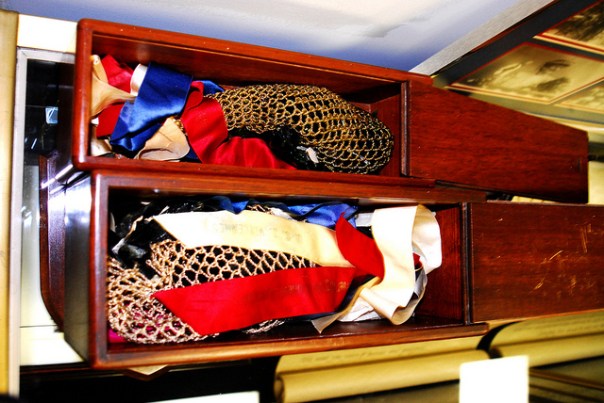
This image shows the rare USS Vincennes tally (along with some officer cap devices), which was sold this week at auction for more than $150 (source: eBay image).

This image shows the rare USS Vincennes tally (along with some officer cap devices), which was sold this week at auction for more than $150 (source: eBay image).

Hopefully, I don’t have to wait as long until I see another USS Vincennes tally!

Commemorating and Collecting Midway


Approaching June 4, many Americans will be reminded of a pivotal event that took place on this very day during World War II, when a massive armada of ships carrying troops that were preparing for an invasion (that would commence on the morning of June 6th, 1944). The plan was to establish a foothold in enemy-held territory, extending their reach with a new base of operations. Thinking of this date in particular, Americans will conjure thoughts of paratroopers flying over a stretch of water as they begin to traverse flak bursts en route to their targets.

For the past several years, veterans and their families have made their way to the hallowed ground on the beaches and drop zones in and around Normandy, France, seeking to re-trace their steps on the ground where the D-Day Invasion commenced. Though few of those brave men remain this eve of the 72nd anniversary, the children of those veterans will be joined by grateful citizens as they remember the sacrifices made by so many men on that day in 1944. With so much attention given to Normandy (especially by Hollywood in recent years with Saving Private Ryan and the Band of Brothers series), typically overlooked (when thinking about this date) is a battle that arguably had the same or even greater impact on the War’s outcome.

The Battle of Midway took place at a time when the U.S. was still ramping up to fight, having been caught unprepared for war. American Army ground troops wouldn’t be committed for a full-scale assault until November of 1942 with Operation Torch in North Africa. The Marines wouldn’t begin any offensive campaigns until landing craft bow ramps were dropped onto the shores of Guadalcanal. This meant that the majority of the fighting that was taking place since December 7, 1941 was being carried out by U.S. naval forces.

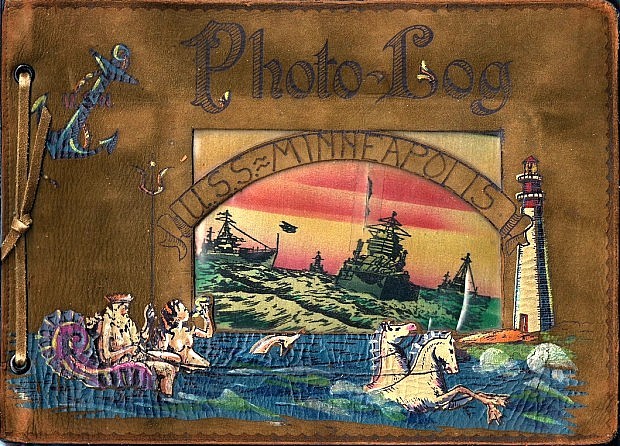
Owning a sailor's photos may seem odd to some, but they could be one-of-a-kind images that you otherwise might not see. This hand-painted USS Minneapolis photo album is a fine example (source: eBay image).

Owning a sailor’s photos may seem odd to some, but they could be one-of-a-kind images that you otherwise might not see. This hand-painted USS Minneapolis photo album is a fine example (source: eBay image).

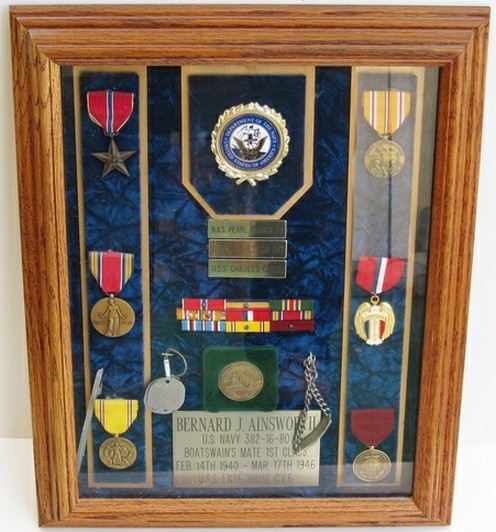
This group of medals from a USS Enterprise veteran largely contains modern hardware. The dog tags appear to be original to the veteran (source: eBay image).

This group of medals from a USS Enterprise veteran largely contains modern hardware. The dog tags appear to be original to the veteran (source: eBay image).

In commemorating the 70th anniversary of the battle, regrettably little ceremonial attention will be paid to the few surviving veterans who are, at the very least, in their late 80s. Yet, we need to remind ourselves of the significance of this battle and remember those who risked it all and sent the Japanese forces into a three-year retreat.


Being a collector (primarily interested in Navy militaria), it takes a fair amount of legwork and an awful lot of providence to acquire authentic pieces that may have been used during this battle. We have to ask ourselves, “what would be the most target-rich focus area that we can pursue for treasure?” Clearly, the answer to that question would be veterans’ uniforms. Considering that there were two task forces containing 28 vessels (and 260 aircraft), there would be literally thousands of veterans each with multiple uniforms to choose from–if you can determine that they actually participated, attached to one of these units.

Those interested in obtaining pieces of ships or aircraft will have an infinitesimal chance to locate authentic items for their collection… but that means there is still a chance. Below is a list of every U.S. Navy ship that participated in the battle (I’ll leave it up to you to research the participating aviation squadrons from the carriers and Midway Island):

  • Carriers
    USS Enterprise, USS Hornet, USS Yorktown
  • Cruisers
    USS Astoria, USS Minneapolis, USS New Orleans, USS Northampton, USS Pensacola, USS Portland, USS Vincennes, USS Atlanta
  • Destroyers
    USS Aylwin, USS Anderson, USS Balch, USS Benham, USS Blue, USS Clark, USS Conyngham, USS Dewey, USS Ellet, USS Gwin| Hammann, USS Hughes, USS Maury, USS Monaghan, USS Monssen, USS Morris, USS Phelps, USS Russell, USS Ralph Talbot, USS Worden
  • Submarines
    USS Cachalot, USS Cuttlefish, USS Dolphin, USS Finback, USS Flying Fish, USS Gato, USS Grayling, USS Grenadier, USS Grouper, USS Growler, USS Gudgeon, USS Narwhal, USS Nautilus, USS Pike, USS Plunger, USS Tambor, USS Tarpon, USS Trigger, USS Trout
  • Oilers
    USS Cimarron, USS Guadalupe, USS Platte


Remember, you can also seek commemorative items, vintage newspapers or original photographs, or named (engraved) medal groups from veterans who fought in the battle – creativity and a lot of research will help you reap great reward!

Remembering (and Collecting) the USS Maine!


In the decades following the American Civil War, the United states was busy dealing with the reconstruction of the South, expansion into the Western states and territories, adding new stars to the blue canton of the national ensign (i.e. the addition of states to the Union), the influx of the destitute of Europe seeking to benefit from the Land of Opportunity and all the trefoils of a growing nation. Few Americans set their eyes upon the instability of governments beyond the borders and shores as the nation surpassed her first century of existence. Life, though fraught with the many diverse challenges of the time, was good.

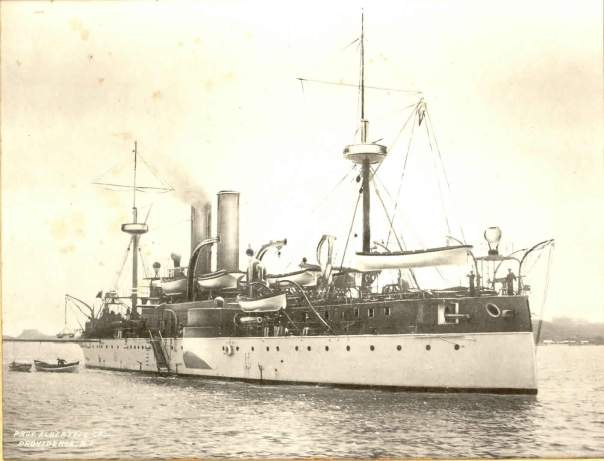
USS Maine ACR-1 – Havana Harbor, 1898

USS Maine ACR-1 – Havana Harbor, 1898

In the latter half of nineteenth century, the American navy commenced a dramatic technological transformation from wooden-hulled sailing sloops and frigates, followed by ironclads and paddle-wheels, to steel coal-fired steam warships. Naval gunnery was advancing and the U.S. leadership was following the advances being made by the British navy that had necessitated a radical departure from the ship design convention (of the time) in order to take full advantage of the new capabilities. The U.S. Navy, had been fully committed to the designs of the ironclad Monitor and many of the European navies adopted similar designs following the American’s success with them during the Civil War. With technology advancing at such a rapid pace and the need for a global naval reach, the Monitor was rendered obsolete, in favor of larger, more powerful ships with greater sailing range which would come to be known as pre-Dreadnoughts.

In the 1880s, the U.S. Navy began planning and designing their first pre-Dreadnought armored cruisers. By 1886, the Navy funded the first two ships of the new design, the lead ship, USS Maine and her (closely-related) sister, the USS Texas. The Maine’s keel was laid down on October 17, 1888 at the Brooklyn Naval Shipyard and wouldn’t be completed for nearly seven years. She was commissioned and placed into service on September 17, 1895 and following sea trials and fitting out, was assigned to the North Atlantic Squadron for service.

As the 1890s were drawing to a close, a spark in the tinderbox of the Cuban independence movement began to be fanned by U.S. financial influence. American capitalism and politics had been involved in Cuba for the past few decades investing heavily in the sugar cane and tobacco industries, driving economic transformation of the Spanish-owned island and fueling unrest among the citizens. American popular sentiment, led by a pro-liberation agenda that was propagandized throughout the newspapers of the day, was growing in favor of intervening against the Spanish government. In January of 1898, a pro-Spanish riot erupted in Havana which prompted the American Consul-General to request assistance to protect U.S. citizens and business interests.

Sailing into Havana Harbor at the end of January, the USS Maine provided a menacing reminder of the United States’ commitment to protect her interests. In addition, her presence could have appeared to the Spanish loyalists as a threat to their sovereignty. Perhaps the revolutionaries saw the ship as an opportunity to draw the United States into a conflict with Spain that could result in the ouster of their oppressive overseers. Regardless of the stance of the two opposing sides, the Maine’s presences added to the already increasing tension.

Aboard ship, the crew was going about settling down for the night on February 15, 1898. Twenty minutes before taps and lights out, the shipboard routines were winding down. Liberty boats had returned to the ship and had been secured for the night. Suddenly and without warning, a massive explosion rocked the forward part of the ship as 5.1 tons of gunpowder ignited. In a matter of seconds, the Maine was sitting on the bottom of the harbor and more than 260 of her crew (of 355 officers and men) were dead.

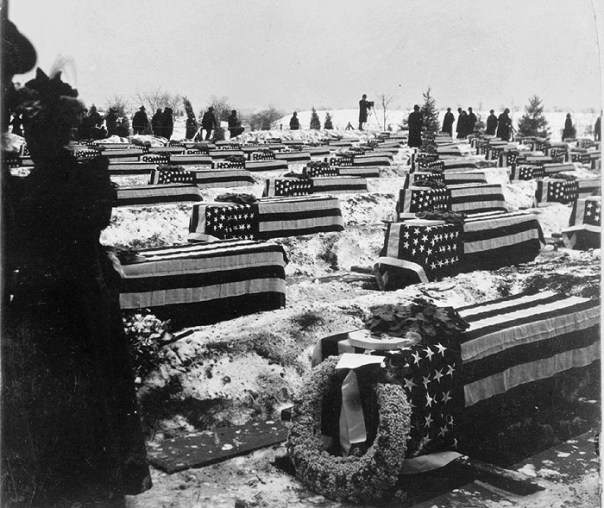
Galax leaf wreaths decorate the coffins containing the dead of the Maine on December 28, 1899.

Galax leaf wreaths decorate the coffins containing the dead of the Maine on December 28, 1899.

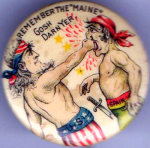
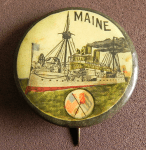
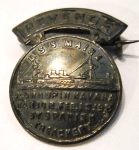
Following a formal investigation and inquiry into the cause of the explosion, the cause was determined to be the result of a mine (though no supporting evidence existed). The slogan of the day, “To hell with Spain! Remember the Maine” could be found in print and plastered across buttons and pins as the American public began to rally to the cause. Following the publication of the findings, a media blitz of inflaming editorials and exaggerated facts ultimately led to an April 21, 1898 formal declaration of war against Spain.

After resounding victories in Manila Bay (in the Philippines) and San Jaun Hill (Puerto Rico), the Spanish pursued peace with the United States by the middle of July, 1898. The peace treaties were signed in Paris on August 12, 1898, relinquishing all rights and claims to the Philippines, Puerto Rico and Cuba.

With the guns now silent and the U.S. reverting to their isolationist stance, the rallying cry of “Remember the Maine” began to fade from the forefront of the U.S. populace. This was not so with Navy leadership who were still seeking definitive facts surrounding her sinking. In 1910, Navy engineers began constructing a cofferdam surrounding the shallow-water wreck of the ship. After the harbor waters receded from the wreck, investigators poured over every inch of the hulk. With no conclusive evidence uncovered and the bodies of the crewmen were removed for burial in the U.S. (at Arlington National Cemetery), the ship was refloated, towed out to sea and scuttled.

Bell of the USS Maine, broken in half by the 1898 explosion, attached to the door of the memorial at Arlington National Cemetery.

Bell of the USS Maine, broken in half by the 1898 explosion, attached to the door of the memorial at Arlington National Cemetery.

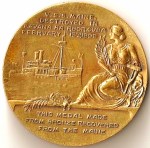
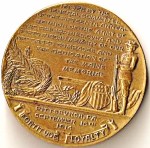
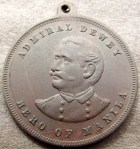
Several pieces of the ship were removed at the time of the 1910-1912 investigation including munitions, guns, pieces of her superstructure and mast and other items that would serve as central components of memorials that were being constructed around the country. Commemorative medallions were cast from metal retrieved from her screws as Americans renewed their commitment to remember the Maine.

Four years following the devastating loss of the cruiser, the U.S. Navy commissioned the USS Maine (BB-10), the lead ship of three-ship class of battleships which also included the USS Missouri (BB-11) and USS Ohio (BB-12). The second USS Maine would proudly carry the name and legacy in Teddy Roosevelt’s Great White Fleet and through World War I. Her 18-year career ended with her May, 1920 decommissioning. The Maine name wouldn’t sail again until 1994 when the Navy launched the 16th Ohio-class Trident submarine, USS Maine (SSBN-741) which is currently homeported in Bangor, Washington.

More than 110 years later, the stricken USS Maine resonates with a minute segment of collectors. While very few items or artifacts originating from the ship surface within the marketplace, memorial pieces are readily available.


Inscription on the Havana USS Maine monument:

“El Pueblo De La Isla De Cuba Es Y De Derecho Debe Ser Libre E Independiente.” Resolucion con junta del Congreso de los Estados Unidos de Norteamerica De 19 de April De 1898.

“The people of the island of Cuba are and of right ought to be free and independent.” Congressional joint resolution with the United States of America from April 19, 1898.

A Legacy: Vincennes Wardroom Silver


More than three months into The War, the United States was reeling from suffering substantial and demoralizing losses at Pearl Harbor and again in the Sunda Strait (with the loss of the USS Houston CA-30). The U.S. was in dire need of stopping the bleeding and gaining a moral victory in order to build momentum for what was to become a nearly half-decade long war.

6054156282_e80b5d3ca3_z

These cased, broken champagne bottles were used to christen the cruisers named for the City of Vincennes, IN. The top bottle helped to name the CA-44 and the bottom, CL-64. Both are preserved at the city’s council chambers archive.

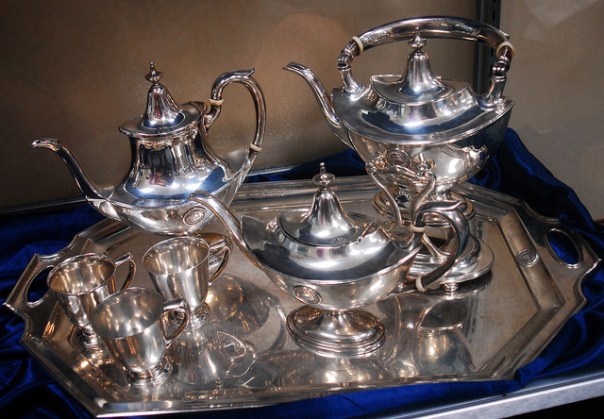
When the keel of the (then, future) USS Vincennes (CA-44) was laid, she was the pride of the small, Southwestern Indiana town of the same name. The citizens embraced her and her future crew, adopting the men who would serve aboard her as their own sons. When she was christened (launched), the daughter (Miss Harriet Virginia Kimmell) of the city’s mayor broke the ceremonial bottle of champagne on her bow, officially naming the heavy cruiser. More than two years later when the ship was commissioned and placed into service (February 24, 1937), the citizens raised funds to purchase and present a gift, a silver tea and coffee service, to the officers of the ship.

With the outbreak of war and the peacetime navy morphing to address the combat needs, USS Vincennes transferred from her home fleet duties within the Atlantic Ocean to augment the Pacific fleet following the losses suffered in the opening days and weeks of the war. As part of readying the ship for service against the Japanese, the Vincennes paid a visit to the Mare Island Naval Shipyard in Vallejo, in San Francisco Bay for additional combat upgrades. In conjunction with the changes being made to the ship, the compliment of officers and men was being increased and with space being a premium and the probability of combat engagement with the enemy being almost certain, the silver service and other items were removed from the ship and placed into storage for the duration of the war.

6053604567_f6bc0af683_z

The USS Vincennes’ sterling silver tea and coffee service is on display in the City of Vincennes, Indiana in the council chambers archive.

Soon afterward, the Vincennes would take part in some of the most pivotal actions in an effort to stem the Japanese Eastward expansion beginning with the Doolittle Raid, (aiding in the aftermath of) the battle of Coral Sea, the Battle of Midway and the US Marines’ first offensive, Guadalcanal. On the evening of the 2nd night of the landings, the Vincennes would sustain hundreds of Japanese naval gunfire hits and being pierced by the enemy’s Long Lance torpedoes, leaving a blazing, sinking inferno.

uss_vincennes_28ca-4429_bombards_guadalcanal

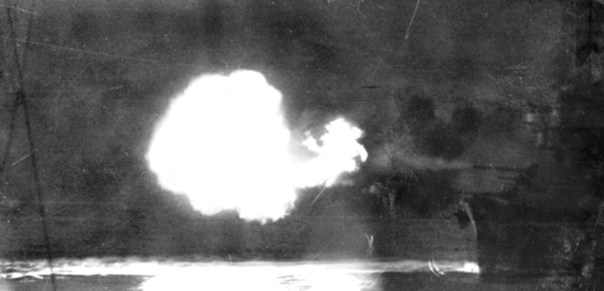
The 8″ main battery of the heavy cruiser, USS Vincennes (CA-44) commence firing at enemy positions on Guadalcanal; early morning, August 7, 1942.

Five decades later, the surviving veterans of the lost cruiser would be instrumental in ensuring that the name of their beloved lost ship would be carried to sea aboard a modern cruiser of the Ticonderoga class. At her commissioning in 1985, the city of Vincennes would once again gift the preserved silver service to their newest ship, the USS Vincennes (CG-49) to be used by the officers and visiting dignitaries and guests throughout her twenty-year life.

Upon her decommissioning in 2005, the silver service was returned to the city where it is now displayed and cared for. Perhaps one day, another ship will bear the name Vincennes and the set will serve the officers of a new generation of the adopted sons and daughters of the southwest Indiana city.

A Whale of a Tooth: 19th Century Naval Scrimshaw


Where does the time go? I know that my writing schedule has been severely impacted by home and work priorities (this column is nowhere near being a day job for me) and other facets of life routinely draw my attention away from my love of military history. However, my interest never truly wanes or strays very far from this passion and yet when I checked to see that my last posting was more than three months ago, I realized that I need to get back on the horse and get the creative juices stirred.

I can’t blame writer’s block or submit any grandiose excuses for not writing. I merely de-prioritized my militaria collecting during the 90-day time span. Though my acquisition pace has slowed during the last half-year, I only suggest that I’ve become hyper selective about what I add to the expanding pile. With the smattering of pieces coming through the door, I found myself asking the question, “what should I write about?”

Not wanting to overload the Veteran’s Collection with an overwhelming theme, I have been putting forth an effort to balance the various subjects. My best efforts aside, I find that my posts are skewed toward the Navy (where I served) with some of those topics focusing on a specific ship. Regardless, after a few moments of careful consideration, I decided that instead of talking about a new (to my collection) piece, I would spend some time with something that eluded me a few years ago (the subject just happens to be in a few of my wheelhouses). Missing out on this piece has haunted me since the online auction bidding surpassed my meager budget.

Without going into detail as to what fuels my interests (read my About page for those details), I’ll jump right into today’s topic.

I can bet that half of those who read this column (all four of you) are familiar with the widely popular PBS television production, Antiques Roadshow and have viewed episodes where 19th century maritime folk art objects have been viewed and appraised. One of the most popular types of that particular folk art is scrimshawed marine mammal bones (or teeth/tusks). Needless to say that along with popularity (and scarcity) of these pieces comes an array of reproductions and outright fakes onto the market. Applying the caution of a mariner skirting the shoal waters, one needs to be very knowledgeable before navigating into these waters.
USS Vincennes Scrimshaw

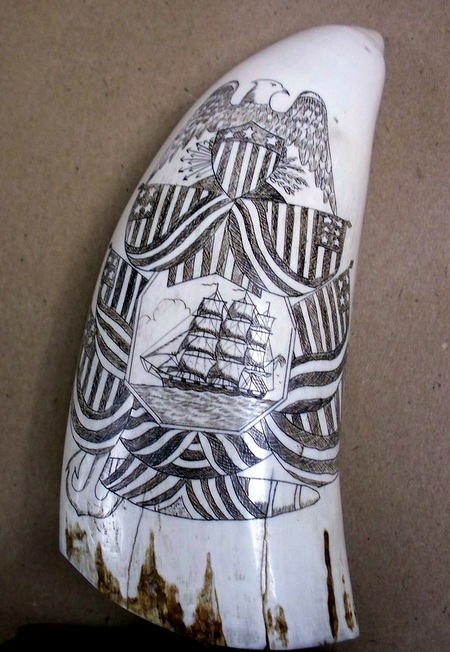
The ship design in the center is clearly that of an 1820s United States Navy sloop of war (source: eBay image).

When this item was listed in an online auction, I was shocked that it lasted without being taken down by the host as genuine scrimshaw violates their established policies that forbid the sale of items made from protected animals. In reading the seller’s description, I noted that it was being sold as a piece that was manufactured from man-made materials rather than from a whale bone or tooth. However, in examining the photos of the piece, it was clearly NOT sourced from synthetics, though I couldn’t be certain without a hands-on inspection. Hoping to get clarification from the seller, I resorted to asking specific questions only to be rebuffed with a message that reiterated the details in the listing’s description.
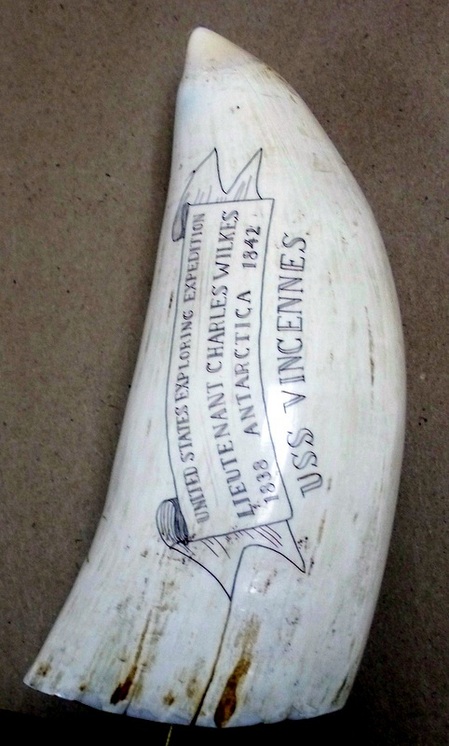
USS Vincennes Scrimshaw

The inscription reads, “United States Exploring Expedition, Lieutenant Charles Wilkes, 1838 | Antarctica | 1842. USS Vincennes” (source: eBay image).

The subject of the scrimshaw artwork is what drew me to the piece from the beginning. The illustrations on either side of the “whale tooth” were made to commemorate the United States very first foray into global exploration. The U.S. Exploring Expedition was led by the US Navy’s polarizing figure (of that era), LT Charles Wilkes from 1838-1842 and consisted of men from several biological and geological scientific disciplines along with illustrators, geographical surveyors and naval officers and men aboard six US Navy vessels – the flagship being the sloop of war, USS Vincennes.

On one side of the tooth is a rather elaborate design of the three-masted sloop (a port-side view) that is centered among an array of flags with an eagle perched above an American-themed shield holding arrows and an olive branch which is very reminiscent of 19th century designs. On the reverse is an unrolled scroll that appears to be a banner with the US Ex. Ex, Wilkes’ name, the dates and “Antarctica” emblazoned across. Immediately beneath the scroll is the name of the expedition’s flagship, “USS Vincennes.”

I grappled with deciding to bid on the object. There was no definitive manner in which to determine the authenticity or if it was, in fact, a mocked up piece of plastic. I was left to weigh all of the evidence and draw conclusions (aside from the fact that the seller stated that it wasn’t the real thing which could easily be that person’s subverting of the online auction site’s rules).

USS Brooklyn Scrimshaw

An example of an 19th Century whale’s tooth scrimshaw depicting the USS Brooklyn (source: dukeriley.info)

Scrimshawed Whale's tooth.

Showing a vintage whale’s tooth scrimshaw mounted to a cork base. Note the similar themes (to the USS Vincennes tooth) and the odd number of stripes on the shield (source: Wikimedia).

The cons

  • The tooth is very bright for an early 19th century piece. Most scrimshawed items tend to yellow with time. After 170 years, the bone/tooth material should be much darker.
  • Taking a look at the artwork design, what gave me reason to pause is that the artist departed from the widely used American themes within his design. The eagle’s shield is lacking the correct number of stars and stripes (shown are three and 11, respectively).
  • The wooden base (which appears to be of dark walnut) that the tooth is mounted to seems to be fairly modern; almost new, conditionally.
Early 19th century flag

This early 19th century flag depicts the three-starred shield and 9 stripes yet the eagle faces his right shoulder (source: NAVA).

The pros

  • As someone who, for the last two decades, has been searching for anything pertaining to any of the US Navy warships that bore the same name, this is the only scrimshaw that I have encountered that had any reference to the ship or the expedition. Uniqueness is definitely a plus in that if someone was going to bother manufacturing fakes of this nature, there would, most-likely be multiple examples appearing on the market.
  • The cons that I listed above can be explained. The artist may not be as detail-oriented when it comes to the thirteen stars and stripes. However, the direction that the eagle’s head faces is accurate for the time (facing its left shoulder). The illustration of the ship is very accurate to that of the 1820s U.S. sloop of war (designed by Samuel Humphreys) which leads me to believe that the artwork is correct to the period.
  • The base could have been merely a replacement or an addition by a subsequent owner.
  • The piece may have been stored in a cool, dark location for most of its existence, which could possibly account for the lack of typical aging effects.
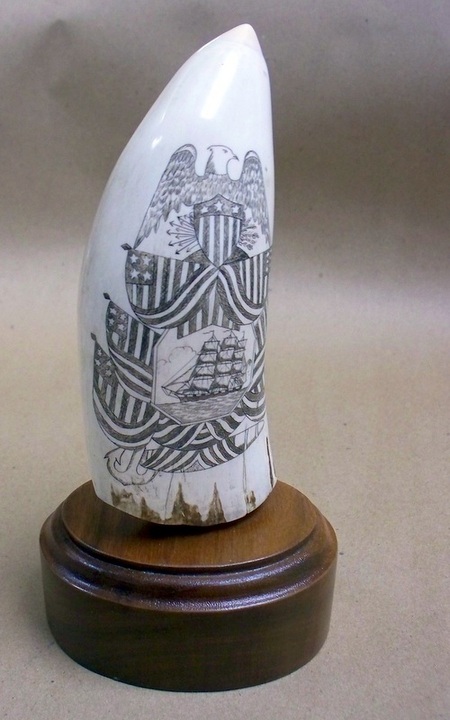
USS Vincennes Scrimshaw

The walnut base appears to be a fairly recent addition as it shows no signs of aging (source: eBay image).

After several days of careful consideration, I decided that it was worth a nominal investment risk and configured my bid snipe program accordingly. Within a few hours of the auction close, the bidding (from multiple parties) surpassed my maximum and I watched this beautiful piece of scrimshaw slip into someone else’s hands for several hundred dollars above my limit. It seems that other collectors had arrived at the same conclusion that I had and the benefit of owning such a nice piece far exceeded the risk that it might not be authentic.

For me, this whale tooth was not to be.

Design a site like this with WordPress.com
Get started