Category Archives: Other Militaria

A Legacy: Vincennes Wardroom Silver


More than three months into The War, the United States was reeling from suffering substantial and demoralizing losses at Pearl Harbor and again in the Sunda Strait (with the loss of the USS Houston CA-30). The U.S. was in dire need of stopping the bleeding and gaining a moral victory in order to build momentum for what was to become a nearly half-decade long war.

6054156282_e80b5d3ca3_z

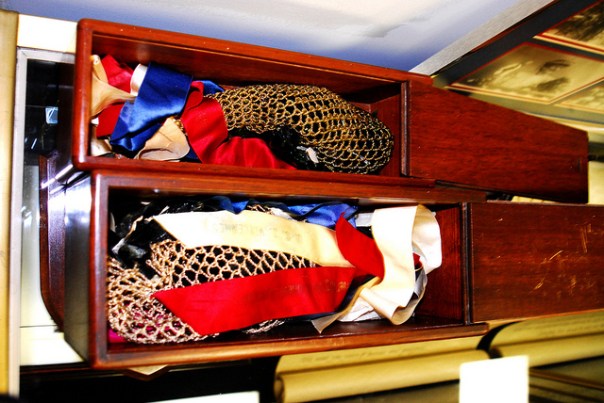
These cased, broken champagne bottles were used to christen the cruisers named for the City of Vincennes, IN. The top bottle helped to name the CA-44 and the bottom, CL-64. Both are preserved at the city’s council chambers archive.

When the keel of the (then, future) USS Vincennes (CA-44) was laid, she was the pride of the small, Southwestern Indiana town of the same name. The citizens embraced her and her future crew, adopting the men who would serve aboard her as their own sons. When she was christened (launched), the daughter (Miss Harriet Virginia Kimmell) of the city’s mayor broke the ceremonial bottle of champagne on her bow, officially naming the heavy cruiser. More than two years later when the ship was commissioned and placed into service (February 24, 1937), the citizens raised funds to purchase and present a gift, a silver tea and coffee service, to the officers of the ship.

With the outbreak of war and the peacetime navy morphing to address the combat needs, USS Vincennes transferred from her home fleet duties within the Atlantic Ocean to augment the Pacific fleet following the losses suffered in the opening days and weeks of the war. As part of readying the ship for service against the Japanese, the Vincennes paid a visit to the Mare Island Naval Shipyard in Vallejo, in San Francisco Bay for additional combat upgrades. In conjunction with the changes being made to the ship, the compliment of officers and men was being increased and with space being a premium and the probability of combat engagement with the enemy being almost certain, the silver service and other items were removed from the ship and placed into storage for the duration of the war.

6053604567_f6bc0af683_z

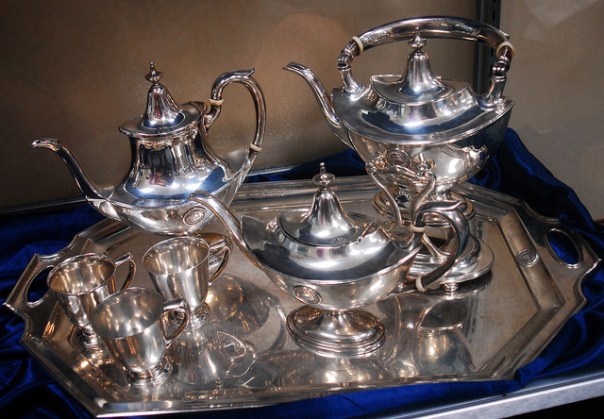
The USS Vincennes’ sterling silver tea and coffee service is on display in the City of Vincennes, Indiana in the council chambers archive.

Soon afterward, the Vincennes would take part in some of the most pivotal actions in an effort to stem the Japanese Eastward expansion beginning with the Doolittle Raid, (aiding in the aftermath of) the battle of Coral Sea, the Battle of Midway and the US Marines’ first offensive, Guadalcanal. On the evening of the 2nd night of the landings, the Vincennes would sustain hundreds of Japanese naval gunfire hits and being pierced by the enemy’s Long Lance torpedoes, leaving a blazing, sinking inferno.

uss_vincennes_28ca-4429_bombards_guadalcanal

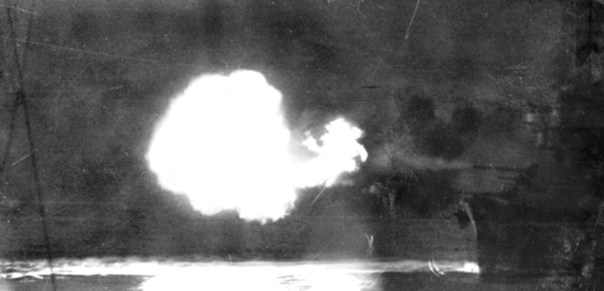
The 8″ main battery of the heavy cruiser, USS Vincennes (CA-44) commence firing at enemy positions on Guadalcanal; early morning, August 7, 1942.

Five decades later, the surviving veterans of the lost cruiser would be instrumental in ensuring that the name of their beloved lost ship would be carried to sea aboard a modern cruiser of the Ticonderoga class. At her commissioning in 1985, the city of Vincennes would once again gift the preserved silver service to their newest ship, the USS Vincennes (CG-49) to be used by the officers and visiting dignitaries and guests throughout her twenty-year life.

Upon her decommissioning in 2005, the silver service was returned to the city where it is now displayed and cared for. Perhaps one day, another ship will bear the name Vincennes and the set will serve the officers of a new generation of the adopted sons and daughters of the southwest Indiana city.

Displaying the Diamond: Military Baseball Public Showing


I have been collecting militaria for several years. I enjoy seeing, touching and sometimes smelling these object of history. I have a couple items on full-time display in my home and I enjoy the ensuing conversation that is sparked by guests who take an interest. For the most part, my collection is hidden in my closet and boxes in various places within my home. However, this week I have been given the opportunity to share a portion of my treasures with a decidedly larger audience that the visitors to my home.

In my home state’s largest fair there is a considerably large facility that is used to showcase various hobbies that people participate in. There are several categories of hobbies represented ranging from wood and metal working, crafts and scrap-booking. Perhaps the largest portion of  floor space is dedicated to the various areas of collecting (coins, stamps, dolls, toys, clocks, etc.). In all my years of attending the fair, I can recollect one instance of a militaria collection displayed and that was last autumn (an amazing collection of armed forces nurse uniforms). From that moment, I was decidedly interested in sharing my significantly smaller (than the nurses display) collection the following year.

As I began to consider what I wanted to submit as an entrant to this year’s fair, I wanted to be more unique, more specific than simply presenting my collection of military uniforms. One area that I have been more focused upon in the past four years, military sports, has afforded me the opportunity to acquire items that span two genres of my collecting interests. Also, my collection has grown enough that a small display consisting of the mixture of types of pieces (uniforms, equipment, photographs and ephemera) would be quite tastefully displayed. With my concept decided, I began the process of submitting my collection.

This slideshow requires JavaScript.

The fair committee does strive for diversity in what they like to have on display and while seeking to prevent repeating collections year after year, they also try to ensure that the spaces are completely filled. I started the two-part process (electronic submission, followed by a paper form and photographs) by completing the online form a week prior to the deadline. I downloaded the paper form and set it aside, forgetting it for several days and then resigning myself to wait until next year as the deadline arrived. The following week, my phone rang during my afternoon commute and I was asked if I could bring the paper form to their office within 48 hours and that they wanted me to display my collection. I was elated and excitedly agreed to complete the remaining elements of the submission process.

Two weeks later, I received the formal acceptance letter and exhibitor packet. Getting a head-start on determining what and how I would display my collection, I selected pieces and acquired the necessary accessories (mannequins, stands, etc.) to achieve a tasteful presentation.

Move-in day went smoothly and my display was finished within a few hours as a raging, late-summer windstorm howled outside.  All items carefully placed and locked into the cabinet, I snapped a few pictures and left for home. Overnight, the high winds were supplanted by terrible rainfall (three inches in just a few hours). Driving home from the fair the previous day, I remembered that I had one more piece that I wanted to display along with a few corrections to the information placard. I intended on returning in the early afternoon. When I turned my phone on, I discovered a harsh reality of displaying outside of my home. It seemed that the storm that blew in deposited a large quantity of leaves on the fair building’s roof clogging the downspouts as the rain (deluge) began to fall. The ensuing flood on the roof resulted in water penetrating the building and meandering its way into the display case that was housing my collection (mine was the only one affected).

The news was not good – some of my pieces were wet and the fair staff emptied my case to allow it to begin drying. When I arrived and saw the stained and crumbling ceiling tiles, I knew that the damage to my pieces would be considerable. Surveying my collection, I was pleasantly surprised to discover that I was very few pieces got wet and – the damage was simply moisture on one of the uniform trousers. The remainder of my collection was safe (and carefully removed from the case by the fair workers) which was a relief considering the ephemera (programs/scorecards from championship games) and photographs (some over 100 years old) were unaffected by the moisture. I was provided a secure space to store the dry items and I loaded what was wet and took it with me. My initial reaction to what happened to my collection was to load it all into my truck and forego displaying. As the current owner ans steward of these artifacts, I was concerned about further risk. Insurance can recoup the financial loss, but the history would be lost should any further harm befall these pieces.

I had to wait for another opportunity to return to put the display back together once the leaks were addressed. Later that week, my wife returned with me to assist and the display came together nicely. With a few changes (from the previous configuration) the final presentation turned out to be much more aesthetically balanced and pleasing. Rather than dominate my display with every piece of military baseball material that I own, I selectively chose examples that would inform the audience of the prevalence and impact that baseball has had on our culture, in particular, within the ranks of the armed forces.

The fair is set to open this week and the risk of loss is still present until I bring my collection home.  What I am learning is invaluable and is preparing me to recognize and consider the risks with clarity for future public showcasing of my collection. Through the militaria collector community I have heard the horror stories regarding theft and damage and I will factor those anecdotes (along with this experience) into future decisions. I am hopeful that the positives outweigh the detractors and the audience truly enjoys and appreciates what they are seeing. Fortunately, there is a feedback mechanism in place and the fair staff told me that it is very common for viewers to submit questions and reach out to the collectors.

It would be an absolute pleasure to hear from a veteran who donned a uniform, cap and spikes and took to the diamond for his unit!

See:

A Whale of a Tooth: 19th Century Naval Scrimshaw


Where does the time go? I know that my writing schedule has been severely impacted by home and work priorities (this column is nowhere near being a day job for me) and other facets of life routinely draw my attention away from my love of military history. However, my interest never truly wanes or strays very far from this passion and yet when I checked to see that my last posting was more than three months ago, I realized that I need to get back on the horse and get the creative juices stirred.

I can’t blame writer’s block or submit any grandiose excuses for not writing. I merely de-prioritized my militaria collecting during the 90-day time span. Though my acquisition pace has slowed during the last half-year, I only suggest that I’ve become hyper selective about what I add to the expanding pile. With the smattering of pieces coming through the door, I found myself asking the question, “what should I write about?”

Not wanting to overload the Veteran’s Collection with an overwhelming theme, I have been putting forth an effort to balance the various subjects. My best efforts aside, I find that my posts are skewed toward the Navy (where I served) with some of those topics focusing on a specific ship. Regardless, after a few moments of careful consideration, I decided that instead of talking about a new (to my collection) piece, I would spend some time with something that eluded me a few years ago (the subject just happens to be in a few of my wheelhouses). Missing out on this piece has haunted me since the online auction bidding surpassed my meager budget.

Without going into detail as to what fuels my interests (read my About page for those details), I’ll jump right into today’s topic.

I can bet that half of those who read this column (all four of you) are familiar with the widely popular PBS television production, Antiques Roadshow and have viewed episodes where 19th century maritime folk art objects have been viewed and appraised. One of the most popular types of that particular folk art is scrimshawed marine mammal bones (or teeth/tusks). Needless to say that along with popularity (and scarcity) of these pieces comes an array of reproductions and outright fakes onto the market. Applying the caution of a mariner skirting the shoal waters, one needs to be very knowledgeable before navigating into these waters.
USS Vincennes Scrimshaw

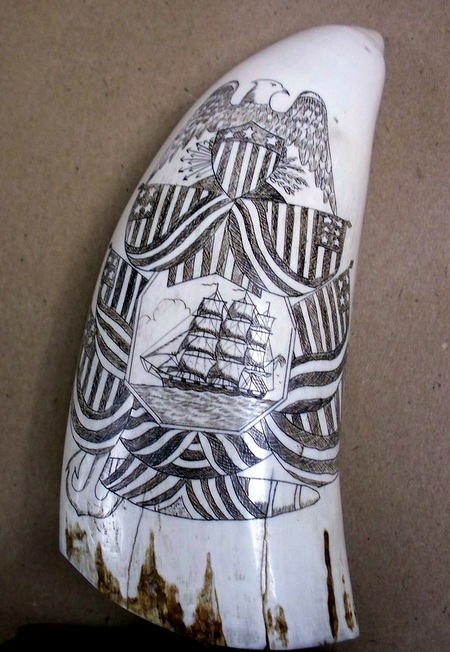
The ship design in the center is clearly that of an 1820s United States Navy sloop of war (source: eBay image).

When this item was listed in an online auction, I was shocked that it lasted without being taken down by the host as genuine scrimshaw violates their established policies that forbid the sale of items made from protected animals. In reading the seller’s description, I noted that it was being sold as a piece that was manufactured from man-made materials rather than from a whale bone or tooth. However, in examining the photos of the piece, it was clearly NOT sourced from synthetics, though I couldn’t be certain without a hands-on inspection. Hoping to get clarification from the seller, I resorted to asking specific questions only to be rebuffed with a message that reiterated the details in the listing’s description.
USS Vincennes Scrimshaw

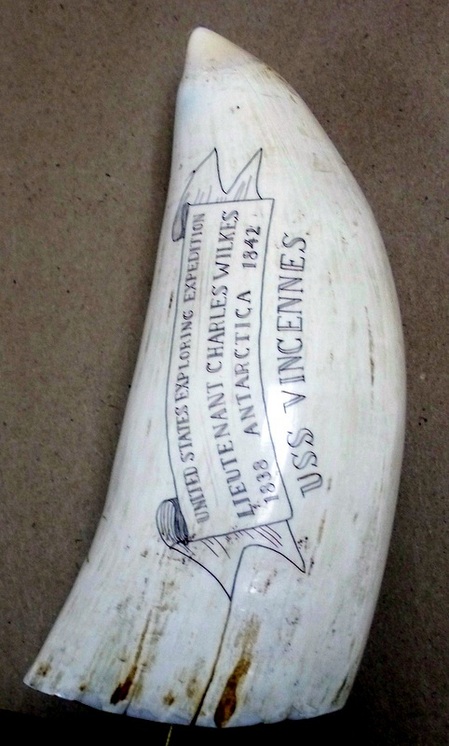
The inscription reads, “United States Exploring Expedition, Lieutenant Charles Wilkes, 1838 | Antarctica | 1842. USS Vincennes” (source: eBay image).

The subject of the scrimshaw artwork is what drew me to the piece from the beginning. The illustrations on either side of the “whale tooth” were made to commemorate the United States very first foray into global exploration. The U.S. Exploring Expedition was led by the US Navy’s polarizing figure (of that era), LT Charles Wilkes from 1838-1842 and consisted of men from several biological and geological scientific disciplines along with illustrators, geographical surveyors and naval officers and men aboard six US Navy vessels – the flagship being the sloop of war, USS Vincennes.

On one side of the tooth is a rather elaborate design of the three-masted sloop (a port-side view) that is centered among an array of flags with an eagle perched above an American-themed shield holding arrows and an olive branch which is very reminiscent of 19th century designs. On the reverse is an unrolled scroll that appears to be a banner with the US Ex. Ex, Wilkes’ name, the dates and “Antarctica” emblazoned across. Immediately beneath the scroll is the name of the expedition’s flagship, “USS Vincennes.”

I grappled with deciding to bid on the object. There was no definitive manner in which to determine the authenticity or if it was, in fact, a mocked up piece of plastic. I was left to weigh all of the evidence and draw conclusions (aside from the fact that the seller stated that it wasn’t the real thing which could easily be that person’s subverting of the online auction site’s rules).

USS Brooklyn Scrimshaw

An example of an 19th Century whale’s tooth scrimshaw depicting the USS Brooklyn (source: dukeriley.info)

Scrimshawed Whale's tooth.

Showing a vintage whale’s tooth scrimshaw mounted to a cork base. Note the similar themes (to the USS Vincennes tooth) and the odd number of stripes on the shield (source: Wikimedia).

The cons

  • The tooth is very bright for an early 19th century piece. Most scrimshawed items tend to yellow with time. After 170 years, the bone/tooth material should be much darker.
  • Taking a look at the artwork design, what gave me reason to pause is that the artist departed from the widely used American themes within his design. The eagle’s shield is lacking the correct number of stars and stripes (shown are three and 11, respectively).
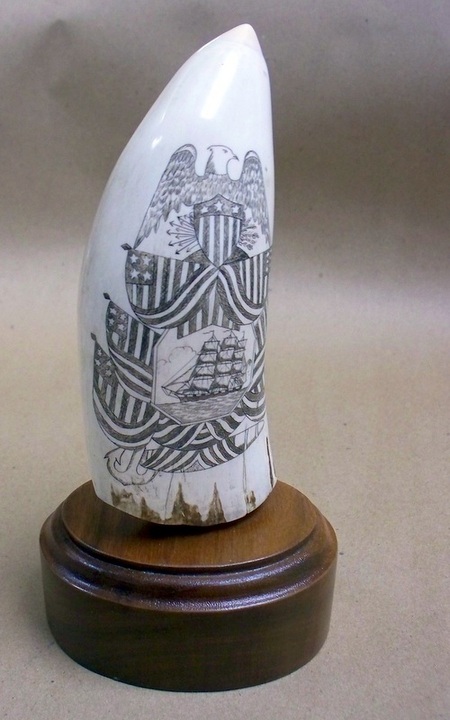
  • The wooden base (which appears to be of dark walnut) that the tooth is mounted to seems to be fairly modern; almost new, conditionally.
Early 19th century flag

This early 19th century flag depicts the three-starred shield and 9 stripes yet the eagle faces his right shoulder (source: NAVA).

The pros

  • As someone who, for the last two decades, has been searching for anything pertaining to any of the US Navy warships that bore the same name, this is the only scrimshaw that I have encountered that had any reference to the ship or the expedition. Uniqueness is definitely a plus in that if someone was going to bother manufacturing fakes of this nature, there would, most-likely be multiple examples appearing on the market.
  • The cons that I listed above can be explained. The artist may not be as detail-oriented when it comes to the thirteen stars and stripes. However, the direction that the eagle’s head faces is accurate for the time (facing its left shoulder). The illustration of the ship is very accurate to that of the 1820s U.S. sloop of war (designed by Samuel Humphreys) which leads me to believe that the artwork is correct to the period.
  • The base could have been merely a replacement or an addition by a subsequent owner.
  • The piece may have been stored in a cool, dark location for most of its existence, which could possibly account for the lack of typical aging effects.
USS Vincennes Scrimshaw

The walnut base appears to be a fairly recent addition as it shows no signs of aging (source: eBay image).

After several days of careful consideration, I decided that it was worth a nominal investment risk and configured my bid snipe program accordingly. Within a few hours of the auction close, the bidding (from multiple parties) surpassed my maximum and I watched this beautiful piece of scrimshaw slip into someone else’s hands for several hundred dollars above my limit. It seems that other collectors had arrived at the same conclusion that I had and the benefit of owning such a nice piece far exceeded the risk that it might not be authentic.

For me, this whale tooth was not to be.

Military Records Research: Pay Attention to the Details


Genealogical research is funny. Overlooking the smallest, insignificant details can insert unintended road blocks into continuing down a valid pathway. With my family (which, I suppose isn’t too different from most families), there are so many branches of the tree to pursue which demands a lot of time spent down in the details. One little detail that I overlooked, kept me guessing on and off for over a year.

In July of 2012, I requested and obtained the WWI Canadian Expeditionary Forces (CEF) service records for my maternal grandmother’s father after making an Ancestry.com discovery of his military attestation record (his service was unknown to my family). Having served in the U.S. military, I am rather familiar with acronyms and terminology that is prevalent across multiple branches of the armed forces. In reviewing my great-grandfather’s CEF records, I began to realize that a fair amount of the documentation was difficult to discern, so much so that I found myself focusing more on the terms I did know and overlooking those that I was unfamiliar with.

Discharge Reason

Unfamiliar with the any of the Canadian military information, “Special Case” was very nebulous. Without an understanding of the references listed here, I was left guessing as to what this meant.

In examining the rather thin record, I found that my great-grandfather had been called up and was inducted on April 22, 1918 and was discharged on May 6, 1918 after just 15 days of service in the Canadian Army.  The discharge certificate reads: “Discharge from the service by reason of ‘Special Case’ Authority Routine Order No. 180 dated 3-2-13. D.C.C. 11 M.D. 99-4-113-13.” This reason was found on several of the pages of his out-processing so from there, I made assumptions and ignored some of the other, more detailed data.  I figured that he might have had a medical condition (note the “M.D.” in the above typed reason) or, perhaps there was a family hardship. Either way, he served slightly more than two weeks prior to being discharged.

Maritime Uniform

The question: If he was drafted into the Army (CEF), then why is he wearing a maritime uniform?

A few years ago, my mother presented me with a box full of snapshots and photographs to scan (which I am slowly working on…when I have the time) in an effort to make them available to whoever in the family desires. One of the pictures caught my attention about the time I received my grandfather’s CEF records. The photo was a framed enlargement (from a snapshot) that showed my great-grandfather in a maritime uniform that was clearly Canadian (or British, even). My exposure to anything Canadian maritime was limited to lifting a few cans of Molson aboard a Canadian Destroyer in Pearl Harbor and riding the British Columbia Ferries to Vancouver Island. Translation: I know next-to-nil about Canadian uniforms (military or civil). Looking at my great-grandfather, I was left guessing.

The perplexing part of this story was that the uniform was maritime rather than Army (the CEF Army uniforms were very similar to the American Expeditionary Forces Army uniforms). Needless to say, I was entirely in the dark. Why was a two-week army veteran wearing a clearly non-army uniform?  Since last year, the photo has been displayed on a table in our living room inspiring questions from family and guests as to the subject and the uniform in question.

In researching another relative who served in the CEF, I finally decided to reach out to experts to see if someone could enlighten me as my uninformed searches over the last year yielded zero positive results. On Tuesday of this week, I posted the images to a Canadian militaria collector’s forum and sent them to the Canadian Navy League. Today, I received word that the uniform is that of a Canadian naval petty officer first or second class. Thankful for the confirmation, I was still left guessing as to why my ancestor was wearing a navy uniform when he served in the army.

Cause of discharge: t Join the Royal Naval Canadian Volunteer Reserve

The cause of discharge as listed on this page that was deeper into the records documents was entirely overlooked. “To join R.N.C.V.R. was left hidden until today.

I scanned the Canadian Archives site to determine the next approach to see if I would be able to request records of my great-grandfather’s naval service (if they actually exist).  None of the information stood out to me so I decided to take another peek at the CEF records that I already had.  As I skimmed through each page, I kept seeing the same reference to the reason for discharge. A few pages deeper, something leapt off the page: “Cause of Discharge – to join R.N.C.V.R.”  One simple Google search and I had it nailed. My great grandfather left the Army to join the Royal Naval Canadian Volunteer Reserve.

Armed with this information, I can now pursue (and hopefully be successful) my great grandfather’s naval reserve service records. Clearly he served long enough to advance to petty officer 2nd or 1st class in a short period of time. By October of 1922, my great grandfather and his bride emigrated to the United States and settled in what would become, my hometown. Less than ten years later, he would pass away leaving behind two young daughters and his widow. Any inkling of his wartime service was lost to the ages, leaving me to discover it more than 90 years later.

Decoration Day: Survivors Honor Fallen Brothers-in-Arms


Marine Corps photo

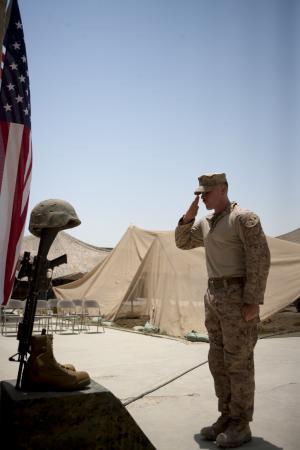
A U.S. Marine with 2nd Battalion, 8th Marines, Regimental Combat Team 8, pays his final respects to U.S. Marine Corps Cpl. Kyle R. Schneider during a memorial ceremony held at Patrol Base Hanjar, Sangin, Afghanistan July 7. Schneider was killed in action while conducting combat operations in the district on June 30, 2011(U.S. Marine Corps photo by Corporal Logan W. Pierce).

Over the past few weeks, I have taken a little time to focus on other priorities such as my primary job (I don’t write on a full-time basis), my family and my fitness (not necessarily in that order). In response to that focus, my attention had shifted away from militaria and the various aspects of collecting during that period of time. Now that we are in the latter half of May, I need to bring my thoughts back to my passion for military history as one of the most important holidays (in my opinion) draws near.

Turning on the news this morning, my interest in the weekend forecast is piqued as the meteorologist begins to discuss the cooler than normal temperatures, the risk of rainfall and how these conditions will impact camping, boating and backyard barbecue plans. The statement really struck me as my only considerations for this weekend surrounded spending time at the various cemeteries and placing flags on fallen veterans’ graves and those of my veteran ancestors and relatives. This activity is something my wife and I have been doing dating back to my time in uniform. Making alternative plans is never a consideration and now my children are so accustomed to this practice, they look forward to Memorial Day.

WWII Navy Veteran Frank Yanick Wreath 2012

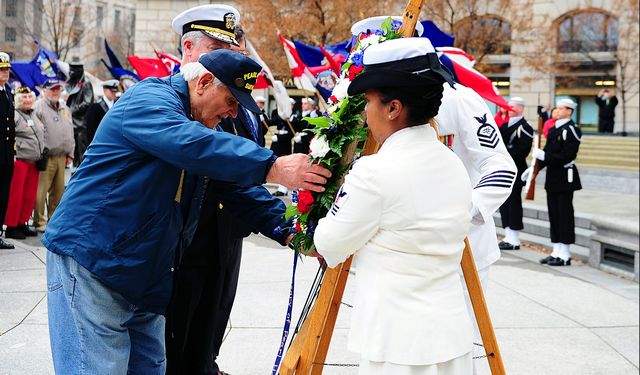
WWII Navy Veteran Frank Yanick honors fallen comrades by placing a wreath at a WWII memorial in 2012 (source: U.S. Navy photo )

As our culture continues to morph and shift with each passing year, the gap of time expands and the meaning and origins of Memorial Day fade from the American population’s conscience. In a time where less than half of one percent of Americans are serving in uniform, there is virtually no understanding of the personal sacrifices (that are routinely paid by those on active duty). When someone falls on the battlefield, that societal understanding of the price paid  just isn’t there. I increasingly wonder how it is that we arrived at this point.

Americans’ Participation in War

  • 1860 US Population (North + South): 29 million | 3.2 million served (10.35% of population)
  • WWII era (avg. 1941-45): 136.7 million | 16.1 million served (11.8 %)

  • Vietnam era (avg. 1964-74) 203 million | 9 million served (4.5%)
  • Current population: 314 million | 1.4 million serving (0.46%)

 With fewer Americans serving in uniform, particularly during the current wars in Iraq and Afghanistan, general population is disconnected from the costly nature of service. It is no wonder that our culture tends to be more self-focused as they spend Memorial Day without considering the sacrifices that afforded them the freedom to enjoy a three-day weekend.

MACKAY-DECK LST 342 #2.jpg

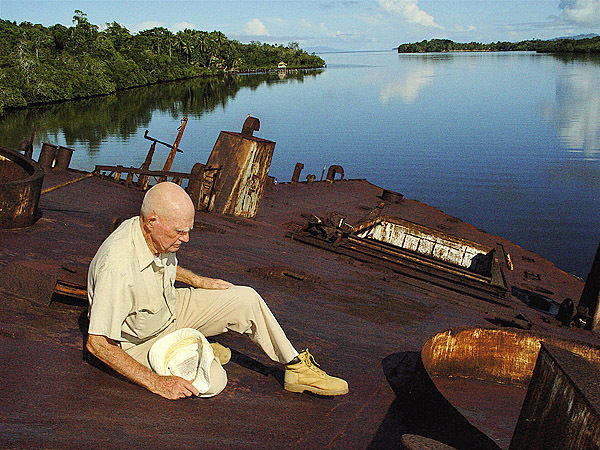
World War II Veteran Mac MacKay pauses for reflection after placing a wreath aboard his former ship, the LST 342, during a trip that several veterans made to Guadalcanal and Tulagi in 2009 (Photo courtesy of Anderson Giles).

Through my quest to understand the origins of this particular holiday, I have been led to be more forgiving of people who choose outdoor activities over trips to cemeteries. Considering that the present-day Memorial Day federal recognition was born from Decoration Day – a tradition started following the end of the American Civil War as surviving veterans began to deal with the battlefield losses of their comrades. Over the passing years, these veterans formed various veterans organizations (ranging from unit-specific to the enormous such as the GAR and UCV) and took the lead on preserving the legacy of those who made the ultimate sacrifice. Because of the efforts of these groups, battlefield and cemetery preservation and monument construction efforts were undertaken along with ceremonial gatherings for commemorative dedications.

Cavalry Veteran Places Wreath

Decked in his cavalry uniform, this old veteran places a wreath among the graves of veterans on Decoration Day.

Throughout our nation’s history, it has been the veterans who have taken the lead on honoring the war dead. Mourning the loss of a brother (or sister) who fell on the field of battle is something a surviving veteran never forgets. That moment isn’t simply a memory etched into their minds but rather akin to a remaining scar in place of a missing limb. It cannot be forgotten or, as some civilians would suggest, something to “get over.”

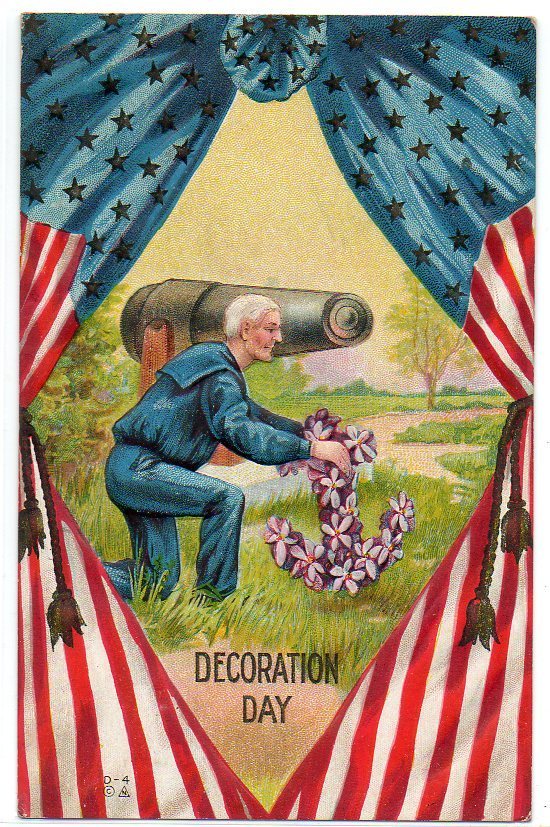
Civil War Navy Veteran

In this postcard, an old Navy veteran donned his uniform before carrying his anchor-shaped flower arrangement to the monument to render honors to the dead of the Civil War.

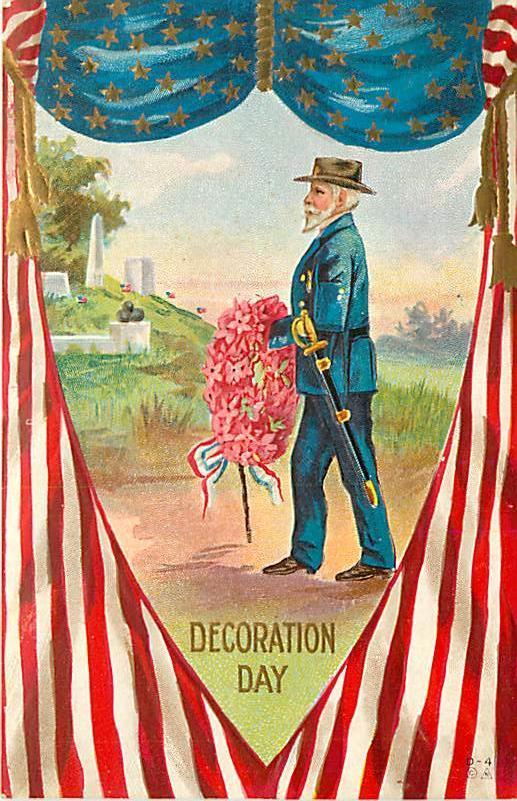
A few years ago, I started taking notice of various references to Decoration Day and antique items that make mention of it. One of those items that caught my attention was a postcard (from the early 20th Century) depicting an elderly Civil War veteran placing a wreath of flowers at a grave. The image, an illustration, was so moving that I was overwhelmed with emotions. The postcard evoked more recent memories of World War II veterans (at D-Day celebrations) paying respects to their fallen comrades some 70 years hence and the fresh, vivid memories painted across their faces.

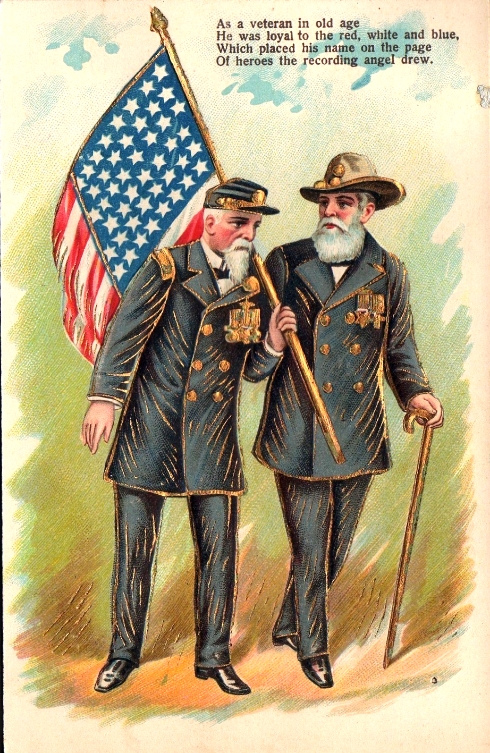
Comrades

This Decoration Day postcard depicts two elderly veterans of the Civil War assisting each other as they honor their comrades who fell in battle.

Over the course of the past century, it seems that nothing has changed. Veterans still ache for their lost buddies and they are compelled to continue to honor them as long as they are physically able to do so. As a veteran, I am committed to continuing the tradition of honoring and remembering those who gave their last full measure protecting and ensuring freedom for future generations.

Design a site like this with WordPress.com
Get started