Category Archives: World War I
Enlisted Aviators: Naval Aviation Pilots and Insignia
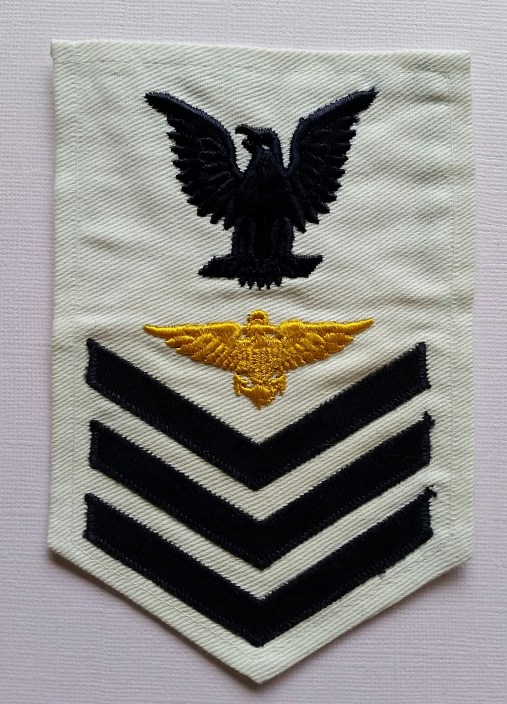
One of collectors’ most sought-after rating badges from the World War II-era (and prior), the Naval Aviation Pilot (NAP).
In the past six months, news stories centered on the increasing pilot-shortage issues faced by the United States Air Force have been frequently published in the media ranging from the Military and Air Force Times to mainstream outlets such as the Washington Post, New York Times and Fox News. With the severe cuts made to the armed forces in the last decade combined with retirements and a vibrant aviation industry, luring aviators from their Air Force careers to more financially lucrative civilian jobs, the stick and rudder vacancies are mounting leaving leadership to think creatively in order to fill the empty seats.
- Air Force May Approve Enlisted Pilots for First Time in 75 Years – By Oriana Pawlyk, Military.com, March 31, 2018
- Air Force program may lead to enlisted combat pilots – By Douglas Ernst – The Washington Times – December 6, 2017
- Enlisted pilots? – Editorial by Dick Trail, McCook Gazette, April 3, 2018
Not since World War II has the Air Force turned to the enlisted ranks to source candidates to pilot aircraft. In 2016, USAF leadership commenced a program to begin training (E-5 and up) enlisted drone pilots in an effort to free up experienced officers for candidacy as manned aircraft aviators. Leadership announced an expansion of the enlisted drone pilot program in January.
Utilizing enlisted personnel is certainly not a new idea for sourcing military aviator candidates. Both the Army and the Navy trained non-commissioned and petty officers as aviators prior to the United States’ entry into World War I. In fact, the Aviation Section, U.S. Signal Corps (the predecessor to the Flying Service which would become the Army Air Corps) was already engaged in training non-officer personnel as early as 1912, graduating the qualified men as Flying Sergeants. Similarly, the Navy graduated seven petty officers and two Marine Corps sergeants in 1916, launching the program that would evolve into the Naval Aviation Pilot rating.
-
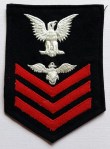
- The curved-wing NAP with a left-facing eagle. One of two such anomalies in my collection.
-
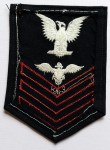
- Showing the reverse of the left-facing rating badge, this one is dated 1943.
-
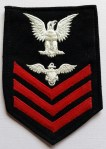
- The second of my two rating badges with a curved-wing NAP and a left-facing eagle.
-
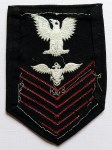
- Showing the reverse of the second (in my collection) left-facing rating badge, dated 1943.
Throughout WWI, enlisted pilot training continued for the Navy with flyers in ratings (Quartermaster and Machinist’s Mate) designated as aviators. A significant number of the enlisted aviators were offered and accepted commissions as naval officers while a few continued serving and flying as petty officers. In the years after the 1918 Armistice, the Bureau of Navigation (the command responsible for managing and training personnel) issued a policy that would incorporate enlisted and warrant officers as a standard practice for flight training. In a March 12, 1924 Bureau of Navigation Circular, the Navy officially established the rating of Naval Aviation Pilot (NAP) for for Chief Petty Officers. As the program continued, the Navy expanded the NAP rating for first class petty officers in September of 1927.
-
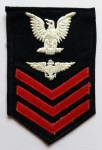
- This straight-wing NAP rating badge features the standard, right-facing eagle and is dated (on the reverse), 1944.
-
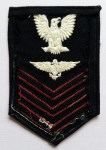
- The left side of the bottom chevron is embroidered with the 1944 date.
-
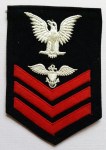
- A standard, right-facing NAP rating badge. This particular rating badge has an anchor embroidered on the reverse side.
-
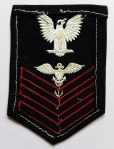
- The anchor-embroidery is not very common on rating badges. The maker that applied this mark is unknown to collectors.
With World War II in full swing and the shift from ship-to-ship fighting became secondary to over-the-horizon, aviation-based offensive tactics expanded the need for pilots exponentially. The Bureau of Navigation further expanded the ratings for NAP to include second and third class petty officers. During World War II, at least 2,200 NAPs earned their wings (according to Bluejackets.com). By 1948 when Congress discontinued the training program for enlisted naval aviation pilots, nearly 3,800 enlisted sailors had completed the training program since it was established. Though there would be no new NAPs following April 2, 1948, those existing in the rating who continued to serve on active duty, also maintained their rating and flight status in dwindling numbers. On January. 31, 1981, the last Navy enlisted pilot, ACCM Robert Jones (who had been designated in 1947) retired, closing the book on the NAP rating and insignia.
-
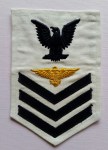
- The gold wings are straight, representing those of the officer’s wing device (worn above the left breast pocket). This 1945 NAP (gold on white) rating badge was made by New York Emblem Company (NYEC).
-
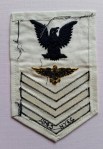
- Showing the revers with the NYEC and 1945 stitching.
-
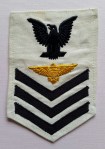
- Another example of the late-WWII straight winged gold NAP distinguishing mark.
-
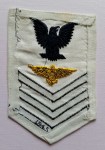
- The reverse of of the 1945-dated dress white NAP rating badge. The manufacturer of these date-only badges are unknown.
One of the most sought-after rating badges from the World War II-era is seemingly the Naval Aviation Pilot due to the decidedly high listing prices (some reaching upwards of $400). Whether people are actually paying these amounts is more difficult to determine.
The NAP rating badge consists of the Naval Aviator wings centered beneath the eagle and above the petty officer chevrons (and beneath the CPO arc). When the mark was established in 1924, the thread-color specification for the winged insignia was gold (or yellow) to match the Naval Aviator gold wing device. In the Bureau of Personnel circular of 12 July 1944, the color of the mark was changed to align it with the all other rating badges (i.e. white thread on dress blues and blue thread on whites).
-
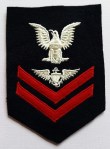
- The pattern of this wing differs from both the straight and the curved wings. This unusual design feature high, rounded shoulders. Also somewhat unusual is that the badge was made as a second class petty officer rather than being a 1/c petty officer to be cut and hemmed by the 2/c petty officer.
-
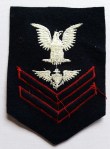
- The reverse of the high, curved-shoulder AP/2c has no maker’s marks or dates.
Aside from the color change of the mark, there are two design differences with the wings. Prior to World War II, the wings had a curved (some collectors call them “drooped”) appearance. Speculation among the collecting community suggest that the straight wing (that matches the appearance of the officer’s metal device) began making its way onto badges after 1942. In John Stacy’s invaluable resource, U.S. Navy Rating Badges, Specialty Marks & Distinguishing Marks 1885 -1982, the author references suggestions that the curved wing rating badge was used by naval personnel and the curved wing was adopted by Coast Guard NAPs, however provides a caveat that no supporting evidence exists.
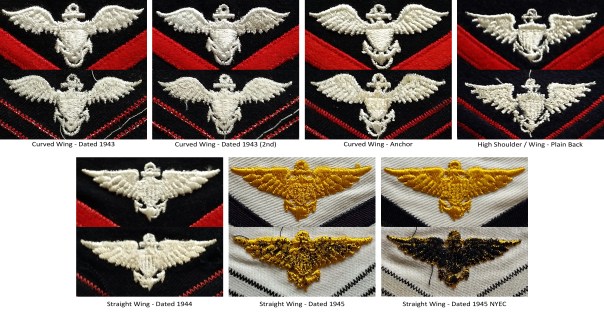
I have seven NAP rating badges and photographed each to show both consistency and variation across the same era. All of these are from the 1940s – perhaps all are from WWII.
John Stacey’s referenced comments made by the last NAP, ACCM Robert Jones regarding the different colored wing marks in the rating badges. The “white ones,” Jones commented, ” were (found in) small stores, gold were PX” referring the sources of the different badges. Further comments made by Jones (in Stacey’s book) state that Jones was authorized to wear either the gold or white (colored) rating badge on his dress (blue) uniform when he attained his designation as an AP1/c.
-
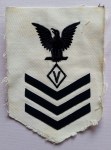
- The 1948-1960 Specialist V rating badge was used for the Aviation Pilots who continued to serve following the disestablishment of the NAP rating. The badge itself is unfinished as the chevrons are only held in place with the manufacturer’s adhesive.
-
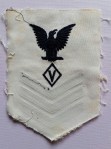
- The unfinished specialist V rating badge shows that the adhered chevrons had yet to be sewn into place.
Besides the winged insignia of the NAP, a specialist rating mark was also used for the Aviation Pilot rating. Originally established in 1942 for the Transport Airman rating, the “V” centered in a diamond insignia was re-purposed for the Aviation Pilot ratings for chief, first and second class petty officers from 1948 until it was disestablished in 1962 (BuPers Notice 1440, dated 29 December 1961; effective 1 March 1962).
Resources:
- Enlisted Naval Aviation Pilots (NAP) USN, USMC & USCG 1916-1981
- Enlisted Pilots Boosted Fledgling Flight Training Program
- The Flying Chiefs
- Navy pilot program opens to enlisted ranks
- U.S. Coast Guard Enlisted Naval Aviation Pilots (NAPs)
- U.S. Navy Rating Badges, Specialty Marks & Distinguishing Marks 1885 -1982
Discovering Rosalie: A French Model 1886 Lebel Bayonet Emerges from the Attic

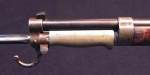
The cruciform blade of the Lebel. The point on this bayonet is quite sharp and could easily penetrate the heavy wool fabrics of the era.
After a lengthy run of posts covering United States militaria, it seemed appropriate to take a side-jaunt with an attempt to shed a little light upon military artifacts from another nation’s armed forces. Considering my limited experience with foreign military in general and thus even less knowledge in their militaria, I am decidedly headed into uncharted territory with this article.
This site’s three subscribers (ok, there are considerably more, but I seldom field any questions or hear any sort of feedback from them so it can be difficult to discern the actual number) understand that my collection does have a few pieces of foreign militaria and that rather than me seeking and adding them to my archive, they were handed down to me from an uncle who liberated them as war souvenirs during his service in Word War II (he continued on active duty until 1954 having also served in the Korean War. His military career commended when he enlisted to serve during the Great War).
Stowed away inside of trunks since they were sealed in theater and shipped back to the United States following the German surrender, the artifacts hadn’t seen the light of day since May of 1945. In 1994 when the trunks were discovered and opened, I took on the task to identify and obtain valuations for what was inside, once my jaw was able to close after being awestruck by what we found. Following disposition of some of the more rare pieces, I kept what was unsold and remained in my possession. The majority of those artifacts were Third Reich military with a smattering of my uncle’s personal effects and one odd item (that is the focus of this article), a French Model 1886 Lebel Bayonet.
When French chemist Paul Vieille introduced Poudre B, the first smokeless gunpowder in 1884, he propelled (pun very much intended) small arms technology light-years ahead, helping to usher in a new era of rifle and bullet design. While Vielle’s Poudre B produced more explosive force (more than three times that of conventional black powder) at a significantly reduced rate, the Swiss Army’s Eduard Rubin was developing a new jacketed round that would prevent the bullet from melting (as it traversed the rifle barrel) at the higher velocities created by the new gunpowder. The result of these advances prompted French military leadership to fast-track a new infantry rifle that would leverage these advances. The result was the Lebel Model 1886 or Fusil Mle 1886 M93 rifle.
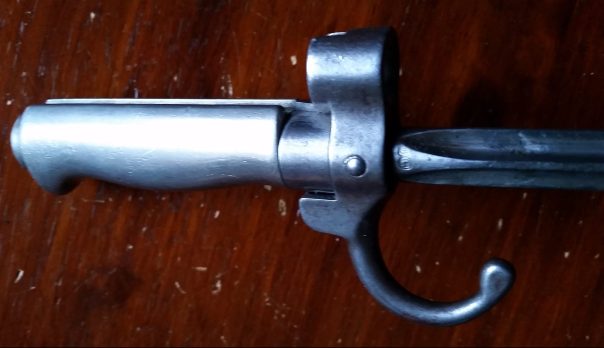
The Lebel bayonet’s handle is in fantastic condition having been stored away for more than 50 years. At the blade’s hilt are the letters “F” and “C” stamped into the metal.
While the Lebel rifle revolutionized infantry weapons, the accompanying bayonet was more inline with earlier , more antiquated designs. The Épée-Baïonnette Modèle 1886 bayonet employed a unique cross-shaped blade (when viewed from the point) which lacked sharpened edges, employing a lengthy point that was designed to penetrate the thick and heavy wool and leather uniforms of the day. The “Rosalie” as it was dubbed by the French, was in use from the 1880s to well into World War I. So popular was the weapon that it became the subject of adoration and lore, that French Poet Théodore Botrel‘s song, Rosalie was dedicated to the glory of “small French bayonets” and came to prominence in 1914 as World War I was ignited.
“Rosalie is elegant
Her sheath-dress tight-fitting,
Pour a drink!
Adorns her up to the neck
Let us drink then”
The Lebel bayonets were made with 20 ½ inch (52.7 cm) long blades, however they can be found in various lengths due to being re-pointed after tip-breakage during battlefield use. During the mid-1930s, many Lebel bayonets were modernized, reducing the length to be more comparable to newer designs and to reduce weight.
-
- Showing the ends of the scabbard and the Lebel.
-
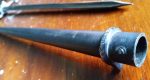
- Even the scabbard is in fantastic condition for this Lebel.
In their original design, the handle of the Lebel bayonets were constructed with a nickel-silver handle and a hooked quillion. However, mid-way through WWI (in 1916), conservation of precious metals for other war-uses led these parts being manufactured from brass. The hooked quillion was subsequently eliminated (during wartime production) as a result of battlefield feedback concerning it being cumbersome and easily ensnared on uniforms and accouterments when used on the enemy.
-
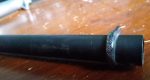
- The serial number of the scabbard is around the frog loop near the opening where the bayonet slides in.
-
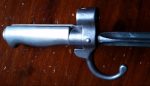
- The Lebel bayonet’s handle is in fantastic condition having been stored away for more than 50 years. At the blade’s hilt are the letters “F” and “C” stamped into the metal.
-

- Showing the handle and the butt-end of the Lebel. Notice the slot in the handle where it slides onto the attach point of the rifle.
The length of the blade was well-suited for use at the end of a rifle, but as ready fighting knife in the trenches of WWI, it was awkwardly lengthy prompting many soldiers to cut down the blade length to a more stiletto-type thrusting knife.
-
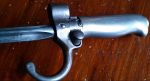
- The Lebels lock-release and the hooked quillion. Barely visible are the letters “T A” stamped into the quillion just below the intersection with the release housing.
-
- The Lebel rifle and bayonet mount (image source: Guns Magazine).
As far as the collectibility of this bayonet is concerned, there are several schools of thought ranging from those who avoid the item due to its seemingly abundance and lower values to collectors who see it as a fine representation of weapons-history, worthy of display. A quick glance at online auction listings, prices (at this article’s publishing date), the prices range from $50-300 (with no bids on any of the 20+ items that are available). Obviously, condition, construction and completeness of the bayonet (inclusive of the scabbard and frog) will affect the value.
Collectors could expend a fair amount of their finances seeking out each of the known examples of the Épée-Baïonnette, however I will stand firm with retaining the sole example of Rosalie in my collection. For me, it has more meaning as it was something that my uncle brought back from his service overseas, though I have no insight into whether he acquired it during WWI or WWII.
Are the Best Sources of Militaria Online?
Almost to a fault, I am an online shopper, especially when I shop for birthday and Christmas gifts. I compare prices and seek out the best deals (inclusive of shipping costs) and try to find the best blend of economy, availability and convenience before I commit to a purchase. If I can avoid visiting a store in person and still find a bargain, I am satisfied. However, there are still merchants that I do enjoy patronizing (my local bike shop, for one) in person.
An overwhelmingly large percentage of my articles here and on my baseball militaria site cover my acquired artifacts that were predominantly sourced via online auctions. Seeking the militaria pieces that I am interested in outside of auctions can be a fruitless task for a person who doesn’t have the patience for garage, yard and estate sales. There are a few military surplus stores in my region as well as a local militaria business (that is seemingly never open) but they typically sell and buy modern items. What other sources are there?
Several years ago when I was becoming active in militaria collecting, I was invited to tag along with some veteran-friends (they are all Vietnam vets) to drive a few hours to a military antiques show held at the Jackson Armory in Portland, Oregon. I was overwhelmed by the number of tables that were filled with artifacts from present-day and back to the Civil War. Not only were there American items but also pieces from other nations’ armed forces, captivating my attention for hours as I walked (and re-walked) each row. I arrived at the show without a single objective – I had nothing targeted as I didn’t know what to expect and as a result, left empty-handed. However, I did leave the show with a new understanding of the possibilities for locating pieces if other sources are do not yield results.

At this year’s show, there were considerably fewer tables of militaria for sale which coincided with the show’s small attendance.
As with other collectible shows (antiques, sports memorabilia, vintage toys, etc.), these gatherings are dominated by collectors and experts who are seeking to buy, sell and trade their pieces and since they are (mostly) private sellers, they don’t have the operating costs that brick-and-mortar business have to cover with their transactions. Items sold by individuals are generally less-expensive as they lack mark-up pricing.
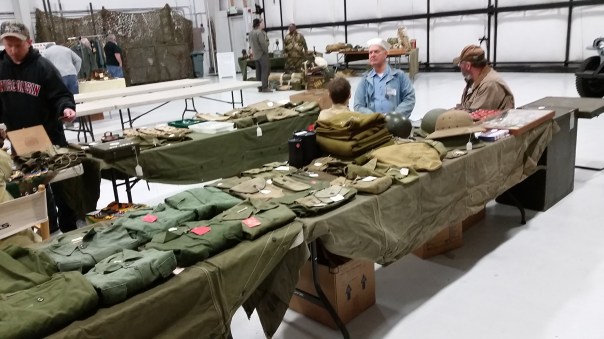
With so few customers to engage with, vendors socialized among themselves. Though the show was smaller than previous years, there was plenty for me see.
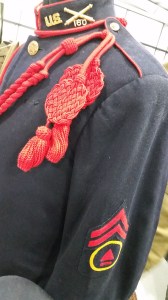
This beautiful CAC uniform (along with the cap from the same period) immediately caught my attention.
Aside from seeking specific items for my collection, I have since discovered that I enjoy attending militaria collectors shows just to be able to converse in person with other collectors and people who are passionate about preserving history. This was the case last month when I made plans to attend a local, semi-annual show, hosted at the Olympic Flight Museum in Olympia, WA. Considering that most of what I am presently seeking (military baseball artifacts) is seldom seen within militaria collections, I had no expectations heading into this show. The last time I attended, my son (a budding military history buff and part-time collector) accompanied me but he has since left the nest and embarked upon his own military career. Desiring to spend more time with my best-friend and wife, I asked her if she would join me. I should mention that I am blessed to be married to someone who shares my passion for history and encourages me with my interests (and sometimes assists with the editing of my writing when she is available).
-
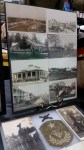
- This display of vintage photographs of local CAC forts was fantastic.
-
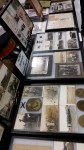
- Each one of these Riker cases displayed vintage artifacts from specific local CAC forts.
-

- Though this cap was not worn by the original owner of the displayed jacket, it is the correct head covering for this type of CAC uniform.
-
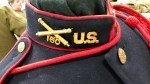
- The large brass crossed cannons devices are spectacular against the blue wool and artilleryman red trim.
It has been nearly four years since my last visit and upon entering (this year), my initial observation, compared to what I saw in 2014, I noticed that there were about half the number of tables. After a few hours of carefully viewing what was for sale along with a fantastic display of a Coast Artillery Corps (CAC) collection (artifacts from now-defunct local coastal forts), I purchased a few small pieces to add to my collection of WWII naval officers metal collar and cap insignia and headed out to take my wife to my favorite local Mexican restaurant for lunch.
-
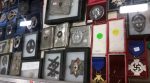
- I noticed that there was greater volume of foreign militaria at this year’s show. A large portion of it consisted of early 20th Century German and Third Reich items.
-
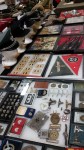
- Unless one is experienced and highly knowledgeable on Third Reich militaria, my advice is to stay away from these pieces as they are highly reproduced and expertly-faked pieces. That is not to suggest that anything at this dealer’s table was less than authentic.
-

- Though I have Third Reich pieces in my collection (my uncle sent them home as war souvenirs), I do not collect this sort of militaria.
-
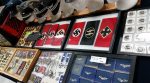
- It seems that with the current political climate, people react negatively at the sight of anything from the Third Reich. Recoiling in fear of artifacts (from our vanquished enemy) is an unreasonable reaction. The preservation of artifacts, even something that came from an evil power such as Nazi Germany, serves to remind us of the the evils of socialism and fascism.
-
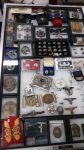
- Yet another case dominated by Third Reich militaria.
-
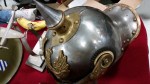
- These Imperial German spike helmets are impressive to see in person.
-

- For a mere $2,500, one could take this beautifully dressed Imperial German spike helmet home.
-
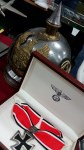
- A boxed Knight’s Cross of the Iron Cross was displayed (and for sale) next to the Imperial German spiked helmet.
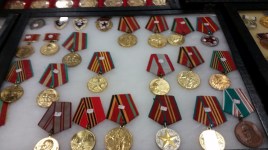
I am a veteran of the Cold War and seeing these Soviet medals being sold made me smile a little as I recalled the images of Russian officers with (seemingly) 60 pounds of medals pinned to their uniforms (see: https://bit.ly/2J0La8g).
With the Olympic show happening twice each year, the local opportunities are rather limited. I might consider driving to the Portland show in the future but that is about the farthest distance that I would consider traveling for militaria. If you reside on left side of the continent, The West Coast Historical Militaria Collectors Show (billed as the largest gathering of military collectibles west of the Mississippi) might be a worthwhile place to seek the obscure or rare pieces that have eluded you.
If you have been a collector of militaria for more than a few years, chances are you have heard about The Show of Shows (SOS). The SOS is the largest gathering of militaria collectors and dealers and is hosted annually by the Ohio Valley Military Society. Imagine, countless rows of tables filled with all manners of militaria being offered for sale. If one cannot find pieces to complete a collection at such a show, then it is either extremely rare or non-existent.
For my humble searches, I will continue with my online pursuits of military artifacts (along with future birthday and holiday gifts)
125 years of Deckplate Leadership: Chief Petty Officers of the U.S. Navy
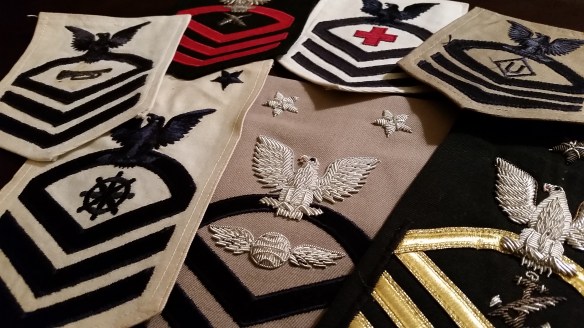
This is just a random selection of my CPO rating badges. A few of these date from WWII and still others are more contemporary, dating from the 1960s and 70s.
As I set out to write this article (I began writing the draft more than two weeks ago), I wasn’t consciously considering the timing of its publishing. Once I began to lay out the pertinent facts, it occurred to me that I needed to push the publishing date ahead by a few days (the originally scheduled date was the 5th). Hopefully my readers will follow this story through to the end to fully understand the historical significance of (what is known to most Americans as April Fools Day) April 1st.
In the decade that I served as a bluejacket; an enlisted sailor, I spent nearly seven of those years aboard ships (where else does real a sailor serve?). Regardless of where I served, my life was positively impacted by men who had the experience, knowledge and zeal for shaping the lives of young sailors in an effort to build cohesive and efficient teams that breathed life into the ships of our nation’s fleets. Like no other branch in the armed forces, the Navy’s senior enlisted leadership is set apart from seamen and petty officers which is visibly apparent, especially when the dress uniforms are worn.

CPO rating badges 1893-94 (image source: US Militaria Forum).
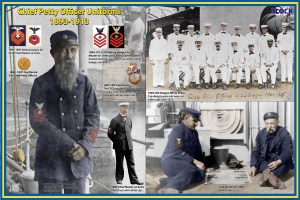
From the establishment of the CPO rating, their dress uniforms were very similar to those of naval officers (source: Naval History and Heritage Command).
Though there are earlier references to Chief Boatswain’s Mate, Chief Gunner’s Mate, and Chief Quartermaster or Signal Quartermaster (as described in General Order 36 of May 16, 1864 – effective July 1, 1864), the rating of Chief Petty Officer would not be truly established until April 1, 1893 when all petty officer ratings (and their pay) were officially set apart. One could argue that chiefs were effectively established on January 8, 1885, when the Navy classed all enlisted personnel as first, second, or third class for petty officers, and as Seaman first, second, or third class for non-petty officers, however at that time chiefs were positions rather than rated personnel.
With the official establishment of CPOs, these senior petty officers were effectively set apart from the lower ratings of petty officers. These sailors were the experts in their fields and it was expected of them to both train and lead their assigned subordinate and junior personnel. Officers also had expectations of the CPOs in their assigned divisions; as experts in these specialty fields, they would also be responsible for providing advice as well as being the conduit between the wardroom and the bluejackets.
For an officer to look back on their career and not see the importance of the role their first chief petty officer played when they were learning the ropes as a young division officer would be a gross oversight. The division CPO advises and guides and a bond of trust is created between the two that lasts a lifetime. At the end of the war (and close to the end of his career) Admiral Halsey participated in a ceremony to honor those who served. The following story was relayed by an author and WWII war correspondent in a subsequent book which illustrates the relationship between the CPO and the junior officer:
“At the end of World War II, all the towns and cities across the country were looking for a Home town boy makes good person to celebrate the victory with. Los Angeles chose Admiral Halsey, whom it was rumored had done quite well. The ceremony was held on the steps of the LA county courthouse, and at the end of it when Halsey was leaving, they had a line of sideboys. They were active duty and retired Chief Petty Officers that had been brought in from all over the country. As he walked through the ranks, my uncle walked apace on the outside. As Halsey approached one old CPO that my uncle described as being older than God, my uncle saw them wink at each other.
Later, at a cocktail party, my uncle had the opportunity to have a chat with the great Admiral. He commented on the wink between Halsey and this old Chief, and asked Halsey if he would mind explaining it. Halsey looked at me uncle very seriously, and said this: ‘That man was my Chief when I was an Ensign, and no one before or after taught me as much about ships or men as he did. You civilians don’t understand. You go down to Long Beach, and you see those battleships sitting there, and you think that they float on the water, don’t you?’ My uncle replied, ‘Yes sir, I guess they do.’ ‘ You are wrong,’ replied Halsey, ‘they are carried to sea on the backs of those Chief Petty Officers!'” – John Reese as told to his nephew, ATCS(AC) Jack Reese, USN (Ret.)
While other U.S. Armed Forces branches’ senior enlisted members possess similar leadership and authority, the role of the CPO is different. Unlike the other branches, the CPO is not a non-commissioned officer – the Navy does not have non-coms (as the Army, Marines and Air Force have with their enlisted leaders), though to some, the differences may be merely a technicality (consider that the two are separately called out in the NCO/PO handbook). Within the Army and Marines, the NCO (albeit, “junior”) status is attained at the paygrade of E-4 (corporal) and within the Air Force, an NCO begins with E-5 (Staff Sergeant). In the Navy, petty officer third class (E-4) commences the junior enlisted leadership status.
To the Navy novice, the uniform of the CPO is scarcely different from that of the naval officer though the subtleties are readily distinguishable. Prior to April 1, 1893, the uniform of a “chief” was essentially the same as that of a first class petty officer; sack coat style uniform. After the CPO rating was established, along with structural changes to all enlisted ratings (pay, rates), all petty officers and enlisted (non-chiefs) wore the same uniform. A new CPO rating badge was created that included three arcs over three chevrons with the distinguishing mark positioned inside. This design was similar to the rating badges that were worn by pre-1893 master-at-arms (MAA) first class petty officers. In the following year, the Navy adopted new designs for badges for all ratings that are still in use (albeit with some gradual design tweaks and the addition of two ratings above CPO: Senior Chief and Master Chief petty officers).
-
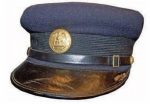
- Chief petty officer blue cape (1893-1897). The CPO cap device adopted in 1893 was the same device previously worn by first class petty officers from 1885-1893 (image source: US Militaria Forum).
-
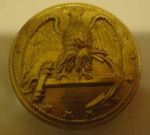
- Close-up of the 1893-97 CPO Cap Device (image source: US Militaria Forum).
Mass Communications Specialist, SN Dakota Rayburn of the USS John C. Stennis wrote in his article, A look back at the history of naval uniforms (published June 20, 2016, Kitsap Sun)”On April 1, 1893, the Navy had grown large and complex enough to necessitate the creation of the chief petty officer to help manage increasingly specialized rates. A chief still worked closely with enlisted personnel but also held managerial roles. That combination (eventually) required them to replace their white Dixie cup covers with the hard-billed combination covers and have durable working uniforms and service and dress uniforms similar to the commissioned officers’ to reflect their status.”
Until the establishment of the CPO rating, first class petty officer MAAs, in addition to the sack coat uniform were already wearing a blue cap that incorporated a rigid visor (or “bill” as noted by MCSN Rayburn). Affixed to the front of this cap was a unique device (resembling a large version of a gold uniform button) that bore the image of an eagle perched upon the shank of a horizontal anchor. Surrounding this design are thirteen stars, located just inside the circumference’s edge. This device and cap combination continued in use for CPOs after the ratings was officially established. Meanwhile, first class petty officers adopted the uniform that was consistent with junior enlisted personnel.
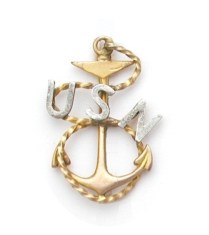
The 1897 CPO cap device was the first official metal insignia designed for chief petty officers. This device was worn at the front of the combination cover and rotated slightly counter-clockwise so that the U.S.N. appeared to be level (image source: Quarterdeck.corg).
By 1897, a new design for chief petty officer caps was approved, “CPO hat devices were first mentioned in the 1897 Navy Uniform Regulations and described the device as ‘The device shall be the letters U. S. N. in silver upon a gilt foul anchor,’ according to quarterdeck.org. The orientation of the silver letters was affixed rotated slightly so that when properly attached to the cap (positioned with the top of the anchor pointed towards 10-o’clock), the letters appear to be horizontal. In the years and decades to follow, the device would see changes ranging from the design of the anchor chain, how the chain was fouled around the anchor, the orientation of the U. S. N., the attachment devices, and finally with the addition of stars for the senior and then master chief petty officer ratings.
Besides the design variations that were the product of uniform regulation changes, the devices were also impacted by the individual manufacturers and suppliers of the devices. Some pieces were constructed from precious metals (such as sterling silver and gold) in different combinations. Many of these deviations are very minute and therefore create scarcities and thus influence values among collectors of CPO devices.
-
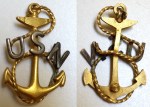
- Though this CPO device is very early (second pattern dating to 1910), had the pillow been associated to this period, the CPO device would be more aligned with this style.
-
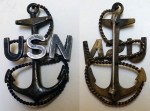
- Though I have been unable to nail down a specific match to this one that can give me a more precise date, I suspect that it was made and used during the 1920s (based upon the clasp, the style of the fouling, lettering, and the design of the anchor).
-
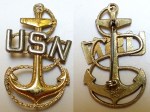
- This CPO device was made and used during the early years of WWII. By the war’s end, the “N” was no longer slanted as seen here.
-
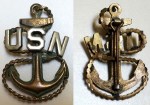
- A rather rare CPO cap device is the Australian-made edition that dates from WWII. It is hallmarked, K.G. Luke, Melbourne (the “K” is very faintly stamped).
Until a few months ago, my collection of CPO items consisted of a handful of rating badges, a half-dozen World War II-era uniform jackets (dress blues, whites and khaki) and a few combination caps with devices. I recently acquired four CPO cap devices that date from the first half of the 20th Century, the earliest piece originating from the first decade. Although I do collect Navy items, these haven’t been on my list of active pursuit.
-
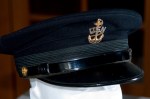
- Several years ago, I acquired this WWII-vintage dress blue CPO combination cover with the unmarked cap device.
-
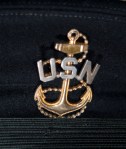
- A close-up of the CPO device on the WWII-era dress blue cap.
-
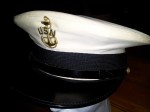
- Like the dress blue cap and device, this WWII-era dress white CPO combination cover also has an unmarked CPO cap device.
The number of CPO rating badges in my collection expanded a bit a few months ago and I am still getting my arms around what came into my collection (along with hundreds rating badges ranging in eras from WWII to the mid-1970s) that include ratings that existed for brief periods, mirroring the rapid development of naval technology and the specialists that would support or operate the associated equipment. Most of the badges are third, second and first class petty officers but there are a few CPO badges that I was quite happy to add into the fold.
Happy 125th to my CPO brethren on this significant milestone in the history of the United States Navy that you have all played such a significant role.
See also:
Embroidered Artistry – Shoulder Sleeve Insignia (SSI)
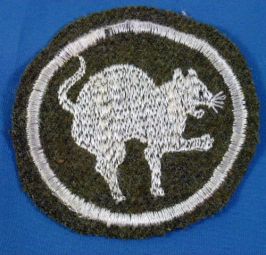
This WWI 81st Division shoulder sleeve insignia shows their division symbol, the Wildcat (image source: griffinmilitaria.com).
To most casual observers, army insignia patches (known as shoulder sleeve insignia or SSI) affixed to the shoulders of military uniforms, while visually interesting, are quite mysterious. Although today’s current designs are subdued (with muted black or brown stitching to be consistent with current camouflage schemes), they still employ sophisticated and intricate embroidery that formerly were lavished with brilliantly colored thread-work. Prior to the early 20th Century, other than rank insignia, army troops’ shoulders were plain.
During World War One, the 81st Division was the first to be authorized to employ a shoulder-affixed unit identification as they headed for France in 1918. The “Wildcats,” as the 81st was known, was the only U.S. Army division with permission for their personnel to wear patches on their uniforms during the war. With only a few short weeks remaining in the war, other units followed suit obtaining permission from General John J. “Black Jack” Pershing to begin wearing patches on October 19, 1918. Soon, there would be an abundance of varying unit insignia with multiple variations of patches for the individual units.
-
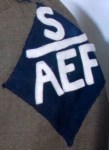
- The patch of the American Expeditionary Force Siberia (AEF Siberia) was a United States Army force that was involved in the Russian Civil War in Vladivostok, Russian Empire, during the end of World War I after the October Revolution.
-
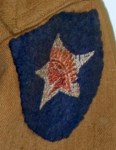
- This patch of the 2nd Infantry Division (the Indianheads) is still active. It was formed in France in 1917 and is now based in Washington State.
Many of the WWI patches were constructed in-theater and were hand-made resulting, in some cases, with various representations on the same design. As a patch collector, this is both a point of frustration and enjoyment as they could spend years tracking down every known SSI-design instance.
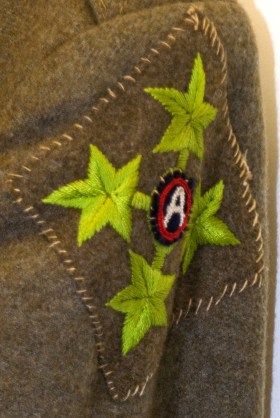
This unique 4th Infantry Division patch features a roundel insignia of their parent, the 3rd Army in the center of the patch.
As WWI veterans returned home, their ornately decorated uniforms drew the attention of would-be collectors and soon, the practice of stripping uniforms for their patches was born. It wasn’t uncommon for veterans to gift these patches to their children, giving birth to what would become one of the largest segments of militaria collecting, to this day.
Exercise caution (or seek advice of experienced collectors) prior to purchasing patches of this era. Considering the availability of period-correct wool flannel material, many of the World War 1 SSIs are easily reproduced and passed off to inexperienced collectors as authentic.
Shoulder Sleeve Insignia of the American Expeditionary Forces 1918-1919
By the mid-1930s, collectors in upstate New York organized an exchange that would become the basis for The American Society of Military Insignia Collectors or ASMIC, one of the oldest organizations in the area of militaria collecting. With a resource such as ASMIC, collectors can draw from the knowledge of professional collectors as well as trade or purchase insignia.
In the years leading up to and during World War II, SSI were mass-produced and designs were standardized which meant that variations would be reduced. However, this did not eliminate variations altogether.
During the Viet Nam war, subdued patches were introduced for wear on combat uniforms providing additional variants of the same insignia. With the downsizing and restructuring of the Army, units have been decommissioned or combined resulting in fewer SSIs. When the U.S. Army transitioned to the Army Service Uniform (ASU), or dress blues, completely by October 1, 2015, the change all but eliminated the colorful patches as they are no longer worn on dress uniforms.
The only constant is change and uniform changes have been happening within the Army, Air Force and Navy in the past few years. Awaiting approval by
Will the Army do away with unit patches all together? Only time will tell.
 The Veteran's Collection