Category Archives: Military Era
A Piece of Memphis Belle’s Heart
In the sub-freezing temperatures, you find yourself watching for them. Anxiety has long-since set in and your heart-rate is rapid causing you to draw quick, short breaths from the cold oxygen flowing into your mask. You’re thinking back to the darkness of the early-morning hours, reviewing all of the landmarks as you check the heading. At 35,000 feet, your aluminum tube is barreling ahead, amidst a cloud of familiar shapes, at nearly 200 miles per hour. Your body is no longer aware of the vibrations and deafening roar of the four Wright Cyclone radial engines and their steady drone. You’ve been through this same routine (as if any of this can be considered “routine”) two dozen times before.
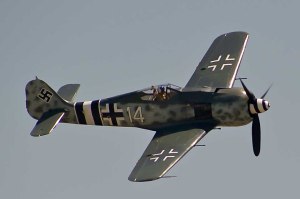
Sighting numerous Focke Wolfe 190 fighters was sadly a common occurrence for B-17 crews.
Suddenly, excited chatter is piped directly to your ears via the cold headset. Your fellow crew-members have sprung to life as they call them out – the dreaded camouflage-painted Focke-Wulf Fw 190 bearing the black cross of Germany. The flight of attackers begins to assail the surrounding B-17F aircraft in your group. You reach for the trusty Browning M2 .50 caliber machine gun as you scan the skies for the attackers.
Gripping the handle of the gun with your fleece-lined leather gloves, you begin to train the weapon as you search for the enemy. You try to fight back the fear while looking through the Plexiglas nose, seeing another Flying Fortress rollover into its deadly dive. You don’t have time to look to see if there are any chutes, yet you are hold on to a shred of hope that those men do somehow manage to survive…

The crew of the Memphis Belle pose in front of the aircraft that returned from 25 deadly missions over German-held positions. Captain Evans is pictured, second from the right in the back row.
52,000 Americans perished in the air over Europe during World War II over the span of three and a half years. Contrast that to 58,000 Americans who lost their lives during the entire Vietnam War. It is difficult to imagine that bomber crews had to complete 25 bombing missions before they could be sent home. More than 750,000 bombing sorties were flown by U.S Army Air Force aircraft over Europe and just under 10,000 bombers were lost. The odds were infinitesimal that one aircraft could survive all of those missions and return home during the war. One of those B-17s that achieved that mark was the famed Memphis Belle (Boeing B-17F-10-BO Flying Fortress Serial 41-24485) – the first heavy bomber to do so. The monumental feat was the subject of a William Wyler documentary, Memphis Belle: A Story of a Flying Fortress, released in 1944 to American audiences by Paramount Pictures.
Though I attempted to paint a picture of what it was like for these men, words could never come close to describing that experience. A single mission was harrowing for these amazing men. I often wonder which was more unnerving – the first mission or the twenty-fifth and final one. For Captain Vince Evans, sitting in the bombardier chair for those several harrowing hours on May 19, 1943 on a raid over German port-city of Kiel on the Jutland peninsula.

Many questions surrounded this jacket as to its authenticity. Some collectors were quite doubtful while still others suggested that it was genuine (source: eBay image).
When an item from one the 10-member crew of the Memphis Belle, it certainly doesn’t go unnoticed. A few years ago, what appeared to be a cut-down, tailor-made officers jacket complete with period correct insignia and devices was listed at auction. Inside the jacket was a label with Captain Evan’s personal information, including his Army serial number (ASN). One issue some collectors raised with this listing was the seemingly incorrect ribbon bar. One important piece absent from the bar was Captain Evan’s Distinguished Flying Cross (DFC) ribbon which was awarded to all ten crewmen. Vince would subsequently receive an additional DFC. The ribbon for the Air Medal is also absent devices which Evans would have had to indicate multiple awards.

The Captain Evans jacket label shows his name and service number (source: eBay image).
Regardless of the minor shortcomings, the jacket is believed (by several collectors) to be genuine and was more than likely set aside by Evans after the war in favor of a newer uniform. The correct (or better yet, original) ribbon bar was probably removed (by Evans) for wear on the new uniform.
-
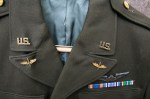
- The period-correct collar devices are beautifully displayed on the Evans jacket (source: eBay image).
-
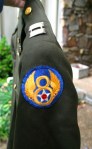
- The Evans jacket has the SSI of the 8th Air Force on the left shoulder (source: eBay image).
-
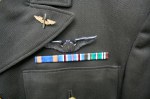
- Captain Evans’ bombardier wings and ribbon bar, complete with a ribbon from his Air Medal, American Campaign Medal and his European–African–Middle Eastern Campaign Medal (source: eBay image).
Following his WWII service, Evans began working with Wyler in his new profession as a writer in Hollywood with two films to his credit: Chain Lightning (starring Humphrey Bogart) and Battle Hymn (starring Rock Hudson). Evans served in the USAF Reserve until his discharge (at the rank of major) in 1953. Sadly, Major Evans would perish (along with his wife, Margery and their 21 year-old daughter, Venetia) in a small airplane when it crashed a few miles short of the Santa Ynez Valley airport in 1980. What the Luftwaffe and Nazi anti-aircraft gunnery could not do, a series of atmospheric conditions did. It was never determined who was in control of the aircraft (Evans or the flight instructor) at the time of the crash.
The Memphis “Belle lost one of her sweetest members” wrote Colonel Robert Morgan (in his book, The Man Who Flew the Memphis Belle: Memoir of a WWII Bomber Pilot), “a large piece” of her heart went down that day.
More than 40 bids from buyers eager to land a piece of history so closely-tied to the famed aircraft drove the final sale price to $1,026.97 which for many militaria collectors is a bargain considering the notoriety of the Memphis Belle and her crew.
Embroidered Artistry – Shoulder Sleeve Insignia (SSI)
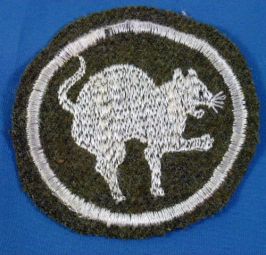
This WWI 81st Division shoulder sleeve insignia shows their division symbol, the Wildcat (image source: griffinmilitaria.com).
To most casual observers, army insignia patches (known as shoulder sleeve insignia or SSI) affixed to the shoulders of military uniforms, while visually interesting, are quite mysterious. Although today’s current designs are subdued (with muted black or brown stitching to be consistent with current camouflage schemes), they still employ sophisticated and intricate embroidery that formerly were lavished with brilliantly colored thread-work. Prior to the early 20th Century, other than rank insignia, army troops’ shoulders were plain.
During World War One, the 81st Division was the first to be authorized to employ a shoulder-affixed unit identification as they headed for France in 1918. The “Wildcats,” as the 81st was known, was the only U.S. Army division with permission for their personnel to wear patches on their uniforms during the war. With only a few short weeks remaining in the war, other units followed suit obtaining permission from General John J. “Black Jack” Pershing to begin wearing patches on October 19, 1918. Soon, there would be an abundance of varying unit insignia with multiple variations of patches for the individual units.
-
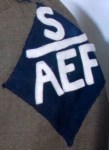
- The patch of the American Expeditionary Force Siberia (AEF Siberia) was a United States Army force that was involved in the Russian Civil War in Vladivostok, Russian Empire, during the end of World War I after the October Revolution.
-
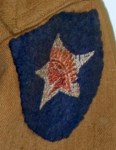
- This patch of the 2nd Infantry Division (the Indianheads) is still active. It was formed in France in 1917 and is now based in Washington State.
Many of the WWI patches were constructed in-theater and were hand-made resulting, in some cases, with various representations on the same design. As a patch collector, this is both a point of frustration and enjoyment as they could spend years tracking down every known SSI-design instance.
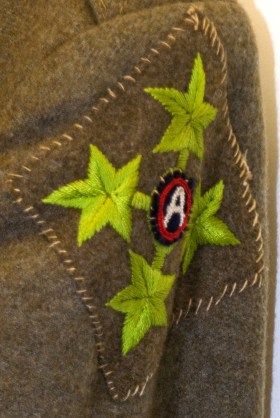
This unique 4th Infantry Division patch features a roundel insignia of their parent, the 3rd Army in the center of the patch.
As WWI veterans returned home, their ornately decorated uniforms drew the attention of would-be collectors and soon, the practice of stripping uniforms for their patches was born. It wasn’t uncommon for veterans to gift these patches to their children, giving birth to what would become one of the largest segments of militaria collecting, to this day.
Exercise caution (or seek advice of experienced collectors) prior to purchasing patches of this era. Considering the availability of period-correct wool flannel material, many of the World War 1 SSIs are easily reproduced and passed off to inexperienced collectors as authentic.
Shoulder Sleeve Insignia of the American Expeditionary Forces 1918-1919
By the mid-1930s, collectors in upstate New York organized an exchange that would become the basis for The American Society of Military Insignia Collectors or ASMIC, one of the oldest organizations in the area of militaria collecting. With a resource such as ASMIC, collectors can draw from the knowledge of professional collectors as well as trade or purchase insignia.
In the years leading up to and during World War II, SSI were mass-produced and designs were standardized which meant that variations would be reduced. However, this did not eliminate variations altogether.
During the Viet Nam war, subdued patches were introduced for wear on combat uniforms providing additional variants of the same insignia. With the downsizing and restructuring of the Army, units have been decommissioned or combined resulting in fewer SSIs. When the U.S. Army transitioned to the Army Service Uniform (ASU), or dress blues, completely by October 1, 2015, the change all but eliminated the colorful patches as they are no longer worn on dress uniforms.
The only constant is change and uniform changes have been happening within the Army, Air Force and Navy in the past few years. Awaiting approval by
Will the Army do away with unit patches all together? Only time will tell.
Theater-Made Militaria: Shoulder Sleeve Insignia…are they Real?
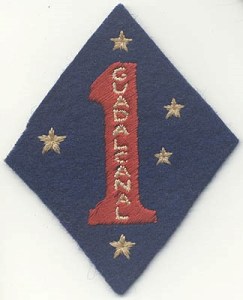
This Australian-made First Marine Division patch was created for the battle-hardened veterans of Guadalcanal while on R&R in Melbourne Australia (source: Flying Tiger Antiques).
Within the realm of just about every collecting pastime exists undocumented glossaries packed with terms and phrases used to describe certain aspects of that particular genre. For those of us new to collecting, these terms can be some of the biggest obstacles to understanding the ins and outs of collecting, especially as we are trying to navigate our way to better understand specifics and details.
In some instances, terms can be rather self-explanatory (at least for people like me), but still may not make a whole lot of sense. Such is the case with “theater-made.” which seems to be bandied about rather freely.
As I launched into militaria collecting, I saw the term applied to a broad swath of army items, predominantly shoulder sleeve insignia (or patches) dating from World War I to present day. What astounded me was that these experts could spot not only that a particular piece was theater-made, but could tell you where in the world it was made. With certain pieces, a theater-made example could sell for considerably more than an American-made patch. The Australian-made 1st Marine Division patch comes to mind.
-
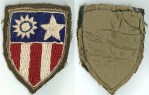
- This China Burma India (CBI) patch is one of my theater made SSIs.
-
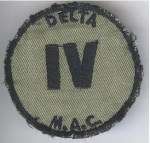
- My father, a Viet Nam combat veteran, wore a patch like this on his OD fatigues in country. I have my doubts as to the authenticity of it as a vintage patch, instead it could be one of the thousands currently reproduced in Viet Nam to capitalize on the growing collector market
As a veteran of the U.S. Navy, theater-made items seem commonplace. During our six month-long deployments to the Western Pacific, our ships would visit ports in countries such as the Philippines and Hong Kong. During our three- and four-day stays, many of us would take what little money we saved and head out to the tailor and embroidery shops to order custom uniforms or uniform items from the local craftsmen. These special-order pieces add a unique and personal touch for uniforms worn out on liberty or to make us stand out in a positive manner during inspection. However, we never thought of these components as theater-made.
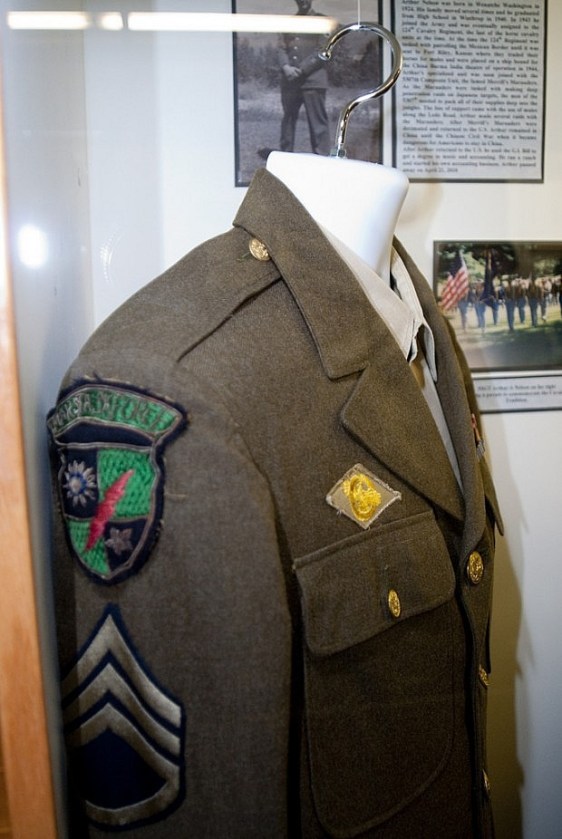
This WWII army veteran’s uniform sports a right-shoulder SSI of the 5307th Composite Unit (also known as Merrill’s Marauders).
As some of the custom pieces are slightly more rudimentary in construction, forgers tend to leverage that to their advantage. When collectors begin to pursue what are being passed off as theater-made items, they must have some sort of education before pulling the trigger to protect themselves from being deceived.

Researching to Establish Provenance: A Cigarette Box with Historical Connections
While much of my militaria collection consists of family-connected items (such as uniforms, decorations, documents and photographs) I also have some oddities that serve to add interest and perhaps to make a display more visually aesthetic. In reviewing the (online displays of) collections from other enthusiasts, it is quite easy to see that many of them have focused their attention upon such areas as service branches, theaters of combat, veterans’ groupings, decorations and medals to list the most prevalent.
-
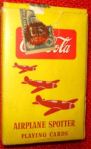
- These Coca-Cola branded “Airplane Spotter” playing cards are a great example of a cross-over collectible. Collectors of Coke memorabilia, militaria and even of playing cards would enjoy these in their collection (source: eBay image).
-
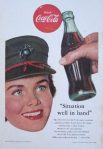
- Military-themed advertising is another example of collectibles that have cross-over appeal (source: eBay image).
-
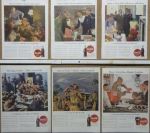
- Plucked from the pages of magazines such as “Life,” these colorful, patriotic adverts look fantastic dislayed with other Coca-Cola memoriabilia or militaria (source: eBay image).
Crossover collecting can be even more rewarding due to the uniqueness that it offers the enthusiast. For example, an individual may already be a collector of memorabilia from a commercial company such as Coca-Cola (focusing on signage, advertising, drinkware, etc.) who then discovers a militaria sub-set within that area of collecting. Other areas of militaria crossover can include Tobacciana, Zippo lighters and my personal favorite, baseball.
The piece that I am focusing this article on does fit into a crossover the tobacciana category but hardly signifies that my interests are branching into that area of collecting. This artifact fits into another crossover facet of collecting that is more my speed: folk art or, in military terms, Trench Art. As an amateur military historian and someone who enjoys artifacts related to the U.S. Navy, this cigarette box was something of interest to me. I also thought that the piece would look great on my dresser and serve as a storage place for personal items while fitting in alongside of my other antique boxes.
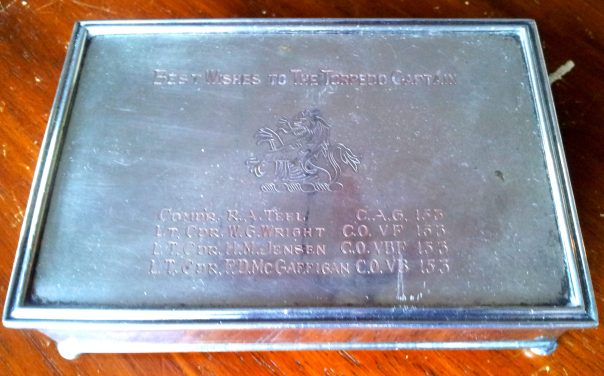
I have owned this silver cigarette box for several years but never spent any significant time researching it.
The cigarette box is engraved with “Best Wishes to the Torpedo Captain” along with a griffin and a list of naval aviators and their commands (part of Air Group 153). When I first acquired this piece, I assumed it was made from scrap metal – possibly obtained from an aircraft part – and crafted by a squadron aviation structural mechanic. As the box has since been displayed for the last few years, the surface has tarnished which leads me to suspect that the metal material is silver. The absence of any hallmarks means that the only way to determine the material composition is to perform one or more tests (hopefully) without damaging the artifact.
-
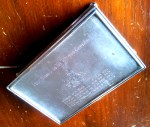
- Though it has no hallmarks, it seems to be a nice piece of craftsmanship.
-
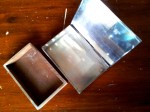
- The cedar lining is removable.
-
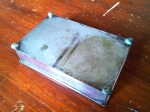
- The feet are brazed onto the bottom which is a mark of good craftsmanship.
As with other militaria artifacts, especially named pieces, researching is part of the enjoyment (and sometimes the pain when research hits a dead-end) and though the collector that I purchased this from included some information, I pursued the information further. Examining the engraving, the names are listed out:
COMD’R. R. A. Teel, CAG 153
L.T. CDR. W.G. Wright, C.O. VF 153
L.T. CDR. H. M. Jensen, C.O. VBF 153
L.T. CDR. F. D. McGaffigan C.O. VB 153
Judging by the present information, one would think that the odds to identify the box’s original owner might be fairly descent, and with good reason considering that there were nine data points (ten, if one includes the griffin and the presentation statement) to base the research upon. Understanding nomenclature, rank abbreviations and the numerics of naval aviation squadrons is a good starting point. Navy rank abbreviations during WWII were a bit more complex than the simplified modern counterparts. Officer rank structure can be defined easily:
| Rank | WWII Abbreviation |
Current Abbreviation |
| Ensign | Ens. | ENS |
| Lieutenant Junior Grade | LT.j.g. | LTJG |
| Lieutenant | LT. | LT |
| Lieutenant Commander | L.T. CDR. | LCDR |
| Commander | COMD’R | CDR |
| Captain | CAPT. | CAPT |
For those who are new to naval aviation squadron designations and their meanings, “V” is the designation for fixed wing aircraft. For the sake of brevity and keeping this post focused on these specific squadrons, I’ll refrain from providing definitions for all WWII naval aviation squadrons.
- CAG – Commander, Air Group
- VF – Fixed Wing Fighting Squadron
- VBF – Fixed Wing Fighting/Bombing Squadron
- VB – Fixed Wing Bombing Squadron
Commander, Air Group 153 (listed above as “CAG”) with Commander R. A. Teel, was the group commander who was responsible for the squadrons within his group (VF-153, VBF-153 and VB-153). Lieutenant Commanders W.G. Wright, H.M. Jensen and F.D. McGaffigan were commanding officers of the subordinate squadrons reporting up to Commander Teel. Successfully researching the information (names, squadrons) will certainly help to provide great information but I have no way of determining the original owner of the box (to whom it was presented). Being geographically located at the farthest reaches from the National Archives or the Naval History and Heritage Command in Washington, DC (while still residing within the contiguous United States) limits the scope of research. I am resigned to scouring the fractional data that is available online.
The ultimate goal of my research was to determine the identity of the original owner of the cigarette box which, when I purchased it, was thought to have been one of the aviators named in the engraving. Judging by the inscription, “Best Wishes to the Torpedo Captain,” that title, in my estimation, refers to the commanding officer of the squadron of torpedo bombers. Being that all of the other listed squadrons were either fighter, fighter-bomber or bomber squadrons, it would seem that the Torpedo Captain would have been the skipper of the Air Group’s VT squadron, which was not engraved onto the box.
Before proceeding further, I sought to confirm that the air group’s assigned VT squadron also shared the same numbering convention. A quick search led me to a very limited listing of Air Group One Fifty Three (ComAirGrp 153). Indeed, the composition of the group consisted of four squadrons:
- VB-153 (composed of 15 VSB aircraft, or fixed wing scouting bombers)
- VF-153 (composed of 36 VF aircraft, or fixed wing fighters)
- VBF-153 (composed of 36 VF aircraft)
- VT-153 (composed of 15 VTB aircraft, or torpedo bombers)
While this information was a solid initial step, the source lacked further confirmation regarding any of the engraved names on my box. As I write this article, I await a response from a fellow collector who has access to naval aviation records. Turning my attention to the names listed on the case, I do have a few avenues in which to proceed in order to get a clearer picture of the careers of these naval aviators. When I received the box, inside was a folded-up printout (of a WWII Memorial entry for Francis D. McGaffigan) that provided me with a head start for one of the box’s engraved names.
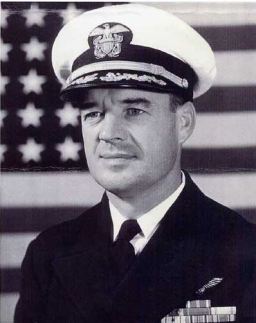
Captain Francis Daniel McGaffigan (source: WWII Memorial).
Lieutenant Commander F. D. McGaffigan, my research revealed, was born January 13, 1910, to Irish immigrants in Boston, Massachusetts. After graduating high school, he enlisted as a Seaman Second Class and was assigned to Naval Aviation Elimination Training in Boston (shown in official records as “Squantum”) in January of 1940. According to his memorial page (submitted by a family member), the naval aviator served with a number of commands during WWII. I’ve spotlighting a few:
- Commanding Officer, Bomber Squadron (VB) 306, flying SBD-5 Dauntless , Solomon Islands
- Commanding Officer, Bombing Squadron 99, Saipan
McGaffigan’s career as listed by his relative is highlighted with the following post-war assignments. Subsequent research could determine what, if any, wartime service the captain might have experienced prior to the conclusion of his career.
- Commanding Officer, Bombing Squadron 150, USS Lake Champlain (CVS-33)
- Commanding Officer, Bomber Squadron 153, USS Kearsarge (CV-33)
- Air Officer, USS Essex (CV-9)
- Commanding Officer, Naval Air Reserve Training Unit, NAS Lakehurst (NJ)
Captain McGaffigan’s awards and decorations which include:
- Distinguished Flying Cross
- Air Medal (3)
- Naval Reserve Medal
- American Defense Service Medal
- Asiatic–Pacific Campaign Medal (with campaign star)
- American Campaign Medal
- World War II Victory
McGaffigan’s post-naval life commenced with retirement in 1960, and he lived out his year, passing in 2001.
After searching through the careers of the naval aviators listed on the box, it is clear that the name that was absent is the one who was presented with the box from the remainder of those listed, starting with the Commander Air Group (CAG), Commander Richard A. Teel.
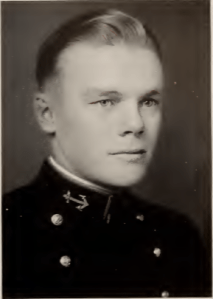
Richard Ashley Teel’s 1936 Naval Academy graduation portrait (source: The Lucky Bag).
Commander Richard Ashley Teel was born on Christmas Day, 1913 in Annapolis, Maryland (his father, Roland M. was a boy’s school principal and his mother, the former Susan B. Ashley, was an English immigrant homemaker), and after completing high school (at Severna Park H.S.), he entered the United States Naval Academy in June of 1932. Upon his graduation and commissioning, Teel was assigned to the battleship, USS New Mexico (BB-40). In 1938, LTJG Teel reported to Naval Air Station Pensacola for aviation training. Teel’s first assignment upon receiving his naval aviator’s wings was with the newly formed Bombing Squadron Seven (VB-7) aboard the USS Wasp (CV-7) in 1939. By 1942, VB-7 was redesignated a fighter squadron (VF-71) and was transferred to shore-based operations on Espirtu Santo following the sinking of the Wasp in September of 1942 (she was torpedoed by a Japanese submarine). After VF-71 was disbanded, LT Teel was flying from the USS Independence (CVL-22). Considering that Commander Teel is not the focus of this research, I ceased pursuing his career further. I was able to find that Captain Richard Teel retired after thirty years of service on July 1, 1966, and enjoyed another 28 years, passing on August 9, 1994. Richard Ashley Teel’s final resting place (the Naval Academy Cemetery) is not far from his birth home in Annapolis.
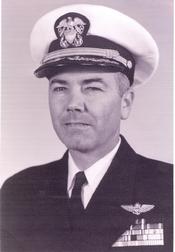
Commander Wilson George Wright III.
Lieutenant Commander Wilson George Wright III was born in Ogden, Utah, on May 15, 1916, to Wilson G. and Lelia D. Wright. He graduated from Ogden High School, and attended Weber College for one year and then entered the U.S. Naval Academy in June of 1935, and was commissioned an ensign on June 1, 1939. Following graduation from the Naval Academy, Wilson served one year on the battleship USS Idaho (BB-42) and one year on the USS Lamson (DD-367). Wright reported to NAS Pensacola for flight training and was designated a Naval Aviator on December 16, 1941. His first aviation duty was in VF-71 aboard USS Wasp (CV-7) and flew combat missions surrounding Guadalcanal in support of the First Marine Division landings during the invasion of Guadalcanal, August 7-8, 1942. LTJG Wright was aboard when the Wasp was torpedoed and sunk by Japanese submarine I-19 near San Cristobal Island in the Solomon Islands.
Wright’s next assignment was as Executive Officer of VF-33 which was land-based in the Solomon Islands, flying many combat missions including fighter sweeps and bomber escort missions over Rabaul.
Following six months as a Fighter Type Instructor at the Naval Air Station Atlantic City, he was ordered to the Naval Air Station Grosse Ile, Michigan, to start and commission Air Group 97, and served in that unit as the Commanding Officer of Fighter Bomber Squadron 97. He was awarded the Navy Commendation Medal for his service in Air Group 97. Upon the decommissioning of Air Group 97, Wright’s next assignment was as the commanding officer of Fighter Squadron 153, followed by a tour as the commanding officer of the Flag Administrative Unit and finally, as the staff personnel officer of Commander Fleet Air Alameda.
Following his retirement, having attained the rank of commander, Wright worked as an engineer and supervisor in the aerospace industry, spending three years with the Lockheed Missile Division on the Polaris Missile project, 17 years with Rockwell Space Division and was involved with the lunar landings and the Space Shuttle programs. He was 95 years old when he passed away on Nov. 2, 2011, and was laid to rest in home state of Utah.
Among Wright’s numerous awards and decorations were:
- Distinguished Flying Cross
- Air Medal (5)
- Navy Commendation Medal
- American Defense Service Medal
- Asiatic–Pacific Campaign Medal
- American Campaign Medal
- World War II Victory
The last of the names listed turned out to not only be notable, but he earned the status of an Ace fighter pilot (meaning that he had five confirmed air-to-air enemy kills) during his service with VF-5.
Lieutenant Commander Hayden Martin Jensen was born on January 30, 1911, in St. Paul, Minnesota where he attended high school and college. Jensen was commissioned an ensign on August 19, 1939. Having completed flight training, Ensign Jensen was assigned to Bombing Squadron Five (VB-5, part of the Yorktown Air Group), flying the Northrop BT-1 aboard the USS Yorktown (CV-5). By 1941, the young ensign had transferred to VF-5 (the “Stafighters”) as his role changed from a bombing to a fighter pilot, flying the F4F-3 Wildcat. Still assigned to VF-5 when it was transferred to the USS Saratoga (CV-3) in June of 1942, Jensen would meet the enemy in the South Pacific – in the Guadalcanal Campaign – in two separate engagements in August of 1942, twice earning the Navy’s second highest valor decoration, the Navy Cross, scoring two enemy kills on August 7, 1942, and three more on August 24. For these engagements, LT Jensen was also awarded the Distinguished Flying Cross. LCDR Jensen assumed command of VBF-153 on March 26, 1945.
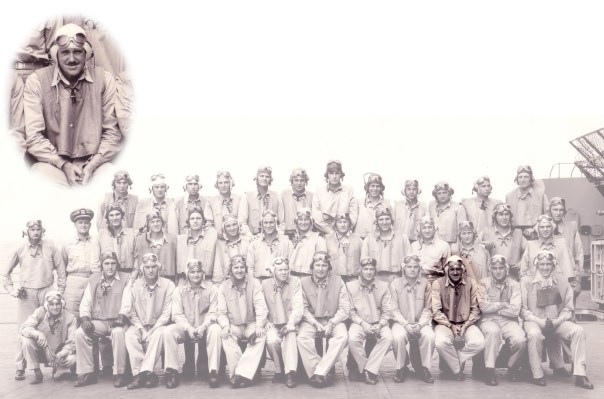
LT Hayden Jensen poses with the men of VF-5 aboard the USS Saratoga, July 15. 1942. In a little more than two weeks, Jensen will have his first two of five enemy air kills.
Jensen married the former Henrietta Mathilda Schirmer (also of St. Paul) on December 27, 1938. Still serving on active duty, 38 year-old LCDR Jensen passed away on June 6, 1949, at Naval Hospital Newport, Rhode Island, with his wife, Henrietta by his side. He was laid to rest at Arlington National Cemetery.
Among Jensen’s numerous awards and decorations were:
- Navy Cross Medal (2): see citations
- Distinguished Flying Cross Medal
- Air Medal (3)
- American Defense Service Medal
- Asiatic–Pacific Campaign Medal
- American Campaign Medal
- World War II Victory Medal
After reviewing the incredible service details for these four naval aviators, I was convinced that the box never belonged to any of the men listed on the box. Based upon their careers, none could be considered as “The Torpedo Captain” leaving me to pursue the next logical step. As with each naval air group, I confirmed that Air Group One Fifty Three did, in fact, have a torpedo squadron (VT). Cursory internet searches were dead-ends as far as attempting to discover possibilities of assigned commanding officers. Fortunately, I am a member of an amazing group of fellow collectors on the U.S. Militaria Forum where there are folks who possess years of experience and knowledge and have access to records and sources. I posted some requests for assistance and like clockwork, two members answered me and began to fill in the blanks. Instantly, I had the names of two naval aviators who commanded VT-153: LCDR H.C. Madden and his successor, LCDR F.G. Lewis.
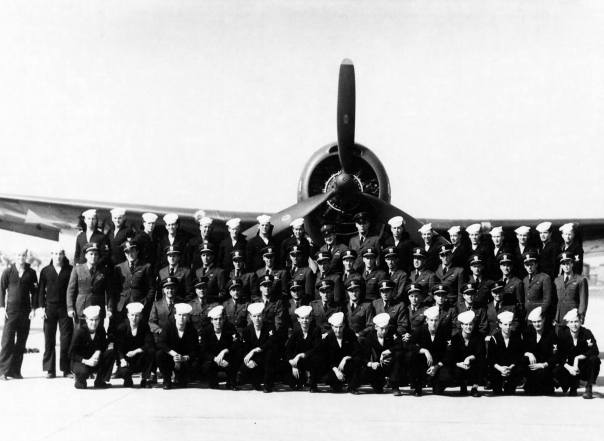
The officers and men of Torpedo Squadron 153 (courtesy of Jack Cook).
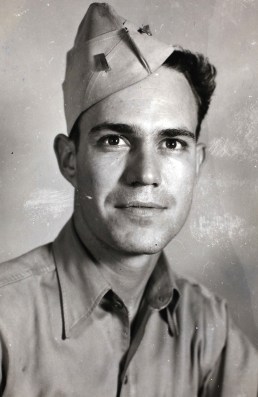
LTJG Harlan C. McFadden Jr.
LCDR Harlan Curtis McFadden Jr. was born June 29, 1918. After completing high school in Clayton, New Mexico, McFadden pursued his degree in English Literature at the University of New Mexico before enlisting as a naval aviation cadet on July 9, 1941. He began six weeks of elimination flight training at Naval Air Station Long Beach, California and, upon completion, McFadden commenced flight training at NAS Corpus Christi for 44 more weeks. Harlan finished his final 12 weeks of operational flight at NAS Ft. Lauderdale.
LT McFadden was assigned to Torpedo Squadron Three Hundred Five (the “Red Asses”) from 1943-44. On August 1, 1944, when VT-305 was ordered decommissioned, McFadden was transferred to VT-99 along with five fellow flyers and additional enlisted support personnel. Much of his early months of service during the war were spent flying missions over various Japanese strongholds in the Solomon Islands, such as Bougainville and Rabaul. On March 26, 1945, LCDR McFadden assumed command of VT-153 at Naval Auxiliary Air Facility (NAAF) Lewiston in Maine. One of McFadden’s assigned aviators was LT George H. W. Bush who served with the squadron from March through September of 1945. Ten days after the squadron was activated, Mcfadden was relieved of command by LCDR Lewis. From April 6 through his discharge on September 5, 1945, I have been unsuccessful in locating McFadden’s naval service or why he was relieved of command. In his four years of service as a naval aviator, McFadden saw a total of 14 (four months in the North Atlantic and 10 in the South Pacific). On his separation documents, McFadden stated that he was pursuing a career in commercial aviation.
LCDR Frederick Gary Lewis was born on March 13, 1916, in Springfield, Massachusetts. Though I have had some success in researching Lewis, I have not been as successful in discovering as much detail regarding his life and the breadth of his time as a naval aviator. He was commissioned an ensign on November 14, 1940, and was assigned to the fleet aboard the battleship USS Pennsylvania (BB-38) as the Communications Officer. Ensign Lewis was present aboard the ship during the Japanese attack on Pearl Harbor, witnessing the carnage and utter destruction on the ships and facilities surrounding the Pennsylvania, including the tremendous damage inflicted upon the destroyers USS Cassin (DD-372) and USS Downes (DD-375) which were sharing the same drydock as the battleship. As the battleship was floated and directed to San Francisco for repairs, LTJG Lewis reported for flight training at Naval Air Station Pensacola. Once Lewis received his wings of gold, he was assigned as a flight instructor at NAS Ft. Lauderdale where he served for the next twelve months. In December 1943, LT Lewis took command of Composite Squadron Seventy-Eight (VC-78) aboard the USS Saginaw Bay (CVE-82). His only combat action that he experienced was in support of the liberation of the Philippines in October of 1944. Receiving a temporary promotion (to LCDR) prior to relieving LCDR McFadden on April 6, 1945, serving as VT-153’s commanding officer until June 1946.
Other than Lewis’s permanent promotion to LCDR in 1950, I was unable to find anything further regarding his naval career. Frederick Lewis passed away on April 7, 1978 at the age of 62 in San Leandro, California.
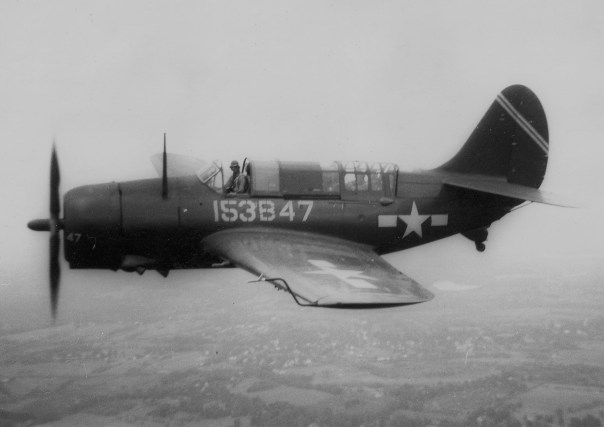
SB2C of VT-153 courtesy of Jack Cook.
After diving deep into each of the men, I had one remaining piece of information left to work through – the insignia of the griffin that was engraved on the top of the cigarette box. I started to seek insignia for all of the listed squadrons. I was able to locate just two insignia and squadron nicknames: VBF-153 was listed as the “Copperheads” though the corresponding insignia that I found didn’t seem to fit the name (more research to follow); VB-153 was known as the “Flying Cannons” and its insignia seemed to fit perfectly.
-
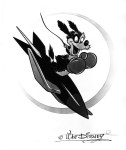
- VBF-153 insignia as drawn by Disney.
-
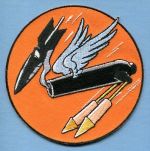
- Bombing Squadron (VB) 153 (“The Flying Cannons”) insignia patch.
-
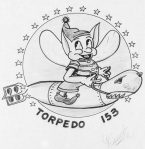
- The “Gremlins” of Torpedo 153 VT-153 (Courtesy of Jack Cook).
My contact at the U.S. Militaria Forum provided me with the insignia for VT-153 which added confusion; the “Gremlins” as they were known, did little to support my thought that the griffin on the box bore some significance, however, that isn’t where my trail ended. Following the lineage of each squadron, I found that VA-153 (“A” for attack squadron, the current designation for a carrier-based fixed wing bombing aircraft), which was disestablished in 1977, employed a very similar-looking griffin in their logo. The two griffin appearances is more than likely coincidental but it certainly leaves me with the idea that there is some connection.
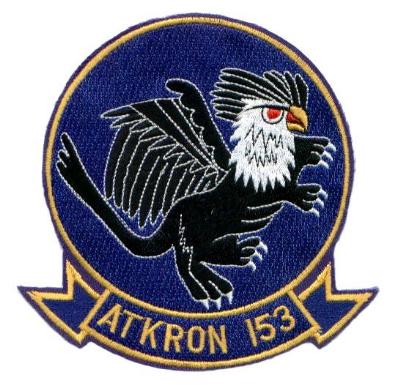
Attack Squadron 153’s insignia – a griffin – (as seen on their unit patch) has to be more than mere coincidence considering the similar image on the cigarette box
Ultimately, my research did not provide me with any sort of definitive evidence that I could use to pinpoint the original owner of my silver cigarette box. I am deducing that it was most likely given to LCDR Frederick G. Lewis from his air group colleagues near or after the end of World War II.
Read more about collecting unusual militaria:
Researching After You Buy – Sometimes it is the Better Option
I’ve said it so many times in the past: it is paramount to making wise purchases that collectors research an item prior to handing over hard-earned finances to make a purchase. However, there are occasions within militaria collecting where the collector is stumped by what he or she might be looking at, yet still feel compelled to pull the trigger on a deal to acquire it.
Recently, a very dear friend and fellow collector presented me one of his most recent acquisitions and wanted to get my input as to the markings and what they might indicate. He was stumped by some of the heraldry and details but there were other engraved elements that showed the piece to be from World War I.
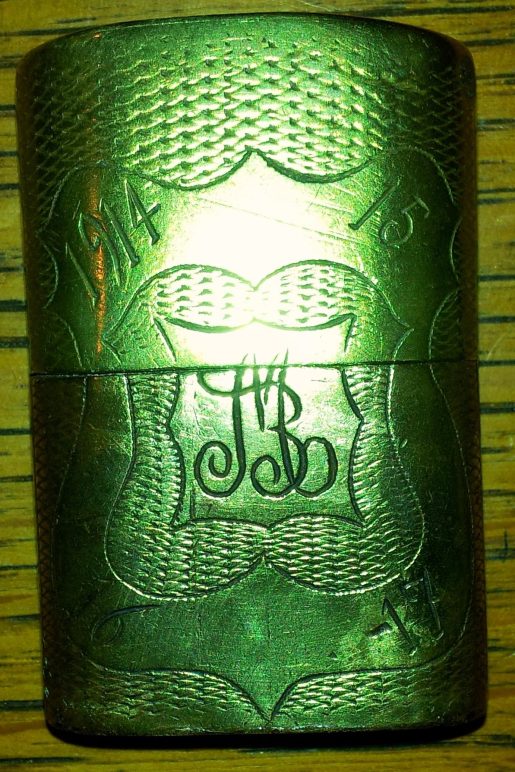
The dates of 1914, 15, 16 and 17 automatically rule out this matchbox as being a U.S. trench art piece.
I spent several minutes examining what appeared to be a trench art matchbox. Clearly, the item shown is constructed from brass and was handmade. The brass plates were rolled out and soldered together to form an oblong can-shape with another piece cut and soldered into place at the top. A piece of wood was shaped and fastened to comprise the case’s bottom, and adhered with some sort of clear glue or shellac. Judging from the length of the box, the brass was an unrolled and flattened small arms casings, a very common resource used in trench art making.
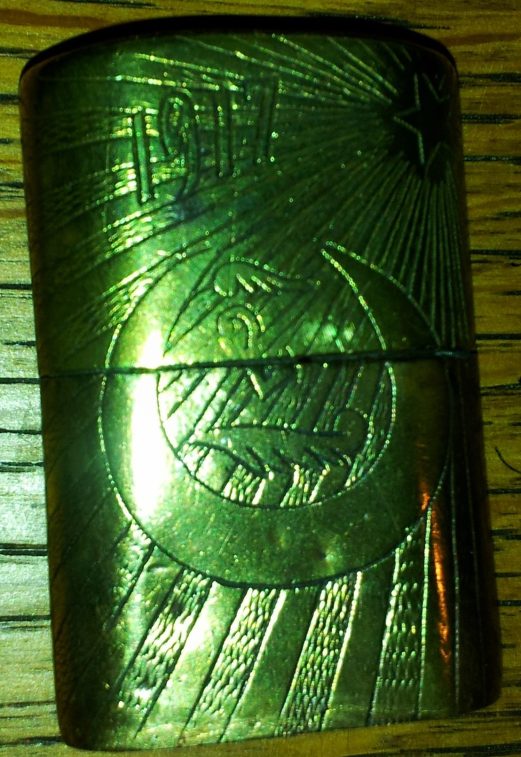
What does the crescent and “winged Z” indicate? The hand-tooling is quite ornate and aesthetically pleasing. I’d say that this was a solid score for my friend.
On one side, the maker tooled a pattern and left a smooth shield motif with what appears to be a monogram of the initials, “MB.” At the surrounding corners of the shield are “1914”,” 15”, “16” and “17” which clearly indicates the first few years of World War I.
Etched into the opposing side of the matchbox is what appears to be a crescent or “C” with the opening pointed upward. Inside the crescent are two wings – one, at the bottom, pointing to the left with the top one pointing to the right. Connecting the two wing tips is a heavy line running diagonally, right to left from the top to the bottom. All three pieces appear to form the letter “Z.” Superimposed over the diagonal line is a small numeral two. Over the top of this “winged Z” is appears the year, “1917.” To the top right is a star with radiant beams extending outward to all directions providing a backdrop design. The top panel is etched simply etched with “Champagne”, surrounded by tooled pattern.
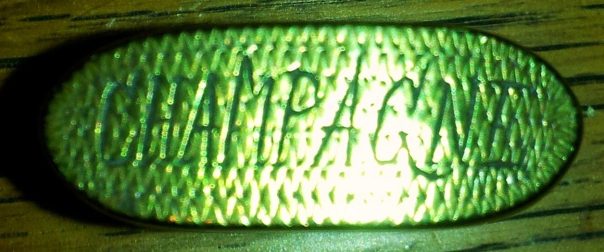
The matchbox top has “Champagne” engraved. To me, this clearly indicates that the owner spent a good portion of WWI serving in these battles.
I knew that the piece was from WWI and was potentially French or British in origin (it could even be German) due to the dates of the piece, as the U.S. didn’t enter the war until 1917. Could the crescent indicate Arabic or Islamic participation? Could it be connected to the French Foreign Legion? Does “Champagne” refer to the battles that were fought in 1914, 1915, 1916 and 1917?
Due to the sheer beauty of this piece, it has proven to be a very wise investment my friend made (at least in my opinion) regardless of his lack of certainty about it. This matchbox will be a fun and interesting research project. Perhaps one of you recognizes the emblems or has any ideas? I’d love to hear your thoughts!
 The Veteran's Collection