Category Archives: Military Era
WWI Aero Trophies: Aviation Artifacts of Aero-Warriors
Archaeologists could agree that in some form or fashion, militaria collecting has been around seemingly since men have gone to war. Though the concept may not have been seen as collecting, at a base level, man has maintained combat-related artifacts to remind him of battles won or brothers-in-arms that were lost. Not only has man sought to remember his warring past, he has long maintained the spoils of war by removing specific items of his vanquished opponent’s body as it laid on the field of battle.
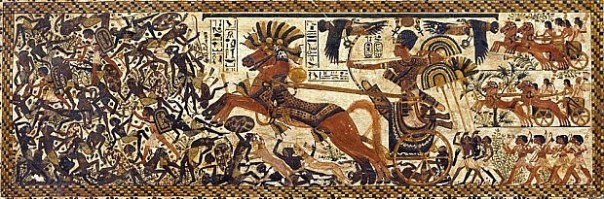
This illustration from Tut’s tomb shows the young pharaoh at war in his chariot (source: Araldo De Luca).
When some of the tombs of the ancient Egyptian pharaohs were opened and the contents were inspected and cataloged, among the gilded, religious and life-story items were weapons of war. Free from the worries and troubles of earth, anthropologists and Egyptologists surmised that the military pieces were objects that heralded the deceased king’s victories. Within the tomb of the most widely known pharaoh, King Tutankhamen (or “Tut”), among several depictions of him in combat, was his beautifully ornate chariot that would, more than likely, have been used in battle as documented throughout his burial treasure.
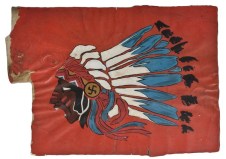
This section of fabric from an aircraft belonging to the famed Lafayette Escadrille (a squadron of American volunteers that flew for France during WWI) recently sold at auction (source: Cowan Auctions).
With the advancement of technology came the modern version of the chariot during World War I, the airplane. The warrior who battled from the seat of these modern machines, though differently equipped, had much in common with the brave Egyptian warriors of ancient times as they bravely piloted their flying machines into the center of the fray. In the quiet of the battle’s aftermath, these warriors would, if possible, descend from their winged chariots to survey their opponent’s wreckage, tearing or cutting strategic pieces of the fabric that contained specific identifying marks that helped to tell their story to both their squadron mates and to their leaders, providing quantifiable evidence of their success.
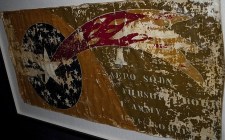
This section of cloth survives from an aircraft of the 1st Army Aero Pursuit Squadron and is preserved at the Museum of Flight in Seattle, Washington.
In many cases, these aerial opponents would extend honors that were reserved for their own fallen heroes, to their vanquished enemies. When Manfred von Richthofen, Rittmeister (Cavalry Captain) of the Luftstreitkräfte (Imperial German Army Air Service) was killed when his Fokker Dr1 was downed, members of the Royal Air Force took custody of his remains. To a casual observer viewing his funeral service, it would have appeared that a renowned British war hero was being laid to rest by the varying honors being rendered to this fallen adversary. However, the preservation of his aircraft was overlooked as souvenir hunters quickly rendered the nearly undamaged plane a shamble as they haphazardly dismantled it.
-
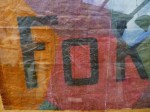
- A section of fabric from a German WWI aircraft with the letters ‘Fok’ could originate from a Fokker war plane. The colorful pattern was typical of the camouflage painting of the war (source: eBay image).
-
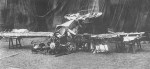
- Showing what was left of Richthofen’s heavily scavenged wrecked Dr 1.
-
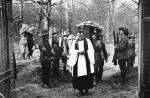
- The elaborate funeral procession for Manfred von Richthofen.
Bestowing honor upon fallen adversaries was practice by the Allies’ opponents, the Germans. Quentin Roosevelt, son of the former president and colonel (from the Spanish-American War’s Rough Riders), was an aviator in the 95th Aero Squadron, flying pursuit aircraft such as the French-made Nieuport 28. After he was shot down during an engagement, his flight of twelve was jumped by seven German fighter planes. Roosevelt received two fatal bullet wounds to his head and his aircraft rolled over and spiraled to the ground. His subsequent funeral service was witnessed by a fellow American soldier, Captain James E. Gee (110th Infantry) who had earlier been taken prisoner:
“In a hollow square about the open grave were assembled approximately one thousand German soldiers, standing stiffly in regular lines. They were dressed in field gray uniforms, wore steel helmets, and carried rifles. Near the grave was a smashed plane, and beside it was a small group of officers, one of whom was speaking to the men. I did not pass close enough to hear what he was saying; we were prisoners and did have the privilege of lingering, even for such an occasion as this. At the time, I did not know who was being buried, but the guards informed me later. The funeral certainly was elaborate. I was told afterward by Germans that they paid Lieutenant Roosevelt such honor not only because he was a gallant aviator, who died fighting bravely against odds, but because he was the son of Colonel Roosevelt whom they esteemed as one of the greatest Americans.”
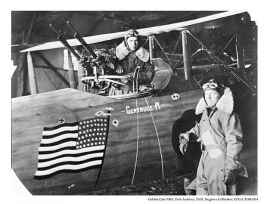
Similar to the flag shown on Pawn Stars, this WWI aircraft has a flag painted on the fuselage side.
Collecting aviation artifacts from WWI is becoming increasingly difficult as nearly a century has elapsed since the armistice was signed. The soft materials that made up the uniforms and accouterments are under continuous attack from the ravages of time and every manner of decay brought on by insects and ultraviolet exposure. Museums in the last few decades have done amazing work at acquiring the best examples of surviving armament and other hardware to provide their audiences with incredible displays and depictions of the Great War. When the rarest pieces arrive in the marketplace, the heavy competition ensues driving the prices skyward.
In an older episode of the History Channel’s Pawn Stars (the “Stick to Your Guns” episode), a woman enters the shop with a rolled-up section of old fabric emblazoned with a hand-painted representation of an American flag. She tells the story of her American serviceman relative darting over to a recently wrecked plane to cut out the flag, saving it from the ensuing fire resulting from the crash.
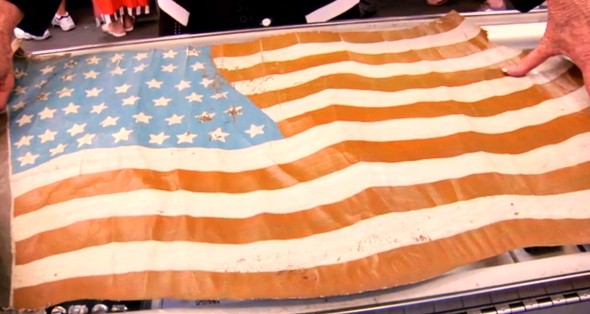
This flag looks to have been cut from a WWI American aircraft. The jury is still out as to whose aircraft it was removed from (source: Pawn Stars screen grab).
In providing the requested provenance, she presents a pair of World War I dog tags. One of the tags shows the information for her ancestor while the other contains the personal identification of Lieutenant Quentin Roosevelt. The Pawn Stars segment could easily lead viewers to draw the conclusion that the flag was removed from Roosevelt’s wreckage but that would be a considerable leap based upon the story of the retrieval and the burning aircraft. It would have been difficult for American to do so, considering that Roosevelt crashed behind enemy lines.
-
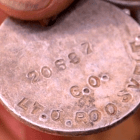
- Could this dogtag have come from Lt. Quentin Roosevelt? It was attached to another WWI tag belonging to the ancestor of the woman who brought in a hand-painted section of WWI airplane fabric to the Pawn Stars’ pawn shop (source: Pawn Stars screen grab).
-
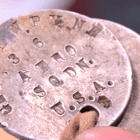
- The reverse side of George Pyne’s dog tag shows that he was a member of the 36th Aero Squadron (source: Pawn Stars screen grab).
-
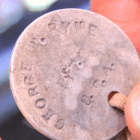
- WWI dog tag belonging to Private George W. Pyne – who is purported to have cut a section of aircraft fabric from a burning wreck – the fabric contains a hand-painted American flag (source: Pawn Stars screen grab).
Ultimately, the Pawn Stars folks purchased the flag (the price was well into four figures) despite the lack of connection to Roosevelt. In my opinion, they probably overpaid for the piece but considering that it was destined for Gold & Silver Pawn Shop owner Rick Harrison’s personal collection, it wasn’t too much of a reach.
Finding the “Lady Lex,” One Piece at a Time
A few weeks ago, our nation honored the 75th anniversary of the sneak attack on the Pacific Fleet at Pearl Harbor on December 7th. In the past few years, we have marked significant anniversaries of victories from WWII, the War of 1812 and this year we will begin recognizing the centennial of the U.S.entrance into the Great War. For collectors, these occasions spur us to evaluate our own collections while attempting to be discerning of sellers’ listings who are also trying to capitalize on the sudden interest.
In May of this year, 75 years will have elapsed since the first significant clash between the opposing naval forces of Japan and the United States in the Coral Sea. Leading up to this battle, the Navy had suffered losses in The Philippines, Wake Island and Guam followed by the sinking of the USS Houston (in the battle of Sunda Strait) all of which were leaving the U.S. extremely vulnerable and nearly incapable of mounting a naval offensive.
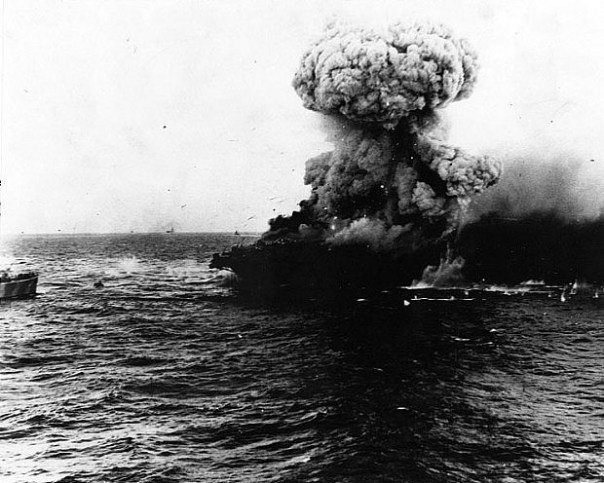
The Lady Lex is rocked by an enormous explosion during the Coral Sea battle, May 8, 1942 (Photo: Naval Historical Center).
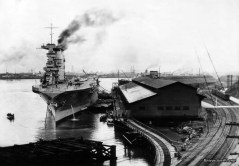
USS Lexington (CV-2) provides electrical power to the City of Tacoma (WA) during a severe drought and subsequent electricity shortage – December 1929 – January 1930 (Photo: Tacoma Public Library).
Beginning with a joint effort between the US Army Air Force and the US Navy, the fight was taken to the Japanese home front with an B-25 air strike launched from the USS Hornet. But the direction of the war was seriously in doubt and Navy brass knew that inevitably, a direct naval engagement with the Japanese fleet were very near on the horizon.
Navy code-breakers had discovered the Imperial Japanese forces intended on taking Port Moresby in New Guinea and quickly dispatched Task Forces (TF) 11 and 17 to join up with TF 44 near the Solomon Islands and proceed West toward the Coral Sea. Over the course of May 3rd through 8th, the ensuing engagements between US and IJN forces resulted in substantial losses for both sides, including a carrier from each navy.
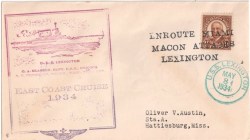
This 1934 postal cover commemorates the Lexington’s East Coast cruise of 1934 (photo: eBay).
For the U.S. Navy, that carrier was the USS Lexington, CV-2. Though not the first purpose-built aircraft carrier (that distinction goes to the USS Ranger CV-4), Lexington was the first to be originally commissioned as a flat top. The Langley (CV-1) had a previous life as a collier, the USS Jupiter, for seven years from 1913 to 1920. The “Lady Lex”, as she would come to be known, laid down as a battle cruiser but was reconfigured during construction and was commissioned in 1927 as the US Navy’s second carrier, CV-2.
The result of the Coral Sea Battle was that the Navy was left with just two operational carrier: Hornet and Enterprise, as the Yorktown also suffered substantial damage in the battle requiring repairs. Less than a month later, the tables would be turned on Japan with the major American victory at Midway.
-
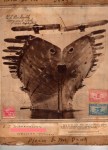
- A postal cover of the USS Lexington (Photo: Navsource.org).
-
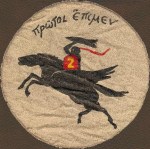
- A leather squadron patch from the Early Knights of Bombing Two (VB-2) from the Lexington (photo: Brian’s WWII Surplus& Antiques Store)
-
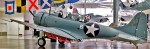
- This SBD-2 Dauntless aircraft was recovered from a lake where it sat since 1945. While it was not a veteran of the Coral Sea battle, it did fly from the decks of the Lexington during the early months of 1942 (photo: National Naval Aviation Museum)
-
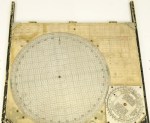
- This plotting board was used by Lieutenant (junior grade) Joseph Smith during the Battle of the Coral Sea when, while on a scouting mission from the carrier Lexington (CV 2), he spotted Japanese aircraft carriers and their escorts (photo: Naval Aviation Museum).
-
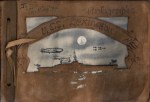
- A sailor’s leather-bound USS Lexington CV-2 Photo album (photo: eBay).
The loss was not only felt by her crew and navy strategists, but also by communities, such as Tacoma, Washington. For 31 days during winter drought conditions, the Lexington was sent to aid the city’s citizens by generating power ’round the clock, helping to keep their homes lit and warm. Many of those beneficiaries of the electrical power assistance were devastated by the news of her loss.
Today, few artifacts remain from the Lady Lex. Militaria collectors would be hard-pressed to obtain anything specific to the ship, instead having to settle for obtaining USS Lexington veterans’ personal effects or uniform items, surviving ephemera, philatelics, or vintage photographs. For many naval collectors, the hunt for anything from this historic ship can very rewarding. Some artifacts can be found by happenstance as was the case with this Curtiss SB2C Hell Diver, recently pulled from the Lower Otay Reservoir near San Diego, discovered by a fisherman who observed the plane’s outline on his fish-finder.
Armed with patience and time, collectors could assemble a nice group of artifacts to pay proper respect to the Lady Lex and the men who served aboard this historic ship.
UPDATE March 5, 2018: Paul Allen’s Undersea Exploration team that has been searching and discovering the wrecks of the Pacific War, finding such infamous sunken vessels as the USS Indianapolis and the lost ships from the Battle of Savo Island (USS Vincennes, Astoria and HMAS Canberra), announced today that they have located and filmed the wreck of the USS Lexington (CV-2) at the bottom of the Coral Sea in nearly two-miles of depth.
Fruitless Searching – The Quest for an Insignificant Patch
After years of searching for a simple uniform accouterment, I am feeling that the possibilities of completing a uniform recreation are far less than I had hoped. When I began my project in 2009, I figured that locating a fairly standard uniform patch would be a simple venture. As I reviewed the photo, seemingly nothing on my uncle’s uniform was rare or would be difficult to source. At the end of four years, I have learned that I may have to place this project on perpetual hold. Where did I go wrong?
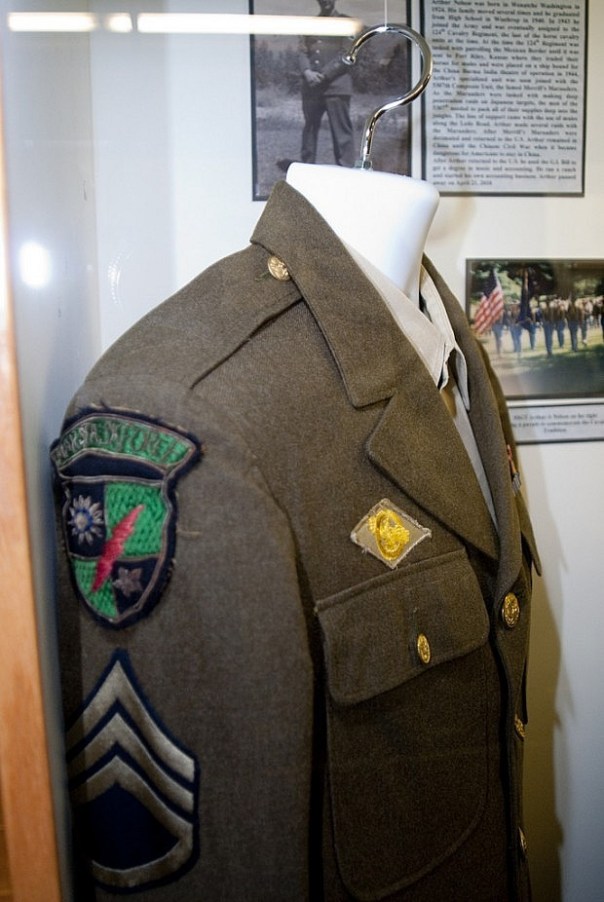
It is unfathomable to me that I stand a better chance locating this Merrill’s Marauders shoulder sleeve insignia patch than the overseas service bars/chevrons combination.
When I received a photo (taken in August of 1952) of my uncle receiving an Army Commendation Medal from a colonel, I knew that I wanted to assemble a uniform jacket with his full military decorations. Around the same time I got the photo, an enormous package arrived from the National Archives which contained a large stack of documents that encapsulated my uncle’s service spanning three wars and nearly 20 years.
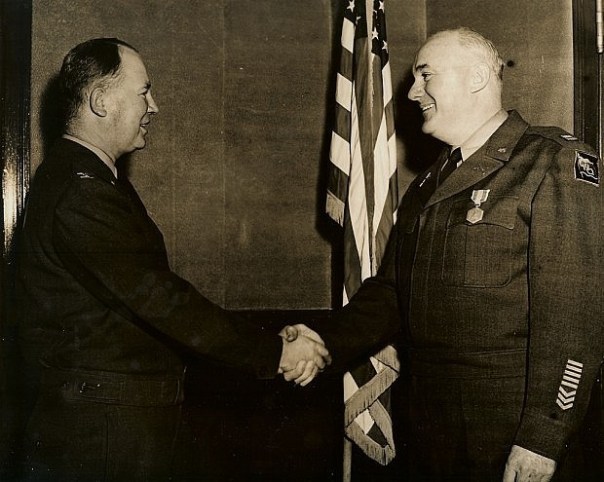
Here, my uncle receives his Army Commendation Medal. Though he is shown in uniform, he is wearing no other decorations or ribbons. The quest for the overseas stripes/chevrons patch continues after 3 years.

Darren McGavin’s wife (in the film A Christmas Story) saw how obviously hideous this lamp was. It was equally apparent that I needed to find the proper patch configuration for my display (source: Warner Brothers).
Reviewing the service records and the photo, I decided that I wanted to put together a uniform that was representative of what my uncle wore at the conclusion of his service in the army. Considering that my uncle enlisted to serve in World War One, I figured that the greatest challenge I faced was in locating the period-correct ribbons with the appropriate devices: the correct campaign stars. I already possessed a good portion of my uncle’s metal devices (rank, corps insignia) along with several period-correct ribbons and medals which meant that it shouldn’t take long to acquire what was still needed.
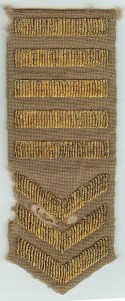
This patch was in my uncle’s possessions but the moth-eaten condition and that it is for a khaki uniform, makes it unsuitable for my display.
In possession of the uniform jacket, I began to take stock of each item before I would begin to sew on any of the patches. From the unit insignia (the GHQ patch) to the all of the various devices, I was ready to go…or so I thought. There, glaring at me like Darren McGavin’s sultry major award, gleaming brightly in the window of the front room from A Christmas Story, I was missing the overseas stripes that would be representative a soldier who served overseas for multiple wars.
One might ask, “What is so significant about this uniform item?” The overseas service bar (or chevron for World War I service) was issued for each block of six months served by a soldier in a combat zone. In the case of my uncle’s uniform, the photo shows that he wore three chevrons and five overseas service bars. With each stripe or chevron representing six months, my uncle served in a combat theater for three chevrons and five bars, or a total four years.
A Thousand Words? Pictures Are Worth so Much More!
As my family members have passed over the past several years, I have managed to acquire a number of antique photo albums and collections of photos of (or by) my family members that nobody else wanted. Most of the images’ subjects were of family gatherings, portraits or nondescript events and contained a lot of unknown faces of people long since gone. As the only person in the family who “seems to be interested” in this sort of history, I have become the default recipient.
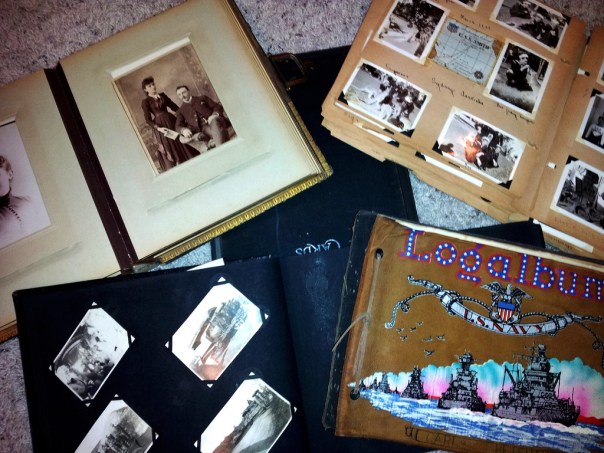
Here is a sampling of vintage photo albums I’ve inherited.
My Hidden Treasure
With all the activities and family functions occurring in my busy life, those albums received a rapid once-over (to see if I could discern any of the faces) and then were shelved to gather dust as they had done with their previous owners. Years later, I began to piece together a narrative of my relatives’ military service (a project you will hear about over the course of my blog posts). I have since returned to those albums only to discover a small treasure of military-related images that are serving to illustrate my narrative project. As an added bonus, they are providing me with an invaluable visual reference as I am reconstructing uniform displays to honor these veterans.
Photographs Can Unlock the Secrets
Similarly, militaria collectors strike gold when they can obtain photo of a veteran in uniform that can help to provide authentication as part of the due diligence for a specific group they are investigating prior to an acquisition. A photo showing the veteran wearing a certain Shoulder Sleeve Insignia (SSI), ribbon configuration or even a specific uniform garment can be authenticated if there are visible traits (such as tears or repairs) within the image.
Photographs from GIs in a wartime theater of operations or in combat are fairly rare. Photography was outlawed by theater commanders (due to the obvious security risks if the film or photographs were captured) and space was at a premium as one had to pack their weapons, ammunition, rations and essential gear. So finding the room to safely carry a camera and film for months at a time was nearly impossible. Similarly, shipboard personnel were not allowed to keep cameras in their personal possessions. Knowing the determination of soldiers, airmen and sailors, rules were meant to be broken and, fortunately for collectors, personal cameras did get used and photos were made while flying under the censors’ radar.
If you have deep pockets and you don’t mind paying a premium for pickers to do the legwork, wartime photo albums can be purchased online (dealers, auction sites) for hundreds of dollars. Many times, this can be a veritable crap-shoot to actually find images that have significant military or historical value and aren’t simply photos of an unnamed soldier partying with pals in a no-name bar in an an unknown location. For militaria collectors at least, there is value in the image details.
As you obtain military-centric photos, take the time to fully examine what can be seen. Don’t get distracted by the principal subject – look for the difficult-to-see details. Purchase a loupe or magnifying glass to enable you discern the traits that can reveal valuable information about when or where the photo was snapped. What unit identifying marks can bee seen on the uniforms? Can you identify anything that would help you to determine the era of the uniforms being worn by the GIs?
My Own Success
In assembling a display for one of my relatives, I wanted to create an example of his World War I uniform because the first of his three wars was quite significant in shaping his character for his lifetime. Having already obtained his service records (which span his entire military career, concluding a few years after the Korean War), a book that was written about his WWI unit (published by a fellow unit member) and my uncle’s photo album which was filled with snapshots of his deployment to France, I figured I would be able create a decent uniform representation.
-
- In this image, you can’t quite make out the left shoulder insignia.
-
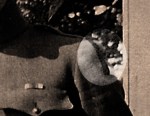
- A close-up of the left shoulder revealed the SSI of the 1st Army (artillery branch).
-
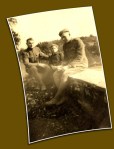
- This photo shows my uncle (on the left) in France with his First Class Gunner rank insignia.
-
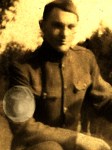
- In the close-up, you can (almost) clearly make out the rank insignia of a First Class Gunner.
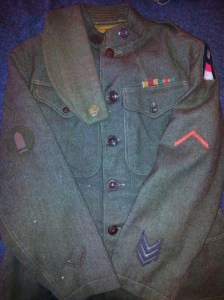
An overview of the uniform (and overseas cap) that I have recreated to represent my uncle’s WWI service. Note the artillery shell insignia on the right sleeve is that of a First Class Gunner.
In the various photo album images, I could see his right sleeve rank insignia as well as the overseas stripes on his left sleeve quite clearly. I could even make out his bronze collar service devices or “collar disks” in the photos (since I had his originals, they weren’t in question), but I had no idea of what unit insignia should go on his left shoulder. Not to be denied, I took the route of investigating his unit and the organizational hierarchy, trying to pinpoint the parent unit to which the 63rd Coastal Artillery Corps was assigned. Having located all of that data, I was still unsure of the SSI for the right shoulder.
Temporarily sidetracked from the uniform project, I returned to the photo album and scanned a few of the images (at the highest possible resolution) for use in my narrative. With one of the photos, I began to pay close attention to the left shoulder as I zoomed in tightly to repair 90 years worth of damage…and there it was! At the extreme magnification, I could clearly see the 1st Army patch (with the artillery bars inside the legs of the “A”) on my uncle’s left shoulder. I had missed it during the previous dozens of times that I viewed the photo.
An overview of the uniform (and overseas cap) that I have recreated to represent my uncle’s WWI service. Note the artillery shell insignia on the right sleeve is that of a First Class Gunner.
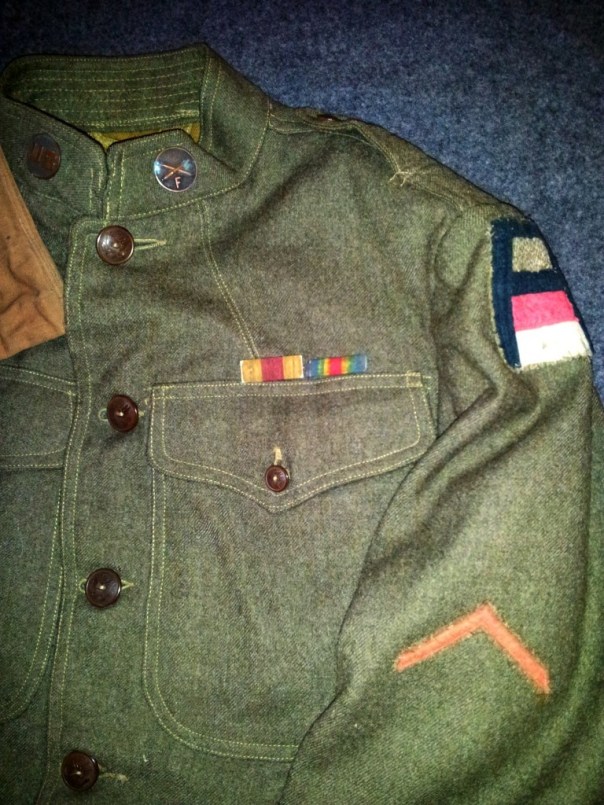
A close up of the SSI of the 1st Army (with the red and white bars of the artillery), my uncle’s collar disks, the honorable discharge chevron and his actual ribbons.
My research now complete, I obtained the correct vintage patches and affixed them to an un-named vintage WWI uniform jacket along with my uncle’s original ribbons and collar devices (disks) to complete this project. Now I have a fantastic and correct example of my uncle’s WWI uniform to display.
Gridiron Near the Trenches: Football During WWI
November 11, 2016 marked the 98th anniversary of the armistice between the allied nations and Germany bringing about a close to the Great War (later known as World War I). On this day, citizens and governments of those WWI nations will mark the end of the war and honor those who were lost during the four years that it raged (predominantly) in Western Europe. The national holidays for most of these nations are very similar in their traditions and in how they honor those killed in action. In the United States, we have long since departed from recognizing this war and the significance of November 11th is all but lost among our citizens. Instead of paying respects (in similar fashion to our WWI allies), we departed entirely from the meaning of this day, choosing instead to honor living veterans who served in the U.S. armed forces.
Coinciding with Veterans Day was the midway point of the National Football season. For two weeks, the NFL spent time honoring veterans with on-field pre-game and halftime ceremonies and festivities. Special sideline merchandise that incorporated military colors and camouflage patters was worn by players and coaching staff (in order to promote and sell special fan merchandise). The league also set aside time to bestow special awards to players and personnel who take their own time to honor and support U.S. service members, veterans and their families. For the casual observers, these activities appear to reflect the NFL’s commitment to veterans but the league is paid rather handsomely for these activities. Nevertheless, veterans and servicemen (and women) do have a passion for the game both as fans and for some who left the service to play and still others left the game to serve (here are a few notables).
The connection between sports (baseball and football, in particular) and the armed forces is lengthy (150 years for baseball and more than a century for football) which makes the NFL’s dedication to honoring those who served not surprising. Being present to see the NFL’s Seattle Seahawks render honors to a World War II hero (who was prominently portrayed in HBO’s award winning series, Band of Brothers) will be an indelible memory.
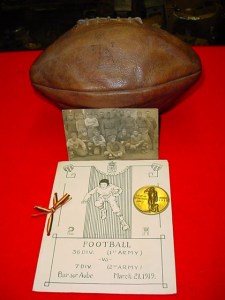
A fellow collector’s AEF football memorabilia – a program – 36th Division (1st Army) vs 7th Division (2nd Army) March 21, 1919; a football from a game between the 77th Division vs 81st Division teams; Football Championship Coin | First Prize – 86th Division.(source: Mark McCaffrey – Falls Creek Military Collectibles)
Well before I took a serious interest in militaria, I collected sports memorabilia. My primary interest, since I was a teenager, was just about anything baseball or football related – specifically, Los Angeles Dodgers or Los Angeles Rams. Growing up in the Northwestern United States during a time in which the region lacked both Major League Baseball and National Football League professional sports franchises, I began following the (then) dominant teams that dominated national television networks’ programming, creating lasting allegiances and collecting focus. As a young adult on active duty in the Navy, I still maintained my loyalty to these two teams regardless of my ship being underway in local waters or on deployment.
Fostering my passion for history, I was led to delve into baseball’s past and the golden years of the game in the 1930s and 40s. I was very familiar with the sacrifices of the game’s stars as many would serve in front-line combat units and ships during the war. I was fascinated by these men who could have played baseball solely on service teams, avoiding combat altogether by serving as morale boosts for troops coming off the line or prior to heading into the fray. Until recent years, I was largely unfamiliar with professional football during its beginnings.
The NFL didn’t truly come into its own until recent decades, arguably taking over and holding onto the position as the national pastime from MLB. Prior to 1920, the game of football was predominantly a college sport. Little did I realize until recently that American football was played on French soil among the troops of the American Expeditionary Force (AEF). I inherited several military pieces that belonged to my uncle (who served in WWI, WWII and the Korean War), including a few photo albums. One of the photo books was of his military service spanning his WWI service along with a few years following his discharge. The first several times scanning through the book,I didn’t pay much attention to the series of photographs that were beyond the subject of military activities. I focused my attention on the images showing my uncle in uniform prior to deploying and on through his return home from the war. I overlooked the others until years later.
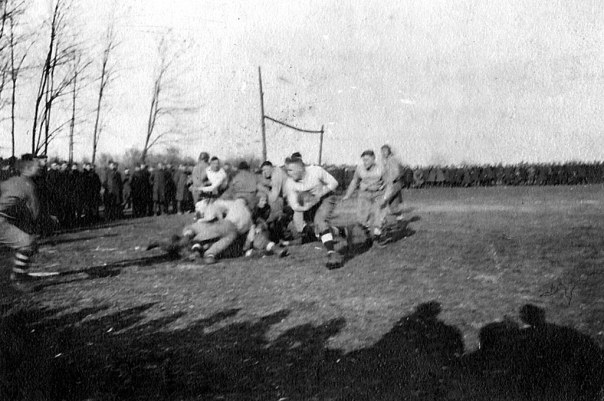
From my uncle’s WWI photo album, this photo shows the gridiron surrounded by soldiers in full uniform. The action on the field is quite compelling as the ball carrier runs to the left for the goal line. Note the makeshift goal post in the background.
A few years ago, I decided to scan some of the photos for use in a family tree project when I discovered a photo that I couldn’t take my attention away from. It showed a football game on a makeshift gridiron surrounded by doughboys in uniform. My curiosity was piqued. What was the story behind this game? Who were the participants? Was the war still raging at the time of the game?
I acquired a unit history book (F, 63*) that was published in 1919 detailing the exploits of my uncle’s artillery regiment during The Great War. Gracing the pages were several photos that were provided by my uncle (with photo credit), including a photo of the football game. The narrative failed to detail specifics about the game but a photo caption noted that the it was being played at St. Selve and that it pitted Battery B (of the 63rd CAC) and the 67th Infantry Regiment (Ninth Infantry Division) against each other. Based upon the linear arrangement of the photos (in context with the entire book), I surmised that the game was played following the signing of the Armistice.
Sadly, scant few details have been written about American football during the war and even fewer artifacts exist for interested collectors.
When I was a teenager, my father (a Vietnam veteran) always thought highly of Rocky Blier, who after his 1968 rookie season with the Steelers, was drafted into the Army and volunteered to serve in Vietnam. During his combat service and while on a patrol, Specialist Blier’s unit was ambushed. Taking heavy enemy fire, Rocky sustained a bullet wound in his leg, disabling him. Down on the ground, Blier sustained additional wounds when an enemy grenade exploded nearby sending shrapnel into his leg. While recovering (from his wounds) in Japan, he was told by doctors that his playing career was over. He went on to play ten seasons, including four championship seasons, all with the Steelers.
References:
For my blog about Baseball in the military, see Chevrons and Diamonds.
*Ashton, John L., Sanford Martin, Fred J. English, Richard K. Beymer, and H. Victor Morgan. 1919. F, 63; being an account of the events and wanderings of that unit during the great war, 1917-1919.
 The Veteran's Collection