Category Archives: Shoulder Sleeve Insignia and Patches
Military Veterans Aiming for Gold: Collecting Olympics Militaria
On the cusp of the 2018 Winter Olympics in PyeongChang, South Korea, I find myself scouring the United States team roster in search of service members (current and former) who are making their way to the icy and snowy venues for this year’s competition. Undoubtedly, as the television production of the games progresses, there will be some special interest stories aired that will cover certain members of Team USA who endured and overcame challenges within their sport on their paths to making the US Olympic Team.
| Veteran | Rank | Unit | Branch | Sport |
| Weber, Nathan | SFC | 10th Special Forces Group | Army | 4-Man Bobsled |
| Olsen, Justin | SGT | NYNG | 4-Man Bobsled | |
| Cunningham, Nick | SGT | 1156 ENG CO | NYNG | 4-Man Bobsled |
| Fogt, Chris | CAPT | Military Intelligence | Army | 4-Man Bobsled |
| Sweeney, Emily | SGT | Military Police | ANG | Luge |
| Mortensen, Matt | SGT | Army | Luge |
When the spotlight of NBC’s coverage shines upon the sledding events (bobsled, luge and skeleton), those feel-good stories very well could include one of more vignettes of the six team USA members who temporarily laid aside their military uniforms in exchange for the read, white and blue skin suits, helmets and spikes for the sledding competition at the Alpensia Sliding Center. Having active duty service personnel and veterans filling spots on Olympics rosters is not a new occurrence for the 2018 team. Some American Olympic competitors were merely civilian, amateur athletes heading into their competitions as was the case with the subject of one of the most compelling and difficult stories of World War II of the experiences of a Southern California track star.
In her 2010 biography, Unbroken, author Laura Hillenbrand’s best-selling work extensively details the life of United States Army Air Force captain, Louis Zamperini and the challenges he faced in the nearly unbelievable life-story. In short, the B-24 that Zamperini was a crew member of, experienced mechanical failures and crashed into the Pacific some 850 miles south of the Hawaiin Islands. Of the 11 crew members, Ernie and two others escaped and spent a harrowing 47 days adrift (one man died) before being picked up by the Japanese. Zamperini would endure two and a half years as a guest of the Emperor of Japan suffering unspeakable abuses, starvation and torture (see the 2014 adapted film, Unbroken).
What does Zamperini have to do with the Olympics? Louis “The Torrence Tornado” Zamperini was a star distance runner from the University of Southern California who placed 8th in the 5,000 meter at the Berlin games in 1936, under Hitler’s watchful eye. Because of his performance at the ’36 games, the Japanese discovered his identity and used his stardom to become the focus of their torture and hatred.
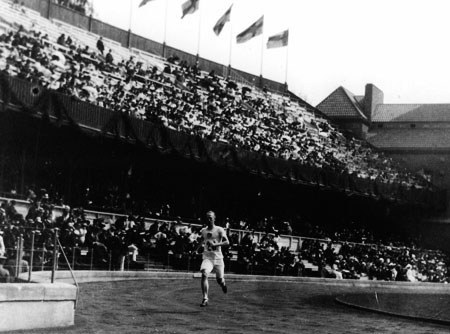
George Patton during the running event of the 1912 Modern Pentathlon (image source: Wired.com).

Patton (at right) fencing (vs Jean de Mas Latrie of France) in the modern pentathlon of the 1912 Summer Olympics (public domain image).
Zamperini’s story aside, I wondered how many U.S. Olympic athletes served in combat. One veteran comes to mind that, for me, has a direct connection to a piece of militaria in my collection. This Olympian finished 5th in the Modern Pentathlon at the 1912 Stockholm summer games behind four Swedes who dominated the event. Second Lieutenant George S. Patton did manage to stir some controversy with the shooting event, opting to use a .38 caliber pistol rather than the more conventional .22-cal. While officially placing 20th, Patton claimed that the rounds which counted as misses had passed through his preceding target strikes. Nevertheless, his low shooting score helped to keep him out of medal contention.
One veteran who competed in two Olympics (1960 Rome and 1964 Tokyo games) as a race walker, has the rare distinction of having been killed in action in the Viet Nam War. West Point graduate (class of 1962), Captain Ronald Zinn, while serving with the 173rd Airborne Division, was killed on July 7, 1965 in a firefight near Saigon. His best Olympic performance was in Tokyo where he placed 6th while competing for his native country, Brazil.
During the summer games in Rio, spectators watched in awe of Michael Phelps’ return to the pool as he racked up five more gold and another silver medal to his already-established record of 22 total. Phelps finished his career with 23 gold, three silver and two bronze medals setting him ahead of the next best (Larisa Latynina of the USSR – 18 total). The all-time greatest Winter Olympic athlete, Ole Einar Bjørndalen, a biathlete from Norway (with 13 medals) has less than half of Phelp’s total. One stat that many Americans will most certainly not know is that prior to Mark Spitz winning his 11th medal at the 1972 games, the sole medal-count (male) leader for the United States was a U.S. Navy veteran.
Naval Academy graduate (class of 1907), Carl Osburn, competed in three Olympic games (Stockholm 1912, Antwerp 1920 and Paris 1924) earning five gold, four silver and two bronze medals in several rifle shooting events. One is left to wonder how many more Osburn would have earned had the 1916 Berlin games not been cancelled due to World War I. In 1936, while in transit from one duty station to another, my uncle was aboard the USS Henderson (AP-1) when Captain Carl Osburn was serving as the ship’s commanding officer which (very) loosely connects pieces of my militaria collection to this Olympic medalist.
Trying to find pieces that cross both militaria and Olympics-collecting can be quite a daunting, if not expensive pursuit for collectors. Due to the extremely small number who competed in the games, anything stemming from one of these veterans will rarely be available for purchase.
-
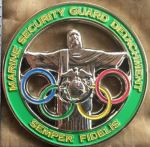
- Challenge coin and Olympics collectors would love to have this Marine Corps U.S. Consulate Guard coin from the Rio de Janeiro Olympics (source: eBay image).
-
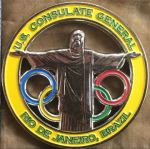
- Reverse of the Marine Corps U.S. Consulate Guard coin from the Rio de Janeiro Olympics (source: eBay image).
One crossover aspect (of these two collecting genres) that I appreciate…and is affordable…is the application of the five rings of the Olympic logo on military-related items. I found a handful of aviation squadron patches that either commemorated the games of a specific year or used the logo in a tongue-in-cheek manner.
-

- The Olympics-theme (the five interlocking rings) is oft-used in many military squadron patches such as this from Lackland, AFB. Perhaps this coincided with the 1996 Atlanta Games (source: eBay image).
-
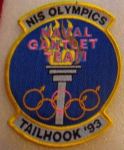
- This rather un-politically-correct attempt at humor (and modification of the Olympic interlocking rings) as the fallout resulting from the investigation of the 1991 convention (and scandal) was still in the forefront of naval personnel (source: eBay image).
These patches definitely interest me and leave me searching the web for theater-made Olympic themed patches that might surface from the returning Afghanistan veterans.
Though the games have yet to begin, the nation that is the heavy favorite to bring home the most hardware is Germany due to the IOC-ban that will exclude the 2014 victor, Russia (as a competing nation) due to their systemic cheating via doping (though a smattering of athletes will be allowed to compete if they are determined to be “clean”). The US team is predicted to finish in fourth place behind Norway and Canada, respectively. I will be watching with great hopes that our sledding teams bring home hardware but more importantly, that they honor both their Team USA and Army uniforms.
See more on U.S. troops competing in the 2018 Winter Games:
2018 Winter Olympics: USA Bobsledders, Soldiers have experience on their side
Military police Soldier leads Army’s charge onto 2018 U.S. Olympic Team
Kennedy Militaria – Where’s the Proof?
With all of the promise and expectations of the aspiring youth of America, President John Fitzgerald Kennedy, the thirty fifth president of the United States, ushered in a movement of service and commitment to country that is still prevalent in our culture. In his January 1961 inauguration speech, Kennedy called Americans contribute to making the nation a better place, “Ask not what your country can do for you. Ask what you can do for your country.”
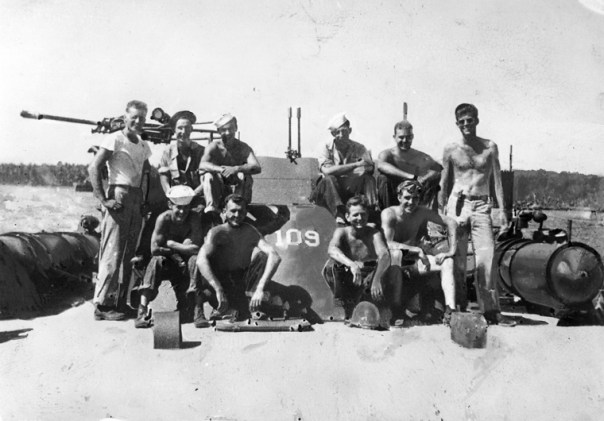
LTJG John F. Kennedy (standing, far right) and crewmen of the PT 109. Solomon Islands, 1943 (Photograph in the John F. Kennedy Presidential Library and Museum, Boston).
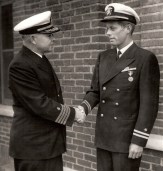
Kennedy receives his Navy and Marine Corps Medal for risking his own life to save those of his PT-109 crew. As an aside, note that the naval officers’ dress uniform was absent sleeve patches unlike some of the enlisted uniforms (source: Naval History and Heritage Command).
His election to the White House was the culmination of the embodiment of this sentiment, having served in the U.S. Senate (1953-1960) and the U.S. House of Representatives (1947-1953) representing the state of Massachusetts. But JFK’s service had been kick started when he volunteered to serve in the United States Navy in October of 1941, through the bulk of World War II before being medically retired in March of 1945.
With an assassin’s bullet, all of that promise was stripped from the American youth replacing the excitement with a vacuum.
During the height of Kennedy’s popularity (while in office), Warner Brothers released a war-film (in June of 1963) documenting Kennedy’s service in the Solomon Islands in the South Pacific when he served as a skipper of three motor torpedo (PT) boats; PT-101, PT109 and PT59. The film focused on JFK’s first command, PT-109 and the events surrounding his heroism following the boat’s sinking (after being rammed by a Japanese destroyer). The film just happened to be showing on one of the cable networks that shows classic movies and I couldn’t stop myself from being captivated by the on-screen dramatization of the President’s WWII actions.
Collectors of all walks and interests have been pursuing Kennedy memorabilia with considerable interest and fervor. The popularity of the president and the film about his service have contributed to persistent demand for anything that can be connected to him. With high demand and substantial popularity comes incredible values for these items. Where there’s money to be made, people seek opportunity to cash in with legitimate, fringe and fraudulent memorabilia.
For buyers of Kennedy memorabilia, iron-clad provenance should be required prior making a purchase. Investing in proper due diligence – researching the piece and the history – has to be a step performed before funds are exchanged. When it comes to militaria and Kennedy, buyers should be especially be wary – as in the case of a current “Kennedy” online auction listing”John F. Kennedy: His Very Own PT-109 Shoulder Patch.”
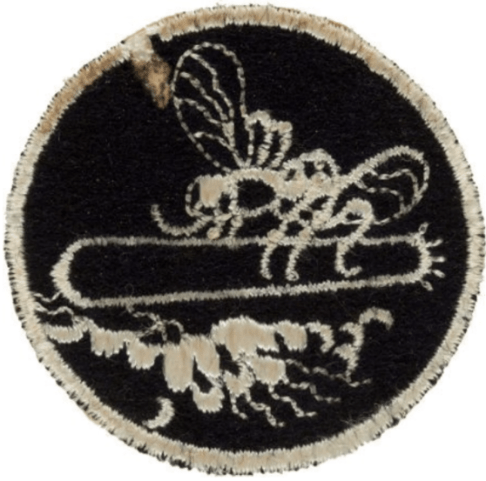
This screen-grab from the auction listing shows the unauthorized mosquito boat insignia that some sailors affixed to their dress uniforms’ left shoulders (source: Liveauctioneers.com)
The seller proceeds to describe exactly how the patch is authentic by detailing the previous owner’s relationship to the deceased president. Noting that then Lieutenant (Junior Grade) Kennedy had sent his personal uniform patch to his cousin as token to cheer her up in the midst of her sorrow for being sent to boarding school. The story certainly seems plausible. Accompanying the patch (which is framed in a display) were:
- Various copy-images of JFK and the crew of the PT-109
- JFK receiving a medal (probably his Navy and Marine Corps Medal)
- A circa 1930 color photo of JFK and Marylou as children
- A patch from the aircraft carrier U.S.S. John F. Kennedy
- A signed notarized statement from Marylou Connelly McCarthy (JFK’s cousin and recipient of the patch), dated 1998, discussing the patch and her relationship with and feelings for JFK.
- A letter of provenance from the family
All of the items do seem to add up except for one small (well, not that small) inaccuracy. U.S. Navy shoulder patches (such as this unauthorized motor torpedo boat example) were worn solely by enlisted personnel (petty officer 1/c and below) on their jumper uniforms. Officers never donned shoulder patches which punches a hole in the story.
-
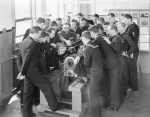
- Enlisted sailors learn about the PT Boat engines at the The Packard Marine Engine School. Note the sailor (third from the left) with the PT Boat patch on the forearm of his right sleeve (image source: pt-king.gdinc.com),
-
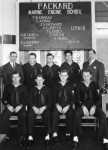
- This graduation photo of Class USN-18 shows the two front-row enlisted sailors (on each end) wearing the PT boat patch on their left forearms (image source: (image source: pt-king.gdinc.com),
I suppose that JFK could have collected the patch from his unit and sent it as a keepsake for his cousin which would solidify those aspects of the seller’s story. Considering the minimum opening bid requirement of $17,000.00 and no takers, it appears that the provenance isn’t quite rock-solid enough for any prospective buyers.
Remember the militaria collectors’ mantra, “buy the item, not the story.”
Showcasing Your Militaria Investment
What good is a collection if it is maintained behind a closet door (where mine tends to be), stored in the basement or locked in a trunk? We spend years gathering items and filling in gaps in our collections as we reach goals that, in some cases, could take a lifetime to achieve. Despite those successes, we fail when we choose to keep them under wraps, hidden from the eyes of our house guests.
Most collectors’ spouses raise objections to the idea of them bringing old, musty-smelling objects into the spaces that we regularly inhabit. Olive drab hardly matches any home decor and the idea of weapons, armament and mannequins occupying limited floor or wall space tends to create friction with our spouses or significant others.
When I can, I like to visit museums that choose to commit their valuable floor real estate to displaying military history. I enjoy seeing the care that was taken by the staff to draw from the collection a tasteful blend of artifacts to present specific themes or create visual representations of specific historic events. Knowing that too much can cause viewers to gloss over the display, missing the all of the details. Too few artifacts or vague information cards in a display can have a similar effect. In both cases, the efforts of the curator are laid to waste as the museum visitor ambles past the display.
Through my membership in the U.S. Militaria Forum, I have seen some very impressive personal collections with well thought out displays that rival any of the best museums in the United States. From the hand-crafted cases and cabinets to the tastefully selected art hung on the walls, these collectors demonstrate that their investment is something to share with others.
-
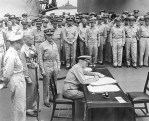
- Fleet Admiral Nimitz signs the documents, accepting the surrender of the Empire of Japan (source: U.S. Navy).
-
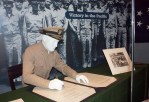
- Note the collar device insignia of Nimitz’ uniform and the tastefully simple display (source: Naval Academy Museum).
-
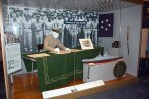
- Tastefully simplistic, the large display has a few items in order to emphasize the monumental significance of the event (source: Naval Academy Museum).
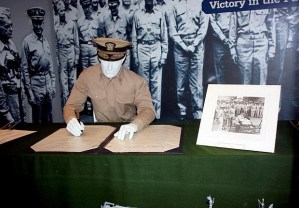
Take note of the mannequin’s altered ring finger on the left hand that matches Nimitz’ partial amputation from 1916 (source: Naval Academy Museum).
Not too long ago, the Naval Academy Museum shared some photos on their Facebook page of one of their latest displays that showcases one of the most historic events of the last century, the signing of the Instrument of Surrender aboard the USS Missouri. Presented is the uniform worn by Fleet Admiral Chester Nimitz on that September 1945 day in Tokyo Bay. The display clearly shows his khaki uniform with the rare 5-star insignia affixed to each collar. The museum staff went as far to alter the mannequin’s left ring finger to match Nimitz’s left hand: a portion of his finger was severed in 1916 by a diesel engine that he was demonstrating.
The key, limiting factor in my home is that I have a considerable lack of space. It is challenging enough to store my collection so the thought of propping up torsos to show my uniforms is nullified. Besides, it can be a little disturbing to walk into a room and see a still and quiet human-form at 4:00 AM as I prepare to head off to work.
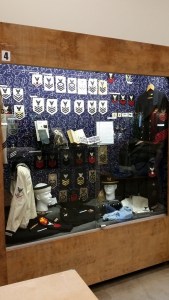 A few years ago, I was invited to participate in a public showing of my military baseball collection at our state fair in their hobby hall. My artifacts where showcased in and among adult and youth collections that were varied, ranging from pig-themed collectibles to artifacts from our nation’s bicentennial celebration. This year, I have yet another part of my militaria collection on display at the state fair. Being that the overwhelming military population (veterans, retirees, reservists and active duty personnel) is army and air force, I wanted to educate the citizenry on enlisted uniforms of the United States Navy. I gathered a few selections of my enlisted rating badges and uniforms to spotlight the history, designs and the ratings themselves. My wife and I visited the fair and stood in the distance to observe visitors to see how they respond to what I had on display. People-watching is fun but seeing people enjoying these artifacts is pleasing and provides some satisfaction to collecting, even if I can only experience it on rare occasions.
-
- Showing the 8-button Machinist’s Mate Chief (bullion) and Electrician (radio) 2/c from WWI uniforms backed by ratings, distinguishing marks and shoulder insignia patches and WWII warrant officer shoulder boards and devices.
-
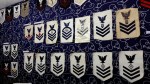
- A selection of rating badges showing eras, specialties, date and manufacturer’s marks.
-
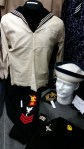
- A few other uniforms: 1905-1913 Coxswain, 1944 Ship’s Cook 1/c and a 1944 Aviation Radioman 3/c (with aerial gun pointer mark) next to a vintage naval academy midshipman rating badge and plebe cover.
Spotlight on private collector militaria displays
- “Belleau Wood Museum” – fabulous World War I Marine Corps displays.
- Chaplain Collection– focused on chaplains of all branches and all conflicts.
- General Officer Collection – one of the most impressive collections – this one focuses solely on officers who attained the rank of general or admiral
Militaria Collecting Made Complicated – No Checklists

One of several checklists within the 1956 baseball card set by Topps.
Prior to delving into militaria and historical research, I collected sports cards for years. My principal interest in this arena was with baseball which is also my favorite sport to watch. Back then, my interest in the game centered on the history – the “golden era” – and the legends of the game. However, with baseball card collecting, I chose to focus on the 1950s and 1960s.
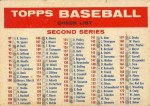
This 1957 Topps baseball card checklists shows the marks the collector made as they worked to complete the set.
With so many players in the game (not all of them represented on a card) in the early 1950s, card companies recognized that they could create more interest by letting their target audience know how many different cards were produced. This information, in the form of checklist cards, contained all the information that informed collectors what cards were produced. This information would keep collectors buying the wax packs (of course, getting the wonderfully powdered sugar covered, hard sticks of bubblegum) and trading their extras with their friends. As they filled out their sets, collectors would check their checklists.
Militaria couldn’t be a more polar opposite from sports card collecting. There are no checklists and finite production runs, no hardened rules about variations, no price guides that afford collectors with knowledge of sales trends….none of that. Militaria collecting requires the collector to acquire knowledge about the artifact – where it was used, who used it, when it was produced and available, when it was issued, how it was modified (in the field), etcetera – before they commit significant finances to collecting.
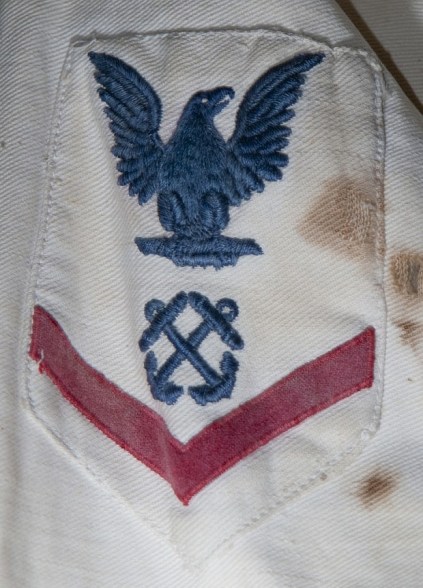
The right-sleeve rate of the 1905-1913 coxswain (with an additional chevron, this would be a boatswain’s mate 2nd class petty officer).
Navy rate collectors can tell stories about variations and just how frustrating it can be to acquire all of the renditions of a specific rate. When considering a long-standing rate, such as a boatswain’s mate (pronounced “bosun’s mate”, BM for short) that has been in existence since the founding of the U.S. Navy, its rate badges have gone through considerable transition. One could assemble an amazing volume of examples of each badge iteration as BM (and Coxswain) insignia have been around since the 1880s.
With each change to uniform regulations (1886, 1905, 1913, 1941, 1946, and so on) rate badges were impacted. Some changes were simply moving from one sleeve to the other (1946) while still others changed the design of the crow (the design of the eagle, color of the chevrons). Additional variations stem from the uniform that the crow is applied to (khaki, blues, whites, greens, grays) as well as the material variations of the base fabric (multiple iterations of blue and white cloth) or the color of the chevrons and eagle (such as bullion).
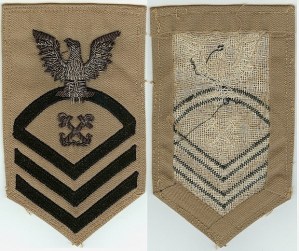
One of countless boatswain’s mate rate badge variations, this post-WWII crow is a bullion on khaki.
If a collector focused solely on the boatswain’s mate rate spanning its entire existence, the collection could potentially be quite large and very costly to build. Unfortunately, there are no checklists to guide collectors. What can confound collectors is the discovery of a rate variant that has never been seen before by seasoned, knowledgeable experts.
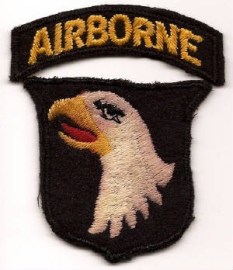
This Screaming Eagles patch is one of countless variants for collectors to pursue (source: Topkick Militaria).
Similar to rate collecting, U.S. Army patches are very diverse and have experienced many iterations over the course of their employment on uniforms. Variations exist within the same era on the same patch design which give collectors reason for pause as they try to collect every option available. Since I don’t really dabble in army patches, my eyes tend to glaze over when other collectors begin to espouse the many facets of the World War II-era Screaming Eagles shoulder insignia. From the different “airborne” tabs to the design of the eagle’s eye and tongue, the 101st Airborne patch could occupy collectors for years as they seek to assemble a complete collection. Cut-edge, marrowed-edge, fully embroidered, felt, greenbacks, white backs, the possibilities are seemingly endless making the concept of having a checklist ideal.
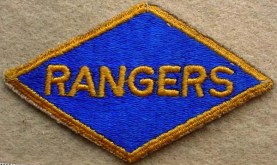
While I can’t vouch as to the authenticity of this being the real thing, it is the design of a World War II Rangers patch (source: SA Militaria).
One aspect I’ve not mentioned and won’t really delve into is the issue of fakes. When a television show or film achieves the level of popularity that Saving Private Ryan (SPR) and Band of Brothers (BoB) have, shady characters create opportunities to separate novices from their hard-earned cash. The Ranger (SPR) and Screaming Eagles patches (BoB) are some of the most heavily-faked embroidery in the militaria market.
In all fairness to those who invest heavily into these areas (with both time and finances), the main reason I shy away from army patches (specifically Rangers and 101st) is that I have no idea how to tell a fake from the real McCoy. I suppose that the pricing of some of the more rare variants (sometimes in excess of $1,000) keep me steering well-clear of collecting army patches all together.
Unlocking the Secrets of Your Collection: Research is the Key
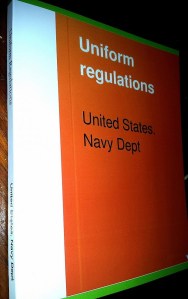
The cover of the 1913 U.S. Navy Uniform Regulations is very high quality in its construction.
Researching early military uniforms to ascertain a date or time period when they were issued or used can pose a challenge for collectors. Navy uniforms can be exceedingly difficult to pinpoint when it comes to dating them for a number of reasons.
Over the last few years, I have stressed that education and research materials only serve to enable collectors to make sound purchasing decisions. Knowing where to turn for information can be a daunting task for someone making their initial foray into this hobby. Simply knowing what research material might exist isn’t in the mindset of those seeking details about a uniform or uniform item.
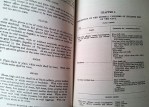
This copy is complete with all of the details including tables and pertinent data.
When I started a serious approach to research (in this case, verifying a jumper as pre-World War I), I was in the dark as to where to look so I turned to Google to begin my investigation. With the understanding that information on the web is seldom complete or authoritative, the search results seemed to be ambiguous and quite vague, so I narrowed my focus to locating people I could glean information from. As with any relationship, time is necessary to determine whether an “expert” is truly knowledgeable in their professed field of experience, so there was a risk that I might have received some inaccurate data.
Wanting to have go-to resources at my disposal, I began to gather reference material that suited my needs. My collection being predominantly focused on the service of my relatives and ancestors, I knew that I had to get the details (i.e. enlistment dates, commands assigned to, campaigns they participated in, etc.) of their individual service records. Armed with hard facts, I could then pursue the pertinent reference materials such as individual unit histories, training manuals, and uniform regulations.
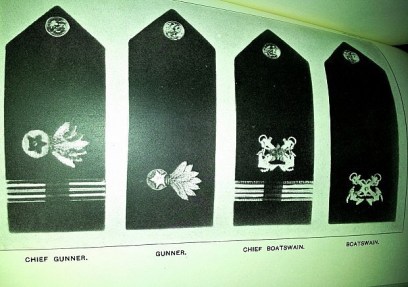
The plates are spectacular! This one shows the warrant officer shoulder boards and insignia.
Some of these materials are plentiful and relatively inexpensive, such as the Navy’s Blue Jackets Manual (issued to new recruits). Others are somewhat rare, making them difficult to find or posing negative impacts onto collecting budgets. One reference book I had been seeking was the 1913 United States Navy Uniform Regulations. I couldn’t locate one through various book stores or eBay. Fortunately for me, Google Books digitized a copy and had the majority of the book’s content available for online use. Unfortunately, the missing portions were the ones I needed for my research. I was amazed to see that I could purchase a hard copy, printed and bound complete book for less than $10.00, shipped to my door! Naturally, I pulled the trigger and less than five days later, I had the needed reference book in my hands.
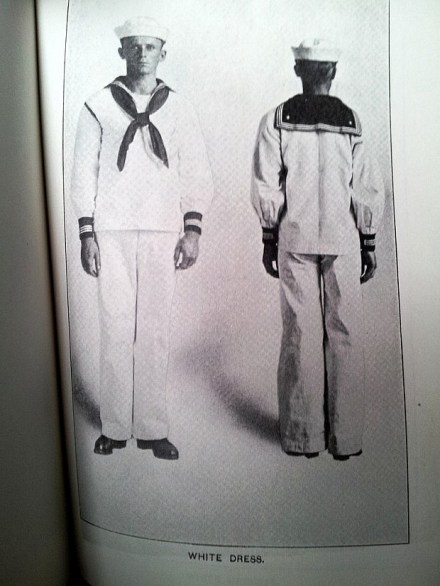
This plate shows the construction of the dress whites – bleached white duck and blue flannel cuffs and collar.
What arrived was a paperback book with a high quality glued-in binding that will withstand repeated viewings or being transported to collector shows much better than an original 100-year-old hardbound book with a weakened spine.
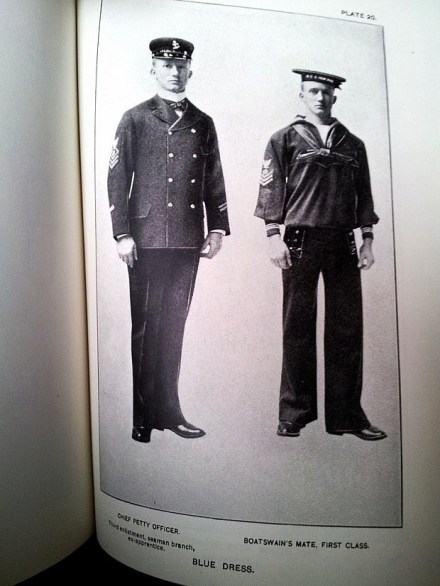
The chief and enlisted dress blues plate shows the proper wear and insignia placement.
Acquiring the 1913 regulations may not appeal to others, but for me this was like locating a missing piece that completes a collection. I’ve confirmed a piece as authentic and I can correctly pursue the remaining outstanding parts to properly complete my uniform display!
 The Veteran's Collection