Category Archives: US Navy
Calculated Risks: Bidding on Online Auctions that Contain Errors
Regardless of how much knowledge you may possess, making good decisions about purchasing something that is “collectible” can be a risky venture ending in disappointment and being taken by, at worst, con-artists or at best, a seller who is wholly ignorant of the item they are selling. Research and gut-instinct should always guide your purchases for militaria. Being armed with the concept that when something is too-good-to-be-true, it is best to avoid it. I recently fell victim to my own foolishness when I saw an online auction listing for an item that was entirely in keeping with what I collect.
I am very interested in some specific areas of American naval history and one of my collecting focus centers around a select-few ships and almost anything (or anyone) who might have been associated with them. One of those ships (really, four: all named to honor the Revolutionary War battle where American George Rogers Clark was victorious in Vincennes, IN), the heavy cruiser USS Vincennes (CA-44) is one in particular that I am constantly on the lookout for.
-

- The auction listing is innocuous; albeit accurate. However, the details are where this seller’s words are misleading and troublesome.
-

- Note in the description that the seller lists specifics about the book (nothing the title, author and edition). Sadly, this is a farse.
-
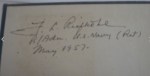
- There were two factors that led me to purchase this book: Admrial Riefkohl’s signaturem that it was in, what I consider to be one of the most accurate accounts of the Savo Island battle.
In early September (2016), a listing for an item that surfaced in one of my saved searches results, caught my attention on eBay. The auction description made mention of a book, Savo: The incredible Naval Debacle Off Guadalcanal, that happens to be one of the principle, reliable sources for countless subsequent publications discussing the August 8-9, 1942 battle in the waters surrounding Savo Island. Though I read this book (it was in our ship’s library) years ago, it is a book that I wanted to add to my collection but until this point, never found a copy that I wanted to purchase. What made this auction more enticing was that this book featured a notable autograph on the inside cover. In viewing the seller’s photos, I noted that the dust jacket was in rough shape but the book appeared to be in good condition (though the cover and binding were not displayed). There were no bids and the starting price was less than $9.00.
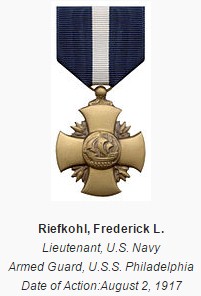
Riefkohl was awarded the Navy Cross medal for actions performed aboard the USS Philadelphia against German submarines during WWI convoy escort operations (see the test of the accompanying citation below).
I have been a collector of autographs and have obtained several directly from cultural icons (sports stars, actors, musicians) but my favorites are of notable military figures (recipients of the Medal of Honor [MOH] and other servicemen and women) who distinguished themselves in service to our country. The signature in this book featured a retired naval officer who was the recipient of the Navy’s highest honor, the Navy Cross (surpassed only by the MOH) and who played a significant role in the Battle of Savo Island as he was the commanding officer of the heavy cruiser, USS Vincennes (CA-44) and the senior officer present afloat (SOPA) for the allied group of ships charged with defending the northern approaches (to Savo and Tulagi islands). Frederick Lois Riefkohl (then a captain) commanded the northern group which consisted of four heavy cruisers; (including Vincennes) USS Quincy (CA-39), Astoria (CA-34) and HMAS Canberra (D33).
By all accounts, the Battle of Savo Island (as the engagement is known as) is thought to be one of the worst losses in U.S. naval history (perhaps second only to the Japanese surprise attack on Pearl Harbor) as within minutes of the opening salvos by the Japanese naval force, all four allied ships were left completely disabled and sinking (all would succumb to the damage and slip beneath the waves in the following hours). Though the loss was substantial, the Japanese turned away from their intended targets (the allied amphibious transport ships that were landing marines and supplies on Guadalcanal and Tulagi) missing a massive opportunity to stop the beginnings of the allied island-hopping campaign. The First Marine division was permanently entrenched on these islands, and would drive the Japanese from the Solomons in the coming months.

Captain Frederick Lois Riefkohl (shown here as a rear admiral).
Captain Riefkohl was promoted to Rear Admiral and retired from the Navy in 1947 having served for more than 36 years. He commanded both the USS Corry (DD-334) and the Vincennes and having served his country with distinction, the Savo Island loss somewhat marred his highly successful career.
As I inspected the book, there were a few aspects that gave me reason for pause. First, the seller described the book as “SAVO by Newcomb 1957 edition” which left me puzzled. Secondly, the Admiral included a date (“May 1957”) with his signature. Recalling that Newcomb’s book was published in 1961 ( See: Newcomb, Richard Fairchild. 1961. Savo. New York: Holt, Rinehart and Winston.), I was a bit dismayed by the four-year discrepancy between the date of the autograph and (what the seller determined to be the) first edition published date. I wondered, “how did he determine this date and where did he find this information?” I noted that there was no photograph of the book’s title page accompanying the auction.
I decided to take a gamble that at worst, would result in me spending a small sum of money for an autograph that I wanted for my collection and at best was merely a fouled up listing by an uninformed seller. I pulled the trigger and my winning bid of $8.99 had the book en route (with free shipping, to boot)!
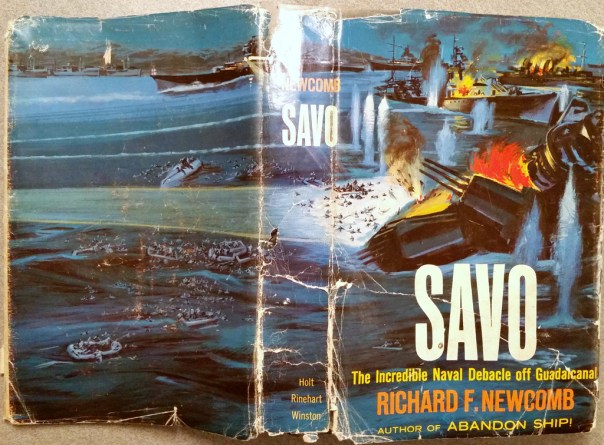
The dust jacket is in very rough shape with tears, creases, cracks, shelf wear and dog-ears. The cover art is fairly intense in conveying what took place in the battle.
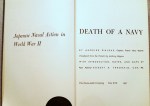
The confirmation that I didn’t want; this book turned out to be”Death of a Navy” which isn’t worth investing time to read as it is known to be a rather erroneous work.
Nearly two weeks later, the package arrived. I reservedly opened the packaging and freed the book from the layers of plastic and bubble wrap. I inspected the ragged dust jacket and removed it to see the very clean cover which didn’t seem to match. I opened the book and viewed Riefkohl’s autograph which appeared to match the examples that I have seen previously. I turned to the title page and confirmed my suspicions. Death of a Navy by an obscure French author, Andrieu D’Albas (Captain, French Navy Reserve). “Death” is not worthy enough to be considered a footnote in the retelling of the Pacific Theater war as D’ Albas’ work is filled with errors. By 1957 (when this book was published), most of what was to be discovered (following the 1945 surrender) from the Japanese naval perspective was well publicized before the start of the Korean War. It is no wonder why Andrieu D’Albas published only one book.
-

- Death of a listing. This acquisition turned out to be a partial dud.
-

- Removing the dust jacket, the cover didn’t seem to match the dust jacket.
My worst-case scenario realized, I now (merely) have the autograph of a notable U.S. naval hero in my collection. While I could have gone with my gut feelings about the auction listing, having this autograph does offset my feelings of being misled (regardless of the seller’s intentions).
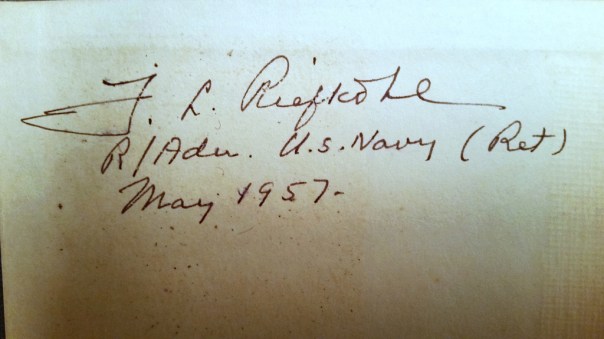
Admiral Riefkohl’s signature appears to be authentic leaving me semi satisfied in that I obtained a great autograph for my collection.
Riefkohl’s Navy Cross Citation:
The Navy Cross is awarded to Lieutenant Frederick L. Riefkohl, U.S. Navy, for distinguished service in the line of his profession as Commander of the Armed Guard of the U.S.S. Philadelphia, and in an engagement with an enemy submarine. On August 2, 1917, a periscope was sighted, and then a torpedo passed under the stern of the ship. A shot was fired, which struck close to the submarine, which then disappeared
Navy Cracker Jacks: No Toy Surprise
Today marks the 241st anniversary of the founding of the United States Navy. What better way to celebrate and honor the best branch of the U.S. armed forces than to discuss this service’s enlisted uniforms?
In writing this blog, I am (happily and willingly) forced to expand my knowledge in a great many areas of military history that I otherwise would have overlooked. As I embark on a new article, I am presented with the opportunity to delve into learning about uniform details and nuances that I’d previously had little or no exposure to. One aspect of this post has finds me diving into uncharted territory (for me).
-
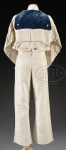
- On this posterior view, note the broadness of the blue flap and the horizontal blue piping along the seam of the jumper. The trousers have lacing at the rear of the waistband which is still in use on present-day dress blue trousers (source: James D. Julia Auctions).
-
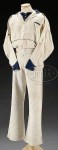
- This Civil War-vintage dress white uniform was recently listed with an estimated sale price of $3,000-$8,000. Note the blue cuffs and the blue flap (white white stars), a design that would persist well into the 20th Century (source: James D. Julia Auctions).
-
- Another close-up view of the SpanAm jumper cuff shows the white button with an embossed anchor (eBay image).
-

- This close-up view of the Civil War uniform shows the hand-embroidered star on the collar flap’s corner (source: James D. Julia Auctions).
The uniforms of the United States Navy, particularly the enlisted version, has maintained relative consistency in its design for more than 160 years. From the bell-bottom trousers and the collar flap to the various trim and appointments, today’s modern design has remained consistent with the original, functional aspects of those early uniforms.
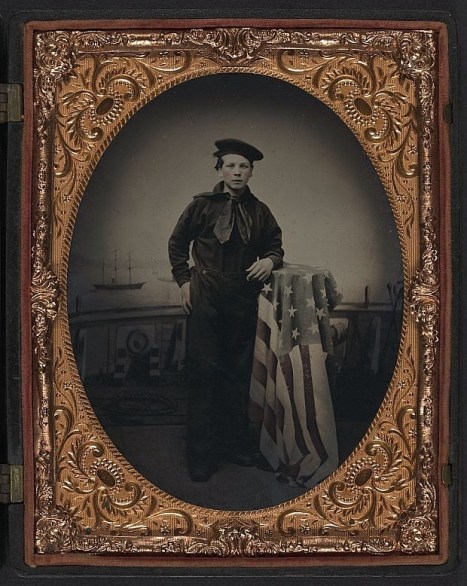
Leaning against a flag-draped table, this sailor’s uniform trouser-buttons are clearly visible and show the 7-button configuration (source: Library of Congress).
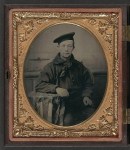
This Civil War-vintage tin type photograph shows a sailor wearing his dress blue jumper, blue neckerchief, and flat hat (source: Library of Congress).
Today’s jumper blouse design was incorporated with the collar flap which was used as a protective cover to protect it from the grease or powder normally worn by seamen to hold hair in place during the twenty years prior to the start of the Civil War.
Piping and stars were added to the flap while the flat hat (affectionately referred to in the 20th century as the “Donald Duck hat”) became a standard uniform item during this period. In the late 1880s, the white hat (or “dixie cup”) was introduced, essentially solidifying the current configuration we see today. Prior to World War II, the blue cuffs were dropped from the white uniform and the flap was switched to all white with blue stars. By 1962, the flat hat was gone.
A collector colleague steered me to an online auction listing for an absolutely stunning Civil War-era white (with blue trim) U.S. Navy cracker jack uniform. Constructed from linen, these white uniforms were hard pressed to survive the rigors of shipboard use, let alone 1.5 centuries. Examples such as these are extremely rare and carry considerable price tags.
-
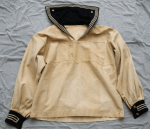
- Continuing the same design elements of the Civil War toward the turn of the century, this Spanish-American War jumper has blue cuffs and a blue flap with the three-stripe piping and the single stars on the corner of the flap (source: eBay image).
-
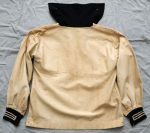
- The rear of the Spanish-American War jumper shows the “sculpted” horizontal seam across the back (source: eBay image).
-

- A close-up of a SpanAm jumper shows the wool material and the three-stripe white piping (source: eBay image).
-

- Another close-up view of the SpanAm jumper cuff shows the white button with an embossed anchor (eBay image).
Since I’ve been collecting, I have seen a handful of late nineteenth century Navy uniforms listed at auction. While most of them are blue wool, I have seen a smattering of dress whites.
With the arrival of the twentieth century, the Navy expanded its fleet and global reach requiring increase of manning. That expansion means that collectors today have greater opportunity (and to pay lower prices) to locate period examples. These later uniforms were constructed using better materials in order to perform better in the harsh, mechanized and considerably dirty shipboard climate. Blue uniforms were constructed from heavy wool while linen was dropped in favor of cotton-based canvas material for the whites.
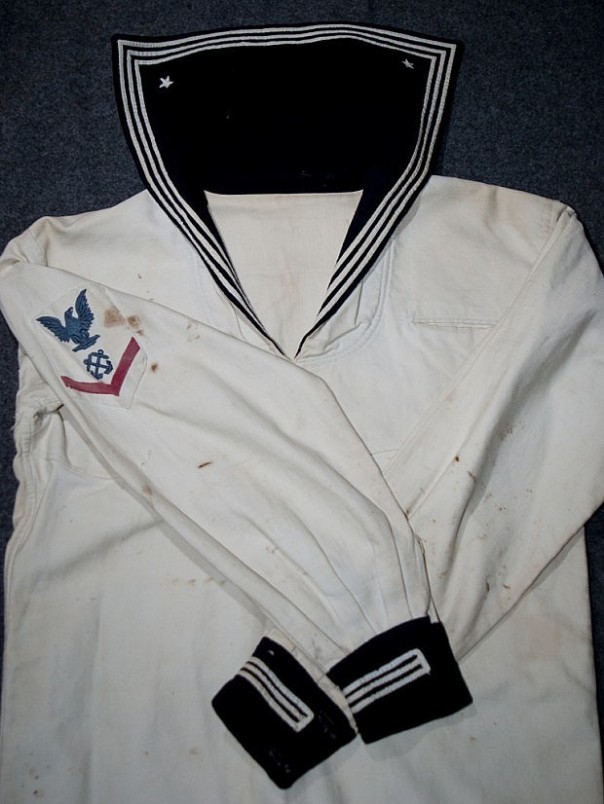
I have the privilege of owning this 1905-1913 coxswain dress white uniform. Note the blue wool cuffs and collar flap and the three-stripe white piping affixed. The flap also has two white stars directly embroidered to each corner.
Today’s enlisted dress uniforms while representative of the pre-Civil War origins, they are quite sanitary and less desirable for collectors. Gone is the heavy wool for the dress blues. The dress whites are polyester, also called “certified navy twill” or CNT. One saving grace is that the white Dixie cup hats are virtually unchanged since their introduction, making them nearly non-distinguishable from early examples.
-
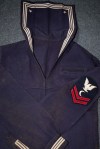
- Another jumper from my collection: this ship’s cook 2/c is from World War I and features a trimmed “crow” with the eagle facing to the left (rear of the sleeve).
-
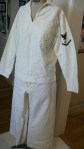
- By World War II, dress whites no longer had the blue cuffs and a white flap replaced the blue one that had existed since the Civil War.
-
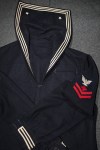
- With the exception of the heavy wool material (which has been supplanted by a light-weight weave), this World War II jumper does not differ from current-issue blues.
-
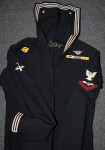
- When the Navy began to specialize the enlisted ranks in the late 1800s, special marks were incorporated to denote the skills of the enlisted sailors. This WWII aviation radioman 3/c uniform has the distinguishing mark of an aerial gunner on the right sleeve.
Happy birthday to all of those who served before me and since my time in uniform. Happy birthday to my shipmates and happy birthday to the United States Navy!
See other U.S. Navy Uniform Topics:
- Collecting US Navy Uniform Ship Identifiers
- Breaking From Tradition Navy Shoulder Sleeve Insignia
- Militaria Bargains to be Had
Navy Enlisted Ratings Eliminated: What are the Impacts on Sailors and Collectors?
Until last week, I have been reluctant with this blog to delve into matters that touch on politics (my first politically-focused article was published yesterday – as of writing this article). The subject of this article has me approaching the line of demarcation (between politics and collecting) and I believe that I was able to keep the content weighted heavily in facts with a slight peppering of opinion interspersed between them as I began to address my concerns regarding the highly controversial decision (that is the central theme of this post) that was announced last week. This blog has a decent following and the stats indicate that a lot of people are searching for information pertaining to Navy ratings and badges (and discovering this site) leaving me soliciting readers to be heard by commenting after you finish reading the post.
With four articles written (see list below) about United States Navy Ratings and Rating Badges, I didn’t see myself delving back into this subject quite so soon. With recently announced changes to the Navy’s enlisted rates and rating structure – a complete overhaul – I am compelled to dive into the subject from my perspectives both as a veteran sailor and a collector.
From the moment that the Chief of Naval Operations (CNO) and the Masterchief Petty officer of the Navy (MCPON) announced that the Navy would be dissolving the 241-year-old tradition of identifying enlisted personnel by their job title (known in the Navy as “rating”), the uproar from veterans, retirees and active duty personnel was instantaneous and deafening. There is no doubt that if you were paying attention to social media on September 29, 2016 you most-likely saw someone lamenting the impending changes and their outrage directed towards the navy leadership for even considering the idea, let alone moving ahead with implementation of a plan to disestablish a tried, true and loved tradition.
Who Cares About 241 Years of Tradition?
Aside from the current leadership, most all sailors care about the preservation of vaunted and successful customs and traditions that set the Navy apart from the other branches of the armed forces. In the earliest days of the naval service, rated sailors have been called by their job titles – specifically, boatswains’ mates (pronounced, “bosun’s” mates) have been so called since 1775. It is a matter of pride to be known by the work that is performed. I remember when I advanced to Operations Specialist, Third Class (“OS3”), it was a matter of pride. No longer was I known as a Seaman and, not just a petty officer, but that I had attained the rating and rate; the culmination of performing my duties; getting qualified on every aspect of my job that was possible, studying and achieving proficiency. This mentality continues and builds as sailors advance through the pay-grades, evolving into an expert that subordinates and seniors alike learn to depend upon. Despite the job title or function, the sailors in each of these ratings own considerable pride in being referred to by their rating. To have that all stripped away and be known only as “petty officer (third, second, first) class” systematically removes sailors’ pride. If I was still serving, instead of being OS1 (Operations Specialist First Class), I would just be “Petty Officer” with an innocuous (hidden) designation; “B440.”
When the Continental Navy began in 1775, there were officers and men and two designated ratings of enlisted men. Once the hostilities ended, Congress agreed that there was no longer a need for a navy, voting to disband it in 1785.
- Armorer – In use in 1775; established 1797;
- Boatswain’s Mate – In use in 1775; established 1797
The new nation experienced renewed aggression from England and tensions grew between the United States and France compelling the government to take action, passing the Naval Act of 1794 to build six warships (known as the original “Six Frigates“). By 1797, the Navy began to establish an enlisted rating structure, solidifying the tradition and practice that was in place until last week. In addition to the boatswains mate and armorer, the newly established rates at that time were:
- Boy
- Carpenter’s Mate
- Cockswain (sic)
- Cook
- Cooper
- Gunner’s Mate
- Master-at-Arms
- Master’s Mate
- Midshipman
- Ordinary Seaman
- Quarter Gunner
- Sailmaker’s Mate
- Seaman
- Steward
- Yeoman of the Gunroom
-
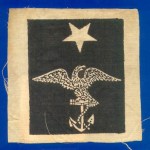
- This is the stenciled pattern that was provided to petty officers to hand-embroider their rating marks, beginning in 1841 (source: Dr. Howard G. Lanham/http://hglanham.tripod.com/datingrating/datingratings.html).
-
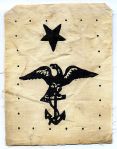
- This summer white uniform stencil for a petty officer badge would be used by the sailor to embroider his own badge (source: warrelics.eu).
-
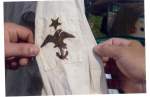
- This summer white jumper appears to be part of an (unofficial) “liberty” uniform. This is a fine example of the hand-embroidered petty officer badge from the Civil War period (source warrelics.eu).
-
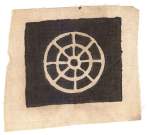
- 1869 Machinist specialty mark (source: warrelics.eu)
As the Navy changed operational procedures and modernized throughout its existence, so did the enlisted rating structure. It wasn’t until 1841 when the Navy established insignia for rated sailors. The design called for an eagle facing left (from the wearer’s perspective) with wings pointed down, while perched on a fouled anchor. It was to be worn half way between the elbow and shoulder on the front of the sleeve. Rated Petty officers in the following wore the badges on their right sleeve:
- Boatswain’s Mates
- Gunner’s Mates
- Carpenter’s Mates
- Masters at Arms
- Ship’s Stewards
- Ship’s Cooks
…while the following petty officers wore the badge on their left uniform sleeve:
- Quarter Masters
- Quarter Gunners
- Captains of the Forecastle
- Captains of Tops
- Captains of the Afterguard
- Armorers, Coopers
- Ship’s Corporals
- Captains of the Hold
-
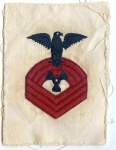
- This Machinist Mate Chief Petty officer badge dates from the late 1880s (source: warrelics.eu).
-
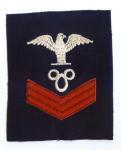
- An early 1880s Sailmaker’s Mate petty officer badge for the winter blue uniform (source: warrelics.eu).
-
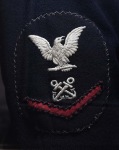
- This 1890s Coxswain crow (affixed to a dress blue jumper) is embellished with hand-embroidered stitching surrounding the edges and the chevron. Sailors often shaped the patch and added their own personal touches to their uniforms and their ratings were a significant part of this (source: Hampton Roads Naval Museum).
-
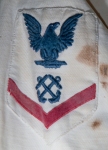
- In 1913, the Navy did away with the red chevrons on dress whites most-likely due to the red dye fading and bleeding onto the white uniforms when laundered. The chevrons were changed to blue matching the eagle and specialty marks.
-
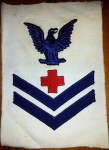
- Prior to WWII, Pharmacists’s Mates were right-arm ratings as indicated by this eagle facing the right. The eagle is also slightly bent as the legs lean toward the left and the torso leans toward the right indicating that it is post WWI.
In the following years (through the Civil War and beyond), the Navy continued to mature the rating badges by adding specialty marks (symbols that represented the sailor’s job). By the mid 1880s, the manufacture of petty officer marks were contracted to private companies, alleviating the need for the petty officers to hand-embroider them. The transition from sail to steam created the need to create new ratings to meet the rapidly changing technological advances. Navigation, communication and gunnery improved and sailors specialize creating new specialties. The Navy adapted and so did the sailors as they took pride in their jobs and uniforms.
For another century and a half, sailors have not only identified themselves by the mark on their sleeve during their careers, their passion and loyalty towards their rating continues throughout their lives. Though veterans of other branches might hold their specialty in high regard long after their service, it doesn’t compare to that of the Navy veteran. One glance at any veteran-memorabilia catalog reveals what sailors demand – t-shirts, polo shirts, ball caps, vehicle decals and challenge coins emblazoned with rating insignia.
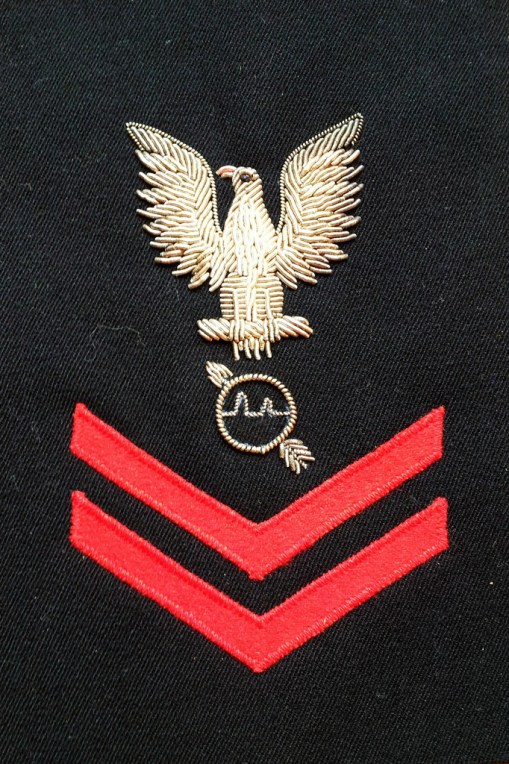
This rating, Operations Specialist, Second Class (OS2) has been discontinued and is now known as a “B440.” The Navy has yet to decide the fate of the rating badges and insignia.
When the CNO and MCPON unceremoniously pulled the plug on the enlisted classification system, there were in excess of 90 active ratings in use. Since the ratings were officially established in 1797, more than 700 have been used. As a collector, I wonder what changes are forthcoming that will have impacts on the items that I am interested. As Mark D. Faram and Sam Fellman of the Navy Times noted, “the moves leaves the enlisted force’s foremost symbols as the petty officer crow and the chief petty officer anchors.” The writers continue, “It remains unclear what will happen to the ratings badges that feature iconic rating insignia that officials are considering changing. An engineman’s gear. An information systems technician’s sparks. These images were beloved by many and inspired countless tattoos.” Apparently, we have to wait and see what will become of our unique (to our branch of the armed forces) sleeve insignia. Will the Navy remove the distinguishing/specialty marks that currently reside between the eagle and chevrons? Since the goal is to make the enlisted structure more in line with the Army, Air Force and Marines (see: Hello, Seaman: Navy Ditches Ratings After Review – Military Times, 9/29/2016), would they simply reduce our insignia to just chevrons, also eliminating the eagle?
-
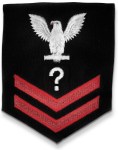
- The Navy’s wisdom shines through yet again. Without any plans for what will happen with rating badges, the decision to gut the system has been decided.
-
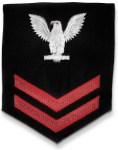
- If we are to follow along with what sailors are to be called, then it is probable that the Navy will remove the specialty mark from the rating badge.
-
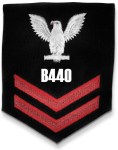
- Rather than Operations Specialist, these sailors would now be known as B440 Second Class Petty Officers (which is far more simpler than “OS2”).
-
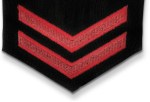
- Commander John Schofield, a spokesman for Navy Personnel Command told the Military Times last week, that the change “completely aligns us with the other services.” One could assume that the uniforms will ultimately be the same as the other branches, deep-sixing the last of the tried and true traditions.
For those who collect rating badges and insignia, the discontinued use of them on enlisted uniforms could spark a sudden boost in interest spurring on an increase in demand while driving up prices. At present, collectors have predominately focused their interest in rating badges that predate the current eagle design (often disparagingly referred to as a “sick parrot”) – prior to the design change in the late 1980s. The earlier “crow” designs incorporate an more aggressive and menacing perched eagle and finer details in the embroidery (see: Discerning Birds: U.S. Navy Rating Badges from WWI to WWII). Another factor that garners collectors’ interest is that many of the distinguishing/specialty marks have been long since disestablished or superseded. Collectors will be watching for any indication of changes (increased interest, more online auction bidders, etc.) in the market. It may be premature to say that the market appears to not be impacted by last week’s announcement. If the rating badges are altogether eliminated, I suspect that there will be a spate of new collectors influencing prices but it will eventually settle down shortly after. Time will tell.
What is Wrong With The New System?
Many people are wondering why are sailors so adamantly opposed to the new system that is being implemented. Why is there such a visceral and negative response to the impending changes? What began in January, 2016 as a directive by the Secretary of the Navy (SECNAV) Ray Maybus to evaluate all of the ratings in order to “ensure they were representative of all sailors and did not discriminate based on gender,” evolved in the elimination of every rating. Rather than to work within the ratings, addressing the directive and fighting to uphold tradition, the MCPON took the easy way out, flippantly recommending (to the SecNav) that simply demolishing the ratings all together “could be be done tomorrow.”
“Make no mistake about it,” MCPON Stevens recalled telling (SecNav) Mabus, “this course of action will be the most labor-intensive, probably the most expensive, certainly the most controversial as well as difficult to accept socially throughout the Navy.”
Stevens had previously presented four scenarios to Maybus that were workable solutions to the directive (removing “man” from 21 specific ratings) before proposing the one that would strike the biggest blow to enlisted morale and to the American taxpayers. Maybus would have the final decision and, according to Stevens, Mabus “sat there a little bit, pondered it, asked a few questions and then decided, in the best interest of the Navy’s future, this was the path he wanted to take.” With that, Navy leadership unceremoniously rendered sailors to be nothing more than generic enlisted people that will no longer be as specialized as they are today.
Rather than focus on the most pressing needs of the navy (preparedness and readiness), the navy instead has shifted gears to be more focused on social issues. This shift in focus has already begun to produce negative results on mission-readiness:
- Fourth breakdown in US Navy littoral combat ship – “…the Coronado’s incident (suffering an ‘engineering casualty’) means four of the six littoral combat ships in service have suffered mechanical failures in the past nine months.
- The New $3B USS Zumwalt Is a Stealthy Oddity That May Already Be a Relic – “On the DDG-1000 [Zumwalt-class], with the waves coming at you from behind, when a ship pitches down, it can lose transverse stability as the stern comes out of the water—and basically roll over…”
- Why More (Navy) Commanding Officers are Getting Fired (due to misconduct) – “…the presence of the opposite sex has led to an exploding rate of fraternization, at every level. Simply put, you cannot put young, healthy men and women into a small box, send them away for extended periods of isolation, and not expect them to interact dynamically with one another. They’re like magnets being put into a box and shaken — they stick.”
There are countless instances of sailors dealing with the effects of extended deployments (due to the reduction of the number of combat-ready vessels and aircraft yet an increased demand), reduced morale, radical changes to command structure, and de-funding of maintenance budgets for active ships – all of this is contributing to a naval force that is wholly unprepared to meet any emergent needs that should arise. Further diminishing morale by removing the enlisted rating system will only serve to continue the downward spiral that could take decades to end.
Contradiction and Irony
The eight-month long effort (January through September) to address Secretary Maybus’ directive to be sensitive to the ever-increasing list of federally recognized genders by removing “man” from rating titles is, at the outset, a failure. Though the leadership did succeed in eradicating the negative connotation from 21 ratings, they doubled-down on “man” for all sailors in pay-grades E-1 to E-3, referring to them all as “seaman,” leaving bluejackets to wonder what was Maybus’ underlying motivation.
Previous Articles about Collecting Navy Ratings and Badges:
- Silver Eagles: Navy Bullion Rate
- Tracking U.S. Navy Specialties: The History of Radarmen
- Chiefly Limited: Space for Uniforms is at a Premium
- Discerning Birds: U.S. Navy Rating Badges from WWI to WWII
References:
- The inside story of how the Navy’s top brass eliminated ratings
- Navy Eliminating 241-Year-Old Rating System in New Enlisted Rank Overhaul
- GOP lawmaker: Navy’s move to strip job titles will hurt morale
- Whitehouse.gov Petition: Restore the Traditional Navy Rating Specialty Titles
- The Navy dumped its time-honored job titles and the decision incited widespread outrage
- Navy move to scrap traditional enlisted ratings system draws criticism, questions in ranks
- War Relics.com – US Navy Rating Badges Discussion Topic
Militaria Bargains to be Had
Taking inventory of my previous blog postings, I find an overwhelming majority of the topics I’ve covered were focused primarily on militaria that is not in the reachable price range for most collectors. These posts have been in stark contrast to my most recent acquisitions, most of which are well below $50 (including shipping costs).
In reality, most of the collectors I know are adept at rooting out the bargains at yard sales, surplus and antique stores, and various other sources. Rather than shelling out loads of cash to online sellers and taking on shipping costs, these collectors locate some very hard-to-find, and in some cases, high dollar items and groups for a pittance.
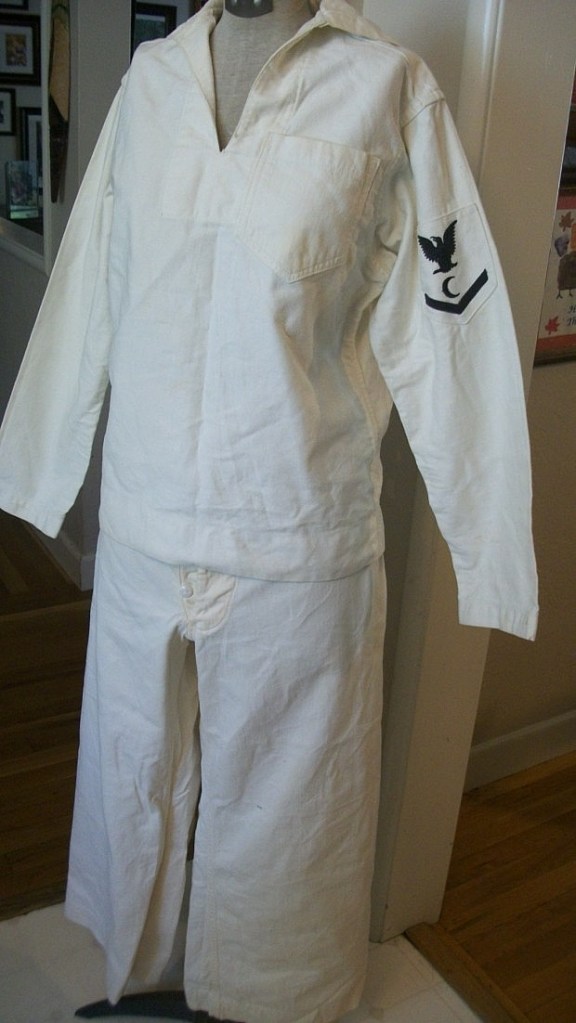
For the bargain-basement price of less than $11.00, I was able to acquire this fantastic tailor-made set of WWII-era dress whites with the precise rating badge I had been seeking (source: eBay image).
One of my collector colleagues spends time sniffing around in bargain bins in a surplus store near one of the local military installations, and once managed to locate a few sets of experimental U.S. Army combat uniform sets for less than $10.00. Subsequently, he discovered that the uniforms were rare and highly sought-after by collectors of current and modern uniforms, and could easily yield several hundred dollars per shirt and trouser set. His find was merely a matter of timing and experience as he recognized that these uniforms had subtle differences from their standard-issue counterparts.
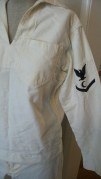
This jumper has a nice, crisp appearance for being 70+ years old. The crow of a Ship’s Cook 3/c is exactly what I was looking for (source: eBay image).
For some collectors (like me), possessing and budgeting for the time to spend scouring these locations for the bargains is difficult. We compensate by letting our browsers and searches do the legwork in discovering the low-priced pieces. Knowledge and experience also comes into play for us as we are able to discover items in listings that are incorrectly identified or tagged by the sellers helping to keep the buyer competition to a minimum.
Still, timing and patience are ultimately the key in finding low-priced pieces. I have been in search of a set of World War II vintage U.S. Navy enlisted dress whites with a ship’s cook third class (SC 3/c) rate and rating badge in good condition for a few years. Such a set would be a great augmentation for the uniform display I am assembling to honor my grandfather. While I already have two sets of his actual dress blues (one is standard Navy-issue and the other is his tailor-made, custom set), his whites were lost to time. When an online auction for a set of whites meeting my criteria was listed for less than $10.00, I began watching, hoping that the competition would be low and I set my snipe bid.
Just a few days ago, I received notice that the auction closed and my bid had been accepted as the winner. I acquired the uniform for less than $11.00 (plus a few bucks more for shipping costs) and I was amazed that this set would sell for such a low price when so many had sold for well over $50.00 during my previous years of searching.
The bargains are still out there for those who arm themselves with knowledge and patience and have a little bit of luck.
Collecting U.S. Navy Uniform Ship Identifiers
To suggest that veterans and sailors of the U.S. Navy have an affinity for their ships would be a gross understatement. It would be difficult to stroll through any public area without seeing a former navy man sporting a ball cap with a USS ___ (fill in the blank). I have seen men well into their late 80s proudly carrying the name of the ship they served aboard, emblazoned across their foreheads, and as I write this, I am proudly wearing one of my own ship’s ball caps.
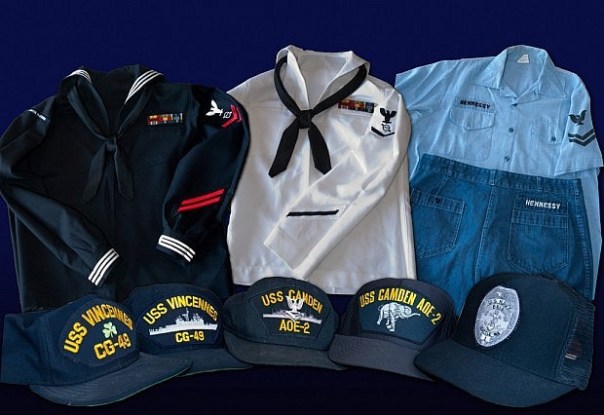
This collection of uniforms shows four official shipboard navy ball caps, authorized for wear with utility uniforms (such as the now-defunct dungaree set on the right). Note the UIM patch on the right sleeve of the dress blue uniform jumper.
Navy ship ball caps are quite commonplace. Many of them have icons or symbols between the name and the hull number designator that make them unique to each specific ship. Some of the symbology might have nothing to do with the ship, instead being representative of the commanding officer or the crew. As far as I’ve determined, ships’ crews have been wearing the named caps aboard ship with utility (dungarees) since the 1960s.
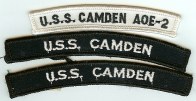
The two blue UIM patches shown are authorized by Navy uniform regulations. The white patch on top is a manufacturing mistake and unauthorized for wear on a Navy uniform. The USS Camden was decommissioned in 2005.
When sailors are required to be in their dress uniforms, identifying them with their associated commands is a requirement… especially when sailors behave like, well… sailors in foreign ports. Present-day enlisted dress uniforms must be adorned with a unit identification mark (UIM) patch on the top of the shoulder of the right sleeve. This regulation has been in place since the late 1950s to early 1960s.
Prior to World War II, the navy employed a much more stylish format of placing the command names on their enlisted sailors. From the 1830s to 1960, sailors wore with their dress blue uniforms a flat hat, affectionately known as the “Donald Duck” hat. Though it wasn’t authorized, in the latter half of the nineteenth century, sailors began to adorn their flat hats with a ribbon (known as a tally) that displayed the name of the ship and was worn only when on liberty (“shore leave” to you landlubbers). Eventually, the tallies were acknowledged within the naval uniform regulations, standardizing their appearance and wear.
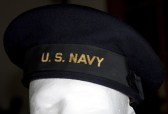
This post-1941 Navy flat hat shows the generic “U.S. Navy” tally. By 1960, these hats were retired from use.
By 1941 and the outbreak of World War II, the rapid expansion of the fleets with many new ships under construction and being delivered to the fleet, the Navy did away with the ship names on the tallies, standardizing all with “U.S. Navy” (there is some speculation that secrecy of ship movement drove the Navy to implement this change).
Ship-named tallies are highly sought after by collectors, pushing prices on some of the more famous (or infamous) vessels well into the ranges of multiple-hundreds of dollars, regardless of condition. Due to the delicate nature of the tallies’ materials and the exposure to the harsh marine environment, the gold threads of the lettering tend to darken and tarnish. The ribbon construction was typically made with silk, so they don’t stand up well to the ravages of several decades of time and storage.
In the last few years, a tally showed up in an online auction for the first time in more than a decade of staking out anything related to USS Vincennes. Until then, I had my doubts as to whether the Navy had allowed the pre-war crew to have the tallies for their ship, even though it was in service since February of 1937, four years before they were abolished. Sadly, the selling price surpassed my maximum bid by nearly triple the amount.
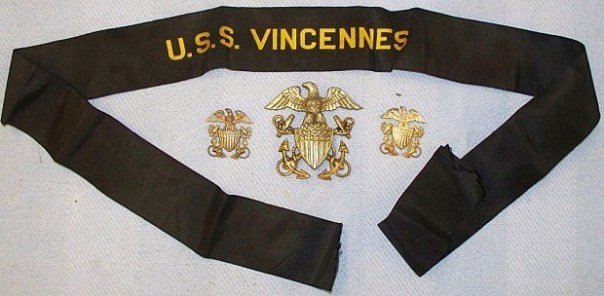
This image shows the rare USS Vincennes tally (along with some officer cap devices), which was sold this week at auction for more than $150 (source: eBay image).
Hopefully, I don’t have to wait as long until I see another USS Vincennes tally!
 The Veteran's Collection