Category Archives: U.S. Army
Provenance and Research Matters: WWII USAAF Aviator’s Cap
I doubt there are many collectors who have NOT experienced the current run that I’ve been on, though I certainly feel alone in this rut.
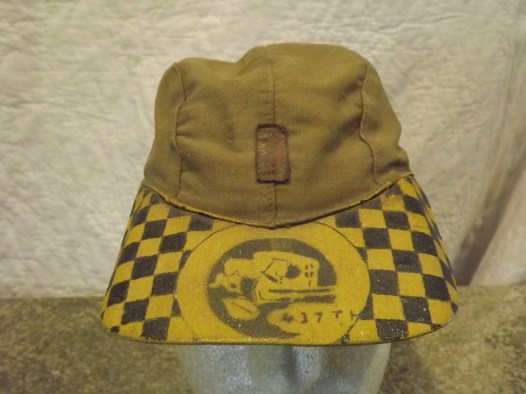
This khaki aviator’s ball cap is an oddity with this artwork on the bill. A sewn-on rank insignia adorns the front panel (source: eBay Image).
Over the past several months, I have been seeing some amazing online auction listings of seldom-seen militaria pieces. It seems that with each week that passes, an item gets listed that falls into one of my many robot-searches, alerting me to investigate and research the piece. After the necessary due diligence, I am reeled-in and decide what I can afford and get set to place my highest bid (yes, I use a sniping program). After a few days of waiting, I receive the dreaded notice that I had been outbid milliseconds after mine was placed.
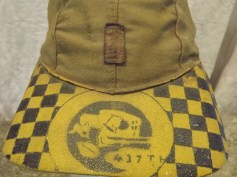
A close-up of the hand-painted bill shows the “437th” in the squadron insignia (source: eBay Image).
Aside from the disappointment of being outbid, the other all-too-familiar letdown that I have been experiencing is the discovery of pieces that would fit perfectly into my collection but the price never seems to align well with my budget. Illustrating this point was when a stunning World War II-vintage aviator’s ball cap, complete with hand-painted squadron artwork was listed at auction.
When I first laid eyes on the khaki ball cap, I was immediately captivated by the hand painted checkerboard pattern surrounding the squadron insignia. Though the design was monochromatic, the design appeared amazingly crisp overlaying the painted-yellow background. My interests lie predominantly with naval history so my expertise is lacking with regards to knowledge of Air Corps squadrons. The “437th inscribed within the insignia was very difficult to research with investigative results being sketchy at that time. Since then, I was able to research further that the hat could most likely have come from an airman who served with the 437th Fighter Squadron (of the 414th Fighter Group) that flew P-47 Thunderbolts in protection of B-29s in the Pacific Theater (in the 20th Air Force).
-
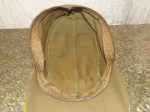
- The cap appears to be a correct-vintage with the leather sweatband (source: eBay Image).
-
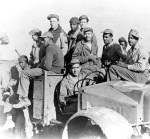
- In this undated WWII photo of the Tuskegee Airmen, notice the aviator ball cap worn by some of the men.
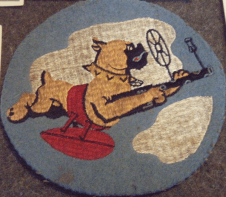
I have only found one single reference to the insignia that is painted onto the ballcap’s bill. It is taken from the unit’s squadron patch. This patch was part of a small group that included a photo and sold at auction for nearly $720.00 in 2014. (source: eBay image).
With no experience in these caps, I had no idea of the range of value for this cap. The one thing that put me off a bit was the initial bid price of $750. On one hand, it seemed to fit my perception of value, but without ironclad provenance (it had none) or any way to confirm the squadron identity, the price started to seem quite high. Too many questions coupled with the lack of sound seller-history, I couldn’t begin to ponder placing a bid even at half the asking price.
Since I first saw the cap, the seller has (unsuccessfully) listed the cap for auction a second time with a lower price. With being listed twice and not a single bid, one could infer that the cap isn’t worth the risk. But something in me keeps me guessing and wondering.
Perhaps I’ll just wait for the next amazing listing to pass on (or be passed on).
Fruitless Searching – The Quest for an Insignificant Patch
After years of searching for a simple uniform accouterment, I am feeling that the possibilities of completing a uniform recreation are far less than I had hoped. When I began my project in 2009, I figured that locating a fairly standard uniform patch would be a simple venture. As I reviewed the photo, seemingly nothing on my uncle’s uniform was rare or would be difficult to source. At the end of four years, I have learned that I may have to place this project on perpetual hold. Where did I go wrong?
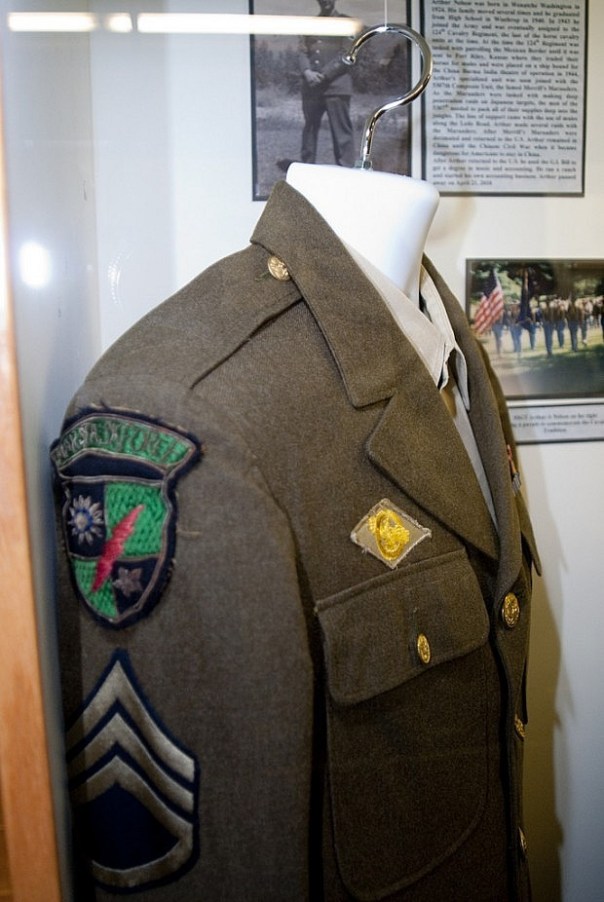
It is unfathomable to me that I stand a better chance locating this Merrill’s Marauders shoulder sleeve insignia patch than the overseas service bars/chevrons combination.
When I received a photo (taken in August of 1952) of my uncle receiving an Army Commendation Medal from a colonel, I knew that I wanted to assemble a uniform jacket with his full military decorations. Around the same time I got the photo, an enormous package arrived from the National Archives which contained a large stack of documents that encapsulated my uncle’s service spanning three wars and nearly 20 years.
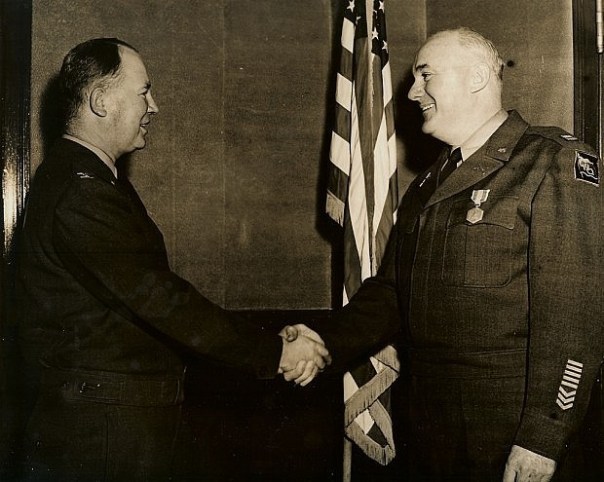
Here, my uncle receives his Army Commendation Medal. Though he is shown in uniform, he is wearing no other decorations or ribbons. The quest for the overseas stripes/chevrons patch continues after 3 years.

Darren McGavin’s wife (in the film A Christmas Story) saw how obviously hideous this lamp was. It was equally apparent that I needed to find the proper patch configuration for my display (source: Warner Brothers).
Reviewing the service records and the photo, I decided that I wanted to put together a uniform that was representative of what my uncle wore at the conclusion of his service in the army. Considering that my uncle enlisted to serve in World War One, I figured that the greatest challenge I faced was in locating the period-correct ribbons with the appropriate devices: the correct campaign stars. I already possessed a good portion of my uncle’s metal devices (rank, corps insignia) along with several period-correct ribbons and medals which meant that it shouldn’t take long to acquire what was still needed.
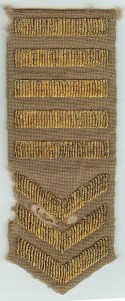
This patch was in my uncle’s possessions but the moth-eaten condition and that it is for a khaki uniform, makes it unsuitable for my display.
In possession of the uniform jacket, I began to take stock of each item before I would begin to sew on any of the patches. From the unit insignia (the GHQ patch) to the all of the various devices, I was ready to go…or so I thought. There, glaring at me like Darren McGavin’s sultry major award, gleaming brightly in the window of the front room from A Christmas Story, I was missing the overseas stripes that would be representative a soldier who served overseas for multiple wars.
One might ask, “What is so significant about this uniform item?” The overseas service bar (or chevron for World War I service) was issued for each block of six months served by a soldier in a combat zone. In the case of my uncle’s uniform, the photo shows that he wore three chevrons and five overseas service bars. With each stripe or chevron representing six months, my uncle served in a combat theater for three chevrons and five bars, or a total four years.
A Thousand Words? Pictures Are Worth so Much More!
As my family members have passed over the past several years, I have managed to acquire a number of antique photo albums and collections of photos of (or by) my family members that nobody else wanted. Most of the images’ subjects were of family gatherings, portraits or nondescript events and contained a lot of unknown faces of people long since gone. As the only person in the family who “seems to be interested” in this sort of history, I have become the default recipient.
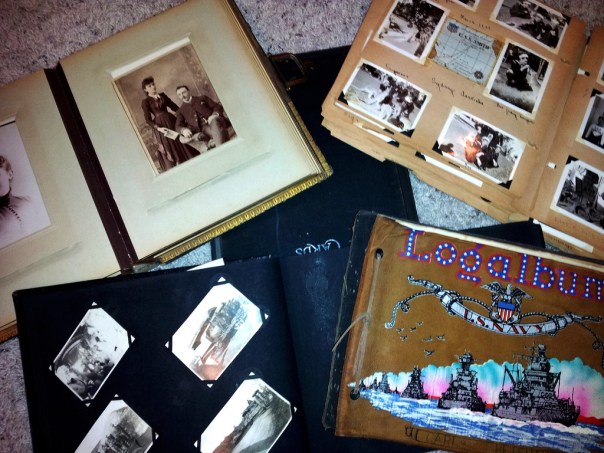
Here is a sampling of vintage photo albums I’ve inherited.
My Hidden Treasure
With all the activities and family functions occurring in my busy life, those albums received a rapid once-over (to see if I could discern any of the faces) and then were shelved to gather dust as they had done with their previous owners. Years later, I began to piece together a narrative of my relatives’ military service (a project you will hear about over the course of my blog posts). I have since returned to those albums only to discover a small treasure of military-related images that are serving to illustrate my narrative project. As an added bonus, they are providing me with an invaluable visual reference as I am reconstructing uniform displays to honor these veterans.
Photographs Can Unlock the Secrets
Similarly, militaria collectors strike gold when they can obtain photo of a veteran in uniform that can help to provide authentication as part of the due diligence for a specific group they are investigating prior to an acquisition. A photo showing the veteran wearing a certain Shoulder Sleeve Insignia (SSI), ribbon configuration or even a specific uniform garment can be authenticated if there are visible traits (such as tears or repairs) within the image.
Photographs from GIs in a wartime theater of operations or in combat are fairly rare. Photography was outlawed by theater commanders (due to the obvious security risks if the film or photographs were captured) and space was at a premium as one had to pack their weapons, ammunition, rations and essential gear. So finding the room to safely carry a camera and film for months at a time was nearly impossible. Similarly, shipboard personnel were not allowed to keep cameras in their personal possessions. Knowing the determination of soldiers, airmen and sailors, rules were meant to be broken and, fortunately for collectors, personal cameras did get used and photos were made while flying under the censors’ radar.
If you have deep pockets and you don’t mind paying a premium for pickers to do the legwork, wartime photo albums can be purchased online (dealers, auction sites) for hundreds of dollars. Many times, this can be a veritable crap-shoot to actually find images that have significant military or historical value and aren’t simply photos of an unnamed soldier partying with pals in a no-name bar in an an unknown location. For militaria collectors at least, there is value in the image details.
As you obtain military-centric photos, take the time to fully examine what can be seen. Don’t get distracted by the principal subject – look for the difficult-to-see details. Purchase a loupe or magnifying glass to enable you discern the traits that can reveal valuable information about when or where the photo was snapped. What unit identifying marks can bee seen on the uniforms? Can you identify anything that would help you to determine the era of the uniforms being worn by the GIs?
My Own Success
In assembling a display for one of my relatives, I wanted to create an example of his World War I uniform because the first of his three wars was quite significant in shaping his character for his lifetime. Having already obtained his service records (which span his entire military career, concluding a few years after the Korean War), a book that was written about his WWI unit (published by a fellow unit member) and my uncle’s photo album which was filled with snapshots of his deployment to France, I figured I would be able create a decent uniform representation.
-
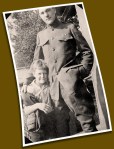
- In this image, you can’t quite make out the left shoulder insignia.
-
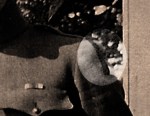
- A close-up of the left shoulder revealed the SSI of the 1st Army (artillery branch).
-

- This photo shows my uncle (on the left) in France with his First Class Gunner rank insignia.
-
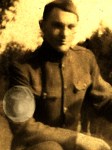
- In the close-up, you can (almost) clearly make out the rank insignia of a First Class Gunner.
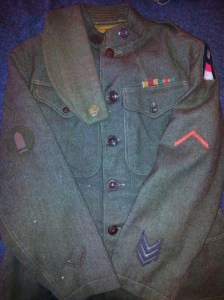
An overview of the uniform (and overseas cap) that I have recreated to represent my uncle’s WWI service. Note the artillery shell insignia on the right sleeve is that of a First Class Gunner.
In the various photo album images, I could see his right sleeve rank insignia as well as the overseas stripes on his left sleeve quite clearly. I could even make out his bronze collar service devices or “collar disks” in the photos (since I had his originals, they weren’t in question), but I had no idea of what unit insignia should go on his left shoulder. Not to be denied, I took the route of investigating his unit and the organizational hierarchy, trying to pinpoint the parent unit to which the 63rd Coastal Artillery Corps was assigned. Having located all of that data, I was still unsure of the SSI for the right shoulder.
Temporarily sidetracked from the uniform project, I returned to the photo album and scanned a few of the images (at the highest possible resolution) for use in my narrative. With one of the photos, I began to pay close attention to the left shoulder as I zoomed in tightly to repair 90 years worth of damage…and there it was! At the extreme magnification, I could clearly see the 1st Army patch (with the artillery bars inside the legs of the “A”) on my uncle’s left shoulder. I had missed it during the previous dozens of times that I viewed the photo.
An overview of the uniform (and overseas cap) that I have recreated to represent my uncle’s WWI service. Note the artillery shell insignia on the right sleeve is that of a First Class Gunner.
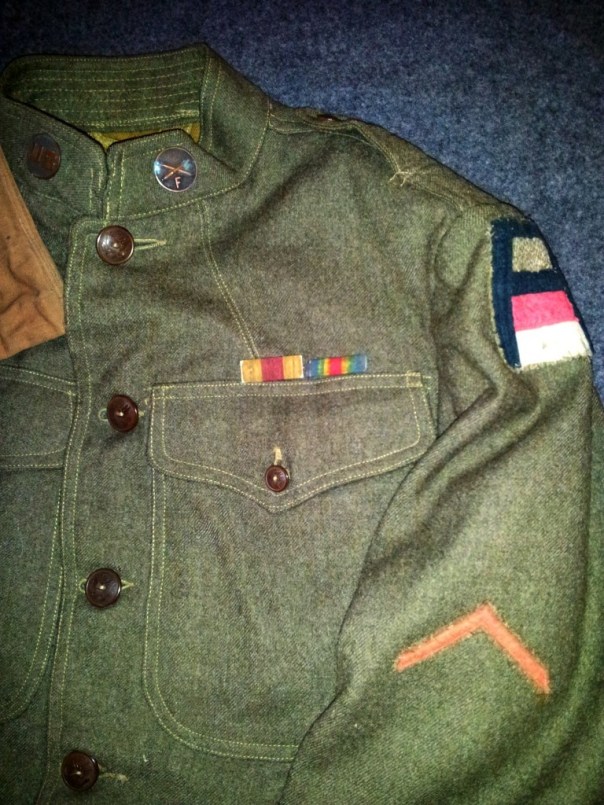
A close up of the SSI of the 1st Army (with the red and white bars of the artillery), my uncle’s collar disks, the honorable discharge chevron and his actual ribbons.
My research now complete, I obtained the correct vintage patches and affixed them to an un-named vintage WWI uniform jacket along with my uncle’s original ribbons and collar devices (disks) to complete this project. Now I have a fantastic and correct example of my uncle’s WWI uniform to display.
 The Veteran's Collection