Category Archives: World War I
Collecting U.S. Navy Uniform Ship Identifiers
To suggest that veterans and sailors of the U.S. Navy have an affinity for their ships would be a gross understatement. It would be difficult to stroll through any public area without seeing a former navy man sporting a ball cap with a USS ___ (fill in the blank). I have seen men well into their late 80s proudly carrying the name of the ship they served aboard, emblazoned across their foreheads, and as I write this, I am proudly wearing one of my own ship’s ball caps.
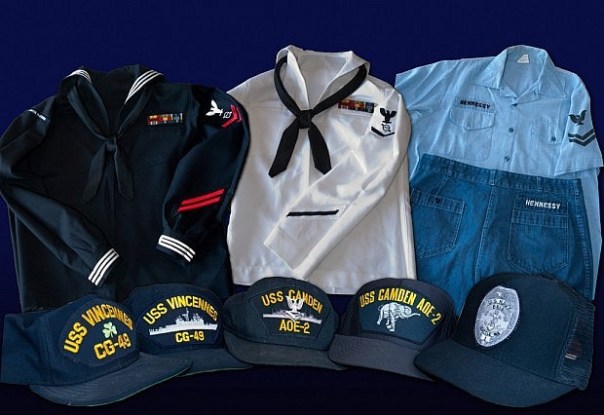
This collection of uniforms shows four official shipboard navy ball caps, authorized for wear with utility uniforms (such as the now-defunct dungaree set on the right). Note the UIM patch on the right sleeve of the dress blue uniform jumper.
Navy ship ball caps are quite commonplace. Many of them have icons or symbols between the name and the hull number designator that make them unique to each specific ship. Some of the symbology might have nothing to do with the ship, instead being representative of the commanding officer or the crew. As far as I’ve determined, ships’ crews have been wearing the named caps aboard ship with utility (dungarees) since the 1960s.
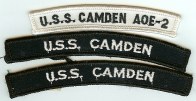
The two blue UIM patches shown are authorized by Navy uniform regulations. The white patch on top is a manufacturing mistake and unauthorized for wear on a Navy uniform. The USS Camden was decommissioned in 2005.
When sailors are required to be in their dress uniforms, identifying them with their associated commands is a requirement… especially when sailors behave like, well… sailors in foreign ports. Present-day enlisted dress uniforms must be adorned with a unit identification mark (UIM) patch on the top of the shoulder of the right sleeve. This regulation has been in place since the late 1950s to early 1960s.
Prior to World War II, the navy employed a much more stylish format of placing the command names on their enlisted sailors. From the 1830s to 1960, sailors wore with their dress blue uniforms a flat hat, affectionately known as the “Donald Duck” hat. Though it wasn’t authorized, in the latter half of the nineteenth century, sailors began to adorn their flat hats with a ribbon (known as a tally) that displayed the name of the ship and was worn only when on liberty (“shore leave” to you landlubbers). Eventually, the tallies were acknowledged within the naval uniform regulations, standardizing their appearance and wear.
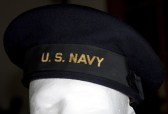
This post-1941 Navy flat hat shows the generic “U.S. Navy” tally. By 1960, these hats were retired from use.
By 1941 and the outbreak of World War II, the rapid expansion of the fleets with many new ships under construction and being delivered to the fleet, the Navy did away with the ship names on the tallies, standardizing all with “U.S. Navy” (there is some speculation that secrecy of ship movement drove the Navy to implement this change).
Ship-named tallies are highly sought after by collectors, pushing prices on some of the more famous (or infamous) vessels well into the ranges of multiple-hundreds of dollars, regardless of condition. Due to the delicate nature of the tallies’ materials and the exposure to the harsh marine environment, the gold threads of the lettering tend to darken and tarnish. The ribbon construction was typically made with silk, so they don’t stand up well to the ravages of several decades of time and storage.
In the last few years, a tally showed up in an online auction for the first time in more than a decade of staking out anything related to USS Vincennes. Until then, I had my doubts as to whether the Navy had allowed the pre-war crew to have the tallies for their ship, even though it was in service since February of 1937, four years before they were abolished. Sadly, the selling price surpassed my maximum bid by nearly triple the amount.
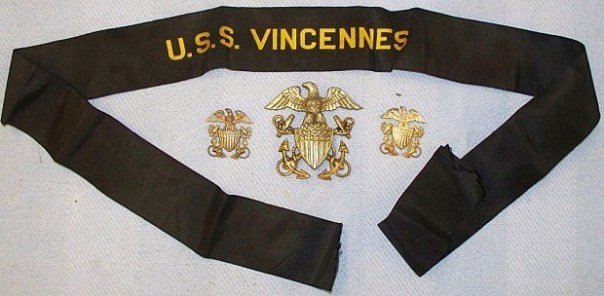
This image shows the rare USS Vincennes tally (along with some officer cap devices), which was sold this week at auction for more than $150 (source: eBay image).
Hopefully, I don’t have to wait as long until I see another USS Vincennes tally!
Silver Eagles: Navy Bullion Rates
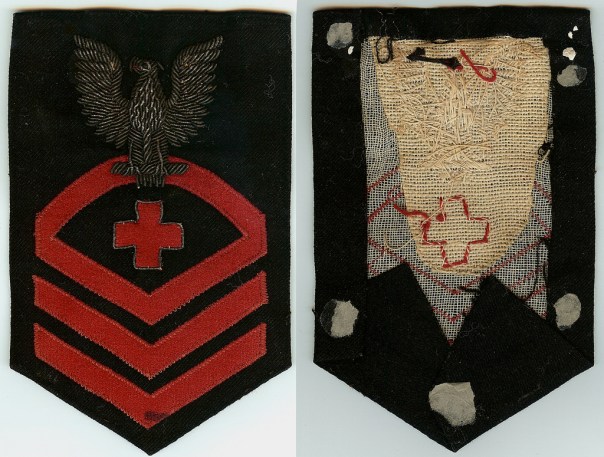
This chief Pharmacist’s Mate’s Geneva Cross is accented with a bullion thread outline.
Beautifully stitched with metallic thread or wound-metal elements overlaid onto crows, bullion navy rates have been in existence for more than a century. By 1913, the U.S. Navy’s uniform regulations established that rate badges with gold stripes (for dress blues) be accompanied with the eagle and specialty mark to be made of silver bullion. Uniform regulations regarding bullion were further expanded providing that all dress blue chief petty officer rates (regardless of the chevron color) would be constructed with silver bullion. These regulations, in my opinion, facilitated the establishment of one of the best aspects of enlisted uniform adornments.
These fantastically embellished crows historically incorporate multiple shades or tones of silver, and at times, gold bullion threads in their designs making for highly detailed and textured rate badges. Along with aesthetics, the bullion crow designs take on a three-dimensional feel and are really quite stunning.
Crow designs are substantially varied in their appearance based upon the time period in which they were made and the manufacturers’ interpretation of the design specification. One can examine two bullion rates from the same period and note that they will have different embroidery patterns. Thread direction will differ as well as the pattern used for the specific elements.
-
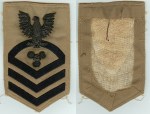
- A nice example of a humble Machinist’s Mate bullion design.
-
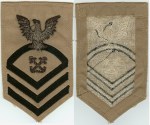
- This post-war Chief Boatswain’s Mate crow-design is subtle and showing some signs of wear.
-
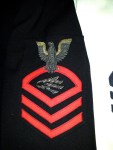
- This Radioman Chief’s eagle is accented with gold thread on the leading edges of the wings.
-
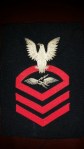
- This red-on-blue chief aviation radioman is a recent acquisition. It appears to be a mid-1940s-era badge.
-
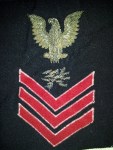
- This rather sloppy Radarman badge has a nice eagle design, however the specialty mark is less than desirable.
Because they were traditionally hand-embroidered, two crows from the same supplier can differ. You might see various embellishments to the bird’s feathers or the beak. Some will have different colored bullion that can really make the bird stand out from the rest of the rate badge.
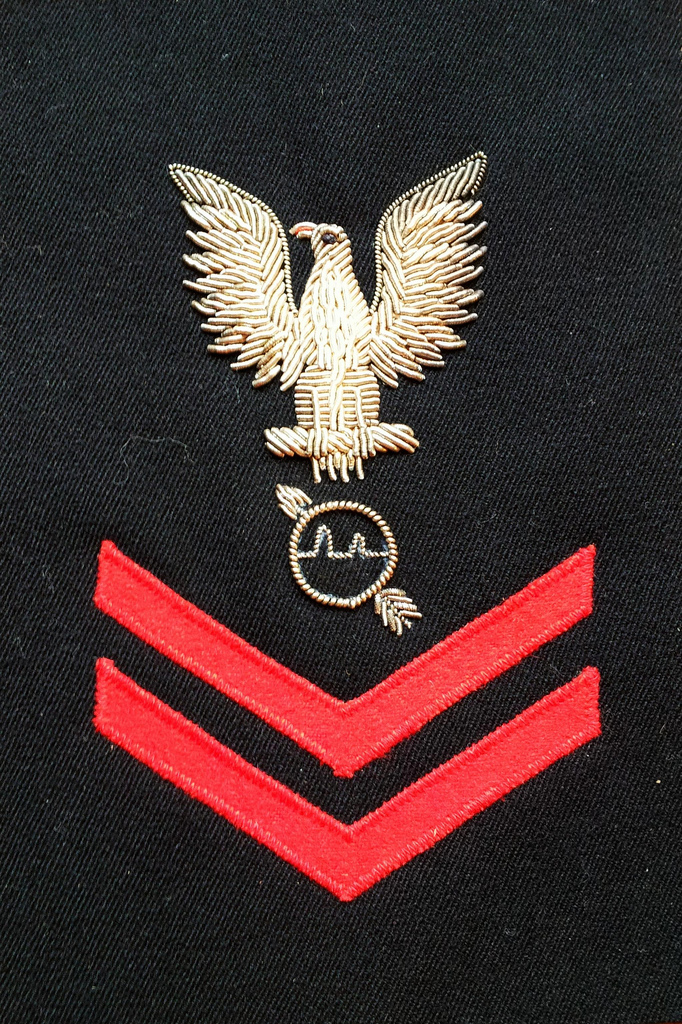
A rare bird. This Radarman/Operations Specialist 2/c badge is not collectors can easily find. Bullion rates were for E-6 and above and this one is clearly not a cut-down E-6 rating badge.
Other embellishments may include custom applications to the specialty mark. Variations to these embellishments pose challenges to collectors. Considering the Pharmacist’s Mate chevron (as seen at the top of this article), for example, one pattern could simply surround the red Geneva Cross with a single outline of thread while another could apply a crisscrossing pattern in addition to the outline. One example of a unique enhancement that I have seen was to a Machinist’s Mate crow that had a precious stone sewn to the center of the propeller insignia. The aquamarine tone of the stone really stood out against the silvery-blue bullion.
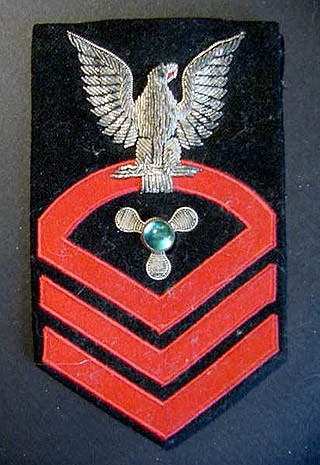
This early Machinist’s Mate crow (right-arm rate) is embellished with a stone in the center of the propeller specialty mark (eBay photo).
With the modern standardization of uniforms and insignia, the highly detailed and character-filled bullion crows are relegated to history (and to collectors). The current designs are sanitized, sterile and merely one-dimensional caricatures of the old patterns causing many navy rate collectors to shy away from them.
Selected References:
USMC Patch Rarities and Scarcities – What to Look For
Admittedly, patch collecting has only been a dabbling affair for me. While I find this focus area quite intriguing and considerably broad, I still only give it contextual attention. What I mean by that is that I tend to acquire patches that are related or connected to something else I am already collecting. However, there are some exceptions that have lead me to dive a little deeper, assembling a little bit more of a complete collection of certain patches and shoulder sleeve insignia.
Being a veteran of the U.S. Navy, I find that I am more inclined toward navy and Marine Corps patches. Considering that Navy shoulder patches, predominantly seen during WWII, are limited to a handful of varieties, I have been slowly working to expand my collection with at least one example of each. Serious patch collectors know that each of these Navy patch types may have several variations in their design, embroidery, thread colors and backing materials, just to name a few. Rather than commit a lot of time and finances in the pursuit, I chose to simply fill the hole in the collection with one of the variations. My collecting of Marine Corps patches has followed the same path, but with the wider spectrum of patches, but building a complete group will require more time.
Time is something I have plenty of. World War II Marine Corps SSI run the gamut of availability and scarcity and unfortunately, more disposable cash is going to be required for me to fill the gaps in my collection as some USMC patches are downright scarce and highly sought-after. A few months ago, I introduced you to the basics of Devil Dog patches, providing you with a brief history and insight into the more common pieces. However, I didn’t begin to scratch the surface regarding those items that draw the attention of hardcore collectors and fakers alike.
One could essentially group Marine Corps patches into a few levels of availability or scarcity. I am hesitant to apply the term “rare” as sometimes it erroneously conveys to novice collectors a sense of exorbitant monetary value on an item. What this means is that while something might be hard to find, it doesn’t mean that there are lots of collectors are competing for the same item. However, in some instances with the hard-to-find USMC patches, rare and scarce can be interchangeable and the values can be cost-prohibitive for the majority of collectors. In my experience, I’ve categorized USMC patches by their use (i.e. unit type).
Divisions
These patches cover the WWII USMC divisions ranging from the First (1st) through the Sixth (6th) Marine Divisions (MarDiv). Besides the common patches, there are some hard-to-find examples, especially those created during the very early months of the war. The 1st MarDiv patches that were made in Australia (when the division was relieved and sent to Melbourne for R&R following the Guadalcanal operation of 1942-43). These patches are quite distinct featuring a unique backing material and unique embroidery. Of course there are a vast number of variations for each of the subsequent divisions to be on the lookout for.
-
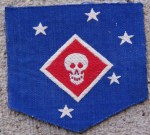
- Marine Raider battalion patches are rare enough, but when they are Australian made (like this example), they command a premium when sold (source: USMF).
-
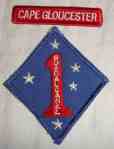
- 1st US Marine Division with Cape Glouseter tab (source: Snyder’s Treasures).
-
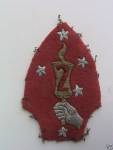
- One of the popular patch backing materials (for both collectors and moths) is wool as seen on this 2nd Marine Division patch (source: USMF).
-

- Variations play a significant role in determining value. This heart-shaped variant of the 2nd Marine Division is going to cost a collector a pretty penny (source: USMF).
Marine Air Wing (MAW)
For the purposes of organizing my collection, I have also grouped in the Marine Aircraft Fuselage patches as the units are connected. The MAW units are organized from the 1st through 4th and also include a headquarters group. Each unit has an associated patch design. The same structure applies to the Fuselage units and their patches (1st-4th and HQ). There are several variants of each patch design which can make a novice get cross-eyed wading through each one.
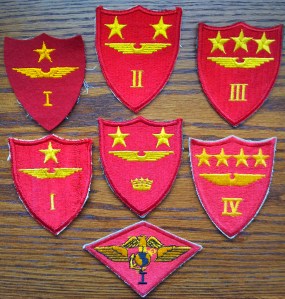
This assortment of patches includes examples of all four Marine Fuselage units along with the HQ patch (shown with the crown). The bottom SSI is from the 1st Marine Air Wing.
Raider Battalions
Perhaps the most widely sought patches originate from the elite Marine Raiders. These legendary units were the original Marine Special Forces units and employed highly skilled grunts who routinely operated behind enemy lines. The unit patch design is simplistic but conveys an ominous symbol superimposed onto a field of blue with five white stars. There are several variations of this patch with correlating price ranges – the upper end of which can break almost any collector’s bank.
-
- Marine Raider battalion patches are rare enough, but when they are Australian made (like this example), they command a premium when sold (source: USMF).
-
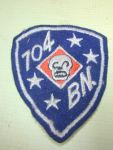
- This patch is frequently seen for sale online and is continuously attributed to a Marine Raider unit. Unfortunately, no such unit has ever been found to have existed. This patch is something of an anomaly and is more than likely a fantasy piece (source: Snyder’s Treasures).
Amphibious Corps
These patches employ a similar design to the Marine Raiders patch, borrowing the shape, color, five-star arrangement and the central white-bordered, red diamond field.
-
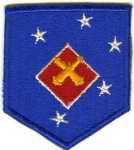
- This 1st Marine Amphibious Corps patch variant features gold-colored thread for the crossed cannons instead of the more common white thread (source: USMF).
-
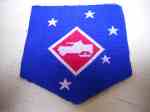
- The half-track-line symbol in this patch is that of the 1st Marine Amphibious Corps – Tank Destroyer unit (source: Snyder’s Treasures).
Marine Defense Battalions
These battalions were responsible for providing protection of bases throughout the Pacific Theater and consisted of more specialized units including coastal gun and anti-aircraft batteries, a detection battery (searchlights and radar) and machine gun units. These patches would be characterized more as scarce rather than rare. Authentic examples are available but are nowhere near as common as the division patches. Expect to pay a bit of a premium for these patches.
-
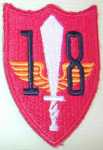
- The 18th Defense Battalion SSI design bears more resemblence to that of a Marine Fuselage Wing patch rather than the other Defense Battalion patches (source: Snyder’s Treasures).
-
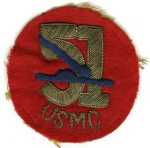
- Though quite subtle in design, the 51st Defense Battalion patch easily conveys their mission. This is a rare bullion example (Source: USMF).
-
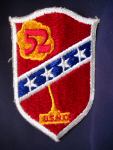
- This patch is in keeping with the other designs associated with Marine Defense battalions. This example is from the 52nd Defense Battalion (source: Snyder’s Treasures).
Fleet Marine Forces Pacific (FMFPAC)
Nine patch designs align with the eight units (anti-aircraft artillery, artillery battalions, bomb disposal companies, dog platoons, DUKW companies, engineer battalions, supply and tractor battalions) along with a headquarters unit, and pose an interesting challenge for collectors. Along with the embroidery and backing variations, there are some color alternatives (white emblems instead of gold) which pose some challenges for collectors locating them all.

Showing the patch fronts of four of the Fleet Marine Forces, Pacific; V Amphibious Corps (with the alligator); also displayed is the “Londonderry” patch of the ” Irish Marines’ of the 1st Provisional Marine Battalion.
Among these patches are four examples of the FMF PAC units. The example in the bottom row (with the star) is a more rare white-thread example of the FMF PAC Supply unit. The two patches flanking the FMF PAC Supply SSI are the 5th Amphibious Corps (at left) and Marine Detachment Londonderry patch.
Marine Detachment
These detachment patches are some of the most desirable USMC patches, the Londonderry and Ship’s Detachment patches being a bit more affordable than the more rare (and unique) Iceland patch.
-
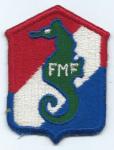
- One of my favorite USMC patch designs is that of the 13th Marine Defense Battalion with the “FMF” superimposed over the seahorse (Source: USMF).
-
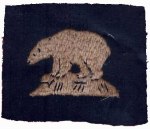
- The 1st Marine Brigade (Iceland) patch is distinct and lacks any of the more common WWII USMC patch traits with its all black field and the polar bear perched upon the ice (Source: USMF).
Aviation Squadrons
Perhaps the most widely sought after and diverse patches stem from USMC aviation squadrons. These patch designs could include variations that range from Disney crafted in painted-leather to embroidered fabric. Each squadron could have many renditions dependent upon how long the squadron was active and based upon where they were located. Squadrons could have their patches made in theater by resident artisans (including squadron personnel) or by domestic manufacturers. Specific designs could vary based upon available materials or leadership changes. As the WWII veterans’ personal artifact groups continue to arrive on the market, collectors still discover new variations of squadron insignia that were previously unknown, making authentication a challenge even for the most experienced patch enthusiast.
-
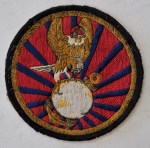
- This could be one of the rarest designs of patches for any service branch incorporate bullion thread as seen in this USMC VMD squadron patch (source: USMF).
-
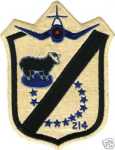
- Perhaps the pinnicle of USMC aviation squadron patch collecting, the “Blacksheep” of VMF-214 is the most replicated and one of the rarest (source: eBay image).
Education about these patches is key. I cannot emphasize enough that research prior to making any purchases of rare patches is highly recommended. One of the best resources is the U.S. Militaria Forum; specifically, What are the Rarest WWII USMC Patches for detailed insight as shared by the most experienced collectors and militaria historians.
US Marine Corps Uniform: Shoulder Sleeve Insignia Introduction
-

- The progression of the uniforms of the USMC from 1741 to 1859 (source: USMC)
-

- Current dress uniforms of the USMC (source: USMC).
As one views any iteration of the current Marine Corps uniform, it will be observed that they are somewhat simple in their design and appointments, paying homage to their traditions and legacy. While the present-day US Marine Corps uniforms may appear to be vastly different from those worn by colonial marines, they carry a significant amount of features and the overall theme from the originals.
-
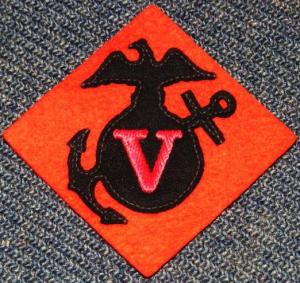
- The WWI-vintage SSI of the 11th Marine Regiment of the 5th Marine Brigade (Source: Hayes Otoupalik).
-
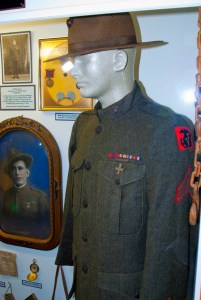
- Here is a pristine example of a WWI Marine uniform with the 11th Marine Regiment, 5TH Marine Brigade patch.
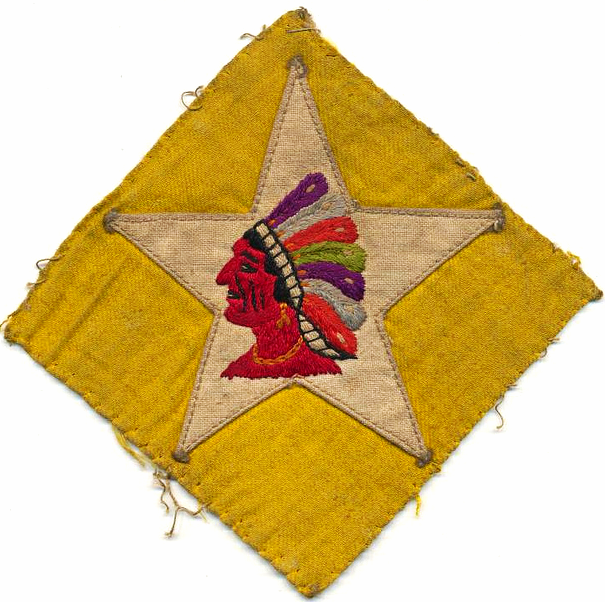
SSI of the 2nd Battalion 6th Marines (Source: Western Front Association).
As war waged in Europe in the early twentieth century, the United States was virtually unprepared to take on any combat activities due to the isolationists’ vehement opposition to the seemingly continuous strife of the monarchies of the old countries. The unpreparedness of the US military became apparent as they began to train and outfit the troops. The leadership had to scramble to buy materials to produce the uniforms required to equip nearly 4 million troops.
The Army had been in a period of transition from the uniform patterns used during the Spanish American War, and evolved through a handful of designs prior to arriving at three patterns used during WWI. The Marines, having been even less prepared, had to rely on the the Army for outfitting, for a number of reasons that included unifying all of the Allied Expeditionary Forces (AEF) and the need to consolidate production due to time and resource constraints.
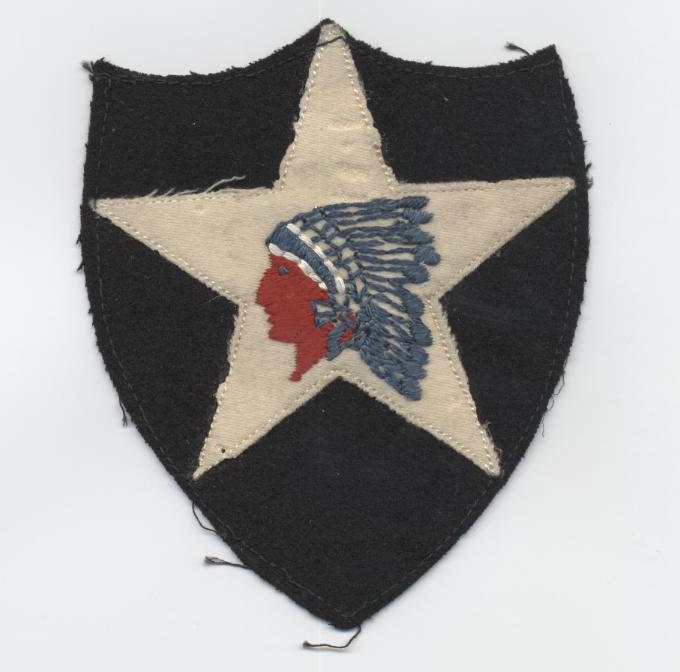
This shoulder patch belongs to the 6th Marine Regiment (Source: US Militaria Forum).
As the AEF began landing in Europe, there was little distinction between the branches of U.S. forces, largely leaving them to all look indistinguishable from each other. The Marines, seeking to set their uniforms apart from those of the Army, began to appoint their jackets with buttons and collar discs while adding the eagle, globe and anchor devices to the overseas cap.
Late in the war, the Marines began applying shoulder sleeve insignia to the left shoulders of their jacket sleeves. With the 6th Marine Regiment being placed under the Army’s 2nd Infantry Division, the design of the Marine SSI bears similarities to the 2ID patch, incorporating the Indian head symbol. The rarer USMC shoulder patch of WWI is that of the 11th Marine Regiment (part of the 5th Marine Brigade) which bears the Roman numeral “V” superimposed over a black EGA. In the years following WWI, the Marine Corps uniforms returned to their original configurations, removing the unit identifiers.
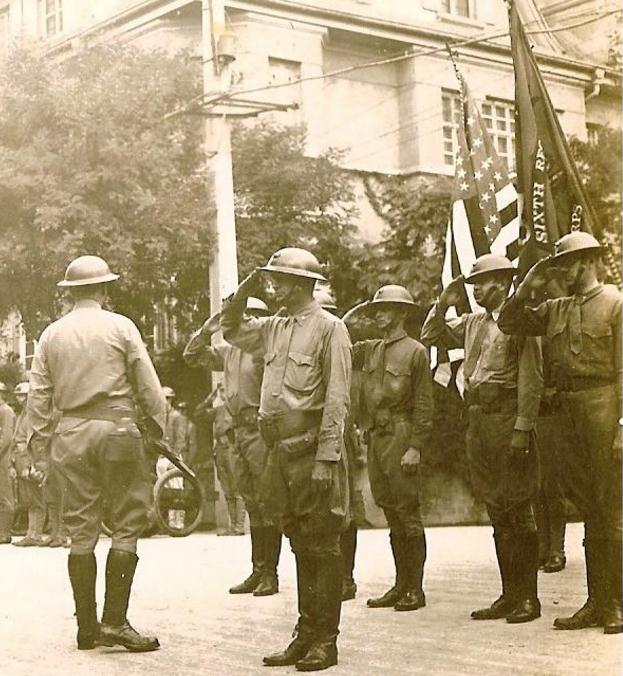
You can clearly see that these interwar-period China Marines lack any SSI (Source: Chinamarine.org).
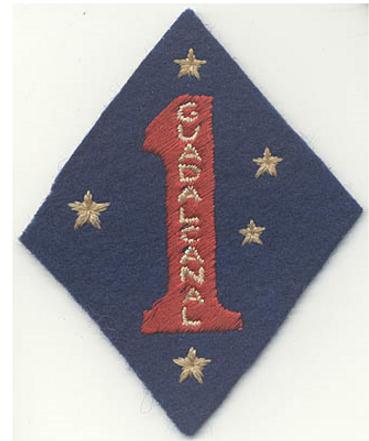
This Australian-made First Marine Division patch was created for the battle-hardened veterans of Guadalcanal while on R&R in Melbourne Australia (source: Flying Tiger Antiques).
Following combat on Guadalcanal, Marines of the 1st Marine Division were en route to Australia for R&R. It was thought that the Marines would again be wearing army uniforms, like they did during the Great War. Seeking to set the Marines apart from the army troops, discussion among the division leadership began taking place about a solution.
“They sat in facing bucket seats, between the litter of packs, seabags, typewriters, briefcases — the kinds of things that staff officers would necessarily bring out of battle.
General Vandegrift (division commander, Major General Alexander A. Vandegrift) had begun to be a little bored with the monotony of the long plane ride. “Twining (then-Lieutenant Colonel Merrill B. Twining),” he said, “what are you doing?”
“An idea I have for a shoulder patch,” said Twining. “The stars are the Southern Cross.”
Vandegrift looked at it for a moment, scribbled something on it, and handed it back to Twining, who saw the word, “Approved,” with the initials, “A.A.V.”
They had been on the ride from Guadalcanal to Brisbane. Because the first few days in Australia were hectic, Twining did nothing else about the patch until one morning he was called into Vandegrift’s office.
“Well, Twining, where’s your patch?” Vandegrift asked to the discomfort of Twining.
“I bought a box of watercolors,” Twining says in recalling the incident, “and turned in with malaria. I made six sketches, each with a different color scheme. In a couple of days I went back to the General with my finished drawings. He studied them only a minute or so and then approved the one that is now the Division patch.” *
-
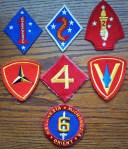
- These are the Marine Divisions (1-6). Shown are two versions of the 2nd MarDiv. Three of these patches are wool felt.
-
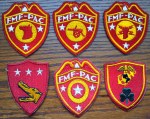
- Showing the patch fronts of four of the Fleet Marine Forces, Pacific; V Amphibious Corps (with the alligator); also displayed is the “Londonderry” patch of the ” Irish Marines’ of the 1st Provisional Marine Battalion.
-
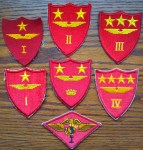
- Marine Air Wing Patch variants. One of these is a felt patch.
-
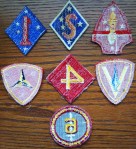
- The backs of the patches can help shed light on whether they are authentic.
-
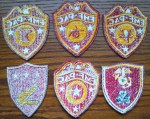
- Showing the backs of the FMF and other patches.
-
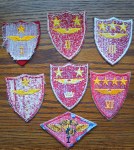
- Showing the backs of the FMF and other patches.
As the war wore on, other Marine Corps units began to design and implement shoulder sleeve insignia, sourcing from many manufacturers resulting in multiple patch variations for each unit identifier. In March of 1943, Marine Corps leadership made shoulder insignia officially supported, approving them for wear on dress uniforms.
Shortly after the end of the war, the Marine Corps struggled to maintain their existence while their ranks contracted from six divisions and five air wings (and several ancillary battalions) down to three divisions and wings. The need for the shoulder insignia had passed and so they were eliminated on January 1, 1948. No SSI has been (officially) worn on a Marine Corps uniform since that time. As with Army SSI, collecting each version of each unit patch can be a fun yet painfully lengthy process. As with any aspect of collecting, the rarer the patch, the larger the dent will be in your budget.
In preparing to move into collecting USMC SSI, I recommend that you start off simple. Pursue the common patches while keeping your eyes open and setting aside funds for the rarities. It is advisable that you obtain trusted publications to learn how to distinguish between the variants and the faked patches.
Available Resources:
- Complete Guide to United States Marine Corps Medals, badges and Insignia: World War II to Present
- Shoulder Sleeve Insignia of the U.S. Armed Forces 1941-1945
*McMillan, George. The Old Breed : A History of the First Marine Division in World War II. Washington: Zenger Pub. Co, 1979.
Military Records Research: Pay Attention to the Details
Genealogical research is funny. Overlooking the smallest, insignificant details can insert unintended road blocks into continuing down a valid pathway. With my family (which, I suppose isn’t too different from most families), there are so many branches of the tree to pursue which demands a lot of time spent down in the details. One little detail that I overlooked, kept me guessing on and off for over a year.
In July of 2012, I requested and obtained the WWI Canadian Expeditionary Forces (CEF) service records for my maternal grandmother’s father after making an Ancestry.com discovery of his military attestation record (his service was unknown to my family). Having served in the U.S. military, I am rather familiar with acronyms and terminology that is prevalent across multiple branches of the armed forces. In reviewing my great-grandfather’s CEF records, I began to realize that a fair amount of the documentation was difficult to discern, so much so that I found myself focusing more on the terms I did know and overlooking those that I was unfamiliar with.

Unfamiliar with the any of the Canadian military information, “Special Case” was very nebulous. Without an understanding of the references listed here, I was left guessing as to what this meant.
In examining the rather thin record, I found that my great-grandfather had been called up and was inducted on April 22, 1918 and was discharged on May 6, 1918 after just 15 days of service in the Canadian Army. The discharge certificate reads: “Discharge from the service by reason of ‘Special Case’ Authority Routine Order No. 180 dated 3-2-13. D.C.C. 11 M.D. 99-4-113-13.” This reason was found on several of the pages of his out-processing so from there, I made assumptions and ignored some of the other, more detailed data. I figured that he might have had a medical condition (note the “M.D.” in the above typed reason) or, perhaps there was a family hardship. Either way, he served slightly more than two weeks prior to being discharged.

The question: If he was drafted into the Army (CEF), then why is he wearing a maritime uniform?
A few years ago, my mother presented me with a box full of snapshots and photographs to scan (which I am slowly working on…when I have the time) in an effort to make them available to whoever in the family desires. One of the pictures caught my attention about the time I received my grandfather’s CEF records. The photo was a framed enlargement (from a snapshot) that showed my great-grandfather in a maritime uniform that was clearly Canadian (or British, even). My exposure to anything Canadian maritime was limited to lifting a few cans of Molson aboard a Canadian Destroyer in Pearl Harbor and riding the British Columbia Ferries to Vancouver Island. Translation: I know next-to-nil about Canadian uniforms (military or civil). Looking at my great-grandfather, I was left guessing.
The perplexing part of this story was that the uniform was maritime rather than Army (the CEF Army uniforms were very similar to the American Expeditionary Forces Army uniforms). Needless to say, I was entirely in the dark. Why was a two-week army veteran wearing a clearly non-army uniform? Since last year, the photo has been displayed on a table in our living room inspiring questions from family and guests as to the subject and the uniform in question.
In researching another relative who served in the CEF, I finally decided to reach out to experts to see if someone could enlighten me as my uninformed searches over the last year yielded zero positive results. On Tuesday of this week, I posted the images to a Canadian militaria collector’s forum and sent them to the Canadian Navy League. Today, I received word that the uniform is that of a Canadian naval petty officer first or second class. Thankful for the confirmation, I was still left guessing as to why my ancestor was wearing a navy uniform when he served in the army.

The cause of discharge as listed on this page that was deeper into the records documents was entirely overlooked. “To join R.N.C.V.R. was left hidden until today.
I scanned the Canadian Archives site to determine the next approach to see if I would be able to request records of my great-grandfather’s naval service (if they actually exist). None of the information stood out to me so I decided to take another peek at the CEF records that I already had. As I skimmed through each page, I kept seeing the same reference to the reason for discharge. A few pages deeper, something leapt off the page: “Cause of Discharge – to join R.N.C.V.R.” One simple Google search and I had it nailed. My great grandfather left the Army to join the Royal Naval Canadian Volunteer Reserve.
Armed with this information, I can now pursue (and hopefully be successful) my great grandfather’s naval reserve service records. Clearly he served long enough to advance to petty officer 2nd or 1st class in a short period of time. By October of 1922, my great grandfather and his bride emigrated to the United States and settled in what would become, my hometown. Less than ten years later, he would pass away leaving behind two young daughters and his widow. Any inkling of his wartime service was lost to the ages, leaving me to discover it more than 90 years later.
 The Veteran's Collection