Category Archives: Insignia and Devices
Militaria Issued: Giving and Receiving
Over the span of the last seven years, I’ve worked diligently in learning the ins and outs of collecting militaria and yet have only begun to scratch the surface. Delving into the details, for me, has produced an incredible wealth of knowledge surrounding many aspects of military pieces, such as when or where an item was worn or used. But that hasn’t been the most substantial reward in my passion for military collecting.
Being a student (not to be glib, as I am always learning) of American history has occupied my attention for decades. My wife and children could tell you stories about my side excursions to see some obscure item or location of historic note during our family vacations, in my passion to align book knowledge with the visual reality. Experiencing history helps to bring the stories to life and while facts are solidified in this process, actually seeing an item or location opens my mind to new questions with this acquired perspective. This process of learning is fun for me, but in regards to militaria, it still isn’t the pinnacle of satisfaction in collecting.
My military artifact collecting was sparked when a few boxes of Third Reich items were dropped into my lap nearly twenty years ago as my family dealt with our aging grandparents and the need to relocate them from their home of fifty years to an assisted living care facility. Having moved only once over the course of eighty-five years, my grandfather had accumulated quite a “treasure-trove” of artifacts including his older brother’s World War II trunks that were untouched from the time they arrived from Germany in 1945. I was suddenly thrust into the task of researching the pieces that my uncle had “acquired” during his participation in the elimination of the Nazi menace.
Though I didn’t get into collecting German militaria, my interest was piqued with the idea of owning pieces of history. The thought of possessing a tangible artifact that was connected to history as well as the connection to my family member’s participation in those events, was compelling and dovetailed nicely into the incessant genealogy project I was, and still am, working on.
-
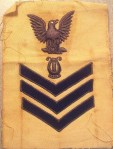
- I was gifted this 1920s navy musician 1/c rating badge – like one my uncle would have worn – from fellow collector when I first began collecting U.S. militaria. This act demonstrated to me that the militaria community was much different from the others I’d participated in.
-
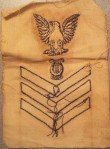
- Showing the reverse side of the rating badge – much can be revealed about these patches by looking at the back.
I have dabbled in collecting in several areas in my lifetime and I have met a lot of nice and passionate people who shared similar interests as me. Those relationships always tended to be more proprietor-patron rather than collaborative and sharing. However, from the moment I started to seek answers to questions regarding personal military artifacts that I had inherited from a few relatives, I began recognizing different traits in the people who collect militaria. Aside from a passion for the objects and the rich history, these collectors were quick with thoughtful responses to my inquiries as they provided detailed descriptions and guided me to research resources in an effort to enable me to be self-reliant. Among all the quirks and odd interests, I noticed an authentic sense of community with militaria collectors.
One trait that really blindsided me as I was increasingly immersed into militaria collecting was the trusting and giving nature of these people. As I participated in the discourse and discussion surrounding these wonderful objects, I began to build relationships with other collectors. Out of the blue, one collector asked me for my address as he had “something” for me. This fellow collector observed and gleaned, from my posts on a militaria forum, what my interests were and subsequently sent me a vintage 1920s rating badge – something that one of my uncles would have worn on his navy uniform. I was humbled by the gesture and that this collector would accept no offer of payment for his trouble. This example was merely a foretaste of what I would experience on a somewhat regular basis and my collection has grown because of the kind hearts of others. The charitable nature of others is infectious which prompted me to do the same with other collectors.
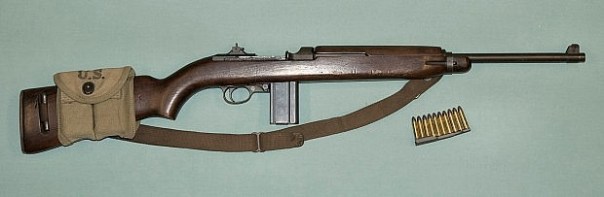
This fine example of the M1 carbine shows a magazine pouch attached to the rifle’s stock.
Awhile ago, I was invited to tag along with two other guys that are as passionate about military history and collecting as me to visit a local dealer of antique books and manuscripts. This dealer, a highly regarded authority in many circles, showed several fantastic pieces from his personal collection that prompted three jaws to repeatedly drop. Toward the end of our visit, the gentleman retrieved a WWII-vintage M1 carbine rifle in immaculate condition that was a distinct departure from the paper artifacts and, knowing that we were all interested in militaria, offered it for sale with a low-ball price tag. Unfortunately for me, financial constraints precluded me from purchasing the vintage weapon. However, one of my companions did “pull the trigger” and came away with the rifle.
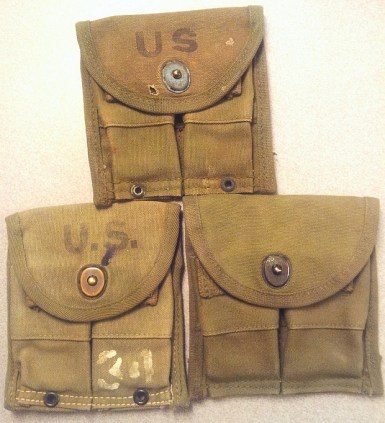
I recently acquired these M1 carbine pouches to give to a friend and fellow collector who recently purchased a late-WWI M1 carbine rifle. The nice, used condition will be great accompanying his rifle.
Not long after the M1 offering, I stumbled across a set of three WWII-vintage M1 carbine magazine pouches that were in good condition and were listed at a very affordable price. Thinking about my friend’s recent purchase, I snagged the pouches to give to the new carbine owner.
-
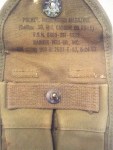
- This mag pouch shows a much later set of markings that appear to have a date stamp of 1957.
-
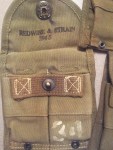
- Looking inside one of the pouch’s magazine flaps reveals a 1945 date stamp.
Over the last few years, I have gifted several pieces from my collection in the hope that it helps a fellow collector fill in the gaps or simply provides enjoyment in receiving a new piece they had not seen before or never knew existed.
Unlocking the Secrets of Your Collection: Research is the Key
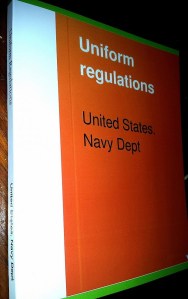
The cover of the 1913 U.S. Navy Uniform Regulations is very high quality in its construction.
Researching early military uniforms to ascertain a date or time period when they were issued or used can pose a challenge for collectors. Navy uniforms can be exceedingly difficult to pinpoint when it comes to dating them for a number of reasons.
Over the last few years, I have stressed that education and research materials only serve to enable collectors to make sound purchasing decisions. Knowing where to turn for information can be a daunting task for someone making their initial foray into this hobby. Simply knowing what research material might exist isn’t in the mindset of those seeking details about a uniform or uniform item.
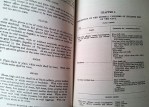
This copy is complete with all of the details including tables and pertinent data.
When I started a serious approach to research (in this case, verifying a jumper as pre-World War I), I was in the dark as to where to look so I turned to Google to begin my investigation. With the understanding that information on the web is seldom complete or authoritative, the search results seemed to be ambiguous and quite vague, so I narrowed my focus to locating people I could glean information from. As with any relationship, time is necessary to determine whether an “expert” is truly knowledgeable in their professed field of experience, so there was a risk that I might have received some inaccurate data.
Wanting to have go-to resources at my disposal, I began to gather reference material that suited my needs. My collection being predominantly focused on the service of my relatives and ancestors, I knew that I had to get the details (i.e. enlistment dates, commands assigned to, campaigns they participated in, etc.) of their individual service records. Armed with hard facts, I could then pursue the pertinent reference materials such as individual unit histories, training manuals, and uniform regulations.
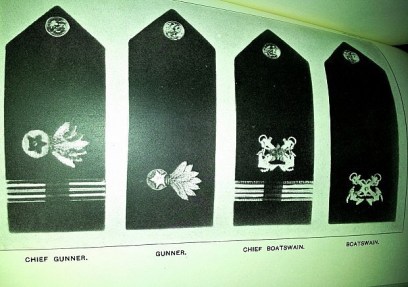
The plates are spectacular! This one shows the warrant officer shoulder boards and insignia.
Some of these materials are plentiful and relatively inexpensive, such as the Navy’s Blue Jackets Manual (issued to new recruits). Others are somewhat rare, making them difficult to find or posing negative impacts onto collecting budgets. One reference book I had been seeking was the 1913 United States Navy Uniform Regulations. I couldn’t locate one through various book stores or eBay. Fortunately for me, Google Books digitized a copy and had the majority of the book’s content available for online use. Unfortunately, the missing portions were the ones I needed for my research. I was amazed to see that I could purchase a hard copy, printed and bound complete book for less than $10.00, shipped to my door! Naturally, I pulled the trigger and less than five days later, I had the needed reference book in my hands.
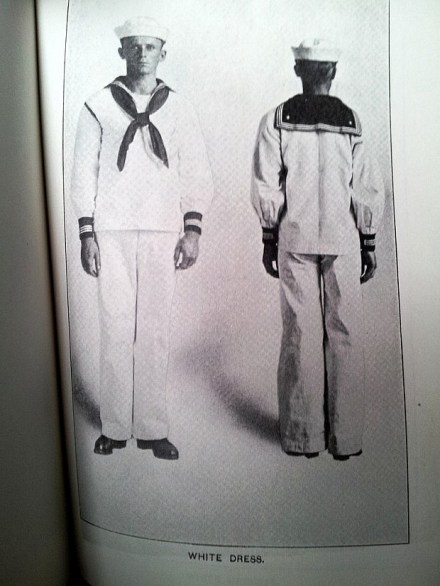
This plate shows the construction of the dress whites – bleached white duck and blue flannel cuffs and collar.
What arrived was a paperback book with a high quality glued-in binding that will withstand repeated viewings or being transported to collector shows much better than an original 100-year-old hardbound book with a weakened spine.
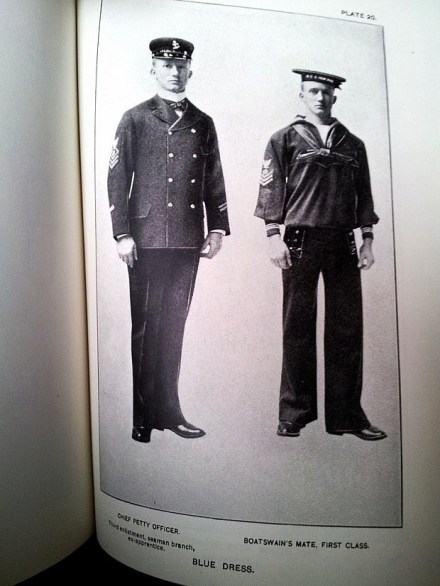
The chief and enlisted dress blues plate shows the proper wear and insignia placement.
Acquiring the 1913 regulations may not appeal to others, but for me this was like locating a missing piece that completes a collection. I’ve confirmed a piece as authentic and I can correctly pursue the remaining outstanding parts to properly complete my uniform display!
Rare Bird – Outside of Uniform Regulations
In an article that I wrote last year, I touched on an aspect of rating badge collecting that focuses on those constructed with bullion-metallic thread. The post was primarily covering the design and aesthetic aspects rather than regulatory or uniform issue standards. However, in order for collectors to make sound purchases or additions for their collections, they need to be well informed.
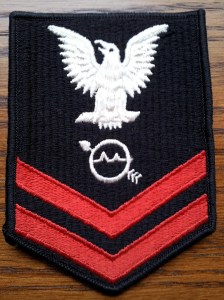
This crow dates from the 1970s and is entirely embroidered. This was a short-lived experimental rating badge.
Let me be very up front by stating that I am, by no means, an expert in rating badge collecting. As I am acquiring pieces for my collection, I am researching and back-filling the details. In some cases, I have the order reversed – researching a piece after acquiring it – hoping that I didn’t make a bad purchase. While reviewing some online auction listings of rating badges (for my former rating), something that I have never seen before caught my attention and without hesitation, I pulled the trigger on the “buy it now” button. Rather than spend time ahead of purchasing the crow, I decided that the best course of action would be to research it after I had it securely in my hands. I had no idea of it’s date of manufacture, whether it was genuine, experimental/prototype or a fantasy piece.
My rating badge collection consists primarily of variations of the rate that I wore when I served. Four years ago, I set out to purchase a new, unused rating badge to mount in my shadow box display. All of the examples I had in my collection were affixed to my old uniforms so they weren’t’ quite up to par with what I’d want to be shown beside my medals and decorations. I ended up with a variety we (in the fleet) referred to as a “peacoat” crow. As it turns out, the fully embroidered rating badge (with merrowed edging) was a test crow that never really caught on. While they are somewhat uncommon, they aren’t necessarily rare or highly desired among collectors.
-
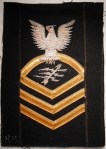
- This pre-1947 Radarman CPO bullion rating badge (with gold good conduct chevrons) is prototypical of what would be seen with a bullion crow.
-
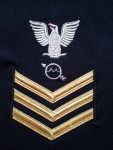
- This current-issue OS1 rating badge is what one would expect to see – a first class petty officer with gold chevrons (indicating at least 12 years of good conduct service) – rather than a second class with bullion and red chevrons.
-

- This is an example of an authorized bullion crow (current-issue) for an Operations Specialist chief petty officer.
The latest addition to my collection is a silver bird – a bullion eagle and specialty mark hovering over red, embroidered chevrons. The reason this is an odd combination is that (according to Navy Uniform Regulations) the silver/red configuration is only available for E-7 through E-9. Ratings fo E-4 through E-6 may use the silver (bullion) eagle and specialty mark in conjunction with gold chevrons (indicating 12 consecutive years of good conduct service). One could deduce that perhaps this predates the current uniform regulations, however, this would be an incorrect assumption.

A rare bird – an Operations Specialist/Radarman badge with a bullion eagle with red chevron stripes.
1913 Uniform Regulations
-
“For petty officers holding three consecutive good-conduct badges, the chevrons for blue clothing (dress/undress blues) shall be made of gold lace instead of scarlet cloth, and the eagle and specialty mark shall be embroidered in silver.”

The reverse of the OS2 bullion rating badge showing the construction and the Gemsco label.
Why then does this E-5, Operations Specialist/Radarman 2nd class crow exist? More than likely, the manufacturer (Gemsco) made this variation either errantly or in anticipation of a uniform regulation change that ultimately never occurred. Not to be stuck with inventory, manufacturers most likely divested these crows and shipped them to uniform shops or uniform tailors to be disseminated to sailors. Seeking to have a measure of individuality with their uniforms, sailors who might be able to “pass,” in wearing the unauthorized embroidery at a command that might not have strict adherence to regulations, would stitch on these subtle “custom” enhancements.
Now that I have this rare bird, I decided that it would display nicely and swapped it into my shadow box (supplanting the standard OS rating badge) as these bullion crows are just too beautiful to sit in a storage box.
You Have the Right to…Collect Armed Forces LEO Militaria
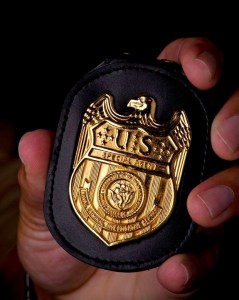
This current-issue NCIS badge is mounted to a leather holder (source: US Navy).
Militaria collecting has a broad spectrum possessing many facets that allow people to specialize or focus their efforts on specific themes or concepts. Aside from settling on a particular branch or time period, collectors might choose to get very narrow with their collections. Some of these focus areas might even cross over into other collecting genres. One category or focus area that has grabbed the attention of collectors beyond the bounds of militaria is law enforcement within the ranks of the armed forces.
When considering military law enforcement, one might immediately begin to think of the Naval Criminal Investigative Service (or NCIS) that has been popularized by the television drama franchise on CBS. The Army has their own similar organization, United States Army Criminal Investigation Command (CID). However, the law enforcement community within the armed forces is significantly more broad, which means that collectors have many options and avenues to pursue.
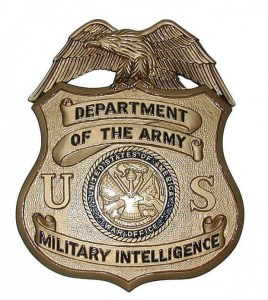
A nice example of a US Army MIS Badge (image source: U.S. Army)
Aside from the civilian-staffed agencies such as the NCIS and CID, there are plenty of uniformed active duty departments and billets that are filled by military personnel. In addition, there are duty-based positions that are performed as an extra responsibility outside the daily duties of the service members’ normal MOS, specialty or job assignment. Regardless of the specific role, there are opportunities for collectors to obtain law enforcement militaria.
In existence since the Revolutionary War, the U.S. Army’s Military Police Corps was not officially organized until September of 1941, when it was formally established. The U.S. Navy’s version of the MP, the Master-at-Arms, has been in place since the nineteenth century, predominantly serving aboard ship in the early days.
One of the more diverse categories of objects available for collectors is in the area of brassards, or arm bands. Within the Air Force Security Police (SP) and Army, this area could present collectors with limitless varieties from countless military police commands. Within the Navy and Marine Corps, there are a fair amount of Shore Patrol (SP) brassard versions—easily confused with the Air Force versions—dating back to well before the second world war.
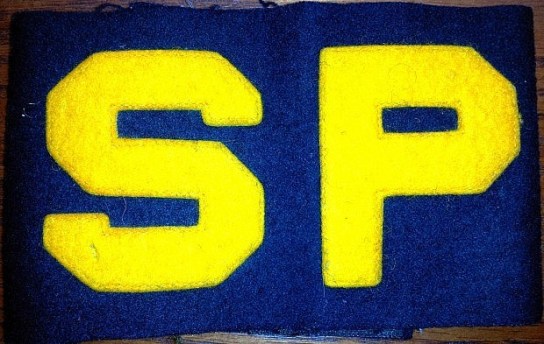
This Shore Patrol brassard is a 1980s vintage. Modern SP arm bands lacking the Velcro attachments can be difficult to discern from examples from the WWII-era.
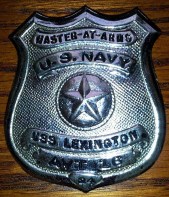
A Master-at-arms badge, dating to the 1970s, was used aboard the aircraft carrier, USS Lexington when she was designated a training carrier.
Along with arm bands, collectors could launch into military law enforcement collecting by pursuing badges. Keep in mind that there could be laws that prohibit owning current versions of these law enforcement badges. Possessing a currently-issued badge could result in considerable legal trouble so be sure to understand what is permissible in your area prior to acquiring the badge. Typically, obsolete badges should be allowable, but I would encourage collectors to remain familiar with their local laws.
Besides brassards and badges, collectors could pursue helmets, uniforms, utility/web belts (and all the attachments) and weapons, such as side arms and batons. The trick is to find your niche and stay within your budget.
Military Police Collecting
I am an American Veteran with Canadian Military Heritage
I’ve been revisiting my family tree research, spurred on by catching up on watching episodes of The Learning Channel’s Who Do You Think You Are? (WDYTYA) The show follows a pretty simplistic theme of tracing some Hollywood notable’s ancestral history as they have been suddenly overcome with desire to know where they came from. There is always some sort of misplaced desire for self-validation as they seek to identify with the very real struggles that someone in their family tree endured centuries ago. In watching them I often find the humor as the celebrity emotionally aligns with a nine or ten times great grandparent as if that person were an active part of their life. Where the humor in this originates is that one must consider exactly how many great grandparents one has at this particular point in our ancestry.
My 3x great grandfather (one of sixteen such 3x great grandfathers) served with the 6th Pennsylvania Cavalry during the American Civil War) and like the Hollywood celebrities on WDYTYA, I have researched him extensively and I do identify with him. But consider that there are 15 other 3x great grandfathers along with eight 2x greats, four greats and two grandfathers. That means that five generations above me encompass 28 grandfathers including the lone Civil War veteran that I thoroughly researched. If viewed this prospective with another one of the great grandfathers (whom I researched and found to have served during the American Revolution), he would be one of 64 5x great grandfathers (for a total of 254 total grandfathers at this generation-level). This can get confusing to grasp without a visual:
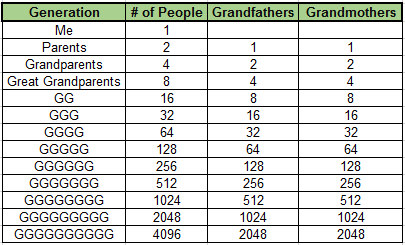
When folks refer to their 7th great grandfather, what does that mean? Did they have more than one? The answer is that everyone has 256 7th great grandfathers. It is simple math, folks!
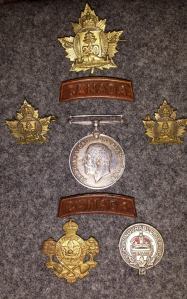
There are a few other pieces that I have for the display that I am assembling, including a section of vintage ribbon for the service medal. The shoulder tabs are a more recent acquisition as is the CFC hat badge (bottom left) that my 2x great grandfather wore prior to being assigned to the 230th. The two smaller insignia flanking the medal were worn on the uniform collar. The pin on the lower right was a veteran’s organization pin.
I have been gathering artifacts together to create representations of some of my ancestors with military service. I have been sporadically researching as many relatives as I can locate to document a historical narrative of service by members of my family. This is a daunting task considering how many direct ancestors I have and I have been also including some uncles and cousins as I uncover them. One of my 2x great grandfathers (one of 8 such great grandfathers) was a British citizen who emigrated to Victoria, British Columbia with his wife and ten children a few years following the turn of the twentieth century. By the time the Great War broke out in Europe in 1914, he was a 45-year-old carpenter and home builder. When he was drafted into the Forestry Corps of the Canadian Expeditionary Force (CEF) in June of 1916, he was 47 and a widower. He served in Europe for the duration of the war harvesting timber for use in the war effort, plying his carpentry skills in some fashion being far too old for combat duty.
Having a Canadian veteran ancestor (one of two – I wrote about the other one, previously) posed some challenges in researching his service as nearly every aspect of research is different from what I am familiar with (with American military records). Learning the terminology and the unit structure was difficult but even more challenging was deciphering my GG grandfather’s service records let alone locating details as to what his uniform insignia and devices would have been. Thanks to a few helpful CEF sites and forums, I was able to piece together some of the principle elements in order to assemble a shadow box at some point in the future.
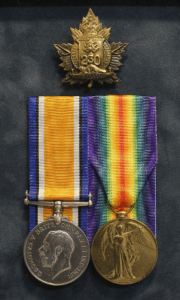
This is a simple, yet tasteful display of a veteran of the 230th Canadian Forestry Corps from WWI. This soldier was in the same unit as my 2x great grandfather.
As any Canadian militaria collector could tell you, locating pieces from individual regiments/units of the Forestry Corps can be daunting. When I started on this path a few years ago, the prices were higher than those of American units by as much as three times. Collar and cap devices and badges were can reach prices beyond $40-50 (collar) and $70-100 (for caps badges). Not that ever intended to purchase actual uniforms pieces (tunic, cap, hat, etc.), I still maintained a watchful eye just to see what might show up for sale. Today, my eyes were enlarged and mouth left agape when something appeared in my automated search for such items.
Listed yesterday on eBay was a 1917-dated British trench hat that is in impeccable condition, complete with the badge of my 2x great-grandfather’s unit. Everything about this century-old cap seems to be in an incredible state – the hat’s shape, the leather sweatband – all of it. But then I saw the opening bid amount – $750.00 (in USD) – and immediately, my jaw struck my desktop beneath me! In the “People who viewed this item also viewed” section were British head covers (one trench hat and two visor caps) of comparable condition but with devices from other, non-Forestry units with prices that ranged from $500-700, depending upon the unit insignia. The hat from my ancestor’s unit topped the range of prices. Being in possession of the cap device, I wouldn’t need to pursue such an expensive purchase (I don’t need the hat for the display that I am assembling) so I will simply watch to see if the hat does end up finding a new home and take note of the selling price.
-
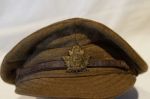
- This hat differs from the peak cap in that the top is slouched down over the sides and the bill is soft and stitched like a baseball cap. The 230th Canadian Forestry Corps device is centered over the leather chinstrap (eBay image).
-
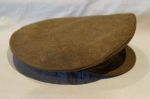
- Showing the hat’s right side and the top of the visor (eBay image).
-
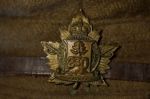
- The close up of the CFC badge – the insignia incorporates crossed pikes superimposed over a maple leaf with a long crosscut saw with a beaver (eBay image).
-
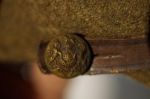
- The chinstrap button detail is impressive (eBay image).
-
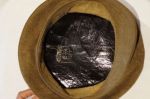
- The high-level view of the hat’s underside (eBay image).
-
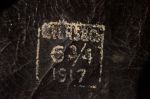
- These markings appear to be the maker’s mark, the hat’s size and the date of manufacture (eBay image).
-
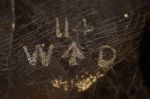
- I am unfamiliar with these markings. I am sure that the experienced collectors and historians could easily provide some insight as to their meaning (eBay image).
-
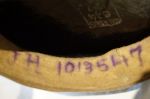
- On the sweatband, the soldier’s initials and service number are hand-inscribed and provide an easy path for researching the original owner’s service (eBay image).
With just one of my maternal 2x great grandfathers with military service (albeit, British-Canadian) and none of my paternal 2x great grandfathers, I don’t have any more military artifacts left to gather for this particular generation (unless I am able to discover new facts for others). The preceding and following generations reveal that I have a lot of research effort in store for me not to mention what lies ahead for me within my wife’s equally extensive family military history.
See Also:
Lumbering Along: Collecting C.E.F. Forestry Militaria
 The Veteran's Collection