Author Archives: VetCollector
Waving the Vexillologists’ Banner
The first step on the path to recovery is admitting that you suffer from vexillology. Let’s say it together, “I am a vexillogist.” Great. Now that we have that out of the way, we can begin to examine this illness along with the diagnosis – treatment relationship.
By now, I am sure that you’ve already sought the definition of the term and know that vexillology is neither a medical or psychological condition requiring any sort of treatment. Many of you would hardly fancy yourselves as vexillologists, yet you do have interest in the subject matter. For me, I only dabble and have a specific, myopic interest as it pertains to my own militaria focus. For those of you who decided to forgo your own online search (knowing that I would eventually get to it), Merriam-Webster defines vexillology very simply as, “the study of flags.” I’ll leave the etymology of the (relatively new) term for you hardcore folks.
-
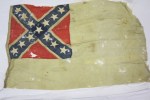
- This tattered example is the second Confederate flag (source: Naval Historical & Heritage Command).
-
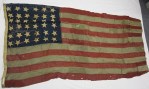
- From the Battle of Manila Bay, this flag flew over the USS Olympia (Source: Naval Historical & Heritage Command).
-
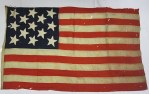
- This small flag was used on one of the small boats from Dewey’s flagship, the USS Olympia (Source: Naval Historical & Heritage Command).
My post today really isn’t about the study of flags per se, but it does play into what I want to share with you. Learning where to turn for sound research and trusted sources is highly important to verifying details as to the authenticity of a flag: the maker, when it was made, who it was made for, et cetera.
Flags play a significant role in militaria collecting. While creating a display with period-correct items, collectors may seek a flag that would provide an appropriate accent or aesthetic value. For a World War II display, the requisite 48-star flag would be fairly easy to source. Or, perhaps a captured German or Japanese flag would be fitting? Acquiring flags that look correct is one thing but buying the real thing requires due diligence and still might not guarantee an authentic flag purchase.
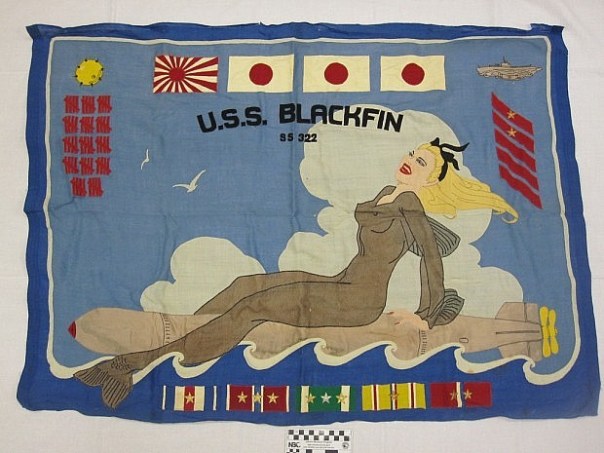
A beautiful example of a WWII Pacific Theater submarine battle flag from the USS Blackfin (SS-322) (source: Naval Historic & Heritage Command).
Perhaps the ultimate American vexillological artifact is the subject of a bicentennial celebration that took place just a few years ago. More than two hundred years have passed since the last national conflict with Great Britain concluded– which is also the last time a foreign enemy invaded the home front (not counting the Confederate northward invasion of 1863) – and there are celebrations and recognition events that took place throughout the United States. The most significant flag of the United States, The Star Spangled Banner, whose popularity stems from the Francis Scott Key poem of the same name, was also recognized during these bicentennial celebrations (the Battle of Baltimore and the shelling of Fort McHenry occurred September 5-7, 1814).
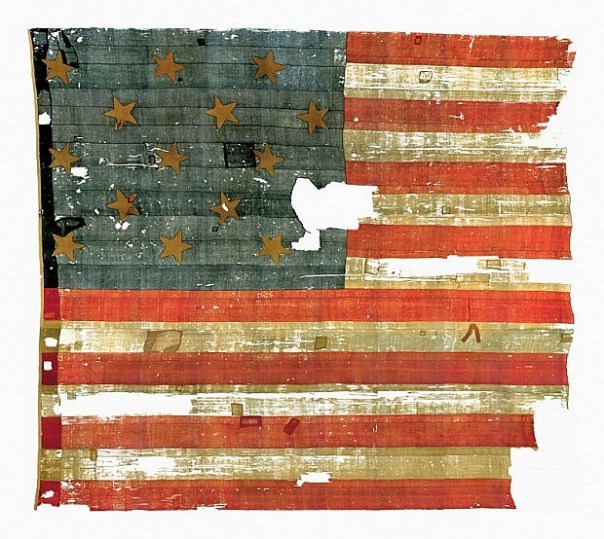
Documenting the Star Spangled Banner: Because of its size and the confined space of the lab, the flag could not be photographed as a whole. This is a composite of seventy-three separate images (source: Smithsonian Institute).
Canvas Bag – the Armistead family kept the Star-Spangled Banner in this large canvas bag (source: Smithsonian institute).
The commander of Fort McHenry, Major George Armistead anticipated a British attack and desired to have an enormous American flag flown over the fort. The renowned flag maker, Mary Pickersgill, was contracted to construct the garrison flag that measured 30 by 42 feet. Pickersgill and her assistants spent seven weeks constructing the flag (along with a smaller, inclement weather or storm flag that measured 17’ x 25’). In the years following the battle, Armistead’s family kept the flag, passing it down two generations. 90 years after the Ft. McHenry bombardment, Key’s poem had gained incredible popularity and the legend of the flag blossomed. Armistead’s grandson, Eben Appleton, released the flag for public display during Baltimore’s sesquicentennial celebration in 1880. The flag then remained in locked storage (in a New York safe deposit box) as deterioration had become an issue. By 1912, the flag was permanently donated to the Smithsonian Institution by Appleton with the directive that it be forever viewable by the American public. The provenance for this flag is traceable and verifiable over the course of the last 198 years, making it truly priceless.
In my collection, I have some significant flags that have more personal historical importance. I served aboard the Navy’s newest (at the time) cruiser, the first of its kind to serve in the Pacific Fleet. I was assigned to the ship 10 months prior to her commissioning. Because of the significant period of time spent with the ship as she was being completed, I developed quite a fondness for her and her legacy (three previous naval warships proudly carried the name). I suppose that my desire for the preservation of history was nurtured in these early years, prompting me to save a number of disposable artifacts.
I have yet to actively pursue any flag purchases, however during that time aboard my ship, five vexillological artifacts found their way into my collection. The most significant (to me, at least) was my ship’s very first commissioning pennant and the acquisition was a matter of happenstance.
During our transit to our home port from Mississippi (where the ship was built and commissioned) a few weeks after the ship was placed into service, I found myself coming off a 4-8am watch, making my way back to the signal bridge to catch up with one of my friends who was a signalman. He was in the process of swapping out the grungy, grimy commissioning pennant with a brand new one, prompting me to ask if I could have it. My shipmate confirmed that the grayed and soiled pennant had flown since the commissioning ceremony and that it was destined for the shredder before I rescued it.
-
- This commissioning pennant is from the heavy cruiser, USS San Francisco CA-38 (source: Naval Historical & Heritage Command).
-
- Commissioning pennant from the WWII light cruiser, USS Vincennes CL-64.
-
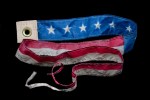
- This is the first commissioning pennant raised aboard the CG-49 on her commissioning day in 1985.
In addition to the pennant, I also have a standard (daily) ensign and union jack set that flew on the ship while in port in 1987. The other two flags were from the captain’s gig (ensign and jack), obtained when I was part of the boat crew serving as the rescue swimmer.
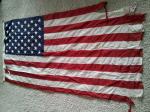
This standard navy ensign’s fly is tattered from the winds and there is some soiling from the stack gasses (exhaust) from the ship’s gas turbine propulsion.
A few years ago, an auction listing for a standard naval ensign that was described as having flown over the USS Vincennes (CG-49) during her 1988 deployment to the Persian Gulf. My interest piqued (mostly fueled by skepticism as to the authenticity of the flag and the credibility of the seller) I placed a watch on the auction. Since I served aboard the ship during that time, I contacted the seller to ascertain details that would prove (or disprove) the veracity of the seller’s description. The seller responded that he was a commissioned officer who had served as the ship’s navigator. This officer departed the ship just prior to the conclusion to our time in the region and was presented the flag by the chief signalman as a memento of the trying deployment and his time serving aboard the ship. A few days later, the auction closed and my bid was one of only three. I was very proud to have the flag along the accompanying provenance from the officer (in a printed email) to add to my collection.
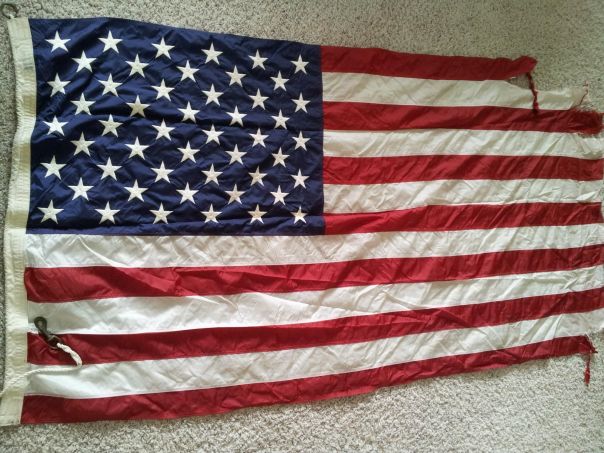
I obtained this flag from the CG-49’s former navigator a few years ago. The flag was presented to him by the chief signalman upon detaching from the ship, bound for a new command.
The ship was decommissioned a few years ago and subsequently scrapped, making these flags even more significant in my collection. As of yet, I have not affixed any documentation or description to provide provenance to the flags and pennants. If something should happen to me, these flags become nothing more than nice examples of naval flags. With the Star Spangled Banner, the flag was kept in a bag that possessed the documented provenance along with the narrative that was passed down from one generation to the next.
Flag Collecting Resources/References
Militaria Bargains to be Had
Taking inventory of my previous blog postings, I find an overwhelming majority of the topics I’ve covered were focused primarily on militaria that is not in the reachable price range for most collectors. These posts have been in stark contrast to my most recent acquisitions, most of which are well below $50 (including shipping costs).
In reality, most of the collectors I know are adept at rooting out the bargains at yard sales, surplus and antique stores, and various other sources. Rather than shelling out loads of cash to online sellers and taking on shipping costs, these collectors locate some very hard-to-find, and in some cases, high dollar items and groups for a pittance.
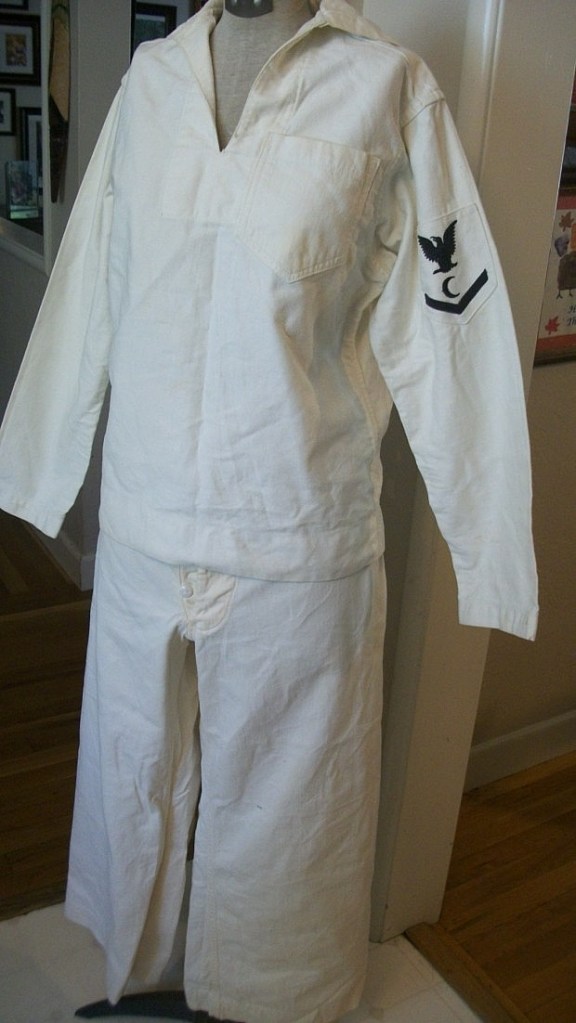
For the bargain-basement price of less than $11.00, I was able to acquire this fantastic tailor-made set of WWII-era dress whites with the precise rating badge I had been seeking (source: eBay image).
One of my collector colleagues spends time sniffing around in bargain bins in a surplus store near one of the local military installations, and once managed to locate a few sets of experimental U.S. Army combat uniform sets for less than $10.00. Subsequently, he discovered that the uniforms were rare and highly sought-after by collectors of current and modern uniforms, and could easily yield several hundred dollars per shirt and trouser set. His find was merely a matter of timing and experience as he recognized that these uniforms had subtle differences from their standard-issue counterparts.
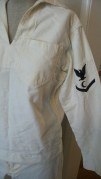
This jumper has a nice, crisp appearance for being 70+ years old. The crow of a Ship’s Cook 3/c is exactly what I was looking for (source: eBay image).
For some collectors (like me), possessing and budgeting for the time to spend scouring these locations for the bargains is difficult. We compensate by letting our browsers and searches do the legwork in discovering the low-priced pieces. Knowledge and experience also comes into play for us as we are able to discover items in listings that are incorrectly identified or tagged by the sellers helping to keep the buyer competition to a minimum.
Still, timing and patience are ultimately the key in finding low-priced pieces. I have been in search of a set of World War II vintage U.S. Navy enlisted dress whites with a ship’s cook third class (SC 3/c) rate and rating badge in good condition for a few years. Such a set would be a great augmentation for the uniform display I am assembling to honor my grandfather. While I already have two sets of his actual dress blues (one is standard Navy-issue and the other is his tailor-made, custom set), his whites were lost to time. When an online auction for a set of whites meeting my criteria was listed for less than $10.00, I began watching, hoping that the competition would be low and I set my snipe bid.
Just a few days ago, I received notice that the auction closed and my bid had been accepted as the winner. I acquired the uniform for less than $11.00 (plus a few bucks more for shipping costs) and I was amazed that this set would sell for such a low price when so many had sold for well over $50.00 during my previous years of searching.
The bargains are still out there for those who arm themselves with knowledge and patience and have a little bit of luck.
Collecting U.S. Navy Uniform Ship Identifiers
To suggest that veterans and sailors of the U.S. Navy have an affinity for their ships would be a gross understatement. It would be difficult to stroll through any public area without seeing a former navy man sporting a ball cap with a USS ___ (fill in the blank). I have seen men well into their late 80s proudly carrying the name of the ship they served aboard, emblazoned across their foreheads, and as I write this, I am proudly wearing one of my own ship’s ball caps.
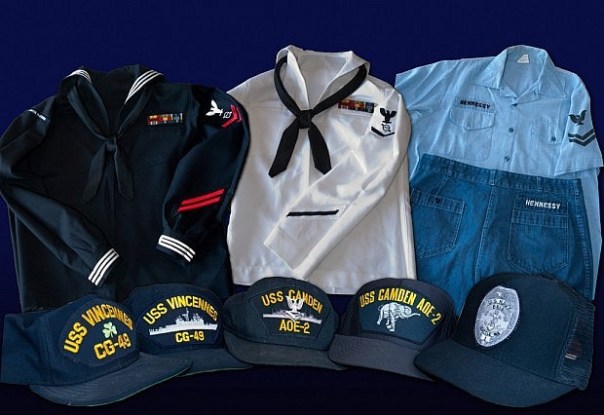
This collection of uniforms shows four official shipboard navy ball caps, authorized for wear with utility uniforms (such as the now-defunct dungaree set on the right). Note the UIM patch on the right sleeve of the dress blue uniform jumper.
Navy ship ball caps are quite commonplace. Many of them have icons or symbols between the name and the hull number designator that make them unique to each specific ship. Some of the symbology might have nothing to do with the ship, instead being representative of the commanding officer or the crew. As far as I’ve determined, ships’ crews have been wearing the named caps aboard ship with utility (dungarees) since the 1960s.
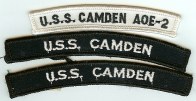
The two blue UIM patches shown are authorized by Navy uniform regulations. The white patch on top is a manufacturing mistake and unauthorized for wear on a Navy uniform. The USS Camden was decommissioned in 2005.
When sailors are required to be in their dress uniforms, identifying them with their associated commands is a requirement… especially when sailors behave like, well… sailors in foreign ports. Present-day enlisted dress uniforms must be adorned with a unit identification mark (UIM) patch on the top of the shoulder of the right sleeve. This regulation has been in place since the late 1950s to early 1960s.
Prior to World War II, the navy employed a much more stylish format of placing the command names on their enlisted sailors. From the 1830s to 1960, sailors wore with their dress blue uniforms a flat hat, affectionately known as the “Donald Duck” hat. Though it wasn’t authorized, in the latter half of the nineteenth century, sailors began to adorn their flat hats with a ribbon (known as a tally) that displayed the name of the ship and was worn only when on liberty (“shore leave” to you landlubbers). Eventually, the tallies were acknowledged within the naval uniform regulations, standardizing their appearance and wear.
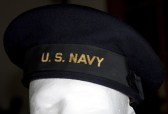
This post-1941 Navy flat hat shows the generic “U.S. Navy” tally. By 1960, these hats were retired from use.
By 1941 and the outbreak of World War II, the rapid expansion of the fleets with many new ships under construction and being delivered to the fleet, the Navy did away with the ship names on the tallies, standardizing all with “U.S. Navy” (there is some speculation that secrecy of ship movement drove the Navy to implement this change).
Ship-named tallies are highly sought after by collectors, pushing prices on some of the more famous (or infamous) vessels well into the ranges of multiple-hundreds of dollars, regardless of condition. Due to the delicate nature of the tallies’ materials and the exposure to the harsh marine environment, the gold threads of the lettering tend to darken and tarnish. The ribbon construction was typically made with silk, so they don’t stand up well to the ravages of several decades of time and storage.
In the last few years, a tally showed up in an online auction for the first time in more than a decade of staking out anything related to USS Vincennes. Until then, I had my doubts as to whether the Navy had allowed the pre-war crew to have the tallies for their ship, even though it was in service since February of 1937, four years before they were abolished. Sadly, the selling price surpassed my maximum bid by nearly triple the amount.
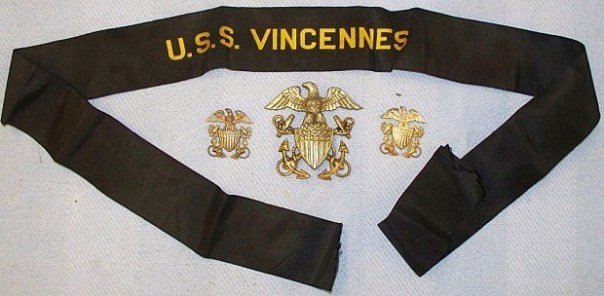
This image shows the rare USS Vincennes tally (along with some officer cap devices), which was sold this week at auction for more than $150 (source: eBay image).
Hopefully, I don’t have to wait as long until I see another USS Vincennes tally!
Shadow Boxing – Determining What to Source
(Note: This is first installment of a multi-part series covering my research and collecting project for one of my ancestors who was a veteran of the American Civil War)
- Part 1 – Shadow Boxing – Determining What to Source
- Part 2 – Civil War Shadow Box Acquisition: “Round” One is a Win
- Part 3 – Due Diligence – Researching My Ancestor’s Civil War Service
- Part 4 – Boxing My Ancestor’s Civil War Service
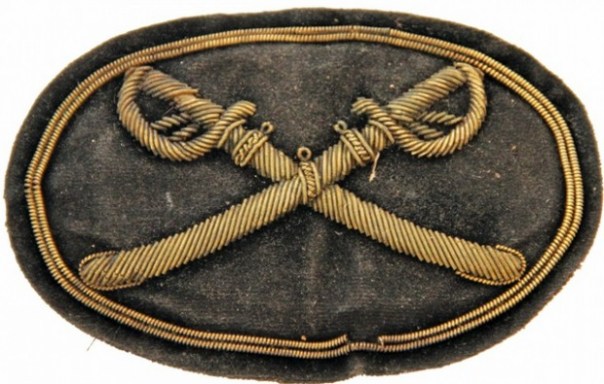
This bullion cavalry hat device could be a centerpiece and would look fantastic in a display (source: Mosby & Co Auctions).
For me, collecting militaria has been an adventure of discovery as I learn about who my ancestors were and what they did to contribute to the freedoms we enjoy in the United States today. As I’ve stated in earlier posts, my research began with the receipt of a handful of militaria pieces and documents for two of my relatives who served in the armed forces.
Rather than simply store the items in a drawer or closet, I wanted to assemble and display them in such a manner as to succinctly describe their service. Seeking to be as complete as possible, I sent for the service records for both relatives so that I could fill in the gaps if there were any missing decorations from what I already possessed. Upon receipt of the records from the National Archives, I noted that there were, in fact, several awards that had never been issued to either veteran (many service members were discharged at the war’s end war, prior to the decorations being created and subsequently awarded) and promptly obtained the missing pieces.
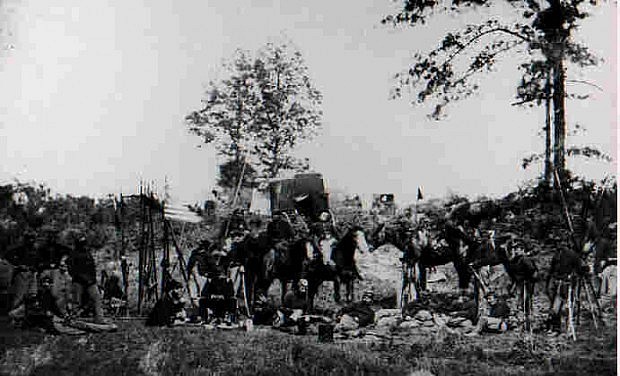
“I” Company of the famed Rush’s Lancers. Photos like these go a long way to help collectors seek the correct items for accurate displays. This photo was taken by Matthew Brady.
In preparation for assembling the displays, I was motivated to learn all that I could about others in my family who served. As I worked on my family tree, I began to discover that there were veterans at each successive prior generation who served. From Vietnam to the Korean War, World War II to the Great War, from the Civil War, the war of 1812 and finally, the American Revolution, I had ancestors who were participants. At the prompting of my kids’ inquiries as to who these people were and what they did, I embarked on a mission to assemble tangible representations of some of the notable veterans in the family lineage – including uniform items, awards and decorations.
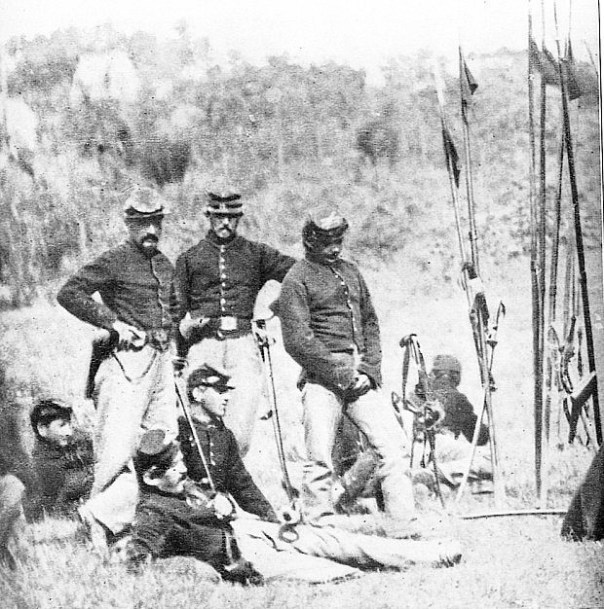
This is a close-up of the soldiers of “I” Company, 6th Pennsylvania Cavalry. This photo was taken by Matthew Brady and clearly shows the weapon that gave the regiment its name.
Limited by financial resources and storage space, I needed to choose the people from our past that would garner my collecting attention. This decision has caused me to abstain from purchasing some of the items that I found very interesting but couldn’t justify acquiring (after all, I am not creating a museum in my home).
One of my recent discoveries is that veteran in my lineage served in a storied regiment during the American Civil War. This unit, the 6th Pennsylvania Cavalry, was the only mounted regiment to be equipped with the lance as their primary weapon, prompting the nickname of Rush’s Lancers (Lt. Colonel Richard Rush was the unit’s first commanding officer). While my ancestor wasn’t a distinguished veteran or officer (he was a corporal), he did serve throughout most of the war, participating in many of the bloodiest battles.
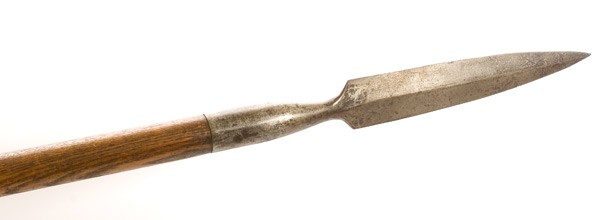
Well out of my budget, this Lance (that was carried by a member of Rankin’s Michigan Lancers) during the Civil War, sold at auction for $1,440.00 a few years ago (Source: Cowan’s Auctions).
I have been pondering how I could create a tasteful, yet small assembly of items that would provide an authentic and visually appealing display. What sort of items are available (and that I could afford) that would fit into a smaller shadow box and tell a story of my great, great, great grandfather’s service?
-
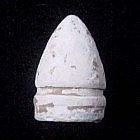
- This .44-caliber slug could provide a measure of authenticity in my display as the revolver was carried by the troops or the 6th Penna. Cav. If this were dug from one of the Lancer’s battlefield sites, it would only make the display that much more personal (Source: Civil War Outpost).
-
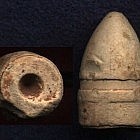
- After shedding the lances, the 6th Penna Cavalry switched to the more traditional weapons. This .52 caliber Sharps carbine round would be appropriate for my display (source: Greg’s Relics).
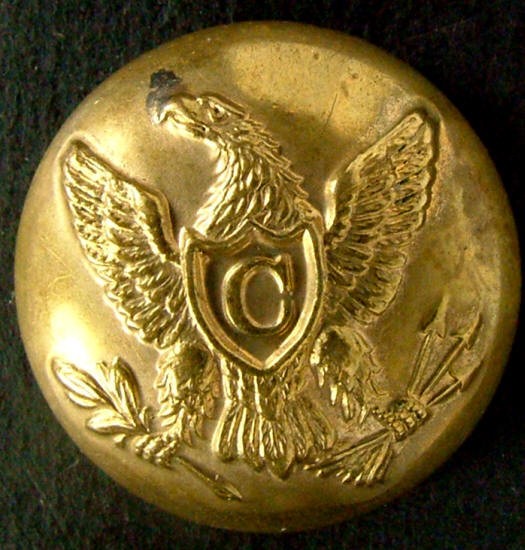
While this cavalry button (as distinguished by the “C” on the eagle’s shield) may be accurate for a cavalryman, it isn’t appropriate for my ancestor’s display as he was a corporal. I am still researching the proper buttons for display to confirm my suspicions, but I may be faced with purchasing the extremely rare Pennsylvania-specific buttons – as Rush’s Lancers were not a mainline Union Army regiment.
Taking into account that my relative was a member of the Union Army, I could pursue pieces of the Union uniform such as buttons or other devices. I would need to focus on cavalry as their buttons are different from those of the infantry. If I was fortunate enough to locate one at a reasonable price, I could obtain the kepi hat device. Including excavated items such as ammunition rounds for weapons carried by cavalry (such as .52- or .56-caliber carbine or .36- or .44-caliber revolver rounds) that were found on one of the unit’s battlefields would be a terrific accent to the display. Ideally, I’d like to get my hands on the blade from a lance, but with the lofty price (one was sold at auction in 2005 for $1,440.00) they command, I will have to abstain. If I can locate a period-correct Civil War medal, it would be icing on the cake.
No matter the direction that I ultimately decide to take, I know that I will be spending the next several months scouring the online dealers and auction sites to acquire the pieces. In the meantime, I await my great, great great grandfather’s service records so that I can (hopefully) nail down his service and create an accurate display.
Continued:
Naval Heritage Commemorated in Silver
When you have a specific area of collecting interest; a focus that keeps your eyes peeled for items that are beyond the realm of the obvious, you will eventually discover the oddities or atypical pieces that you wouldn’t have intentionally sought out. Collecting can be fun when these discoveries surface, prompting you to act quickly in order to secure the piece for your collection.
Since I started collecting militaria, I have progress from a somewhat broad stance; being very unfocused and undiscriminating about what I would acquire. Lacking in direction can be problematic in that your collection grows in such a manner that you have glaring vacancies that would have otherwise helped to convey the story that you want to tell with your collection. For example, one area (of militaria collecting) that has piqued my interest baseball within the armed forces (uniforms, equipment, photographs, ephemera). Because I remain diligent in keeping my attention on this particular sport, I have abstained from allowing myself to be distracted by other sports-related areas. I have passed on several very impressive pieces that are football-oriented and would be great for a military-sports themed collection. However, these items would have detracted from focus while diverting funds away from another piece that would have been a perfect fit.
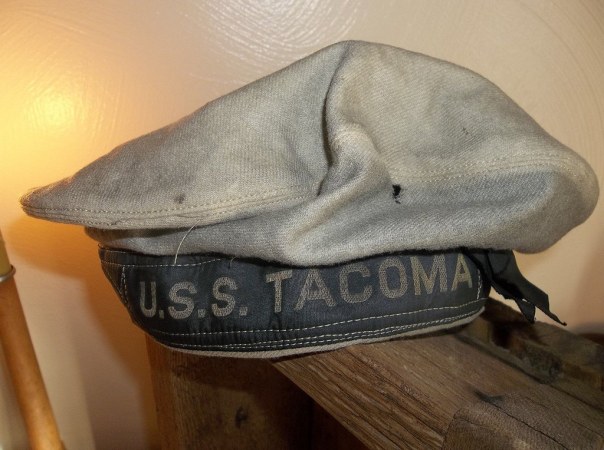
While this pre-WWI flat hat is in rough condition (very faded, misshaped, mothed and shoddy stitching over the ship tally), it is still highly sought after due to the scarcity of the tally. The Tacoma was lost on Blanquilla Reef near Vera Cruz, Mexico following an accidental grounding in 1924. Four of her crew were killed, including her commanding officer, Captain Herbert Sparrow. (Image source: eBay)
Being geographically-centered on my home region, I have been seeking out naval militaria that relates to my home state. Again, what I have been interested in are pieces that have ties to any installation, operation, event, person and, in particular, naval vessels named for cities and geographic features located within my home state. This mini quest has yielded some interesting artifacts that are predominately of the ephemera and antique photographic variety. Two of the most recent pieces (that are not paper or pictures) are not artifacts derived from the ships or the men who served aboard (having a flat hat with a ship’s tally are like gold) but are, instead, commemorative items that may have been presented to crew members.
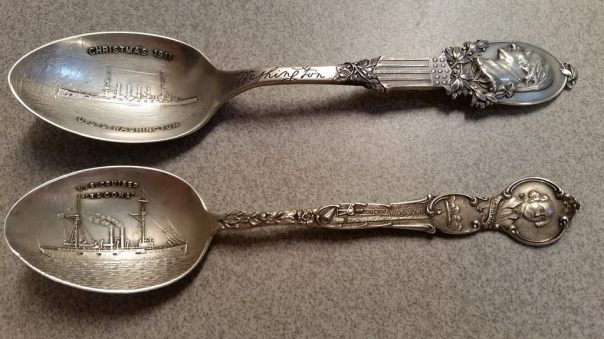
Two sterling silver commemorative spoons (top: USS Washington ACR-11. Bottom: USS Tacoma Cruiser No. 18)
I am not at all interested in collecting souvenir spoons but I made an exception for these two examples from historic ships.
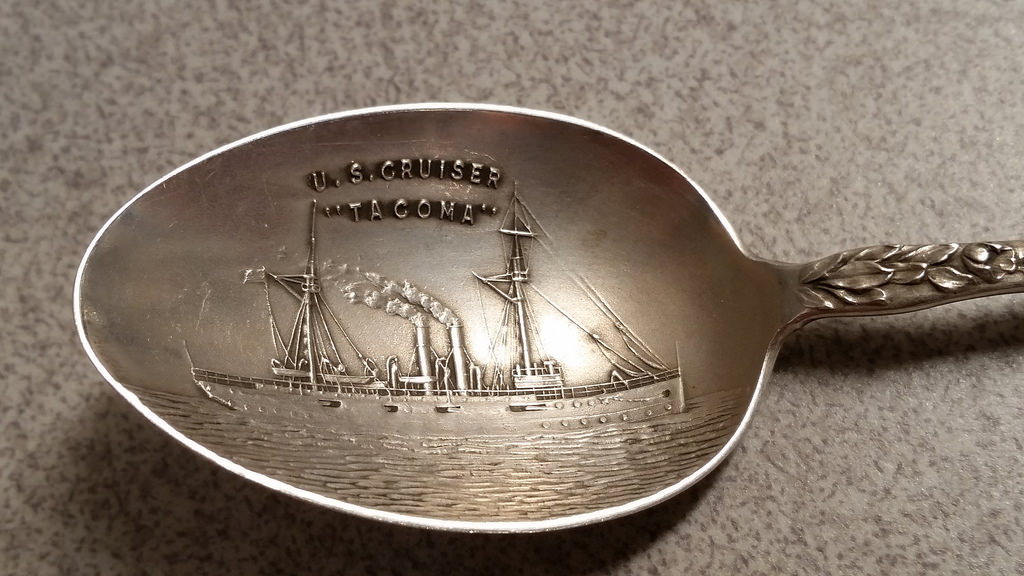
The inside of the bowl has a very detailed depiction of the cruiser. The reverse of the spoon is engraved with “1907, Helen.”
The first spoon that I found a few years ago was in an online auction. The ornate design combined with the silver content made it easier to pull the trigger on purchasing. That it was from a ship with a great history and was named form my hometown made the purchase a no-brainer. The USS Tacoma (Cruiser No. 18) is not only a veteran of five World War One convoys, she also escorted the (then) recently discovered remains of Revolutionary War naval hero, John Paul Jones to the United States from France.
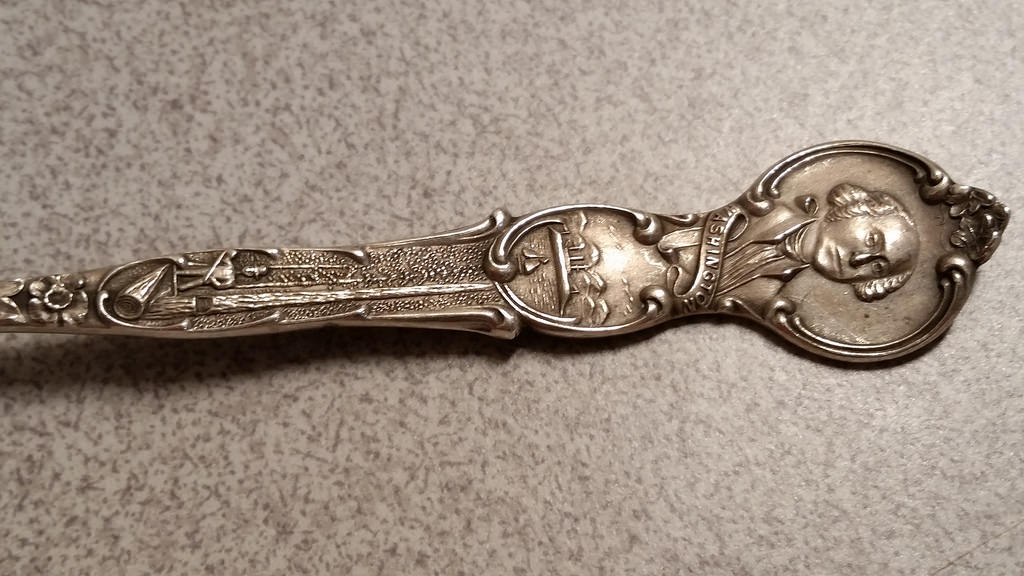
The USS Tacoma spoon is far more ornately decorated with fine details – embellishments of various aspects of Washington State and the city of Tacoma.
The second spoon in my collection arrived just a few days ago – again, purchased from a seller in an online auction. This spoon, slightly longer and more broad than the USS Tacoma example, commemorates the Armored Cruiser, USS Washington (ACR-11). This spoon, along with the relief of the ship (in the spoon’s bowl) has “Christmas 1911” imprinted, indicating that the spoon may have been given to crew members for that year’s holiday. By 1916, the USS Washington was reclassified and renamed USS Seattle. She went on to serve as a flagship during Atlantic convoy operations during WWI. After the war, the Seattle would be relegated to training duties and then as a receiving ship before being scrapped during WWII.
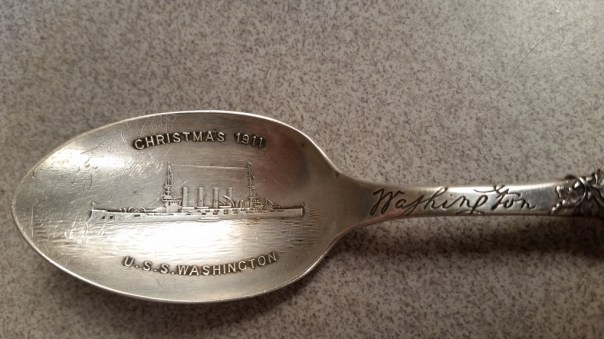
The armored cruiser, USS Washington is beautifully captured in relief in the spoon’s bowl along with the details commemorating Christmas of 1911.
I have had no success in my research attempts regarding either of these pieces beyond what is imprinted on either one. For now, I am content with having them as artistic enhancements to my collection.
 The Veteran's Collection