A Whale of a Tooth: 19th Century Naval Scrimshaw


Where does the time go? I know that my writing schedule has been severely impacted by home and work priorities (this column is nowhere near being a day job for me) and other facets of life routinely draw my attention away from my love of military history. However, my interest never truly wanes or strays very far from this passion and yet when I checked to see that my last posting was more than three months ago, I realized that I need to get back on the horse and get the creative juices stirred.

I can’t blame writer’s block or submit any grandiose excuses for not writing. I merely de-prioritized my militaria collecting during the 90-day time span. Though my acquisition pace has slowed during the last half-year, I only suggest that I’ve become hyper selective about what I add to the expanding pile. With the smattering of pieces coming through the door, I found myself asking the question, “what should I write about?”

Not wanting to overload the Veteran’s Collection with an overwhelming theme, I have been putting forth an effort to balance the various subjects. My best efforts aside, I find that my posts are skewed toward the Navy (where I served) with some of those topics focusing on a specific ship. Regardless, after a few moments of careful consideration, I decided that instead of talking about a new (to my collection) piece, I would spend some time with something that eluded me a few years ago (the subject just happens to be in a few of my wheelhouses). Missing out on this piece has haunted me since the online auction bidding surpassed my meager budget.

Without going into detail as to what fuels my interests (read my About page for those details), I’ll jump right into today’s topic.

I can bet that half of those who read this column (all four of you) are familiar with the widely popular PBS television production, Antiques Roadshow and have viewed episodes where 19th century maritime folk art objects have been viewed and appraised. One of the most popular types of that particular folk art is scrimshawed marine mammal bones (or teeth/tusks). Needless to say that along with popularity (and scarcity) of these pieces comes an array of reproductions and outright fakes onto the market. Applying the caution of a mariner skirting the shoal waters, one needs to be very knowledgeable before navigating into these waters.
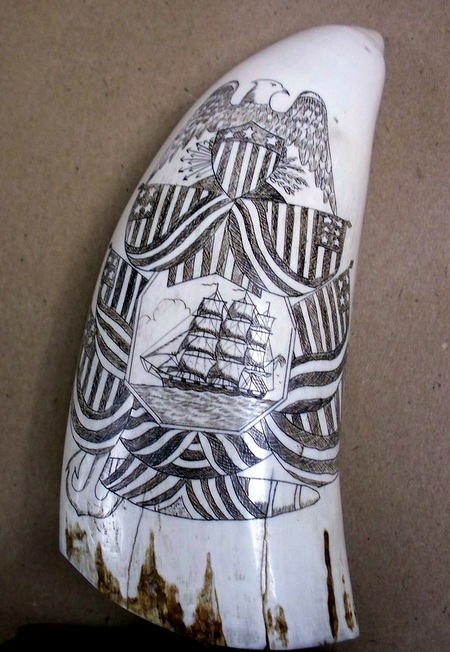
USS Vincennes Scrimshaw

The ship design in the center is clearly that of an 1820s United States Navy sloop of war (source: eBay image).

When this item was listed in an online auction, I was shocked that it lasted without being taken down by the host as genuine scrimshaw violates their established policies that forbid the sale of items made from protected animals. In reading the seller’s description, I noted that it was being sold as a piece that was manufactured from man-made materials rather than from a whale bone or tooth. However, in examining the photos of the piece, it was clearly NOT sourced from synthetics, though I couldn’t be certain without a hands-on inspection. Hoping to get clarification from the seller, I resorted to asking specific questions only to be rebuffed with a message that reiterated the details in the listing’s description.
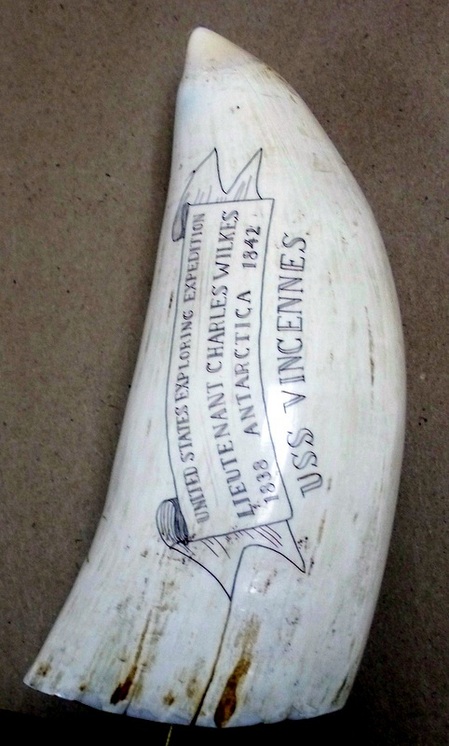
USS Vincennes Scrimshaw

The inscription reads, “United States Exploring Expedition, Lieutenant Charles Wilkes, 1838 | Antarctica | 1842. USS Vincennes” (source: eBay image).

The subject of the scrimshaw artwork is what drew me to the piece from the beginning. The illustrations on either side of the “whale tooth” were made to commemorate the United States very first foray into global exploration. The U.S. Exploring Expedition was led by the US Navy’s polarizing figure (of that era), LT Charles Wilkes from 1838-1842 and consisted of men from several biological and geological scientific disciplines along with illustrators, geographical surveyors and naval officers and men aboard six US Navy vessels – the flagship being the sloop of war, USS Vincennes.

On one side of the tooth is a rather elaborate design of the three-masted sloop (a port-side view) that is centered among an array of flags with an eagle perched above an American-themed shield holding arrows and an olive branch which is very reminiscent of 19th century designs. On the reverse is an unrolled scroll that appears to be a banner with the US Ex. Ex, Wilkes’ name, the dates and “Antarctica” emblazoned across. Immediately beneath the scroll is the name of the expedition’s flagship, “USS Vincennes.”

I grappled with deciding to bid on the object. There was no definitive manner in which to determine the authenticity or if it was, in fact, a mocked up piece of plastic. I was left to weigh all of the evidence and draw conclusions (aside from the fact that the seller stated that it wasn’t the real thing which could easily be that person’s subverting of the online auction site’s rules).

USS Brooklyn Scrimshaw

An example of an 19th Century whale’s tooth scrimshaw depicting the USS Brooklyn (source: dukeriley.info)

Scrimshawed Whale's tooth.

Showing a vintage whale’s tooth scrimshaw mounted to a cork base. Note the similar themes (to the USS Vincennes tooth) and the odd number of stripes on the shield (source: Wikimedia).

The cons

  • The tooth is very bright for an early 19th century piece. Most scrimshawed items tend to yellow with time. After 170 years, the bone/tooth material should be much darker.
  • Taking a look at the artwork design, what gave me reason to pause is that the artist departed from the widely used American themes within his design. The eagle’s shield is lacking the correct number of stars and stripes (shown are three and 11, respectively).
  • The wooden base (which appears to be of dark walnut) that the tooth is mounted to seems to be fairly modern; almost new, conditionally.
Early 19th century flag

This early 19th century flag depicts the three-starred shield and 9 stripes yet the eagle faces his right shoulder (source: NAVA).

The pros

  • As someone who, for the last two decades, has been searching for anything pertaining to any of the US Navy warships that bore the same name, this is the only scrimshaw that I have encountered that had any reference to the ship or the expedition. Uniqueness is definitely a plus in that if someone was going to bother manufacturing fakes of this nature, there would, most-likely be multiple examples appearing on the market.
  • The cons that I listed above can be explained. The artist may not be as detail-oriented when it comes to the thirteen stars and stripes. However, the direction that the eagle’s head faces is accurate for the time (facing its left shoulder). The illustration of the ship is very accurate to that of the 1820s U.S. sloop of war (designed by Samuel Humphreys) which leads me to believe that the artwork is correct to the period.
  • The base could have been merely a replacement or an addition by a subsequent owner.
  • The piece may have been stored in a cool, dark location for most of its existence, which could possibly account for the lack of typical aging effects.
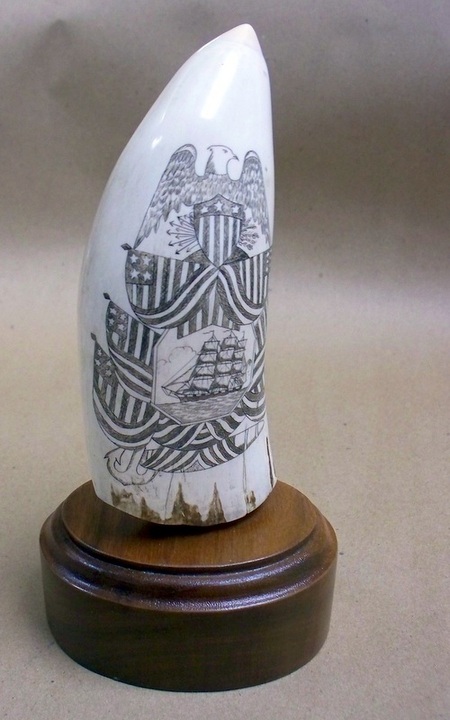
USS Vincennes Scrimshaw

The walnut base appears to be a fairly recent addition as it shows no signs of aging (source: eBay image).

After several days of careful consideration, I decided that it was worth a nominal investment risk and configured my bid snipe program accordingly. Within a few hours of the auction close, the bidding (from multiple parties) surpassed my maximum and I watched this beautiful piece of scrimshaw slip into someone else’s hands for several hundred dollars above my limit. It seems that other collectors had arrived at the same conclusion that I had and the benefit of owning such a nice piece far exceeded the risk that it might not be authentic.

For me, this whale tooth was not to be.

Military Records Research: Pay Attention to the Details


Genealogical research is funny. Overlooking the smallest, insignificant details can insert unintended road blocks into continuing down a valid pathway. With my family (which, I suppose isn’t too different from most families), there are so many branches of the tree to pursue which demands a lot of time spent down in the details. One little detail that I overlooked, kept me guessing on and off for over a year.

In July of 2012, I requested and obtained the WWI Canadian Expeditionary Forces (CEF) service records for my maternal grandmother’s father after making an Ancestry.com discovery of his military attestation record (his service was unknown to my family). Having served in the U.S. military, I am rather familiar with acronyms and terminology that is prevalent across multiple branches of the armed forces. In reviewing my great-grandfather’s CEF records, I began to realize that a fair amount of the documentation was difficult to discern, so much so that I found myself focusing more on the terms I did know and overlooking those that I was unfamiliar with.

Discharge Reason

Unfamiliar with the any of the Canadian military information, “Special Case” was very nebulous. Without an understanding of the references listed here, I was left guessing as to what this meant.

In examining the rather thin record, I found that my great-grandfather had been called up and was inducted on April 22, 1918 and was discharged on May 6, 1918 after just 15 days of service in the Canadian Army.  The discharge certificate reads: “Discharge from the service by reason of ‘Special Case’ Authority Routine Order No. 180 dated 3-2-13. D.C.C. 11 M.D. 99-4-113-13.” This reason was found on several of the pages of his out-processing so from there, I made assumptions and ignored some of the other, more detailed data.  I figured that he might have had a medical condition (note the “M.D.” in the above typed reason) or, perhaps there was a family hardship. Either way, he served slightly more than two weeks prior to being discharged.

Maritime Uniform

The question: If he was drafted into the Army (CEF), then why is he wearing a maritime uniform?

A few years ago, my mother presented me with a box full of snapshots and photographs to scan (which I am slowly working on…when I have the time) in an effort to make them available to whoever in the family desires. One of the pictures caught my attention about the time I received my grandfather’s CEF records. The photo was a framed enlargement (from a snapshot) that showed my great-grandfather in a maritime uniform that was clearly Canadian (or British, even). My exposure to anything Canadian maritime was limited to lifting a few cans of Molson aboard a Canadian Destroyer in Pearl Harbor and riding the British Columbia Ferries to Vancouver Island. Translation: I know next-to-nil about Canadian uniforms (military or civil). Looking at my great-grandfather, I was left guessing.

The perplexing part of this story was that the uniform was maritime rather than Army (the CEF Army uniforms were very similar to the American Expeditionary Forces Army uniforms). Needless to say, I was entirely in the dark. Why was a two-week army veteran wearing a clearly non-army uniform?  Since last year, the photo has been displayed on a table in our living room inspiring questions from family and guests as to the subject and the uniform in question.

In researching another relative who served in the CEF, I finally decided to reach out to experts to see if someone could enlighten me as my uninformed searches over the last year yielded zero positive results. On Tuesday of this week, I posted the images to a Canadian militaria collector’s forum and sent them to the Canadian Navy League. Today, I received word that the uniform is that of a Canadian naval petty officer first or second class. Thankful for the confirmation, I was still left guessing as to why my ancestor was wearing a navy uniform when he served in the army.

Cause of discharge: t Join the Royal Naval Canadian Volunteer Reserve

The cause of discharge as listed on this page that was deeper into the records documents was entirely overlooked. “To join R.N.C.V.R. was left hidden until today.

I scanned the Canadian Archives site to determine the next approach to see if I would be able to request records of my great-grandfather’s naval service (if they actually exist).  None of the information stood out to me so I decided to take another peek at the CEF records that I already had.  As I skimmed through each page, I kept seeing the same reference to the reason for discharge. A few pages deeper, something leapt off the page: “Cause of Discharge – to join R.N.C.V.R.”  One simple Google search and I had it nailed. My great grandfather left the Army to join the Royal Naval Canadian Volunteer Reserve.

Armed with this information, I can now pursue (and hopefully be successful) my great grandfather’s naval reserve service records. Clearly he served long enough to advance to petty officer 2nd or 1st class in a short period of time. By October of 1922, my great grandfather and his bride emigrated to the United States and settled in what would become, my hometown. Less than ten years later, he would pass away leaving behind two young daughters and his widow. Any inkling of his wartime service was lost to the ages, leaving me to discover it more than 90 years later.

Chiefly Limited: Space for Uniforms is at a Premium


Chief Machinist Mate bullion

Always an attention-grabber, vintage silver-bullion chief petty officer rating badges are highly collectible due to their intricate designs and usage of silver thread.

There are many challenges and hurdles for collectors of militaria. Not unlike the difficulties other collectors face, militaria requires research, authentication and a healthy bank account in order to enable the afflicted with the tools to be successful in such endeavors. One of the most significant universal hurdles collectors face is the ever-increasing deficit of square footage needed for storing and displaying collections.

I am no different from any other collector in that space is at a premium when it comes to safely storing my militaria. Without the proper controls being set in place, I could easily displace my closet space needed for hanging my wardrobe in favor of a growing assortment of vintage military uniforms. What sort of proper control could bring to bear the appropriate amount of pause before pulling the trigger on a deal to acquire the next amazing uniform?

My collection, almost from my entry into militaria, has grown slowly due to my tempered approach, focusing on specific areas of interest. Within those areas, I incorporate a finer set of specificity that helps me to keep things under control. Like many U.S. naval collectors, I enjoy uniforms, rates, shoulder insignia, collar and cap devices and other assorted pieces. However, I tend to direct my attention to specific rates when it comes to uniforms and badges. Mostly, my naval uniform collecting focuses on rates that were held by members of my family.

Only one member of member of my family ever advanced through the enlisted ranks to don the rocker-topped chevron of a chief petty officer, so my collection of CPO uniforms is very limited.

On occasion, I might be tempted to acquire an item that falls outside of my parameters if it possesses other aspects that make it too good to pass up as was the case of my most recent acquisition.

WWII CPO machinist's mate jacket

This CPO jacket has it all…well almost. It is an 8-button, tailor-made dress blue, World War II-era jacket complete with a silver bullion chief machinist’s mate rating badge and custom sewn-on ribbons.

A few weeks ago, a chief’s uniform jacket and cap became available that was just too good to pass up. The dress blue coat was an older, tailored eight-button version indicating that it was made during (or prior to) World War II. Affixed above the left breast pocket were 2-⅓ rows of custom (sewn-on) ribbons which clearly showed the chief as having served during and after World War I up to (and probably through) World War II. On the left sleeve were six hash marks showing that the chief served for at least 24 years. I have an affinity for bullion rates or insignia and the chief machinist’s mate insignia on this coat was the icing on the cake that put me over the top to make the decision to pick it up.

WWII CPO combination cap with white cover

Included with the CPO jacket was this WWII-era (wicker-framed) combination cap. The condition of the frame, visor and white cover are outstanding.

For many of us, researching veterans is a challenge and when we learn about the original owners (of military uniforms) were, there is a compulsion that pushes us to discover where the served and what they did during their time in uniform. When a uniform (that we acquire) is inscribed with a name, we are invariably driven to pursue the history in order to retain it with the item. Sadly, this jacket was unmarked which only meant that I wouldn’t have any further work once I had my hands on it.

Navy custom, sewn-on ribbon rack

The custom ribbon rack, though a little deformed from years of use and storage is complete with a Navy Good Conduct, WWI Victory, China Service, American Defense, American Campaign, Asiatic Pacific Campaign (with three campaign stars) and WWII Victory.

After it arrived, I was even more impressed by the condition of the jacket and the silver bullion of the rate badge. One glance at the Good Conduct ribbon (sans devices) and the six red hash marks, it is very apparent that the chief had some challenges with Navy regulations, staying out of trouble (when on liberty) or simply clashed with his superiors. I am sure his disciplinary record would make for an entertaining read. It is unfortunate that the jacket is forever decoupled from the sailor’s service. Regardless, the uniform is a great addition to my collection.

Now…where to put it?

Price, Provenance, Preservation and Procrastination


I have been doing some thinking lately about history and items that are specifically linked to notable events or people. One visit to just about any museum will yield an item that is connected in some form or fashion to history. The museum visitor can study the item, read the placard and then view the piece again, visualizing the associative connection.  Without the placard, the item is relegated to a mere visual enhancement within the display.

Personal narratives connected to objects have considerable meaning to the person in possession of the object. For a family member to whom the item was handed down, because of the value they place upon their family member’s service, the item possesses immeasurable financial worth. If that person decides to sell the item, the story and the family history drives up their asking price well-beyond the actual value a collector is willing to pay.

As someone who inherited a decent amount of militaria from my family members, I have pondered the historical aspects of the pieces that are now part of my collection. For much of these pieces, if they stand alone, they are nothing more than objects from history. When combined with the narrative and the connection to my respective relative, they have meaning. The challenge lies in establishing (and maintaining) the historical connection.

In collecting militaria, the adage, “buy the item, not the story” should be adhered to with prejudice. Regardless of the narrative being shared by the item’s present owner, without iron-clad documented proof, an item can only be valued on it’s individual properties (demand, scarcity, condition, etc.). For those who are new to militaria (or any other vintage collectibles), the term normally applied (regarding veracity of an item’s history) is provenance (not providence):

1: origin, source
2: the history of ownership of a valued object or work of art or literature

Tattered U.S. Naval Ensign - Combat-used

U.S. naval ensign flown over a warship during a combat deployment in the Persian Gulf during the late 1980s. The tattered ends of the fly are due to wind damage sustained during round-the-clock exposure to the elements.

One item in my collection (shown above), a flag that was flown aboard a warship during a combat engagement, possesses no identifying marks that would be able to associate it with the ship nor the engagement. However, when I acquired the item, I corresponded with the seller and saved his account of how he obtained the piece. That correspondence combined with the standard military supply markings (NSN, etc.) stamped onto the flag’s hoist and the fact that I personally know the seller (an officer who served aboard the ship) and I was present when the flag was flown, provide me with assurance that the flag and its history are genuine.

Sadly, much of the narrative history that is associated with militaria is not documented. Veterans do not take the time to preserve the history by capturing how or why the item was important enough to hold onto for the decades that followed their military service. After the veteran passes away, their estate is inventoried and these military items are disposed by the surviving family members as the history faded to oblivion.

Small arms spent bullet

My uncle saved this spent small arms projectile in his personal effects along with ribbons, medals and collar devices. What he didn’t save was the history of the item or the reason for keeping it for so many years.

One of the most fascinating pieces that I inherited from one of my relatives was a small arms round that had clearly been fired as evident by the striations surrounding the projectile’s body and the mushed tip. My uncle saved this bullet among his ribbons, medals, collar devices and marksmanship awards since his separation from the Army in 1954. Since I received the box containing these objects a few years after he passed, the history surrounding the bullet was lost to time. He was awarded a Purple Heart medal during WWII but the details surrounding his wound were not in his record (his records were recreated by NARA – the originals were lost in the 1973 fire), so one assumption could be a connection to his combat wound.

The desired reader-response that I have for this article is many-fold. I hope that:

  • Veterans take the time to document the history surrounding each item in their collection.

  • Collectors, dealers, and family members preserve history of the items they acquire from veterans

  • Prospective buyers press militaria sellers for solid provenance when they ask premium prices for items (being sold with a story).

Fall In! Getting Back to Militaria After a Long Summer


What a summer! For the small percentage of my readers who know me personally, understanding my absence from this blog is quite easy. For the rest of those who follow this blog, I apologize for my absence as these past few months have been consumed by some of my other passions (family time and cycling).

During my hiatus from writing about my militaria passion one would suspect that I would have increased my collection and subsequently queued up a backlog of topics and subjects to capture your attention. Sadly (for you), I’ve done neither choosing instead to spend time immersed in a myriad of activities and projects. As certain as the coming of the autumn rain (I know, it is still technically summer for a few more days), my attention can now wander back toward military history and the related objects we collect.

Speaking of working on projects, my collecting subsequent research has me steadily gathering items for a surprise shadow box for a family member. Without going into great detail, the subject of the shadow box was a Navy veteran of World War II enlisting a year (or so) prior to the Unite States’ entry. In fact, this sailor was serving aboard the USS Pennsylvania (BB-38) along with his older brother during the Japanese surprise attack on Pearl Harbor.

USS Pennsylvania - After the Japanese attack.

USS Pennsylvania (BB-38) smoldering in Pearl Harbor Navy Yard dry dock #1 along with USS Cassin (DD-372) and USS Downes (DD-375) following the Japanese attack (source: U.S. Navy image).

Armed with scant few details, I embarked upon a search of available (online) sources to uncover as much data as possible in order to submit a detailed request (to obtain service records) to the National Archives (NARA). In order to create a complete shadow box (with all of the appropriate medals, ribbons, rating badge, etc.), I need to be armed with the most accurate information about the veteran’s service as I can.

One thing that I have learned through my experiences in dealing with records from NARA is that I cannot rely on the information as being entirely complete or the last, defining word in accuracy. In requesting a copy of my own “complete” service record, I noted that it lacked entire years of my service and resulted in the processor summarizing my career awards and decorations significantly short of what I actually earned. Fortunately for me, my command made an entire hard copy of my full service record upon separation from active duty. So, proceed with caution when using NARA-obtained service records and awards summaries.

WWII Navy Shadow Box

An example of a WWII Navy Veteran’s shadow box (my grandfather’s) is what I am going for with this project.

For accuracy, it is best to have multiple data sources to both verify what one source states but to also discover any holes or gaps. Researching beyond individuals’ service records requires exponentially more work. If one can determine which commands (i.e. vessels) a sailor served aboard (using muster sheets), the researcher then needs to determine the specific history of that unit including campaigns and battles it participated in. This will help determine any unit awards the sailor might have earned that are not listed within the personnel file or service record.

Due to their popularity and the nature of their service, researching unit history for a well-known combatant such as a battleship or cruiser can be much more simplified than that of a fleet tug or minesweeper. For the BB-38 and this relative’s service aboard the ship, the research is quite simple and the decorations are minimal (considering the ship spent the majority of the first sixteen months under repair and modernization). During her inactive time in the shipyards, the crew was sent out to the fleet to serve where needed. Following detachment from the Pennsylvania, this relative served aboard a destroyer followed by time in confinement (for fighting), ultimately being punitively discharged late in the war.

Regardless of the manner in which his wartime service came to an abrupt end, looking back on the positives of this veteran’s wartime service and honoring it with a collection of artifacts that recognize that is a worthwhile project. This will be much appreciated by his family and serves to bring me back from my lengthy summer distraction from militaria collecting.

Design a site like this with WordPress.com
Get started