Shredding History Part II – Severing the History from the Artifact


In part I of this series, I focused my attention on a transaction (hopefully the only one) between the National World War II Museum and Bands for Arms, discussing the handling of artifacts that had been donated to the museum by individuals. Part I is the catalyst for this series, but today’s could stand on it’s own.

With that ordeal between those two entities and the militaria collector community, it is debatable as to whether the collectors are actually happy with the results. While the artifacts in question were decided (by the museum staffer) to not have been World War II pieces, that doesn’t equate to them not being historically significant or valuable to militaria collectors.

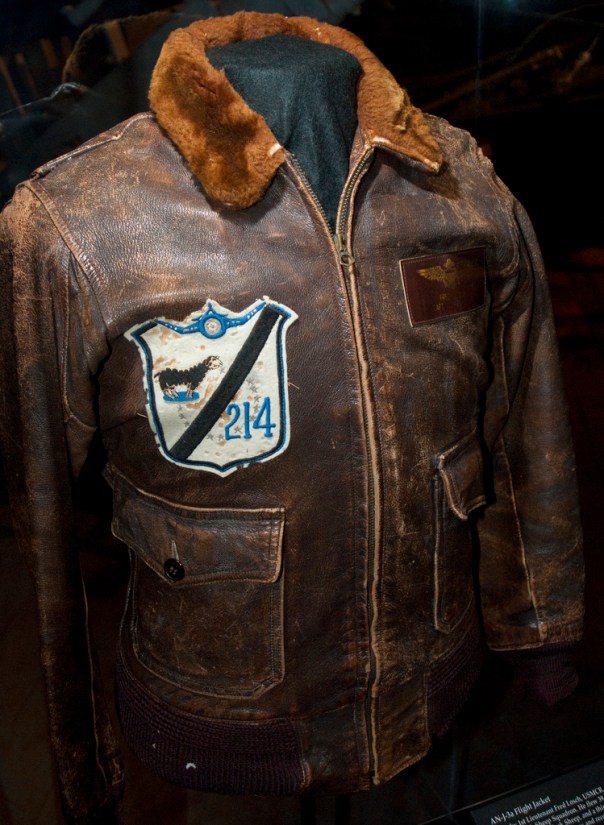
This G-1 flight jacket belonged to Fred Losch (Capt. USMC), aviator of the famed VMF-214 (Blacksheep Squadron) is housed at the Museum of Flight in Seattle.

This G-1 flight jacket belonged to Fred Losch (Capt. USMC), aviator of the famed VMF-214 (Blacksheep Squadron) is housed at the Museum of Flight in Seattle.

In other areas of collecting, destroying an historic artifact for the sum of it’s parts is nothing new. Even within the area of military collecting it is still practiced — stripping uniforms of decorations, patches, buttons, etc. — yet it is frowned upon by purists.

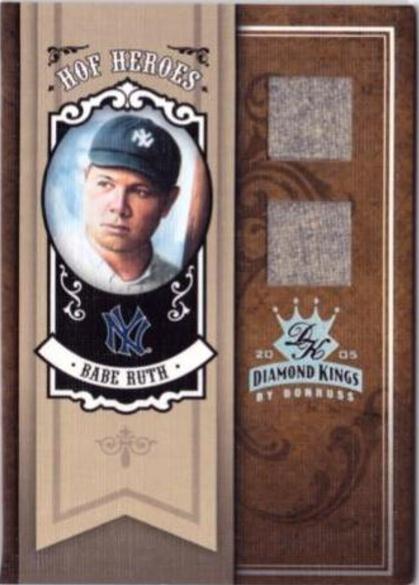
To make this limited edition insert card, Donruss destroyed one full set of Babe Ruth’s road gray uniforms.

To make this limited edition insert card, Donruss destroyed one full set of Babe Ruth’s road gray uniforms.

Being a huge fan of major and minor league baseball, I dabbled in this arena of collecting, including baseball cards. My financial resources were limited so I had to collect within my means, focusing on certain aspects rather than any and all cards. I recall some card manufacturers in the 1990s launched into a practice of adding “insert” or special cards that were limited in production into their card sets making them rare and highly desirable among collectors. As the fervor increased with each new series or product line, so did the drive to make the insert cards more significant and create increased demand. This translated into significant revenue generation for the card companies.

I started to get disenchanted with sports cards at the point where they began destroying pieces of history for profit. Several card companies were acquiring rare artifacts (specifically, bats and uniforms) that were attributed to legendary ball players, cutting them into ¾-inch square pieces and mounting these into special insert cards. Imagine shredding a game-worn Babe Ruth jersey such as a 1920 Yankees road uniform top – which ultimately sold for $4,4m – into a few hundred little pieces. It has been done… several times.

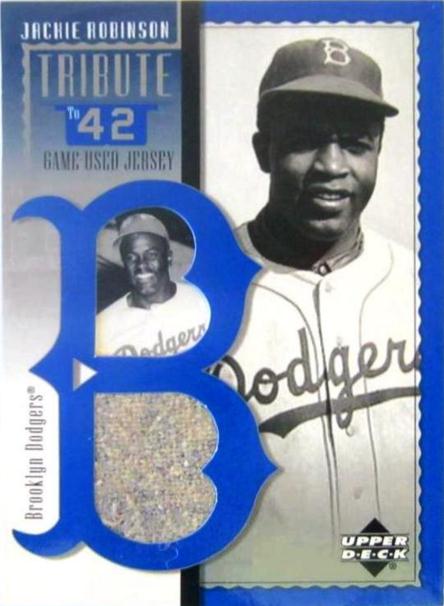
Upper Deck carved up a road jersey worn by Hall of Fame player, Jackie Robinson.

Upper Deck carved up a road jersey worn by Hall of Fame player, Jackie Robinson.

Baseball players do wear a number of uniforms throughout a season – multiples of both home and road. Considering the typically lengthy Hall-of-Fame careers, these stars will don a considerable number of uniforms. For combat veterans who only served during a conflict, their uniform count will be significantly less. Veterans of World War II often returned with just the dress uniform they were wearing. When the war was over, these veterans either disposed of their military garb or stowed it away in the closet or attic.

To reiterate, militaria collectors do not take issue with veterans’ (or their families) decisions to donate their own uniforms to companies like Bands for Arms. What is difficult to contend with is the loss of the military heritage and connection to individual history through these uniforms. Would anyone imagine doing the same thing with a uniform from Medal of Honor recipient Sergeant John Basilone?

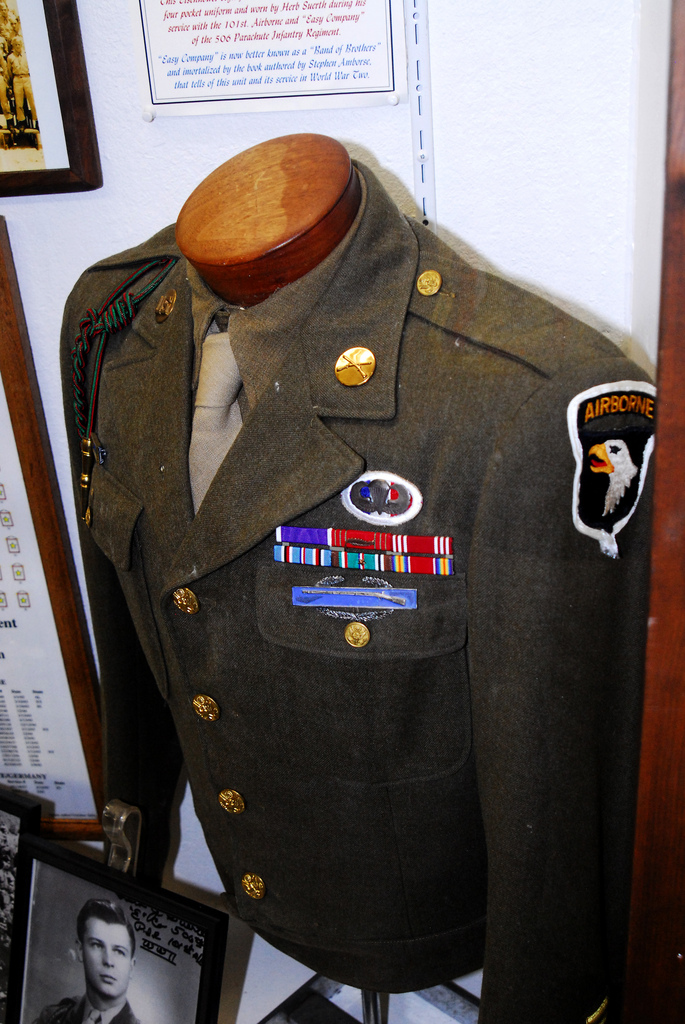
Private Herb Suerth (of “E” Company, 506 PIR, 101st A/B) “Ike” jacket on display at the Indiana Military Museum.

Private Herb Suerth (of “E” Company, 506 PIR, 101st A/B) “Ike” jacket on display at the Indiana Military Museum.

Would the band buyers rush to purchase a bracelet made from Major Richard Winters (of “Band of Brothers” fame) uniform? I’d imagine that bracelets made from these high-profile veterans would necessitate a boosted sale price, which would lead to a considerable amount of funds for the museum’s upkeep. But at what cost?

Advance to part III of this series!

Shredding History or Genuine Fundraising? Part I


I am kicking off a three-part series this week to focus on a hot-button militaria collector topic : re-purposing militaria artifacts for monetary gain. While the discussion can be category agnostic (meaning that it can be applied to virtually all areas of collecting rather than just militaria), I am focusing on this from the area of military memorabilia.
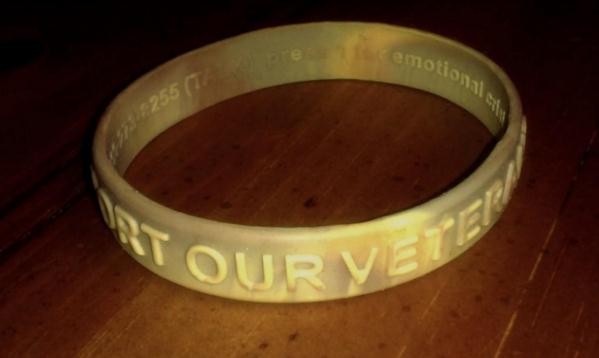
A desert camouflage bracelet for veterans from the VA with crisis support information imprinted on the inside surface.

A desert camouflage bracelet for veterans from the VA with crisis support information imprinted on the inside surface.

Wrist bands. They are typically made from a rubbery, silicone-like substance and come in a range of colors from bright and flashy to muted and subdued with some even in camouflage patterns. They have messages embossed (actually molded into the material) that are intended to call attention to various causes and are used to market a company’s brand.

A trendy fashion statement made popular by Lance Armstrong’s LiveStrong charity, you have seen these wrist bands worn by everyone from celebrities, to colleagues, neighbors and even family members over the past half decade. You have probably worn or are wearing one at this very moment. I am sure that there are collectors who focus their attention on them.

In the true spirit of capitalism (which I enthusiastically subscribe to), a Navy veteran found a niche market and created a business called Bands for Arms (B4A) that manufactured and sold their own version – an evolutionary step, if you will – of the message-laden wrist band. Their company website described their products as a way to honor veterans and to help families (and supporters of the U.S. military) feel connected to service members and veterans.

Bands for Arms’ operating model was essentially taking donated U.S. military uniforms (mostly from veterans or their families), dismantling them and constructing wrist bands from the materials that in some way represent the intended message or sentiments of the wearer. I am not disparaging this company or the products they sell as I do find the bands rather intriguing – some are very tastefully designed. And who could find fault with their support (50% of all proceeds) of organizations such as USO JapanProject Lifting Spirits and the Marine Toys for Tots Foundation?

So what does this have to do with militaria collecting you ask?

Recently, a thread on a popular militaria discussion board alerted collectors to an activity where historic uniforms, worn by veterans who served this nation for the cause of freedom, were donated to B4A as part of a special project, resulting is a special product line. Detailed on the B4A site was how the uniforms had been donated to them by the National WWII Museum (in New Orleans, LA) to create the new line of bracelets known as The Historic Bracelet Collection and 50% of the sales proceeds from this product line would subsequently be donated back to the museum. While the finished product is very well-made, the end result is that the historic uniforms are gone, along with the connection to history associated with the veteran who wore it.
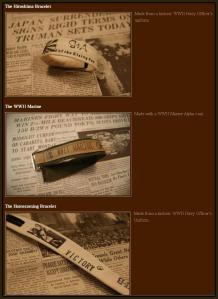
This screen capture shows bracelets were made from uniforms donated by the National World War II Museum. (Source: BandsforArms.com)

This screen capture shows bracelets were made from uniforms donated by the National World War II Museum. (Source: BandsforArms.com)

For the non-collector, this action may not be an issue. However, it is gut-wrenching for militaria collectors and historians, and has caused them to question the ethical practices of the museum and how they manage their artifacts. The unrest centers around the idea of a museum having donated uniforms for this purpose : intentionally destroying historic artifacts that had been entrusted to them with the promise that they would be preserved and displayed in that museum.

The militaria collectors I’ve associated with take the trust between donors and museums very seriously. If prospective donors no longer have the expectation of proper handling and care of their artifacts, why would they entrust them to any museum? Considering this trust, militaria collectors reacted to the idea that an entity as highly regarded as the National World War II Museum would remove these uniforms from their collection and send them out to be dismembered (and I use this term to emphasize the emotion surrounding this concept) to generate revenue in support of operational cost.
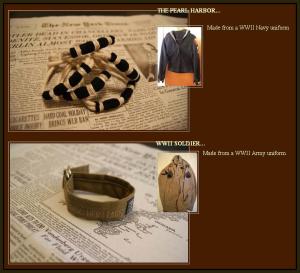
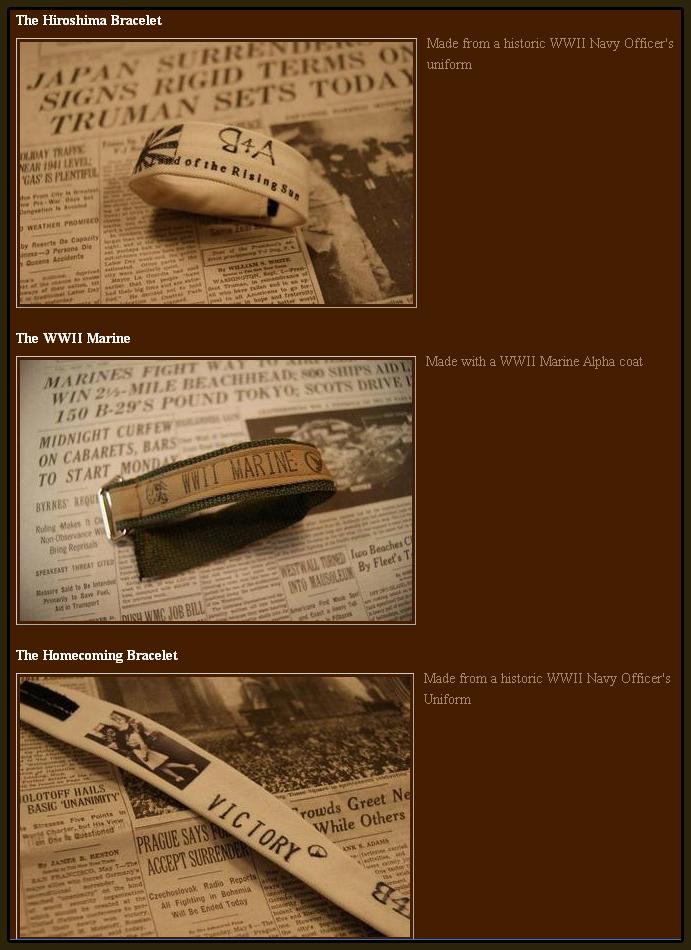
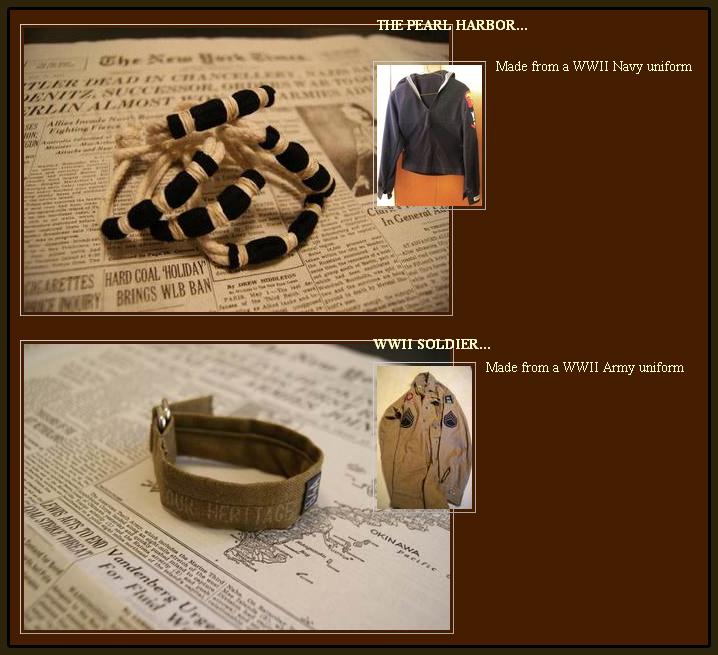
Displayed in this screen capture are two bracelets and the uniforms that were destroyed to make them. (Source: BandsforArms.com)

Displayed in this screen capture are two bracelets and the uniforms that were destroyed to make them. (Source: BandsforArms.com)

The militaria discussion board posts raised questions surrounding the proper handling of donated artifacts and the apparent disregard for the widely accepted, industry standard, museum deaccessioning processes. What opened the floodgates of animosity toward both entities were statements posted on the B4A sites (which includes their Facebook page) acknowledging the museum for the donated uniforms, which was the catalyst to the creation of the History Collection.

Frustrated collectors began posting their sentiments directly on the Facebook pages of both the National WWII museum and Bands for Arms, challenging the practice of dismantling historic artifacts (specifically, the WWII uniforms). B4A personnel responded by deleting any posts that called the B4A and National WWII Museum partnership into question.

Bands for Arms personnel added comments to their Facebook page that appeared to mock the collectors with statements such as:
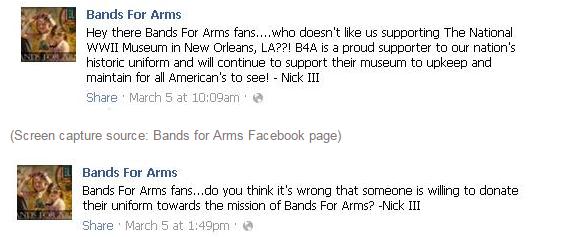
(Screen capture source: Bands for Arms Facebook page)

(Screen capture source: Bands for Arms Facebook page)

Over the span of a few days,  B4A purged all evidence that referenced the uniform donation from the museum. The messaging on the (now defunct) B4A Historic Collection page had been carefully re-worded to describe the transaction more vaguely, between the ambiguously identified source of the uniform donations.

In stark contrast, the folks managing the Museum’s Facebook page began to directly address the collectors’ challenges openly while also requesting offline dialogue in order to fully explain the details of the transaction. A few of the responses demonstrate their positive actions:

  • “We have been working to make sure all parties have the correct information and we are always available to respond to questions or concerns about the Museum.”
  • “I would be happy to put you in touch with our registrar who can answer any questions you may have and share the details of our collections policy.”

Several collectors (at least one of which is a museum curator himself) did contact the museum directly and I know that a few had phone conversations with the staffer at the museum who was at the center of the transaction with Bands for Arms. The museum staffer also provided an e-mail response to inquiries regarding the issue:

“Thank you for your recent online inquiry regarding how the Museum cares for artifacts. I’d like to address your concern about a small number of items given to the Bands for Arms organization, but first want to explain our collections process. As you will see, we take very seriously our responsibility for handling artifacts in a professional and proper way.

Items donated to the Museum are considered for two major collections. The first is our Permanent Collection, which contains items that are rare and have a strong historical connection. The Museum always tries to link a military service member’s personal war experience to items donated by the individual or by family members.

The second major collection of the Museum is our Education Collection, which is used by several departments at the Museum for teaching activities. These activities include Living History Corps presentations, where presenters wear genuine World War II uniforms and gear for Museum visitors and students. Other selected items travel off-site under staff supervision for use with students and other interested groups. Educational uses do not preserve the life of the item long-term, but are instrumental in teaching World War II history.

Items that are dropped off at the Museum that do not meet the criteria for either the Permanent or Education Collection are typically returned to the donor. However, some donors do not wish to have items returned to them and the Museum makes these items available to other museums that may be able to use them. These items typically do not relate to the WWII period and have not been accepted into the Museum’s Permanent or Education collection.

When it has not been possible to return items to their original owner and no other institution is found to care for the items, we have utilized various methods to find another place for these pieces, including donation to local charities or other organizations. In 2010, after we were unable to return them to their owner and could not find another museum home for them, five uniform pieces—none from the WWII era—were given to Bands for Arms. These items did not qualify for inclusion in our collection. They are also the only items the Museum has provided to this organization. My personal connection is that I assist Bands for Arms in determining historical dates of uniforms they receive, a role that we play with many inquiring parties.

We currently house more than 140,000 items in our collection. While many items in the collection — including but not limited to Allied and Axis uniforms, weaponry, vehicles, medals, diaries, letters, artwork, photographs and other mementos — are on exhibit, the majority are kept safely in the Museum’s professional storage vault to be used for research and future exhibitions, or are being restored to their original condition.

The artifacts, documents, and personal accounts in the Museum’s Permanent and Education Collections are extremely important to the Museum’s mission of interpreting the American experience in WWII for current and future generations. In addition to carefully preserving these items, the Museum is embarking on a project to provide greater public access by improving our cataloguing and broadening our digitization of these items.”

Clearly, the museum is being responsive and professionally addressing the concerns head on, and I applaud them for these actions. As a novice historian, I still struggle with the destruction of the artifact, but I do understand the position the museum was in with regards to unwanted (at least by other museums or the donors) uniforms.

I know that the community of collectors are also satisfied with the museum’s responsiveness and willingness to be open about how they manage their collection. We are all hopeful that in the future, they will seek other avenues of artifact deaccession, avoiding destruction or disposal in order to continue to preserve our nation’s military history.
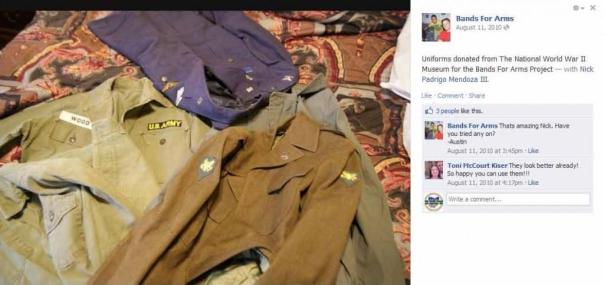
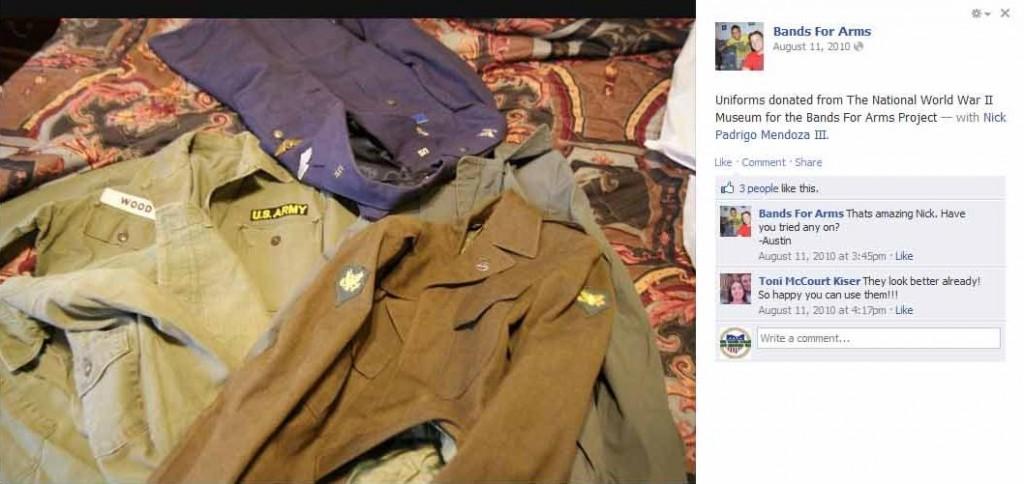
Shown here on an older Facebook post on the Bands for Arms page, references to the uniform donation by the National World War II Museum. These posts were subsequently removed.

Shown here on an older Facebook post on the Bands for Arms page, references to the uniform donation by the National World War II Museum. These posts were subsequently removed.

What was difficult about the event was that Bands for Arms began a denial and suppression campaign when confronted by collectors who took issue with the uniform destruction. Instead of taking an above-board position by addressing the collectors’ concerns head on, they demonstrated a lack of maturity (and do not perceive this as an attack on B4A as I am not saying they behaved like children) that comes from having seasoned professionals managing external communications and messaging. I am betting that the leadership at B4A will use this event as a learning opportunity and will take note of the mistakes and missteps striving to not repeat them.

I’d also like to note that collectors do not take issue with B4A’s business model as they agree that veterans and family members may certainly do whatever they desire with their personal property. The folks at Bands for Arms do manufacture tasteful products and paying tribute to veterans while funding noteworthy veteran charities is quite admirable.

With the dust settling and the discussion posts winding down, is this the end of the debate? Do bracelets made from veterans’ uniforms truly honor them? As a collector, I have my own thoughts on this topic which will be the subject of the following segments in this series of posts.
Settling the Score Between the Army and Navy, Hawaii 1944

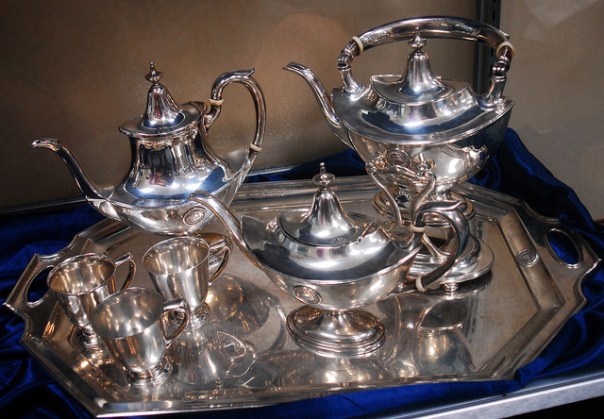
A Legacy: Vincennes Wardroom Silver


More than three months into The War, the United States was reeling from suffering substantial and demoralizing losses at Pearl Harbor and again in the Sunda Strait (with the loss of the USS Houston CA-30). The U.S. was in dire need of stopping the bleeding and gaining a moral victory in order to build momentum for what was to become a nearly half-decade long war.

6054156282_e80b5d3ca3_z

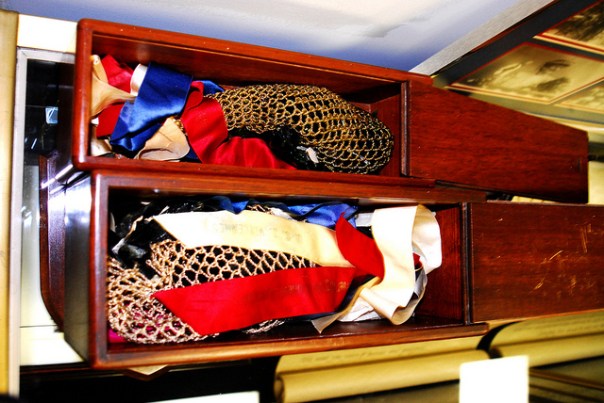
These cased, broken champagne bottles were used to christen the cruisers named for the City of Vincennes, IN. The top bottle helped to name the CA-44 and the bottom, CL-64. Both are preserved at the city’s council chambers archive.

When the keel of the (then, future) USS Vincennes (CA-44) was laid, she was the pride of the small, Southwestern Indiana town of the same name. The citizens embraced her and her future crew, adopting the men who would serve aboard her as their own sons. When she was christened (launched), the daughter (Miss Harriet Virginia Kimmell) of the city’s mayor broke the ceremonial bottle of champagne on her bow, officially naming the heavy cruiser. More than two years later when the ship was commissioned and placed into service (February 24, 1937), the citizens raised funds to purchase and present a gift, a silver tea and coffee service, to the officers of the ship.

With the outbreak of war and the peacetime navy morphing to address the combat needs, USS Vincennes transferred from her home fleet duties within the Atlantic Ocean to augment the Pacific fleet following the losses suffered in the opening days and weeks of the war. As part of readying the ship for service against the Japanese, the Vincennes paid a visit to the Mare Island Naval Shipyard in Vallejo, in San Francisco Bay for additional combat upgrades. In conjunction with the changes being made to the ship, the compliment of officers and men was being increased and with space being a premium and the probability of combat engagement with the enemy being almost certain, the silver service and other items were removed from the ship and placed into storage for the duration of the war.

6053604567_f6bc0af683_z

The USS Vincennes’ sterling silver tea and coffee service is on display in the City of Vincennes, Indiana in the council chambers archive.

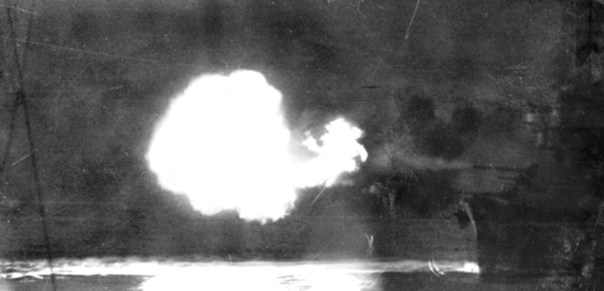
Soon afterward, the Vincennes would take part in some of the most pivotal actions in an effort to stem the Japanese Eastward expansion beginning with the Doolittle Raid, (aiding in the aftermath of) the battle of Coral Sea, the Battle of Midway and the US Marines’ first offensive, Guadalcanal. On the evening of the 2nd night of the landings, the Vincennes would sustain hundreds of Japanese naval gunfire hits and being pierced by the enemy’s Long Lance torpedoes, leaving a blazing, sinking inferno.

uss_vincennes_28ca-4429_bombards_guadalcanal

The 8″ main battery of the heavy cruiser, USS Vincennes (CA-44) commence firing at enemy positions on Guadalcanal; early morning, August 7, 1942.

Five decades later, the surviving veterans of the lost cruiser would be instrumental in ensuring that the name of their beloved lost ship would be carried to sea aboard a modern cruiser of the Ticonderoga class. At her commissioning in 1985, the city of Vincennes would once again gift the preserved silver service to their newest ship, the USS Vincennes (CG-49) to be used by the officers and visiting dignitaries and guests throughout her twenty-year life.

Upon her decommissioning in 2005, the silver service was returned to the city where it is now displayed and cared for. Perhaps one day, another ship will bear the name Vincennes and the set will serve the officers of a new generation of the adopted sons and daughters of the southwest Indiana city.

Naval Coverings of WWII – Navy Hats


My military collecting focuses almost entirely on documenting my family’s service with both a narrative and visual materials. One of the products of my research will ultimately be a hardbound, four-color book complete with original photographs of these veterans and displays of their uniforms and artifacts. You’ll have to take my word that this is a lengthy undertaking, considering that most of my subjects are long-deceased, requiring interaction with the National Archives and a lot of lag time waiting for the requested service records and materials.

As I began assembling a representative group portraying my uncle’s service in the United States Navy, I soon realized that I would have to collect several uniforms as he went from an Apprentice Seaman to a Chief Warrant Officer during his thirty years of service. For this article, I am going to cover one aspect of the assembled group : headwear.

My uncle enlisted in 1932 and remained on active duty throughout World War II. By 1941, he had advanced to first class petty officer radioman. His specialty was in intelligence and he had been with Joe Rochefort, having attended the Navy’s highly secretive and fledgling cryptologic school in the 1930s. He was meritoriously promoted to chief petty officer (CPO) for his efforts supporting the commander of Task Force 16 during the Battle of Midway. In 1944, he was promoted again to Radio Electrician, Warrant Officer (grade W-1).

Possessing that information, I knew that I had to collect some chief petty officer uniforms as well as some difficult to find warrant officer items. To complete those sets, headgear could pose a significant challenge. I first had to determine what a W-1 (the Navy discontinued this rank at the war’s end) would wear as I had personally never seen the uniform. I referred to some reference material that provided some basic information, but not the specifics regarding all of the hat components for this grade. I could select either (or both) a combination or garrison cap.

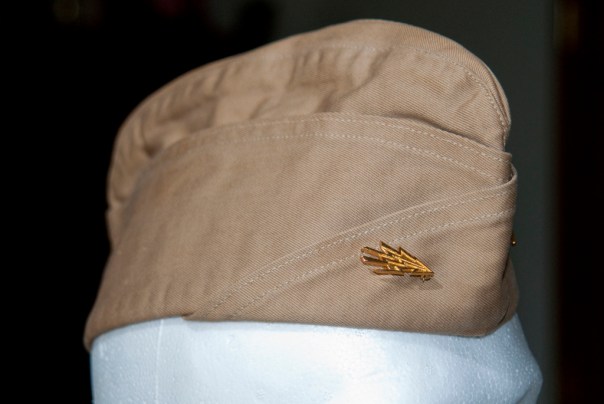
With a khaki jacket in my possession and the appropriate epaulettes (shoulder boards) that are affixed to the jacket’s shoulders, I knew that I wanted to have at the very minimum, a garrison cover. Current Chief Warrant Officers’ garrison cover devices include the naval officer’s crest on one side and the rank bar on the opposing side. The rank bar devices did not exist yet during the war (instituted in the 1950s) so I was at a loss for what they wore. I contacted some navy uniform experts who informed me that the W-1 would wear only their specialty devices (in this case, the radioman insignia). During WWII, these devices are mirrored, meaning that they both “point” forward yet look the same from either side. Current devices are not mirrored – Chief Radio Electricians wear two of the same device – one is upside down.

I located a vintage set of the devices and pinned them to the WWII-vintage Navy khaki garrison cap that I had previously obtained. The hat was now complete.

6780958138_dce152675c_b

WWII-Era U.S. Navy Radio Electrician Warrant Officer’s Garrison Cap.

I turned my attention to the combination cover (some erroneously call the Navy caps “visor caps”) which is a hat with a visor that may be simply altered to match the uniform by replacing the cover with the appropriate color/material cover. Chiefs and officers could feasibly own a single hat frame (the sweatband/frame/visor) and simply change from white to blue or khaki (also grey or green) to align with the uniform of the day. I wanted to create a combination cap to go with this uniform as it looks classy.

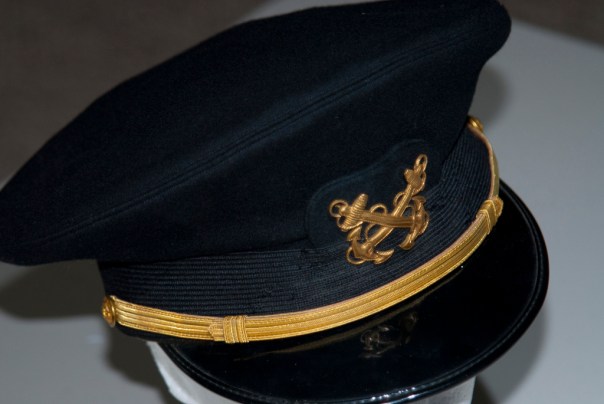
I located a standard officer’s dress blue cover with the wide gold chin strap and the line officer’s crest. I already had a nice example of this cap so I decided that this would be a good base to create the warrant hat. Any alterations I made could easily be reversed to return it to its original state. I also kept the original owner’s name placard in the holder inside the hat. I found an original W-1 hat band and a 24k large hat insignia as well as the unique ½-inch gold chin strap (all vintage components). I disassembled the hat and replaced the appropriate parts with the newly acquired components.

6927142749_75b648227c_b

WWII U.S. Navy Warrant Officer’s (W-1) Combination Cover

One last cover I focused on was the CPO hat. Examining numerous period-photographs, I locked onto the hat that I wanted to acquire or assemble. Through the assistance of a friend, I was directed to an early WWII CPO combination cap with a grey cover that was well-enjoyed by a family of moths. The sterling silver hat device was outstanding as was the remainder of the hat. I purchased the hat and obtained a set of covers (blue, white and khaki) to accompany the three CPO uniforms (all chief radioman). Now I could display each chief uniform with using a single combination cover.

6780979352_53c9301e92_b

World War II-Era U.S. Navy Chief Petty Officer Combination Cover.

The remaining uniform left to tackle (for this relative, at least)? A dress blue or white jumper with neckerchief and white hat.

Design a site like this with WordPress.com
Get started