Category Archives: Sports Militaria
“Skimming” Your Way to Overpaying for Militaria
After spending more than two decades working in some capacity in a career field in the Internet industry, I have gained a considerable amount of understanding of user behaviors and tendencies. One of the most challenging user behaviors (for online content providers) to overcome is how to motivate them to actually read written content.
Countless usability studies conducted over the last decade (see UXMyths.com’s article: Myth #1: People read on the web) reveal that internet users seldom read text on the computer, tablet or smart phone screen. News media and some shady business tend to rely on this fact spending more effort on hooking audiences with headlines or product names (and photos) with the idea that the facts and details will be left unread.
Another facet of audiences not reading text is the unintended consequences. I bet this has happened to most, if not all of my readers. You search Google for an item that you want or need and hundreds of results are displayed. You see scroll through the countless listings, skimming through each blurb (abbreviated description) until you find the one that interests you the most. In a matter of seconds, confirming that the item meets your approval, credit card in hand, you quickly walk through the buying process and click the “purchase” button. After several days of tracking the shipment, it finally arrives. Excited, you tear into the box, rifle through the packaging to get hold of your eagerly anticipated item. Within a few milliseconds you discover that a mistake has been made and frustration begins to build. After a 20-minute search through your 85 gigabytes of emails, you find the order confirmation and you are ready to contact the company to confront them on their mistake. Then you realize that you are the one who didn’t read the entire product description. Sound familiar?
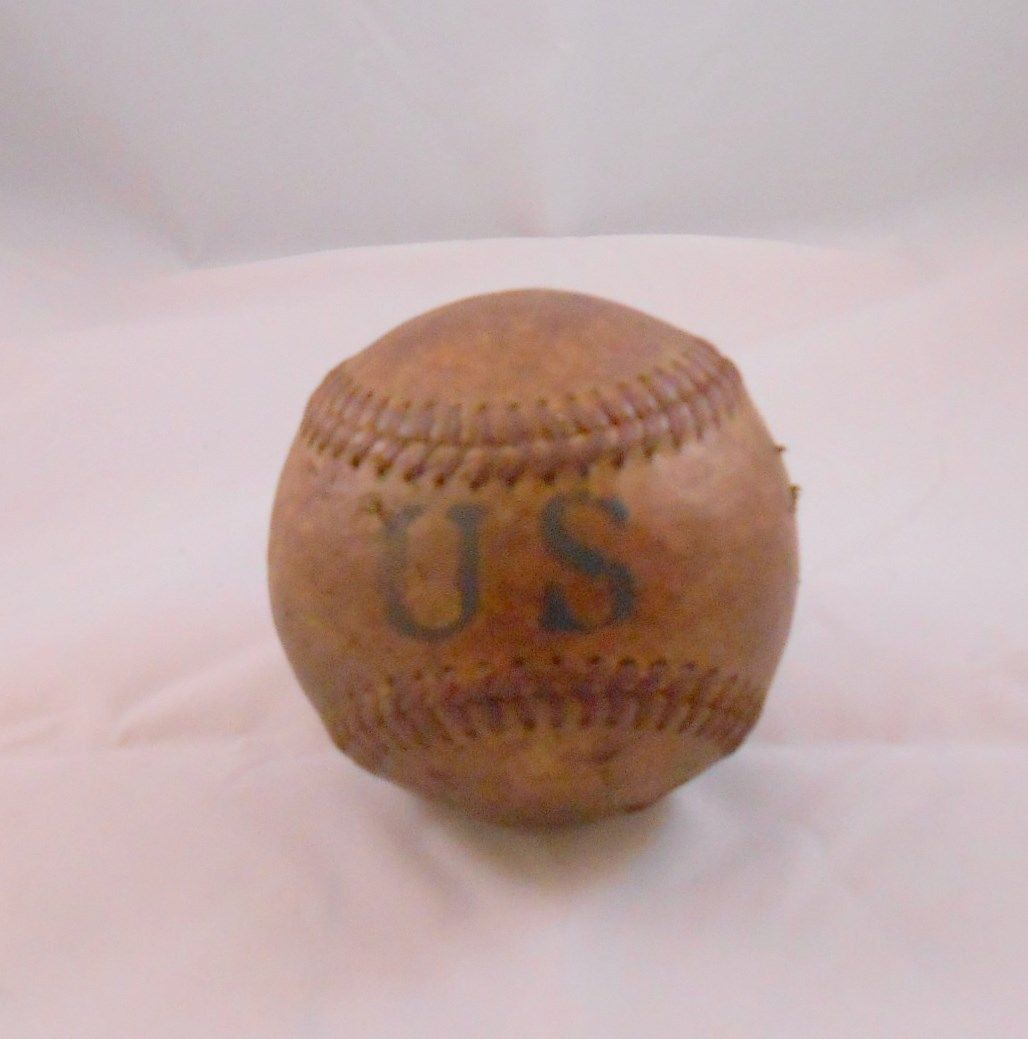
Clearly, a nothing-special WWII Special Services baseball. This is the main image used for the auction.
In the last few days as I was looking through my eBay searches, I noticed a listing for a U.S. Special Services WWII-era baseball. The listing seemed to be fairly straight forward and the $22.00 opening bid amount was consistent with what these balls routinely sell for ($20-$40), dependent upon whether they are Army, Navy or USMC variations. When I clicked on the link to view the entire auction, I noticed that the seller had included some contextual images of the ball along with other items that were not part of the auction.
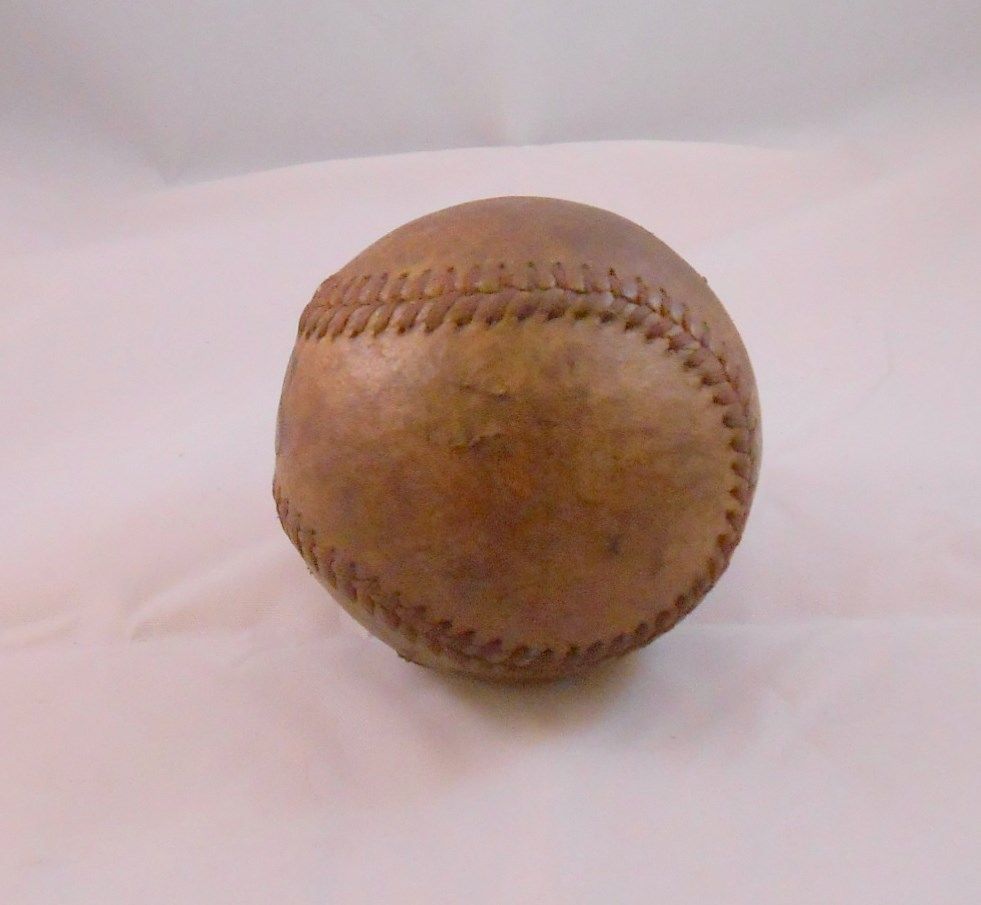
No other notable markings can be seen on the baseball. This is a common WWII U.S. military baseball.
The description, in part reads:
This auction is for one (1) baseball, the gloves are shown for reference only. These balls where found in an old canvas US Army bucket that was 1944 dated along with the gloves shown. One glove is dated 1945 and stamped US Army, and the other glove is stamped special services US Army. The special services where greatly different in WW2 than they are today, back then they where in charge of recreation, and other “special items” for the troops. You will receive the ball pictured alone in the pics.
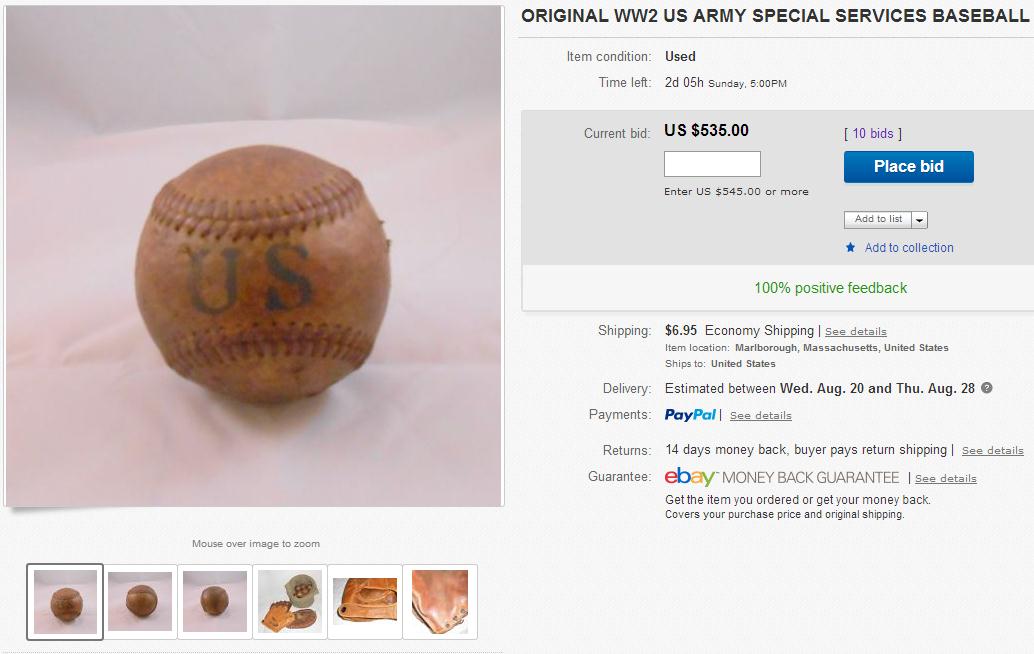
With two days remaining on this auction, the astronomically high bid is going to be a tough pill to swallow for the “winner.” The seller is probably seeing dollar signs as he imagines $500+ for each ball that he lists.
I clicked through the series of photos that showed the canvas bucket filled with baseballs and three WWII-era baseball gloves. Then, I looked at the current bid amount and my jaw hit the floor. With four days left for the auction, the current bid (of five bids from four bidders) was $275.00! How could the bids be so exorbitant; so high for a single, common WWII baseball? I re-read the description and paid close attention to the images of the ball. There was absolutely nothing that out of the ordinary about this ball. Then, it occurred to me that the bidders failed to read the full text of the auction or the auction title. When the auction closes and the highest bidder pays for the auction, he will eagerly anticipate the arrival of the ball, the canvas bucket, three vintage gloves and several other baseballs. When the diminutive package arrives, the reality will set in along with a massive pile of anger and frustration. The auction winner will either blast the seller for deception or feel like a complete idiot for not reading the auction description.
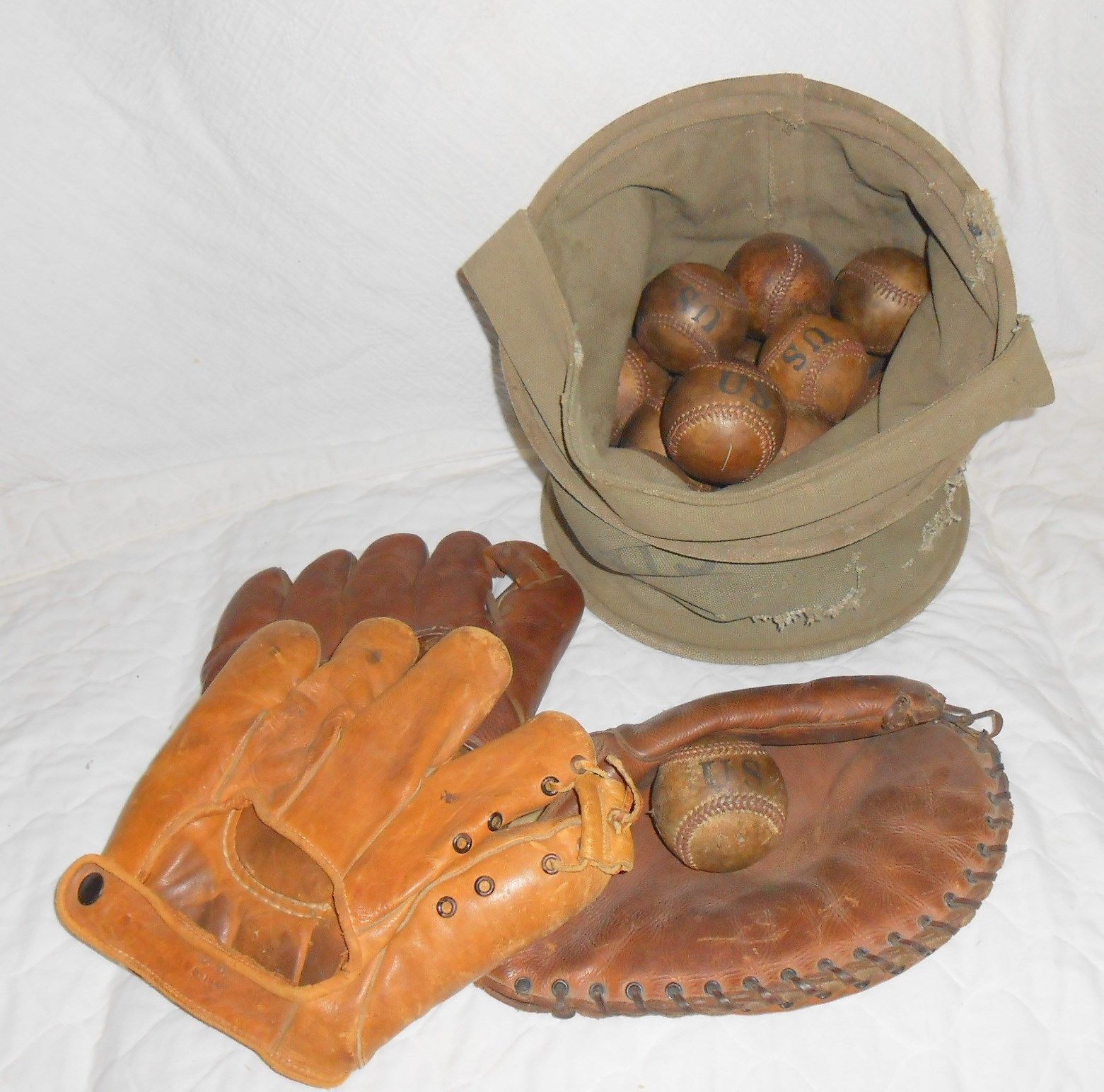
Without the auction text, this image could be misleading. Buyer beware!
With two days left (at the time of writing this article), there are five bidders that have placed 10 bids. The current highest bid is $535.00 for an ordinary (lone) WWII baseball that is now, $490.00 overvalued.
A costly lesson is about to be learned.
Militaria Collecting: It Isn’t Just Fatigues and Helmets
Why Collect Militaria?
I try to resist talking to people outside my sphere of militaria collecting acquaintances and friends for the simple reason that I choose to avoid the typical unrehearsed (body language) responses when they learn this particular interest of mine. You might have experienced it – the glazed, vacant stare – uninterested people seem to look way past you as you cautiously respond to someone seeking to learn something about you.
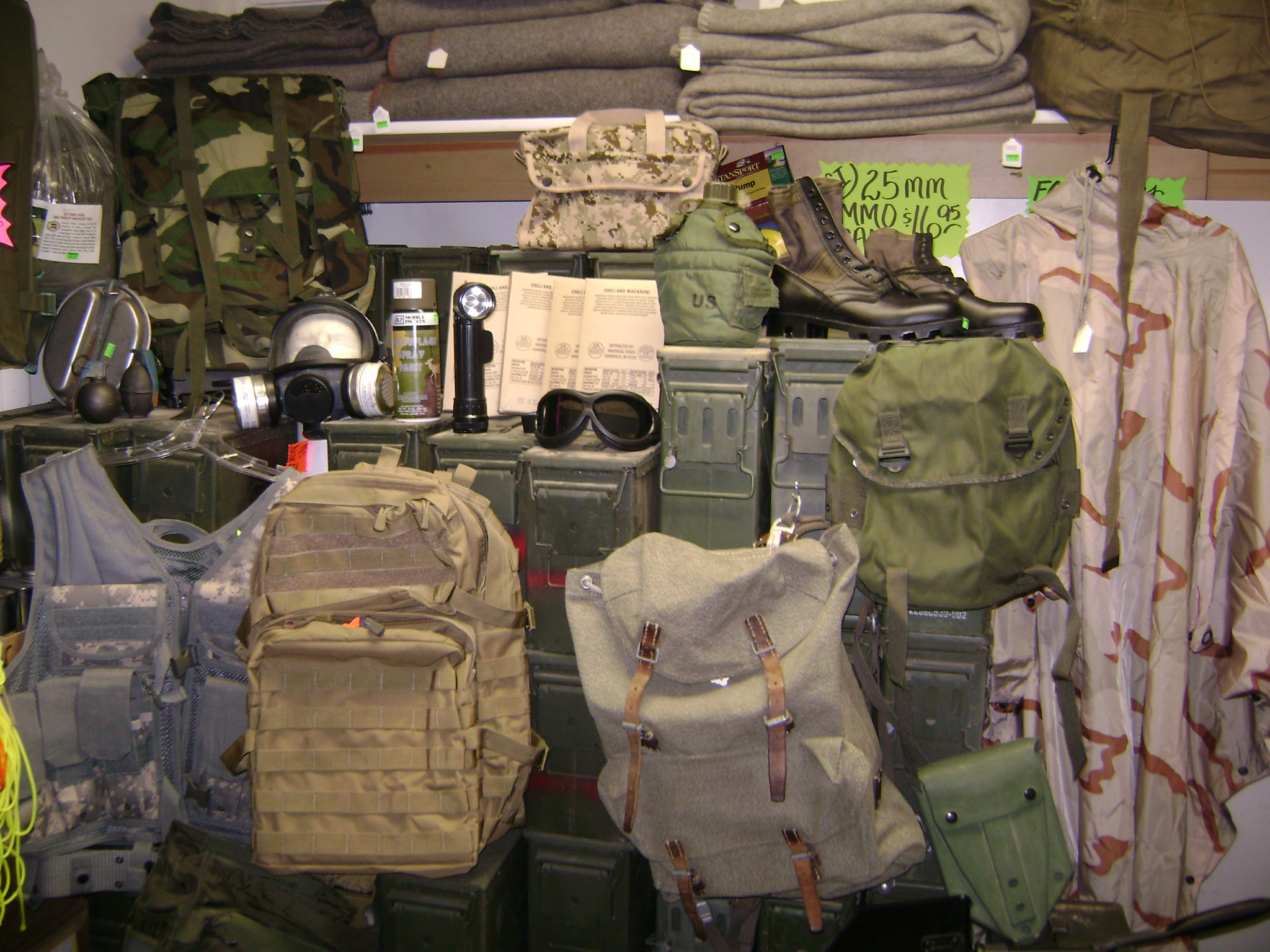
Many non-collectors envision scenes from military surplus stores when they hear militaria collectors speak about their interests and collections. (image source: Freedommilitarysurplus.com).
The perception is that militaria collectors are interested in a bunch of junk that can be found for pennies-on-the-dollar at a mildew-laden military surplus store. They assume that we are gobsmacked by olive-drab army fatigues, rusty canteens and other military cast-off items. You should see the eyes roll when I attempt to describe what truly inspires my collecting.
Militaria collecting represents an extensive and broad range of categories. For certain, there are elements such as uniforms, edged weapons, head-wear and medals/decorations at the hobby’s core. But there is incredible variety in this “genre.” Though my own collection pays homage to my veteran ancestors and relatives, I have dabbled in a few of these non-standard areas in militaria collecting. One in particular is the product of combining two passions sports (specifically baseball) and military history. I wouldn’t consider myself a hard core collector in this area, but I have been fortunate enough to land some great pieces that align these two interests. Other than my other focus area (naval history) which I have covered extensively, military sports, namely baseball, has been the subject of many postings in the past several years in writing about this passion:
Baseball Uniforms
- Stars, Stripes and Diamonds: Photographs of America’s Pastime in Uniform
- The Corps on the Diamond: US Marines Baseball Uniforms
Ephemera
Autographs
Military Football
Collecting militaria can pose some financial challenges when faced with stiff competition for rare or exceptional items. This is something I routinely face as with my special interest in items pertaining to a specific U.S. Navy warship (actually four of them) that was named for a city in Indiana. When items associated with this ship turn up in online auction listings, the competition can get rather fierce, pushing the bidding price out of my range of affordability. There are times when one of the pieces does manage to slip past my competitors allowing my maximum bid to be sufficient in securing the prize. These are rare occurrences that when they do happen, I am elated to the point of becoming borderline-addicted to collecting.
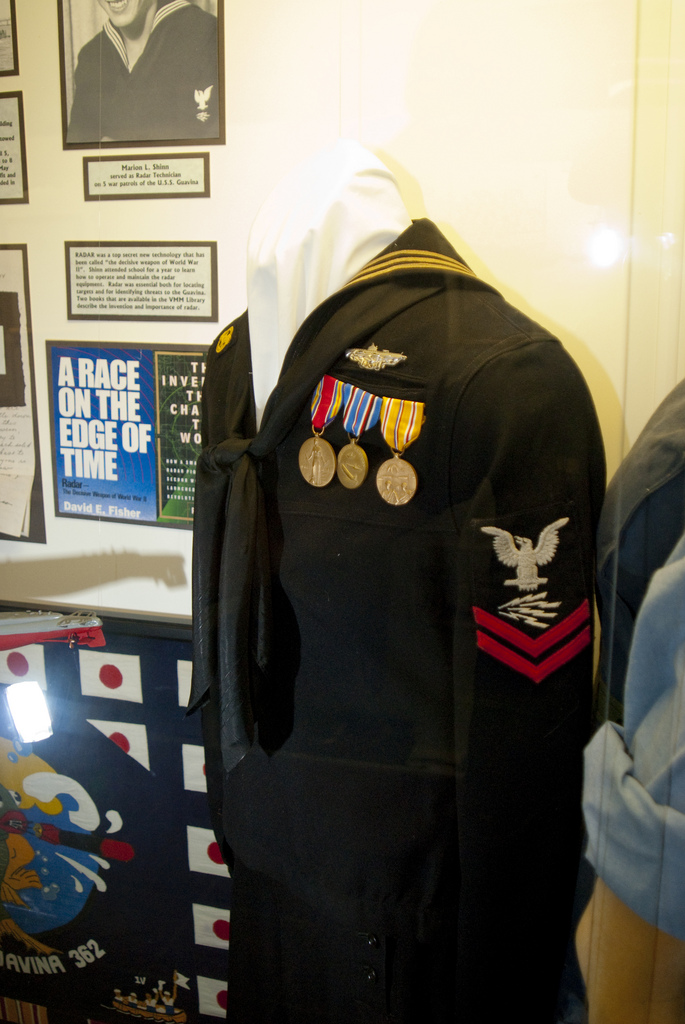
While this particular uniform group (of a WWII radioman 2/c submariner) is on display at a museum, I know of several collectors who have their collections displayed in similar, well-executed arrangements.
The point of militaria collecting is that it provides for a hands-on connection with history that transcends what is talked or written about in print. It provides those who are interested with a method to comprehend historic events or people while transforming what is read in books or portrayed on screen into (nearly) living history.
In future posts you will, no doubt, observe trends that belie my interests and what I tend to focus my collecting on. However, I will also attempt to provide you with informative posts in order to share the knowledge I’ve gained from a vast network of collectors, historians, museum curators and several other knowledgeable people in order to assist you in making wise decisions with your acquisitions.
 The Veteran's Collection