Category Archives: Rates and Ranks
Fall In! Getting Back to Militaria After a Long Summer
What a summer! For the small percentage of my readers who know me personally, understanding my absence from this blog is quite easy. For the rest of those who follow this blog, I apologize for my absence as these past few months have been consumed by some of my other passions (family time and cycling).
During my hiatus from writing about my militaria passion one would suspect that I would have increased my collection and subsequently queued up a backlog of topics and subjects to capture your attention. Sadly (for you), I’ve done neither choosing instead to spend time immersed in a myriad of activities and projects. As certain as the coming of the autumn rain (I know, it is still technically summer for a few more days), my attention can now wander back toward military history and the related objects we collect.
Speaking of working on projects, my collecting subsequent research has me steadily gathering items for a surprise shadow box for a family member. Without going into great detail, the subject of the shadow box was a Navy veteran of World War II enlisting a year (or so) prior to the Unite States’ entry. In fact, this sailor was serving aboard the USS Pennsylvania (BB-38) along with his older brother during the Japanese surprise attack on Pearl Harbor.

USS Pennsylvania (BB-38) smoldering in Pearl Harbor Navy Yard dry dock #1 along with USS Cassin (DD-372) and USS Downes (DD-375) following the Japanese attack (source: U.S. Navy image).
Armed with scant few details, I embarked upon a search of available (online) sources to uncover as much data as possible in order to submit a detailed request (to obtain service records) to the National Archives (NARA). In order to create a complete shadow box (with all of the appropriate medals, ribbons, rating badge, etc.), I need to be armed with the most accurate information about the veteran’s service as I can.
One thing that I have learned through my experiences in dealing with records from NARA is that I cannot rely on the information as being entirely complete or the last, defining word in accuracy. In requesting a copy of my own “complete” service record, I noted that it lacked entire years of my service and resulted in the processor summarizing my career awards and decorations significantly short of what I actually earned. Fortunately for me, my command made an entire hard copy of my full service record upon separation from active duty. So, proceed with caution when using NARA-obtained service records and awards summaries.

An example of a WWII Navy Veteran’s shadow box (my grandfather’s) is what I am going for with this project.
For accuracy, it is best to have multiple data sources to both verify what one source states but to also discover any holes or gaps. Researching beyond individuals’ service records requires exponentially more work. If one can determine which commands (i.e. vessels) a sailor served aboard (using muster sheets), the researcher then needs to determine the specific history of that unit including campaigns and battles it participated in. This will help determine any unit awards the sailor might have earned that are not listed within the personnel file or service record.
Due to their popularity and the nature of their service, researching unit history for a well-known combatant such as a battleship or cruiser can be much more simplified than that of a fleet tug or minesweeper. For the BB-38 and this relative’s service aboard the ship, the research is quite simple and the decorations are minimal (considering the ship spent the majority of the first sixteen months under repair and modernization). During her inactive time in the shipyards, the crew was sent out to the fleet to serve where needed. Following detachment from the Pennsylvania, this relative served aboard a destroyer followed by time in confinement (for fighting), ultimately being punitively discharged late in the war.
Regardless of the manner in which his wartime service came to an abrupt end, looking back on the positives of this veteran’s wartime service and honoring it with a collection of artifacts that recognize that is a worthwhile project. This will be much appreciated by his family and serves to bring me back from my lengthy summer distraction from militaria collecting.
Discerning Birds: U.S. Navy Rating Badges from WWI to WWII
Patch collecting is one of the most affordable aspects of militaria collecting and can be a highly rewarding venture to delve into the history and variations that are available. I am, by no means a serious collector of patches opting instead to be selective about the embroidered and colorful pieces of uniform history.
While the overwhelming majority of militaria collectors who have interests in patch collecting are primarily focused on United States Army unit and rank insignia, a smaller portion of us enjoy the eclectic realm of U.S. Navy enlisted rank insignia and the very colorful and meaningful progression of their designs through the ages. That historical progression along with all of its nuances is enough to fill a book (see U.S. Navy Rating Badges, Specialty Marks & Distinguishing Marks 1885-1982
, by John A. Stacey) so with today’s article, I am instead zeroing in on a specific design from a seemingly specific era.

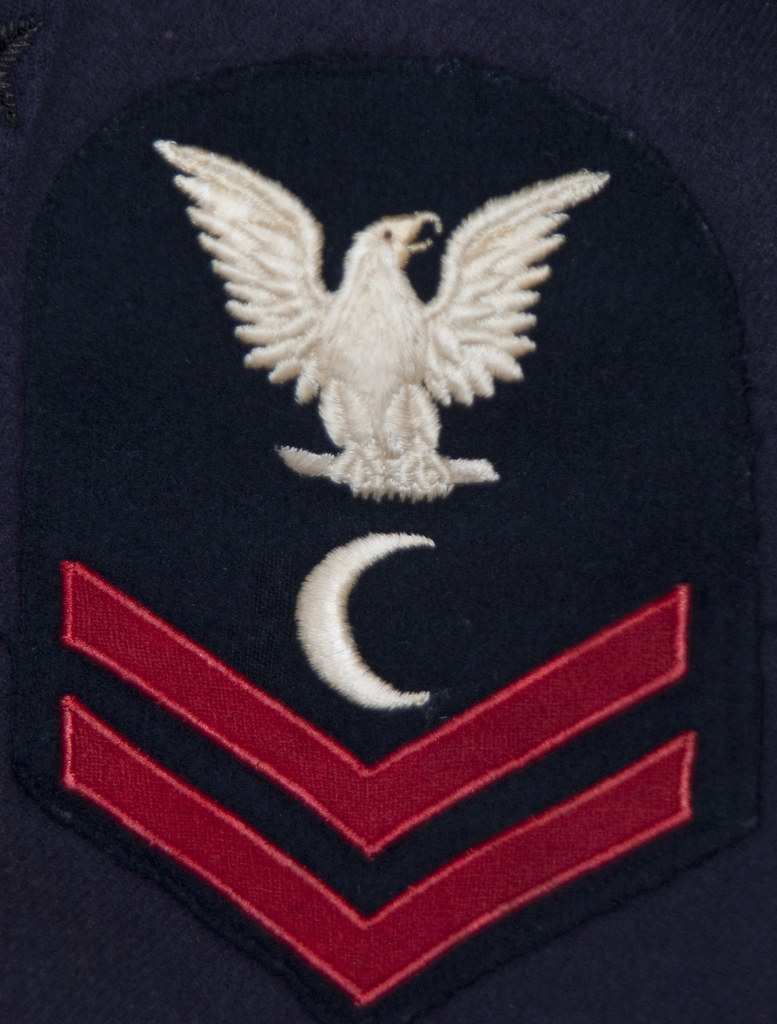
In the modern US Navy, rating badges are consistent in appearance and wear. From the design elements (eagle, specialty mark and chevrons) to the materials they are constructed from, they are all consistent. While this concept places emphasis on the uniformity of appearance and the unit-mindset (that all crew members work together as a single entity), it does restrict the ability for sailors to express and exhibit a measure of individuality and personal pride in their uniform appearance. The current rating insignia (in my opinion) have a rather sterile and sanitized appearance as they are all manufactured by a single source using one design pattern for each and every piece that is made. However, in previous years, sailors had much more freedom to instill their own spices into their uniforms.
Rating badge collectors might focus their approach from casting a wide net (collecting everything that comes their way) to obtaining every single variety of a specific rating over the course of its existence. I find my collecting efforts to be even more specific as I seek only a handful of specialties (Radarman, Radioman, Ship’s Cook and Pharmacist’s Mate along with a few others) from varied eras (WWI-WWII) on select uniform choices (such as dress blues, whites or khakis). Though my choice of eras might seem rather specific, a closer look at the uniform regulations and the changes imposed during that time-frame reveals that the design of the ratings experienced several iterations.
“All petty officers shall wear on the outer garment a rating-badge, consisting of a spread eagle placed above a class chevron. In the interior angle of the chevron, under the eagle, the specialty mark of the wearer shall be placed. The badge shall be worn on the outer side of the right or left sleeve, half way between the shoulder and elbow. Petty officers of the starboard watch will wear the badge on the right arm; those of the port watch on the left arm.” – Regulations Governing the Uniform of Commissioned Officers, Warrant Officers, and Enlisted Men of the United States 1886
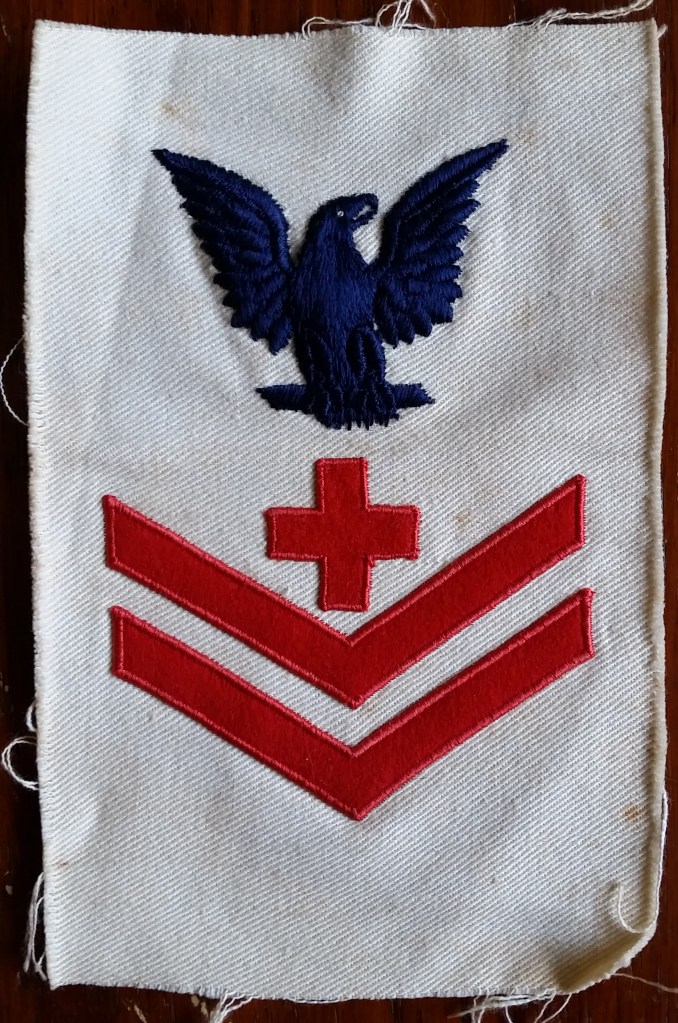
Dating back to 1886, the design (as cited in the uniform regulations) of the eagle called for its wings to be spread. The eagle’s head also now faced toward its left shoulder (having previously faced to the right) and would do so until 1941 when regulations then called for the head to point to the wearer’s front (regardless of the sleeve it was to be worn…more on that later).
Prior to 1913, ships’ crews were divided into two watchstanding sections and were designated with terms that corresponded with the left (port) and right (starboard) sides of the ship which dictated which sleeve the sections’ petty officers would wear their rating badges. From 1913 onward, all petty officers whose specialties were in the Seaman Branch (such as Boatswain’s Mate, Coxswain, Gunner’s Mate, Turret Captain and Quartermaster) were right-arm ratings while all others in the Artificer Branch and Engine Room Force wore theirs on the left sleeve. What can make this confusing for new collectors is finding a rating badge (such as an electrician’s mate) with the eagle pointing toward the left shoulder. Finding this rating badge affixed to a dress blue jumper with it worn on the left sleeve would narrow the time-period down (given the embroidered pattern of the eagle had the eagle sitting completely vertical on the perch) to the inter-war era.
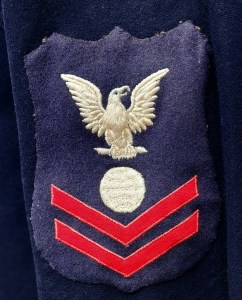
Though the practice started years before, during World War I, rating badges were customized by petty officers by trimming them from the traditional 5-sided shape (rectangle with the bottom corners cut away to form a point) to a contoured pattern. Fancy hand-stitching was then applied to follow the new shape (many times in the shape of a shield) providing a highly stylized appearance on the jumper shirt. As with many fads, this adornment fell out of practice as the Navy specified the pentagon shape and dimensions in a specific change (dated 16 February 1933) to the Navy Uniform Regulations.
In 1941, the Navy changed the eagle to point to the wearer’s front specifying that all non-Seaman Branch petty officers’ ratings have the eagle look to its right shoulder (rather than to the left). The Seaman Branch (which had grown to include Fire Controlman, Mineman, Signalman, Torpedoman’s Mate). In addition to the eagle’s direction, the eagle no longer included the slouched (or leaning) posture that had existed for decades.Though there is no provenance to support this, the idea for these changes was to have the eagle positioned for fighting (facing the enemy and standing tall).


During WWII, a handful of manufacturers provided dates embroidered directly onto the back of rating badges which nullifies the need for researching.


I have merely scratched the surface with these details. There are pages-worth of content that I could provide that provides additional points and factors to pay attention to in order to discern the date of manufacture (and use) of the rating badge, such as:
- Cloth material (enlisted dress blue material changed between WWI and WWII, additional materials were introduced for WWII, etc.)
- Rating Specialties (ratings were added/retired throughout this period)
In 1947, the most significant change that indicated a desire for uniform appearance across enlisted ranks was moving all ratings to the left arm with the eagle facing forward. The distinction between the Seaman Branch and all other petty officers was removed.
In the months to come, I will be providing additional articles in order to provide you with more insight into collecting rating badges and how to discern them without having to rely on others.
—-
All images are the property of their respective owners or The Veteran’s Collection unless otherwise noted. Photo source may or may not indicate the original owner / copyright holder of the image.
 The Veteran's Collection