Category Archives: General Militaria Collecting
A Legacy: Vincennes Wardroom Silver
More than three months into The War, the United States was reeling from suffering substantial and demoralizing losses at Pearl Harbor and again in the Sunda Strait (with the loss of the USS Houston CA-30). The U.S. was in dire need of stopping the bleeding and gaining a moral victory in order to build momentum for what was to become a nearly half-decade long war.
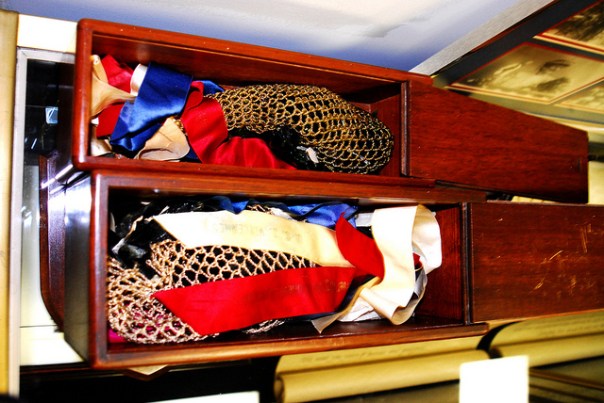
These cased, broken champagne bottles were used to christen the cruisers named for the City of Vincennes, IN. The top bottle helped to name the CA-44 and the bottom, CL-64. Both are preserved at the city’s council chambers archive.
When the keel of the (then, future) USS Vincennes (CA-44) was laid, she was the pride of the small, Southwestern Indiana town of the same name. The citizens embraced her and her future crew, adopting the men who would serve aboard her as their own sons. When she was christened (launched), the daughter (Miss Harriet Virginia Kimmell) of the city’s mayor broke the ceremonial bottle of champagne on her bow, officially naming the heavy cruiser. More than two years later when the ship was commissioned and placed into service (February 24, 1937), the citizens raised funds to purchase and present a gift, a silver tea and coffee service, to the officers of the ship.
With the outbreak of war and the peacetime navy morphing to address the combat needs, USS Vincennes transferred from her home fleet duties within the Atlantic Ocean to augment the Pacific fleet following the losses suffered in the opening days and weeks of the war. As part of readying the ship for service against the Japanese, the Vincennes paid a visit to the Mare Island Naval Shipyard in Vallejo, in San Francisco Bay for additional combat upgrades. In conjunction with the changes being made to the ship, the compliment of officers and men was being increased and with space being a premium and the probability of combat engagement with the enemy being almost certain, the silver service and other items were removed from the ship and placed into storage for the duration of the war.
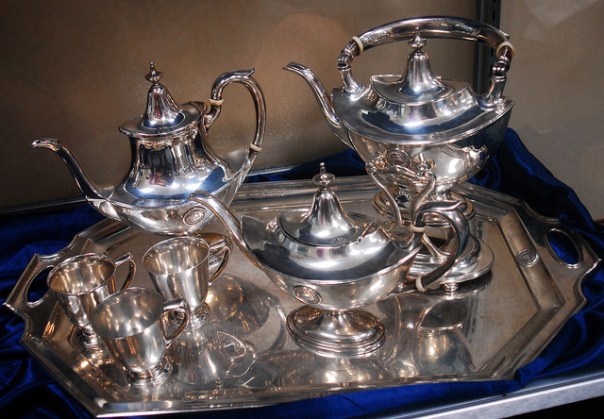
The USS Vincennes’ sterling silver tea and coffee service is on display in the City of Vincennes, Indiana in the council chambers archive.
Soon afterward, the Vincennes would take part in some of the most pivotal actions in an effort to stem the Japanese Eastward expansion beginning with the Doolittle Raid, (aiding in the aftermath of) the battle of Coral Sea, the Battle of Midway and the US Marines’ first offensive, Guadalcanal. On the evening of the 2nd night of the landings, the Vincennes would sustain hundreds of Japanese naval gunfire hits and being pierced by the enemy’s Long Lance torpedoes, leaving a blazing, sinking inferno.
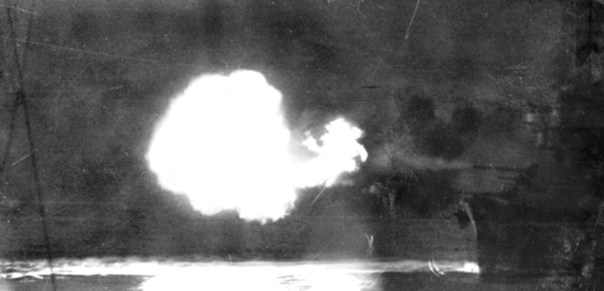
The 8″ main battery of the heavy cruiser, USS Vincennes (CA-44) commence firing at enemy positions on Guadalcanal; early morning, August 7, 1942.
Five decades later, the surviving veterans of the lost cruiser would be instrumental in ensuring that the name of their beloved lost ship would be carried to sea aboard a modern cruiser of the Ticonderoga class. At her commissioning in 1985, the city of Vincennes would once again gift the preserved silver service to their newest ship, the USS Vincennes (CG-49) to be used by the officers and visiting dignitaries and guests throughout her twenty-year life.
Upon her decommissioning in 2005, the silver service was returned to the city where it is now displayed and cared for. Perhaps one day, another ship will bear the name Vincennes and the set will serve the officers of a new generation of the adopted sons and daughters of the southwest Indiana city.
Naval Coverings of WWII – Navy Hats
My military collecting focuses almost entirely on documenting my family’s service with both a narrative and visual materials. One of the products of my research will ultimately be a hardbound, four-color book complete with original photographs of these veterans and displays of their uniforms and artifacts. You’ll have to take my word that this is a lengthy undertaking, considering that most of my subjects are long-deceased, requiring interaction with the National Archives and a lot of lag time waiting for the requested service records and materials.
As I began assembling a representative group portraying my uncle’s service in the United States Navy, I soon realized that I would have to collect several uniforms as he went from an Apprentice Seaman to a Chief Warrant Officer during his thirty years of service. For this article, I am going to cover one aspect of the assembled group : headwear.
My uncle enlisted in 1932 and remained on active duty throughout World War II. By 1941, he had advanced to first class petty officer radioman. His specialty was in intelligence and he had been with Joe Rochefort, having attended the Navy’s highly secretive and fledgling cryptologic school in the 1930s. He was meritoriously promoted to chief petty officer (CPO) for his efforts supporting the commander of Task Force 16 during the Battle of Midway. In 1944, he was promoted again to Radio Electrician, Warrant Officer (grade W-1).
Possessing that information, I knew that I had to collect some chief petty officer uniforms as well as some difficult to find warrant officer items. To complete those sets, headgear could pose a significant challenge. I first had to determine what a W-1 (the Navy discontinued this rank at the war’s end) would wear as I had personally never seen the uniform. I referred to some reference material that provided some basic information, but not the specifics regarding all of the hat components for this grade. I could select either (or both) a combination or garrison cap.
With a khaki jacket in my possession and the appropriate epaulettes (shoulder boards) that are affixed to the jacket’s shoulders, I knew that I wanted to have at the very minimum, a garrison cover. Current Chief Warrant Officers’ garrison cover devices include the naval officer’s crest on one side and the rank bar on the opposing side. The rank bar devices did not exist yet during the war (instituted in the 1950s) so I was at a loss for what they wore. I contacted some navy uniform experts who informed me that the W-1 would wear only their specialty devices (in this case, the radioman insignia). During WWII, these devices are mirrored, meaning that they both “point” forward yet look the same from either side. Current devices are not mirrored – Chief Radio Electricians wear two of the same device – one is upside down.
I located a vintage set of the devices and pinned them to the WWII-vintage Navy khaki garrison cap that I had previously obtained. The hat was now complete.
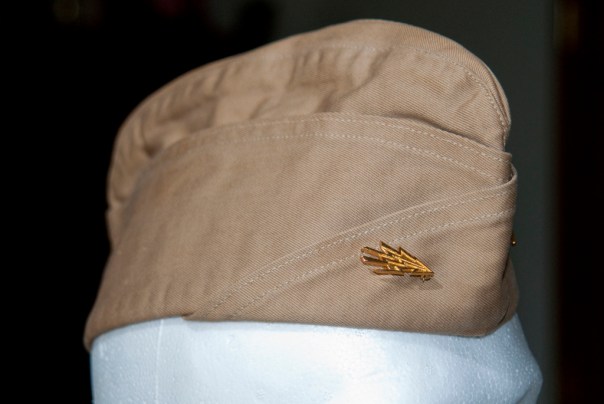
WWII-Era U.S. Navy Radio Electrician Warrant Officer’s Garrison Cap.
I turned my attention to the combination cover (some erroneously call the Navy caps “visor caps”) which is a hat with a visor that may be simply altered to match the uniform by replacing the cover with the appropriate color/material cover. Chiefs and officers could feasibly own a single hat frame (the sweatband/frame/visor) and simply change from white to blue or khaki (also grey or green) to align with the uniform of the day. I wanted to create a combination cap to go with this uniform as it looks classy.
I located a standard officer’s dress blue cover with the wide gold chin strap and the line officer’s crest. I already had a nice example of this cap so I decided that this would be a good base to create the warrant hat. Any alterations I made could easily be reversed to return it to its original state. I also kept the original owner’s name placard in the holder inside the hat. I found an original W-1 hat band and a 24k large hat insignia as well as the unique ½-inch gold chin strap (all vintage components). I disassembled the hat and replaced the appropriate parts with the newly acquired components.
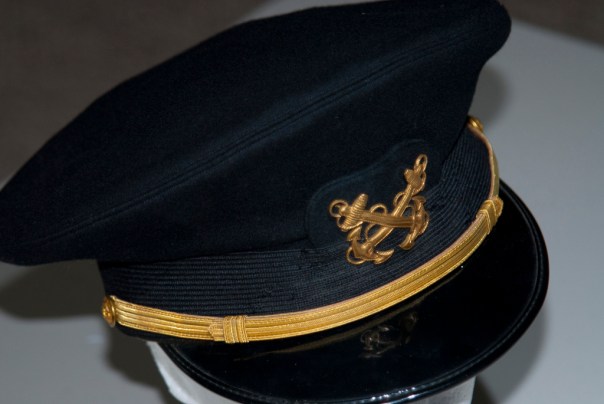
WWII U.S. Navy Warrant Officer’s (W-1) Combination Cover
One last cover I focused on was the CPO hat. Examining numerous period-photographs, I locked onto the hat that I wanted to acquire or assemble. Through the assistance of a friend, I was directed to an early WWII CPO combination cap with a grey cover that was well-enjoyed by a family of moths. The sterling silver hat device was outstanding as was the remainder of the hat. I purchased the hat and obtained a set of covers (blue, white and khaki) to accompany the three CPO uniforms (all chief radioman). Now I could display each chief uniform with using a single combination cover.
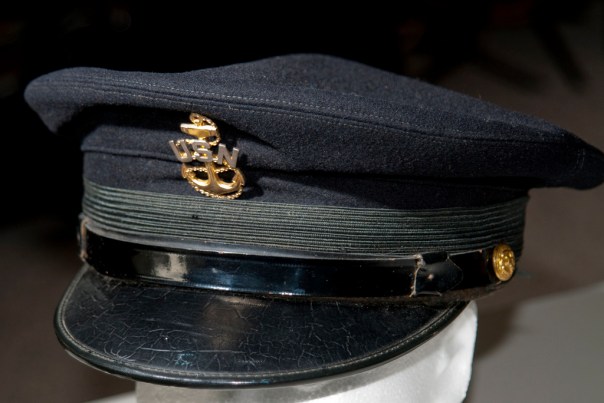
World War II-Era U.S. Navy Chief Petty Officer Combination Cover.
The remaining uniform left to tackle (for this relative, at least)? A dress blue or white jumper with neckerchief and white hat.
Collector’s Mantra: “Buy the Item, Not the Story”
To the informed and educated collector, buying militaria is like traversing a minefield, poking and prodding the ground, seeking to avoid the triggers and tripwires prior to each step. New collectors however plow through the field that is laden with Bouncing Betties without a care in the world and without realizing that they have suffered devastating wounds.
Online selling has opened the floodgates for collectors to more easily locate hard to find (dare I say rare?) items. Included in the vast array of internet listings are sellers seeking to pad their revenue by creating a fantastic story to accompany the item or group.
Other sellers are less nefarious as they attempt to properly list grandpa’s uniform items in hopes that it will be seen by the right buyer as something extraordinary. They think that they know enough of the story of their beloved veteran and fill their auction description with glowing accounts of heroism and touches of greatness for an otherwise ordinary marine, airman, soldier or sailor (I am not disparaging those veterans who, like the majority of our servicemen and women, served bravely regardless of their assignment, unit or theater of service). If there is no accompanying documentation (military records, photos of the item in context) to provide provenance, the story is nice but adds no value to the item.
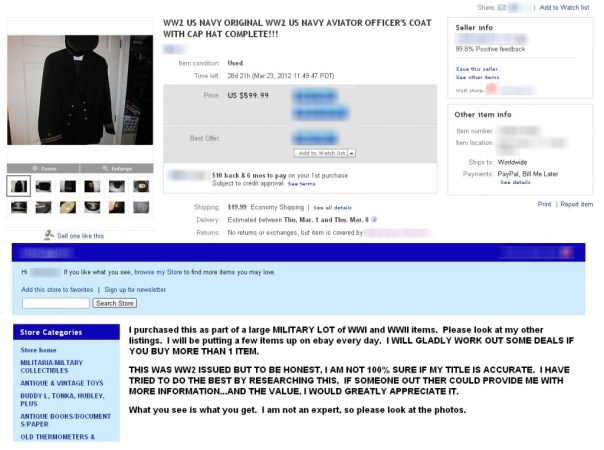
While this listing has issues (it isn’t a Naval Aviator Uniform as described), it is difficult to determine the seller’s intent.
In some listings (as with the above actual listing), the seller may be trying to pull the wool over the unsuspecting buyers with an inaccurate description which includes a subtle caveat stating that he/she isn’t certain if they have been accurate with the way they have presented the item. This could lead buyers to think, “Aha! I’ve found an item that is worth a lot but I am getting it at a bargain price because this seller doesn’t know what he has!” When in reality the seller does know what they have, but they are merely trolling for a vulnerable customer.
In either of these scenarios, the unsuspecting buyer could wind up severely overpaying for an item that is rather common or mundane. While there is no rock-solid way for militaria buyers to protect themselves from overpaying for an item, educating oneself prior to making a purchase can certainly limit the risk.
Prospective buyers maybe asking themselves, “okay, how do I go about educating myself about militaria?” Fortunately for new (all) collectors, there are several online forums whose membership contains passionate individuals with countless years of experience as well as access to hard-to-find publications who can provide almost instantaneous feedback as to the identity and veracity of an item. Many will offer their knowledge and wisdom to nurture interest and assist in making intelligent purchases.
Some helpful collecting forums:
- http://www.usmilitariaforum.com– All U.S. Military Items, all eras
- http://www.wehrmacht-awards.com– Third Reich medals and decorations
- http://www.walhalla.se– German Helmets
- http://militariaforum.germanmilitariacollectibles.com– German Militaria
- http://www.worldwarmilitaria.com– A general forum for militaria of the world wars
There are many expert communities with websites dedicated to specific types of items such as:
- http://www.asmic.org– ASMIC | The American Society of Military Insignia Collectors
- http://www.omsa.org– OMSA |The Orders and Medals Society of America
A great place to begin your education is at your local library. There are several militaria-based books already in print that can guide you. Consider also reference materials such as era-specific uniform regulations (each U.S. military branch has produced them since the late 19th century) as they have invaluable details on what officers or enlisted personnel wore (or could wear) on their uniforms.
One simple rule to follow is that if it appears too good to be true, it probably is. In the militaria collecting world this is all summed up with one simple phrase, “Buy the Item, not the Story.”

Displaying the Diamond: Military Baseball Public Showing
I have been collecting militaria for several years. I enjoy seeing, touching and sometimes smelling these object of history. I have a couple items on full-time display in my home and I enjoy the ensuing conversation that is sparked by guests who take an interest. For the most part, my collection is hidden in my closet and boxes in various places within my home. However, this week I have been given the opportunity to share a portion of my treasures with a decidedly larger audience that the visitors to my home.
In my home state’s largest fair there is a considerably large facility that is used to showcase various hobbies that people participate in. There are several categories of hobbies represented ranging from wood and metal working, crafts and scrap-booking. Perhaps the largest portion of floor space is dedicated to the various areas of collecting (coins, stamps, dolls, toys, clocks, etc.). In all my years of attending the fair, I can recollect one instance of a militaria collection displayed and that was last autumn (an amazing collection of armed forces nurse uniforms). From that moment, I was decidedly interested in sharing my significantly smaller (than the nurses display) collection the following year.
As I began to consider what I wanted to submit as an entrant to this year’s fair, I wanted to be more unique, more specific than simply presenting my collection of military uniforms. One area that I have been more focused upon in the past four years, military sports, has afforded me the opportunity to acquire items that span two genres of my collecting interests. Also, my collection has grown enough that a small display consisting of the mixture of types of pieces (uniforms, equipment, photographs and ephemera) would be quite tastefully displayed. With my concept decided, I began the process of submitting my collection.
The fair committee does strive for diversity in what they like to have on display and while seeking to prevent repeating collections year after year, they also try to ensure that the spaces are completely filled. I started the two-part process (electronic submission, followed by a paper form and photographs) by completing the online form a week prior to the deadline. I downloaded the paper form and set it aside, forgetting it for several days and then resigning myself to wait until next year as the deadline arrived. The following week, my phone rang during my afternoon commute and I was asked if I could bring the paper form to their office within 48 hours and that they wanted me to display my collection. I was elated and excitedly agreed to complete the remaining elements of the submission process.
Two weeks later, I received the formal acceptance letter and exhibitor packet. Getting a head-start on determining what and how I would display my collection, I selected pieces and acquired the necessary accessories (mannequins, stands, etc.) to achieve a tasteful presentation.
Move-in day went smoothly and my display was finished within a few hours as a raging, late-summer windstorm howled outside. All items carefully placed and locked into the cabinet, I snapped a few pictures and left for home. Overnight, the high winds were supplanted by terrible rainfall (three inches in just a few hours). Driving home from the fair the previous day, I remembered that I had one more piece that I wanted to display along with a few corrections to the information placard. I intended on returning in the early afternoon. When I turned my phone on, I discovered a harsh reality of displaying outside of my home. It seemed that the storm that blew in deposited a large quantity of leaves on the fair building’s roof clogging the downspouts as the rain (deluge) began to fall. The ensuing flood on the roof resulted in water penetrating the building and meandering its way into the display case that was housing my collection (mine was the only one affected).
The news was not good – some of my pieces were wet and the fair staff emptied my case to allow it to begin drying. When I arrived and saw the stained and crumbling ceiling tiles, I knew that the damage to my pieces would be considerable. Surveying my collection, I was pleasantly surprised to discover that I was very few pieces got wet and – the damage was simply moisture on one of the uniform trousers. The remainder of my collection was safe (and carefully removed from the case by the fair workers) which was a relief considering the ephemera (programs/scorecards from championship games) and photographs (some over 100 years old) were unaffected by the moisture. I was provided a secure space to store the dry items and I loaded what was wet and took it with me. My initial reaction to what happened to my collection was to load it all into my truck and forego displaying. As the current owner ans steward of these artifacts, I was concerned about further risk. Insurance can recoup the financial loss, but the history would be lost should any further harm befall these pieces.
I had to wait for another opportunity to return to put the display back together once the leaks were addressed. Later that week, my wife returned with me to assist and the display came together nicely. With a few changes (from the previous configuration) the final presentation turned out to be much more aesthetically balanced and pleasing. Rather than dominate my display with every piece of military baseball material that I own, I selectively chose examples that would inform the audience of the prevalence and impact that baseball has had on our culture, in particular, within the ranks of the armed forces.
The fair is set to open this week and the risk of loss is still present until I bring my collection home. What I am learning is invaluable and is preparing me to recognize and consider the risks with clarity for future public showcasing of my collection. Through the militaria collector community I have heard the horror stories regarding theft and damage and I will factor those anecdotes (along with this experience) into future decisions. I am hopeful that the positives outweigh the detractors and the audience truly enjoys and appreciates what they are seeing. Fortunately, there is a feedback mechanism in place and the fair staff told me that it is very common for viewers to submit questions and reach out to the collectors.
It would be an absolute pleasure to hear from a veteran who donned a uniform, cap and spikes and took to the diamond for his unit!
See:
The L.A. Angels “Waffle Weave” Uniform and Other Experiments
I love this post. The tail end of the flannel era was one of experimentation and the obvious sign that baseball was trying to find cost-effective and comfortable uniforms for their players. Nothing beats flannel for comfort but it doesn’t hold up to the countless washings that double-knit can endure.
I collect military baseball uniforms and recently landed a WWII-era 5th Army (Headquarters team) uniform that, from my assessment, is made from a lightweight cotton canvas/duck material rather than the typical wool flannels of the period.

Wool uniforms were quite heavy prior to World War II, and there were a few attempts to alter the traditional flannel suits before double knit polyester uniforms arrived with a bang (or a thud, depending on your viewpoint) in the early 1970s. Another issue was mobility, particularly for running and throwing. One experiment can possibly be tied to Branch Rickey, as several Brooklyn-affiliated clubs tried flannel shorts and a rayon pullover shirt in the early 1950s. This experiment was most famously associated with the Hollywood Stars, but the uniform style was also worn by the Ft. Worth Cats, Miami Beach Flamingos, Bisbee-Douglas Copper Kings, and others. The shirts were made of the same “durene” rayon/cotton blend that football and hockey had adopted (although the shorts were made of the standard wool flannel material).
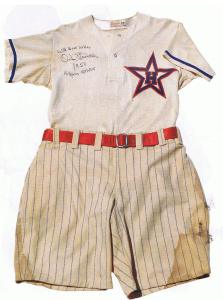 Hollywood Stars 1950 uniform. Note satin belt.
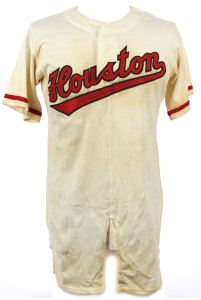 Houston Buffs rayon jersey, early 1950s.
In 1956 the Los…
View original post 295 more words
 The Veteran's Collection